Created by: Richa Pant
          BBA (I st year)
            Roll no: 35
   A Computer languages are the languages by which a
    user command a computer. Just like human languages
    computer’s also have certain languages which they
    can understand. There are four generations of
    computer language, first generation ,second
    generation, third generation and fourth generation.
   Computer languages are of two types :-
   1: Low level language -:first & second generation
   2:High level languages-:Third generation
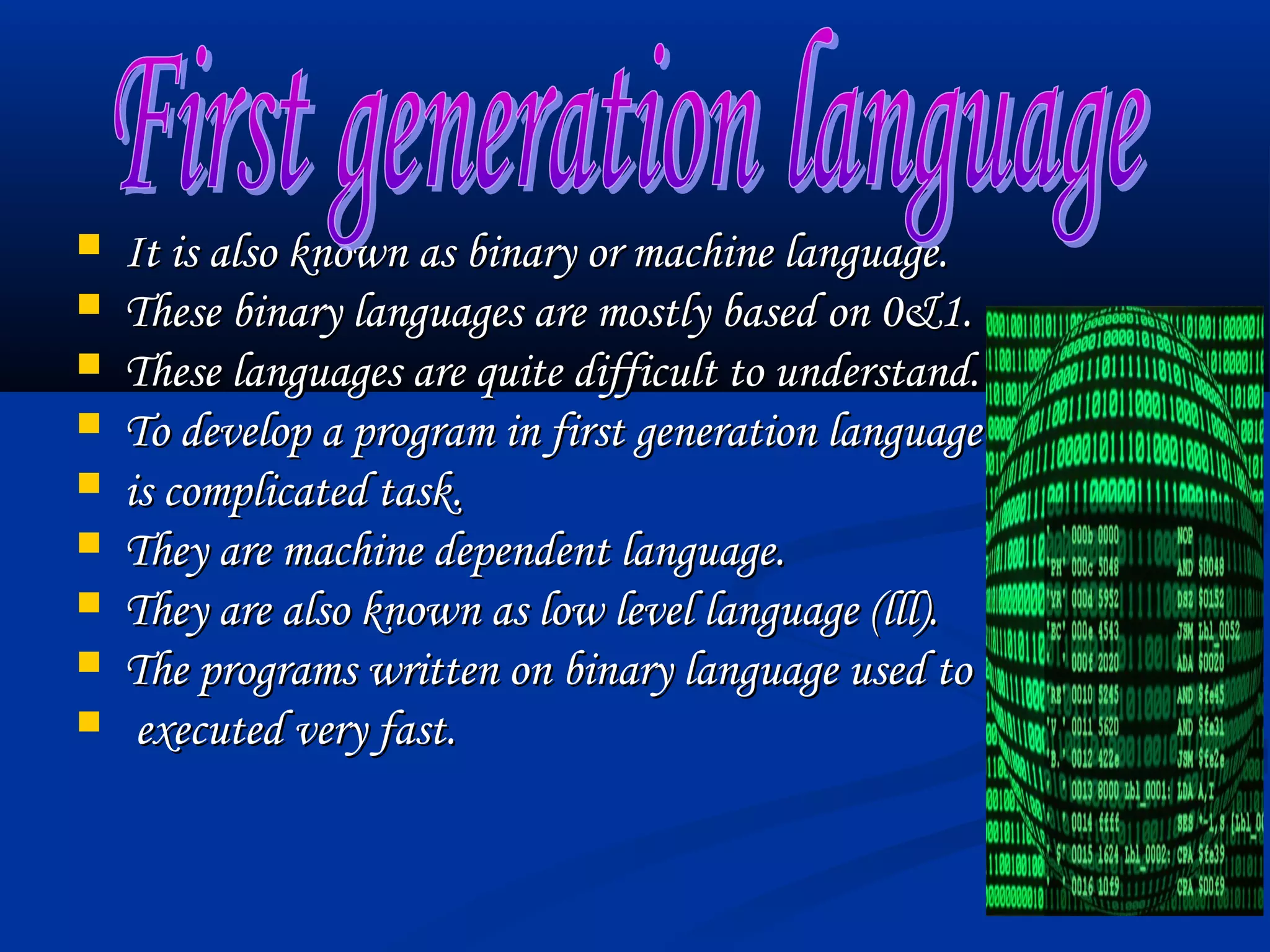
   It is also known as binary or machine language.
   These binary languages are mostly based on 0&1.
   These languages are quite difficult to understand.
   To develop a program in first generation language
   is complicated task.
   They are machine dependent language.
   They are also known as low level language (lll).
   The programs written on binary language used to
    executed very fast.
   These languages are also belong to the category of low level
    language (lll).
   Second generation language were also known as assembly
    language.
   The binary digits o&1 were replaced by some special symbol
    known as Mnemonics eg:-sub = -, add=+,div=/,sav=save.
   This language is machine independent language.
   They are also known as high level language (h.l.l).
   In this the commands written are in simple English language.
   Third generation language were portable.
   As the commands written are in simple language so special
    software were develop which are known as Language
    processor.
   For example:-LOGO, PASCAL;
    COBOL,JAVA etc….
   As 3gl were based on certain syntax ,which a programmer
    has to follow during developing a progran which is known as
    procedural language.
   To overcome from this problem fourth generation language
    were evolved.
   These programs were written in non-procedural way
   For example SQL, LIPS, PROLOG etc……
   They are system software they are used to translate high
    level language into machine language and vice –versa.
   These language processor converts high level language into
    computer understandable binary language(0&1).
   These language processor are of 3 types;-
   Compiler
   Interpreter
   Assembler
   It is a special type of software that converts high level
    program into binary code.
   It transfer whole program into a single goal it means the
    whole program will be converted into equivalent binary
    language.
   Its speed of translation is quite high but the execution speed
    is low.
   It use to convert high level language program into
    equivalent binary code by translating whole
    program line by line.
   Interpreter has slow speed of translation than
    compiler.
   T he program execution time is interpreter is less
    than compiler.
   It is also a language processor it converts the assembly
    language programs into object code,
   They are required in low level languages which were machine
    dependent.
   Today these assemblers are used to collect all component of
    the program and send to the leader and linker.
   Modem :It is modulator and demodulator that is used to convert analog signal into digtal
    signal and vice versa.
   Amplifier/Repeaters: It is used to boost up the weak signals.
   Routers: It is like traffic police that is used to direct the data that are transfer through
    networks.
   Clint &servers: Clint are the computer that has more storage capacity and are more
    powerful than other computer and server are the computer that are serve by clints .
   T here are some other networking devices:
   Bridge
   Cables
   Hubs etc…..

Presentation on generation of languages

  • 1.
    Created by: RichaPant BBA (I st year) Roll no: 35
  • 2.
    A Computer languages are the languages by which a user command a computer. Just like human languages computer’s also have certain languages which they can understand. There are four generations of computer language, first generation ,second generation, third generation and fourth generation.  Computer languages are of two types :-  1: Low level language -:first & second generation  2:High level languages-:Third generation
  • 3.
    It is also known as binary or machine language.  These binary languages are mostly based on 0&1.  These languages are quite difficult to understand.  To develop a program in first generation language  is complicated task.  They are machine dependent language.  They are also known as low level language (lll).  The programs written on binary language used to  executed very fast.
  • 4.
    These languages are also belong to the category of low level language (lll).  Second generation language were also known as assembly language.  The binary digits o&1 were replaced by some special symbol known as Mnemonics eg:-sub = -, add=+,div=/,sav=save.  This language is machine independent language.
  • 5.
    They are also known as high level language (h.l.l).  In this the commands written are in simple English language.  Third generation language were portable.  As the commands written are in simple language so special software were develop which are known as Language processor.  For example:-LOGO, PASCAL;  COBOL,JAVA etc….
  • 6.
    As 3gl were based on certain syntax ,which a programmer has to follow during developing a progran which is known as procedural language.  To overcome from this problem fourth generation language were evolved.  These programs were written in non-procedural way  For example SQL, LIPS, PROLOG etc……
  • 7.
    They are system software they are used to translate high level language into machine language and vice –versa.  These language processor converts high level language into computer understandable binary language(0&1).  These language processor are of 3 types;-  Compiler  Interpreter  Assembler
  • 8.
    It is a special type of software that converts high level program into binary code.  It transfer whole program into a single goal it means the whole program will be converted into equivalent binary language.  Its speed of translation is quite high but the execution speed is low.
  • 9.
    It use to convert high level language program into equivalent binary code by translating whole program line by line.  Interpreter has slow speed of translation than compiler.  T he program execution time is interpreter is less than compiler.
  • 10.
    It is also a language processor it converts the assembly language programs into object code,  They are required in low level languages which were machine dependent.  Today these assemblers are used to collect all component of the program and send to the leader and linker.
  • 11.
    Modem :It is modulator and demodulator that is used to convert analog signal into digtal signal and vice versa.  Amplifier/Repeaters: It is used to boost up the weak signals.  Routers: It is like traffic police that is used to direct the data that are transfer through networks.  Clint &servers: Clint are the computer that has more storage capacity and are more powerful than other computer and server are the computer that are serve by clints .  T here are some other networking devices:  Bridge  Cables  Hubs etc…..