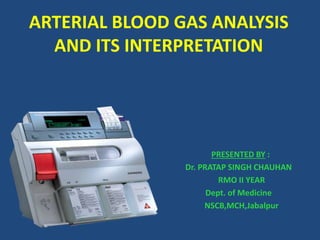
ARTERIAL BLOOD GAS ANALYSIS
AND ITS INTERPRETATION
PRESENTED BY :
Dr. PRATAP SINGH CHAUHAN
RMO II YEAR
Dept. of Medicine
NSCB,MCH,Jabalpur
Overview of the
discussion
• ABG Sampling , Technical Errors and Complications
• Gas Exchange
• Regulation of acid-base homeostasis
• Basics of acid-base balance and Interpretation of ABG
• Step-wise approach in diagnosis of acid-base disorders
• Examples
Indications for performing an ABG
analysis
• To document respiratory failure and assess its severity.
• To assess acid base imbalance, oxygenation status and
the oxygen carrying capacity of blood in critical illness.
• To monitor patients on ventilators and assist in
weaning.
• To assess response to therapeutic interventions and
mechanical ventilation .
Why an ABG instead of Pulse
oximetry?
• Pulse oximetry does not assess ventilation (PaCO2)
or acid base status.
• Pulse oximetry becomes unreliable when saturations
fall below 70-80%.
• Technical sources of error (hypoperfusion, nail polish,
skin pigmentation)
• Pulse oximetry cannot interpret methemoglobin or
carboxyhemoglobin.
ABG Sampling ,Technical Errors and Complications
Site
Procedure
Pre analytical Error
 Complication
 Contraindication
Site & Procedure - RadialArtery (Ideally)
BrachialArtery
FemoralArtery
 Perform a modified allen’s test
 Pre-heparinised ABG syringes :
- Syringe should be FLUSHED with 0.5ml of
1:1000 Heparin solution and emptied.
DO NOT LEAVE EXCESSIVE HEPARIN IN
THE SYRINGE
HEPARIN DILUTIONAL
EFFECT
HCO3
PCO2
 Only small 0.5ml Heparin for flushing and discard it
 Syringes must have > 50% blood. Use only 2ml or less syringe
 Use Lignocaine
 AIR BUBBLES
1. PO2 150 mmHg & PCO2 0 mm Hg in air bubble
2. Mixing with sample lead to  PaO2 &  PaCO2
DELAYED ANALYSIS
• Consumption of O2 & Production of CO2 continues
after blood drawn into syringe
• Iced Sample maintains values for 1-2 hours
• Uniced sample quickly becomes invalid
PaCO2  3-10 mmHg/hour
PaO2  at a rate related to initial value & dependant on Hb Sat
• Complications :
1. Bleeding or bruising at the puncture site
2. Infection at the puncture site
3. Accmulation of blood under the skin
4. Feeling faint
• Contraindications :
1. Inadequate collateral circulation at the puncture site
2. Surgical shunt
3. Peripheral vascular disease distant to puncture site
4. Coagulopathy
Parameter 37 C (Change
every 10 min)
UNICED
4 C (Change
every 10 min)
ICED
 pH 0.01 0.001
 PCO2 1 mm Hg 0.1 mm Hg
EFFECT OF TEMPERATURE ON RATE OF
CHANGE IN ABG VALUES :
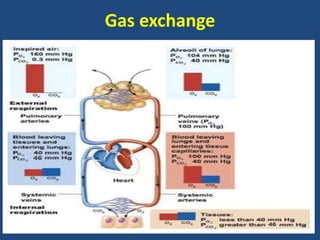
Gas exchange
Understanding Arterial Blood Gases
• PaCO2 & its determinants
• PaO2 & its determinants
• The determinants of the PAO2 and PaO2 (Alveolar
gas equation)
• PaO2/FiO2 ratio
Determinants of PaC02
• PaC02 is based on the production of CO2 (VC02) and on
alveolar Ventilation (VA)
• Alveolar Ventilation (VA) is defined as minute ventilation (VE)
minus dead space ventilation (VD)
• PaC02 = VC02 x 0.86 or VC02 x 0.86
VA VE – VD
• The decrease in (VA) may be due to a decrease in minute
ventilation (VE) or an increase in dead space ventilation (VD)
since VA = VE-VD
• PaC02 increases with increased production of C02
– Hypermetabolism , malignant hyperthermia, high
carbohydrate diet
• Examples of an inadequate minute ventilation (VE)
leading to hypercapnia include
• Sedative Drug Overdose
• Respiratory muscle paralysis
• Central hypoventilation
• Examples of increased dead space ventilation (VD)
leading to hypercapnia include
• COPD
• Severe restrictive lung disease with rapid shallow
breathing
Determination of PaO2
2PaO is dependant upon Age, FiO ,P2 atm
As Age the expected PaO2
• PaO2 = 109 - 0.4 (Age)
As FiO2 the expected PaO2
• Alveolar Gas Equation:
• PAO2= (PB-P h2o) x FiO2- pCO2/R
O
X
Y
G
E
N
A
T
I
O
N
A 2 BP O = partial pressure of oxygen in alveolargas, P = barometric pressure
(760mmHg), Ph2o = water vapor pressure (47 mm Hg), FiO2 = fraction of
inspired oxygen, PCO2 = partial pressure of CO2 in the ABG, R = respiratory
quotient (0.8)
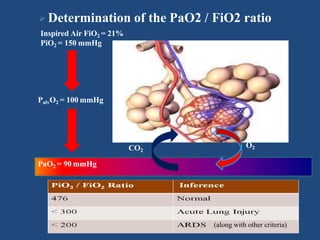
Determination of the PaO2 / FiO2 ratio
Inspired Air FiO2 = 21%
PiO2 = 150 mmHg
PalvO2 = 100 mmHg
PaO2 = 90 mmHg
O2CO2
(along with other criteria)
PaO2/ FiO2 ratio( P:F Ratio )
 Gives understanding that the patients
OXYGENATION with respect to OXYGEN delivered
is more important than simply the PaO2 value.
Example,
Patient 1
On RoomAir
Patient 2
On MV
PaO2 60 90
FiO2 21% (0.21) 50% (0.50)
P:F
Ratio
285 180
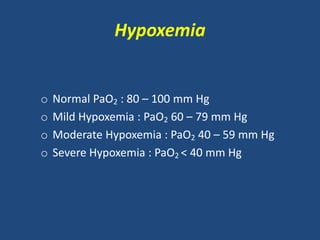
Hypoxemia
o Normal PaO2 : 80 – 100 mm Hg
o Mild Hypoxemia : PaO2 60 – 79 mm Hg
o Moderate Hypoxemia : PaO2 40 – 59 mm Hg
o Severe Hypoxemia : PaO2 < 40 mm Hg
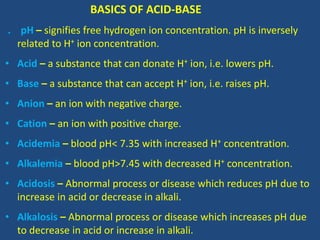
BASICS OF ACID-BASE
. pH – signifies free hydrogen ion concentration. pH is inversely
related to H+ ion concentration.
• Acid – a substance that can donate H+ ion, i.e. lowers pH.
• Base – a substance that can accept H+ ion, i.e. raises pH.
• Anion – an ion with negative charge.
• Cation – an ion with positive charge.
• Acidemia – blood pH< 7.35 with increased H+ concentration.
• Alkalemia – blood pH>7.45 with decreased H+ concentration.
• Acidosis – Abnormal process or disease which reduces pH due to
increase in acid or decrease in alkali.
• Alkalosis – Abnormal process or disease which increases pH due
to decrease in acid or increase in alkali.
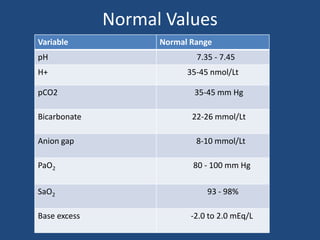
Normal Values
Variable Normal Range
pH 7.35 - 7.45
H+ 35-45 nmol/Lt
pCO2 35-45 mm Hg
Bicarbonate 22-26 mmol/Lt
Anion gap 8-10 mmol/Lt
PaO2 80 - 100 mm Hg
SaO2 93 - 98%
Base excess -2.0 to 2.0 mEq/L
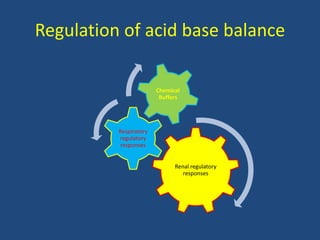
Regulation of acid base balance
Renal regulatory
responses
Respiratory
regulatory
responses
Chemical
Buffers
Buffers
• Buffers are chemical systems which either
release or accept H+ and minimize change in
pH induced by an acid or base load.
• First line of defense blunting the changes in
[H+]
• A buffer pair consists of: A base (H+ acceptor)
& An acid (H+ donor)
• Extracellular and Intracellular Buffer.
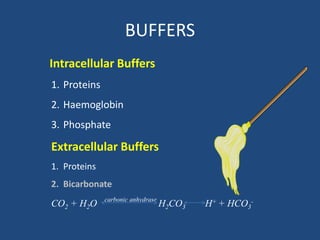
Intracellular Buffers
1. Proteins
2. Haemoglobin
3. Phosphate
Extracellular Buffers
1. Proteins
2. Bicarbonate
CO2 + H2O
carbonic anhydrase
H2CO3 H+ + HCO3
-
BUFFERS
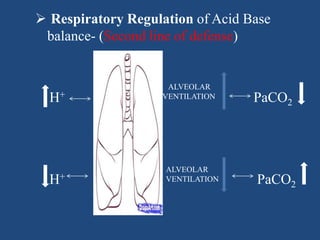
 Respiratory Regulation of Acid Base
balance- (Second line of defense)
H+ PaCO2
H+ PaCO2
ALVEOLAR
VENTILATION
ALVEOLAR
VENTILATION
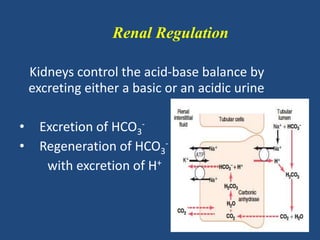
Renal Regulation
Kidneys control the acid-base balance by
excreting either a basic or an acidic urine
• Excretion of HCO3
-
• Regeneration of HCO3
-
with excretion of H+
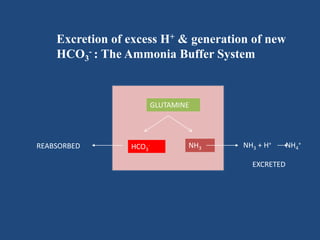
Excretion of excess H+ & generation of new
HCO3
- : The Ammonia Buffer System
GLUTAMINE
HCO3
- NH3REABSORBED NH3 + H+ NH4
+
EXCRETED
Abnormal Values
pH < 7.35
• Acidosis (metabolic
and/or respiratory)
pH > 7.45
• Alkalosis (metabolic
and/or respiratory)
paCO2 > 45 mm Hg
• Respiratory acidosis
(alveolar hypoventilation)
paCO2 < 35 mm Hg
• Respiratory alkalosis
(alveolar hyperventilation)
HCO3
- < 22 meq/L
• Metabolic acidosis
HCO3
- > 26 meq/L
• Metabolic alkalosis
Simple Acid Base Disorder/ Primary Acid Base
disorder – a single primary process of acidosis or
alkalosis due to an initial change in PCO2 and HCO3.
Compensation - The normal response of
the respiratory system or kidneys to change in pH
induced by a primary acid-base disorder
 The Compensatory responses to a primary Acid Base
disturbance are never enough to correct the change in
pH , they only act to reduce the severity.
Mixed Acid Base Disorder – Presence of more than
one acid base disorder simultaneously .
•Metabolic
DisorderHCO3
•Respiratory
DisorderPaCO2
During compensation HCO3¯ & PaCO2 move in
the same direction
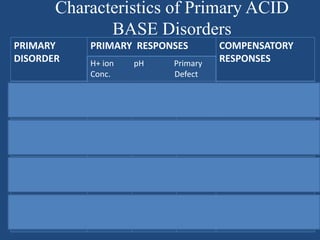
Characteristics of Primary ACID
BASE Disorders
PRIMARY
DISORDER
PRIMARY RESPONSES COMPENSATORY
RESPONSESH+ ion pH Primary
Conc. Defect
Metabolic
Acidosis H+ pH HCO3
PCO2
Alveolar Hyperventilation
Metabolic
Alkalosis H+ pH HCO3
PCO2
Alveolar
Hypoventilation
Respiratory
Acidosis H+ pH PCO2 HCO3
Respiratory
Alkalosis H+ pH PCO2 HCO3
Compensatory changes (Metabolic disorders)
Primary
disorder
Primary
defect
Compensatory
response
Expected Compensation
Metabolic
acidosis
↓ HCO3 ↓ PCO2 PCO2=1.5[HCO3] + 8 ± 2
PCO2= PaCO2 will ↓ 1.25 mmHg per mmol/L ↓ in
HCO3
PCO2= 15+ [HCO3]
Metabolic
Alkalosis
↑ HCO3 ↑ PCO2 PCO2=1.5[HCO3] + 8 ± 2
PCO2= PaCO2 will ↑ 0.75 mmHg per mmol/L↑
in HCO3
PCO2=15+ [HCO3]
Compensatory changes (Respiratory disorders)
Primary
disorder
Primary
defect
Compensatory
response
Expected Compensation
Respiratory
acidosis
↑ PCO2 ↑ HCO3 Acute:
HCO3 will ↑ + 1 Meq/L for each10mmHg ↑ in
PCO2
Chronic:
+4 Meq/L ↑ HCO3 for each ↑ PCO2 of 10mmHg
Respiratory
Alkalosis
↓ PCO2 ↓ HCO3 Acute:
-2Meq/l ↓ in HCO3 for each ↓ in PCO2 of
10mmHg
Chronic:
-4 Meq/L ↓ in HCO3 for each ↓ in PCO2 of
10mmHg
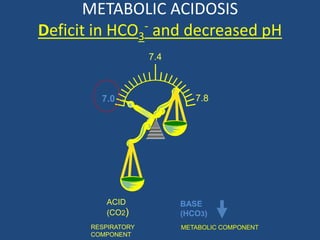
METABOLIC ACIDOSIS
Deficit in HCO3
- and decreased pH
ACID
(CO2)
BASE
(HCO3)
RESPIRATORY
COMPONENT
METABOLIC COMPONENT
7.8
7.4
7.0
Classification of Metabolic Acidosis
 High Anion gap Metabolic Acidosis
– Lactic Acidosis
– Ketoacidosis (Diabetes, Alcohol, Starvation)
– Renal Failure
– Toxic Ingestion
• Salicylates, Methanol, Ethylene Glycol, Paraldehyde, INH
 Non- anion gap (Hyperchloremic metabolic Acidosis)
– GI loss of HCO3 (Diarrhoea,Ureteral Diversion)
– Renal Loss of HCO3(Carbonic Anhydrase inhibitor)
– Renal Tubular Disease
– Drug induced Hyperkalemia (with Renal insufficiency)
– Acid Loads (ammonium chloride , hyperalimentation)
Clinical sign and symptoms
• Kussmaul’s Respirations – deep and rapid breathing
• Lethargy, confusion, headache, weakness
• Nausea and Vomiting
• Arrhythmias
• Suppressed myocardial contractility
• Right shift of the oxyhemoglobin dissociation curve
• Hyperkalemia
• Increased protein catabolism
• Insulin resistance
Treatment of Met Acidosis
 Rx Underlying Cause
 HCO3- Therapy
• Aim to bring up pH to 7.2 & HCO3-  10 meq/L
• Qty of HCO3 administration calculated:
0.2 x weight (kg) x HCO3 Deficit (meq/L)
•Most recommendations favour use of base when pH
< 7.15-7.2 or HCO3 < 8-10 meq/L.
Adverse Effects of HCO3- Therapy
•  CO2 production from HCO3 decomposition 
Hypercarbia especially when pulmonary ventilation is
impaired.
• Myocardial Hypercarbia  Myocardial acidosis
Impaired myocardial contractility &  C.O.
 SVR and Coronary A perfusion pressure 
Myocardial Ischemia especially in pts with HF.
• Hypernatremia & Hyperosmolarity  Vol expansion 
Fluid overload especially in pts with HF.
• Intracellular (paradoxical) acidosis especially in liver &
CNS ( CSF CO2).
• Stimulation of Phosphofructokinase activity enhances
lactate production and worsens acidosis.
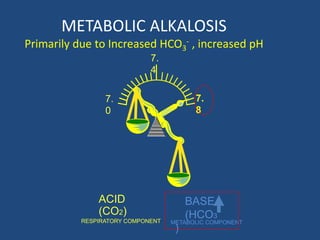
METABOLIC ALKALOSIS
Primarily due to Increased HCO3
- , increased pH
ACID
(CO2)
BASE
(HCO3
)
RESPIRATORY COMPONENT METABOLIC COMPONENT
7.
0
7.
4
7.
8
Metabolic Alkalosis
Etiology pH > 7.45, HCO3
- > 26 Meq/l
 Exogenous HCO3
- loads (Milk Alkali Syndrome)
 Acid loss ( Vomiting, Gastric Aspiration)
 Diuretics,Cushing’s Disease, Bartter’s syndrome
 Primary Hyperaldosteronism
 Liddle’s Syndrome
 Low K+ and Mg2+
 Symptoms
– Mental Confusion, obtundation, seizure
– Aggravation of Arrhythmias, dizziness
– Paresthesia, numbness, tingling of extremities
– Tetany
 Treatment
– Correct the primary cause of disorder
– Correct the deficiency which impairing renal HCO3
Excretion (give Chloride, water and k+)
– Expand ECF Volume
– Acetazolamide
– Supportive Measure
RESPIRATORY ACIDOSIS
ACID
(CO2)
BASE
(HCO3
)RESPIRATORY
COMPONENT
METABOLIC
COMPONENT
7.8
7.4
7.0
RESPIRATORY ACIDOSIS
H2O + CO2  H2CO3  H+ + HCO3
-
Cause - hypoventilation
Retention of CO2
Drives equation rightward
Increases both [H+] and [HCO3
-]
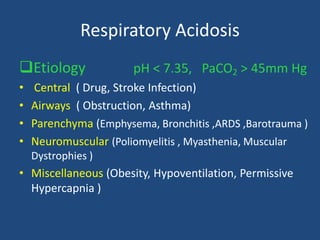
Respiratory Acidosis
Etiology pH < 7.35, PaCO2 > 45mm Hg
• Central ( Drug, Stroke Infection)
• Airways ( Obstruction, Asthma)
• Parenchyma (Emphysema, Bronchitis ,ARDS ,Barotrauma )
• Neuromuscular (Poliomyelitis , Myasthenia, Muscular
Dystrophies )
• Miscellaneous (Obesity, Hypoventilation, Permissive
Hypercapnia )
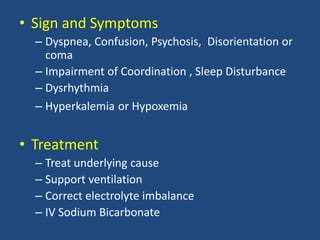
• Sign and Symptoms
– Dyspnea, Confusion, Psychosis, Disorientation or
coma
– Impairment of Coordination , Sleep Disturbance
– Dysrhythmia
– Hyperkalemia or Hypoxemia
• Treatment
– Treat underlying cause
– Support ventilation
– Correct electrolyte imbalance
– IV Sodium Bicarbonate
RESPIRATORY ALKALOSIS
H2O + CO2  H2CO3  H+ + HCO3-
cause - hyperventilation
Blows off CO2
Drives equation leftward decreasing both [H+] and [HCO3
-]
RESPIRATORY ALKALOSIS
ACID
(CO2)
BASE
(HCO3)
7.
0
7.
4
7.
8
RESPIRATORY
COMPONENT
METABOLIC
COMPONENT
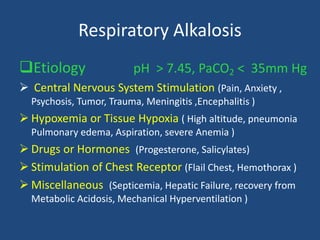
Respiratory Alkalosis
Etiology pH > 7.45, PaCO2 < 35mm Hg
 Central Nervous System Stimulation (Pain, Anxiety ,
Psychosis, Tumor, Trauma, Meningitis ,Encephalitis )
 Hypoxemia or Tissue Hypoxia ( High altitude, pneumonia
Pulmonary edema, Aspiration, severe Anemia )
 Drugs or Hormones (Progesterone, Salicylates)
 Stimulation of Chest Receptor (Flail Chest, Hemothorax )
 Miscellaneous (Septicemia, Hepatic Failure, recovery from
Metabolic Acidosis, Mechanical Hyperventilation )
 Symptoms
• Tachypnea
• Complaints of SOB, chest pain
• Light-headedness, syncope, coma, seizures
• Numbness and tingling of extremities
• Difficult concentrating, tremors, blurred vision
• Weakness, paresthesias, tetany
 Treatment
• Monitor Vital Signs and ABG’s
• Treat underlying disease
• Assist the patient to breathe more slowly
• Help the patient to breath in a paper bag
• Sedation
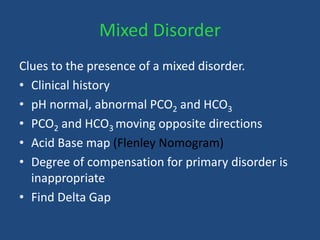
Mixed Disorder
Clues to the presence of a mixed disorder.
• Clinical history
• pH normal, abnormal PCO2 and HCO3
• PCO2 and HCO3 moving opposite directions
• Acid Base map (Flenley Nomogram)
• Degree of compensation for primary disorder is
inappropriate
• Find Delta Gap
STEP WISE APPROACH
to
Interpretation Of
ABG reports
1. HISTORY AND PHYSICAL EXAMINATION
• Its gives an idea of what acid base disorder
might be present even before collecting the
Arterial Blood Gas sample
e.g. Diarrhoea  Bicarbonate loss  pH 
Metabolic Acidosis
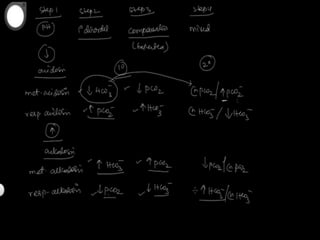
2.Look at the pH
 pH < 7.35 : Acidosis
 pH > 7.45 : Alkalosis
 pH 7.35 – 7.45 : Normal/Mixed Disorder
 Look at the pO2 (<80 mm Hg) and O2
saturation (<90%) for hypoxemia
3. Look at pCO2 and HCO3
-
 pCO2 > 45 mm Hg : Increased (Acidosis)
 pCO2 < 35 mm Hg : Decreased (Alkalosis)
 HCO3
- > 26 mEq/L : Increased (Alkalosis)
 HCO3
- < 22 mEq/L : Decreased (Acidosis)
4.Determine the Primary acid-base disorder
 IS PRIMARY DISTURBANCE RESPIRATORY OR
METABOLIC
 If the pH is low (acidosis), then look to see ↑ CO2 or ↓ HCO3
(which ever is acidosis will be primary)
 If the pH is high (alkalosis), then look to see ↓ CO2 or ↑ HCO3
(which ever is alkalosis is the primary).
 pH ↑ HCO3
- ↑ or pH ↓ HCO3
- ↓ METABOLIC
 pH ↑ PCO2 ↓ or pH ↓ PCO2 ↑ RESPIRATORY
• If trend of change in paCO2 and HCO3
- is the
same, check the percentage difference . The one
with greater % difference , between the two is
the one that is the dominant disorder
• Example pH= 7.25, HCO3
- =16, paCO2 =60
here pH is acidotic and both paCO2 and HCO3
- explain its
acidosis : so look at difference
% difference = (24-16)/24 = 0.33
% difference = (60-40)/40 = 0.50
Therefore, Respiratory acidosis as the dominant disorder
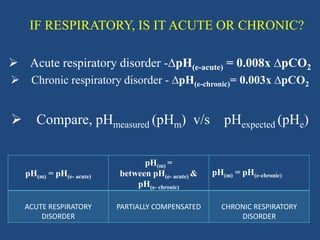
IF RESPIRATORY, IS IT ACUTE OR CHRONIC?
 Acute respiratory disorder -∆pH(e-acute) = 0.008x ∆pCO2
 Chronic respiratory disorder - ∆pH(e-chronic)= 0.003x ∆pCO2
 Compare, pHmeasured (pHm) v/s pHexpected (pHe)
pH(m) = pH(e- acute)
pH(m) =
between pH(e- acute) &
pH(e- chronic)
pH(m) = pH(e-chronic)
ACUTE RESPIRATORY
DISORDER
PARTIALLY COMPENSATED CHRONIC RESPIRATORY
DISORDER
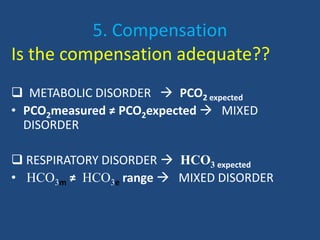
5. Compensation
Is the compensation adequate??
 METABOLIC DISORDER  PCO2 expected
• PCO2measured ≠ PCO2expected  MIXED
DISORDER
 RESPIRATORY DISORDER  HCO3 expected
• HCO3m ≠ HCO3e range  MIXED DISORDER
6. If Metabolic Acidosis then Calculate
Anion Gap
 Total Serum Cations = Total Serum Anions
 M cations + U cations = M anions + U anions
 Na + (K + Ca + Mg) = HCO3 + Cl + (PO4 + SO4
+ Protein + Organic Acids)
 Na + UC = HCO3 + Cl + UA
 But in Blood, there is a relative abundance of Anions. hence
Anions > Cations
 Na – (HCO3 + Cl) = UA – UC
 Na - (HCO3 + Cl) = Anion Gap
 AG= Na⁺ – (Cl¯ + HCO3¯)
 Normal range is 10 ± 2 mEq /L
 It represents unmeasured anions. These unmeasured anions can be;
– Anionic proteins
– SO4, PO4, organic anions
– Acid anions (acetoacetate, lactate, uremic anions)
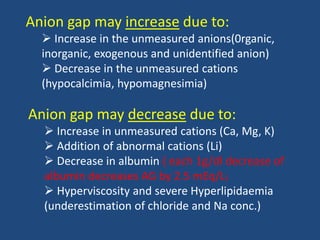
Anion gap may increase due to:
 Increase in the unmeasured anions(0rganic,
inorganic, exogenous and unidentified anion)
 Decrease in the unmeasured cations
(hypocalcimia, hypomagnesimia)
Anion gap may decrease due to:
 Increase in unmeasured cations (Ca, Mg, K)
 Addition of abnormal cations (Li)
 Decrease in albumin ( each 1g/dl decrease of
albumin decreases AG by 2.5 mEq/L)
 Hyperviscosity and severe Hyperlipidaemia
(underestimation of chloride and Na conc.)
 Osmolar Gap
• The Osmolar gap is used to detect the presence of ingested toxins
such as ethylene glycol, methanol or isopropyl alcohol
• These Toxins often cause an increased AG acidosis. The Osmolar gap
is the difference between the measured osmolality and the
calculated osmolality
• The calculated osmolality is determined by 2*[Na] + Serum
Glucose/18 + BUN/2.8
• An Osmolar gap >15mOsm suggests the presence of an ingested toxin
as a contributor to the anion gap acidosis
 Urinary Anion Gap
Used to differentiate between Renal and Extra-renal cause of
normal anion gap metabolic acidosis
It Represent unmeasured Anion in Urine like Sulfate,phosphate
Indirect estimation of Urinary Ammonium Excretion
Urinary Anion Gap = UNa + Uk-Ucl
Normal Value -10 to +10
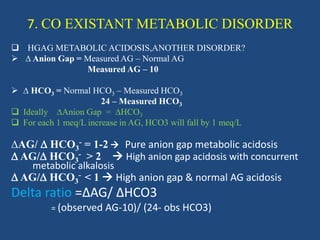
7. CO EXISTANT METABOLIC DISORDER
 HGAG METABOLIC ACIDOSIS,ANOTHER DISORDER?
 ∆ Anion Gap = Measured AG – Normal AG
Measured AG – 10
 ∆ HCO3 = Normal HCO3 – Measured HCO3
24 – Measured HCO3
 Ideally ∆Anion Gap = ∆HCO3
 For each 1 meq/L increase in AG, HCO3 will fall by 1 meq/L
∆AG/  HCO3
- = 1-2  Pure anion gap metabolic acidosis
 AG/ HCO3
- > 2  High anion gap acidosis with concurrent
metabolic alkalosis
 AG/ HCO3
- < 1  High anion gap & normal AG acidosis
Delta ratio =∆AG/ ∆HCO3
= (observed AG-10)/ (24- obs HCO3)
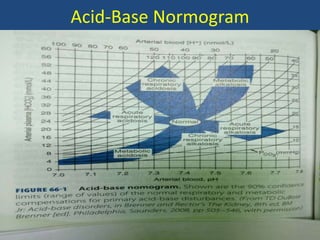
Acid-Base Normogram
EXAMPLEs
Case 1
 A 19 year old pregnant insulin dependent diabetic
patient was admitted with a history of polyuria and
thirst. She now felt ill and presented to hospital. There
was a history of poor compliance with medical therapy.
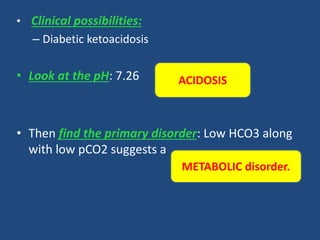
She was afebrile. Chest was clear. Circulation was
adequate. Urinalysis: 2+ ketones, 4+ glucose.
• Na+ 136, K+ 4.8, Cl- 101, pH 7.26, pCO2 16.5 mmHg,
pO2 128 mmHg, HCO3 7.1 mmol/l ,AG 28.1
• Describe its Acid Base Disorder.
• Clinical possibilities:
– Diabetic ketoacidosis
• Look at the pH: 7.26
• Then find the primary disorder: Low HCO3 along
with low pCO2 suggests a
METABOLIC disorder.
ACIDOSIS
• Check for compensation: compensation for
metabolic acidosis brings pCO2 to 16.5-20.6 mmHg.
PCO₂ = (1.5 ×HCO3 ) + 8 ±2) Thus the acidosis is
by respiratory regulation and there is
• Anion Gap= 136+4.8-(101+7.1)=32.7
• ∆AG=32.7-12=20.7, ∆HCO3=24-7.1=16.9
• Delta ratio=20.7/16.9=1.22
• ∆AG/  HCO3
- = 1-2  Pure anion gap metabolic
acidosis
• FINAL ABG DIAGNOSIS
PURE ANION GAP METABOLIC
ACIDOSIS (Etiology, DKA)
PURE ANION GAP
ACIDOSIS
HIGH ANION
GAP acidosis
NO MIXED disorder.
FULLY COMPENSATED
Case 2
 A known case of chronic kidney disease, discontinued
Maintenance Hemodialysis & presented to the emergency in an
altered state of sensorium. Attendants gave history of repeated
episodes of vomiting at home. Describe its Acid Base Disorder.
ABG results
pH 7.42
PCO₂ 40
HCO₃ 25
Na 140
K 3.0
Cl 95
AG 23
• Clinical possibilities:
– Uremia  Metabolic Acidosis
– Vomiting  Metabolic Alkalosis
• Look at the pH: 7.42
• Then find the primary disorder: HCO3 along with
pCO2 are WNL So it is
NORMAL/MIXED DISORDER
NORMAL
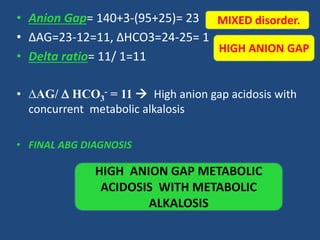
• Anion Gap= 140+3-(95+25)= 23
• ∆AG=23-12=11, ∆HCO3=24-25= 1
• Delta ratio= 11/ 1=11
• ∆AG/  HCO3
- = 11  High anion gap acidosis with
concurrent metabolic alkalosis
• FINAL ABG DIAGNOSIS
HIGH ANION GAP METABOLIC
ACIDOSIS WITH METABOLIC
ALKALOSIS
HIGH ANION GAP
MIXED disorder.
REFERENCES
• Rao SM, Nagendranath V. Arterial Blood Gas Monitoring:
Indian J Anaesth. 2002;46:289-97
• Marino PL. Arterial Blood Gas Interpretation 3rd edi.
• Harrison’s Principles of Internal Medicine, 19th edition,
Chap 66 – Acidosis and Alkalosis
• Guyton and Hall – Textbook of Medical Physiology, 12th
edition
• Davenport – The ABC of Acid Base Chemistry, 6th edition
• Cohen and Kassirer – Acid Base
• Hansen JE, Clinics in Chest medicine10(2), 1989, 227-37
• Williams AJ. ABC of oxygen: assessing and interpreting
arterial blood gases and acid base
balance.BMJ1998;317:1213-6
ABG Analysis

ABG Analysis

  • 1.
    ARTERIAL BLOOD GASANALYSIS AND ITS INTERPRETATION PRESENTED BY : Dr. PRATAP SINGH CHAUHAN RMO II YEAR Dept. of Medicine NSCB,MCH,Jabalpur
  • 2.
    Overview of the discussion •ABG Sampling , Technical Errors and Complications • Gas Exchange • Regulation of acid-base homeostasis • Basics of acid-base balance and Interpretation of ABG • Step-wise approach in diagnosis of acid-base disorders • Examples
  • 3.
    Indications for performingan ABG analysis • To document respiratory failure and assess its severity. • To assess acid base imbalance, oxygenation status and the oxygen carrying capacity of blood in critical illness. • To monitor patients on ventilators and assist in weaning. • To assess response to therapeutic interventions and mechanical ventilation .
  • 4.
    Why an ABGinstead of Pulse oximetry? • Pulse oximetry does not assess ventilation (PaCO2) or acid base status. • Pulse oximetry becomes unreliable when saturations fall below 70-80%. • Technical sources of error (hypoperfusion, nail polish, skin pigmentation) • Pulse oximetry cannot interpret methemoglobin or carboxyhemoglobin.
  • 5.
    ABG Sampling ,TechnicalErrors and Complications Site Procedure Pre analytical Error  Complication  Contraindication
  • 6.
    Site & Procedure- RadialArtery (Ideally) BrachialArtery FemoralArtery  Perform a modified allen’s test  Pre-heparinised ABG syringes : - Syringe should be FLUSHED with 0.5ml of 1:1000 Heparin solution and emptied. DO NOT LEAVE EXCESSIVE HEPARIN IN THE SYRINGE HEPARIN DILUTIONAL EFFECT HCO3 PCO2  Only small 0.5ml Heparin for flushing and discard it  Syringes must have > 50% blood. Use only 2ml or less syringe  Use Lignocaine
  • 7.
     AIR BUBBLES 1.PO2 150 mmHg & PCO2 0 mm Hg in air bubble 2. Mixing with sample lead to  PaO2 &  PaCO2 DELAYED ANALYSIS • Consumption of O2 & Production of CO2 continues after blood drawn into syringe • Iced Sample maintains values for 1-2 hours • Uniced sample quickly becomes invalid PaCO2  3-10 mmHg/hour PaO2  at a rate related to initial value & dependant on Hb Sat
  • 8.
    • Complications : 1.Bleeding or bruising at the puncture site 2. Infection at the puncture site 3. Accmulation of blood under the skin 4. Feeling faint • Contraindications : 1. Inadequate collateral circulation at the puncture site 2. Surgical shunt 3. Peripheral vascular disease distant to puncture site 4. Coagulopathy
  • 9.
    Parameter 37 C(Change every 10 min) UNICED 4 C (Change every 10 min) ICED  pH 0.01 0.001  PCO2 1 mm Hg 0.1 mm Hg EFFECT OF TEMPERATURE ON RATE OF CHANGE IN ABG VALUES :
  • 10.
  • 11.
    Understanding Arterial BloodGases • PaCO2 & its determinants • PaO2 & its determinants • The determinants of the PAO2 and PaO2 (Alveolar gas equation) • PaO2/FiO2 ratio
  • 12.
    Determinants of PaC02 •PaC02 is based on the production of CO2 (VC02) and on alveolar Ventilation (VA) • Alveolar Ventilation (VA) is defined as minute ventilation (VE) minus dead space ventilation (VD) • PaC02 = VC02 x 0.86 or VC02 x 0.86 VA VE – VD • The decrease in (VA) may be due to a decrease in minute ventilation (VE) or an increase in dead space ventilation (VD) since VA = VE-VD • PaC02 increases with increased production of C02 – Hypermetabolism , malignant hyperthermia, high carbohydrate diet
  • 13.
    • Examples ofan inadequate minute ventilation (VE) leading to hypercapnia include • Sedative Drug Overdose • Respiratory muscle paralysis • Central hypoventilation • Examples of increased dead space ventilation (VD) leading to hypercapnia include • COPD • Severe restrictive lung disease with rapid shallow breathing
  • 14.
    Determination of PaO2 2PaOis dependant upon Age, FiO ,P2 atm As Age the expected PaO2 • PaO2 = 109 - 0.4 (Age) As FiO2 the expected PaO2 • Alveolar Gas Equation: • PAO2= (PB-P h2o) x FiO2- pCO2/R O X Y G E N A T I O N A 2 BP O = partial pressure of oxygen in alveolargas, P = barometric pressure (760mmHg), Ph2o = water vapor pressure (47 mm Hg), FiO2 = fraction of inspired oxygen, PCO2 = partial pressure of CO2 in the ABG, R = respiratory quotient (0.8)
  • 15.
    Determination of thePaO2 / FiO2 ratio Inspired Air FiO2 = 21% PiO2 = 150 mmHg PalvO2 = 100 mmHg PaO2 = 90 mmHg O2CO2 (along with other criteria)
  • 16.
    PaO2/ FiO2 ratio(P:F Ratio )  Gives understanding that the patients OXYGENATION with respect to OXYGEN delivered is more important than simply the PaO2 value. Example, Patient 1 On RoomAir Patient 2 On MV PaO2 60 90 FiO2 21% (0.21) 50% (0.50) P:F Ratio 285 180
  • 17.
    Hypoxemia o Normal PaO2: 80 – 100 mm Hg o Mild Hypoxemia : PaO2 60 – 79 mm Hg o Moderate Hypoxemia : PaO2 40 – 59 mm Hg o Severe Hypoxemia : PaO2 < 40 mm Hg
  • 18.
    BASICS OF ACID-BASE .pH – signifies free hydrogen ion concentration. pH is inversely related to H+ ion concentration. • Acid – a substance that can donate H+ ion, i.e. lowers pH. • Base – a substance that can accept H+ ion, i.e. raises pH. • Anion – an ion with negative charge. • Cation – an ion with positive charge. • Acidemia – blood pH< 7.35 with increased H+ concentration. • Alkalemia – blood pH>7.45 with decreased H+ concentration. • Acidosis – Abnormal process or disease which reduces pH due to increase in acid or decrease in alkali. • Alkalosis – Abnormal process or disease which increases pH due to decrease in acid or increase in alkali.
  • 19.
    Normal Values Variable NormalRange pH 7.35 - 7.45 H+ 35-45 nmol/Lt pCO2 35-45 mm Hg Bicarbonate 22-26 mmol/Lt Anion gap 8-10 mmol/Lt PaO2 80 - 100 mm Hg SaO2 93 - 98% Base excess -2.0 to 2.0 mEq/L
  • 20.
    Regulation of acidbase balance Renal regulatory responses Respiratory regulatory responses Chemical Buffers
  • 21.
    Buffers • Buffers arechemical systems which either release or accept H+ and minimize change in pH induced by an acid or base load. • First line of defense blunting the changes in [H+] • A buffer pair consists of: A base (H+ acceptor) & An acid (H+ donor) • Extracellular and Intracellular Buffer.
  • 22.
    Intracellular Buffers 1. Proteins 2.Haemoglobin 3. Phosphate Extracellular Buffers 1. Proteins 2. Bicarbonate CO2 + H2O carbonic anhydrase H2CO3 H+ + HCO3 - BUFFERS
  • 23.
     Respiratory Regulationof Acid Base balance- (Second line of defense) H+ PaCO2 H+ PaCO2 ALVEOLAR VENTILATION ALVEOLAR VENTILATION
  • 24.
    Renal Regulation Kidneys controlthe acid-base balance by excreting either a basic or an acidic urine • Excretion of HCO3 - • Regeneration of HCO3 - with excretion of H+
  • 25.
    Excretion of excessH+ & generation of new HCO3 - : The Ammonia Buffer System GLUTAMINE HCO3 - NH3REABSORBED NH3 + H+ NH4 + EXCRETED
  • 26.
    Abnormal Values pH <7.35 • Acidosis (metabolic and/or respiratory) pH > 7.45 • Alkalosis (metabolic and/or respiratory) paCO2 > 45 mm Hg • Respiratory acidosis (alveolar hypoventilation) paCO2 < 35 mm Hg • Respiratory alkalosis (alveolar hyperventilation) HCO3 - < 22 meq/L • Metabolic acidosis HCO3 - > 26 meq/L • Metabolic alkalosis
  • 27.
    Simple Acid BaseDisorder/ Primary Acid Base disorder – a single primary process of acidosis or alkalosis due to an initial change in PCO2 and HCO3. Compensation - The normal response of the respiratory system or kidneys to change in pH induced by a primary acid-base disorder  The Compensatory responses to a primary Acid Base disturbance are never enough to correct the change in pH , they only act to reduce the severity. Mixed Acid Base Disorder – Presence of more than one acid base disorder simultaneously .
  • 28.
  • 29.
    Characteristics of PrimaryACID BASE Disorders PRIMARY DISORDER PRIMARY RESPONSES COMPENSATORY RESPONSESH+ ion pH Primary Conc. Defect Metabolic Acidosis H+ pH HCO3 PCO2 Alveolar Hyperventilation Metabolic Alkalosis H+ pH HCO3 PCO2 Alveolar Hypoventilation Respiratory Acidosis H+ pH PCO2 HCO3 Respiratory Alkalosis H+ pH PCO2 HCO3
  • 30.
    Compensatory changes (Metabolicdisorders) Primary disorder Primary defect Compensatory response Expected Compensation Metabolic acidosis ↓ HCO3 ↓ PCO2 PCO2=1.5[HCO3] + 8 ± 2 PCO2= PaCO2 will ↓ 1.25 mmHg per mmol/L ↓ in HCO3 PCO2= 15+ [HCO3] Metabolic Alkalosis ↑ HCO3 ↑ PCO2 PCO2=1.5[HCO3] + 8 ± 2 PCO2= PaCO2 will ↑ 0.75 mmHg per mmol/L↑ in HCO3 PCO2=15+ [HCO3]
  • 31.
    Compensatory changes (Respiratorydisorders) Primary disorder Primary defect Compensatory response Expected Compensation Respiratory acidosis ↑ PCO2 ↑ HCO3 Acute: HCO3 will ↑ + 1 Meq/L for each10mmHg ↑ in PCO2 Chronic: +4 Meq/L ↑ HCO3 for each ↑ PCO2 of 10mmHg Respiratory Alkalosis ↓ PCO2 ↓ HCO3 Acute: -2Meq/l ↓ in HCO3 for each ↓ in PCO2 of 10mmHg Chronic: -4 Meq/L ↓ in HCO3 for each ↓ in PCO2 of 10mmHg
  • 32.
    METABOLIC ACIDOSIS Deficit inHCO3 - and decreased pH ACID (CO2) BASE (HCO3) RESPIRATORY COMPONENT METABOLIC COMPONENT 7.8 7.4 7.0
  • 33.
    Classification of MetabolicAcidosis  High Anion gap Metabolic Acidosis – Lactic Acidosis – Ketoacidosis (Diabetes, Alcohol, Starvation) – Renal Failure – Toxic Ingestion • Salicylates, Methanol, Ethylene Glycol, Paraldehyde, INH  Non- anion gap (Hyperchloremic metabolic Acidosis) – GI loss of HCO3 (Diarrhoea,Ureteral Diversion) – Renal Loss of HCO3(Carbonic Anhydrase inhibitor) – Renal Tubular Disease – Drug induced Hyperkalemia (with Renal insufficiency) – Acid Loads (ammonium chloride , hyperalimentation)
  • 35.
    Clinical sign andsymptoms • Kussmaul’s Respirations – deep and rapid breathing • Lethargy, confusion, headache, weakness • Nausea and Vomiting • Arrhythmias • Suppressed myocardial contractility • Right shift of the oxyhemoglobin dissociation curve • Hyperkalemia • Increased protein catabolism • Insulin resistance
  • 36.
    Treatment of MetAcidosis  Rx Underlying Cause  HCO3- Therapy • Aim to bring up pH to 7.2 & HCO3-  10 meq/L • Qty of HCO3 administration calculated: 0.2 x weight (kg) x HCO3 Deficit (meq/L) •Most recommendations favour use of base when pH < 7.15-7.2 or HCO3 < 8-10 meq/L.
  • 37.
    Adverse Effects ofHCO3- Therapy •  CO2 production from HCO3 decomposition  Hypercarbia especially when pulmonary ventilation is impaired. • Myocardial Hypercarbia  Myocardial acidosis Impaired myocardial contractility &  C.O.  SVR and Coronary A perfusion pressure  Myocardial Ischemia especially in pts with HF. • Hypernatremia & Hyperosmolarity  Vol expansion  Fluid overload especially in pts with HF. • Intracellular (paradoxical) acidosis especially in liver & CNS ( CSF CO2). • Stimulation of Phosphofructokinase activity enhances lactate production and worsens acidosis.
  • 38.
    METABOLIC ALKALOSIS Primarily dueto Increased HCO3 - , increased pH ACID (CO2) BASE (HCO3 ) RESPIRATORY COMPONENT METABOLIC COMPONENT 7. 0 7. 4 7. 8
  • 39.
    Metabolic Alkalosis Etiology pH> 7.45, HCO3 - > 26 Meq/l  Exogenous HCO3 - loads (Milk Alkali Syndrome)  Acid loss ( Vomiting, Gastric Aspiration)  Diuretics,Cushing’s Disease, Bartter’s syndrome  Primary Hyperaldosteronism  Liddle’s Syndrome  Low K+ and Mg2+
  • 40.
     Symptoms – MentalConfusion, obtundation, seizure – Aggravation of Arrhythmias, dizziness – Paresthesia, numbness, tingling of extremities – Tetany  Treatment – Correct the primary cause of disorder – Correct the deficiency which impairing renal HCO3 Excretion (give Chloride, water and k+) – Expand ECF Volume – Acetazolamide – Supportive Measure
  • 41.
  • 42.
    RESPIRATORY ACIDOSIS H2O +CO2  H2CO3  H+ + HCO3 - Cause - hypoventilation Retention of CO2 Drives equation rightward Increases both [H+] and [HCO3 -]
  • 43.
    Respiratory Acidosis Etiology pH< 7.35, PaCO2 > 45mm Hg • Central ( Drug, Stroke Infection) • Airways ( Obstruction, Asthma) • Parenchyma (Emphysema, Bronchitis ,ARDS ,Barotrauma ) • Neuromuscular (Poliomyelitis , Myasthenia, Muscular Dystrophies ) • Miscellaneous (Obesity, Hypoventilation, Permissive Hypercapnia )
  • 44.
    • Sign andSymptoms – Dyspnea, Confusion, Psychosis, Disorientation or coma – Impairment of Coordination , Sleep Disturbance – Dysrhythmia – Hyperkalemia or Hypoxemia • Treatment – Treat underlying cause – Support ventilation – Correct electrolyte imbalance – IV Sodium Bicarbonate
  • 45.
    RESPIRATORY ALKALOSIS H2O +CO2  H2CO3  H+ + HCO3- cause - hyperventilation Blows off CO2 Drives equation leftward decreasing both [H+] and [HCO3 -]
  • 46.
  • 47.
    Respiratory Alkalosis Etiology pH> 7.45, PaCO2 < 35mm Hg  Central Nervous System Stimulation (Pain, Anxiety , Psychosis, Tumor, Trauma, Meningitis ,Encephalitis )  Hypoxemia or Tissue Hypoxia ( High altitude, pneumonia Pulmonary edema, Aspiration, severe Anemia )  Drugs or Hormones (Progesterone, Salicylates)  Stimulation of Chest Receptor (Flail Chest, Hemothorax )  Miscellaneous (Septicemia, Hepatic Failure, recovery from Metabolic Acidosis, Mechanical Hyperventilation )
  • 48.
     Symptoms • Tachypnea •Complaints of SOB, chest pain • Light-headedness, syncope, coma, seizures • Numbness and tingling of extremities • Difficult concentrating, tremors, blurred vision • Weakness, paresthesias, tetany  Treatment • Monitor Vital Signs and ABG’s • Treat underlying disease • Assist the patient to breathe more slowly • Help the patient to breath in a paper bag • Sedation
  • 49.
    Mixed Disorder Clues tothe presence of a mixed disorder. • Clinical history • pH normal, abnormal PCO2 and HCO3 • PCO2 and HCO3 moving opposite directions • Acid Base map (Flenley Nomogram) • Degree of compensation for primary disorder is inappropriate • Find Delta Gap
  • 50.
  • 51.
    1. HISTORY ANDPHYSICAL EXAMINATION • Its gives an idea of what acid base disorder might be present even before collecting the Arterial Blood Gas sample e.g. Diarrhoea  Bicarbonate loss  pH  Metabolic Acidosis
  • 52.
    2.Look at thepH  pH < 7.35 : Acidosis  pH > 7.45 : Alkalosis  pH 7.35 – 7.45 : Normal/Mixed Disorder  Look at the pO2 (<80 mm Hg) and O2 saturation (<90%) for hypoxemia
  • 53.
    3. Look atpCO2 and HCO3 -  pCO2 > 45 mm Hg : Increased (Acidosis)  pCO2 < 35 mm Hg : Decreased (Alkalosis)  HCO3 - > 26 mEq/L : Increased (Alkalosis)  HCO3 - < 22 mEq/L : Decreased (Acidosis)
  • 54.
    4.Determine the Primaryacid-base disorder  IS PRIMARY DISTURBANCE RESPIRATORY OR METABOLIC  If the pH is low (acidosis), then look to see ↑ CO2 or ↓ HCO3 (which ever is acidosis will be primary)  If the pH is high (alkalosis), then look to see ↓ CO2 or ↑ HCO3 (which ever is alkalosis is the primary).  pH ↑ HCO3 - ↑ or pH ↓ HCO3 - ↓ METABOLIC  pH ↑ PCO2 ↓ or pH ↓ PCO2 ↑ RESPIRATORY
  • 55.
    • If trendof change in paCO2 and HCO3 - is the same, check the percentage difference . The one with greater % difference , between the two is the one that is the dominant disorder • Example pH= 7.25, HCO3 - =16, paCO2 =60 here pH is acidotic and both paCO2 and HCO3 - explain its acidosis : so look at difference % difference = (24-16)/24 = 0.33 % difference = (60-40)/40 = 0.50 Therefore, Respiratory acidosis as the dominant disorder
  • 56.
    IF RESPIRATORY, ISIT ACUTE OR CHRONIC?  Acute respiratory disorder -∆pH(e-acute) = 0.008x ∆pCO2  Chronic respiratory disorder - ∆pH(e-chronic)= 0.003x ∆pCO2  Compare, pHmeasured (pHm) v/s pHexpected (pHe) pH(m) = pH(e- acute) pH(m) = between pH(e- acute) & pH(e- chronic) pH(m) = pH(e-chronic) ACUTE RESPIRATORY DISORDER PARTIALLY COMPENSATED CHRONIC RESPIRATORY DISORDER
  • 57.
    5. Compensation Is thecompensation adequate??  METABOLIC DISORDER  PCO2 expected • PCO2measured ≠ PCO2expected  MIXED DISORDER  RESPIRATORY DISORDER  HCO3 expected • HCO3m ≠ HCO3e range  MIXED DISORDER
  • 58.
    6. If MetabolicAcidosis then Calculate Anion Gap  Total Serum Cations = Total Serum Anions  M cations + U cations = M anions + U anions  Na + (K + Ca + Mg) = HCO3 + Cl + (PO4 + SO4 + Protein + Organic Acids)  Na + UC = HCO3 + Cl + UA  But in Blood, there is a relative abundance of Anions. hence Anions > Cations  Na – (HCO3 + Cl) = UA – UC  Na - (HCO3 + Cl) = Anion Gap  AG= Na⁺ – (Cl¯ + HCO3¯)  Normal range is 10 ± 2 mEq /L  It represents unmeasured anions. These unmeasured anions can be; – Anionic proteins – SO4, PO4, organic anions – Acid anions (acetoacetate, lactate, uremic anions)
  • 59.
    Anion gap mayincrease due to:  Increase in the unmeasured anions(0rganic, inorganic, exogenous and unidentified anion)  Decrease in the unmeasured cations (hypocalcimia, hypomagnesimia) Anion gap may decrease due to:  Increase in unmeasured cations (Ca, Mg, K)  Addition of abnormal cations (Li)  Decrease in albumin ( each 1g/dl decrease of albumin decreases AG by 2.5 mEq/L)  Hyperviscosity and severe Hyperlipidaemia (underestimation of chloride and Na conc.)
  • 60.
     Osmolar Gap •The Osmolar gap is used to detect the presence of ingested toxins such as ethylene glycol, methanol or isopropyl alcohol • These Toxins often cause an increased AG acidosis. The Osmolar gap is the difference between the measured osmolality and the calculated osmolality • The calculated osmolality is determined by 2*[Na] + Serum Glucose/18 + BUN/2.8 • An Osmolar gap >15mOsm suggests the presence of an ingested toxin as a contributor to the anion gap acidosis  Urinary Anion Gap Used to differentiate between Renal and Extra-renal cause of normal anion gap metabolic acidosis It Represent unmeasured Anion in Urine like Sulfate,phosphate Indirect estimation of Urinary Ammonium Excretion Urinary Anion Gap = UNa + Uk-Ucl Normal Value -10 to +10
  • 61.
    7. CO EXISTANTMETABOLIC DISORDER  HGAG METABOLIC ACIDOSIS,ANOTHER DISORDER?  ∆ Anion Gap = Measured AG – Normal AG Measured AG – 10  ∆ HCO3 = Normal HCO3 – Measured HCO3 24 – Measured HCO3  Ideally ∆Anion Gap = ∆HCO3  For each 1 meq/L increase in AG, HCO3 will fall by 1 meq/L ∆AG/  HCO3 - = 1-2  Pure anion gap metabolic acidosis  AG/ HCO3 - > 2  High anion gap acidosis with concurrent metabolic alkalosis  AG/ HCO3 - < 1  High anion gap & normal AG acidosis Delta ratio =∆AG/ ∆HCO3 = (observed AG-10)/ (24- obs HCO3)
  • 63.
  • 64.
  • 65.
    Case 1  A19 year old pregnant insulin dependent diabetic patient was admitted with a history of polyuria and thirst. She now felt ill and presented to hospital. There was a history of poor compliance with medical therapy. She was afebrile. Chest was clear. Circulation was adequate. Urinalysis: 2+ ketones, 4+ glucose. • Na+ 136, K+ 4.8, Cl- 101, pH 7.26, pCO2 16.5 mmHg, pO2 128 mmHg, HCO3 7.1 mmol/l ,AG 28.1 • Describe its Acid Base Disorder.
  • 66.
    • Clinical possibilities: –Diabetic ketoacidosis • Look at the pH: 7.26 • Then find the primary disorder: Low HCO3 along with low pCO2 suggests a METABOLIC disorder. ACIDOSIS
  • 67.
    • Check forcompensation: compensation for metabolic acidosis brings pCO2 to 16.5-20.6 mmHg. PCO₂ = (1.5 ×HCO3 ) + 8 ±2) Thus the acidosis is by respiratory regulation and there is • Anion Gap= 136+4.8-(101+7.1)=32.7 • ∆AG=32.7-12=20.7, ∆HCO3=24-7.1=16.9 • Delta ratio=20.7/16.9=1.22 • ∆AG/  HCO3 - = 1-2  Pure anion gap metabolic acidosis • FINAL ABG DIAGNOSIS PURE ANION GAP METABOLIC ACIDOSIS (Etiology, DKA) PURE ANION GAP ACIDOSIS HIGH ANION GAP acidosis NO MIXED disorder. FULLY COMPENSATED
  • 68.
    Case 2  Aknown case of chronic kidney disease, discontinued Maintenance Hemodialysis & presented to the emergency in an altered state of sensorium. Attendants gave history of repeated episodes of vomiting at home. Describe its Acid Base Disorder. ABG results pH 7.42 PCO₂ 40 HCO₃ 25 Na 140 K 3.0 Cl 95 AG 23
  • 69.
    • Clinical possibilities: –Uremia  Metabolic Acidosis – Vomiting  Metabolic Alkalosis • Look at the pH: 7.42 • Then find the primary disorder: HCO3 along with pCO2 are WNL So it is NORMAL/MIXED DISORDER NORMAL
  • 70.
    • Anion Gap=140+3-(95+25)= 23 • ∆AG=23-12=11, ∆HCO3=24-25= 1 • Delta ratio= 11/ 1=11 • ∆AG/  HCO3 - = 11  High anion gap acidosis with concurrent metabolic alkalosis • FINAL ABG DIAGNOSIS HIGH ANION GAP METABOLIC ACIDOSIS WITH METABOLIC ALKALOSIS HIGH ANION GAP MIXED disorder.
  • 71.
    REFERENCES • Rao SM,Nagendranath V. Arterial Blood Gas Monitoring: Indian J Anaesth. 2002;46:289-97 • Marino PL. Arterial Blood Gas Interpretation 3rd edi. • Harrison’s Principles of Internal Medicine, 19th edition, Chap 66 – Acidosis and Alkalosis • Guyton and Hall – Textbook of Medical Physiology, 12th edition • Davenport – The ABC of Acid Base Chemistry, 6th edition • Cohen and Kassirer – Acid Base • Hansen JE, Clinics in Chest medicine10(2), 1989, 227-37 • Williams AJ. ABC of oxygen: assessing and interpreting arterial blood gases and acid base balance.BMJ1998;317:1213-6