Classroom
Management
Strategies
By Mann Rentoy
By Harry and Rosemary
Wong
First Days of
School
By Rafe Esquith
Teach Like
Your Hair is
on Fire
By Hal Urban
Lessons from
the Classroom
20 Things Good Teachers Do
The Four Stages of Teaching:
FANTASY
SURVIVAL
MASTERY
IMPACT
Leadership
Top 3 Traits of an
Effective Teacher:
(based on a 50-year study
published by
EDUCATIONAL LEADERSHIP)
An Effective Teacher
is a Good
Classroom Manager
An Effective Teacher
designs lessons
to reach mastery
An Effective Teacher
has
positive expectations
that students
will be successful
Quiz
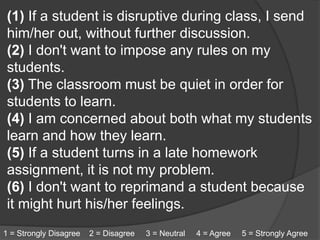
(1) If a student is disruptive during class, I send
him/her out, without further discussion.
(2) I don't want to impose any rules on my
students.
(3) The classroom must be quiet in order for
students to learn.
(4) I am concerned about both what my students
learn and how they learn.
(5) If a student turns in a late homework
assignment, it is not my problem.
(6) I don't want to reprimand a student because
it might hurt his/her feelings.
1 = Strongly Disagree 2 = Disagree 3 = Neutral 4 = Agree 5 = Strongly Agree
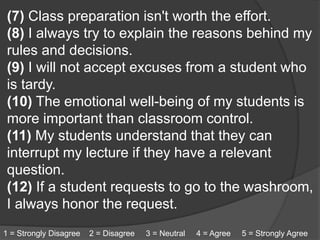
(7) Class preparation isn't worth the effort.
(8) I always try to explain the reasons behind my
rules and decisions.
(9) I will not accept excuses from a student who
is tardy.
(10) The emotional well-being of my students is
more important than classroom control.
(11) My students understand that they can
interrupt my lecture if they have a relevant
question.
(12) If a student requests to go to the washroom,
I always honor the request.
1 = Strongly Disagree 2 = Disagree 3 = Neutral 4 = Agree 5 = Strongly Agree
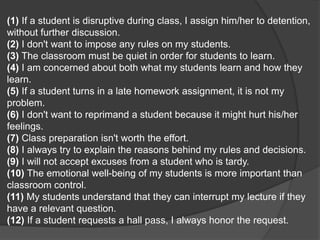
(1) If a student is disruptive during class, I assign him/her to detention,
without further discussion.
(2) I don't want to impose any rules on my students.
(3) The classroom must be quiet in order for students to learn.
(4) I am concerned about both what my students learn and how they
learn.
(5) If a student turns in a late homework assignment, it is not my
problem.
(6) I don't want to reprimand a student because it might hurt his/her
feelings.
(7) Class preparation isn't worth the effort.
(8) I always try to explain the reasons behind my rules and decisions.
(9) I will not accept excuses from a student who is tardy.
(10) The emotional well-being of my students is more important than
classroom control.
(11) My students understand that they can interrupt my lecture if they
have a relevant question.
(12) If a student requests a hall pass, I always honor the request.
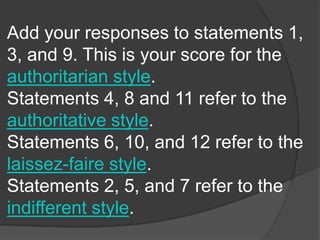
Add your responses to statements 1,
3, and 9. This is your score for the
authoritarian style.
Statements 4, 8 and 11 refer to the
authoritative style.
Statements 6, 10, and 12 refer to the
laissez-faire style.
Statements 2, 5, and 7 refer to the
indifferent style.
The Number one factor
governing learning is
Classroom Management
Not discipline
Not self esteem
Not motivation
Not class size, etc.
Discipline
v.s.
Classroom Management
The best way to manage is to
have Procedures & Routines.
Clearly define
classroom procedures
and routines.
You want responsible
students?
1. The only way you can have
responsible students is if you have
procedures and routines which the
students can be responsible to.
2. When students know how the class is
run, they will more willingly do whatever
you want them to do.
PROCEDURES
AND
ROUTINES
PROCEDURES:
What you want students to do.
ROUTINES:
What the students do automatically.
THE NUMBER ONE
PROBLEM
IN THE CLASSROOM
IS NOT
DISCIPLINE;
IT IS THE LACK OF
PROCEDURES AND
ROUTINES.
Passing in papers
Heading of papers
Roll call
Entering the classroom
When asking a question
Getting to work immediately
When teacher is tardy
End of period class dismissal
Participating in Class Discussion
When a student needs paper/pen
Coming to attention
When you are absent
Working cooperatively
Changing groups
IT IS THE
PROCEDURES
THAT SET UP
THE CLASS
FOR ACHIEVEMENT
TO TAKE PLACE.
Once and for all,
you can solve
that discipline problem.
THE KIDS
WANT DISCIPLINE
EVEN MORE THAN
YOU DO!
5 Myths of
Discipline
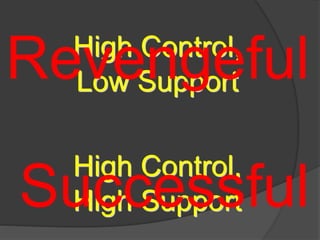
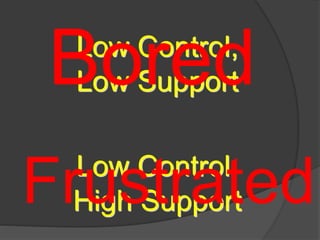
Low Control,
Low Support
Low Control,
High Support
Bored
Frustrated
High Control,
Low Support
High Control,
High Support
Revengeful
Successful
The
Discipline
Plan
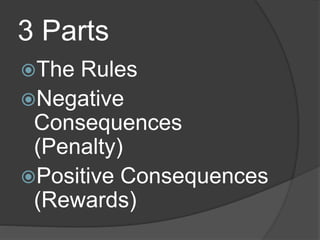
3 Parts
The Rules
Negative
Consequences
(Penalty)
Positive Consequences
(Rewards)
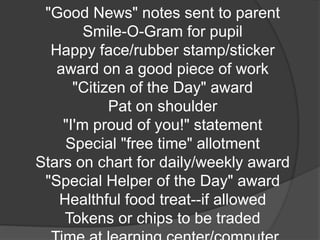
"Good News" notes sent to parent
Smile-O-Gram for pupil
Happy face/rubber stamp/sticker
award on a good piece of work
"Citizen of the Day" award
Pat on shoulder
"I'm proud of you!" statement
Special "free time" allotment
Stars on chart for daily/weekly award
"Special Helper of the Day" award
Healthful food treat--if allowed
Tokens or chips to be traded
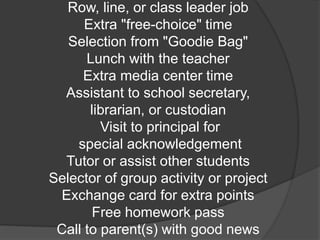
Row, line, or class leader job
Extra "free-choice" time
Selection from "Goodie Bag"
Lunch with the teacher
Extra media center time
Assistant to school secretary,
librarian, or custodian
Visit to principal for
special acknowledgement
Tutor or assist other students
Selector of group activity or project
Exchange card for extra points
Free homework pass
Call to parent(s) with good news
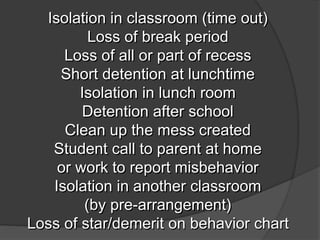
Isolation in classroom (time out)
Loss of break period
Loss of all or part of recess
Short detention at lunchtime
Isolation in lunch room
Detention after school
Clean up the mess created
Student call to parent at home
or work to report misbehavior
Isolation in another classroom
(by pre-arrangement)
Loss of star/demerit on behavior chart
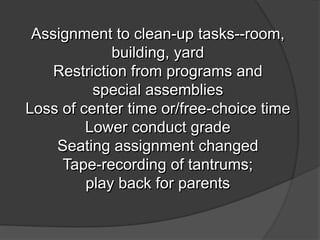
Assignment to clean-up tasks--room,
building, yard
Restriction from programs and
special assemblies
Loss of center time or/free-choice time
Lower conduct grade
Seating assignment changed
Tape-recording of tantrums;
play back for parents
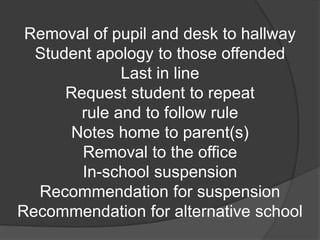
Removal of pupil and desk to hallway
Student apology to those offended
Last in line
Request student to repeat
rule and to follow rule
Notes home to parent(s)
Removal to the office
In-school suspension
Recommendation for suspension
Recommendation for alternative school
There should be
more rewards
than penalties.
Check System
Stop Watch
System
Reward System
The Stare
Good Deeds Bowl
Merit/Rewards
Class Culture &
Identity
Trophy Technique
Three (or Five)
Circles Technique
as a Class Reward
The mediocre teacher tells,
The good one explains,
The superior oneshows,
The great oneinspires. . .
Better Classroom
Management
Todownload all the slides and videos
from this presentation:
www.mannrentoy.com
mannrentoy@gmail.com
www.mannrentoy.com
www.scribd.com
cepphilippines. com
mann@cepphilippines.com
Classroom
Management
Strategies
By Mann Rentoy

CLASSROOM MANAGEMENT

  • 1.
  • 3.
    By Harry andRosemary Wong First Days of School
  • 7.
    By Rafe Esquith TeachLike Your Hair is on Fire
  • 9.
    By Hal Urban Lessonsfrom the Classroom 20 Things Good Teachers Do
  • 11.
    The Four Stagesof Teaching: FANTASY SURVIVAL MASTERY IMPACT
  • 12.
  • 14.
    Top 3 Traitsof an Effective Teacher: (based on a 50-year study published by EDUCATIONAL LEADERSHIP)
  • 15.
    An Effective Teacher isa Good Classroom Manager
  • 16.
    An Effective Teacher designslessons to reach mastery
  • 17.
    An Effective Teacher has positiveexpectations that students will be successful
  • 19.
  • 21.
    (1) If astudent is disruptive during class, I send him/her out, without further discussion. (2) I don't want to impose any rules on my students. (3) The classroom must be quiet in order for students to learn. (4) I am concerned about both what my students learn and how they learn. (5) If a student turns in a late homework assignment, it is not my problem. (6) I don't want to reprimand a student because it might hurt his/her feelings. 1 = Strongly Disagree 2 = Disagree 3 = Neutral 4 = Agree 5 = Strongly Agree
  • 22.
    (7) Class preparationisn't worth the effort. (8) I always try to explain the reasons behind my rules and decisions. (9) I will not accept excuses from a student who is tardy. (10) The emotional well-being of my students is more important than classroom control. (11) My students understand that they can interrupt my lecture if they have a relevant question. (12) If a student requests to go to the washroom, I always honor the request. 1 = Strongly Disagree 2 = Disagree 3 = Neutral 4 = Agree 5 = Strongly Agree
  • 23.
    (1) If astudent is disruptive during class, I assign him/her to detention, without further discussion. (2) I don't want to impose any rules on my students. (3) The classroom must be quiet in order for students to learn. (4) I am concerned about both what my students learn and how they learn. (5) If a student turns in a late homework assignment, it is not my problem. (6) I don't want to reprimand a student because it might hurt his/her feelings. (7) Class preparation isn't worth the effort. (8) I always try to explain the reasons behind my rules and decisions. (9) I will not accept excuses from a student who is tardy. (10) The emotional well-being of my students is more important than classroom control. (11) My students understand that they can interrupt my lecture if they have a relevant question. (12) If a student requests a hall pass, I always honor the request.
  • 24.
    Add your responsesto statements 1, 3, and 9. This is your score for the authoritarian style. Statements 4, 8 and 11 refer to the authoritative style. Statements 6, 10, and 12 refer to the laissez-faire style. Statements 2, 5, and 7 refer to the indifferent style.
  • 25.
    The Number onefactor governing learning is Classroom Management Not discipline Not self esteem Not motivation Not class size, etc.
  • 26.
  • 27.
    The best wayto manage is to have Procedures & Routines. Clearly define classroom procedures and routines.
  • 28.
    You want responsible students? 1.The only way you can have responsible students is if you have procedures and routines which the students can be responsible to. 2. When students know how the class is run, they will more willingly do whatever you want them to do.
  • 29.
  • 30.
    PROCEDURES: What you wantstudents to do. ROUTINES: What the students do automatically.
  • 31.
    THE NUMBER ONE PROBLEM INTHE CLASSROOM IS NOT DISCIPLINE; IT IS THE LACK OF PROCEDURES AND ROUTINES.
  • 32.
    Passing in papers Headingof papers Roll call Entering the classroom When asking a question Getting to work immediately When teacher is tardy
  • 33.
    End of periodclass dismissal Participating in Class Discussion When a student needs paper/pen Coming to attention When you are absent Working cooperatively Changing groups
  • 34.
    IT IS THE PROCEDURES THATSET UP THE CLASS FOR ACHIEVEMENT TO TAKE PLACE.
  • 36.
    Once and forall, you can solve that discipline problem.
  • 37.
  • 38.
  • 39.
    Low Control, Low Support LowControl, High Support Bored Frustrated
  • 41.
    High Control, Low Support HighControl, High Support Revengeful Successful
  • 43.
  • 44.
  • 45.
    "Good News" notessent to parent Smile-O-Gram for pupil Happy face/rubber stamp/sticker award on a good piece of work "Citizen of the Day" award Pat on shoulder "I'm proud of you!" statement Special "free time" allotment Stars on chart for daily/weekly award "Special Helper of the Day" award Healthful food treat--if allowed Tokens or chips to be traded
  • 46.
    Row, line, orclass leader job Extra "free-choice" time Selection from "Goodie Bag" Lunch with the teacher Extra media center time Assistant to school secretary, librarian, or custodian Visit to principal for special acknowledgement Tutor or assist other students Selector of group activity or project Exchange card for extra points Free homework pass Call to parent(s) with good news
  • 47.
    Isolation in classroom(time out) Loss of break period Loss of all or part of recess Short detention at lunchtime Isolation in lunch room Detention after school Clean up the mess created Student call to parent at home or work to report misbehavior Isolation in another classroom (by pre-arrangement) Loss of star/demerit on behavior chart
  • 48.
    Assignment to clean-uptasks--room, building, yard Restriction from programs and special assemblies Loss of center time or/free-choice time Lower conduct grade Seating assignment changed Tape-recording of tantrums; play back for parents
  • 49.
    Removal of pupiland desk to hallway Student apology to those offended Last in line Request student to repeat rule and to follow rule Notes home to parent(s) Removal to the office In-school suspension Recommendation for suspension Recommendation for alternative school
  • 50.
    There should be morerewards than penalties.
  • 53.
  • 54.
  • 55.
  • 56.
  • 57.
  • 58.
  • 59.
  • 60.
  • 61.
    Three (or Five) CirclesTechnique as a Class Reward
  • 62.
    The mediocre teachertells, The good one explains, The superior oneshows, The great oneinspires. . .
  • 65.
  • 67.
    Todownload all theslides and videos from this presentation: www.mannrentoy.com
  • 71.
  • 72.
  • 75.