Classroom Management
and
Discipline
Discussant: Amalia D. Aquino
EDUC 508
Dr. Wilhelmina Q. Tomas
Classroom Management and Discipline
• Goal of discipline is internal control
• Positive leads to self-discipline
• Negative leads to unwanted results
• Effective teacher manages
• Ineffective teacher punishes
Management and Discipline
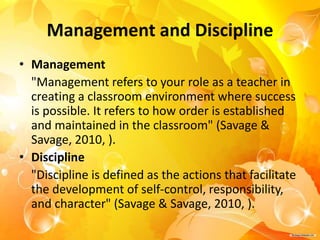
• Management
"Management refers to your role as a teacher in
creating a classroom environment where success
is possible. It refers to how order is established
and maintained in the classroom" (Savage &
Savage, 2010, ).
• Discipline
"Discipline is defined as the actions that facilitate
the development of self-control, responsibility,
and character" (Savage & Savage, 2010, ).
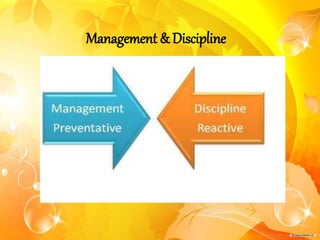
Management & Discipline
Classroom Management
Profile
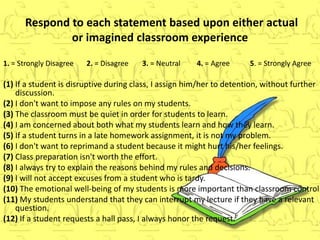
Respond to each statement based upon either actual
or imagined classroom experience
1. = Strongly Disagree 2. = Disagree 3. = Neutral 4. = Agree 5. = Strongly Agree
(1) If a student is disruptive during class, I assign him/her to detention, without further
discussion.
(2) I don't want to impose any rules on my students.
(3) The classroom must be quiet in order for students to learn.
(4) I am concerned about both what my students learn and how they learn.
(5) If a student turns in a late homework assignment, it is not my problem.
(6) I don't want to reprimand a student because it might hurt his/her feelings.
(7) Class preparation isn't worth the effort.
(8) I always try to explain the reasons behind my rules and decisions.
(9) I will not accept excuses from a student who is tardy.
(10) The emotional well-being of my students is more important than classroom control.
(11) My students understand that they can interrupt my lecture if they have a relevant
question.
(12) If a student requests a hall pass, I always honor the request.
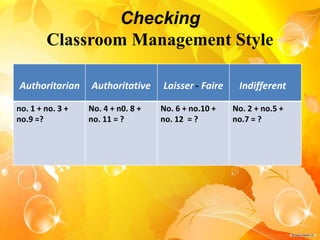
Checking
Classroom Management Style
no. 1 + no. 3 +
no.9 =?
No. 4 + n0. 8 +
no. 11 = ?
No. 6 + no.10 +
no. 12 = ?
No. 2 + no.5 +
no.7 = ?
Authoritarian Authoritative Laisser - Faire Indifferent
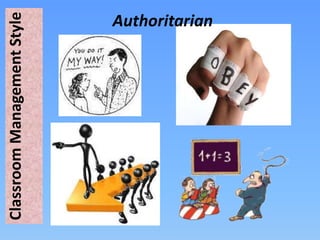
ClassroomManagementStyle Authoritarian
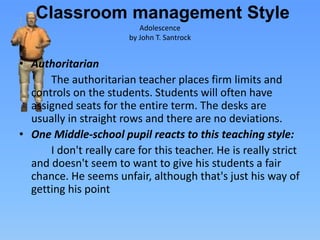
Classroom management Style
• Authoritarian
The authoritarian teacher places firm limits and
controls on the students. Students will often have
assigned seats for the entire term. The desks are
usually in straight rows and there are no deviations.
• One Middle-school pupil reacts to this teaching style:
I don't really care for this teacher. He is really strict
and doesn't seem to want to give his students a fair
chance. He seems unfair, although that's just his way of
getting his point
Adolescence
by John T. Santrock
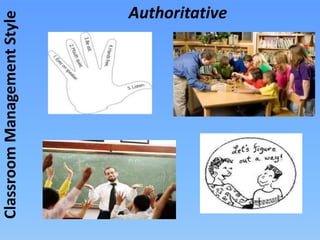
ClassroomManagementStyle Authoritative
• Authoritative
The authoritative teacher places limits and controls on
the students but simultaneously encourages independence.
This teacher often explains the reasons behind the rules
and decisions. If a student is disruptive, the teacher offers a
polite, but firm, reprimand. This teacher sometimes metes
out discipline, but only after careful consideration of the
circumstances.
• A student reacts to this style:
I like this teacher. She is fair and understands that
students can't be perfect. She is the kind of teacher you can
talk to without being put down or feeling embarrassed.
Classroom management Style
ClassroomManagementStyle
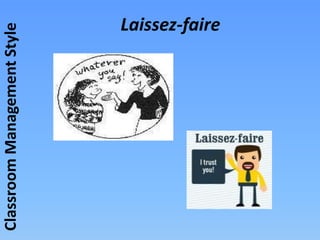
Laissez-faire
• Laissez-faire
The laissez-faire teacher places few demand
or controls on the students. "Do your own thing"
describes this classroom. This teacher accepts the
student's impulses and actions and is less likely to
monitor their behavior.
• A Middle School student says:
This is a pretty popular teacher. You don't
have to be serious throughout the class. But
sometimes things get out of control and we learn
nothing at all.
Classroom management Style
ClassroomManagementStyle
Indifferent
• Indifferent
The indifferent teacher is not very involved in the
classroom. This teacher places few demands, if any, on the
students and appears generally uninterested. The
indifferent teacher just doesn't want to impose on the
students. As such, he/she often feels that class preparation
is not worth the effort.
Also, classroom discipline is lacking. This teacher may
lack the skills, confidence, or courage to discipline students.
• According to one student:
This teacher can't control the class and we never learn
anything in there. There is hardly ever homework and
people rarely bring their books.
Classroom management Style
Principles in Classroom Management
Qualities of Effective Teachers ( 2002 )
By: James H. Strong
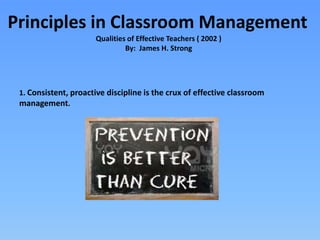
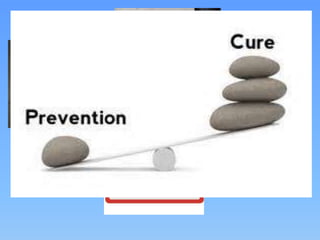
1. Consistent, proactive discipline is the crux of effective classroom
management.
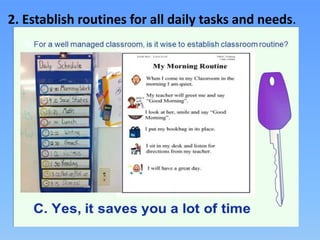
2. Establish routines for all daily tasks and needs.
3. Orchestrate smooth transitions and continuity of
momentum throughout the day.
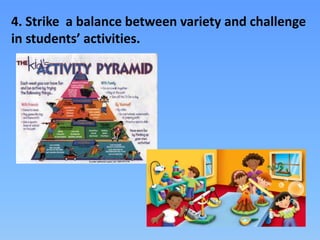
4. Strike a balance between variety and challenge
in students’ activities.
5. As classroom manager, be aware of all actions
and activities in the classroom
“ Have eyes on the back of your heads”
6. Resolve minor inattention and disruption
before they become major disruptions.
7. Reinforce positive behavior.
8. Treat minor disturbance calmly.
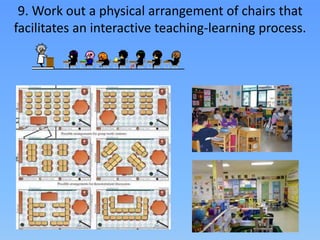
9. Work out a physical arrangement of chairs that
facilitates an interactive teaching-learning process.
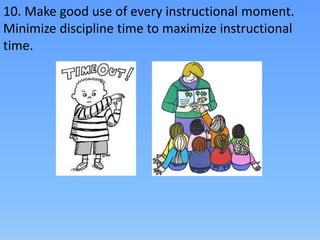
10. Make good use of every instructional moment.
Minimize discipline time to maximize instructional
time.
• Proverbs 11:14a states that "Without wise
leadership, a nation falls." The same can be
applied for the classroom. The key to the
success of a class is the leadership the class is
underneath. Without the wise leadership of a
teacher, the class will not succeed.
Amalia D. Aquino
EDUC 508
DR. WILHELMINA Q. TOMAS

Classroom management and discipline

  • 1.
    Classroom Management and Discipline Discussant: AmaliaD. Aquino EDUC 508 Dr. Wilhelmina Q. Tomas
  • 4.
    Classroom Management andDiscipline • Goal of discipline is internal control • Positive leads to self-discipline • Negative leads to unwanted results • Effective teacher manages • Ineffective teacher punishes
  • 5.
    Management and Discipline •Management "Management refers to your role as a teacher in creating a classroom environment where success is possible. It refers to how order is established and maintained in the classroom" (Savage & Savage, 2010, ). • Discipline "Discipline is defined as the actions that facilitate the development of self-control, responsibility, and character" (Savage & Savage, 2010, ).
  • 6.
  • 7.
  • 8.
    Respond to eachstatement based upon either actual or imagined classroom experience 1. = Strongly Disagree 2. = Disagree 3. = Neutral 4. = Agree 5. = Strongly Agree (1) If a student is disruptive during class, I assign him/her to detention, without further discussion. (2) I don't want to impose any rules on my students. (3) The classroom must be quiet in order for students to learn. (4) I am concerned about both what my students learn and how they learn. (5) If a student turns in a late homework assignment, it is not my problem. (6) I don't want to reprimand a student because it might hurt his/her feelings. (7) Class preparation isn't worth the effort. (8) I always try to explain the reasons behind my rules and decisions. (9) I will not accept excuses from a student who is tardy. (10) The emotional well-being of my students is more important than classroom control. (11) My students understand that they can interrupt my lecture if they have a relevant question. (12) If a student requests a hall pass, I always honor the request.
  • 9.
    Checking Classroom Management Style no.1 + no. 3 + no.9 =? No. 4 + n0. 8 + no. 11 = ? No. 6 + no.10 + no. 12 = ? No. 2 + no.5 + no.7 = ? Authoritarian Authoritative Laisser - Faire Indifferent
  • 10.
  • 11.
    Classroom management Style •Authoritarian The authoritarian teacher places firm limits and controls on the students. Students will often have assigned seats for the entire term. The desks are usually in straight rows and there are no deviations. • One Middle-school pupil reacts to this teaching style: I don't really care for this teacher. He is really strict and doesn't seem to want to give his students a fair chance. He seems unfair, although that's just his way of getting his point Adolescence by John T. Santrock
  • 12.
  • 13.
    • Authoritative The authoritativeteacher places limits and controls on the students but simultaneously encourages independence. This teacher often explains the reasons behind the rules and decisions. If a student is disruptive, the teacher offers a polite, but firm, reprimand. This teacher sometimes metes out discipline, but only after careful consideration of the circumstances. • A student reacts to this style: I like this teacher. She is fair and understands that students can't be perfect. She is the kind of teacher you can talk to without being put down or feeling embarrassed. Classroom management Style
  • 14.
  • 15.
    • Laissez-faire The laissez-faireteacher places few demand or controls on the students. "Do your own thing" describes this classroom. This teacher accepts the student's impulses and actions and is less likely to monitor their behavior. • A Middle School student says: This is a pretty popular teacher. You don't have to be serious throughout the class. But sometimes things get out of control and we learn nothing at all. Classroom management Style
  • 16.
  • 17.
    • Indifferent The indifferentteacher is not very involved in the classroom. This teacher places few demands, if any, on the students and appears generally uninterested. The indifferent teacher just doesn't want to impose on the students. As such, he/she often feels that class preparation is not worth the effort. Also, classroom discipline is lacking. This teacher may lack the skills, confidence, or courage to discipline students. • According to one student: This teacher can't control the class and we never learn anything in there. There is hardly ever homework and people rarely bring their books. Classroom management Style
  • 18.
    Principles in ClassroomManagement Qualities of Effective Teachers ( 2002 ) By: James H. Strong 1. Consistent, proactive discipline is the crux of effective classroom management.
  • 20.
    2. Establish routinesfor all daily tasks and needs.
  • 21.
    3. Orchestrate smoothtransitions and continuity of momentum throughout the day.
  • 22.
    4. Strike abalance between variety and challenge in students’ activities.
  • 23.
    5. As classroommanager, be aware of all actions and activities in the classroom “ Have eyes on the back of your heads”
  • 24.
    6. Resolve minorinattention and disruption before they become major disruptions.
  • 25.
  • 26.
    8. Treat minordisturbance calmly.
  • 27.
    9. Work outa physical arrangement of chairs that facilitates an interactive teaching-learning process.
  • 28.
    10. Make gooduse of every instructional moment. Minimize discipline time to maximize instructional time.
  • 29.
    • Proverbs 11:14astates that "Without wise leadership, a nation falls." The same can be applied for the classroom. The key to the success of a class is the leadership the class is underneath. Without the wise leadership of a teacher, the class will not succeed.
  • 30.
    Amalia D. Aquino EDUC508 DR. WILHELMINA Q. TOMAS