GENERAL PATHWAYS OF AMINO
     ACIDS METABOLISM
Digestion and absorbtion of
        proteins in the
    gastrointestinal tract.
   Nitrogenous balance.
Proteins function in the organism.
 All enzymes are proteins.
 Storing amino acids as nutrients and as building
blocks for the growing organism.
 Transport function (proteins transport fatty acids,
bilirubin, ions, hormones, some drugs etc.).
 Proteins are essential elements in contractile and
motile systems (actin, myosin).
 Protective or defensive function (fibrinogen,
antibodies).
 Some hormones are proteins (insulin, somatotropin).
 Structural function (collagen, elastin).
GENERAL PATHWAYS OF AMINO ACIDS METABOLISM

                 Proteins of food


                                                Metabolites of
                    Amino acids                 glycolysis and
                                                Krebs cycle

    Anabolic ways                     Catabolic ways


Synthesis of   Synthesis of         Trans-   Deami-     Decar-
cell and       peptide              ami-     nation     boxila-
extracell      physiologi-          nation              tion
proteins       cally active
               substances                                Amines

Proteins and peptides                  Urea, CO2, H2O
   of the organism
Nitrogen Balance (NB):
 Nitrogen balance is a comparison between
  Nitrogen intake (in the form of dietary
  protein) and Nitrogen loss (as undigested
  protein in feces,NPN as urea, ammonia,
  creatinine & uric acid in urine,sweat &
  saliva & losses by hair, nail, skin).

 NB is important in defining
1.overall protein metabolism of an individual
2.nutritional nitrogen requirement.
Nitrogenous balance
It may be positive, negative and neutral (zero).
Positive nitrogenous balance – the amount of nitrogen entered the
organism is more than amount of nitrogen removed from the
organism. It occurs in young growing organism, during
recovering after severe diseases, at the using of anabolic
medicines pregnancy, lactation and convulascence

Negative nitrogenous balance – the amount of nitrogen removed
from the organism is more than amount of nitrogen entered the
organism. It occurs in senile age, destroying of malignant tumor,
vast combustions, poisoning by some toxins. High loss of tissue
proteins in wasting diseases like burns, hemorrhage & kidney
diseases with albuminurea (High breakdown of tissue proteins )
in hyperthyroidism, fever, infection

Zero nitrogenous balance – the amount of nitrogen removed from the
organism is equal to the amount of nitrogen entered the organism. It
occurs in healthy adult people
 Normal adult: will be in nitrogen equilibrium, Losses = Intake
A deficiency of
even one amino
acid results in a
negative nitrogen
balance.
In this state, more
protein is
degraded than
synthesized.
Protein Requirement for humans
         in Healthy and Disease Conditions
The normal daily requirement of protein for
adults is 0.8 g/Kg body wt. day-1.

• That requirement is increased in healthy
conditions:
during the periods of rapid growth, pregnancy,
lactation and adolescence.
• Protein requirement is increased in disease
states:
illness, major trauma and surgery.
• RDA for protein should be reduced in:
hepatic failure and renal failure
Biological Value for Protein (BV)
BV is : a measure for the ability of dietary
protein to provide the essential amino acids
required for tissue protein maintenance.

•Proteins of animal sources (meat, milk, eggs)
have high BV because they contain all the
essential amino acids.
•Proteins from plant sources (wheat, corn,
beans) have low BV thus combination of more
than one plant protein is required (a
vegetarian diet) to increase its BV.
Protein digestion
        Chemical composition of digestive juices.

Gastric juice contains water, enzymes, hydrochloric acid,
mineral salts and other compounds. About 2,5 l of
gastric juice is secreted per day.
The role of hydrochloric acid in digestion.
 Denaturate proteins (denaturated proteins easier
undergo digestion by pepsin than native proteins).
 Stimulates the activity of pepsin.
 Hydrochloric acid has bactericidial properties.
 Stimulates the peristalsis.
 Regulate the enzymatic function of pancreas.
Digestion in Stomach

Stimulated by food acetylcholine, histamine and gastrin are
released onto the cells of the stomach
The combination of acetylcholine, histamine and gastrin cause
the liberation of the gastric juice.
    Mucin - is always secreted in the stomach
    HCl - pH 0.8-2.5 (secreted by parietal cells)
    Pepsinogen (a zymogen, secreted by the chief cells)
Proteolytic enzymes and their activation.
Three enzymes are in gastric juice: pepsin, gastricsin and rennin. All these enzymes cleave
proteins or peptides.

Pepsinogen (MW=40,000) is activated by the enzyme pepsin, which is already present in the
stomach and by hydrochloric acid.
Pepsinogen cleaved off to become the enzyme pepsin (MW=33,000) and a peptide fragment to
be degraded.
Pepsin partially digests proteins by cleaving the peptide bond formed by aromatic amino
acids: Phe, Tyr, Trp
Optimal pH for gastricsin is 2,0-3,0. The ratio between
gastricsin and pepsin in gastric juice is 1:5,5. This ratio can be
changed in some pathological states.

Rennin also possesses a proteolytic activity and causes
a rapid coagulation of ingested casein. But this enzyme
plays important role only in children because the optimal pH
for it is 5-6.
Digestion in the Duodenum
Stimulated by food secretin and cholecystokinin regulate the
secretion of bicarbonate and zymogens trypsinogen,
chymotrypsinogen, proelastase and procarboxypeptidase by
pancreas into the duodenum
Bicarbonate changes the pH to about 7


 The intestinal cells
 secrete an enzyme
 called enteropeptidase
 that acts on trypsinogen
 cleaving it into trypsin
Enteropeptidase secreted by the mucosa of duodenum initiates
the activation of the pancreatic proenzymes


                                                          14
Proteolytic enzymes exhibit the preference for particular
types of peptide bonds

Proteinases preferentially attacks the bond after:
Pepsin        aromatic (Phe, Tyr) and acidic AA (Glu, Asp)
Trypsin              basic AA (Arg, Lys)
Chymotrypsin hydrophobic (Phe, Tyr, Trp, Leu) and acidic AA (Glu,
Asp)
Elastase               AA with a small side chain (Gly, Ala, Ser)

Peptidases:
Carboxypeptidase A      nearly all AA (not Arg and Lys)
Carboxypeptidase B      basic AA (Arg, Lys)
aminopeptidase                   nearly all AA
Prolidase              proline
                                                             15
Dipeptidase            only dipeptides
The splitting of elastin in an intestine is catalyzed by elastase
and collagen is decomposed by collagenase.

Digestion of protein takes place not only in the intestinal cavity
but also on the surface of mucosa cells.
Mechanism of amino acid absorbtion.


This explanation is called the sodium cotransport
theory for amino acid transport; it is also called secondary
active transport of amino acid.
Absorption of amino acids through the intestine mucosa can occur
 far more rapidly than protein can be digested in the lumen of the
intestine.
Since most protein digestion occurs in the upper small intestine
most protein absorption occurs in the duodenum and jejunum.
Most proteins are completely digested to free amino acids
Amino acids and sometimes short oligopeptides are absorbed by the
secondary active transport
Amino acids are transported via the blood to the cells of the body.
The sources of amino acids:
1) absorption in the intestine;
 2) formation during the protein decomposition;
 3) synthesis from the carbohydrates and lipids.

Using of amino acids:
1) for protein synthesis;
2) for synthesis of nitrogen containing compounds (creatine, purines,
choline, pyrimidine);
3) as the source of energy (oxidation – deamination, transamination,
decarboxilation);
4) for the gluconeogenesis;
5) for the formation of biologically active compounds.
Overview of Amino Acid Catabolism:
     Interorgan Relationships
Overview of Amino Acid Catabolism:
     Interorgan Relationships
• Liver
  – Synthesis of liver and plasma proteins
  – Catabolism of amino acids
    • Gluconeogenesis
    • Ketogenesis
    • Branched chain amino acids (BCAA) not
      catabolized
    • Urea synthesis
  – Amino acids released into general
    circulation
    • Enriched in BCAA (2-3X)
Overview of Amino Acid Catabolism:
     Interorgan Relationships
• Skeletal Muscle
  – Muscle protein synthesis
  – Catabolism of BCAA
     • Amino groups transported away as alanine and
       glutamine (50% of AA released)
        – Alanine to liver for gluconeogenesis
        – Glutamine to kidneys
• Kidney
  – Glutamine metabolized to a-KG + NH4
     • a-KG for gluconeogenesis
     • NH4 excreted or used for urea cycle (arginine
       synthesis)
        – Important buffer from acidosis
PROTEIN TURNOVER

Protein turnover — the degradation and resynthesis
of proteins
Half-lives of proteins – from several minutes to many years

Structural proteins – usually stable (lens protein crystallin lives
during the whole life of the organism)
Regulatory proteins - short lived (altering the amounts of these
proteins can rapidly change the rate of metabolic processes)


How can a cell distinguish proteins that are meant
for degradation?
Ubiquitin - is the tag that marks
proteins for destruction ("black
spot" - the signal for death)
Ubiquitin - a small (8.5-kd) protein
present in all eukaryotic cells

Structure:
 extended carboxyl terminus
(glycine) that is linked to other
proteins;
 lysine residues for linking
additional ubiquitin molecules
Proteasomes degrade regulatory proteins (short half-life)
and abnormal or misfolded proteins
  - hollow cylindric supramolecule,
  28 polypeptides                                 Protein-Ub
  - four cyclic heptamers (4 × 7 =
  28)                                                      regulation of
  - the caps on the ends regulate
  the entry of proteins into                               cell cycle,
  destruction chamber, upon ATP
                                                           apoptosis,
  hydrolysis
  - inside the barrel, differently                         angiogenesis
  specific proteases hydrolyze
  target protein into short (8 AA)
  peptides                                                 cytosolic
  - Ub is not degraded, it is                              peptidases
                                   Ub + short peptides                AA
  released intact

                                                                   25
GENERAL WAYS OF AMINO
       ACIDS METABOLISM
The fates of amino acids:

1) for protein synthesis;

2) for synthesis of other nitrogen containing compounds
(creatine, purines, choline, pyrimidine);

3) as the source of energy;

4) for the gluconeogenesis.
The general ways of amino acids degradation:
     Deamination
     Transamination
     Decarboxilation

    The major site of amino acid degradation - the liver.

                     Deamination of amino acids
  Deamination - elimination of amino group from amino acid with
ammonia formation.

   Four types of deamination:
   - oxidative (the most important for higher animals),
   - reduction,
   - hydrolytic, and
   - intramolecular
Reduction deamination:

R-CH(NH2)-COOH + 2H+ → R-CH2-COOH + NH3
     amino acid            fatty acid

          Hydrolytic deamination:

R-CH(NH2)-COOH + H2O → R-CH(OH)-COOH +
                 NH3
      amino acid        hydroxyacid

        Intramolecular deamination:

R-CH(NH2)-COOH → R-CH-CH-COOH + NH3
   amino acid    unsaturated fatty acid
General scheme of oxydative
       transamination
R CH COOH       +     HOOC C CH2CH2COOH
   NH2                       O
aminokyselina
 amino acid            2-oxoglutarate
                        2-oxoglutarát

                    aminotransferase
                    aminotransferasa
                     pyridoxalfosfát
                    pyridoxal phosphate


R C    COOH     +     HOOC CH CH2CH2COOH
   O                         NH2

2-oxokyselina
  2-oxo acid               glutamát
                         glutamate        29
Glutamate dehydrogenase (GMD, GD, GDH)

• requires pyridine cofactor NAD(P)+

• GMD reaction is reversible: dehydrogenation with NAD+,
  hydrogenation with NADPH+H+

• two steps:

• dehydrogenation of CH-NH2 to imino group C=NH

• hydrolysis of imino group to oxo group and ammonia


                                                           30
In transaminations, nitrogen of most


                                       !
AA is concentrated in glutamate

Glutamate then undergoes
dehydrogenation + deamination
  and releases free ammonia NH3


                                       31
Oxidative deamination
L-Glutamate dehydrogenase plays a central role in amino acid
deamination
In most organisms glutamate is the only amino acid that has
active dehydrogenase
Present in both the cytosol and mitochondria of the liver
Transamination of amino acids
  Transamination - transfer of an amino group from an α -
  amino acid to an α -keto acid (usually to α -ketoglutarate)
  Enzymes: aminotransferases (transaminases).


                α -keto acid
α -amino acid                       α -keto acid   α -amino acid
There are different transaminases
The most common:
alanine aminotransferase alanine + α-ketoglutarate ⇔ pyruvate +
glutamate
aspartate aminotransferase
aspartate + α-ketoglutarate ⇔ oxaloacetate + glutamate

Aminotransferases funnel α -amino groups from a variety of
amino acids to α-ketoglutarate with glutamate formation
Glutamate can be deaminated with NH4+ release
Mechanism of transamination
All aminotransferases require the
prosthetic group pyridoxal
phosphate (PLP), which is derived
from pyridoxine (vitamin B6).

Ping-pong kinetic mechanism
First step: the amino group of
amino acid is transferred to
pyridoxal phosphate, forming
pyridoxamine phosphate and
releasing ketoacid.
Second step: α-ketoglutarate
reacts with pyridoxamine
phosphate forming glutamate
Ping-pong kinetic mechanism of aspartate transaminase


aspartate + α-ketoglutarate ⇔ oxaloacetate + glutamate
Decarboxylation of amino acids

 Decarboxylation – removal of carbon dioxide from amino
 acid with formation of amines.


                                       amine

Usually amines have high physiological activity
(hormones, neurotransmitters etc).

 Enzyme: decarboxylases
   Coenzyme – pyrydoxalphosphate
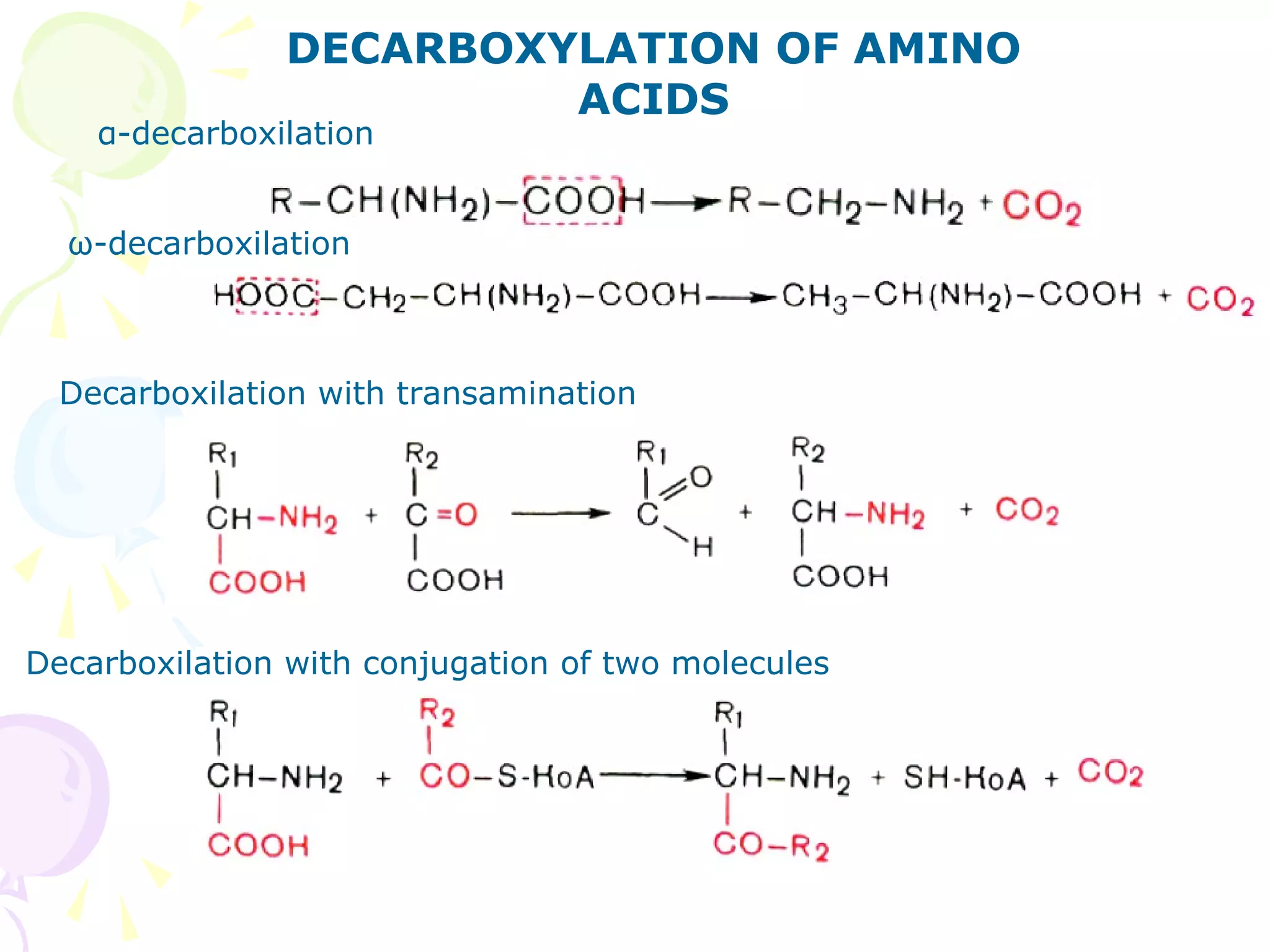
DECARBOXYLATION OF AMINO
                        ACIDS
    α-decarboxilation


  ω-decarboxilation


  Decarboxilation with transamination


Decarboxilation with conjugation of two molecules
Significance of amino acid decarboxylation
1. Formation of physiologically active compounds


   glutamate        gamma-aminobutyric acid
                           (GABA)


        histidine                    histamine
1) A lot of histamine is formed in inflamatory place;
It has vasodilator action;
Mediator of inflamation, mediator of pain;
Responsible for the allergy development;
Stimulate HCI secretion in stomach.                -CO2
2) Tryptophan → Serotonin
Vasokonstrictor
Takes part in regulation of arterial pressure, body
temperature, respiration, kidney filtration, mediator of
nervous system

3) Tyrosine → Dopamine
It is precursor of epinephrine and norepinephrine.
mediator of central nervous system

4) Glutamate → γ -aminobutyrate (GABA)
Is is ingibitory mediator of central nervous system. In
medicine we use with anticonvulsion purpose (action).
2. Catabolism of amino acids during the decomposition
                     of proteins
Enzymes of microorganisms (in colon; dead organisms)
decarboxylate amino acids with the formation of diamines.


ornithine                          putrescine


  lysine                              cadaverine

Amino acids metabolism new

  • 1.
    GENERAL PATHWAYS OFAMINO ACIDS METABOLISM Digestion and absorbtion of proteins in the gastrointestinal tract. Nitrogenous balance.
  • 2.
    Proteins function inthe organism.  All enzymes are proteins.  Storing amino acids as nutrients and as building blocks for the growing organism.  Transport function (proteins transport fatty acids, bilirubin, ions, hormones, some drugs etc.).  Proteins are essential elements in contractile and motile systems (actin, myosin).  Protective or defensive function (fibrinogen, antibodies).  Some hormones are proteins (insulin, somatotropin).  Structural function (collagen, elastin).
  • 3.
    GENERAL PATHWAYS OFAMINO ACIDS METABOLISM Proteins of food Metabolites of Amino acids glycolysis and Krebs cycle Anabolic ways Catabolic ways Synthesis of Synthesis of Trans- Deami- Decar- cell and peptide ami- nation boxila- extracell physiologi- nation tion proteins cally active substances Amines Proteins and peptides Urea, CO2, H2O of the organism
  • 4.
    Nitrogen Balance (NB): Nitrogen balance is a comparison between Nitrogen intake (in the form of dietary protein) and Nitrogen loss (as undigested protein in feces,NPN as urea, ammonia, creatinine & uric acid in urine,sweat & saliva & losses by hair, nail, skin).  NB is important in defining 1.overall protein metabolism of an individual 2.nutritional nitrogen requirement.
  • 5.
    Nitrogenous balance It maybe positive, negative and neutral (zero). Positive nitrogenous balance – the amount of nitrogen entered the organism is more than amount of nitrogen removed from the organism. It occurs in young growing organism, during recovering after severe diseases, at the using of anabolic medicines pregnancy, lactation and convulascence Negative nitrogenous balance – the amount of nitrogen removed from the organism is more than amount of nitrogen entered the organism. It occurs in senile age, destroying of malignant tumor, vast combustions, poisoning by some toxins. High loss of tissue proteins in wasting diseases like burns, hemorrhage & kidney diseases with albuminurea (High breakdown of tissue proteins ) in hyperthyroidism, fever, infection Zero nitrogenous balance – the amount of nitrogen removed from the organism is equal to the amount of nitrogen entered the organism. It occurs in healthy adult people Normal adult: will be in nitrogen equilibrium, Losses = Intake
  • 6.
    A deficiency of evenone amino acid results in a negative nitrogen balance. In this state, more protein is degraded than synthesized.
  • 7.
    Protein Requirement forhumans in Healthy and Disease Conditions The normal daily requirement of protein for adults is 0.8 g/Kg body wt. day-1. • That requirement is increased in healthy conditions: during the periods of rapid growth, pregnancy, lactation and adolescence. • Protein requirement is increased in disease states: illness, major trauma and surgery. • RDA for protein should be reduced in: hepatic failure and renal failure
  • 8.
    Biological Value forProtein (BV) BV is : a measure for the ability of dietary protein to provide the essential amino acids required for tissue protein maintenance. •Proteins of animal sources (meat, milk, eggs) have high BV because they contain all the essential amino acids. •Proteins from plant sources (wheat, corn, beans) have low BV thus combination of more than one plant protein is required (a vegetarian diet) to increase its BV.
  • 9.
    Protein digestion Chemical composition of digestive juices. Gastric juice contains water, enzymes, hydrochloric acid, mineral salts and other compounds. About 2,5 l of gastric juice is secreted per day. The role of hydrochloric acid in digestion.  Denaturate proteins (denaturated proteins easier undergo digestion by pepsin than native proteins).  Stimulates the activity of pepsin.  Hydrochloric acid has bactericidial properties.  Stimulates the peristalsis.  Regulate the enzymatic function of pancreas.
  • 10.
    Digestion in Stomach Stimulatedby food acetylcholine, histamine and gastrin are released onto the cells of the stomach The combination of acetylcholine, histamine and gastrin cause the liberation of the gastric juice. Mucin - is always secreted in the stomach HCl - pH 0.8-2.5 (secreted by parietal cells) Pepsinogen (a zymogen, secreted by the chief cells)
  • 11.
    Proteolytic enzymes andtheir activation. Three enzymes are in gastric juice: pepsin, gastricsin and rennin. All these enzymes cleave proteins or peptides. Pepsinogen (MW=40,000) is activated by the enzyme pepsin, which is already present in the stomach and by hydrochloric acid. Pepsinogen cleaved off to become the enzyme pepsin (MW=33,000) and a peptide fragment to be degraded. Pepsin partially digests proteins by cleaving the peptide bond formed by aromatic amino acids: Phe, Tyr, Trp
  • 12.
    Optimal pH forgastricsin is 2,0-3,0. The ratio between gastricsin and pepsin in gastric juice is 1:5,5. This ratio can be changed in some pathological states. Rennin also possesses a proteolytic activity and causes a rapid coagulation of ingested casein. But this enzyme plays important role only in children because the optimal pH for it is 5-6.
  • 13.
    Digestion in theDuodenum Stimulated by food secretin and cholecystokinin regulate the secretion of bicarbonate and zymogens trypsinogen, chymotrypsinogen, proelastase and procarboxypeptidase by pancreas into the duodenum Bicarbonate changes the pH to about 7 The intestinal cells secrete an enzyme called enteropeptidase that acts on trypsinogen cleaving it into trypsin
  • 14.
    Enteropeptidase secreted bythe mucosa of duodenum initiates the activation of the pancreatic proenzymes 14
  • 15.
    Proteolytic enzymes exhibitthe preference for particular types of peptide bonds Proteinases preferentially attacks the bond after: Pepsin aromatic (Phe, Tyr) and acidic AA (Glu, Asp) Trypsin basic AA (Arg, Lys) Chymotrypsin hydrophobic (Phe, Tyr, Trp, Leu) and acidic AA (Glu, Asp) Elastase AA with a small side chain (Gly, Ala, Ser) Peptidases: Carboxypeptidase A nearly all AA (not Arg and Lys) Carboxypeptidase B basic AA (Arg, Lys) aminopeptidase nearly all AA Prolidase proline 15 Dipeptidase only dipeptides
  • 16.
    The splitting ofelastin in an intestine is catalyzed by elastase and collagen is decomposed by collagenase. Digestion of protein takes place not only in the intestinal cavity but also on the surface of mucosa cells.
  • 17.
    Mechanism of aminoacid absorbtion. This explanation is called the sodium cotransport theory for amino acid transport; it is also called secondary active transport of amino acid. Absorption of amino acids through the intestine mucosa can occur far more rapidly than protein can be digested in the lumen of the intestine. Since most protein digestion occurs in the upper small intestine most protein absorption occurs in the duodenum and jejunum.
  • 18.
    Most proteins arecompletely digested to free amino acids Amino acids and sometimes short oligopeptides are absorbed by the secondary active transport Amino acids are transported via the blood to the cells of the body.
  • 19.
    The sources ofamino acids: 1) absorption in the intestine; 2) formation during the protein decomposition; 3) synthesis from the carbohydrates and lipids. Using of amino acids: 1) for protein synthesis; 2) for synthesis of nitrogen containing compounds (creatine, purines, choline, pyrimidine); 3) as the source of energy (oxidation – deamination, transamination, decarboxilation); 4) for the gluconeogenesis; 5) for the formation of biologically active compounds.
  • 20.
    Overview of AminoAcid Catabolism: Interorgan Relationships
  • 21.
    Overview of AminoAcid Catabolism: Interorgan Relationships • Liver – Synthesis of liver and plasma proteins – Catabolism of amino acids • Gluconeogenesis • Ketogenesis • Branched chain amino acids (BCAA) not catabolized • Urea synthesis – Amino acids released into general circulation • Enriched in BCAA (2-3X)
  • 22.
    Overview of AminoAcid Catabolism: Interorgan Relationships • Skeletal Muscle – Muscle protein synthesis – Catabolism of BCAA • Amino groups transported away as alanine and glutamine (50% of AA released) – Alanine to liver for gluconeogenesis – Glutamine to kidneys • Kidney – Glutamine metabolized to a-KG + NH4 • a-KG for gluconeogenesis • NH4 excreted or used for urea cycle (arginine synthesis) – Important buffer from acidosis
  • 23.
    PROTEIN TURNOVER Protein turnover— the degradation and resynthesis of proteins Half-lives of proteins – from several minutes to many years Structural proteins – usually stable (lens protein crystallin lives during the whole life of the organism) Regulatory proteins - short lived (altering the amounts of these proteins can rapidly change the rate of metabolic processes) How can a cell distinguish proteins that are meant for degradation?
  • 24.
    Ubiquitin - isthe tag that marks proteins for destruction ("black spot" - the signal for death) Ubiquitin - a small (8.5-kd) protein present in all eukaryotic cells Structure:  extended carboxyl terminus (glycine) that is linked to other proteins;  lysine residues for linking additional ubiquitin molecules
  • 25.
    Proteasomes degrade regulatoryproteins (short half-life) and abnormal or misfolded proteins - hollow cylindric supramolecule, 28 polypeptides Protein-Ub - four cyclic heptamers (4 × 7 = 28) regulation of - the caps on the ends regulate the entry of proteins into cell cycle, destruction chamber, upon ATP apoptosis, hydrolysis - inside the barrel, differently angiogenesis specific proteases hydrolyze target protein into short (8 AA) peptides cytosolic - Ub is not degraded, it is peptidases Ub + short peptides AA released intact 25
  • 26.
    GENERAL WAYS OFAMINO ACIDS METABOLISM The fates of amino acids: 1) for protein synthesis; 2) for synthesis of other nitrogen containing compounds (creatine, purines, choline, pyrimidine); 3) as the source of energy; 4) for the gluconeogenesis.
  • 27.
    The general waysof amino acids degradation:  Deamination  Transamination  Decarboxilation The major site of amino acid degradation - the liver. Deamination of amino acids Deamination - elimination of amino group from amino acid with ammonia formation. Four types of deamination: - oxidative (the most important for higher animals), - reduction, - hydrolytic, and - intramolecular
  • 28.
    Reduction deamination: R-CH(NH2)-COOH +2H+ → R-CH2-COOH + NH3 amino acid fatty acid Hydrolytic deamination: R-CH(NH2)-COOH + H2O → R-CH(OH)-COOH + NH3 amino acid hydroxyacid Intramolecular deamination: R-CH(NH2)-COOH → R-CH-CH-COOH + NH3 amino acid unsaturated fatty acid
  • 29.
    General scheme ofoxydative transamination R CH COOH + HOOC C CH2CH2COOH NH2 O aminokyselina amino acid 2-oxoglutarate 2-oxoglutarát aminotransferase aminotransferasa pyridoxalfosfát pyridoxal phosphate R C COOH + HOOC CH CH2CH2COOH O NH2 2-oxokyselina 2-oxo acid glutamát glutamate 29
  • 30.
    Glutamate dehydrogenase (GMD,GD, GDH) • requires pyridine cofactor NAD(P)+ • GMD reaction is reversible: dehydrogenation with NAD+, hydrogenation with NADPH+H+ • two steps: • dehydrogenation of CH-NH2 to imino group C=NH • hydrolysis of imino group to oxo group and ammonia 30
  • 31.
    In transaminations, nitrogenof most ! AA is concentrated in glutamate Glutamate then undergoes dehydrogenation + deamination and releases free ammonia NH3 31
  • 32.
    Oxidative deamination L-Glutamate dehydrogenaseplays a central role in amino acid deamination In most organisms glutamate is the only amino acid that has active dehydrogenase Present in both the cytosol and mitochondria of the liver
  • 33.
    Transamination of aminoacids Transamination - transfer of an amino group from an α - amino acid to an α -keto acid (usually to α -ketoglutarate) Enzymes: aminotransferases (transaminases). α -keto acid α -amino acid α -keto acid α -amino acid
  • 34.
    There are differenttransaminases The most common: alanine aminotransferase alanine + α-ketoglutarate ⇔ pyruvate + glutamate aspartate aminotransferase aspartate + α-ketoglutarate ⇔ oxaloacetate + glutamate Aminotransferases funnel α -amino groups from a variety of amino acids to α-ketoglutarate with glutamate formation Glutamate can be deaminated with NH4+ release
  • 35.
    Mechanism of transamination Allaminotransferases require the prosthetic group pyridoxal phosphate (PLP), which is derived from pyridoxine (vitamin B6). Ping-pong kinetic mechanism First step: the amino group of amino acid is transferred to pyridoxal phosphate, forming pyridoxamine phosphate and releasing ketoacid. Second step: α-ketoglutarate reacts with pyridoxamine phosphate forming glutamate
  • 36.
    Ping-pong kinetic mechanismof aspartate transaminase aspartate + α-ketoglutarate ⇔ oxaloacetate + glutamate
  • 37.
    Decarboxylation of aminoacids Decarboxylation – removal of carbon dioxide from amino acid with formation of amines. amine Usually amines have high physiological activity (hormones, neurotransmitters etc). Enzyme: decarboxylases Coenzyme – pyrydoxalphosphate
  • 38.
    DECARBOXYLATION OF AMINO ACIDS α-decarboxilation ω-decarboxilation Decarboxilation with transamination Decarboxilation with conjugation of two molecules
  • 39.
    Significance of aminoacid decarboxylation 1. Formation of physiologically active compounds glutamate gamma-aminobutyric acid (GABA) histidine histamine
  • 40.
    1) A lotof histamine is formed in inflamatory place; It has vasodilator action; Mediator of inflamation, mediator of pain; Responsible for the allergy development; Stimulate HCI secretion in stomach. -CO2 2) Tryptophan → Serotonin Vasokonstrictor Takes part in regulation of arterial pressure, body temperature, respiration, kidney filtration, mediator of nervous system 3) Tyrosine → Dopamine It is precursor of epinephrine and norepinephrine. mediator of central nervous system 4) Glutamate → γ -aminobutyrate (GABA) Is is ingibitory mediator of central nervous system. In medicine we use with anticonvulsion purpose (action).
  • 41.
    2. Catabolism ofamino acids during the decomposition of proteins Enzymes of microorganisms (in colon; dead organisms) decarboxylate amino acids with the formation of diamines. ornithine putrescine lysine cadaverine