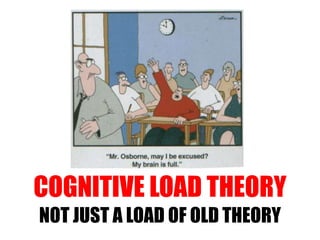
COGNITIVE LOAD THEORY
NOT JUST A LOAD OF OLD THEORY
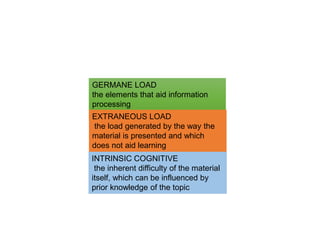
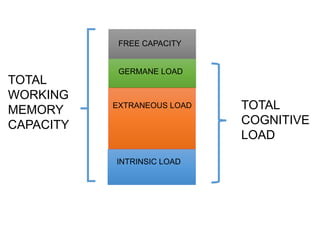
GERMANE LOAD
the elements that aid information
processing
EXTRANEOUS LOAD
the load generated by the way the
material is presented and which
does not aid learning
INTRINSIC COGNITIVE
the inherent difficulty of the material
itself, which can be influenced by
prior knowledge of the topic
TOTAL
COGNITIVE
LOAD
TOTAL
WORKING
MEMORY
CAPACITY
FREE CAPACITY
GERMANE LOAD
EXTRANEOUS LOAD
INTRINSIC LOAD
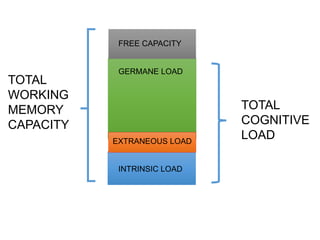
GERMANE LOAD
TOTAL
COGNITIVE
LOAD
TOTAL
WORKING
MEMORY
CAPACITY
INTRINSIC LOAD
EXTRANEOUS LOAD
FREE CAPACITY
‘We searched for small improvements everywhere and found
countless opportunities. Taken together, we felt they gave us
a competitive advantage’
COGNITIVE LOAD THEORY
EFFECTS
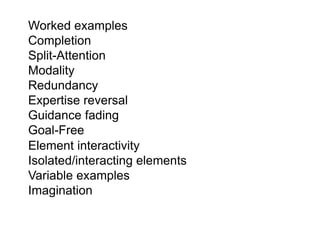
Worked examples
Completion
Split-Attention
Modality
Redundancy
Expertise reversal
Guidance fading
Goal-Free
Element interactivity
Isolated/interacting elements
Variable examples
Imagination
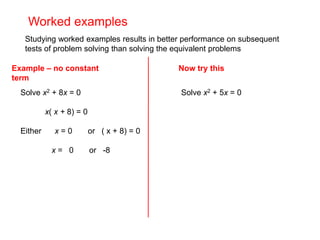
Worked examples
Studying worked examples results in better performance on subsequent
tests of problem solving than solving the equivalent problems
Example – no constant
term
Solve x2 + 8x = 0
x( x + 8) = 0
Either x = 0 or ( x + 8) = 0
x = 0 or -8
Solve x2 + 5x = 0
Now try this
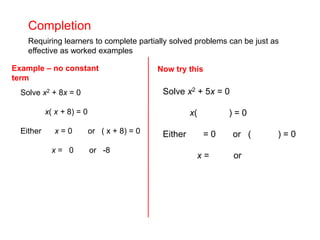
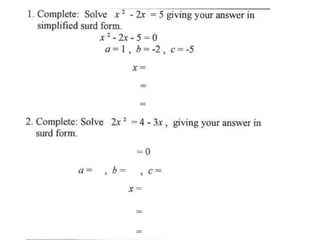
Completion
Requiring learners to complete partially solved problems can be just as
effective as worked examples
Example – no constant
term
Now try this
Solve x2 + 5x = 0
x( ) = 0
Either = 0 or ( ) = 0
x = or
Solve x2 + 8x = 0
x( x + 8) = 0
Either x = 0 or ( x + 8) = 0
x = 0 or -8
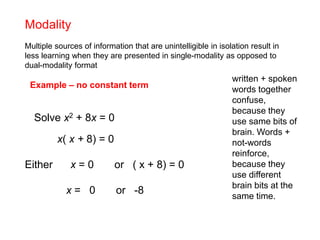
Modality
Multiple sources of information that are unintelligible in isolation result in
less learning when they are presented in single-modality as opposed to
dual-modality format
Example – no constant term
x( x + 8) = 0
Either x = 0 or ( x + 8) = 0
x = 0 or -8
Solve x2 + 8x = 0
written + spoken
words together
confuse,
because they
use same bits of
brain. Words +
not-words
reinforce,
because they
use different
brain bits at the
same time.
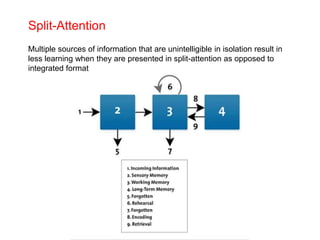
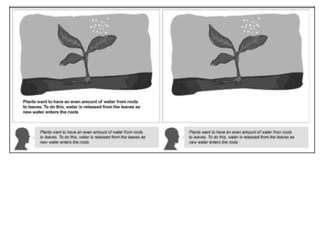
Split-Attention
Multiple sources of information that are unintelligible in isolation result in
less learning when they are presented in split-attention as opposed to
integrated format
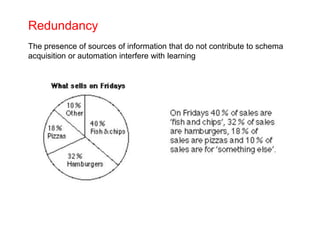
Redundancy
The presence of sources of information that do not contribute to schema
acquisition or automation interfere with learning
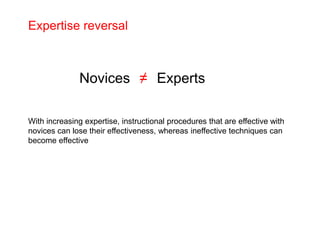
Expertise reversal
With increasing expertise, instructional procedures that are effective with
novices can lose their effectiveness, whereas ineffective techniques can
become effective
Novices ≠ Experts
Guidance fading
With increasing expertise, learners should be presented
worked examples
followed by completion problems
and then full problems rather than worked examples alone
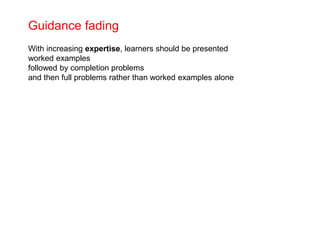
Goal-Free
Problems presented in goal-free form enhance learning compared with
conventional problems
For the right triangle shown, determine the length of the hypotenuse
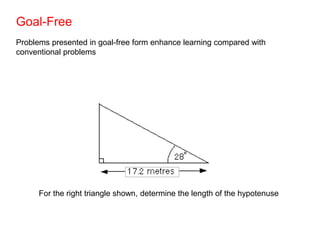
For the right triangle shown,
Find what you can.
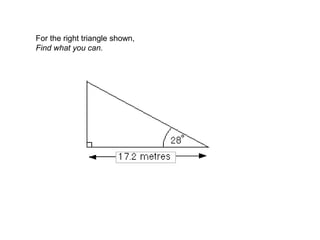
Goal-Free
Problems presented in goal-free form enhance learning compared with
conventional problems
What was the speed of the
bicycle after 10 seconds?
How far did the person travel
in the last 30 seconds?
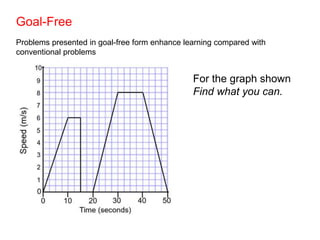
Goal-Free
Problems presented in goal-free form enhance learning compared with
conventional problems
For the graph shown
Find what you can.
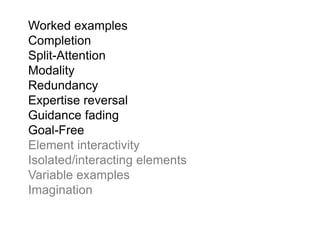
Worked examples
Completion
Split-Attention
Modality
Redundancy
Expertise reversal
Guidance fading
Goal-Free
Element interactivity
Isolated/interacting elements
Variable examples
Imagination
Element interactivity
Cognitive load effects are only obtainable using high rather than
low element interactivity material
Isolated/interacting elements
Learning is enhanced if very high element interactivity material is first
presented as isolated elements followed by interacting elements
versions rather than as interacting elements form initially
Variable examples
Examples with variable surface features enhance learning compared
with examples with similar features
Imagination
Imagining procedures or concepts enhance learning compared with
studying materials

Cognitive load theory