Instruction for Instructional Designers!Cognitive Load TheoryForDUMMIESCreate instruction that optimizes learner’s intellectual performanceA Referencefor theRest of Us!Greg Francom, Carolina Robinsonand Jessica Wals
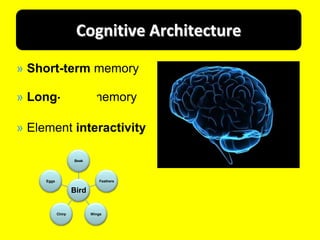
Cognitive ArchitectureShort-term memory
Long-term memory
 Element interactivityTypes of Cognitive LoadIntrinsic – All subjects have an inherent level of difficulty.
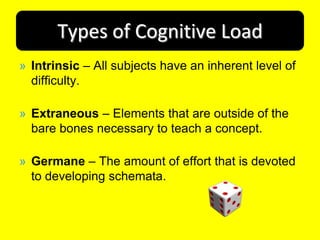
Extraneous – Elements that are outside of the bare bones necessary to teach a concept.
Germane – The amount of effort that is devoted to developing schemata.Researchers and ContributionsJeroen van MeriënboerOpen Universiteit Nederland John SwellerUniversity of NSW, AustraliaThe Four-Component Instructional Design model or 4C/ID-model
Formulated Cognitive Load Theory
Research based on cognitive factors in instructional design with emphasis on instructional implications of working memory.Researchers and ContributionsPaul ChandlerUniversity of Wollongong, AUFred PaasOpen Universiteit NederlandInternational Expert on cognition and learning
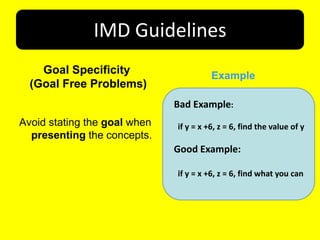
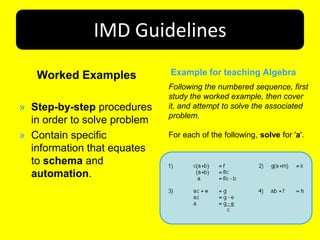
Cognitive Load Measurement as a Means to Advance Cognitive Load TheoryIMD GuidelinesExampleGoal Specificity (Goal Free Problems)Avoid stating the goal when presenting the concepts.Bad Example:   if y = x +6, z = 6, find the value of yGood Example:  if y = x +6, z = 6, find what you can

Cognitive Load Theory

  • 1.
    Instruction for InstructionalDesigners!Cognitive Load TheoryForDUMMIESCreate instruction that optimizes learner’s intellectual performanceA Referencefor theRest of Us!Greg Francom, Carolina Robinsonand Jessica Wals
  • 2.
  • 3.
  • 4.
    Element interactivityTypesof Cognitive LoadIntrinsic – All subjects have an inherent level of difficulty.
  • 5.
    Extraneous – Elementsthat are outside of the bare bones necessary to teach a concept.
  • 6.
    Germane – Theamount of effort that is devoted to developing schemata.Researchers and ContributionsJeroen van MeriënboerOpen Universiteit Nederland John SwellerUniversity of NSW, AustraliaThe Four-Component Instructional Design model or 4C/ID-model
  • 7.
  • 8.
    Research based oncognitive factors in instructional design with emphasis on instructional implications of working memory.Researchers and ContributionsPaul ChandlerUniversity of Wollongong, AUFred PaasOpen Universiteit NederlandInternational Expert on cognition and learning
  • 9.
    Cognitive Load Measurementas a Means to Advance Cognitive Load TheoryIMD GuidelinesExampleGoal Specificity (Goal Free Problems)Avoid stating the goal when presenting the concepts.Bad Example: if y = x +6, z = 6, find the value of yGood Example: if y = x +6, z = 6, find what you can

Editor's Notes

  • #4 Intrinsic Load- Give the example of standardized tests. You present a low level question, it is answered correctly, you move on to a more difficult one. If it is answered incorrectly, you move on to an easier concept. Difficult subjects can be broken down into single schema learning objectives that can be combined to learn a more difficult concept. Extraneous- There are two different ways that you can teach someone about a die. You can use many words and descriptive terms to illustrate the die, or you can show the picture below. Germane and Intrinsic load are relational. IDs should try to limit intrinsic load to promote germane.
  • #5 The 4C/ID model developed by VanMerrienboer makes use of cognitive load theory. He is always balancing the use of complex tasks in learning with the cognitive load that these tasks cause.
  • #6 Chandler did some of the original work for development of cognitive load theory along with Sweller. I would just say that Paas has done research testing the different aspects of cognitive load theory.
  • #7 When designing instruction, we want our students to focus on all the data we have presented. If we state the goal in the beginning they are so focused on the goal that they lose the ability to keep other critical data in the cognitive realm. Use a goal-free setup and present information so that the student can make any conclusions possible.