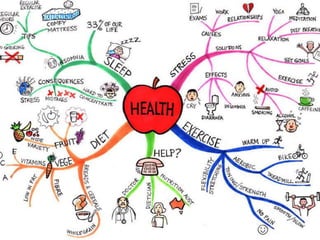
• A mind map is a diagram used to visually
organize information. A mind map is often
created around a single concept, drawn as
an image in the center of a blank landscape
page, to which associated representations
of ideas such as images, words and parts of
words are added.
• Mind Maps are a unique thinking tool
that will bring out your natural genius and
enable you to shine in every area of your
life.
1. Come up with innovative ideas and creative solutions?
2. Memorize information and recall it under pressure?
3. Set goals and achieve them?
4. Change career or start up your own venture?
5. Be an excellent time manager?
6. Run meetings with efficiency and ease?
7. Budget and plan to perfection?
8. Deliver excellent presentations with confidence?
9. Have more time for yourself and your family?
10.Enjoy success after success in your life?
Origins
• The term "mind map" was first popularized by British
popular psychology author and television personality
Tony Buzan.
• The use of diagrams that visually "map" information
using branching and radial maps traces back centuries.
These pictorial methods record knowledge and model
systems, and have a long history in learning,
brainstorming, memory, visual thinking, and problem
solving by educators, engineers, psychologists, and
others.
Historical Examples
• Some of the earliest examples of such
graphical records were developed by
Porphyry of Tyros, a noted thinker of the 3rd
century, as he graphically visualized the
concept categories of Aristotle. Philosopher
Ramon Llull (1235–1315) also used such
techniques.
• The semantic network was developed in the
late 1950s as a theory to understand human
learning and developed further by Allan M.
Collins and M. Ross Quillian during the early
1960s.
The process for creating a mind
map can be described in
eight steps:
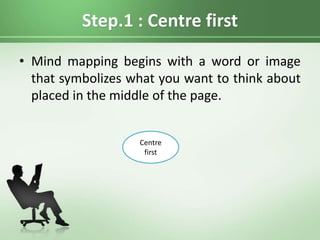
Step.1 : Centre first
• Mind mapping begins with a word or image
that symbolizes what you want to think about
placed in the middle of the page.
Centre
first
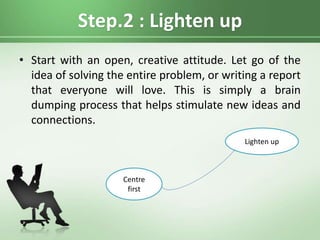
Step.2 : Lighten up
• Start with an open, creative attitude. Let go of the
idea of solving the entire problem, or writing a report
that everyone will love. This is simply a brain
dumping process that helps stimulate new ideas and
connections.
Centre
first
Lighten up
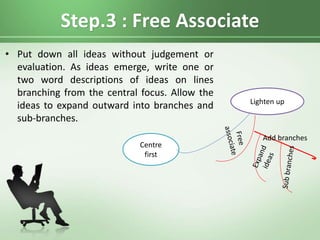
Step.3 : Free Associate
• Put down all ideas without judgement or
evaluation. As ideas emerge, write one or
two word descriptions of ideas on lines
branching from the central focus. Allow the
ideas to expand outward into branches and
sub-branches.
Centre
first
Lighten up
Add branches
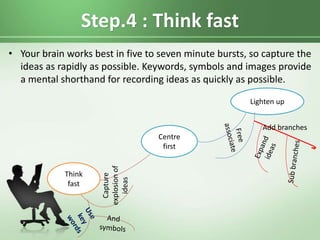
Step.4 : Think fast
• Your brain works best in five to seven minute bursts, so capture the
ideas as rapidly as possible. Keywords, symbols and images provide
a mental shorthand for recording ideas as quickly as possible.
Centre
first
Lighten up
Add branches
Capture
explosionof
ideas
Think
fast
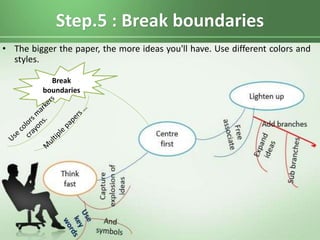
Step.5 : Break boundaries
• The bigger the paper, the more ideas you'll have. Use different colors and
styles.
Break
boundaries
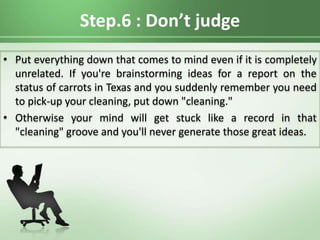
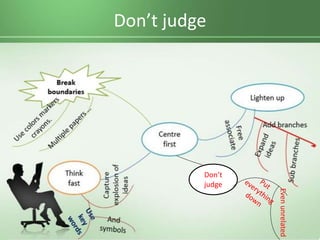
Step.6 : Don’t judge
• Put everything down that comes to mind even if it is completely
unrelated. If you're brainstorming ideas for a report on the
status of carrots in Texas and you suddenly remember you need
to pick-up your cleaning, put down "cleaning."
• Otherwise your mind will get stuck like a record in that
"cleaning" groove and you'll never generate those great ideas.
Don’t judge
Don’t
judge
Evenunrelated
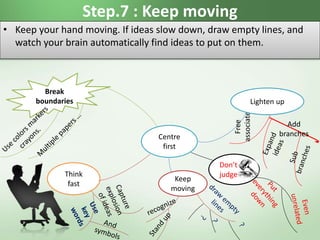
Step.7 : Keep moving
• Keep your hand moving. If ideas slow down, draw empty lines, and
watch your brain automatically find ideas to put on them.
Centre
first
Think
fast
Don’t
judge
Free
associate
Lighten up
Add
branches
Break
boundaries
Keep
moving
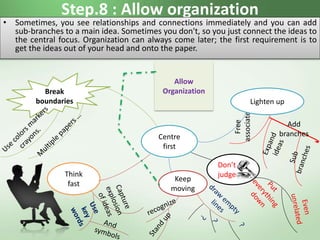
Step.8 : Allow organization
• Sometimes, you see relationships and connections immediately and you can add
sub-branches to a main idea. Sometimes you don't, so you just connect the ideas to
the central focus. Organization can always come later; the first requirement is to
get the ideas out of your head and onto the paper.
Centre
first
Think
fast
Don’t
judge
Free
associate
Lighten up
Add
branches
Break
boundaries
Keep
moving
Allow
Organization
Benefits
 The main benefits of using Mind Maps are the following:
1. The process of creating a mind maps is more interesting
and entertaining than a standard chart or table.
2. Their visual quality permits users to highlight and review
key points easily and more quickly than with standard sets
of notes.
3. They facilitate recall, because the association of ideas,
mirrors the way the brain works.
4. They help groups make sense out of things and help
establish priorities.
Mind Mapping VS. Concept Mapping
• Concept maps - Mind maps differ from concept
maps in that :
• Mind maps focus on only one word or idea,
whereas concept maps connect multiple words or
ideas.
• Also, concept maps typically have text labels on
their connecting lines/arms. Mind maps are
based on tree structures denoting relationships
with a central governing concept, whereas
concept maps are based on connections between
concepts in more diverse patterns.
Mind maps & Nursing process
• The nursing process is a modified scientific method. Nursing
practice was first described as a four stage nursing process by
Ida Jean Orlando in 1958.
• Some authors refer to a mind map as a potential alternative
strategy for organizing care.
• Intuition plays a part for experienced nurses.
• Phases
1 Assessing phase
2 Diagnosing phase
3 Planning phase
4 Implementing phase
5 Evaluating phase
Nursing process : Mind & Concept
Mapping
A concept map or conceptual diagram is a diagram that depicts suggested
relationships between concepts A concept map typically represents ideas
and information as boxes or circles, which it connects with labeled arrows.
The relationship between concepts can be articulated in linking phrases
such as causes, requires, or contributes to.
1. Concept mapping helps nurses organize thoughts and methods.
2. Improve memory and comprehension with concept mapping.
3. Concept mapping for nursing enhances decision making.
4. Use concept mapping software to Develop reports ( electronic health
records).
5. Assessing Patient Needs.
6. Finding Relationships Between Symptoms.
7. Revealing Diagnosis.
8. Care Plans.
Thank you

mind map

  • 2.
    • A mindmap is a diagram used to visually organize information. A mind map is often created around a single concept, drawn as an image in the center of a blank landscape page, to which associated representations of ideas such as images, words and parts of words are added.
  • 3.
    • Mind Mapsare a unique thinking tool that will bring out your natural genius and enable you to shine in every area of your life.
  • 4.
    1. Come upwith innovative ideas and creative solutions? 2. Memorize information and recall it under pressure? 3. Set goals and achieve them? 4. Change career or start up your own venture? 5. Be an excellent time manager? 6. Run meetings with efficiency and ease? 7. Budget and plan to perfection? 8. Deliver excellent presentations with confidence? 9. Have more time for yourself and your family? 10.Enjoy success after success in your life?
  • 5.
    Origins • The term"mind map" was first popularized by British popular psychology author and television personality Tony Buzan. • The use of diagrams that visually "map" information using branching and radial maps traces back centuries. These pictorial methods record knowledge and model systems, and have a long history in learning, brainstorming, memory, visual thinking, and problem solving by educators, engineers, psychologists, and others.
  • 6.
    Historical Examples • Someof the earliest examples of such graphical records were developed by Porphyry of Tyros, a noted thinker of the 3rd century, as he graphically visualized the concept categories of Aristotle. Philosopher Ramon Llull (1235–1315) also used such techniques. • The semantic network was developed in the late 1950s as a theory to understand human learning and developed further by Allan M. Collins and M. Ross Quillian during the early 1960s.
  • 7.
    The process forcreating a mind map can be described in eight steps:
  • 8.
    Step.1 : Centrefirst • Mind mapping begins with a word or image that symbolizes what you want to think about placed in the middle of the page. Centre first
  • 9.
    Step.2 : Lightenup • Start with an open, creative attitude. Let go of the idea of solving the entire problem, or writing a report that everyone will love. This is simply a brain dumping process that helps stimulate new ideas and connections. Centre first Lighten up
  • 10.
    Step.3 : FreeAssociate • Put down all ideas without judgement or evaluation. As ideas emerge, write one or two word descriptions of ideas on lines branching from the central focus. Allow the ideas to expand outward into branches and sub-branches. Centre first Lighten up Add branches
  • 11.
    Step.4 : Thinkfast • Your brain works best in five to seven minute bursts, so capture the ideas as rapidly as possible. Keywords, symbols and images provide a mental shorthand for recording ideas as quickly as possible. Centre first Lighten up Add branches Capture explosionof ideas Think fast
  • 12.
    Step.5 : Breakboundaries • The bigger the paper, the more ideas you'll have. Use different colors and styles. Break boundaries
  • 13.
    Step.6 : Don’tjudge • Put everything down that comes to mind even if it is completely unrelated. If you're brainstorming ideas for a report on the status of carrots in Texas and you suddenly remember you need to pick-up your cleaning, put down "cleaning." • Otherwise your mind will get stuck like a record in that "cleaning" groove and you'll never generate those great ideas.
  • 14.
  • 15.
    Step.7 : Keepmoving • Keep your hand moving. If ideas slow down, draw empty lines, and watch your brain automatically find ideas to put on them. Centre first Think fast Don’t judge Free associate Lighten up Add branches Break boundaries Keep moving
  • 16.
    Step.8 : Alloworganization • Sometimes, you see relationships and connections immediately and you can add sub-branches to a main idea. Sometimes you don't, so you just connect the ideas to the central focus. Organization can always come later; the first requirement is to get the ideas out of your head and onto the paper. Centre first Think fast Don’t judge Free associate Lighten up Add branches Break boundaries Keep moving Allow Organization
  • 18.
    Benefits  The mainbenefits of using Mind Maps are the following: 1. The process of creating a mind maps is more interesting and entertaining than a standard chart or table. 2. Their visual quality permits users to highlight and review key points easily and more quickly than with standard sets of notes. 3. They facilitate recall, because the association of ideas, mirrors the way the brain works. 4. They help groups make sense out of things and help establish priorities.
  • 19.
    Mind Mapping VS.Concept Mapping • Concept maps - Mind maps differ from concept maps in that : • Mind maps focus on only one word or idea, whereas concept maps connect multiple words or ideas. • Also, concept maps typically have text labels on their connecting lines/arms. Mind maps are based on tree structures denoting relationships with a central governing concept, whereas concept maps are based on connections between concepts in more diverse patterns.
  • 20.
    Mind maps &Nursing process • The nursing process is a modified scientific method. Nursing practice was first described as a four stage nursing process by Ida Jean Orlando in 1958. • Some authors refer to a mind map as a potential alternative strategy for organizing care. • Intuition plays a part for experienced nurses. • Phases 1 Assessing phase 2 Diagnosing phase 3 Planning phase 4 Implementing phase 5 Evaluating phase
  • 21.
    Nursing process :Mind & Concept Mapping A concept map or conceptual diagram is a diagram that depicts suggested relationships between concepts A concept map typically represents ideas and information as boxes or circles, which it connects with labeled arrows. The relationship between concepts can be articulated in linking phrases such as causes, requires, or contributes to. 1. Concept mapping helps nurses organize thoughts and methods. 2. Improve memory and comprehension with concept mapping. 3. Concept mapping for nursing enhances decision making. 4. Use concept mapping software to Develop reports ( electronic health records). 5. Assessing Patient Needs. 6. Finding Relationships Between Symptoms. 7. Revealing Diagnosis. 8. Care Plans.
  • 22.

Editor's Notes

  • #23 You can remove this slide if you need. But we will strongly appreciate that you help us to spread the voice and let your colleagues and audience to download our free templates. Here are a free resources: Prepare your presentations: SlideHunter.com lets you download free templates for your presentations. Share online: SlideOnline.com lets you upload presentations for free.