Information - Processing View
(Atkinson Shiffrin)
MULTI STORE MODEL OF MEMORY
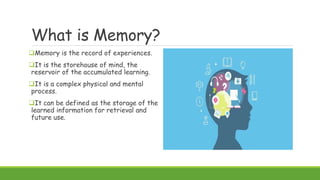
What is Memory?
Memory is the record of experiences.
It is the storehouse of mind, the
reservoir of the accumulated learning.
It is a complex physical and mental
process.
It can be defined as the storage of the
learned information for retrieval and
future use.
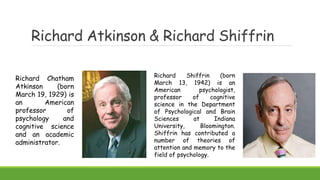
Richard Atkinson & Richard Shiffrin
Richard Shiffrin (born
March 13, 1942) is an
American psychologist,
professor of cognitive
science in the Department
of Psychological and Brain
Sciences at Indiana
University, Bloomington.
Shiffrin has contributed a
number of theories of
attention and memory to the
field of psychology.
Richard Chatham
Atkinson (born
March 19, 1929) is
an American
professor of
psychology and
cognitive science
and an academic
administrator.
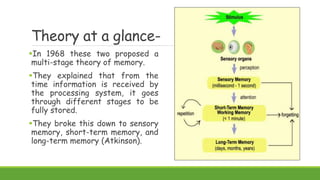
Theory at a glance-
In 1968 these two proposed a
multi-stage theory of memory.
They explained that from the
time information is received by
the processing system, it goes
through different stages to be
fully stored.
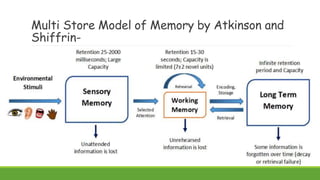
They broke this down to sensory
memory, short-term memory, and
long-term memory (Atkinson).
Information Processing-
The processing of information, typically by a computer or by
an organism, so as to yield new or more useful information.
The human mind’s activity of taking-in, storing and using the
information as and when required.
The whole system is guided by control processes.
Just like the computer, human mind takes in information, performs
operations on to it to change its form and content, stores the
information, retrieves it when needed and generates responses to it.
Defn. of Information Processing-
The model of learning that examines how we learn using the
Mind As A Computer metaphor.
The Information Processing Model represents what
happens when information flows through various internal
structures which are supposed to exist inside the learner.
Three Step Process of Memorizing-
1. Encoding- The processing of information into the memory system.
2. Storage- The retention of encoded material over time.
3. Retrieval- The process of getting the information out of memory
storage for some application.
Multi Store Model of Memory by Atkinson and
Shiffrin-
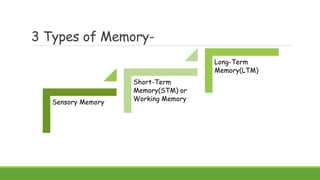
3 Types of Memory-
Sensory Memory
Short-Term
Memory(STM) or
Working Memory
Long-Term
Memory(LTM)
Sensory Memory
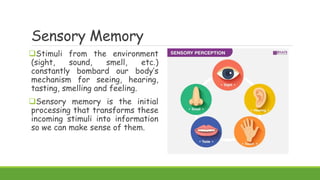
Stimuli from the environment
(sight, sound, smell, etc.)
constantly bombard our body’s
mechanism for seeing, hearing,
tasting, smelling and feeling.
Sensory memory is the initial
processing that transforms these
incoming stimuli into information
so we can make sense of them.
Short-Term Memory(STM) or Working Memory
Short-Term Memory(STM) or Working Memory refers only to the temporary stage
of information in memory.
It just usually means storage, the immediate memory for new information that can
be held for 15-20 seconds.
To retain information in working memory following steps top be followed-
1. Chunking
2. Mnemonic Devices
3. Rehearsal
Forgetting-
Meaning-
Forgetting or disremembering is the apparent loss or modification
of information already encoded and stored in an individual's short or
long-term memory.
It is a spontaneous or gradual process in which old memories are
unable to be recalled from memory storage.
Factors responsible for Forgetting-
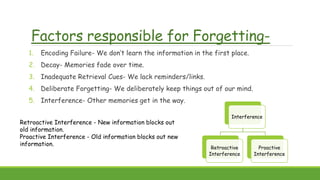
1. Encoding Failure- We don’t learn the information in the first place.
2. Decay- Memories fade over time.
3. Inadequate Retrieval Cues- We lack reminders/links.
4. Deliberate Forgetting- We deliberately keep things out of our mind.
5. Interference- Other memories get in the way.
Interference
Retroactive
Interference
Proactive
Interference
Retroactive Interference - New information blocks out
old information.
Proactive Interference - Old information blocks out new
information.
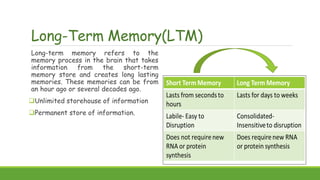
Long-Term Memory(LTM)
Long-term memory refers to the
memory process in the brain that takes
information from the short-term
memory store and creates long lasting
memories. These memories can be from
an hour ago or several decades ago.
Unlimited storehouse of information
Permanent store of information.
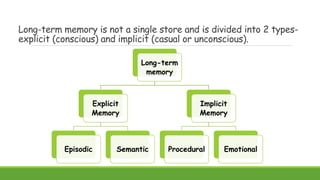
Long-term memory is not a single store and is divided into 2 types-
explicit (conscious) and implicit (casual or unconscious).
Long-term
memory
Explicit
Memory
Episodic Semantic
Implicit
Memory
Procedural Emotional
Explicit and Implicit memory are both types of long-term memory. The information we memorize consciously is known as
explicit memory while the information we store or remember unconsciously is called implicit memory.
Episodic Memory - Episodic memory is responsible for storing information about events (i.e. episodes) that we have
experienced in our lives. It involves conscious thought and is declarative. An example would be a memory of our 1st day at
school. The knowledge that we hold in episodic memory focuses on “knowing that” something is the case (i.e.
declarative). For example, we might have an episodic memory of knowing that we caught the bus to college today.
Semantic Memory - Semantic memory is responsible for storing information about the world. This includes knowledge
about the meaning of words, as well as general knowledge. For example, London is the capital of England. It involves
conscious thought and is declarative. The knowledge that we hold in semantic memory focuses on “knowing that”
something is the case (i.e. declarative). For example, we might have a semantic memory for knowing that Paris is the
capital of France.
Procedural Memory - Procedural memory is responsible for knowing how to do things, i.e., memory of motor skills. It
does not involve conscious (i.e., it’s unconscious-automatic) thought and is not declarative. For example, procedural
memory would involve knowledge of how to ride a bicycle.
Emotional Memory-Emotional memory is shorthand for denoting the memory of experiences that evoked an emotional
reaction.
Types of LTM-
Educational Implications of Multi Store Model of
Memory by Atkinson and Shiffrin-
1. Plan for higher Attention Span.
2. Use attention signals.
3. Keep student’s attention engaged.
4. Respect attention limit.
5. Follow Chunking, Mnemonic Devices and Rehearsal techniques.
6. Help students for effective storage and retrieval.
7. Implicit and Explicit Memory.
8. Take efforts to minimize student’s forgetting.
Criticism of Atkinson Shiffrin View of Learning-
The model is oversimplified, in particular when it suggests that both short-term
and long-term memory each operate in a single, uniform fashion. We now know is
this not the case. It has now become apparent that both short-term and long-term
memory are more complicated that previously thought.
It assumes that each of the stores works as an independent unit.
The model does not explain memory distortion.
The model does not explain why some things may be learned with a minimal amount
of rehearsal.
All the best!!!

Information - Processing View (Atkinson Shiffrin).pptx

  • 1.
    Information - ProcessingView (Atkinson Shiffrin) MULTI STORE MODEL OF MEMORY
  • 2.
    What is Memory? Memoryis the record of experiences. It is the storehouse of mind, the reservoir of the accumulated learning. It is a complex physical and mental process. It can be defined as the storage of the learned information for retrieval and future use.
  • 3.
    Richard Atkinson &Richard Shiffrin Richard Shiffrin (born March 13, 1942) is an American psychologist, professor of cognitive science in the Department of Psychological and Brain Sciences at Indiana University, Bloomington. Shiffrin has contributed a number of theories of attention and memory to the field of psychology. Richard Chatham Atkinson (born March 19, 1929) is an American professor of psychology and cognitive science and an academic administrator.
  • 4.
    Theory at aglance- In 1968 these two proposed a multi-stage theory of memory. They explained that from the time information is received by the processing system, it goes through different stages to be fully stored. They broke this down to sensory memory, short-term memory, and long-term memory (Atkinson).
  • 5.
    Information Processing- The processingof information, typically by a computer or by an organism, so as to yield new or more useful information. The human mind’s activity of taking-in, storing and using the information as and when required. The whole system is guided by control processes. Just like the computer, human mind takes in information, performs operations on to it to change its form and content, stores the information, retrieves it when needed and generates responses to it.
  • 6.
    Defn. of InformationProcessing- The model of learning that examines how we learn using the Mind As A Computer metaphor. The Information Processing Model represents what happens when information flows through various internal structures which are supposed to exist inside the learner.
  • 7.
    Three Step Processof Memorizing- 1. Encoding- The processing of information into the memory system. 2. Storage- The retention of encoded material over time. 3. Retrieval- The process of getting the information out of memory storage for some application.
  • 8.
    Multi Store Modelof Memory by Atkinson and Shiffrin-
  • 9.
    3 Types ofMemory- Sensory Memory Short-Term Memory(STM) or Working Memory Long-Term Memory(LTM)
  • 10.
    Sensory Memory Stimuli fromthe environment (sight, sound, smell, etc.) constantly bombard our body’s mechanism for seeing, hearing, tasting, smelling and feeling. Sensory memory is the initial processing that transforms these incoming stimuli into information so we can make sense of them.
  • 11.
    Short-Term Memory(STM) orWorking Memory Short-Term Memory(STM) or Working Memory refers only to the temporary stage of information in memory. It just usually means storage, the immediate memory for new information that can be held for 15-20 seconds. To retain information in working memory following steps top be followed- 1. Chunking 2. Mnemonic Devices 3. Rehearsal
  • 12.
    Forgetting- Meaning- Forgetting or disrememberingis the apparent loss or modification of information already encoded and stored in an individual's short or long-term memory. It is a spontaneous or gradual process in which old memories are unable to be recalled from memory storage.
  • 13.
    Factors responsible forForgetting- 1. Encoding Failure- We don’t learn the information in the first place. 2. Decay- Memories fade over time. 3. Inadequate Retrieval Cues- We lack reminders/links. 4. Deliberate Forgetting- We deliberately keep things out of our mind. 5. Interference- Other memories get in the way. Interference Retroactive Interference Proactive Interference Retroactive Interference - New information blocks out old information. Proactive Interference - Old information blocks out new information.
  • 14.
    Long-Term Memory(LTM) Long-term memoryrefers to the memory process in the brain that takes information from the short-term memory store and creates long lasting memories. These memories can be from an hour ago or several decades ago. Unlimited storehouse of information Permanent store of information.
  • 15.
    Long-term memory isnot a single store and is divided into 2 types- explicit (conscious) and implicit (casual or unconscious). Long-term memory Explicit Memory Episodic Semantic Implicit Memory Procedural Emotional
  • 16.
    Explicit and Implicitmemory are both types of long-term memory. The information we memorize consciously is known as explicit memory while the information we store or remember unconsciously is called implicit memory. Episodic Memory - Episodic memory is responsible for storing information about events (i.e. episodes) that we have experienced in our lives. It involves conscious thought and is declarative. An example would be a memory of our 1st day at school. The knowledge that we hold in episodic memory focuses on “knowing that” something is the case (i.e. declarative). For example, we might have an episodic memory of knowing that we caught the bus to college today. Semantic Memory - Semantic memory is responsible for storing information about the world. This includes knowledge about the meaning of words, as well as general knowledge. For example, London is the capital of England. It involves conscious thought and is declarative. The knowledge that we hold in semantic memory focuses on “knowing that” something is the case (i.e. declarative). For example, we might have a semantic memory for knowing that Paris is the capital of France. Procedural Memory - Procedural memory is responsible for knowing how to do things, i.e., memory of motor skills. It does not involve conscious (i.e., it’s unconscious-automatic) thought and is not declarative. For example, procedural memory would involve knowledge of how to ride a bicycle. Emotional Memory-Emotional memory is shorthand for denoting the memory of experiences that evoked an emotional reaction. Types of LTM-
  • 17.
    Educational Implications ofMulti Store Model of Memory by Atkinson and Shiffrin- 1. Plan for higher Attention Span. 2. Use attention signals. 3. Keep student’s attention engaged. 4. Respect attention limit. 5. Follow Chunking, Mnemonic Devices and Rehearsal techniques. 6. Help students for effective storage and retrieval. 7. Implicit and Explicit Memory. 8. Take efforts to minimize student’s forgetting.
  • 18.
    Criticism of AtkinsonShiffrin View of Learning- The model is oversimplified, in particular when it suggests that both short-term and long-term memory each operate in a single, uniform fashion. We now know is this not the case. It has now become apparent that both short-term and long-term memory are more complicated that previously thought. It assumes that each of the stores works as an independent unit. The model does not explain memory distortion. The model does not explain why some things may be learned with a minimal amount of rehearsal.
  • 19.