Dr. Rakhesh Singh Kshetrimayum
2. Electrostatics
Dr. Rakhesh Singh Kshetrimayum
8/11/20141 Electromagnetic FieldTheory by R. S. Kshetrimayum
2.1 Introduction
• In this chapter, we will study
• how to find the electrostatic fields for various cases?
• for symmetric known charge distribution
• for un-symmetric known charge distribution
• when electric potential, etc.
• what is the energy density of electrostatic fields?
8/11/2014Electromagnetic FieldTheory by R. S. Kshetrimayum2
• what is the energy density of electrostatic fields?
• how does electrostatic fields behave at a media interface?
• We will start with Coulomb’s law and discuss how to find
electric fields?
What is Coulomb’s law?
It is an experimental law
2.2 Coulomb’s law and electric field
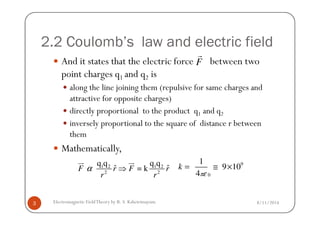
And it states that the electric force between two
point charges q1 and q2 is
along the line joining them (repulsive for same charges and
attractive for opposite charges)
directly proportional to the product q1 and q2
F
r
8/11/2014Electromagnetic FieldTheory by R. S. Kshetrimayum3
directly proportional to the product q1 and q2
inversely proportional to the square of distance r between
them
Mathematically,
1 2 1 2
2 2
q q q q
ˆ ˆ= kF r F r
r r
α ⇒
ur ur 9
0
1
9 10
4
k
πε
= ≅ ×
2.2 Coulomb’s law and electric field
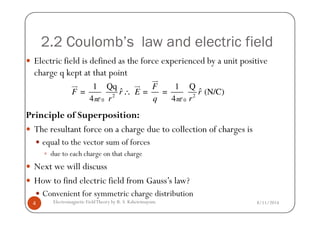
Electric field is defined as the force experienced by a unit positive
charge q kept at that point
Principle of Superposition:
2 2
0 0
1 Qq 1 Q
ˆ ˆ= = = (N/C)
4 4
F
F r E r
r q rπ πε ε
∴
ur
ur ur
8/11/2014Electromagnetic FieldTheory by R. S. Kshetrimayum4
Principle of Superposition:
The resultant force on a charge due to collection of charges is
equal to the vector sum of forces
due to each charge on that charge
Next we will discuss
How to find electric field from Gauss’s law?
Convenient for symmetric charge distribution
2.3 Electric flux and Gauss’s law
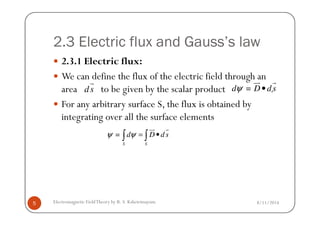
2.3.1 Electric flux:
We can define the flux of the electric field through an
area to be given by the scalar product .
For any arbitrary surface S, the flux is obtained by
integrating over all the surface elements
ds
r
=d D dsψ •
ur r
8/11/2014Electromagnetic FieldTheory by R. S. Kshetrimayum5
integrating over all the surface elements
=
S S
d D dsψ ψ = •∫ ∫
ur r
2.3 Electric flux and Gauss’s law
enclosed
S
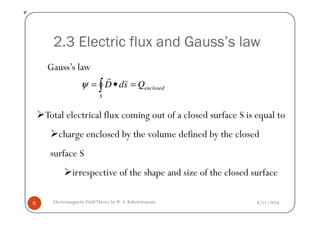
QsdD =•= ∫
vr
ψ
ψ
Total electrical flux coming out of a closed surface S is equal to
Gauss’s law
8/11/2014Electromagnetic FieldTheory by R. S. Kshetrimayum6
Total electrical flux coming out of a closed surface S is equal to
charge enclosed by the volume defined by the closed
surface S
irrespective of the shape and size of the closed surface
2.3 Electric flux and Gauss’s law
( ) dvQdvDsdD
V
enclosed
VS
∫∫∫ ==•∇=•= ρψ
rvr
ψ
Since it is true for any arbitrary volume, we may equate the two
integrands and write,
Applying divergence theorem,
8/11/2014Electromagnetic FieldTheory by R. S. Kshetrimayum7
integrands and write,
Next we will discuss
How to find electric field from electric potential?
Easier since electric potential is a scalar quantity
0
= =D E
ρ
ρ
ε
∇ • ⇒ ∇ •
r r
[First law of Maxwell’s Equations]
2.4 Electric potential
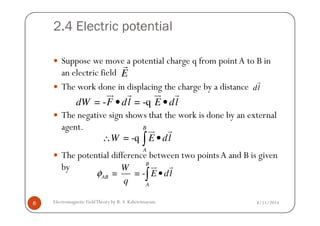
Suppose we move a potential charge q from point A to B in
an electric field
The work done in displacing the charge by a distance
The negative sign shows that the work is done by an external
E
r
dl
r
= - = -qdW F dl E dl• •
ur r ur r
8/11/2014Electromagnetic FieldTheory by R. S. Kshetrimayum8
The negative sign shows that the work is done by an external
agent.
The potential difference between two pointsA and B is given
by
= -q
B
A
W E dl∴ •∫
ur r
= = -
B
AB
A
W
E dl
q
φ •∫
ur r
2.4 Electric potential
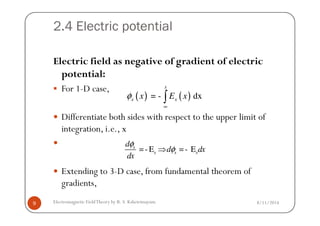
Electric field as negative of gradient of electric
potential:
For 1-D case,
Differentiate both sides with respect to the upper limit of
( ) ( )= - dx
x
x xx E xφ
∞
∫
8/11/2014Electromagnetic FieldTheory by R. S. Kshetrimayum9
Differentiate both sides with respect to the upper limit of
integration, i.e., x
Extending to 3-D case, from fundamental theorem of
gradients,
=- E =- Ex
x x x
d
d dx
dx
φ
φ⇒
2.4 Electric potential
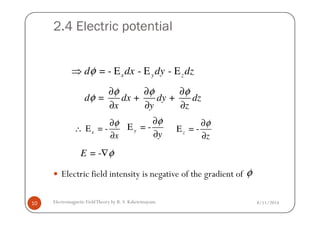
= - E - E - Ex y zd dx dy dzφ⇒
= + +d dx dy dz
x y z
φ φ φ
φ
∂ ∂ ∂
∂ ∂ ∂
8/11/2014Electromagnetic FieldTheory by R. S. Kshetrimayum10
Electric field intensity is negative of the gradient of
E = -x
x
φ∂
∴
∂
E = -y
y
φ∂
∂
E = -z
z
φ∂
∂
= -E φ∇
φ
2.4 Electric potential
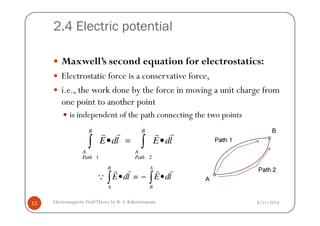
Maxwell’s second equation for electrostatics:
Electrostatic force is a conservative force,
i.e., the work done by the force in moving a unit charge from
one point to another point
is independent of the path connecting the two points
8/11/2014Electromagnetic FieldTheory by R. S. Kshetrimayum11
is independent of the path connecting the two points
1 2
B B
A A
Path Path
E dl E dl• = •∫ ∫
r rr r
=
B A
A B
E dl E dl• − •∫ ∫
r rr r
Q
2.4 Electric potential
1 2
+ 0
B A
A B
Path Path
E dl E dl∴ • • =∫ ∫
r rr r
∫ =•⇒ 0ldE
rr
8/11/2014Electromagnetic FieldTheory by R. S. Kshetrimayum12
Applying Stoke’s theorem, we have,
∫
( )∫ ∫ =•×∇=•⇒ 0sdEldE
rrrr
0=×∇ E
r [Second law of Maxwell’s
Equations for electrostatics]
2.5 Boundary value problems for
electrostatic fields
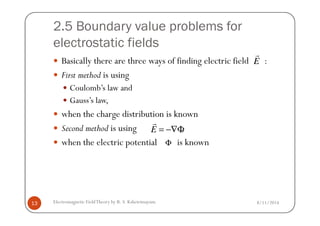
Basically there are three ways of finding electric field :
First method is using
Coulomb’s law and
Gauss’s law,
when the charge distribution is known
E
r
8/11/2014Electromagnetic FieldTheory by R. S. Kshetrimayum13
when the charge distribution is known
Second method is using ,
when the electric potential is known
E = −∇Φ
r
Φ
2.5 Boundary value problems for
electrostatic fields
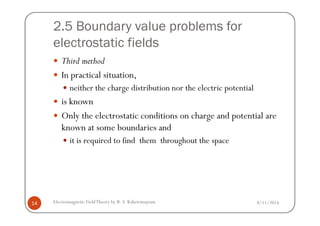
Third method
In practical situation,
neither the charge distribution nor the electric potential
is known
Only the electrostatic conditions on charge and potential are
8/11/2014Electromagnetic FieldTheory by R. S. Kshetrimayum14
Only the electrostatic conditions on charge and potential are
known at some boundaries and
it is required to find them throughout the space
2.5 Boundary value problems for
electrostatic fields
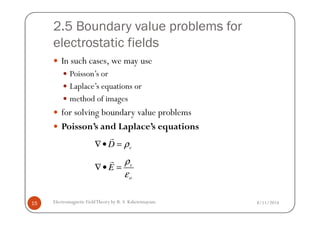
In such cases, we may use
Poisson’s or
Laplace’s equations or
method of images
for solving boundary value problems
8/11/2014Electromagnetic FieldTheory by R. S. Kshetrimayum15
for solving boundary value problems
Poisson’s and Laplace’s equations
vD ρ∇• =
r
v
o
E
ρ
ε
∇• =
r
2.5 Boundary value problems for
electrostatic fields
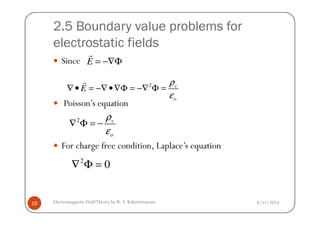
Since
Poisson’s equation
E = −∇Φ
r
2 v
o
E
ρ
ε
∇ • = −∇ •∇Φ = −∇ Φ =
r
ρ
8/11/2014Electromagnetic FieldTheory by R. S. Kshetrimayum16
For charge free condition, Laplace’s equation
2 v
o
ρ
ε
∇ Φ = −
2
0∇ Φ =
2.5 Boundary value problems for
electrostatic fields
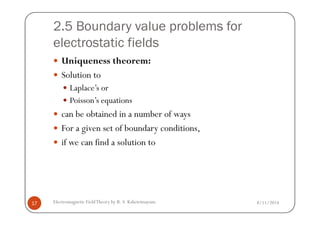
Uniqueness theorem:
Solution to
Laplace’s or
Poisson’s equations
can be obtained in a number of ways
8/11/2014Electromagnetic FieldTheory by R. S. Kshetrimayum17
can be obtained in a number of ways
For a given set of boundary conditions,
if we can find a solution to
2.5 Boundary value problems for
electrostatic fields
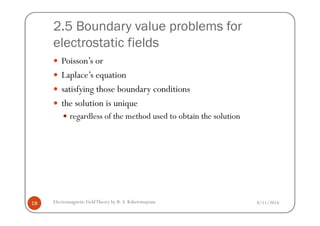
Poisson’s or
Laplace’s equation
satisfying those boundary conditions
the solution is unique
regardless of the method used to obtain the solution
8/11/2014Electromagnetic FieldTheory by R. S. Kshetrimayum18
regardless of the method used to obtain the solution
2.5 Boundary value problems for
electrostatic fields
Procedure for solving Poisson’s or Laplace’s
equation:
Solve the
Laplace’s or
Poisson’s equation
8/11/2014Electromagnetic FieldTheory by R. S. Kshetrimayum19
Poisson’s equation
using either direct integration
where is a function of one variableΦ
2.5 Boundary value problems for
electrostatic fields
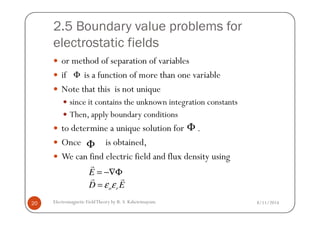
or method of separation of variables
if is a function of more than one variable
Note that this is not unique
since it contains the unknown integration constants
Then, apply boundary conditions
Φ
8/11/2014Electromagnetic FieldTheory by R. S. Kshetrimayum20
Then, apply boundary conditions
to determine a unique solution for .
Once is obtained,
We can find electric field and flux density using
Φ
Φ
E = −∇Φ
r
o rD Eε ε=
r r
2.5 Boundary value problems for
electrostatic fields
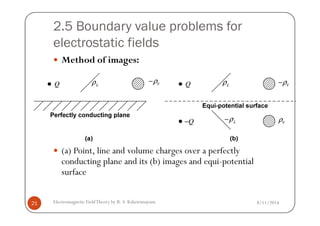
Method of images:
Q QLρ LρVρ− Vρ−
8/11/2014Electromagnetic FieldTheory by R. S. Kshetrimayum21
(a) Point, line and volume charges over a perfectly
conducting plane and its (b) images and equi-potential
surface
Q− Lρ− Vρ
2.5 Boundary value problems for
electrostatic fields
commonly used to find
electric potential,
field and
flux density
due to charges in presence of conductors
8/11/2014Electromagnetic FieldTheory by R. S. Kshetrimayum22
due to charges in presence of conductors
2.5 Boundary value problems for
electrostatic fields
States that given a charge configuration above an infinite
grounded perfect conducting plane
may be replaced by the
charge configuration itself,
its image and
8/11/2014Electromagnetic FieldTheory by R. S. Kshetrimayum23
its image and
an equipotential surface
A surface in which potential is same is known as
equipotential surface
For a point charge the equipotential surfaces are spheres
2.5 Boundary value problems for
electrostatic fields
In applying image method,
two conditions must always be satisfied:
The image charges must be located within conducting region
and
8/11/2014Electromagnetic FieldTheory by R. S. Kshetrimayum24
and
the image charge must be located such that on conducting
surface S,
the potential is zero or constant
2.5 Boundary value problems for
electrostatic fields
For instance,
Suppose a point charge q is held at a distance d above an
infinite ground plane
What is the potential above the plane?
8/11/2014Electromagnetic FieldTheory by R. S. Kshetrimayum25
What is the potential above the plane?
Note that the image method doesn’t give correct potential
inside the conductor
It gives correct values for potential above the conductor only
2.6 Electrostatic energy
Assume all charges were at infinity initially,
then, we bring them one by one and fix them in different
positions
To find the energy present in an assembly of charges,
we must first find the amount of work necessary to assemble
8/11/2014Electromagnetic FieldTheory by R. S. Kshetrimayum26
we must first find the amount of work necessary to assemble
them
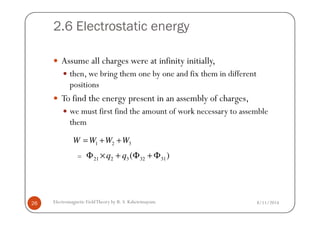
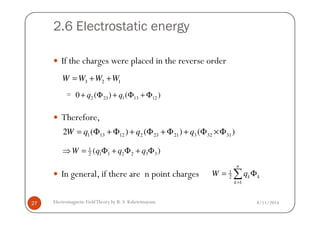
1 2 3W W W W= + +
21 2 3 32 31( )q qΦ × + Φ + Φ=
2.6 Electrostatic energy
If the charges were placed in the reverse order
Therefore,
3 2 1W W W W= + +
2 23 1 13 120 ( ) ( )q q+ Φ + Φ + Φ=
8/11/2014Electromagnetic FieldTheory by R. S. Kshetrimayum27
Therefore,
In general, if there are n point charges
1
1 1 2 2 3 32 ( )W q q q⇒ = Φ + Φ + Φ
1 13 12 2 23 21 3 32 312 ( ) ( ) ( )W q q q= Φ + Φ + Φ + Φ + Φ ×Φ
1
2
1
n
k k
k
W q
=
= Φ∑
2.6 Electrostatic energy
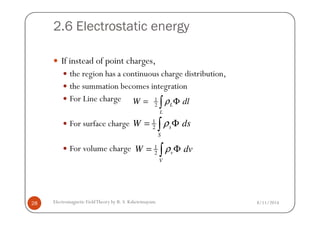
If instead of point charges,
the region has a continuous charge distribution,
the summation becomes integration
For Line charge 1
2 L
L
W dlρ= Φ∫
8/11/2014Electromagnetic FieldTheory by R. S. Kshetrimayum28
For surface charge
For volume charge
L
1
2 s
S
W dsρ= Φ∫
1
2 v
V
W dvρ= Φ∫
2.6 Electrostatic energy
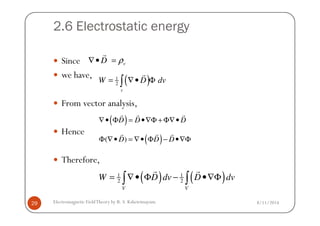
Since
we have,
From vector analysis,
vD ρ∇• =
r
( )1
2
v
W D dv= ∇• Φ∫
r
8/11/2014Electromagnetic FieldTheory by R. S. Kshetrimayum29
Hence
Therefore,
( )D D D∇• Φ = •∇Φ + Φ∇•
r r r
( )( )D D DΦ ∇• = ∇• Φ − •∇Φ
r r r
( ) ( )1 1
2 2
V V
W D dv D dv= ∇• Φ − •∇Φ∫ ∫
r r
2.6 Electrostatic energy
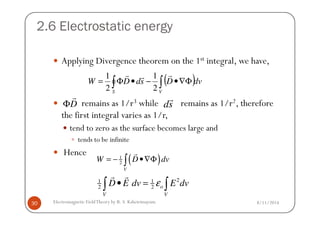
Applying Divergence theorem on the 1st integral, we have,
remains as 1/r3 while remains as 1/r2, therefore
the first integral varies as 1/r,
( )dvDsdDW
VS
∫∫ Φ∇•−•Φ=
rrr
2
1
2
1
D
r
Φ sd
r
8/11/2014Electromagnetic FieldTheory by R. S. Kshetrimayum30
the first integral varies as 1/r,
tend to zero as the surface becomes large and
tends to be infinite
Hence
( )1
2
V
W D dv= − •∇Φ∫
r
21 1
2 2 o
V V
D E dv E dvε• =∫ ∫
r r
2.6 Electrostatic energy
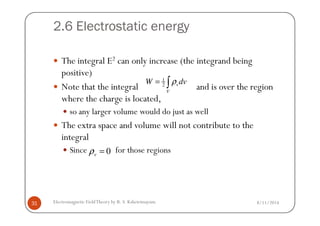
The integral E2 can only increase (the integrand being
positive)
Note that the integral and is over the region
where the charge is located,
so any larger volume would do just as well
1
2 v
V
W dvρ= ∫
8/11/2014Electromagnetic FieldTheory by R. S. Kshetrimayum31
so any larger volume would do just as well
The extra space and volume will not contribute to the
integral
Since for those regions0=vρ
2.6 Electrostatic energy
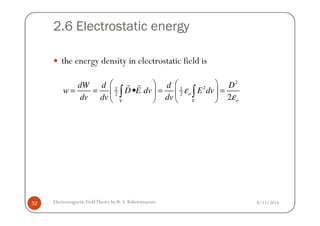
the energy density in electrostatic field is
2
21 1
2 2
2
o
oV V
dW d d D
w D E dv E dv
dv dv dv
ε
ε
   
= = • = =   
   
∫ ∫
r r
8/11/2014Electromagnetic FieldTheory by R. S. Kshetrimayum32
2.7 Boundary conditions for electrostatic
fields
Two theorems or
Maxwell’s first and
second equations in integral form
are sufficient to find the boundary conditions
2.7.1 Boundary conditions for electric field
8/11/2014Electromagnetic FieldTheory by R. S. Kshetrimayum33
2.7.1 Boundary conditions for electric field
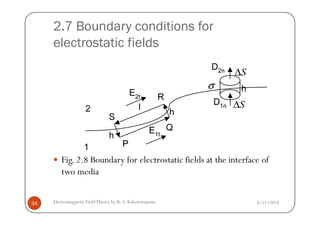
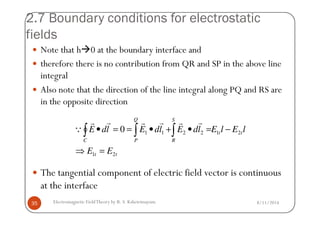
Let us consider the small rectangular contour PQRSP (see
Fig. 2.8
l is chosen such that E1t and E2t are constant along this
length
2.7 Boundary conditions for
electrostatic fields
S∆
S∆
σ
8/11/2014Electromagnetic FieldTheory by R. S. Kshetrimayum34
Fig. 2.8 Boundary for electrostatic fields at the interface of
two media
2.7 Boundary conditions for electrostatic
fields
Note that h 0 at the boundary interface and
therefore there is no contribution from QR and SP in the above line
integral
Also note that the direction of the line integral along PQ and RS are
in the opposite direction
8/11/2014Electromagnetic FieldTheory by R. S. Kshetrimayum35
The tangential component of electric field vector is continuous
at the interface
tt
tt
C
S
R
Q
P
EE
lElEldEldEldE
21
2122110
=⇒
−=•+•==•∫ ∫∫
rrrrrr
Q
2.7 Boundary conditions for
electrostatic fields
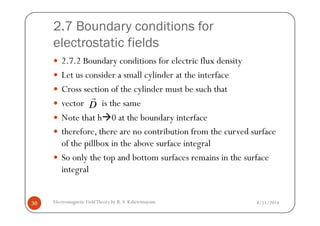
2.7.2 Boundary conditions for electric flux density
Let us consider a small cylinder at the interface
Cross section of the cylinder must be such that
vector is the same
Note that h 0 at the boundary interface
D
r
8/11/2014Electromagnetic FieldTheory by R. S. Kshetrimayum36
Note that h 0 at the boundary interface
therefore, there are no contribution from the curved surface
of the pillbox in the above surface integral
So only the top and bottom surfaces remains in the surface
integral
2.7 Boundary conditions for
electrostatic fields
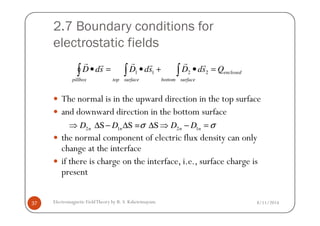
The normal is in the upward direction in the top surface
and downward direction in the bottom surface
∫∫∫ =•+•=•
surfacebottom
enclosed
surfacetoppillbox
QsdDsdDsdD 2211
rrrrrr
8/11/2014Electromagnetic FieldTheory by R. S. Kshetrimayum37
and downward direction in the bottom surface
the normal component of electric flux density can only
change at the interface
if there is charge on the interface, i.e., surface charge is
present
2 1 2 1S S = Sn n n nD D D Dσ σ⇒ ∆ − ∆ ∆ ⇒ − =
2.7 Boundary conditions for
electrostatic fields
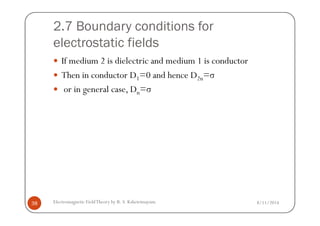
If medium 2 is dielectric and medium 1 is conductor
Then in conductor D1=0 and hence D2n=σ
or in general case, Dn=σ
8/11/2014Electromagnetic FieldTheory by R. S. Kshetrimayum38

2 slides

  • 1.
    Dr. Rakhesh SinghKshetrimayum 2. Electrostatics Dr. Rakhesh Singh Kshetrimayum 8/11/20141 Electromagnetic FieldTheory by R. S. Kshetrimayum
  • 2.
    2.1 Introduction • Inthis chapter, we will study • how to find the electrostatic fields for various cases? • for symmetric known charge distribution • for un-symmetric known charge distribution • when electric potential, etc. • what is the energy density of electrostatic fields? 8/11/2014Electromagnetic FieldTheory by R. S. Kshetrimayum2 • what is the energy density of electrostatic fields? • how does electrostatic fields behave at a media interface? • We will start with Coulomb’s law and discuss how to find electric fields? What is Coulomb’s law? It is an experimental law
  • 3.
    2.2 Coulomb’s lawand electric field And it states that the electric force between two point charges q1 and q2 is along the line joining them (repulsive for same charges and attractive for opposite charges) directly proportional to the product q1 and q2 F r 8/11/2014Electromagnetic FieldTheory by R. S. Kshetrimayum3 directly proportional to the product q1 and q2 inversely proportional to the square of distance r between them Mathematically, 1 2 1 2 2 2 q q q q ˆ ˆ= kF r F r r r α ⇒ ur ur 9 0 1 9 10 4 k πε = ≅ ×
  • 4.
    2.2 Coulomb’s lawand electric field Electric field is defined as the force experienced by a unit positive charge q kept at that point Principle of Superposition: 2 2 0 0 1 Qq 1 Q ˆ ˆ= = = (N/C) 4 4 F F r E r r q rπ πε ε ∴ ur ur ur 8/11/2014Electromagnetic FieldTheory by R. S. Kshetrimayum4 Principle of Superposition: The resultant force on a charge due to collection of charges is equal to the vector sum of forces due to each charge on that charge Next we will discuss How to find electric field from Gauss’s law? Convenient for symmetric charge distribution
  • 5.
    2.3 Electric fluxand Gauss’s law 2.3.1 Electric flux: We can define the flux of the electric field through an area to be given by the scalar product . For any arbitrary surface S, the flux is obtained by integrating over all the surface elements ds r =d D dsψ • ur r 8/11/2014Electromagnetic FieldTheory by R. S. Kshetrimayum5 integrating over all the surface elements = S S d D dsψ ψ = •∫ ∫ ur r
  • 6.
    2.3 Electric fluxand Gauss’s law enclosed S QsdD =•= ∫ vr ψ ψ Total electrical flux coming out of a closed surface S is equal to Gauss’s law 8/11/2014Electromagnetic FieldTheory by R. S. Kshetrimayum6 Total electrical flux coming out of a closed surface S is equal to charge enclosed by the volume defined by the closed surface S irrespective of the shape and size of the closed surface
  • 7.
    2.3 Electric fluxand Gauss’s law ( ) dvQdvDsdD V enclosed VS ∫∫∫ ==•∇=•= ρψ rvr ψ Since it is true for any arbitrary volume, we may equate the two integrands and write, Applying divergence theorem, 8/11/2014Electromagnetic FieldTheory by R. S. Kshetrimayum7 integrands and write, Next we will discuss How to find electric field from electric potential? Easier since electric potential is a scalar quantity 0 = =D E ρ ρ ε ∇ • ⇒ ∇ • r r [First law of Maxwell’s Equations]
  • 8.
    2.4 Electric potential Supposewe move a potential charge q from point A to B in an electric field The work done in displacing the charge by a distance The negative sign shows that the work is done by an external E r dl r = - = -qdW F dl E dl• • ur r ur r 8/11/2014Electromagnetic FieldTheory by R. S. Kshetrimayum8 The negative sign shows that the work is done by an external agent. The potential difference between two pointsA and B is given by = -q B A W E dl∴ •∫ ur r = = - B AB A W E dl q φ •∫ ur r
  • 9.
    2.4 Electric potential Electricfield as negative of gradient of electric potential: For 1-D case, Differentiate both sides with respect to the upper limit of ( ) ( )= - dx x x xx E xφ ∞ ∫ 8/11/2014Electromagnetic FieldTheory by R. S. Kshetrimayum9 Differentiate both sides with respect to the upper limit of integration, i.e., x Extending to 3-D case, from fundamental theorem of gradients, =- E =- Ex x x x d d dx dx φ φ⇒
  • 10.
    2.4 Electric potential =- E - E - Ex y zd dx dy dzφ⇒ = + +d dx dy dz x y z φ φ φ φ ∂ ∂ ∂ ∂ ∂ ∂ 8/11/2014Electromagnetic FieldTheory by R. S. Kshetrimayum10 Electric field intensity is negative of the gradient of E = -x x φ∂ ∴ ∂ E = -y y φ∂ ∂ E = -z z φ∂ ∂ = -E φ∇ φ
  • 11.
    2.4 Electric potential Maxwell’ssecond equation for electrostatics: Electrostatic force is a conservative force, i.e., the work done by the force in moving a unit charge from one point to another point is independent of the path connecting the two points 8/11/2014Electromagnetic FieldTheory by R. S. Kshetrimayum11 is independent of the path connecting the two points 1 2 B B A A Path Path E dl E dl• = •∫ ∫ r rr r = B A A B E dl E dl• − •∫ ∫ r rr r Q
  • 12.
    2.4 Electric potential 12 + 0 B A A B Path Path E dl E dl∴ • • =∫ ∫ r rr r ∫ =•⇒ 0ldE rr 8/11/2014Electromagnetic FieldTheory by R. S. Kshetrimayum12 Applying Stoke’s theorem, we have, ∫ ( )∫ ∫ =•×∇=•⇒ 0sdEldE rrrr 0=×∇ E r [Second law of Maxwell’s Equations for electrostatics]
  • 13.
    2.5 Boundary valueproblems for electrostatic fields Basically there are three ways of finding electric field : First method is using Coulomb’s law and Gauss’s law, when the charge distribution is known E r 8/11/2014Electromagnetic FieldTheory by R. S. Kshetrimayum13 when the charge distribution is known Second method is using , when the electric potential is known E = −∇Φ r Φ
  • 14.
    2.5 Boundary valueproblems for electrostatic fields Third method In practical situation, neither the charge distribution nor the electric potential is known Only the electrostatic conditions on charge and potential are 8/11/2014Electromagnetic FieldTheory by R. S. Kshetrimayum14 Only the electrostatic conditions on charge and potential are known at some boundaries and it is required to find them throughout the space
  • 15.
    2.5 Boundary valueproblems for electrostatic fields In such cases, we may use Poisson’s or Laplace’s equations or method of images for solving boundary value problems 8/11/2014Electromagnetic FieldTheory by R. S. Kshetrimayum15 for solving boundary value problems Poisson’s and Laplace’s equations vD ρ∇• = r v o E ρ ε ∇• = r
  • 16.
    2.5 Boundary valueproblems for electrostatic fields Since Poisson’s equation E = −∇Φ r 2 v o E ρ ε ∇ • = −∇ •∇Φ = −∇ Φ = r ρ 8/11/2014Electromagnetic FieldTheory by R. S. Kshetrimayum16 For charge free condition, Laplace’s equation 2 v o ρ ε ∇ Φ = − 2 0∇ Φ =
  • 17.
    2.5 Boundary valueproblems for electrostatic fields Uniqueness theorem: Solution to Laplace’s or Poisson’s equations can be obtained in a number of ways 8/11/2014Electromagnetic FieldTheory by R. S. Kshetrimayum17 can be obtained in a number of ways For a given set of boundary conditions, if we can find a solution to
  • 18.
    2.5 Boundary valueproblems for electrostatic fields Poisson’s or Laplace’s equation satisfying those boundary conditions the solution is unique regardless of the method used to obtain the solution 8/11/2014Electromagnetic FieldTheory by R. S. Kshetrimayum18 regardless of the method used to obtain the solution
  • 19.
    2.5 Boundary valueproblems for electrostatic fields Procedure for solving Poisson’s or Laplace’s equation: Solve the Laplace’s or Poisson’s equation 8/11/2014Electromagnetic FieldTheory by R. S. Kshetrimayum19 Poisson’s equation using either direct integration where is a function of one variableΦ
  • 20.
    2.5 Boundary valueproblems for electrostatic fields or method of separation of variables if is a function of more than one variable Note that this is not unique since it contains the unknown integration constants Then, apply boundary conditions Φ 8/11/2014Electromagnetic FieldTheory by R. S. Kshetrimayum20 Then, apply boundary conditions to determine a unique solution for . Once is obtained, We can find electric field and flux density using Φ Φ E = −∇Φ r o rD Eε ε= r r
  • 21.
    2.5 Boundary valueproblems for electrostatic fields Method of images: Q QLρ LρVρ− Vρ− 8/11/2014Electromagnetic FieldTheory by R. S. Kshetrimayum21 (a) Point, line and volume charges over a perfectly conducting plane and its (b) images and equi-potential surface Q− Lρ− Vρ
  • 22.
    2.5 Boundary valueproblems for electrostatic fields commonly used to find electric potential, field and flux density due to charges in presence of conductors 8/11/2014Electromagnetic FieldTheory by R. S. Kshetrimayum22 due to charges in presence of conductors
  • 23.
    2.5 Boundary valueproblems for electrostatic fields States that given a charge configuration above an infinite grounded perfect conducting plane may be replaced by the charge configuration itself, its image and 8/11/2014Electromagnetic FieldTheory by R. S. Kshetrimayum23 its image and an equipotential surface A surface in which potential is same is known as equipotential surface For a point charge the equipotential surfaces are spheres
  • 24.
    2.5 Boundary valueproblems for electrostatic fields In applying image method, two conditions must always be satisfied: The image charges must be located within conducting region and 8/11/2014Electromagnetic FieldTheory by R. S. Kshetrimayum24 and the image charge must be located such that on conducting surface S, the potential is zero or constant
  • 25.
    2.5 Boundary valueproblems for electrostatic fields For instance, Suppose a point charge q is held at a distance d above an infinite ground plane What is the potential above the plane? 8/11/2014Electromagnetic FieldTheory by R. S. Kshetrimayum25 What is the potential above the plane? Note that the image method doesn’t give correct potential inside the conductor It gives correct values for potential above the conductor only
  • 26.
    2.6 Electrostatic energy Assumeall charges were at infinity initially, then, we bring them one by one and fix them in different positions To find the energy present in an assembly of charges, we must first find the amount of work necessary to assemble 8/11/2014Electromagnetic FieldTheory by R. S. Kshetrimayum26 we must first find the amount of work necessary to assemble them 1 2 3W W W W= + + 21 2 3 32 31( )q qΦ × + Φ + Φ=
  • 27.
    2.6 Electrostatic energy Ifthe charges were placed in the reverse order Therefore, 3 2 1W W W W= + + 2 23 1 13 120 ( ) ( )q q+ Φ + Φ + Φ= 8/11/2014Electromagnetic FieldTheory by R. S. Kshetrimayum27 Therefore, In general, if there are n point charges 1 1 1 2 2 3 32 ( )W q q q⇒ = Φ + Φ + Φ 1 13 12 2 23 21 3 32 312 ( ) ( ) ( )W q q q= Φ + Φ + Φ + Φ + Φ ×Φ 1 2 1 n k k k W q = = Φ∑
  • 28.
    2.6 Electrostatic energy Ifinstead of point charges, the region has a continuous charge distribution, the summation becomes integration For Line charge 1 2 L L W dlρ= Φ∫ 8/11/2014Electromagnetic FieldTheory by R. S. Kshetrimayum28 For surface charge For volume charge L 1 2 s S W dsρ= Φ∫ 1 2 v V W dvρ= Φ∫
  • 29.
    2.6 Electrostatic energy Since wehave, From vector analysis, vD ρ∇• = r ( )1 2 v W D dv= ∇• Φ∫ r 8/11/2014Electromagnetic FieldTheory by R. S. Kshetrimayum29 Hence Therefore, ( )D D D∇• Φ = •∇Φ + Φ∇• r r r ( )( )D D DΦ ∇• = ∇• Φ − •∇Φ r r r ( ) ( )1 1 2 2 V V W D dv D dv= ∇• Φ − •∇Φ∫ ∫ r r
  • 30.
    2.6 Electrostatic energy ApplyingDivergence theorem on the 1st integral, we have, remains as 1/r3 while remains as 1/r2, therefore the first integral varies as 1/r, ( )dvDsdDW VS ∫∫ Φ∇•−•Φ= rrr 2 1 2 1 D r Φ sd r 8/11/2014Electromagnetic FieldTheory by R. S. Kshetrimayum30 the first integral varies as 1/r, tend to zero as the surface becomes large and tends to be infinite Hence ( )1 2 V W D dv= − •∇Φ∫ r 21 1 2 2 o V V D E dv E dvε• =∫ ∫ r r
  • 31.
    2.6 Electrostatic energy Theintegral E2 can only increase (the integrand being positive) Note that the integral and is over the region where the charge is located, so any larger volume would do just as well 1 2 v V W dvρ= ∫ 8/11/2014Electromagnetic FieldTheory by R. S. Kshetrimayum31 so any larger volume would do just as well The extra space and volume will not contribute to the integral Since for those regions0=vρ
  • 32.
    2.6 Electrostatic energy theenergy density in electrostatic field is 2 21 1 2 2 2 o oV V dW d d D w D E dv E dv dv dv dv ε ε     = = • = =        ∫ ∫ r r 8/11/2014Electromagnetic FieldTheory by R. S. Kshetrimayum32
  • 33.
    2.7 Boundary conditionsfor electrostatic fields Two theorems or Maxwell’s first and second equations in integral form are sufficient to find the boundary conditions 2.7.1 Boundary conditions for electric field 8/11/2014Electromagnetic FieldTheory by R. S. Kshetrimayum33 2.7.1 Boundary conditions for electric field Let us consider the small rectangular contour PQRSP (see Fig. 2.8 l is chosen such that E1t and E2t are constant along this length
  • 34.
    2.7 Boundary conditionsfor electrostatic fields S∆ S∆ σ 8/11/2014Electromagnetic FieldTheory by R. S. Kshetrimayum34 Fig. 2.8 Boundary for electrostatic fields at the interface of two media
  • 35.
    2.7 Boundary conditionsfor electrostatic fields Note that h 0 at the boundary interface and therefore there is no contribution from QR and SP in the above line integral Also note that the direction of the line integral along PQ and RS are in the opposite direction 8/11/2014Electromagnetic FieldTheory by R. S. Kshetrimayum35 The tangential component of electric field vector is continuous at the interface tt tt C S R Q P EE lElEldEldEldE 21 2122110 =⇒ −=•+•==•∫ ∫∫ rrrrrr Q
  • 36.
    2.7 Boundary conditionsfor electrostatic fields 2.7.2 Boundary conditions for electric flux density Let us consider a small cylinder at the interface Cross section of the cylinder must be such that vector is the same Note that h 0 at the boundary interface D r 8/11/2014Electromagnetic FieldTheory by R. S. Kshetrimayum36 Note that h 0 at the boundary interface therefore, there are no contribution from the curved surface of the pillbox in the above surface integral So only the top and bottom surfaces remains in the surface integral
  • 37.
    2.7 Boundary conditionsfor electrostatic fields The normal is in the upward direction in the top surface and downward direction in the bottom surface ∫∫∫ =•+•=• surfacebottom enclosed surfacetoppillbox QsdDsdDsdD 2211 rrrrrr 8/11/2014Electromagnetic FieldTheory by R. S. Kshetrimayum37 and downward direction in the bottom surface the normal component of electric flux density can only change at the interface if there is charge on the interface, i.e., surface charge is present 2 1 2 1S S = Sn n n nD D D Dσ σ⇒ ∆ − ∆ ∆ ⇒ − =
  • 38.
    2.7 Boundary conditionsfor electrostatic fields If medium 2 is dielectric and medium 1 is conductor Then in conductor D1=0 and hence D2n=σ or in general case, Dn=σ 8/11/2014Electromagnetic FieldTheory by R. S. Kshetrimayum38