6.Electromagnetic Induction
Coaching for 8-10th, PU I & II (Sci. & Commerce), NTSE, Olympiad, KVPY, NDA, CET, NEET, JEE. Call: 9663320948 Page 112
INTRODUCTION
 Electricity and magnetism were considered separate and unrelated phenomena for a
long time. In the nineteenth century, experiments on electric current by Hans Oersted,
Ampere established the fact that electricity and magnetism are inter-related.
 They found that moving electric charges produce magnetic fields. For example, an
electric current deflects a magnetic compass needle placed nearby.
 Can moving magnets produce electric currents? The answer is yes! The experiments of
Michael Faraday and Joseph Henry demonstrated that electric currents were induced
in closed coils when subjected to changing magnetic fields.
 The phenomenon in which electric current is generated by varying magnetic fields is
appropriately called ELECTROMAGNETIC INDUCTION.
OR
 Whenever the magnetic flux linked with an electric circuit changes, an emf is induced in
the circuit. This phenomenon is called ELECTROMAGNETIC INDUCTION
Hans Oersted Experiments: Whenever current passed through the wire it produces magnetic
field around it. The nature of magnetic field is in the form of concentric circles. The direction of
magnetic field given by right hand rule.
THE EXPERIMENTS OF FARADAY AND HENRY: Michael Faraday [1791– 1867]
Faraday made numerous
contributions to science, viz., the
discovery of electromagnetic
induction, the laws of electrolysis,
benzene, and the fact that the plane
of polarisation is rotated in an
electric field. He is also credited
with the invention of the electric
motor, the electric generator and
the transformer. He is widely
regarded as the greatest
experimental scientist of the
nineteenth century.
6.Electromagnetic Induction
Coaching for 8-10th Page 113
The discovery and understanding of electromagnetic induction are based on a long
series of experiments carried out by Faraday and Henry
Experiment(1) : Coil and Magnets Experiments
Josheph Henry [1797 – 1878]
American experimental physicist,
professor at Princeton University
and first director of the
Smithsonian Institution. He made
important improvements in
electromagnets by winding coils
of insulated wire around iron
pole pieces and invented an
electromagnetic motor and a
new, efficient telegraph. He
discovered self-induction and
investigated how currents in one
circuit induce currents in
another.
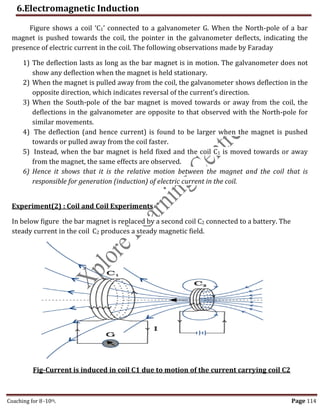
Figure: When the bar magnet is pushed towards the coil, the
pointer in the galvanometer G deflects
,
6.Electromagnetic Induction
Coaching for 8-10th Page 114
Figure shows a coil ‘C1’ connected to a galvanometer G. When the North-pole of a bar
magnet is pushed towards the coil, the pointer in the galvanometer deflects, indicating the
presence of electric current in the coil. The following observations made by Faraday
1) The deflection lasts as long as the bar magnet is in motion. The galvanometer does not
show any deflection when the magnet is held stationary.
2) When the magnet is pulled away from the coil, the galvanometer shows deflection in the
opposite direction, which indicates reversal of the current’s direction.
3) When the South-pole of the bar magnet is moved towards or away from the coil, the
deflections in the galvanometer are opposite to that observed with the North-pole for
similar movements.
4) The deflection (and hence current) is found to be larger when the magnet is pushed
towards or pulled away from the coil faster.
5) Instead, when the bar magnet is held fixed and the coil C1 is moved towards or away
from the magnet, the same effects are observed.
6) Hence it shows that it is the relative motion between the magnet and the coil that is
responsible for generation (induction) of electric current in the coil.
Experiment(2) : Coil and Coil Experiments
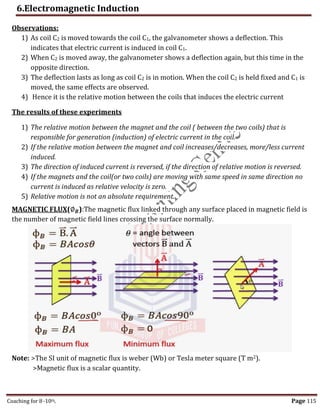
In below figure the bar magnet is replaced by a second coil C2 connected to a battery. The
steady current in the coil C2 produces a steady magnetic field.
Fig-Current is induced in coil C1 due to motion of the current carrying coil C2
,
6.Electromagnetic Induction
Coaching for 8-10th Page 115
Observations:
1) As coil C2 is moved towards the coil C1, the galvanometer shows a deflection. This
indicates that electric current is induced in coil C1.
2) When C2 is moved away, the galvanometer shows a deflection again, but this time in the
opposite direction.
3) The deflection lasts as long as coil C2 is in motion. When the coil C2 is held fixed and C1 is
moved, the same effects are observed.
4) Hence it is the relative motion between the coils that induces the electric current
The results of these experiments
1) The relative motion between the magnet and the coil ( between the two coils) that is
responsible for generation (induction) of electric current in the coil.
2) If the relative motion between the magnet and coil increases/decreases, more/less current
induced.
3) The direction of induced current is reversed, if the direction of relative motion is reversed.
4) If the magnets and the coil(or two coils) are moving with same speed in same direction no
current is induced as relative velocity is zero.
5) Relative motion is not an absolute requirement.
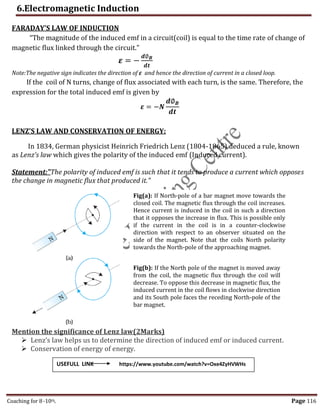
MAGNETIC FLUX(∅𝑩):The magnetic flux linked through any surface placed in magnetic field is
the number of magnetic field lines crossing the surface normally.
Note: >The SI unit of magnetic flux is weber (Wb) or Tesla meter square (T m2).
>Magnetic flux is a scalar quantity.
,
6.Electromagnetic Induction
Coaching for 8-10th Page 116
FARADAY’S LAW OF INDUCTION
“The magnitude of the induced emf in a circuit(coil) is equal to the time rate of change of
magnetic flux linked through the circuit.”
𝜺 = −
𝒅∅𝑩
𝒅𝒕
Note:The negative sign indicates the direction of ε and hence the direction of current in a closed loop.
If the coil of N turns, change of flux associated with each turn, is the same. Therefore, the
expression for the total induced emf is given by
𝜺 = −𝑵
𝒅∅𝑩
𝒅𝒕
LENZ’S LAW AND CONSERVATION OF ENERGY:
In 1834, German physicist Heinrich Friedrich Lenz (1804-1865) deduced a rule, known
as Lenz’s law which gives the polarity of the induced emf (Induced current).
Statement:"The polarity of induced emf is such that it tends to produce a current which opposes
the change in magnetic flux that produced it."
Mention the significance of Lenz law(2Marks)
 Lenz’s law helps us to determine the direction of induced emf or induced current.
 Conservation of energy of energy.
Fig(a): If North-pole of a bar magnet move towards the
closed coil. The magnetic flux through the coil increases.
Hence current is induced in the coil in such a direction
that it opposes the increase in flux. This is possible only
if the current in the coil is in a counter-clockwise
direction with respect to an observer situated on the
side of the magnet. Note that the coils North polarity
towards the North-pole of the approaching magnet.
Fig(b): If the North pole of the magnet is moved away
from the coil, the magnetic flux through the coil will
decrease. To oppose this decrease in magnetic flux, the
induced current in the coil flows in clockwise direction
and its South pole faces the receding North-pole of the
bar magnet.
USEFULL LINK https://www.youtube.com/watch?v=Oxe4ZyHVWHs
,
6.Electromagnetic Induction
Coaching for 8-10th Page 117
𝜺 = 𝑩𝒍𝒗 𝐬𝐢𝐧 𝜽
MOTIONAL ELECTROMOTIVE FORCE OR MOTIONAL EMF (𝜺)
When an conducting loop or rod moves in the in an uniform magnetic field, so that flux
through the loop changes, an emf is induced it the loop is called motional emf.
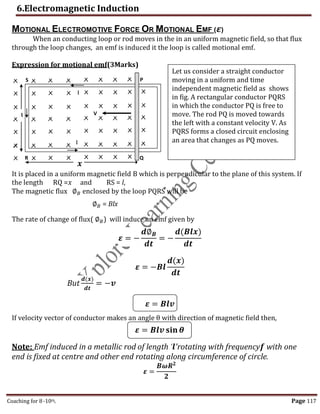
Expression for motional emf(3Marks)
It is placed in a uniform magnetic field B which is perpendicular to the plane of this system. If
the length RQ =𝑥 and RS = l,
The magnetic flux ∅𝐵 enclosed by the loop PQRS will be
∅𝐵 = Blx
The rate of change of flux( ∅𝐵) will induce an emf given by
𝜺 = −
𝒅∅𝑩
𝒅𝒕
= −
𝒅(𝑩𝒍𝒙)
𝒅𝒕
𝜺 = −𝑩𝒍
𝒅(𝒙)
𝒅𝒕
But
𝒅(𝒙)
𝒅𝒕
= −𝒗
𝜺 = 𝑩𝒍𝒗
If velocity vector of conductor makes an angle θ with direction of magnetic field then,
Note: Emf induced in a metallic rod of length '𝒍'rotating with frequency𝒇 with one
end is fixed at centre and other end rotating along circumference of circle.
𝜺 =
𝑩𝝎𝑹𝟐
𝟐
Ɩ
P
𝒙
Q
R
S
V
I
I
Let us consider a straight conductor
moving in a uniform and time
independent magnetic field as shows
in fig. A rectangular conductor PQRS
in which the conductor PQ is free to
move. The rod PQ is moved towards
the left with a constant velocity V. As
PQRS forms a closed circuit enclosing
an area that changes as PQ moves.
,
6.Electromagnetic Induction
Coaching for 8-10th Page 118
EDDY CURRENTS: When bulk pieces of conductors are subjected to changing magnetic
flux, induced currents are produced in them such currents are called eddy currents. This
effect was discovered by physicist Foucault (1819-1868)
Advantage in certain applications like
I. Magnetic braking in trains
II. Electromagnetic damping
III. Induction furnace
IV. Electric power meters
ELECTROMAGNETIC DAMPING
a) Take two hollow thin cylindrical pipes of equal internal diameters made of aluminium
and PVC, respectively.
b) Fix them vertically with clamps on retort stands. Take a small cylinderical magnet
having diameter slightly smaller than the inner diameter of the pipes and drop it
through each pipe in such a way that the magnet does not touch the sides of the pipes
during its fall.
c) The magnet dropped through the PVC pipe takes the same time to come out of the pipe
as it would take when dropped through the same height without the pipe. Note the time
it takes to come out of the pipe in each case.
d) The magnet takes much longer time in the case of aluminium pipe. It is due to the eddy
currents that are generated in the aluminium pipe which oppose the change in magnetic
flux, i.e., the motion of the magnet.
e) The retarding force due to the eddy currents inhibits the motion of the magnet. Such
phenomena are referred to as electromagnetic damping.
f) Note that eddy currents are not generated in PVC pipe as its material is an insulator
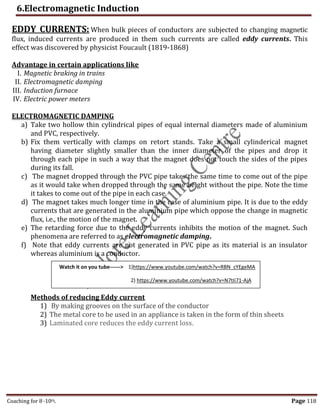
whereas aluminium is a conductor.
Methods of reducing Eddy current
1) By making grooves on the surface of the conductor
2) The metal core to be used in an appliance is taken in the form of thin sheets
3) Laminated core reduces the eddy current loss.
Watch it on you tube------> 1)https://www.youtube.com/watch?v=RBN_cYEgeMA
2) https://www.youtube.com/watch?v=N7tIi71-AjA
,
6.Electromagnetic Induction
Coaching for 8-10th Page 119
SELF INDUCTANCE(L): Emf is induced in a single isolated coil due to change of flux
through the coil by means of varying the current through the same coil. This phenomenon is
called self-induction.
i.e. Flux linkage through a coil of N turns is proportional to the current through the coil
∅𝐵 ∝ 𝐼
For N turns,
𝑁∅𝐵 = 𝐿𝐼
Where constant of proportionality L is called self-inductance of the coil. It is also called the
coefficient of self-induction of the coil.
Also from Faradays law the induced emf is given by,
𝜺 = −
𝒅(𝑵∅𝑩)
𝒅𝒕
= −𝑳
𝒅𝑰
𝒅𝒕
𝜺 = −𝑳
𝒅𝑰
𝒅𝒕
The negative sign indicates that emf is opposing the cause producing it.
 Self Inductance is a scalar quantity. It has the dimensions of [M L2 T–2 A–2]
 The SI unit of self-inductance is Henry and is denoted by H.
Self-inductance of a long solenoid of cross-sectional area A and length l, having n turns
per unit length.
𝑳 = 𝝁𝒐𝒏𝟐
𝑨𝒍 OR 𝑳 =
𝝁𝒐𝑵𝟐𝑨
𝒍
Where ,
𝜇𝑜 =Permeability of free space.
𝑛 = Number of turns per unit length
𝐴 = Cross-sectional area of solenoid
𝑙 = Length of the solenoid
Note: The self-inductance of the coil depends on,
1) Its geometry, shape and size of the solenoid.
2) Permeability of the medium
Back emf: The self-induced emf is also called the back emf as it opposes any change in the
current in a circuit
ONE HENRY(1H):It is the value of self-inductance of a coil in which one volt is produced by a
variation of the inducing current of one ampere per second.
,
6.Electromagnetic Induction
Coaching for 8-10th Page 120
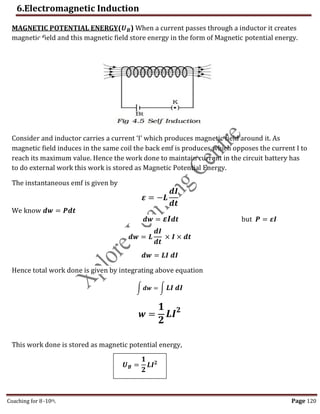
MAGNETIC POTENTIAL ENERGY(𝑼𝑩) When a current passes through a inductor it creates
magnetic field and this magnetic field store energy in the form of Magnetic potential energy.
Consider and inductor carries a current ‘I’ which produces magnetic field around it. As
magnetic field induces in the same coil the back emf is produces which opposes the current I to
reach its maximum value. Hence the work done to maintain current in the circuit battery has
to do external work this work is stored as Magnetic Potential Energy.
The instantaneous emf is given by
𝜺 = −𝑳
𝒅𝑰
𝒅𝒕
We know 𝒅𝒘 = 𝑷𝒅𝒕
𝒅𝒘 = 𝜺𝑰𝒅𝒕 but 𝑷 = 𝜺𝑰
𝒅𝒘 = 𝑳
𝒅𝑰
𝒅𝒕
× 𝑰 × 𝒅𝒕
𝒅𝒘 = 𝑳𝑰 𝒅𝑰
Hence total work done is given by integrating above equation
∫ 𝒅𝒘 = ∫ 𝑳𝑰 𝒅𝑰
𝒘 =
𝟏
𝟐
𝑳𝑰𝟐
This work done is stored as magnetic potential energy,
𝑼𝑩 =
𝟏
𝟐
𝑳𝑰𝟐
,
6.Electromagnetic Induction
Coaching for 8-10th Page 121
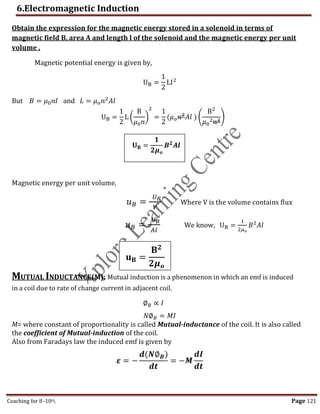
Obtain the expression for the magnetic energy stored in a solenoid in terms of
magnetic field B, area A and length l of the solenoid and the magnetic energy per unit
volume .
Magnetic potential energy is given by,
UB =
1
2
LI2
But 𝐵 = 𝜇0𝑛𝐼 and 𝐿 = 𝜇𝑜𝑛2
𝐴𝑙
UB =
1
2
L (
B
𝜇0𝑛
)
2
=
1
2
(𝜇𝑜𝑛2
𝐴𝑙 ) (
B2
𝜇0
2𝑛2)
Magnetic energy per unit volume,
𝑢𝐵 =
𝑈𝐵
𝑉
Where V is the volume contains flux
𝑢𝐵 =
𝑈𝐵
𝐴𝑙
We know, UB =
1
2𝜇𝑜
𝐵2
𝐴𝑙
MUTUAL INDUCTANCE(M): Mutual induction is a phenomenon in which an emf is induced
in a coil due to rate of change current in adjacent coil.
∅𝐵 ∝ 𝐼
𝑁∅𝐵 = 𝑀𝐼
M= where constant of proportionality is called Mutual-inductance of the coil. It is also called
the coefficient of Mutual-induction of the coil.
Also from Faradays law the induced emf is given by
𝜺 = −
𝒅(𝑵∅𝑩)
𝒅𝒕
= −𝑴
𝒅𝑰
𝒅𝒕
𝐔𝐁 =
𝟏
𝟐𝝁𝒐
𝑩𝟐
𝑨𝒍
𝐮𝐁 =
𝐁𝟐
𝟐𝝁𝒐
,
6.Electromagnetic Induction
Coaching for 8-10th Page 122
𝜺 = −𝑴
𝒅𝑰
𝒅𝒕
The negative sign indicates that emf is opposing the cause producing it.
 Self Inductance is a scalar quantity. It has the dimensions of [M L2 T–2 A–2]
 The SI unit of mutual-inductance is Henry and is denoted by H.
COEFFICIENT OF MUTUAL INDUCTION :One henry is defined as the coefficient of mutual
induction between a pair of coils when a change of current of one ampere per second in one
coil produces an induced emf of one volt in the other coil
MUTUAL INDUCTANCE BETWEEN THE TWO COILS
Two long co-axial solenoids each of length l. The radius of the solenoid S1 by r1 and the
number of turns per unit length by n1. The corresponding quantities for the other solenoid S2
are r2 and n2, respectively. Let N1 and N2 be the total number of turns of coils S1 and S2,
respectively.
When a current I1 is set up through S1, it sets up a magnetic flux through S2. Let us denote it by
∅2. The corresponding flux linkage with solenoid S2 is,
𝑁2∅2 = 𝑀21𝐼1--------------------(1)
Consider the reverse case, When a current I2 is set up through S2, it sets up a magnetic flux
through S1. Let us denote it by ∅1. The corresponding flux linkage with solenoid S1 is,
𝑁1∅1 = 𝑀12𝐼2-------------(2)
Now we know , 𝐵 = 𝜇0𝑛𝐼 and N=nl apply it to any above equation say (2) then
(𝑛1𝑙)𝜇0𝑛2𝐼1𝐴 = 𝑀21𝐼1 ∅𝐵 = BA
S1
S2
𝜺
Source
,
6.Electromagnetic Induction
Coaching for 8-10th Page 123
𝑀12 = 𝜇0 𝑛1𝑛2𝐴𝑙 ---------------------(3)
Similarly,
𝑀21 = 𝜇0 𝑛1𝑛2𝐴𝑙------------------------ (4)
From Eq.(3) and (4) we can say 𝑀12 = 𝑀21 = 𝑀
𝑴 = 𝝁𝟎 𝒏𝟏𝒏𝟐𝑨𝒍 OR M =
𝝁𝟎𝑵𝟏𝑵𝟐𝑨
𝒍
A= Effective Area( larger one) 𝑙= Effective length(smaller one)
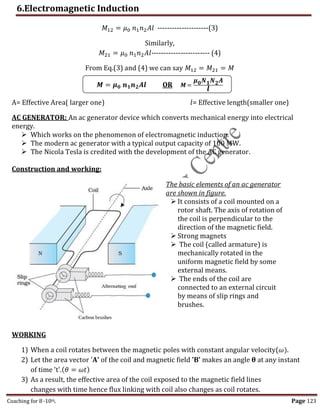
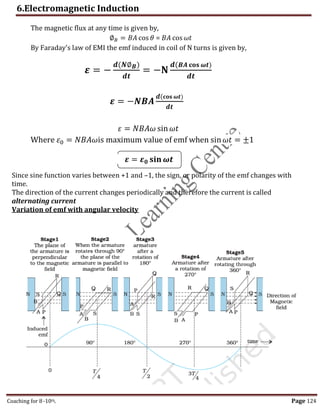
AC GENERATOR: An ac generator device which converts mechanical energy into electrical
energy.
 Which works on the phenomenon of electromagnetic induction.
 The modern ac generator with a typical output capacity of 100 MW.
 The Nicola Tesla is credited with the development of the AC generator.
Construction and working:
WORKING
1) When a coil rotates between the magnetic poles with constant angular velocity(𝜔).
2) Let the area vector 'A' of the coil and magnetic field 'B' makes an angle θ at any instant
of time 't'.(𝜃 = 𝜔𝑡)
3) As a result, the effective area of the coil exposed to the magnetic field lines
changes with time hence flux linking with coil also changes as coil rotates.
The basic elements of an ac generator
are shown in figure.
 It consists of a coil mounted on a
rotor shaft. The axis of rotation of
the coil is perpendicular to the
direction of the magnetic field.
 Strong magnets
 The coil (called armature) is
mechanically rotated in the
uniform magnetic field by some
external means.
 The ends of the coil are
connected to an external circuit
by means of slip rings and
brushes.
,
6.Electromagnetic Induction
Coaching for 8-10th Page 124
The magnetic flux at any time is given by,
∅𝐵 = 𝐵𝐴 cos 𝜃 = 𝐵𝐴 cos 𝜔𝑡
By Faraday's law of EMI the emf induced in coil of N turns is given by,
𝜺 = −
𝒅(𝑵∅𝑩)
𝒅𝒕
= −𝐍
𝒅(𝑩𝑨 𝐜𝐨𝐬 𝝎𝒕)
𝒅𝒕
𝜺 = −𝑵𝑩𝑨
𝒅(𝐜𝐨𝐬 𝝎𝒕)
𝒅𝒕
𝜀 = 𝑁𝐵𝐴𝜔 sin𝜔𝑡
Where 𝜀0 = 𝑁𝐵𝐴𝜔is maximum value of emf when sin𝜔𝑡 = ±1
𝜺 = 𝜺𝟎 𝐬𝐢𝐧 𝝎𝒕
Since sine function varies between +1 and –1, the sign, or polarity of the emf changes with
time.
The direction of the current changes periodically and therefore the current is called
alternating current
Variation of emf with angular velocity
,
6.Electromagnetic Induction
Coaching for 8-10th Page 125
Physical Quantity Symbol Dimensions Unit
Magnetic field B [𝑳𝟐] Tesla(T)
Magnetic Flux ∅𝐵 [𝑴𝑳𝟐
𝑻−𝟐
𝑨−𝟏] Weber(Wb)
EMF 𝜀 [𝑴𝑳𝟐
𝑻−𝟑
𝑨−𝟏] Volt(V)
Mutual Inductance M [𝑴𝑳𝟐
𝑻−𝟐
𝑨𝟐] Henry(H)
Self Inductance L [𝑴𝑳𝟐
𝑻−𝟐
𝑨𝟐] Henry(H)
ONE MARK QUESTIONS
1. What is electromagnetic induction?
2. Define magnetic flux through a surface.
3. State Faraday’s law of electromagnetic induction.
4. State Lenz’s law of electromagnetic induction.
5. What are eddy currents?
6. Define self-inductance of a coil.
7. Write the S.I unit of self-inductance.
8. Define the S.I unit of self-inductance.
9. What is mutual inductance?
10.Define co-efficient of mutual inductance.
11.What is motional emf?
12.What happens to self-inductance of a coil if a ferromagnetic material is inserted
inside the coil?
13.Mention the expression for magnetic potential energy stored in an inductor
when current flows through it.
14.On what principle AC generator works?
TWO MARK QUESTIONS
1. Define magnetic flux through a surface? Give its mathematical formula in vector form.
2. For what angle of inclination the magnetic flux through the surface is (a)
maximum (b) minimum?
3. State and explain Faraday’s law of electromagnetic induction.
4. A wheel with 10 metallic spokes each 0.5 m long is rotated with a speed of 120 revolutions
per minute in a plane normal to the horizontal component of earth’s magnetic field 0.4 x 10-
4T. What is the induced emf between the axle and the rim of the wheel?
5. State and explain Lenz’s law in electromagnetic induction.
6. Mention two methods of reducing eddy currents.
7. The magnetic flux linked with a coil changes from 12 x 10-3 Wb (Tm2) to 6x10⁻³Wb in 0.01
second. Calculate the induced emf in the coil.
,
6.Electromagnetic Induction
th Page 126
8. Give the expression for mutual inductance induced between two co-axial
solenoids and explain the terms.
9. Give an expression for self-inductance of a coil and explain the terms.
10.Draw a neat labeled diagram of AC generator.
THREE MARK QUESTIONS
1. Describe coil and magnet experiment of Faraday and Henry to demonstrate electromagnetic
induction phenomena.
2. Describe coil and coil experiment of Faraday and Henry to demonstrate electromagnetic
induction.
3. Derive the expression for motional emf in a conducting rod moving in uniform magnetic
field.
4. Mention any three applications of eddy currents.
5. Obtain the expression for co-efficient of mutual inductance between two co-axial solenoids.
6. Obtain the expression for energy stored in an inductor.
FIVE MARK QUESTIONS
1. Describe the construction and working of AC generator with a labeled diagram and hence
arrive at the expression for the instantaneous value of emf induced in it.
2. Show that solenoid is equivalent to bar magnet.
NUMERICAL PROBLEMS
1. A circular coil of 100 turns, 0.2m radius has a resistance of 100Ω is held at right angles to a
uniform magnetic field of 2T. it is then turned through 450 about an axis at right angles to
the field. Calculate the charge induced in the coil. [73.5X10⁻³]
2. The electric current in a circuit varies from +2A to -2A in a time interval of 10-2s.another
coil of resistance 20Ω and inductance 2H is placed near it. Find the induced current in the
second coil. [40A]
3. A solenoid of radius 2.5cm, length 0.5m has 500 turns per centimeter. If a current of 1A is
set up in the solenoid calculate the magnetic flux through the solenoid. [3Wb]
4. An iron core is inserted into a solenoid of length 0.5m, area of cross-section 0.001m2 and
400 turns per unit length. Find the permeability of the core if 5A of current produces a
magnetic flux of 1.6X10- 3Wb through it. [636.94]
5. A vertical copper disc of diameter 20cm makes 10 revolutions per second about a
horizontal axis passing through its center. A uniform magnetic field 10-2T acts
perpendicular to the plane of the disc. Calculate the potential difference between its center
and rim. [3.14X10⁻³V]
,

PHY PUC 2 Notes Electromagnetic induction

  • 1.
    6.Electromagnetic Induction Coaching for8-10th, PU I & II (Sci. & Commerce), NTSE, Olympiad, KVPY, NDA, CET, NEET, JEE. Call: 9663320948 Page 112 INTRODUCTION  Electricity and magnetism were considered separate and unrelated phenomena for a long time. In the nineteenth century, experiments on electric current by Hans Oersted, Ampere established the fact that electricity and magnetism are inter-related.  They found that moving electric charges produce magnetic fields. For example, an electric current deflects a magnetic compass needle placed nearby.  Can moving magnets produce electric currents? The answer is yes! The experiments of Michael Faraday and Joseph Henry demonstrated that electric currents were induced in closed coils when subjected to changing magnetic fields.  The phenomenon in which electric current is generated by varying magnetic fields is appropriately called ELECTROMAGNETIC INDUCTION. OR  Whenever the magnetic flux linked with an electric circuit changes, an emf is induced in the circuit. This phenomenon is called ELECTROMAGNETIC INDUCTION Hans Oersted Experiments: Whenever current passed through the wire it produces magnetic field around it. The nature of magnetic field is in the form of concentric circles. The direction of magnetic field given by right hand rule. THE EXPERIMENTS OF FARADAY AND HENRY: Michael Faraday [1791– 1867] Faraday made numerous contributions to science, viz., the discovery of electromagnetic induction, the laws of electrolysis, benzene, and the fact that the plane of polarisation is rotated in an electric field. He is also credited with the invention of the electric motor, the electric generator and the transformer. He is widely regarded as the greatest experimental scientist of the nineteenth century.
  • 2.
    6.Electromagnetic Induction Coaching for8-10th Page 113 The discovery and understanding of electromagnetic induction are based on a long series of experiments carried out by Faraday and Henry Experiment(1) : Coil and Magnets Experiments Josheph Henry [1797 – 1878] American experimental physicist, professor at Princeton University and first director of the Smithsonian Institution. He made important improvements in electromagnets by winding coils of insulated wire around iron pole pieces and invented an electromagnetic motor and a new, efficient telegraph. He discovered self-induction and investigated how currents in one circuit induce currents in another. Figure: When the bar magnet is pushed towards the coil, the pointer in the galvanometer G deflects ,
  • 3.
    6.Electromagnetic Induction Coaching for8-10th Page 114 Figure shows a coil ‘C1’ connected to a galvanometer G. When the North-pole of a bar magnet is pushed towards the coil, the pointer in the galvanometer deflects, indicating the presence of electric current in the coil. The following observations made by Faraday 1) The deflection lasts as long as the bar magnet is in motion. The galvanometer does not show any deflection when the magnet is held stationary. 2) When the magnet is pulled away from the coil, the galvanometer shows deflection in the opposite direction, which indicates reversal of the current’s direction. 3) When the South-pole of the bar magnet is moved towards or away from the coil, the deflections in the galvanometer are opposite to that observed with the North-pole for similar movements. 4) The deflection (and hence current) is found to be larger when the magnet is pushed towards or pulled away from the coil faster. 5) Instead, when the bar magnet is held fixed and the coil C1 is moved towards or away from the magnet, the same effects are observed. 6) Hence it shows that it is the relative motion between the magnet and the coil that is responsible for generation (induction) of electric current in the coil. Experiment(2) : Coil and Coil Experiments In below figure the bar magnet is replaced by a second coil C2 connected to a battery. The steady current in the coil C2 produces a steady magnetic field. Fig-Current is induced in coil C1 due to motion of the current carrying coil C2 ,
  • 4.
    6.Electromagnetic Induction Coaching for8-10th Page 115 Observations: 1) As coil C2 is moved towards the coil C1, the galvanometer shows a deflection. This indicates that electric current is induced in coil C1. 2) When C2 is moved away, the galvanometer shows a deflection again, but this time in the opposite direction. 3) The deflection lasts as long as coil C2 is in motion. When the coil C2 is held fixed and C1 is moved, the same effects are observed. 4) Hence it is the relative motion between the coils that induces the electric current The results of these experiments 1) The relative motion between the magnet and the coil ( between the two coils) that is responsible for generation (induction) of electric current in the coil. 2) If the relative motion between the magnet and coil increases/decreases, more/less current induced. 3) The direction of induced current is reversed, if the direction of relative motion is reversed. 4) If the magnets and the coil(or two coils) are moving with same speed in same direction no current is induced as relative velocity is zero. 5) Relative motion is not an absolute requirement. MAGNETIC FLUX(∅𝑩):The magnetic flux linked through any surface placed in magnetic field is the number of magnetic field lines crossing the surface normally. Note: >The SI unit of magnetic flux is weber (Wb) or Tesla meter square (T m2). >Magnetic flux is a scalar quantity. ,
  • 5.
    6.Electromagnetic Induction Coaching for8-10th Page 116 FARADAY’S LAW OF INDUCTION “The magnitude of the induced emf in a circuit(coil) is equal to the time rate of change of magnetic flux linked through the circuit.” 𝜺 = − 𝒅∅𝑩 𝒅𝒕 Note:The negative sign indicates the direction of ε and hence the direction of current in a closed loop. If the coil of N turns, change of flux associated with each turn, is the same. Therefore, the expression for the total induced emf is given by 𝜺 = −𝑵 𝒅∅𝑩 𝒅𝒕 LENZ’S LAW AND CONSERVATION OF ENERGY: In 1834, German physicist Heinrich Friedrich Lenz (1804-1865) deduced a rule, known as Lenz’s law which gives the polarity of the induced emf (Induced current). Statement:"The polarity of induced emf is such that it tends to produce a current which opposes the change in magnetic flux that produced it." Mention the significance of Lenz law(2Marks)  Lenz’s law helps us to determine the direction of induced emf or induced current.  Conservation of energy of energy. Fig(a): If North-pole of a bar magnet move towards the closed coil. The magnetic flux through the coil increases. Hence current is induced in the coil in such a direction that it opposes the increase in flux. This is possible only if the current in the coil is in a counter-clockwise direction with respect to an observer situated on the side of the magnet. Note that the coils North polarity towards the North-pole of the approaching magnet. Fig(b): If the North pole of the magnet is moved away from the coil, the magnetic flux through the coil will decrease. To oppose this decrease in magnetic flux, the induced current in the coil flows in clockwise direction and its South pole faces the receding North-pole of the bar magnet. USEFULL LINK https://www.youtube.com/watch?v=Oxe4ZyHVWHs ,
  • 6.
    6.Electromagnetic Induction Coaching for8-10th Page 117 𝜺 = 𝑩𝒍𝒗 𝐬𝐢𝐧 𝜽 MOTIONAL ELECTROMOTIVE FORCE OR MOTIONAL EMF (𝜺) When an conducting loop or rod moves in the in an uniform magnetic field, so that flux through the loop changes, an emf is induced it the loop is called motional emf. Expression for motional emf(3Marks) It is placed in a uniform magnetic field B which is perpendicular to the plane of this system. If the length RQ =𝑥 and RS = l, The magnetic flux ∅𝐵 enclosed by the loop PQRS will be ∅𝐵 = Blx The rate of change of flux( ∅𝐵) will induce an emf given by 𝜺 = − 𝒅∅𝑩 𝒅𝒕 = − 𝒅(𝑩𝒍𝒙) 𝒅𝒕 𝜺 = −𝑩𝒍 𝒅(𝒙) 𝒅𝒕 But 𝒅(𝒙) 𝒅𝒕 = −𝒗 𝜺 = 𝑩𝒍𝒗 If velocity vector of conductor makes an angle θ with direction of magnetic field then, Note: Emf induced in a metallic rod of length '𝒍'rotating with frequency𝒇 with one end is fixed at centre and other end rotating along circumference of circle. 𝜺 = 𝑩𝝎𝑹𝟐 𝟐 Ɩ P 𝒙 Q R S V I I Let us consider a straight conductor moving in a uniform and time independent magnetic field as shows in fig. A rectangular conductor PQRS in which the conductor PQ is free to move. The rod PQ is moved towards the left with a constant velocity V. As PQRS forms a closed circuit enclosing an area that changes as PQ moves. ,
  • 7.
    6.Electromagnetic Induction Coaching for8-10th Page 118 EDDY CURRENTS: When bulk pieces of conductors are subjected to changing magnetic flux, induced currents are produced in them such currents are called eddy currents. This effect was discovered by physicist Foucault (1819-1868) Advantage in certain applications like I. Magnetic braking in trains II. Electromagnetic damping III. Induction furnace IV. Electric power meters ELECTROMAGNETIC DAMPING a) Take two hollow thin cylindrical pipes of equal internal diameters made of aluminium and PVC, respectively. b) Fix them vertically with clamps on retort stands. Take a small cylinderical magnet having diameter slightly smaller than the inner diameter of the pipes and drop it through each pipe in such a way that the magnet does not touch the sides of the pipes during its fall. c) The magnet dropped through the PVC pipe takes the same time to come out of the pipe as it would take when dropped through the same height without the pipe. Note the time it takes to come out of the pipe in each case. d) The magnet takes much longer time in the case of aluminium pipe. It is due to the eddy currents that are generated in the aluminium pipe which oppose the change in magnetic flux, i.e., the motion of the magnet. e) The retarding force due to the eddy currents inhibits the motion of the magnet. Such phenomena are referred to as electromagnetic damping. f) Note that eddy currents are not generated in PVC pipe as its material is an insulator whereas aluminium is a conductor. Methods of reducing Eddy current 1) By making grooves on the surface of the conductor 2) The metal core to be used in an appliance is taken in the form of thin sheets 3) Laminated core reduces the eddy current loss. Watch it on you tube------> 1)https://www.youtube.com/watch?v=RBN_cYEgeMA 2) https://www.youtube.com/watch?v=N7tIi71-AjA ,
  • 8.
    6.Electromagnetic Induction Coaching for8-10th Page 119 SELF INDUCTANCE(L): Emf is induced in a single isolated coil due to change of flux through the coil by means of varying the current through the same coil. This phenomenon is called self-induction. i.e. Flux linkage through a coil of N turns is proportional to the current through the coil ∅𝐵 ∝ 𝐼 For N turns, 𝑁∅𝐵 = 𝐿𝐼 Where constant of proportionality L is called self-inductance of the coil. It is also called the coefficient of self-induction of the coil. Also from Faradays law the induced emf is given by, 𝜺 = − 𝒅(𝑵∅𝑩) 𝒅𝒕 = −𝑳 𝒅𝑰 𝒅𝒕 𝜺 = −𝑳 𝒅𝑰 𝒅𝒕 The negative sign indicates that emf is opposing the cause producing it.  Self Inductance is a scalar quantity. It has the dimensions of [M L2 T–2 A–2]  The SI unit of self-inductance is Henry and is denoted by H. Self-inductance of a long solenoid of cross-sectional area A and length l, having n turns per unit length. 𝑳 = 𝝁𝒐𝒏𝟐 𝑨𝒍 OR 𝑳 = 𝝁𝒐𝑵𝟐𝑨 𝒍 Where , 𝜇𝑜 =Permeability of free space. 𝑛 = Number of turns per unit length 𝐴 = Cross-sectional area of solenoid 𝑙 = Length of the solenoid Note: The self-inductance of the coil depends on, 1) Its geometry, shape and size of the solenoid. 2) Permeability of the medium Back emf: The self-induced emf is also called the back emf as it opposes any change in the current in a circuit ONE HENRY(1H):It is the value of self-inductance of a coil in which one volt is produced by a variation of the inducing current of one ampere per second. ,
  • 9.
    6.Electromagnetic Induction Coaching for8-10th Page 120 MAGNETIC POTENTIAL ENERGY(𝑼𝑩) When a current passes through a inductor it creates magnetic field and this magnetic field store energy in the form of Magnetic potential energy. Consider and inductor carries a current ‘I’ which produces magnetic field around it. As magnetic field induces in the same coil the back emf is produces which opposes the current I to reach its maximum value. Hence the work done to maintain current in the circuit battery has to do external work this work is stored as Magnetic Potential Energy. The instantaneous emf is given by 𝜺 = −𝑳 𝒅𝑰 𝒅𝒕 We know 𝒅𝒘 = 𝑷𝒅𝒕 𝒅𝒘 = 𝜺𝑰𝒅𝒕 but 𝑷 = 𝜺𝑰 𝒅𝒘 = 𝑳 𝒅𝑰 𝒅𝒕 × 𝑰 × 𝒅𝒕 𝒅𝒘 = 𝑳𝑰 𝒅𝑰 Hence total work done is given by integrating above equation ∫ 𝒅𝒘 = ∫ 𝑳𝑰 𝒅𝑰 𝒘 = 𝟏 𝟐 𝑳𝑰𝟐 This work done is stored as magnetic potential energy, 𝑼𝑩 = 𝟏 𝟐 𝑳𝑰𝟐 ,
  • 10.
    6.Electromagnetic Induction Coaching for8-10th Page 121 Obtain the expression for the magnetic energy stored in a solenoid in terms of magnetic field B, area A and length l of the solenoid and the magnetic energy per unit volume . Magnetic potential energy is given by, UB = 1 2 LI2 But 𝐵 = 𝜇0𝑛𝐼 and 𝐿 = 𝜇𝑜𝑛2 𝐴𝑙 UB = 1 2 L ( B 𝜇0𝑛 ) 2 = 1 2 (𝜇𝑜𝑛2 𝐴𝑙 ) ( B2 𝜇0 2𝑛2) Magnetic energy per unit volume, 𝑢𝐵 = 𝑈𝐵 𝑉 Where V is the volume contains flux 𝑢𝐵 = 𝑈𝐵 𝐴𝑙 We know, UB = 1 2𝜇𝑜 𝐵2 𝐴𝑙 MUTUAL INDUCTANCE(M): Mutual induction is a phenomenon in which an emf is induced in a coil due to rate of change current in adjacent coil. ∅𝐵 ∝ 𝐼 𝑁∅𝐵 = 𝑀𝐼 M= where constant of proportionality is called Mutual-inductance of the coil. It is also called the coefficient of Mutual-induction of the coil. Also from Faradays law the induced emf is given by 𝜺 = − 𝒅(𝑵∅𝑩) 𝒅𝒕 = −𝑴 𝒅𝑰 𝒅𝒕 𝐔𝐁 = 𝟏 𝟐𝝁𝒐 𝑩𝟐 𝑨𝒍 𝐮𝐁 = 𝐁𝟐 𝟐𝝁𝒐 ,
  • 11.
    6.Electromagnetic Induction Coaching for8-10th Page 122 𝜺 = −𝑴 𝒅𝑰 𝒅𝒕 The negative sign indicates that emf is opposing the cause producing it.  Self Inductance is a scalar quantity. It has the dimensions of [M L2 T–2 A–2]  The SI unit of mutual-inductance is Henry and is denoted by H. COEFFICIENT OF MUTUAL INDUCTION :One henry is defined as the coefficient of mutual induction between a pair of coils when a change of current of one ampere per second in one coil produces an induced emf of one volt in the other coil MUTUAL INDUCTANCE BETWEEN THE TWO COILS Two long co-axial solenoids each of length l. The radius of the solenoid S1 by r1 and the number of turns per unit length by n1. The corresponding quantities for the other solenoid S2 are r2 and n2, respectively. Let N1 and N2 be the total number of turns of coils S1 and S2, respectively. When a current I1 is set up through S1, it sets up a magnetic flux through S2. Let us denote it by ∅2. The corresponding flux linkage with solenoid S2 is, 𝑁2∅2 = 𝑀21𝐼1--------------------(1) Consider the reverse case, When a current I2 is set up through S2, it sets up a magnetic flux through S1. Let us denote it by ∅1. The corresponding flux linkage with solenoid S1 is, 𝑁1∅1 = 𝑀12𝐼2-------------(2) Now we know , 𝐵 = 𝜇0𝑛𝐼 and N=nl apply it to any above equation say (2) then (𝑛1𝑙)𝜇0𝑛2𝐼1𝐴 = 𝑀21𝐼1 ∅𝐵 = BA S1 S2 𝜺 Source ,
  • 12.
    6.Electromagnetic Induction Coaching for8-10th Page 123 𝑀12 = 𝜇0 𝑛1𝑛2𝐴𝑙 ---------------------(3) Similarly, 𝑀21 = 𝜇0 𝑛1𝑛2𝐴𝑙------------------------ (4) From Eq.(3) and (4) we can say 𝑀12 = 𝑀21 = 𝑀 𝑴 = 𝝁𝟎 𝒏𝟏𝒏𝟐𝑨𝒍 OR M = 𝝁𝟎𝑵𝟏𝑵𝟐𝑨 𝒍 A= Effective Area( larger one) 𝑙= Effective length(smaller one) AC GENERATOR: An ac generator device which converts mechanical energy into electrical energy.  Which works on the phenomenon of electromagnetic induction.  The modern ac generator with a typical output capacity of 100 MW.  The Nicola Tesla is credited with the development of the AC generator. Construction and working: WORKING 1) When a coil rotates between the magnetic poles with constant angular velocity(𝜔). 2) Let the area vector 'A' of the coil and magnetic field 'B' makes an angle θ at any instant of time 't'.(𝜃 = 𝜔𝑡) 3) As a result, the effective area of the coil exposed to the magnetic field lines changes with time hence flux linking with coil also changes as coil rotates. The basic elements of an ac generator are shown in figure.  It consists of a coil mounted on a rotor shaft. The axis of rotation of the coil is perpendicular to the direction of the magnetic field.  Strong magnets  The coil (called armature) is mechanically rotated in the uniform magnetic field by some external means.  The ends of the coil are connected to an external circuit by means of slip rings and brushes. ,
  • 13.
    6.Electromagnetic Induction Coaching for8-10th Page 124 The magnetic flux at any time is given by, ∅𝐵 = 𝐵𝐴 cos 𝜃 = 𝐵𝐴 cos 𝜔𝑡 By Faraday's law of EMI the emf induced in coil of N turns is given by, 𝜺 = − 𝒅(𝑵∅𝑩) 𝒅𝒕 = −𝐍 𝒅(𝑩𝑨 𝐜𝐨𝐬 𝝎𝒕) 𝒅𝒕 𝜺 = −𝑵𝑩𝑨 𝒅(𝐜𝐨𝐬 𝝎𝒕) 𝒅𝒕 𝜀 = 𝑁𝐵𝐴𝜔 sin𝜔𝑡 Where 𝜀0 = 𝑁𝐵𝐴𝜔is maximum value of emf when sin𝜔𝑡 = ±1 𝜺 = 𝜺𝟎 𝐬𝐢𝐧 𝝎𝒕 Since sine function varies between +1 and –1, the sign, or polarity of the emf changes with time. The direction of the current changes periodically and therefore the current is called alternating current Variation of emf with angular velocity ,
  • 14.
    6.Electromagnetic Induction Coaching for8-10th Page 125 Physical Quantity Symbol Dimensions Unit Magnetic field B [𝑳𝟐] Tesla(T) Magnetic Flux ∅𝐵 [𝑴𝑳𝟐 𝑻−𝟐 𝑨−𝟏] Weber(Wb) EMF 𝜀 [𝑴𝑳𝟐 𝑻−𝟑 𝑨−𝟏] Volt(V) Mutual Inductance M [𝑴𝑳𝟐 𝑻−𝟐 𝑨𝟐] Henry(H) Self Inductance L [𝑴𝑳𝟐 𝑻−𝟐 𝑨𝟐] Henry(H) ONE MARK QUESTIONS 1. What is electromagnetic induction? 2. Define magnetic flux through a surface. 3. State Faraday’s law of electromagnetic induction. 4. State Lenz’s law of electromagnetic induction. 5. What are eddy currents? 6. Define self-inductance of a coil. 7. Write the S.I unit of self-inductance. 8. Define the S.I unit of self-inductance. 9. What is mutual inductance? 10.Define co-efficient of mutual inductance. 11.What is motional emf? 12.What happens to self-inductance of a coil if a ferromagnetic material is inserted inside the coil? 13.Mention the expression for magnetic potential energy stored in an inductor when current flows through it. 14.On what principle AC generator works? TWO MARK QUESTIONS 1. Define magnetic flux through a surface? Give its mathematical formula in vector form. 2. For what angle of inclination the magnetic flux through the surface is (a) maximum (b) minimum? 3. State and explain Faraday’s law of electromagnetic induction. 4. A wheel with 10 metallic spokes each 0.5 m long is rotated with a speed of 120 revolutions per minute in a plane normal to the horizontal component of earth’s magnetic field 0.4 x 10- 4T. What is the induced emf between the axle and the rim of the wheel? 5. State and explain Lenz’s law in electromagnetic induction. 6. Mention two methods of reducing eddy currents. 7. The magnetic flux linked with a coil changes from 12 x 10-3 Wb (Tm2) to 6x10⁻³Wb in 0.01 second. Calculate the induced emf in the coil. ,
  • 15.
    6.Electromagnetic Induction th Page126 8. Give the expression for mutual inductance induced between two co-axial solenoids and explain the terms. 9. Give an expression for self-inductance of a coil and explain the terms. 10.Draw a neat labeled diagram of AC generator. THREE MARK QUESTIONS 1. Describe coil and magnet experiment of Faraday and Henry to demonstrate electromagnetic induction phenomena. 2. Describe coil and coil experiment of Faraday and Henry to demonstrate electromagnetic induction. 3. Derive the expression for motional emf in a conducting rod moving in uniform magnetic field. 4. Mention any three applications of eddy currents. 5. Obtain the expression for co-efficient of mutual inductance between two co-axial solenoids. 6. Obtain the expression for energy stored in an inductor. FIVE MARK QUESTIONS 1. Describe the construction and working of AC generator with a labeled diagram and hence arrive at the expression for the instantaneous value of emf induced in it. 2. Show that solenoid is equivalent to bar magnet. NUMERICAL PROBLEMS 1. A circular coil of 100 turns, 0.2m radius has a resistance of 100Ω is held at right angles to a uniform magnetic field of 2T. it is then turned through 450 about an axis at right angles to the field. Calculate the charge induced in the coil. [73.5X10⁻³] 2. The electric current in a circuit varies from +2A to -2A in a time interval of 10-2s.another coil of resistance 20Ω and inductance 2H is placed near it. Find the induced current in the second coil. [40A] 3. A solenoid of radius 2.5cm, length 0.5m has 500 turns per centimeter. If a current of 1A is set up in the solenoid calculate the magnetic flux through the solenoid. [3Wb] 4. An iron core is inserted into a solenoid of length 0.5m, area of cross-section 0.001m2 and 400 turns per unit length. Find the permeability of the core if 5A of current produces a magnetic flux of 1.6X10- 3Wb through it. [636.94] 5. A vertical copper disc of diameter 20cm makes 10 revolutions per second about a horizontal axis passing through its center. A uniform magnetic field 10-2T acts perpendicular to the plane of the disc. Calculate the potential difference between its center and rim. [3.14X10⁻³V] ,