Lignans
BY:- SABAL REGMI
PURWANCHAL UNIVERSITY
LIGNANS
• In 1936, Haworth defined lignans as
“Phenylpropanoid dimers consisting of two phenyl propane
units (C6C3) linked by their central C8 carbon.”
• biosynthetically derived from the Phenylpropanoid pathway
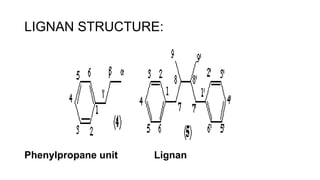
LIGNAN STRUCTURE:
Phenylpropane unit Lignan
OCCURRENCE OF LIGNANS
Widely distributed in plants.
 Usually occur in root, stem, bark,
fruits and seed parts of plant.
LIGNANS OF PODOPHYLLUM
Podophyllum is obtained from the dried root and rhizomes of two species of Podophyllum
(Berberidaceae), the American species P. peltatum and the Indian species P. hexandrum (P.
emodi).
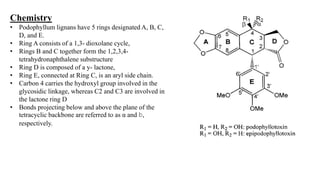
Chemistry
• Podophyllum lignans have 5 rings designated A, B, C,
D, and E.
• Ring A consists of a 1,3- dioxolane cycle,
• Rings B and C together form the 1,2,3,4-
tetrahydronaphthalene substructure
• Ring D is composed of a y- lactone,
• Ring E, connected at Ring C, is an aryl side chain.
• Carbon 4 carries the hydroxyl group involved in the
glycosidic linkage, whereas C2 and C3 are involved in
the lactone ring D
• Bonds projecting below and above the plane of the
tetracyclic backbone are referred to as α and b,
respectively.
Pharmacological activity
• Anticancer activity
testicular, lymphoid and myeloid leukemia, stomach, ovarian, brain,
breast, pancreatic, and small and non-small cell lung cancers
• Antiviral activity
in the treatment of venereal warts, caused by the human papilloma virus
• Rheumatoid arthritis
• immunosupressive, antimalarial and antifungal agents
Piper Cubeba
• The berries of P. cubeba are commonly known as cubeb (in Indonesia
known as kemukus) and used in Indonesian traditional medicine to
treat gonorrhea, dysentery, syphilis, abdominal pain,diarrhea, enteritis
and asthma
• P. cubeba is important as a source of pepper (the dried berries) for the
worldwide spice market
(1), cubebinone (2), yatein (3),
thujaplicatin trimethylether (4), cubebinin
Pharmacological activity
• Analgesic and anti inflammatory activity
• Aphrodisiac
• Antiseptic and diuretic action
• As a remedy for vomiting, abdominal disorders, indigestion, and amoebic dysentery
• To treat veneral diseases like gonorrhea
• Also prescribed for the relief of fever, asthma, sunstroke, rheutasim, malaria etc.
Flaxseed (Linum usitatissimum)
• Flaxseed (Linum usitatissimum L.) is an oilseed used in industrial and natural health
products.
• Flaxseed accumulates many biologically active compounds and elements including linolenic
acid, linoleic acid, lignans, cyclic peptides, polysaccharides, alkaloids, cyanogenic
glycosides, and cadmium.
• The prevailing lignan in the flaxseed is secoisolariciresinol diglucoside (SDG)
• In addition to SDG, smaller quantities of other type lignans such as matairesinol,
isolariciresinol, lariciresinol and pinoresinol have also been identifed in the flaxseed.
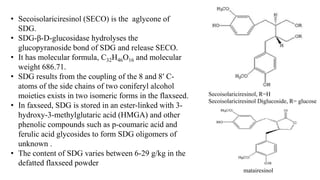
• Secoisolariciresinol (SECO) is the aglycone of
SDG.
• SDG-β-D-glucosidase hydrolyses the
glucopyranoside bond of SDG and release SECO.
• It has molecular formula, C32H46O16 and molecular
weight 686.71.
• SDG results from the coupling of the 8 and 8′ C-
atoms of the side chains of two coniferyl alcohol
moieties exists in two isomeric forms in the flaxseed.
• In faxseed, SDG is stored in an ester-linked with 3-
hydroxy-3-methylglutaric acid (HMGA) and other
phenolic compounds such as p-coumaric acid and
ferulic acid glycosides to form SDG oligomers of
unknown .
• The content of SDG varies between 6-29 g/kg in the
defatted flaxseed powder
Secoisolariciresinol, R=H
Secoisolariciresinol Diglucoside, R= glucose
matairesinol
Pharmacological activity
• Antioxidant
inhibition of lipid peroxidation and scavenging of hydroxy radical
• Anti-platelet-activation factor (PAF) activity.
PAF can induce the release of reactive oxygen species from neutrophils.
• Antiestrogenic,
• Anticarcinogenic,
• Antiatherogenic
• Antidiabetic activities.
FLAVONOIDS
•The flavonoids are polyphenolic compounds
possessing 15 carbon atoms; two benzene rings
joined by a linear three carbon chain having the
carbon skeleton C6 - C3 - C6 and they are the plant
pigments and they are having polar nature and is
solouble in methanol and water.
• Flavonoids constitute one of the most
characteristic classes of compounds in higher plants.
Many flavonoids are easily recognised as flower
pigments in most angiosperm families (flowering
plants).
•They are secondary metabolite and effective in
CNS disorders.
Easily recognized as flower pigments in most
angiosperm plants but are not always flower
pigments
 In plants they repair damage and shield from
environmental toxins
TESTS FOR FLAVONOIDS
 The extracts were dissolved in ethanol, filtered and subjected
to following tests.
 Shinoda test: The dried extracts were dissolved in 95%
ethanol (5ml) and few drops of concentrated hydrochloric
acid (HCL) were added. Then the magnesium turnings were
put into the solution and observed for appearance of pink
color.
 Lead acetate solution test: To small quantity of above
residue, lead acetate solution was added and observed for
appearance of formation of yellow colored precipitates.
CORE STRUCTURES AND NOMENCLATURE
• The nomenclature of flavonoids proper is
straight-forward with the aromatic ring A
condensed to the heterocyclic ring C and
the aromatic ring B most often attached at
the C2 position. The various substituents
are listed first for the A and C ring and - as
primed numbers - for the B ring (note that
the numbering for the aromatic rings of the
open-chained precursor chalcones is
reversed).
(Harborne JB, ed. (1988) The Flavonoids. Advances in Research. Chapman &
Hall.)
O O
O O
OH
O
OH
O O
O O
OH
O
OH
+
Flavanone Dihydroflavonol Flavan-3-ol
Flavone Flavon-3-ol Anthocyanidin
O
OH
Chalcone
A
B
O
O
Isoflavone
O
Neoflavone
A
B
C
FLAVONOIDS & THEIR EXAMPLES
 Flavone:- Luteolin, Apigenin, Tangeritin
 Flavonol:- Quercetin, Kaempferol, Myricetin,
Fisetin, Isorhamnetin,
Pachypodol, Rhamnazin
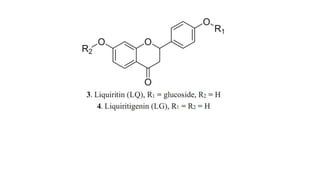
 Flavanone:- Hesperetin, Naringenin, liquiritin, liquiritigenin
Eriodictyol, Homoeriodictyol
 Flavanonol- Taxifolin, Dihydrokaempferol
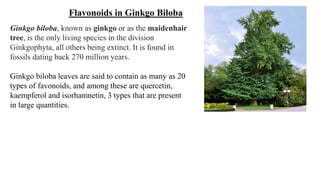
Flavonoids in Ginkgo Biloba
Ginkgo biloba, known as ginkgo or as the maidenhair
tree, is the only living species in the division
Ginkgophyta, all others being extinct. It is found in
fossils dating back 270 million years.
Ginkgo biloba leaves are said to contain as many as 20
types of favonoids, and among these are quercetin,
kaempferol and isorhamnetin, 3 types that are present
in large quantities.
• Antiviral
can inhibit reverse transcriptase, part of the replication process of retroviruses. The
therapeutic relevance of this inhibition has not been established.
• Asthma
• is an effective bronchodilator and helps reduce the release of histamine and other
allergic or inflammatory chemicals in the body.
• has demonstrated significant anti-inflammatory activity because of direct
inhibition of several initial processes of inflammation
• Eczema
Serum IgE levels are highly elevated in eczema patients, and virtually all eczema
patients are positive for allergy testing. Excessive histamine release can be
minimized by the use of antioxidants. Quercetin has been shown to be effective in
reducing IgE levels in rodent models.
Pharmacological activity / Uses
• Inflammation
• Quercetin has been reported to be of use in alleviating symptoms of pollinosis. An
enzymatically modified derivative was found to alleviate ocular but not nasal symptoms
of pollinosis.
• Studies done in test tubes have shown quercetin may prevent immune cells from releasing
histamines which might influence symptoms of allergies.
• A study with rats showed that quercetin effectively reduced immediate-release niacin
(vitamin B3) flush, in part by means of reducing prostaglandin D2 production. A pilot
clinical study of four humans gave preliminary data supporting this.
• Quercetin may have properties of a calcineurin inhibitor, similar to cyclosporin A and
tacrolimus, according to one laboratory study.
• Fibromyalgia
• Quercetin may be effective in the treatment of fibromyalgia because of its
potential anti-inflammatory or mast cell inhibitory properties shown in laboratory
studies
• Cancer
• Laboratory studies have investigated Quercetin's potential for use in anti-cancer
applications. The American Cancer Society says quercetin has been promoted as
being effective against a wide variety of diseases, including cancer.
• Metabolic syndrome
• Quercetin has been shown to increase energy expenditure in rats, but only
for short periods (fewer than 8 weeks). Effects of quercetin on exercise
tolerance in mice have been associated with increased mitochondrial
biogenesis.In mice, an oral quercetin dose of 12.5 to 25 mg/kg increased
gene expression of mitochondrial biomarkers and improved exercise
endurance.
• It has also been claimed that quercetin reduces blood pressure in
hypertensive and obese subjects in whom LDL cholesterol levels were
also reduced.
• In vitro studies showed quercetin and resveratrol combined inhibited
production of fat cells and vascular smooth muscle cell proliferation.
• Supplements of quercetin with vitamin C and niacin does not cause any
significant difference in body mass or composition and has no significant
effect on inflammatory markers, diagnostic blood chemistries, blood
pressure, and blood lipid profiles.
• Monoamine-oxidase inhibitor
• Possibly an active component of heather (Calluna vulgaris), quercetin was
suspected from a bioassay test on crude extracts to selectively inhibit monoamine
oxidase, possibly indicating pharmacological properties.
• Prostatitis
• Quercetin has been found to provides significant symptomatic improvement in
most men with chronic prostatitis, a condition also known as male chronic pelvic
pain syndrome.
Liquorice
• Licorice (Glycyrrhiza glabra) is a traditional medicinal, sweet and soothing herb growing in
several regions of the world.
• The biologically-active components of licorice are well known as glycyrrhizic acid,
liquiritin, glabridin and liquiritigenin.
• anti-inflammatory,
• anti-bacterial,
• antioxidative,
• anti-viral
• expectorant properties and
• effective in the detoxification and protection of the liver.
Pharmacological activity / Uses
Quassinoids (Quassia wood)
Scientific Name(s):Quassia is a collective term for 2 plants: Picrasma excelsa and Quassia
amara L. Family: Simaroubaceae.
Common Name(s): Bitter wood , picrasma , Jamaican quassia ( P. excelsa ), Surinam quassia
( Q. amara ), Amara species , Amargo , Surinam wood , ruda
Chemical constituents
most species of quassia contain quassin and isomers of neoquassinl, volatile oil, gummy
extractive pectin, woody fiber, tartrate and sulphate of lime, chlorides of calcium, sodium,
various salts such as oxalate and ammoniacal salt, nitrate of potassa and sulphate of
soda. Quassia amara, specifically, contains both beta-carbonile and cantin-6 alkaloids as well
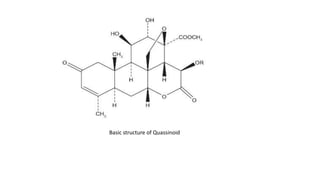
as, primarily, the bitter compounds known as quassinoids
Basic structure of Quassinoid
Uses and Pharmacology
• Quassia has been used as an insecticide.
• Traditional use includes remedies for infestations of lice or worms, anorexia, and
dyspepsia.
• Certain tribes have used the plants to treat measles and fever, and as a mouthwash.
• antilarval activity (by inhibition of cuticle development
• has been used successfully to treat head lice
• possesses antibacterial and antifungal activity.
• antileukemic properties when tested in animals.
• Antitumor activity in mice has been demonstrated, as well as in vitro activity of quassin
against human nasopharynx carcinoma.
• antifertility effects.

Lignans

  • 1.
  • 2.
    LIGNANS • In 1936,Haworth defined lignans as “Phenylpropanoid dimers consisting of two phenyl propane units (C6C3) linked by their central C8 carbon.” • biosynthetically derived from the Phenylpropanoid pathway
  • 3.
  • 4.
    OCCURRENCE OF LIGNANS Widelydistributed in plants.  Usually occur in root, stem, bark, fruits and seed parts of plant.
  • 5.
    LIGNANS OF PODOPHYLLUM Podophyllumis obtained from the dried root and rhizomes of two species of Podophyllum (Berberidaceae), the American species P. peltatum and the Indian species P. hexandrum (P. emodi).
  • 6.
    Chemistry • Podophyllum lignanshave 5 rings designated A, B, C, D, and E. • Ring A consists of a 1,3- dioxolane cycle, • Rings B and C together form the 1,2,3,4- tetrahydronaphthalene substructure • Ring D is composed of a y- lactone, • Ring E, connected at Ring C, is an aryl side chain. • Carbon 4 carries the hydroxyl group involved in the glycosidic linkage, whereas C2 and C3 are involved in the lactone ring D • Bonds projecting below and above the plane of the tetracyclic backbone are referred to as α and b, respectively.
  • 7.
    Pharmacological activity • Anticanceractivity testicular, lymphoid and myeloid leukemia, stomach, ovarian, brain, breast, pancreatic, and small and non-small cell lung cancers • Antiviral activity in the treatment of venereal warts, caused by the human papilloma virus • Rheumatoid arthritis • immunosupressive, antimalarial and antifungal agents
  • 8.
    Piper Cubeba • Theberries of P. cubeba are commonly known as cubeb (in Indonesia known as kemukus) and used in Indonesian traditional medicine to treat gonorrhea, dysentery, syphilis, abdominal pain,diarrhea, enteritis and asthma • P. cubeba is important as a source of pepper (the dried berries) for the worldwide spice market
  • 9.
    (1), cubebinone (2),yatein (3), thujaplicatin trimethylether (4), cubebinin
  • 10.
    Pharmacological activity • Analgesicand anti inflammatory activity • Aphrodisiac • Antiseptic and diuretic action • As a remedy for vomiting, abdominal disorders, indigestion, and amoebic dysentery • To treat veneral diseases like gonorrhea • Also prescribed for the relief of fever, asthma, sunstroke, rheutasim, malaria etc.
  • 11.
    Flaxseed (Linum usitatissimum) •Flaxseed (Linum usitatissimum L.) is an oilseed used in industrial and natural health products. • Flaxseed accumulates many biologically active compounds and elements including linolenic acid, linoleic acid, lignans, cyclic peptides, polysaccharides, alkaloids, cyanogenic glycosides, and cadmium. • The prevailing lignan in the flaxseed is secoisolariciresinol diglucoside (SDG) • In addition to SDG, smaller quantities of other type lignans such as matairesinol, isolariciresinol, lariciresinol and pinoresinol have also been identifed in the flaxseed.
  • 12.
    • Secoisolariciresinol (SECO)is the aglycone of SDG. • SDG-β-D-glucosidase hydrolyses the glucopyranoside bond of SDG and release SECO. • It has molecular formula, C32H46O16 and molecular weight 686.71. • SDG results from the coupling of the 8 and 8′ C- atoms of the side chains of two coniferyl alcohol moieties exists in two isomeric forms in the flaxseed. • In faxseed, SDG is stored in an ester-linked with 3- hydroxy-3-methylglutaric acid (HMGA) and other phenolic compounds such as p-coumaric acid and ferulic acid glycosides to form SDG oligomers of unknown . • The content of SDG varies between 6-29 g/kg in the defatted flaxseed powder Secoisolariciresinol, R=H Secoisolariciresinol Diglucoside, R= glucose matairesinol
  • 13.
    Pharmacological activity • Antioxidant inhibitionof lipid peroxidation and scavenging of hydroxy radical • Anti-platelet-activation factor (PAF) activity. PAF can induce the release of reactive oxygen species from neutrophils. • Antiestrogenic, • Anticarcinogenic, • Antiatherogenic • Antidiabetic activities.
  • 14.
    FLAVONOIDS •The flavonoids arepolyphenolic compounds possessing 15 carbon atoms; two benzene rings joined by a linear three carbon chain having the carbon skeleton C6 - C3 - C6 and they are the plant pigments and they are having polar nature and is solouble in methanol and water. • Flavonoids constitute one of the most characteristic classes of compounds in higher plants. Many flavonoids are easily recognised as flower pigments in most angiosperm families (flowering plants). •They are secondary metabolite and effective in CNS disorders.
  • 15.
    Easily recognized asflower pigments in most angiosperm plants but are not always flower pigments  In plants they repair damage and shield from environmental toxins
  • 16.
    TESTS FOR FLAVONOIDS The extracts were dissolved in ethanol, filtered and subjected to following tests.  Shinoda test: The dried extracts were dissolved in 95% ethanol (5ml) and few drops of concentrated hydrochloric acid (HCL) were added. Then the magnesium turnings were put into the solution and observed for appearance of pink color.  Lead acetate solution test: To small quantity of above residue, lead acetate solution was added and observed for appearance of formation of yellow colored precipitates.
  • 17.
    CORE STRUCTURES ANDNOMENCLATURE • The nomenclature of flavonoids proper is straight-forward with the aromatic ring A condensed to the heterocyclic ring C and the aromatic ring B most often attached at the C2 position. The various substituents are listed first for the A and C ring and - as primed numbers - for the B ring (note that the numbering for the aromatic rings of the open-chained precursor chalcones is reversed). (Harborne JB, ed. (1988) The Flavonoids. Advances in Research. Chapman & Hall.) O O O O OH O OH O O O O OH O OH + Flavanone Dihydroflavonol Flavan-3-ol Flavone Flavon-3-ol Anthocyanidin O OH Chalcone A B O O Isoflavone O Neoflavone A B C
  • 18.
    FLAVONOIDS & THEIREXAMPLES  Flavone:- Luteolin, Apigenin, Tangeritin  Flavonol:- Quercetin, Kaempferol, Myricetin, Fisetin, Isorhamnetin, Pachypodol, Rhamnazin  Flavanone:- Hesperetin, Naringenin, liquiritin, liquiritigenin Eriodictyol, Homoeriodictyol  Flavanonol- Taxifolin, Dihydrokaempferol
  • 19.
    Flavonoids in GinkgoBiloba Ginkgo biloba, known as ginkgo or as the maidenhair tree, is the only living species in the division Ginkgophyta, all others being extinct. It is found in fossils dating back 270 million years. Ginkgo biloba leaves are said to contain as many as 20 types of favonoids, and among these are quercetin, kaempferol and isorhamnetin, 3 types that are present in large quantities.
  • 21.
    • Antiviral can inhibitreverse transcriptase, part of the replication process of retroviruses. The therapeutic relevance of this inhibition has not been established. • Asthma • is an effective bronchodilator and helps reduce the release of histamine and other allergic or inflammatory chemicals in the body. • has demonstrated significant anti-inflammatory activity because of direct inhibition of several initial processes of inflammation • Eczema Serum IgE levels are highly elevated in eczema patients, and virtually all eczema patients are positive for allergy testing. Excessive histamine release can be minimized by the use of antioxidants. Quercetin has been shown to be effective in reducing IgE levels in rodent models. Pharmacological activity / Uses
  • 22.
    • Inflammation • Quercetinhas been reported to be of use in alleviating symptoms of pollinosis. An enzymatically modified derivative was found to alleviate ocular but not nasal symptoms of pollinosis. • Studies done in test tubes have shown quercetin may prevent immune cells from releasing histamines which might influence symptoms of allergies. • A study with rats showed that quercetin effectively reduced immediate-release niacin (vitamin B3) flush, in part by means of reducing prostaglandin D2 production. A pilot clinical study of four humans gave preliminary data supporting this. • Quercetin may have properties of a calcineurin inhibitor, similar to cyclosporin A and tacrolimus, according to one laboratory study.
  • 23.
    • Fibromyalgia • Quercetinmay be effective in the treatment of fibromyalgia because of its potential anti-inflammatory or mast cell inhibitory properties shown in laboratory studies • Cancer • Laboratory studies have investigated Quercetin's potential for use in anti-cancer applications. The American Cancer Society says quercetin has been promoted as being effective against a wide variety of diseases, including cancer.
  • 24.
    • Metabolic syndrome •Quercetin has been shown to increase energy expenditure in rats, but only for short periods (fewer than 8 weeks). Effects of quercetin on exercise tolerance in mice have been associated with increased mitochondrial biogenesis.In mice, an oral quercetin dose of 12.5 to 25 mg/kg increased gene expression of mitochondrial biomarkers and improved exercise endurance. • It has also been claimed that quercetin reduces blood pressure in hypertensive and obese subjects in whom LDL cholesterol levels were also reduced. • In vitro studies showed quercetin and resveratrol combined inhibited production of fat cells and vascular smooth muscle cell proliferation. • Supplements of quercetin with vitamin C and niacin does not cause any significant difference in body mass or composition and has no significant effect on inflammatory markers, diagnostic blood chemistries, blood pressure, and blood lipid profiles.
  • 25.
    • Monoamine-oxidase inhibitor •Possibly an active component of heather (Calluna vulgaris), quercetin was suspected from a bioassay test on crude extracts to selectively inhibit monoamine oxidase, possibly indicating pharmacological properties. • Prostatitis • Quercetin has been found to provides significant symptomatic improvement in most men with chronic prostatitis, a condition also known as male chronic pelvic pain syndrome.
  • 26.
    Liquorice • Licorice (Glycyrrhizaglabra) is a traditional medicinal, sweet and soothing herb growing in several regions of the world. • The biologically-active components of licorice are well known as glycyrrhizic acid, liquiritin, glabridin and liquiritigenin.
  • 28.
    • anti-inflammatory, • anti-bacterial, •antioxidative, • anti-viral • expectorant properties and • effective in the detoxification and protection of the liver. Pharmacological activity / Uses
  • 29.
    Quassinoids (Quassia wood) ScientificName(s):Quassia is a collective term for 2 plants: Picrasma excelsa and Quassia amara L. Family: Simaroubaceae. Common Name(s): Bitter wood , picrasma , Jamaican quassia ( P. excelsa ), Surinam quassia ( Q. amara ), Amara species , Amargo , Surinam wood , ruda Chemical constituents most species of quassia contain quassin and isomers of neoquassinl, volatile oil, gummy extractive pectin, woody fiber, tartrate and sulphate of lime, chlorides of calcium, sodium, various salts such as oxalate and ammoniacal salt, nitrate of potassa and sulphate of soda. Quassia amara, specifically, contains both beta-carbonile and cantin-6 alkaloids as well as, primarily, the bitter compounds known as quassinoids
  • 30.
  • 31.
    Uses and Pharmacology •Quassia has been used as an insecticide. • Traditional use includes remedies for infestations of lice or worms, anorexia, and dyspepsia. • Certain tribes have used the plants to treat measles and fever, and as a mouthwash. • antilarval activity (by inhibition of cuticle development • has been used successfully to treat head lice • possesses antibacterial and antifungal activity. • antileukemic properties when tested in animals. • Antitumor activity in mice has been demonstrated, as well as in vitro activity of quassin against human nasopharynx carcinoma. • antifertility effects.