How Fiber Optics Work
You hear about fiber-optic cables whenever people
  talk about the telephone system, the cable TV
   system or the Internet. They are also used in
   medical imaging and mechanical engineering
                     inspection.
What are Fiber Optics?
   Fiber optics (optical fibers) are long, thin strands
of very pure glass about the diameter of a human
 hair. They are arranged in bundles called optical
cables and used to transmit light signals over long
  distances. If you look closely at a single optical
  fiber, you will see that it has the following parts:
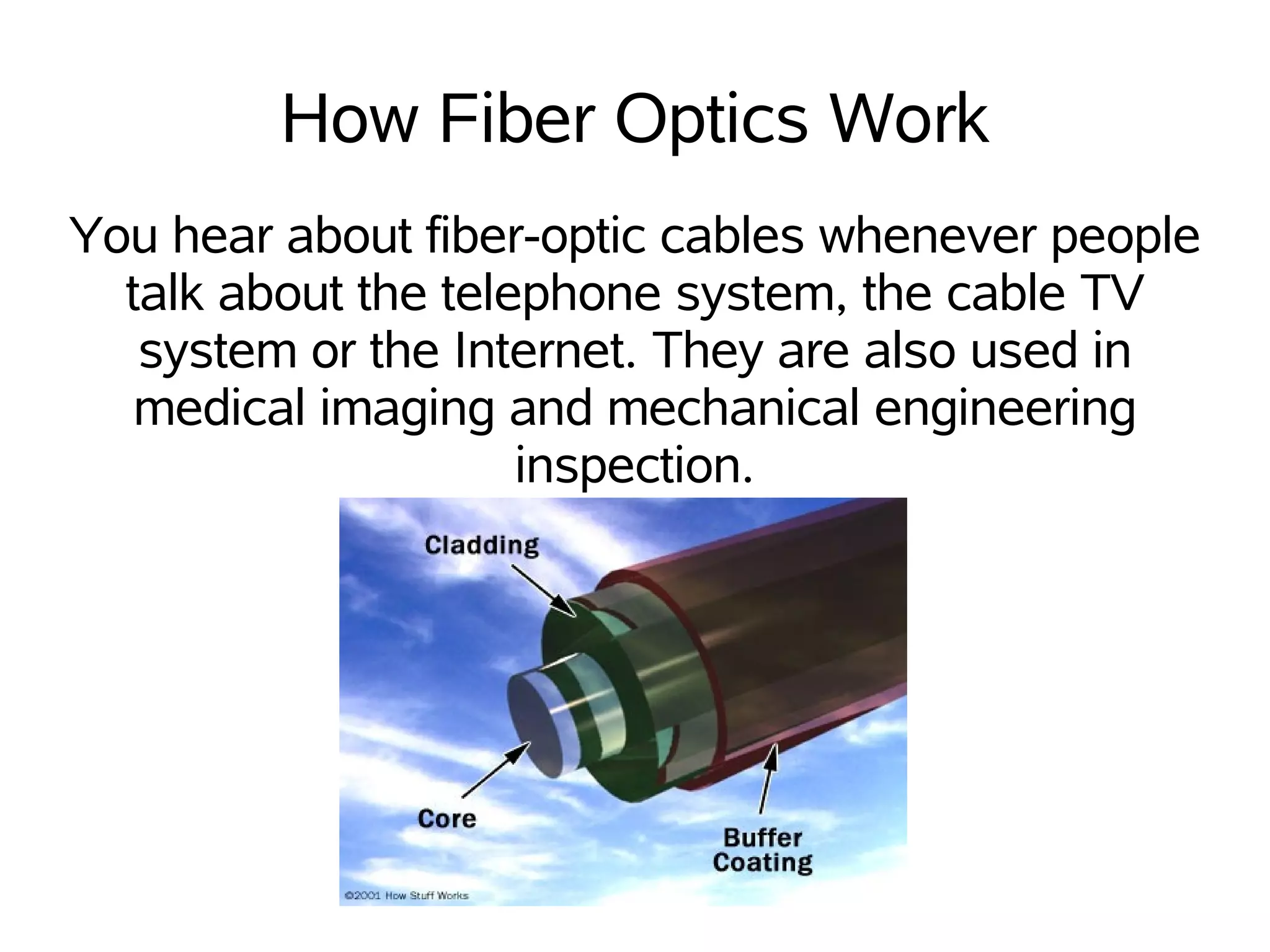
  *Core - Thin glass center of the fiber where the
                      light travels
*Cladding - Outer optical material surrounding the
     core that reflects the light back into the core
 *Buffer coating - Plastic coating that protects the
           fiber from damage and moisture
How Does an Optical Fiber Transmit
             Light?
  The light in a fiber-optic cable travels through the
   core (hallway) by constantly bouncing from the
cladding (mirror-lined walls), a principle called total
 internal reflection. Because the cladding does not
 absorb any light from the core, the light wave can
                 travel great distances.
A Fiber-Optic Relay System
Fiber-optic relay systems consist of the following:
  *Transmitter - Produces and encodes the light
                       signals
 *Optical fiber - Conducts the light signals over a
                      distance
*Optical regenerator - May be necessary to boost
        the light signal (for long distances)
*Optical receiver - Receives and decodes the light
                       signals
Advantages of Fiber Optics
   Compared to conventional metal wire (copper
               wire), optical fibers are:
1.Less expensive
2.Thinner
3.Higher carrying capacity
4.Less signal degradation
5.Light signals
6.Low power
7.Digital signals
8.Non-flammable
9.Lightweight
10.Flexible
How Are Optical Fibers Made?


   1.Making a preform glass cylinder
 2.Drawing the fibers from the preform
         3.Testing the fibers

How Fiber Optics Work

  • 1.
    How Fiber OpticsWork You hear about fiber-optic cables whenever people talk about the telephone system, the cable TV system or the Internet. They are also used in medical imaging and mechanical engineering inspection.
  • 2.
    What are FiberOptics? Fiber optics (optical fibers) are long, thin strands of very pure glass about the diameter of a human hair. They are arranged in bundles called optical cables and used to transmit light signals over long distances. If you look closely at a single optical fiber, you will see that it has the following parts: *Core - Thin glass center of the fiber where the light travels *Cladding - Outer optical material surrounding the core that reflects the light back into the core *Buffer coating - Plastic coating that protects the fiber from damage and moisture
  • 3.
    How Does anOptical Fiber Transmit Light? The light in a fiber-optic cable travels through the core (hallway) by constantly bouncing from the cladding (mirror-lined walls), a principle called total internal reflection. Because the cladding does not absorb any light from the core, the light wave can travel great distances.
  • 4.
    A Fiber-Optic RelaySystem Fiber-optic relay systems consist of the following: *Transmitter - Produces and encodes the light signals *Optical fiber - Conducts the light signals over a distance *Optical regenerator - May be necessary to boost the light signal (for long distances) *Optical receiver - Receives and decodes the light signals
  • 5.
    Advantages of FiberOptics Compared to conventional metal wire (copper wire), optical fibers are: 1.Less expensive 2.Thinner 3.Higher carrying capacity 4.Less signal degradation 5.Light signals 6.Low power 7.Digital signals 8.Non-flammable 9.Lightweight 10.Flexible
  • 6.
    How Are OpticalFibers Made? 1.Making a preform glass cylinder 2.Drawing the fibers from the preform 3.Testing the fibers