@graphific
Roelof Pieters
Introduc0on	
  to	
  

Deep	
  Learning	
  for	
  NLP
22	
  January	
  2015	
  

Stockholm	
  Natural	
  Language	
  Processing	
  Meetup
FEEDA
Slides at:

http://www.slideshare.net/roelofp/220115dlmeetup
1
Deep
Learning ???
2
A couple of headlines… [all November ’14]
3
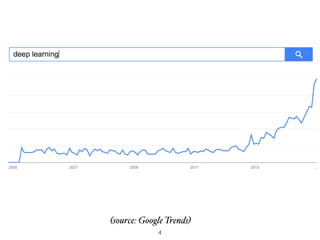
(source: Google Trends)
4
Machine Learning ??
- Audience Check -
5
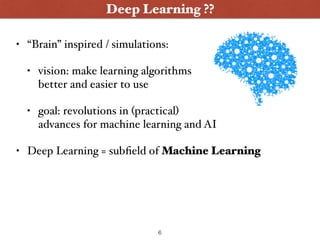
• “Brain” inspired / simulations:
• vision: make learning algorithms 

better and easier to use
• goal: revolutions in (practical) 

advances for machine learning and AI
• Deep Learning = subfield of Machine Learning
Deep Learning ??
6
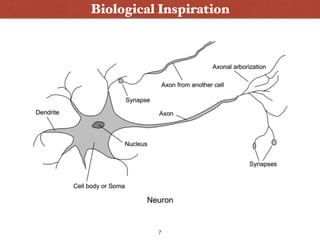
Biological Inspiration
7
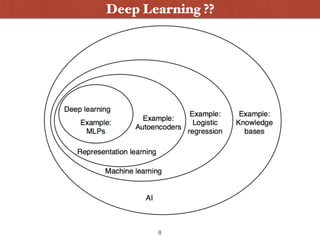
Deep Learning ??
8
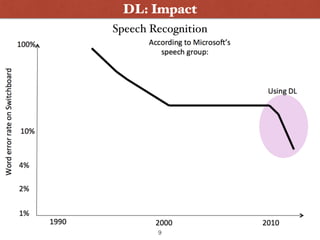
DL: Impact
9
Speech Recognition
DL: Impact
10
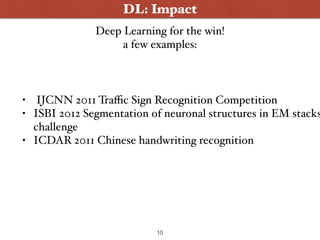
Deep Learning for the win!
a few examples:
• IJCNN 2011 Traffic Sign Recognition Competition
• ISBI 2012 Segmentation of neuronal structures in EM stacks
challenge
• ICDAR 2011 Chinese handwriting recognition
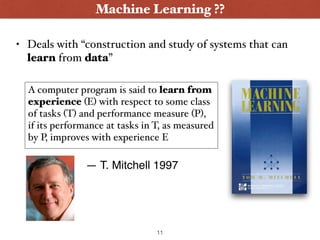
• Deals with “construction and study of systems that can
learn from data”
Machine Learning ??
A computer program is said to learn from
experience (E) with respect to some class
of tasks (T) and performance measure (P),
if its performance at tasks in T, as measured
by P, improves with experience E
— T. Mitchell 1997
11
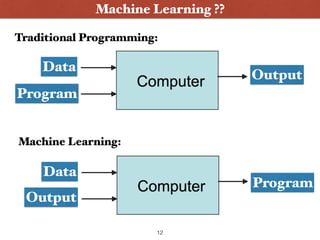
Machine Learning ??
Traditional Programming:
Data
Program
Output
Data
Program
Output
Machine Learning:
12
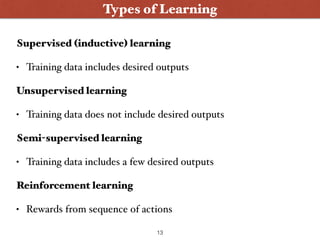
Supervised (inductive) learning
• Training data includes desired outputs
Unsupervised learning
• Training data does not include desired outputs
Semi-supervised learning
• Training data includes a few desired outputs
Reinforcement learning
• Rewards from sequence of actions
Types of Learning
13
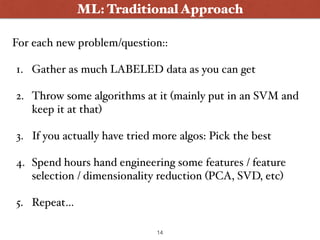
ML: Traditional Approach
1. Gather as much LABELED data as you can get
2. Throw some algorithms at it (mainly put in an SVM and
keep it at that)
3. If you actually have tried more algos: Pick the best
4. Spend hours hand engineering some features / feature
selection / dimensionality reduction (PCA, SVD, etc)
5. Repeat…
For each new problem/question::
14
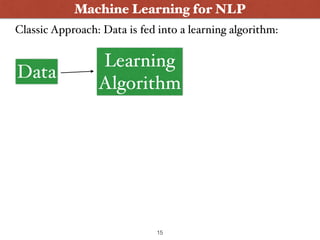
Machine Learning for NLP
Data
Classic Approach: Data is fed into a learning algorithm:
Learning 

Algorithm
15
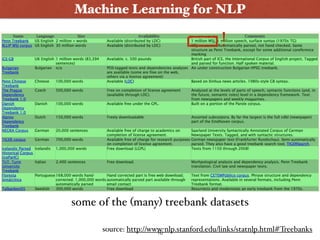
Machine Learning for NLP
some of the (many) treebank datasets
source: http://www-nlp.stanford.edu/links/statnlp.html#Treebanks
!
16
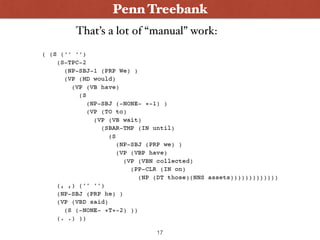
Penn Treebank
That’s a lot of “manual” work:
17
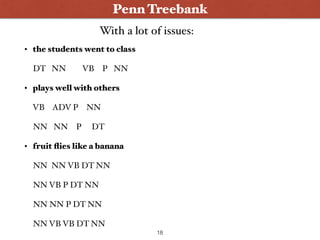
• the students went to class
DT NN VB P NN
• plays well with others
VB ADV P NN
NN NN P DT
• fruit flies like a banana
NN NN VB DT NN
NN VB P DT NN
NN NN P DT NN
NN VB VB DT NN
With a lot of issues:
Penn Treebank
18
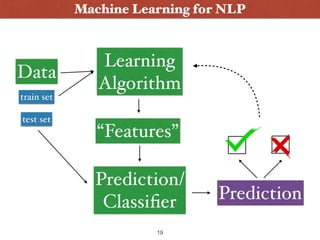
Machine Learning for NLP
Learning 

Algorithm
Data
“Features”
Prediction
Prediction/

Classifier
train set
test set
19
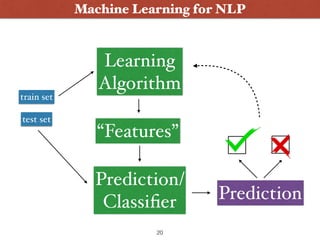
Machine Learning for NLP
Learning 

Algorithm
“Features”
Prediction
Prediction/

Classifier
train set
test set
20
Machine Learning for NLP
• Until the early 1990’s, NLP systems were built manually
with hand-crafted dictionaries and rules.
• As large electronic text corpora became increasingly
available, researchers began using machine learning
techniques to automatically build NLP systems.
• Today, the vast majority of NLP systems use machine
learning.
21
2. Neural Networks

and a short history lesson
22
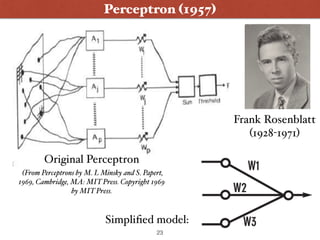
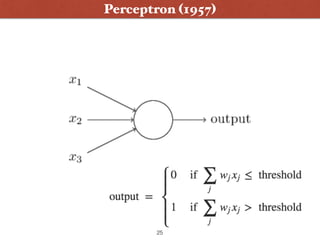
Perceptron (1957)
Frank Rosenblatt 

(1928-1971)
Original Perceptron
Simplified model:
(From Perceptrons by M. L Minsky and S. Papert,
1969, Cambridge, MA: MIT Press. Copyright 1969
by MIT Press.
23
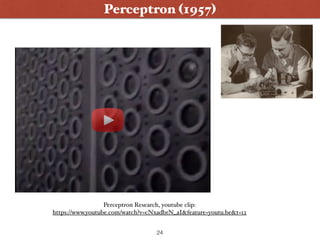
Perceptron (1957)
Perceptron Research, youtube clip: 

https://www.youtube.com/watch?v=cNxadbrN_aI&feature=youtu.be&t=12
24
Perceptron (1957)
25
or
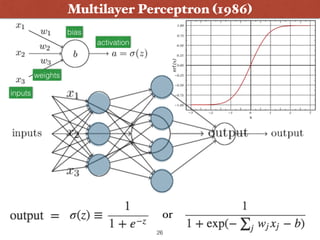
Multilayer Perceptron (1986)
inputs
weights
bias
activation
26
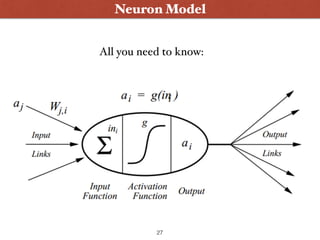
Neuron Model
All you need to know:
27
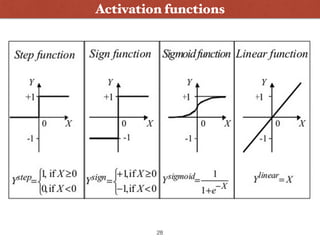
Activation functions
28
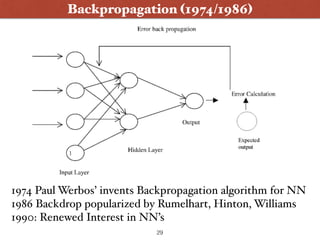
Backpropagation (1974/1986)
1974 Paul Werbos’ invents Backpropagation algorithm for NN
1986 Backdrop popularized by Rumelhart, Hinton, Williams
1990: Renewed Interest in NN’s
29
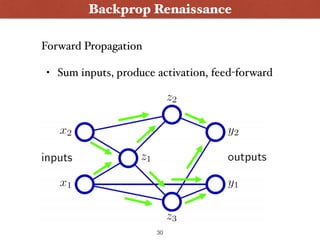
Backprop Renaissance
Forward Propagation
• Sum inputs, produce activation, feed-forward
30
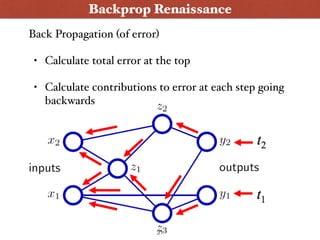
Backprop Renaissance
Back Propagation (of error)
• Calculate total error at the top
• Calculate contributions to error at each step going
backwards
31
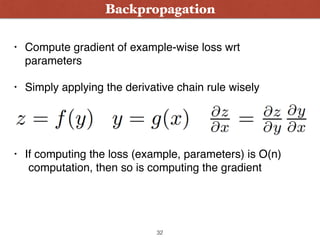
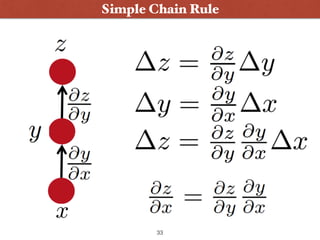
• Compute gradient of example-wise loss wrt
parameters
• Simply applying the derivative chain rule wisely 


• If computing the loss (example, parameters) is O(n)
computation, then so is computing the gradient
Backpropagation
32
Simple Chain Rule
33
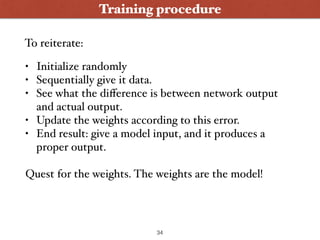
Training procedure
• Initialize randomly
• Sequentially give it data.
• See what the difference is between network output
and actual output.
• Update the weights according to this error.
• End result: give a model input, and it produces a
proper output.
Quest for the weights. The weights are the model!
To reiterate:
34
So why only now?
• Inspired by the architectural depth of the brain,
researchers wanted for decades to train deep
multi-layer neural networks.
• No successful attempts were reported before 2006
…Exception: convolutional neural networks,
LeCun 1998
• SVM: Vapnik and his co-workers developed the
Support Vector Machine (1993) (shallow
architecture).
• Breakthrough in 2006!
35
2006 Breakthrough
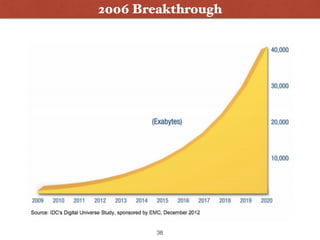
• More data
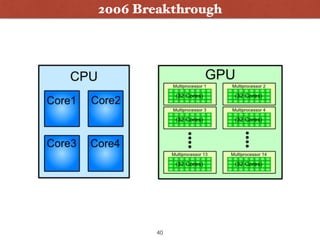
• Faster hardware: GPU’s, multi-core CPU’s
• Working ideas on how to train deep architectures
36
2006 Breakthrough
• More data
• Faster hardware: GPU’s, multi-core CPU’s
• Working ideas on how to train deep architectures
37
2006 Breakthrough
38
2006 Breakthrough
• More data
• Faster hardware: GPU’s, multi-core CPU’s
• Working ideas on how to train deep architectures
39
2006 Breakthrough
40
2006 Breakthrough
• More data
• Faster hardware: GPU’s, multi-core CPU’s
• Working ideas on how to train deep
architectures
41
2006 Breakthrough
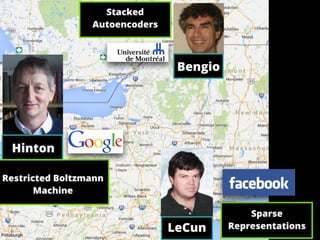
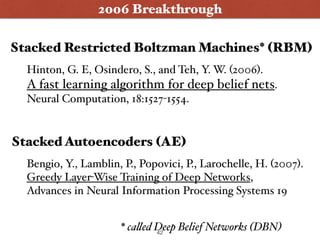
Stacked Restricted Boltzman Machines* (RBM)
Hinton, G. E, Osindero, S., and Teh, Y. W. (2006).

A fast learning algorithm for deep belief nets.

Neural Computation, 18:1527-1554.
Stacked Autoencoders (AE)
Bengio, Y., Lamblin, P., Popovici, P., Larochelle, H. (2007).

Greedy Layer-Wise Training of Deep Networks,

Advances in Neural Information Processing Systems 19
* called Deep Belief Networks (DBN)
42
3. Deep Learning

onwards we go…
43
44
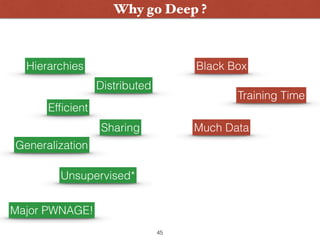
Hierarchies
Efficient
Generalization
Distributed
Sharing
Unsupervised*
Black Box
Training Time
Major PWNAGE!
Much Data
Why go Deep ?
45
No More Handcrafted Features !
46
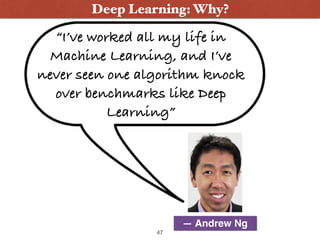
— Andrew Ng
“I’ve worked all my life in
Machine Learning, and I’ve
never seen one algorithm knock
over benchmarks like Deep
Learning”
Deep Learning: Why?
47
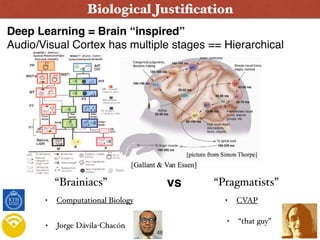
Biological Justification
Deep Learning = Brain “inspired”

Audio/Visual Cortex has multiple stages == Hierarchical
• Computational Biology • CVAP
• Jorge Dávila-Chacón
• “that guy”
“Brainiacs” “Pragmatists”vs
48
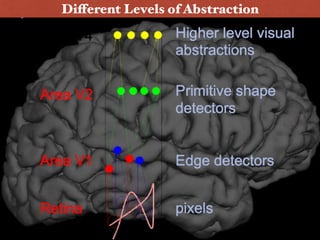
Different Levels of Abstraction
49
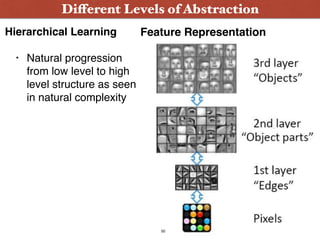
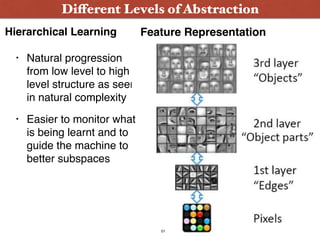
Hierarchical Learning
• Natural progression
from low level to high
level structure as seen
in natural complexity
Different Levels of Abstraction
Feature Representation
50
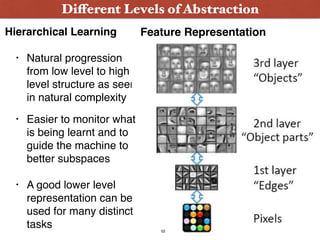
Hierarchical Learning
• Natural progression
from low level to high
level structure as seen
in natural complexity
• Easier to monitor what
is being learnt and to
guide the machine to
better subspaces
Different Levels of Abstraction
Feature Representation
51
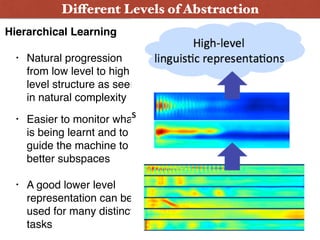
Hierarchical Learning
• Natural progression
from low level to high
level structure as seen
in natural complexity
• Easier to monitor what
is being learnt and to
guide the machine to
better subspaces
• A good lower level
representation can be
used for many distinct
tasks
Different Levels of Abstraction
Feature Representation
52
Hierarchical Learning
• Natural progression
from low level to high
level structure as seen
in natural complexity
• Easier to monitor what
is being learnt and to
guide the machine to
better subspaces
• A good lower level
representation can be
used for many distinct
tasks
Different Levels of Abstraction
Feature Representation
53
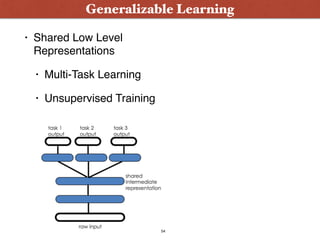
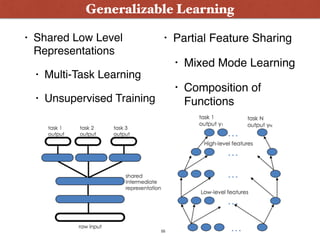
• Shared Low Level
Representations
• Multi-Task Learning
• Unsupervised Training
Generalizable Learning
54
• Shared Low Level
Representations
• Multi-Task Learning
• Unsupervised Training
• Partial Feature Sharing
• Mixed Mode Learning
• Composition of
Functions
Generalizable Learning
55
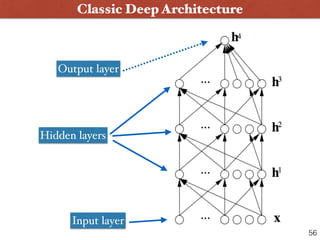
Classic Deep Architecture
Input layer
Hidden layers
Output layer
56
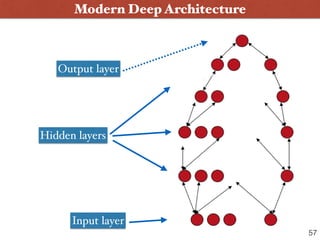
Modern Deep Architecture
Input layer
Hidden layers
Output layer
57
Deep Learning: Why? (again)
Beat state of the art in many areas:
• Language Modeling (2012, Mikolov et al)
• Image Recognition (Krizhevsky won
2012 ImageNet competition)
• Sentiment Classification (2011, Socher et
al)
• Speech Recognition (2010, Dahl et al)
• MNIST hand-written digit recognition
(Ciresan et al, 2010)
58
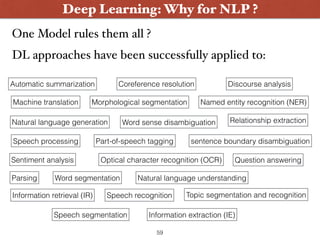
One Model rules them all ?


DL approaches have been successfully applied to:
Deep Learning: Why for NLP ?
Automatic summarization Coreference resolution Discourse analysis
Machine translation Morphological segmentation Named entity recognition (NER)
Natural language generation
Natural language understanding
Optical character recognition (OCR)
Part-of-speech tagging
Parsing
Question answering
Relationship extraction
sentence boundary disambiguation
Sentiment analysis
Speech recognition
Speech segmentation
Topic segmentation and recognition
Word segmentation
Word sense disambiguation
Information retrieval (IR)
Information extraction (IE)
Speech processing
59
- COFFEE BREAK -
after the break we return with: CODE
Download the code samples already now from:
https://github.com/graphific/DL-Meetup-intro
http://goo.gl/abX1E2shortened url: 
 60
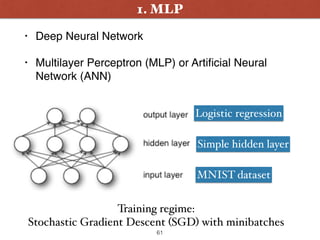
• Deep Neural Network
• Multilayer Perceptron (MLP) or Artificial Neural
Network (ANN)
1. MLP
Logistic regression
Training regime: 

Stochastic Gradient Descent (SGD) with minibatches
MNIST dataset
Simple hidden layer
61
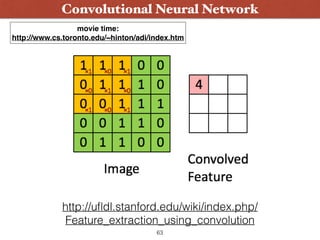
2. Convolutional Neural Network
62
from: Krizhevsky, Sutskever, Hinton. (2012). ImageNet Classification with Deep Convolutional Neural Networks
[breakthrough in object recognition, Imagenet 2012]
Convolutional Neural Network
http://ufldl.stanford.edu/wiki/index.php/
Feature_extraction_using_convolution
movie time:
http://www.cs.toronto.edu/~hinton/adi/index.htm
63
Thats it, no more code! (for now)
64
Deep Learning: Future Developments
Currently an explosion of developments
• Hessian-Free networks (2010)
• Long Short Term Memory (2011)
• Large Convolutional nets, max-pooling (2011)
• Nesterov’s Gradient Descent (2013)
Currently state of the art but...
• No way of doing logical inference (extrapolation)
• No easy integration of abstract knowledge
• Hypothetic space bias might not conform with reality
65
Deep Learning: Future Challenges
a
66
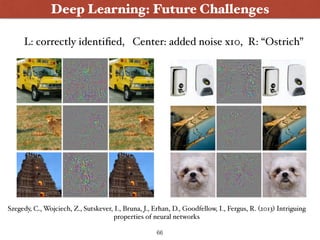
Szegedy, C., Wojciech, Z., Sutskever, I., Bruna, J., Erhan, D., Goodfellow, I., Fergus, R. (2013) Intriguing
properties of neural networks
L: correctly identified, Center: added noise x10, R: “Ostrich”
• cuda-convnet2 (Alex Krizhevsky, Toronto) (c++/
CUDA, optimized for GTX 580) 

https://code.google.com/p/cuda-convnet2/
• Caffe (Berkeley) (Cuda/OpenCL, Theano, Python)

http://caffe.berkeleyvision.org/
• OverFeat (NYU) 

http://cilvr.nyu.edu/doku.php?id=code:start
Wanna Play ?
• Theano - CPU/GPU symbolic expression compiler in
python (from LISA lab at University of Montreal). http://
deeplearning.net/software/theano/
• Pylearn2 - library designed to make machine learning
research easy. http://deeplearning.net/software/pylearn2/
• Torch - Matlab-like environment for state-of-the-art
machine learning algorithms in lua (from Ronan Collobert,
Clement Farabet and Koray Kavukcuoglu) http://torch.ch/
• more info: http://deeplearning.net/software links/
Wanna Play ?
Wanna Play ?
as PhD candidate KTH/CSC:
“Always interested in discussing
Machine Learning, Deep
Architectures, Graphs, and
Language Technology”
In touch!
roelof@kth.se
www.csc.kth.se/~roelof/
Internship / EntrepeneurshipAcademic/Research
as CIO/CTO Feeda:
“Always looking for additions to our 

brand new R&D team”


[Internships upcoming on 

KTH exjobb website…]
roelof@feeda.com
www.feeda.com
Feeda
69
Were Hiring!
roelof@feeda.com
www.feeda.com
Feeda
• Dev Ops
• Software Developers
• Data Scientists
70
Thanks for listening
Mingling time!
71
72
Can’t get enough?
Come to my talk Tomorrow (friday)
Description on KTH website
Visual-Semantic Embeddings: 

some thoughts on Language
Roelof Pieters TCS/CSC
Friday jan 23 13:30.
Room 304, Teknikringen 14 level 3
Appendum
Some of the exciting recent developments in NLP

especially Distributed Semantics
73
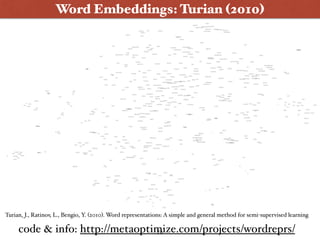
Word Embeddings: Turian (2010)
Turian, J., Ratinov, L., Bengio, Y. (2010). Word representations: A simple and general method for semi-supervised learning
code & info: http://metaoptimize.com/projects/wordreprs/74
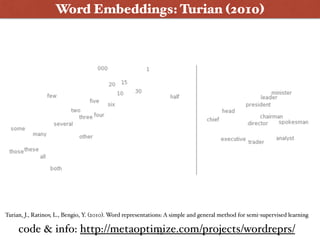
Word Embeddings: Turian (2010)
Turian, J., Ratinov, L., Bengio, Y. (2010). Word representations: A simple and general method for semi-supervised learning
code & info: http://metaoptimize.com/projects/wordreprs/75
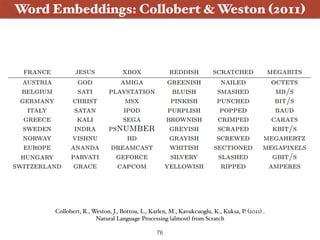
Word Embeddings: Collobert & Weston (2011)
Collobert, R., Weston, J., Bottou, L., Karlen, M., Kavukcuoglu, K., Kuksa, P. (2011) .
Natural Language Processing (almost) from Scratch
76
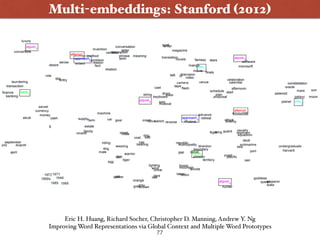
Multi-embeddings: Stanford (2012)
Eric H. Huang, Richard Socher, Christopher D. Manning, Andrew Y. Ng 

Improving Word Representations via Global Context and Multiple Word Prototypes
77
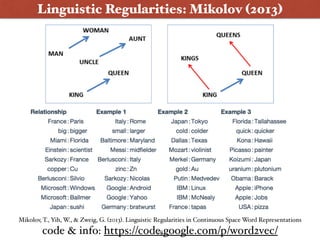
Linguistic Regularities: Mikolov (2013)
code & info: https://code.google.com/p/word2vec/
Mikolov, T., Yih, W., & Zweig, G. (2013). Linguistic Regularities in Continuous Space Word Representations
78
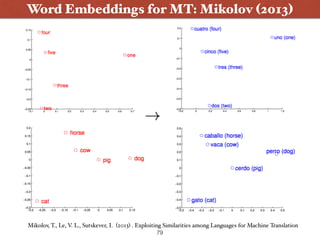
Word Embeddings for MT: Mikolov (2013)
Mikolov, T., Le, V. L., Sutskever, I. (2013) . Exploiting Similarities among Languages for Machine Translation
79
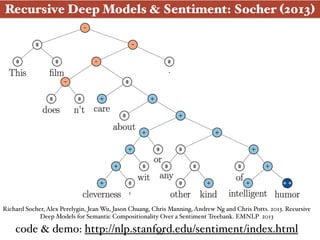
Recursive Deep Models & Sentiment: Socher (2013)
Richard Socher, Alex Perelygin, Jean Wu, Jason Chuang, Chris Manning, Andrew Ng and Chris Potts. 2013. Recursive
Deep Models for Semantic Compositionality Over a Sentiment Treebank. EMNLP 2013
code & demo: http://nlp.stanford.edu/sentiment/index.html80
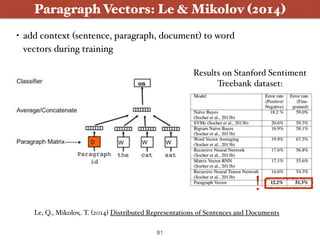
Paragraph Vectors: Le & Mikolov (2014)
Le, Q., Mikolov,. T. (2014) Distributed Representations of Sentences and Documents
81
• add context (sentence, paragraph, document) to word
vectors during training
!
Results on Stanford Sentiment 

Treebank dataset:
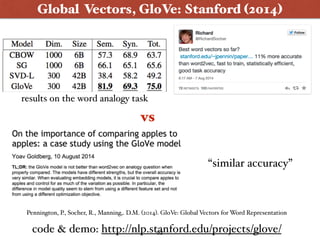
Global Vectors, GloVe: Stanford (2014)
Pennington, P., Socher, R., Manning,. D.M. (2014). GloVe: Global Vectors for Word Representation
code & demo: http://nlp.stanford.edu/projects/glove/
vs
results on the word analogy task
“similar accuracy”
82
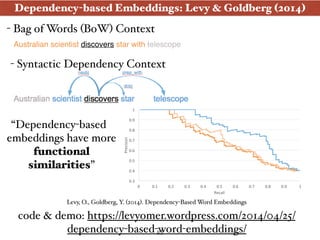
Dependency-based Embeddings: Levy & Goldberg (2014)
Levy, O., Goldberg, Y. (2014). Dependency-Based Word Embeddings
code & demo: https://levyomer.wordpress.com/2014/04/25/
dependency-based-word-embeddings/
- Syntactic Dependency Context
Australian scientist discovers star with telescope
- Bag of Words (BoW) Context
0.3$
0.4$
0.5$
0.6$
0.7$
0.8$
0.9$
1$
0$ 0.1$ 0.2$ 0.3$ 0.4$ 0.5$ 0.6$ 0.7$ 0.8$ 0.9$ 1$
Precision$
Recall$
“Dependency-based
embeddings have more
functional
similarities”
83

Deep Learning, an interactive introduction for NLP-ers

  • 1.
    @graphific Roelof Pieters Introduc0on  to  
 Deep  Learning  for  NLP 22  January  2015  
 Stockholm  Natural  Language  Processing  Meetup FEEDA Slides at:
 http://www.slideshare.net/roelofp/220115dlmeetup 1
  • 2.
  • 3.
    A couple ofheadlines… [all November ’14] 3
  • 4.
  • 5.
    Machine Learning ?? -Audience Check - 5
  • 6.
    • “Brain” inspired/ simulations: • vision: make learning algorithms 
 better and easier to use • goal: revolutions in (practical) 
 advances for machine learning and AI • Deep Learning = subfield of Machine Learning Deep Learning ?? 6
  • 7.
  • 8.
  • 9.
  • 10.
    DL: Impact 10 Deep Learningfor the win! a few examples: • IJCNN 2011 Traffic Sign Recognition Competition • ISBI 2012 Segmentation of neuronal structures in EM stacks challenge • ICDAR 2011 Chinese handwriting recognition
  • 11.
    • Deals with“construction and study of systems that can learn from data” Machine Learning ?? A computer program is said to learn from experience (E) with respect to some class of tasks (T) and performance measure (P), if its performance at tasks in T, as measured by P, improves with experience E — T. Mitchell 1997 11
  • 12.
    Machine Learning ?? TraditionalProgramming: Data Program Output Data Program Output Machine Learning: 12
  • 13.
    Supervised (inductive) learning •Training data includes desired outputs Unsupervised learning • Training data does not include desired outputs Semi-supervised learning • Training data includes a few desired outputs Reinforcement learning • Rewards from sequence of actions Types of Learning 13
  • 14.
    ML: Traditional Approach 1.Gather as much LABELED data as you can get 2. Throw some algorithms at it (mainly put in an SVM and keep it at that) 3. If you actually have tried more algos: Pick the best 4. Spend hours hand engineering some features / feature selection / dimensionality reduction (PCA, SVD, etc) 5. Repeat… For each new problem/question:: 14
  • 15.
    Machine Learning forNLP Data Classic Approach: Data is fed into a learning algorithm: Learning 
 Algorithm 15
  • 16.
    Machine Learning forNLP some of the (many) treebank datasets source: http://www-nlp.stanford.edu/links/statnlp.html#Treebanks ! 16
  • 17.
    Penn Treebank That’s alot of “manual” work: 17
  • 18.
    • the studentswent to class DT NN VB P NN • plays well with others VB ADV P NN NN NN P DT • fruit flies like a banana NN NN VB DT NN NN VB P DT NN NN NN P DT NN NN VB VB DT NN With a lot of issues: Penn Treebank 18
  • 19.
    Machine Learning forNLP Learning 
 Algorithm Data “Features” Prediction Prediction/
 Classifier train set test set 19
  • 20.
    Machine Learning forNLP Learning 
 Algorithm “Features” Prediction Prediction/
 Classifier train set test set 20
  • 21.
    Machine Learning forNLP • Until the early 1990’s, NLP systems were built manually with hand-crafted dictionaries and rules. • As large electronic text corpora became increasingly available, researchers began using machine learning techniques to automatically build NLP systems. • Today, the vast majority of NLP systems use machine learning. 21
  • 22.
    2. Neural Networks
 anda short history lesson 22
  • 23.
    Perceptron (1957) Frank Rosenblatt
 (1928-1971) Original Perceptron Simplified model: (From Perceptrons by M. L Minsky and S. Papert, 1969, Cambridge, MA: MIT Press. Copyright 1969 by MIT Press. 23
  • 24.
    Perceptron (1957) Perceptron Research,youtube clip: 
 https://www.youtube.com/watch?v=cNxadbrN_aI&feature=youtu.be&t=12 24
  • 25.
  • 26.
  • 27.
    Neuron Model All youneed to know: 27
  • 28.
  • 29.
    Backpropagation (1974/1986) 1974 PaulWerbos’ invents Backpropagation algorithm for NN 1986 Backdrop popularized by Rumelhart, Hinton, Williams 1990: Renewed Interest in NN’s 29
  • 30.
    Backprop Renaissance Forward Propagation •Sum inputs, produce activation, feed-forward 30
  • 31.
    Backprop Renaissance Back Propagation(of error) • Calculate total error at the top • Calculate contributions to error at each step going backwards 31
  • 32.
    • Compute gradientof example-wise loss wrt parameters • Simply applying the derivative chain rule wisely 
 
 
 • If computing the loss (example, parameters) is O(n) computation, then so is computing the gradient Backpropagation 32
  • 33.
  • 34.
    Training procedure • Initializerandomly • Sequentially give it data. • See what the difference is between network output and actual output. • Update the weights according to this error. • End result: give a model input, and it produces a proper output. Quest for the weights. The weights are the model! To reiterate: 34
  • 35.
    So why onlynow? • Inspired by the architectural depth of the brain, researchers wanted for decades to train deep multi-layer neural networks. • No successful attempts were reported before 2006 …Exception: convolutional neural networks, LeCun 1998 • SVM: Vapnik and his co-workers developed the Support Vector Machine (1993) (shallow architecture). • Breakthrough in 2006! 35
  • 36.
    2006 Breakthrough • Moredata • Faster hardware: GPU’s, multi-core CPU’s • Working ideas on how to train deep architectures 36
  • 37.
    2006 Breakthrough • Moredata • Faster hardware: GPU’s, multi-core CPU’s • Working ideas on how to train deep architectures 37
  • 38.
  • 39.
    2006 Breakthrough • Moredata • Faster hardware: GPU’s, multi-core CPU’s • Working ideas on how to train deep architectures 39
  • 40.
  • 41.
    2006 Breakthrough • Moredata • Faster hardware: GPU’s, multi-core CPU’s • Working ideas on how to train deep architectures 41
  • 42.
    2006 Breakthrough Stacked RestrictedBoltzman Machines* (RBM) Hinton, G. E, Osindero, S., and Teh, Y. W. (2006).
 A fast learning algorithm for deep belief nets.
 Neural Computation, 18:1527-1554. Stacked Autoencoders (AE) Bengio, Y., Lamblin, P., Popovici, P., Larochelle, H. (2007).
 Greedy Layer-Wise Training of Deep Networks,
 Advances in Neural Information Processing Systems 19 * called Deep Belief Networks (DBN)
42
  • 43.
  • 44.
  • 45.
  • 46.
    No More HandcraftedFeatures ! 46
  • 47.
    — Andrew Ng “I’veworked all my life in Machine Learning, and I’ve never seen one algorithm knock over benchmarks like Deep Learning” Deep Learning: Why? 47
  • 48.
    Biological Justification Deep Learning= Brain “inspired”
 Audio/Visual Cortex has multiple stages == Hierarchical • Computational Biology • CVAP • Jorge Dávila-Chacón • “that guy” “Brainiacs” “Pragmatists”vs 48
  • 49.
    Different Levels ofAbstraction 49
  • 50.
    Hierarchical Learning • Naturalprogression from low level to high level structure as seen in natural complexity Different Levels of Abstraction Feature Representation 50
  • 51.
    Hierarchical Learning • Naturalprogression from low level to high level structure as seen in natural complexity • Easier to monitor what is being learnt and to guide the machine to better subspaces Different Levels of Abstraction Feature Representation 51
  • 52.
    Hierarchical Learning • Naturalprogression from low level to high level structure as seen in natural complexity • Easier to monitor what is being learnt and to guide the machine to better subspaces • A good lower level representation can be used for many distinct tasks Different Levels of Abstraction Feature Representation 52
  • 53.
    Hierarchical Learning • Naturalprogression from low level to high level structure as seen in natural complexity • Easier to monitor what is being learnt and to guide the machine to better subspaces • A good lower level representation can be used for many distinct tasks Different Levels of Abstraction Feature Representation 53
  • 54.
    • Shared LowLevel Representations • Multi-Task Learning • Unsupervised Training Generalizable Learning 54
  • 55.
    • Shared LowLevel Representations • Multi-Task Learning • Unsupervised Training • Partial Feature Sharing • Mixed Mode Learning • Composition of Functions Generalizable Learning 55
  • 56.
    Classic Deep Architecture Inputlayer Hidden layers Output layer 56
  • 57.
    Modern Deep Architecture Inputlayer Hidden layers Output layer 57
  • 58.
    Deep Learning: Why?(again) Beat state of the art in many areas: • Language Modeling (2012, Mikolov et al) • Image Recognition (Krizhevsky won 2012 ImageNet competition) • Sentiment Classification (2011, Socher et al) • Speech Recognition (2010, Dahl et al) • MNIST hand-written digit recognition (Ciresan et al, 2010) 58
  • 59.
    One Model rulesthem all ?
 
 DL approaches have been successfully applied to: Deep Learning: Why for NLP ? Automatic summarization Coreference resolution Discourse analysis Machine translation Morphological segmentation Named entity recognition (NER) Natural language generation Natural language understanding Optical character recognition (OCR) Part-of-speech tagging Parsing Question answering Relationship extraction sentence boundary disambiguation Sentiment analysis Speech recognition Speech segmentation Topic segmentation and recognition Word segmentation Word sense disambiguation Information retrieval (IR) Information extraction (IE) Speech processing 59
  • 60.
    - COFFEE BREAK- after the break we return with: CODE Download the code samples already now from: https://github.com/graphific/DL-Meetup-intro http://goo.gl/abX1E2shortened url: 
 60
  • 61.
    • Deep NeuralNetwork • Multilayer Perceptron (MLP) or Artificial Neural Network (ANN) 1. MLP Logistic regression Training regime: 
 Stochastic Gradient Descent (SGD) with minibatches MNIST dataset Simple hidden layer 61
  • 62.
    2. Convolutional NeuralNetwork 62 from: Krizhevsky, Sutskever, Hinton. (2012). ImageNet Classification with Deep Convolutional Neural Networks [breakthrough in object recognition, Imagenet 2012]
  • 63.
  • 64.
    Thats it, nomore code! (for now) 64
  • 65.
    Deep Learning: FutureDevelopments Currently an explosion of developments • Hessian-Free networks (2010) • Long Short Term Memory (2011) • Large Convolutional nets, max-pooling (2011) • Nesterov’s Gradient Descent (2013) Currently state of the art but... • No way of doing logical inference (extrapolation) • No easy integration of abstract knowledge • Hypothetic space bias might not conform with reality 65
  • 66.
    Deep Learning: FutureChallenges a 66 Szegedy, C., Wojciech, Z., Sutskever, I., Bruna, J., Erhan, D., Goodfellow, I., Fergus, R. (2013) Intriguing properties of neural networks L: correctly identified, Center: added noise x10, R: “Ostrich”
  • 67.
    • cuda-convnet2 (AlexKrizhevsky, Toronto) (c++/ CUDA, optimized for GTX 580) 
 https://code.google.com/p/cuda-convnet2/ • Caffe (Berkeley) (Cuda/OpenCL, Theano, Python)
 http://caffe.berkeleyvision.org/ • OverFeat (NYU) 
 http://cilvr.nyu.edu/doku.php?id=code:start Wanna Play ?
  • 68.
    • Theano -CPU/GPU symbolic expression compiler in python (from LISA lab at University of Montreal). http:// deeplearning.net/software/theano/ • Pylearn2 - library designed to make machine learning research easy. http://deeplearning.net/software/pylearn2/ • Torch - Matlab-like environment for state-of-the-art machine learning algorithms in lua (from Ronan Collobert, Clement Farabet and Koray Kavukcuoglu) http://torch.ch/ • more info: http://deeplearning.net/software links/ Wanna Play ? Wanna Play ?
  • 69.
    as PhD candidateKTH/CSC: “Always interested in discussing Machine Learning, Deep Architectures, Graphs, and Language Technology” In touch! roelof@kth.se www.csc.kth.se/~roelof/ Internship / EntrepeneurshipAcademic/Research as CIO/CTO Feeda: “Always looking for additions to our 
 brand new R&D team”
 
 [Internships upcoming on 
 KTH exjobb website…] roelof@feeda.com www.feeda.com Feeda 69
  • 70.
    Were Hiring! roelof@feeda.com www.feeda.com Feeda • DevOps • Software Developers • Data Scientists 70
  • 71.
  • 72.
    72 Can’t get enough? Cometo my talk Tomorrow (friday) Description on KTH website Visual-Semantic Embeddings: 
 some thoughts on Language Roelof Pieters TCS/CSC Friday jan 23 13:30. Room 304, Teknikringen 14 level 3
  • 73.
    Appendum Some of theexciting recent developments in NLP
 especially Distributed Semantics 73
  • 74.
    Word Embeddings: Turian(2010) Turian, J., Ratinov, L., Bengio, Y. (2010). Word representations: A simple and general method for semi-supervised learning code & info: http://metaoptimize.com/projects/wordreprs/74
  • 75.
    Word Embeddings: Turian(2010) Turian, J., Ratinov, L., Bengio, Y. (2010). Word representations: A simple and general method for semi-supervised learning code & info: http://metaoptimize.com/projects/wordreprs/75
  • 76.
    Word Embeddings: Collobert& Weston (2011) Collobert, R., Weston, J., Bottou, L., Karlen, M., Kavukcuoglu, K., Kuksa, P. (2011) . Natural Language Processing (almost) from Scratch 76
  • 77.
    Multi-embeddings: Stanford (2012) EricH. Huang, Richard Socher, Christopher D. Manning, Andrew Y. Ng 
 Improving Word Representations via Global Context and Multiple Word Prototypes 77
  • 78.
    Linguistic Regularities: Mikolov(2013) code & info: https://code.google.com/p/word2vec/ Mikolov, T., Yih, W., & Zweig, G. (2013). Linguistic Regularities in Continuous Space Word Representations 78
  • 79.
    Word Embeddings forMT: Mikolov (2013) Mikolov, T., Le, V. L., Sutskever, I. (2013) . Exploiting Similarities among Languages for Machine Translation 79
  • 80.
    Recursive Deep Models& Sentiment: Socher (2013) Richard Socher, Alex Perelygin, Jean Wu, Jason Chuang, Chris Manning, Andrew Ng and Chris Potts. 2013. Recursive Deep Models for Semantic Compositionality Over a Sentiment Treebank. EMNLP 2013 code & demo: http://nlp.stanford.edu/sentiment/index.html80
  • 81.
    Paragraph Vectors: Le& Mikolov (2014) Le, Q., Mikolov,. T. (2014) Distributed Representations of Sentences and Documents 81 • add context (sentence, paragraph, document) to word vectors during training ! Results on Stanford Sentiment 
 Treebank dataset:
  • 82.
    Global Vectors, GloVe:Stanford (2014) Pennington, P., Socher, R., Manning,. D.M. (2014). GloVe: Global Vectors for Word Representation code & demo: http://nlp.stanford.edu/projects/glove/ vs results on the word analogy task “similar accuracy” 82
  • 83.
    Dependency-based Embeddings: Levy& Goldberg (2014) Levy, O., Goldberg, Y. (2014). Dependency-Based Word Embeddings code & demo: https://levyomer.wordpress.com/2014/04/25/ dependency-based-word-embeddings/ - Syntactic Dependency Context Australian scientist discovers star with telescope - Bag of Words (BoW) Context 0.3$ 0.4$ 0.5$ 0.6$ 0.7$ 0.8$ 0.9$ 1$ 0$ 0.1$ 0.2$ 0.3$ 0.4$ 0.5$ 0.6$ 0.7$ 0.8$ 0.9$ 1$ Precision$ Recall$ “Dependency-based embeddings have more functional similarities” 83