@graphific
Roelof Pieters
Guest	
  Lecture:	
  Deep	
  Learning	
  
for	
  Informa8on	
  Retrieval
28	
  April	
  2015
www.csc.kth.se/~roelof/
roelof@kth.se
roelof@graph-technologies.com
Gve Systems
Graph Technologies R&D
DD2476 Search Engines and Information Retrieval Systems
https://www.kth.se/social/course/DD2476/
slides	
  online	
  at	
  

h4p://www.slideshare.net/roelofp/deep-­‐learning-­‐for-­‐informa=on-­‐retrieval	
  
2
About Me
• (-10y) CS dropout (Amsterdam Technical Univ.)
• (2y) Msc Social Anthropology, Stockholm
University
• Current: PhD candidate at KTH/CSC with focus
on:
• Deep Learning for Natural Language
Processing (Distributed Semantics)
• Graph-based approaches for Knowledge
Representation
• Multi-modal models
• Current: Data Science Consultant at Graph
Technologies RD & Gve-Systems
• Recommender Systems
• Deep Learning
• Realtime Graph-based Search Engines
3
Information Retrieval (IR)
- Hedvig Kjellström, lecture 1
4
Data landscape is changing
1. Amount of digital data
is growing at
increasing rate (IOT,
digitalization,
wearables, phones/
tablets)
2. Data types are shifting as well:
1. from text to audio-visual
2. from professional to personal/social (social media)
3. from semi-structured to unstructured
[Jussi Karlgren, NLP Sthlm Meetup 2014]
6
Data landscape is changing
Triple V’s of Big Data:
1. Volume
2. Velocity
3. Variety
7
Making sense of Data
Typical ML Regression
8
Making sense of Data
Neural NetTypical ML Regression
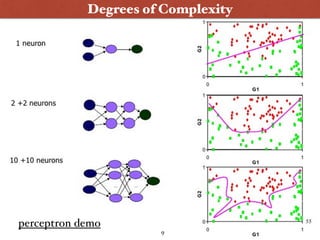
Degrees of Complexity
9
perceptron demo
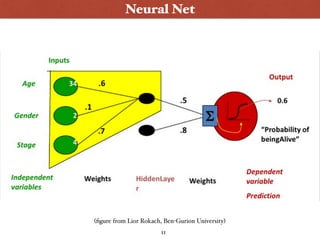
Neural Net
10
(figure from Lior Rokach, Ben-Gurion University)
Neural Net
11
(figure from Lior Rokach, Ben-Gurion University)
Neural Net
12
(figure from Lior Rokach, Ben-Gurion University)
Neural Net
13
(figure from Lior Rokach, Ben-Gurion University)
Neural Net
14
(figure from Lior Rokach, Ben-Gurion University)
Neural Net
15
multilayer nn demo
Deep Learning ??
16
Deep Learning ??
17
• Learning multiple layers
• “Back propagation”
• Can “theoretically” learn any function!
Prior to 2006:
• Very slow and inefficient
• SVMs, random forests, etc. SOTA
18
2006+: the 3 Deep Learning Conspirators
19
20
— Andrew Ng
“I’ve worked all my life in
Machine Learning, and I’ve
never seen one algorithm knock
over benchmarks like Deep
Learning”
Deep Learning: Why?
21
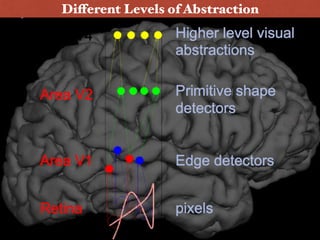
Different Levels of Abstraction
22
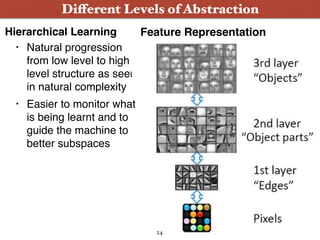
Hierarchical Learning
• Natural progression
from low level to high
level structure as seen
in natural complexity
Different Levels of Abstraction
Feature Representation
23
Hierarchical Learning
• Natural progression
from low level to high
level structure as seen
in natural complexity
• Easier to monitor what
is being learnt and to
guide the machine to
better subspaces
Different Levels of Abstraction
Feature Representation
24
Hierarchical Learning
• Natural progression
from low level to high
level structure as seen
in natural complexity
• Easier to monitor what
is being learnt and to
guide the machine to
better subspaces
• A good lower level
representation can be
used for many distinct
tasks
Different Levels of Abstraction
Feature Representation
25
Hierarchical Learning
• Natural progression
from low level to high
level structure as seen
in natural complexity
Different Levels of Abstraction
Feature Representation
2626
• Easier to monitor what
is being learnt and to
guide the machine to
better subspaces
• A good lower level
representation can be
used for many distinct
tasks
Classic Deep Architecture
Input layer
Hidden layers
Output layer
27
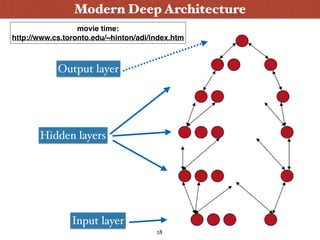
Modern Deep Architecture
Input layer
Hidden layers
Output layer
movie time:
http://www.cs.toronto.edu/~hinton/adi/index.htm
28
[Kudos to Richard Socher, for this eloquent summary :) ]
• Manually designed features are often over-specified, incomplete
and take a long time to design and validate
• Learned Features are easy to adapt, fast to learn
• Deep learning provides a very flexible, (almost?) universal,
learnable framework for representing world, visual and
linguistic information.
• Deep learning can learn unsupervised (from raw text/audio/
images/whatever content) and supervised (with specific labels
like positive/negative)
Why Deep Learning ?
29
Word Embeddings
30
31
What about NLP ?
1. Language is ambiguous:

Every sentence has many possible interpretations.
2. Language is productive:

We will always encounter new words or new
constructions
3. Language is culturally specific
Some of the challenges in Language Understanding:
• NLP treats words mainly (rule-based/statistical
approaches at least) as atomic symbols:

• or in vector space:

• also known as “one hot” representation.
• Its problem ?
Language Representation
Love Candy Store
[0 0 0 0 0 1 0 0 0 0 0 0 0 0 0 0 0 …]
Candy [0 0 0 0 0 1 0 0 0 0 0 0 0 0 0 0 0 …] AND
Store [0 0 0 0 0 0 0 0 0 0 0 0 0 0 0 1 0 …] = 0 !
32
Language Representation
33
- Johan Boye, lecture 2
Term-document matrix = Sparse!
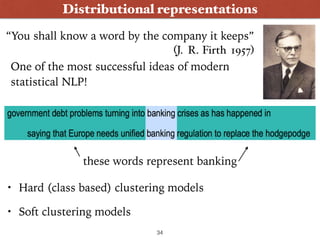
Distributional representations
“You shall know a word by the company it keeps”

(J. R. Firth 1957)
One of the most successful ideas of modern
statistical NLP!
these words represent banking
• Hard (class based) clustering models
• Soft clustering models
34
Distributional hypothesis
He filled the wampimuk, passed it
around and we all drunk some
We found a little, hairy wampimuk
sleeping behind the tree
(McDonald & Ramscar 2001)
35
Distributional semantics
Landauer and Dumais (1997), Turney and Pantel (2010), …
36
Distributional semantics
Distributional meaning as co-occurrence vector:
37
Distributional representations
• Taking it further:
• Continuous word embeddings
• Combine vector space semantics with the
prediction of probabilistic models
• Words are represented as a dense vector:
Candy =
38
Word Embeddings: SocherVector Space Model
adapted rom Bengio, “Representation Learning and Deep Learning”, July, 2012, UCLA
In a perfect world:
39
Word Embeddings: SocherVector Space Model
adapted rom Bengio, “Representation Learning and Deep Learning”, July, 2012, UCLA
In a perfect world:
the country of my birth
the place where I was born
40
• Can theoretically (given enough units) approximate
“any” function
• and fit to “any” kind of data
• Efficient for NLP: hidden layers can be used as word
lookup tables
• Dense distributed word vectors + efficient NN
training algorithms:
• Can scale to billions of words !
Why Neural Networks for NLP?
41
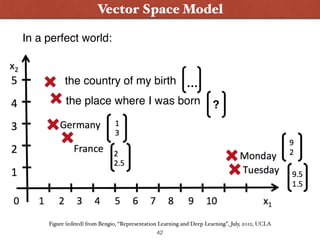
Word Embeddings: SocherVector Space Model
Figure (edited) from Bengio, “Representation Learning and Deep Learning”, July, 2012, UCLA
In a perfect world:
the country of my birth
the place where I was born ?
…
42
Compositionality
Principle of compositionality:
the “meaning (vector) of a
complex expression (sentence)
is determined by:
— Gottlob Frege 

(1848 - 1925)
- the meanings of its constituent
expressions (words) and
- the rules (grammar) used to
combine them”
43
• How do we handle the compositionality of language in
our models?
44
Compositionality
• How do we handle the compositionality of language in
our models?
• Recursion :

the same operator (same parameters) is
applied repeatedly on different components
45
Compositionality
• How do we handle the compositionality of language in
our models?
• Option 1: Recurrent Neural Networks (RNN)
46
RNN 1: Recurrent Neural Networks
(we ignore recurrent NN’s for this talk)
• How do we handle the compositionality of language in
our models?
• Option 2: Recursive Neural Networks (also
sometimes called RNN)
47
RNN 2: Recursive Neural Networks
Recursive Neural Tensor Network
48
Recursive Neural Tensor Network
49
code & info: http://www.socher.org/index.php/Main/
ParsingNaturalScenesAndNaturalLanguageWithRecursiveNeuralNetworks
Socher, R., Liu, C.C., NG, A.Y., Manning, C.D. (2011) 

Parsing Natural Scenes and Natural Language with Recursive Neural Networks
NP
PP/IN
NP
DT NN PRP$ NN
Parse Tree
Recurrent NN for Vector Space
50
NP
PP/IN
NP
DT NN PRP$ NN
Parse Tree
INDT NN PRP NN
Compositionality
51
Recurrent NN: CompositionalityRecurrent NN for Vector Space
NP
IN
NP
PRP NN
Parse Tree
DT NN
Compositionality
52
Recurrent NN: CompositionalityRecurrent NN for Vector Space
NP
IN
NP
DT NN PRP NN
PP
NP (S / ROOT)
“rules” “meanings”
Compositionality
53
Recurrent NN: CompositionalityRecurrent NN for Vector Space
Vector Space + Word Embeddings: Socher
54
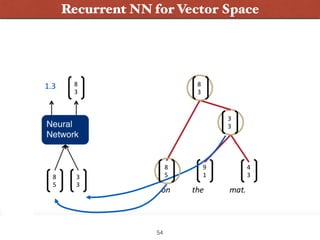
Recurrent NN: CompositionalityRecurrent NN for Vector Space
Vector Space + Word Embeddings: Socher
55
Recurrent NN for Vector Space
Word Embeddings: Turian (2010)
Turian, J., Ratinov, L., Bengio, Y. (2010). Word representations: A simple and general method for semi-supervised learning
code & info: http://metaoptimize.com/projects/wordreprs/56
Word Embeddings: Turian (2010)
Turian, J., Ratinov, L., Bengio, Y. (2010). Word representations: A simple and general method for semi-supervised learning
code & info: http://metaoptimize.com/projects/wordreprs/
57
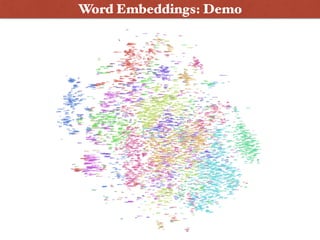
Word Embeddings: Demo
Word Embeddings: Collobert & Weston (2011)
Collobert, R., Weston, J., Bottou, L., Karlen, M., Kavukcuoglu, K., Kuksa, P. (2011) .
Natural Language Processing (almost) from Scratch
59
Polysemous-embeddings: Stanford (2012)
Eric H. Huang, Richard Socher, Christopher D. Manning, Andrew Y. Ng (2012)

Improving Word Representations via Global Context and Multiple Word Prototypes
60
Linguistic Regularities: Mikolov (2013)
code & info: https://code.google.com/p/word2vec/
Mikolov, T., Yih, W., & Zweig, G. (2013). Linguistic Regularities in Continuous Space Word Representations
61
Word Embeddings for MT: Mikolov (2013)
Mikolov, T., Le, V. L., Sutskever, I. (2013) . 

Exploiting Similarities among Languages for Machine Translation
62
Word Embeddings for MT: Kiros (2014)
Kiros, R., Zemel, R. S., Salakhutdinov, R. (2014) . 

A Multiplicative Model for Learning Distributed Text-Based Attribute Representations
63
Recursive Deep Models & Sentiment: Socher (2013)
Socher, R., Perelygin, A., Wu, J., Chuang, J.,Manning, C., Ng, A., Potts, C. (2013) 

Recursive Deep Models for Semantic Compositionality Over a Sentiment Treebank.
code & demo: http://nlp.stanford.edu/sentiment/index.html
64
Paragraph Vectors: Le & Mikolov (2014)
Le, Q., Mikolov,. T. (2014) Distributed Representations of Sentences and Documents
65
• add context (sentence, paragraph, document) to word
vectors during training
!
Results on Stanford Sentiment 

Treebank dataset:
Paragraph Vectors: Dai et al. (2014)
Dai, A., Olah,. C., Le, Q., Corrado, G. (2014) Document Embedding with Paragraph Vectors
66
Paragraph Vectors: Dai et al. (2014)
Dai, A., Olah,. C., Le, Q., Corrado, G. (2014) Document Embedding with Paragraph Vectors
67
Paragraph Vectors: Dai et al. (2014)
Dai, A., Olah,. C., Le, Q., Corrado, G. (2014) Document Embedding with Paragraph Vectors
68
Nearest neighbours to the machine learning paper “Distributed
Representations of Sentences and Documents” in arXiv.
Joint Image-Word Embeddings
69
1. Multimodal representation learning
2. Generating descriptions of images
3. Ranking images and captions (“image-sentence
ranking”)
Some Current Approaches
70
Bags of Visual Words
71
Source credit : K. Grauman, B. Leibe
Bags of Visual Words (Sivic & Zisserman 2003)
standard BoW issues however
What we get:
But we want:
• visual word order/relations
• location
• scale/viewpoint invariance
• …
72
Zero-shot Learning
• skip-gram text model on wikipedia corpus of 5.7 million
documents (5.4 billion words) - approach from (Mikolov
et al. ICLR 2013)
73
Frome, A., Corrado, G.S., Shlens, J., Bengio, S., Dean, J., Mikolov, T., Ranzato, M.A. (2013) 

Devise: A deep visual-semantic embedding model
DeViSE model
Encoder: A deep convolutional network (CNN) and long short-
term memory recurrent network (LSTM) for learning a joint
image-sentence embedding.
Decoder: A new neural language model that combines structure
and content vectors for generating words one at a time in
sequence.
Encoder-Decoder pipeline
74
Kiros, R., Salakhutdinov, R., Zemerl, R. S. (2014) 

Unifying Visual-Semantic Embeddings with Multimodal Neural Language Models
(Kiros et al 2014)
• captures Multimodal linguistic regularities
Encoder-Decoder pipeline
75
• captures Multimodal linguistic regularities
Encoder-Decoder pipeline
76
(PCA projection of (300-dimensional) word and image representations)
77
Vinyals, O., Toshev, A., Bengio, S., Erhan. D. (2015) 

Show and Tell: A Neural Image Caption Generator
Joint Visual-Semantic embedding
Karpathy, A., Fei Fei, L. (2015) 

Deep Visual-Semantic Alignments for Generating Image Descriptions
CNN+LSTM
CNN+RNN
78
Karpathy, A., Fei Fei, L. (2015) 

Deep Visual-Semantic Alignments for Generating Image Descriptions
Joint Visual-Semantic embedding
79
Joint Visual-Semantic embedding
Karpathy, A., Fei Fei, L. (2015) 

Deep Visual-Semantic Alignments for Generating Image Descriptions
80
Joint Visual-Semantic embedding
Karpathy, A., Fei Fei, L. (2015) 

Deep Visual-Semantic Alignments for Generating Image Descriptions
Joint Visual-Semantic embedding
81
Karpathy, A., Fei Fei, L. (2015) 

Deep Visual-Semantic Alignments for Generating Image Descriptions
demo
Any Questions?
Download example code samples from
https://github.com/graphific/DL-Meetup-intro
83
git clone --recursive https://github.com/graphific/
DL-Meetup-intro.git
Wanna Play ? Code!
(more at http://deeplearning.net/ )
• Theano - CPU/GPU symbolic expression compiler in
python (from LISA lab at University of Montreal).
http://deeplearning.net/software/theano/
• Pylearn2 - library designed to make machine learning
research easy. http://deeplearning.net/software/
pylearn2/
• Torch - Matlab-like environment for state-of-the-art
machine learning algorithms in lua (from Ronan
Collobert, Clement Farabet and Koray Kavukcuoglu)
http://torch.ch/
• more info: http://deeplearning.net/software links/
Wanna Play ?
Wanna Play ? General Deep Learning
84
• RNNLM (Mikolov)

http://rnnlm.org
• NB-SVM

https://github.com/mesnilgr/nbsvm
• Word2Vec (skipgrams/cbow)

https://code.google.com/p/word2vec/ (original)

http://radimrehurek.com/gensim/models/word2vec.html (python)
• GloVe

http://nlp.stanford.edu/projects/glove/ (original)

https://github.com/maciejkula/glove-python (python)
• Socher et al / Stanford RNN Sentiment code:

http://nlp.stanford.edu/sentiment/code.html
• Deep Learning without Magic Tutorial:

http://nlp.stanford.edu/courses/NAACL2013/
Wanna Play ? NLP
85
• cuda-convnet2 (Alex Krizhevsky, Toronto) (c++/
CUDA, optimized for GTX 580) 

https://code.google.com/p/cuda-convnet2/
• Caffe (Berkeley) (Cuda/OpenCL, Theano, Python)

http://caffe.berkeleyvision.org/
• OverFeat (NYU) 

http://cilvr.nyu.edu/doku.php?id=code:start
Wanna Play ? Computer Vision
86
87
Impact on Computer Vision
88
Impact on Computer Vision
(from Clarifai)89
Impact on Audio Processing
Speech Recognition
90
Impact on Audio Processing
TIMIT Speech Recognition
(from: Clarifai)91
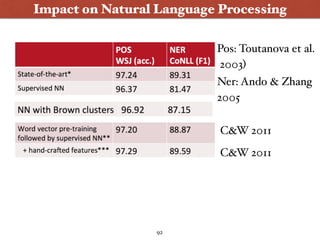
C&W 2011
Impact on Natural Language Processing
Pos: Toutanova et al.

2003)
Ner: Ando & Zhang 

2005
C&W 2011
92
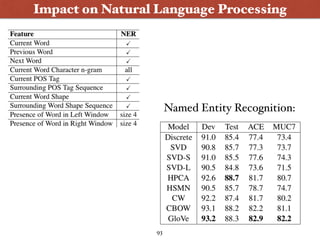
Impact on Natural Language Processing
Named Entity Recognition:
93

Deep Learning for Information Retrieval

  • 1.
    @graphific Roelof Pieters Guest  Lecture:  Deep  Learning   for  Informa8on  Retrieval 28  April  2015 www.csc.kth.se/~roelof/ roelof@kth.se roelof@graph-technologies.com Gve Systems Graph Technologies R&D DD2476 Search Engines and Information Retrieval Systems https://www.kth.se/social/course/DD2476/ slides  online  at  
 h4p://www.slideshare.net/roelofp/deep-­‐learning-­‐for-­‐informa=on-­‐retrieval  
  • 2.
    2 About Me • (-10y)CS dropout (Amsterdam Technical Univ.) • (2y) Msc Social Anthropology, Stockholm University • Current: PhD candidate at KTH/CSC with focus on: • Deep Learning for Natural Language Processing (Distributed Semantics) • Graph-based approaches for Knowledge Representation • Multi-modal models • Current: Data Science Consultant at Graph Technologies RD & Gve-Systems • Recommender Systems • Deep Learning • Realtime Graph-based Search Engines
  • 3.
    3 Information Retrieval (IR) -Hedvig Kjellström, lecture 1
  • 4.
    4 Data landscape ischanging 1. Amount of digital data is growing at increasing rate (IOT, digitalization, wearables, phones/ tablets) 2. Data types are shifting as well: 1. from text to audio-visual 2. from professional to personal/social (social media) 3. from semi-structured to unstructured
  • 5.
    [Jussi Karlgren, NLPSthlm Meetup 2014]
  • 6.
    6 Data landscape ischanging Triple V’s of Big Data: 1. Volume 2. Velocity 3. Variety
  • 7.
    7 Making sense ofData Typical ML Regression
  • 8.
    8 Making sense ofData Neural NetTypical ML Regression
  • 9.
  • 10.
    Neural Net 10 (figure fromLior Rokach, Ben-Gurion University)
  • 11.
    Neural Net 11 (figure fromLior Rokach, Ben-Gurion University)
  • 12.
    Neural Net 12 (figure fromLior Rokach, Ben-Gurion University)
  • 13.
    Neural Net 13 (figure fromLior Rokach, Ben-Gurion University)
  • 14.
    Neural Net 14 (figure fromLior Rokach, Ben-Gurion University)
  • 15.
  • 16.
  • 17.
    Deep Learning ?? 17 •Learning multiple layers • “Back propagation” • Can “theoretically” learn any function! Prior to 2006: • Very slow and inefficient • SVMs, random forests, etc. SOTA
  • 18.
    18 2006+: the 3Deep Learning Conspirators
  • 19.
  • 20.
  • 21.
    — Andrew Ng “I’veworked all my life in Machine Learning, and I’ve never seen one algorithm knock over benchmarks like Deep Learning” Deep Learning: Why? 21
  • 22.
    Different Levels ofAbstraction 22
  • 23.
    Hierarchical Learning • Naturalprogression from low level to high level structure as seen in natural complexity Different Levels of Abstraction Feature Representation 23
  • 24.
    Hierarchical Learning • Naturalprogression from low level to high level structure as seen in natural complexity • Easier to monitor what is being learnt and to guide the machine to better subspaces Different Levels of Abstraction Feature Representation 24
  • 25.
    Hierarchical Learning • Naturalprogression from low level to high level structure as seen in natural complexity • Easier to monitor what is being learnt and to guide the machine to better subspaces • A good lower level representation can be used for many distinct tasks Different Levels of Abstraction Feature Representation 25
  • 26.
    Hierarchical Learning • Naturalprogression from low level to high level structure as seen in natural complexity Different Levels of Abstraction Feature Representation 2626 • Easier to monitor what is being learnt and to guide the machine to better subspaces • A good lower level representation can be used for many distinct tasks
  • 27.
    Classic Deep Architecture Inputlayer Hidden layers Output layer 27
  • 28.
    Modern Deep Architecture Inputlayer Hidden layers Output layer movie time: http://www.cs.toronto.edu/~hinton/adi/index.htm 28
  • 29.
    [Kudos to RichardSocher, for this eloquent summary :) ] • Manually designed features are often over-specified, incomplete and take a long time to design and validate • Learned Features are easy to adapt, fast to learn • Deep learning provides a very flexible, (almost?) universal, learnable framework for representing world, visual and linguistic information. • Deep learning can learn unsupervised (from raw text/audio/ images/whatever content) and supervised (with specific labels like positive/negative) Why Deep Learning ? 29
  • 30.
  • 31.
    31 What about NLP? 1. Language is ambiguous:
 Every sentence has many possible interpretations. 2. Language is productive:
 We will always encounter new words or new constructions 3. Language is culturally specific Some of the challenges in Language Understanding:
  • 32.
    • NLP treatswords mainly (rule-based/statistical approaches at least) as atomic symbols:
 • or in vector space:
 • also known as “one hot” representation. • Its problem ? Language Representation Love Candy Store [0 0 0 0 0 1 0 0 0 0 0 0 0 0 0 0 0 …] Candy [0 0 0 0 0 1 0 0 0 0 0 0 0 0 0 0 0 …] AND Store [0 0 0 0 0 0 0 0 0 0 0 0 0 0 0 1 0 …] = 0 ! 32
  • 33.
    Language Representation 33 - JohanBoye, lecture 2 Term-document matrix = Sparse!
  • 34.
    Distributional representations “You shallknow a word by the company it keeps”
 (J. R. Firth 1957) One of the most successful ideas of modern statistical NLP! these words represent banking • Hard (class based) clustering models • Soft clustering models 34
  • 35.
    Distributional hypothesis He filledthe wampimuk, passed it around and we all drunk some We found a little, hairy wampimuk sleeping behind the tree (McDonald & Ramscar 2001) 35
  • 36.
    Distributional semantics Landauer andDumais (1997), Turney and Pantel (2010), … 36
  • 37.
  • 38.
    Distributional representations • Takingit further: • Continuous word embeddings • Combine vector space semantics with the prediction of probabilistic models • Words are represented as a dense vector: Candy = 38
  • 39.
    Word Embeddings: SocherVectorSpace Model adapted rom Bengio, “Representation Learning and Deep Learning”, July, 2012, UCLA In a perfect world: 39
  • 40.
    Word Embeddings: SocherVectorSpace Model adapted rom Bengio, “Representation Learning and Deep Learning”, July, 2012, UCLA In a perfect world: the country of my birth the place where I was born 40
  • 41.
    • Can theoretically(given enough units) approximate “any” function • and fit to “any” kind of data • Efficient for NLP: hidden layers can be used as word lookup tables • Dense distributed word vectors + efficient NN training algorithms: • Can scale to billions of words ! Why Neural Networks for NLP? 41
  • 42.
    Word Embeddings: SocherVectorSpace Model Figure (edited) from Bengio, “Representation Learning and Deep Learning”, July, 2012, UCLA In a perfect world: the country of my birth the place where I was born ? … 42
  • 43.
    Compositionality Principle of compositionality: the“meaning (vector) of a complex expression (sentence) is determined by: — Gottlob Frege 
 (1848 - 1925) - the meanings of its constituent expressions (words) and - the rules (grammar) used to combine them” 43
  • 44.
    • How dowe handle the compositionality of language in our models? 44 Compositionality
  • 45.
    • How dowe handle the compositionality of language in our models? • Recursion :
 the same operator (same parameters) is applied repeatedly on different components 45 Compositionality
  • 46.
    • How dowe handle the compositionality of language in our models? • Option 1: Recurrent Neural Networks (RNN) 46 RNN 1: Recurrent Neural Networks (we ignore recurrent NN’s for this talk)
  • 47.
    • How dowe handle the compositionality of language in our models? • Option 2: Recursive Neural Networks (also sometimes called RNN) 47 RNN 2: Recursive Neural Networks
  • 48.
  • 49.
    Recursive Neural TensorNetwork 49 code & info: http://www.socher.org/index.php/Main/ ParsingNaturalScenesAndNaturalLanguageWithRecursiveNeuralNetworks Socher, R., Liu, C.C., NG, A.Y., Manning, C.D. (2011) 
 Parsing Natural Scenes and Natural Language with Recursive Neural Networks
  • 50.
    NP PP/IN NP DT NN PRP$NN Parse Tree Recurrent NN for Vector Space 50
  • 51.
    NP PP/IN NP DT NN PRP$NN Parse Tree INDT NN PRP NN Compositionality 51 Recurrent NN: CompositionalityRecurrent NN for Vector Space
  • 52.
    NP IN NP PRP NN Parse Tree DTNN Compositionality 52 Recurrent NN: CompositionalityRecurrent NN for Vector Space
  • 53.
    NP IN NP DT NN PRPNN PP NP (S / ROOT) “rules” “meanings” Compositionality 53 Recurrent NN: CompositionalityRecurrent NN for Vector Space
  • 54.
    Vector Space +Word Embeddings: Socher 54 Recurrent NN: CompositionalityRecurrent NN for Vector Space
  • 55.
    Vector Space +Word Embeddings: Socher 55 Recurrent NN for Vector Space
  • 56.
    Word Embeddings: Turian(2010) Turian, J., Ratinov, L., Bengio, Y. (2010). Word representations: A simple and general method for semi-supervised learning code & info: http://metaoptimize.com/projects/wordreprs/56
  • 57.
    Word Embeddings: Turian(2010) Turian, J., Ratinov, L., Bengio, Y. (2010). Word representations: A simple and general method for semi-supervised learning code & info: http://metaoptimize.com/projects/wordreprs/ 57
  • 58.
  • 59.
    Word Embeddings: Collobert& Weston (2011) Collobert, R., Weston, J., Bottou, L., Karlen, M., Kavukcuoglu, K., Kuksa, P. (2011) . Natural Language Processing (almost) from Scratch 59
  • 60.
    Polysemous-embeddings: Stanford (2012) EricH. Huang, Richard Socher, Christopher D. Manning, Andrew Y. Ng (2012)
 Improving Word Representations via Global Context and Multiple Word Prototypes 60
  • 61.
    Linguistic Regularities: Mikolov(2013) code & info: https://code.google.com/p/word2vec/ Mikolov, T., Yih, W., & Zweig, G. (2013). Linguistic Regularities in Continuous Space Word Representations 61
  • 62.
    Word Embeddings forMT: Mikolov (2013) Mikolov, T., Le, V. L., Sutskever, I. (2013) . 
 Exploiting Similarities among Languages for Machine Translation 62
  • 63.
    Word Embeddings forMT: Kiros (2014) Kiros, R., Zemel, R. S., Salakhutdinov, R. (2014) . 
 A Multiplicative Model for Learning Distributed Text-Based Attribute Representations 63
  • 64.
    Recursive Deep Models& Sentiment: Socher (2013) Socher, R., Perelygin, A., Wu, J., Chuang, J.,Manning, C., Ng, A., Potts, C. (2013) 
 Recursive Deep Models for Semantic Compositionality Over a Sentiment Treebank. code & demo: http://nlp.stanford.edu/sentiment/index.html 64
  • 65.
    Paragraph Vectors: Le& Mikolov (2014) Le, Q., Mikolov,. T. (2014) Distributed Representations of Sentences and Documents 65 • add context (sentence, paragraph, document) to word vectors during training ! Results on Stanford Sentiment 
 Treebank dataset:
  • 66.
    Paragraph Vectors: Daiet al. (2014) Dai, A., Olah,. C., Le, Q., Corrado, G. (2014) Document Embedding with Paragraph Vectors 66
  • 67.
    Paragraph Vectors: Daiet al. (2014) Dai, A., Olah,. C., Le, Q., Corrado, G. (2014) Document Embedding with Paragraph Vectors 67
  • 68.
    Paragraph Vectors: Daiet al. (2014) Dai, A., Olah,. C., Le, Q., Corrado, G. (2014) Document Embedding with Paragraph Vectors 68 Nearest neighbours to the machine learning paper “Distributed Representations of Sentences and Documents” in arXiv.
  • 69.
  • 70.
    1. Multimodal representationlearning 2. Generating descriptions of images 3. Ranking images and captions (“image-sentence ranking”) Some Current Approaches 70
  • 71.
    Bags of VisualWords 71 Source credit : K. Grauman, B. Leibe
  • 72.
    Bags of VisualWords (Sivic & Zisserman 2003) standard BoW issues however What we get: But we want: • visual word order/relations • location • scale/viewpoint invariance • … 72
  • 73.
    Zero-shot Learning • skip-gramtext model on wikipedia corpus of 5.7 million documents (5.4 billion words) - approach from (Mikolov et al. ICLR 2013) 73 Frome, A., Corrado, G.S., Shlens, J., Bengio, S., Dean, J., Mikolov, T., Ranzato, M.A. (2013) 
 Devise: A deep visual-semantic embedding model DeViSE model
  • 74.
    Encoder: A deepconvolutional network (CNN) and long short- term memory recurrent network (LSTM) for learning a joint image-sentence embedding. Decoder: A new neural language model that combines structure and content vectors for generating words one at a time in sequence. Encoder-Decoder pipeline 74 Kiros, R., Salakhutdinov, R., Zemerl, R. S. (2014) 
 Unifying Visual-Semantic Embeddings with Multimodal Neural Language Models (Kiros et al 2014)
  • 75.
    • captures Multimodallinguistic regularities Encoder-Decoder pipeline 75
  • 76.
    • captures Multimodallinguistic regularities Encoder-Decoder pipeline 76 (PCA projection of (300-dimensional) word and image representations)
  • 77.
    77 Vinyals, O., Toshev,A., Bengio, S., Erhan. D. (2015) 
 Show and Tell: A Neural Image Caption Generator Joint Visual-Semantic embedding Karpathy, A., Fei Fei, L. (2015) 
 Deep Visual-Semantic Alignments for Generating Image Descriptions CNN+LSTM CNN+RNN
  • 78.
    78 Karpathy, A., FeiFei, L. (2015) 
 Deep Visual-Semantic Alignments for Generating Image Descriptions Joint Visual-Semantic embedding
  • 79.
    79 Joint Visual-Semantic embedding Karpathy,A., Fei Fei, L. (2015) 
 Deep Visual-Semantic Alignments for Generating Image Descriptions
  • 80.
    80 Joint Visual-Semantic embedding Karpathy,A., Fei Fei, L. (2015) 
 Deep Visual-Semantic Alignments for Generating Image Descriptions
  • 81.
    Joint Visual-Semantic embedding 81 Karpathy,A., Fei Fei, L. (2015) 
 Deep Visual-Semantic Alignments for Generating Image Descriptions demo
  • 82.
  • 83.
    Download example codesamples from https://github.com/graphific/DL-Meetup-intro 83 git clone --recursive https://github.com/graphific/ DL-Meetup-intro.git Wanna Play ? Code! (more at http://deeplearning.net/ )
  • 84.
    • Theano -CPU/GPU symbolic expression compiler in python (from LISA lab at University of Montreal). http://deeplearning.net/software/theano/ • Pylearn2 - library designed to make machine learning research easy. http://deeplearning.net/software/ pylearn2/ • Torch - Matlab-like environment for state-of-the-art machine learning algorithms in lua (from Ronan Collobert, Clement Farabet and Koray Kavukcuoglu) http://torch.ch/ • more info: http://deeplearning.net/software links/ Wanna Play ? Wanna Play ? General Deep Learning 84
  • 85.
    • RNNLM (Mikolov)
 http://rnnlm.org •NB-SVM
 https://github.com/mesnilgr/nbsvm • Word2Vec (skipgrams/cbow)
 https://code.google.com/p/word2vec/ (original)
 http://radimrehurek.com/gensim/models/word2vec.html (python) • GloVe
 http://nlp.stanford.edu/projects/glove/ (original)
 https://github.com/maciejkula/glove-python (python) • Socher et al / Stanford RNN Sentiment code:
 http://nlp.stanford.edu/sentiment/code.html • Deep Learning without Magic Tutorial:
 http://nlp.stanford.edu/courses/NAACL2013/ Wanna Play ? NLP 85
  • 86.
    • cuda-convnet2 (AlexKrizhevsky, Toronto) (c++/ CUDA, optimized for GTX 580) 
 https://code.google.com/p/cuda-convnet2/ • Caffe (Berkeley) (Cuda/OpenCL, Theano, Python)
 http://caffe.berkeleyvision.org/ • OverFeat (NYU) 
 http://cilvr.nyu.edu/doku.php?id=code:start Wanna Play ? Computer Vision 86
  • 87.
  • 88.
  • 89.
    Impact on ComputerVision (from Clarifai)89
  • 90.
    Impact on AudioProcessing Speech Recognition 90
  • 91.
    Impact on AudioProcessing TIMIT Speech Recognition (from: Clarifai)91
  • 92.
    C&W 2011 Impact onNatural Language Processing Pos: Toutanova et al.
 2003) Ner: Ando & Zhang 
 2005 C&W 2011 92
  • 93.
    Impact on NaturalLanguage Processing Named Entity Recognition: 93