Download as PDF, PPTX
![Key Ideas
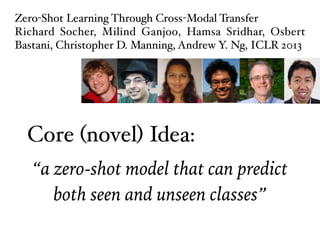
• Semantic word vector representations:
• Allows transfer of knowledge between modalities
• Even when these representations are learned in an
unsupervised way
• Bayesian framework:
1. Differentiate between unseen/seen classes
2. From points on the semantic manifold of trained classes
3. Allows combining both zero-shot and seen classification
into one framework
[ Ø-shot + 1-shot = “multi-shot” :) ]](https://image.slidesharecdn.com/zero-shotlearningthroughcross-modaltransfer-150220101019-conversion-gate01/85/Zero-shot-learning-through-cross-modal-transfer-3-320.jpg)
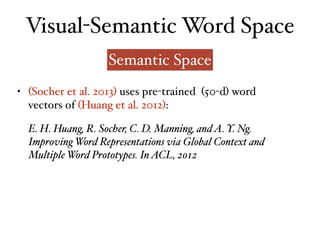
![Visual-Semantic Word Space
• Word vectors capture distributional similarities
from a large, unsupervised text corpus. [Word
vectors create a semantic space] (Huang et al. 2012)
• Images are mapped into a semantic space of words that is
learned by a neural network model (Coates & Ng 2011;
Coates et al. 2011)
• By learning an image mapping into this space, the word
vectors get implicitly grounded by the visual modality,
allowing us to give prototypical instances for various word
(Socher et al. 2013, this paper)](https://image.slidesharecdn.com/zero-shotlearningthroughcross-modaltransfer-150220101019-conversion-gate01/85/Zero-shot-learning-through-cross-modal-transfer-4-320.jpg)
![• Word vectors capture distributional similarities from a
large, unsupervised text corpus. [Word vectors create a
semantic space] (Huang et al. 2012)
• Images are mapped into a semantic space of words that is
learned by a neural network model (Coates & Ng 2011;
Coates et al. 2011)
• By learning an image mapping into this space, the word
vectors get implicitly grounded by the visual modality,
allowing us to give prototypical instances for various word
(Socher et al. 2013, this paper)
Visual-Semantic Word Space
Semantic Space](https://image.slidesharecdn.com/zero-shotlearningthroughcross-modaltransfer-150220101019-conversion-gate01/85/Zero-shot-learning-through-cross-modal-transfer-5-320.jpg)
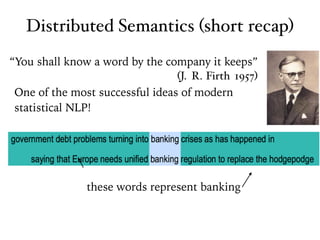
![http://www.socher.org/index.php/Main/ImprovingWordRepresentationsViaGlobalContextAndMultipleWordPrototypes
[Huang et al. 2012]
Semantic Space](https://image.slidesharecdn.com/zero-shotlearningthroughcross-modaltransfer-150220101019-conversion-gate01/85/Zero-shot-learning-through-cross-modal-transfer-7-320.jpg)
![[Huang et al. 2012]](https://image.slidesharecdn.com/zero-shotlearningthroughcross-modaltransfer-150220101019-conversion-gate01/85/Zero-shot-learning-through-cross-modal-transfer-9-320.jpg)
![[Huang et al. 2012]](https://image.slidesharecdn.com/zero-shotlearningthroughcross-modaltransfer-150220101019-conversion-gate01/85/Zero-shot-learning-through-cross-modal-transfer-10-320.jpg)
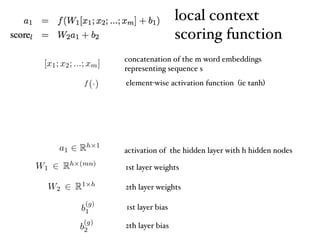
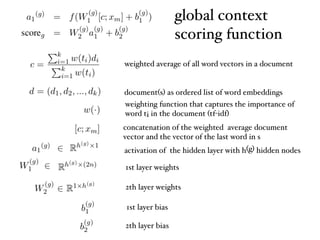
![local context:
global context:
final score:
[Huang et al. 2012]](https://image.slidesharecdn.com/zero-shotlearningthroughcross-modaltransfer-150220101019-conversion-gate01/85/Zero-shot-learning-through-cross-modal-transfer-11-320.jpg)
![• Word vectors capture distributional similarities from a
large, unsupervised text corpus. [Word vectors create a
semantic space] (Huang et al. 2012)
• Images are mapped into a semantic space of words
that is learned by a neural network model (Coates &
Ng 2011; Coates et al. 2011)
• By learning an image mapping into this space, the word
vectors get implicitly grounded by the visual modality,
allowing us to give prototypical instances for various word
(Socher et al. 2013, this paper)
Visual-Semantic Word Space
Semantic Space](https://image.slidesharecdn.com/zero-shotlearningthroughcross-modaltransfer-150220101019-conversion-gate01/85/Zero-shot-learning-through-cross-modal-transfer-14-320.jpg)
![• Word vectors capture distributional similarities from a
large, unsupervised text corpus. [Word vectors create a
semantic space] (Huang et al. 2012)
• Images are mapped into a semantic space of words that is
learned by a neural network model (Coates & Ng 2011;
Coates et al. 2011)
• By learning an image mapping into this space, the word
vectors get implicitly grounded by the visual modality,
allowing us to give prototypical instances for various word
(Socher et al. 2013, this paper)
Visual-Semantic Word Space
Semantic Space
Image Features](https://image.slidesharecdn.com/zero-shotlearningthroughcross-modaltransfer-150220101019-conversion-gate01/85/Zero-shot-learning-through-cross-modal-transfer-15-320.jpg)
![Image Feature Learning
• high level description: extract random patches, extract features
from sub-patches, pool features, train liner classifier to predict
labels
• = fast simple algorithms with the correct parameters work as
well as complex, slow algorithms
[Coates et al. 2011 (used by Coates & Ng 2011)]](https://image.slidesharecdn.com/zero-shotlearningthroughcross-modaltransfer-150220101019-conversion-gate01/85/Zero-shot-learning-through-cross-modal-transfer-16-320.jpg)
![• Word vectors capture distributional similarities from a
large, unsupervised text corpus. [Word vectors create a
semantic space] (Huang et al. 2012)
• Images are mapped into a semantic space of words that is
learned by a neural network model (Coates & Ng 2011;
Coates et al. 2011)
• By learning an image mapping into this space, the
word vectors get implicitly grounded by the visual
modality, allowing us to give prototypical instances
for various word (Socher et al. 2013, this paper)
Visual-Semantic Word Space
Semantic Space
Image Features](https://image.slidesharecdn.com/zero-shotlearningthroughcross-modaltransfer-150220101019-conversion-gate01/85/Zero-shot-learning-through-cross-modal-transfer-17-320.jpg)
![• Word vectors capture distributional similarities from a
large, unsupervised text corpus. [Word vectors create a
semantic space] (Huang et al. 2012)
• Images are mapped into a semantic space of words that is
learned by a neural network model (Coates & Ng 2011;
Coates et al. 2011)
• By learning an image mapping into this space, the word
vectors get implicitly grounded by the visual modality,
allowing us to give prototypical instances for various word
(Socher et al. 2013, this paper)
Visual-Semantic Word Space
Semantic Space
Visual-Semantic Space
Image Features](https://image.slidesharecdn.com/zero-shotlearningthroughcross-modaltransfer-150220101019-conversion-gate01/85/Zero-shot-learning-through-cross-modal-transfer-18-320.jpg)
![[this paper, Socher et al. 2013]
Visual-Semantic Space](https://image.slidesharecdn.com/zero-shotlearningthroughcross-modaltransfer-150220101019-conversion-gate01/85/Zero-shot-learning-through-cross-modal-transfer-19-320.jpg)
![Projecting Images into Visual Space
Objective function(s):
[Socher et al. 2013]
training images
set of word vectors seen/unseen visual classes
mapped to the word vector (class name)](https://image.slidesharecdn.com/zero-shotlearningthroughcross-modaltransfer-150220101019-conversion-gate01/85/Zero-shot-learning-through-cross-modal-transfer-20-320.jpg)
![Projecting Images into Visual Space
Objective function(s):
[Socher et al. 2013]
training images
set of word vectors seen/unseen visual classes
mapped to the word vector (class name)](https://image.slidesharecdn.com/zero-shotlearningthroughcross-modaltransfer-150220101019-conversion-gate01/85/Zero-shot-learning-through-cross-modal-transfer-21-320.jpg)
![T-SNE visualization of the semantic word space [Socher et al. 2013]](https://image.slidesharecdn.com/zero-shotlearningthroughcross-modaltransfer-150220101019-conversion-gate01/85/Zero-shot-learning-through-cross-modal-transfer-22-320.jpg)
![[Socher et al. 2013]
Projecting Images into Visual Space
Mapped points of
seen classes:
(Outlier Detection)
Predicting class y:
binary visibility random variable
probability of an image being in an unseen class
Treshold T:](https://image.slidesharecdn.com/zero-shotlearningthroughcross-modaltransfer-150220101019-conversion-gate01/85/Zero-shot-learning-through-cross-modal-transfer-23-320.jpg)
![[Socher et al. 2013]
Projecting Images into Visual Space
(Outlier Detection)
binary visibility random variable
probability of an image being in an unseen class
known class prediction:](https://image.slidesharecdn.com/zero-shotlearningthroughcross-modaltransfer-150220101019-conversion-gate01/85/Zero-shot-learning-through-cross-modal-transfer-24-320.jpg)
![[Socher et al. 2013][Socher et al. NIPS 2013]
Results](https://image.slidesharecdn.com/zero-shotlearningthroughcross-modaltransfer-150220101019-conversion-gate01/85/Zero-shot-learning-through-cross-modal-transfer-25-320.jpg)
![Main Contributions
Zero-shot learning
• Good classification of (pairs of) unseen classes can be
achieved based on learned representations for these
classes
• => as opposed to hand designed representations
• => extends (Lampert 2009; Guo-Jun 2011) [Manual defined
visual/semantic attributes to classify unseen classes]](https://image.slidesharecdn.com/zero-shotlearningthroughcross-modaltransfer-150220101019-conversion-gate01/85/Zero-shot-learning-through-cross-modal-transfer-26-320.jpg)
![Main Contributions
“Multi”-shot learning
• Deal with both seen and unseen classes: Allows combining both
zero-shot and seen classification into one framework:
[ Ø-shot + 1-shot = “multi-shot” :) ]
• Assumption: unseen classes as outliers
• Major weakness:
drop from 80% to 70% for 15%-30% accuracy (on particular classes)
• => extends (Lampert 2009; Palatucci 2009) [manual defined
representations, limited to zero-shot classes], using outlier
detection
• => extends (Weston et al. 2010) (joint embedding images and labels
through linear mapping) [linear mapping only, so cant generalise to
new classes: 1-shot], using outlier detection](https://image.slidesharecdn.com/zero-shotlearningthroughcross-modaltransfer-150220101019-conversion-gate01/85/Zero-shot-learning-through-cross-modal-transfer-27-320.jpg)
![Main Contributions
Knowledge-Transfer
• Allows transfer of knowledge between modalities, within
multimodal embeddings
• Allows for unsupervised matching
• => extends (Socher & Fei-Fei 2012) (kernelized canonical
correlation analysis) [still require small amount of training
data for each class: 1-shot]
• => extends (Salakhutdinov et al. 2012) (learn low-level image
features followed by a probabilistic model to transfer
knowledge) [also limited to 1-shot classes]](https://image.slidesharecdn.com/zero-shotlearningthroughcross-modaltransfer-150220101019-conversion-gate01/85/Zero-shot-learning-through-cross-modal-transfer-28-320.jpg)

The document discusses a zero-shot learning framework that enables classification of both seen and unseen classes using semantic word vector representations and a Bayesian approach. It emphasizes the transfer of knowledge between modalities through visual-semantic mappings, allowing better classification and knowledge transfer with minimal training data. Key contributions include the integration of zero-shot and multi-shot learning and the potential for unsupervised learning in various applications.


![[DL輪読会]Pyramid Stereo Matching Network](https://cdn.slidesharecdn.com/ss_thumbnails/2019-05-31psmnetpyramidstereomatchingnetwork-hiroakisugisaki-190531000258-thumbnail.jpg?width=640&height=640&fit=bounds)


![[NS][Lab_Seminar_250407]AlignmentLearning.pptx](https://cdn.slidesharecdn.com/ss_thumbnails/nslabseminar250407alignmentlearning-250407124309-1acb59f1-thumbnail.jpg?width=640&height=640&fit=bounds)
![[DSC Europe 24] Nemanja Milosevic - Beyond Supervised Learning with Zero-Shot...](https://cdn.slidesharecdn.com/ss_thumbnails/nemanjamilosevic-241219150756-b1cc16e6-thumbnail.jpg?width=640&height=640&fit=bounds)


