Towards String-to-Tree
Neural Machine Translation
Roee Aharoni & Yoav Goldberg
NLP Lab, Bar Ilan University
ACL 2017
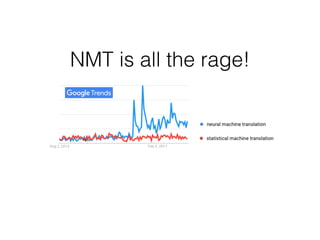
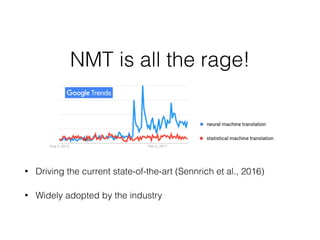
NMT is all the rage!
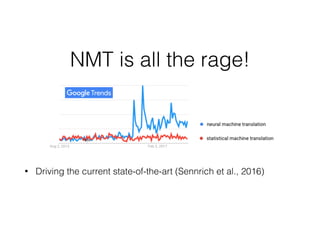
• Driving the current state-of-the-art (Sennrich et al., 2016)
NMT is all the rage!
• Driving the current state-of-the-art (Sennrich et al., 2016)
• Widely adopted by the industry
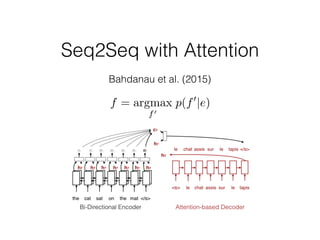
Seq2Seq with Attention
Bahdanau et al. (2015)
Seq2Seq with Attention
f = argmax
f0
p(f0
|e)
Bahdanau et al. (2015)
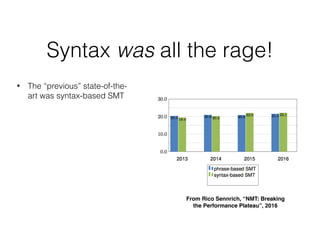
Syntax was all the rage!
• The “previous” state-of-the-
art was syntax-based SMT
From Rico Sennrich, “NMT: Breaking
the Performance Plateau”, 2016
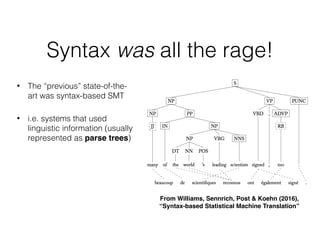
From Williams, Sennrich, Post & Koehn (2016),
“Syntax-based Statistical Machine Translation”
Syntax was all the rage!
• The “previous” state-of-the-
art was syntax-based SMT
• i.e. systems that used
linguistic information (usually
represented as parse trees)
Syntax was all the rage!
• The “previous” state-of-the-
art was syntax-based SMT
• i.e. systems that used
linguistic information (usually
represented as parse trees)
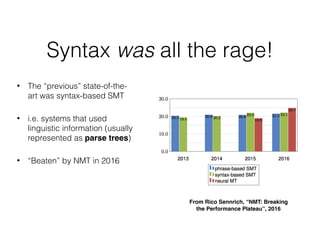
• “Beaten” by NMT in 2016
From Rico Sennrich, “NMT: Breaking
the Performance Plateau”, 2016
Syntax was all the rage!
• The “previous” state-of-the-
art was syntax-based SMT
• i.e. systems that used
linguistic information (usually
represented as parse trees)
• “Beaten” by NMT in 2016
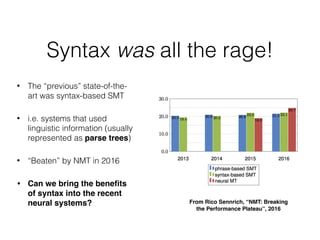
• Can we bring the benefits
of syntax into the recent
neural systems? From Rico Sennrich, “NMT: Breaking
the Performance Plateau”, 2016
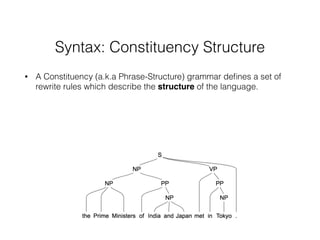
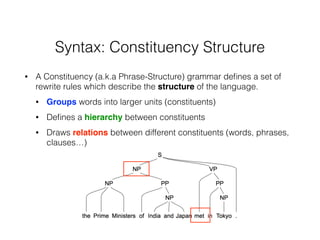
Syntax: Constituency Structure
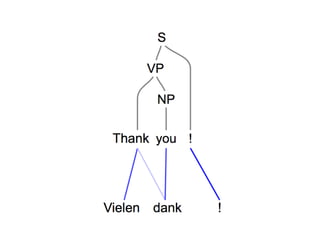
• A Constituency (a.k.a Phrase-Structure) grammar defines a set of
rewrite rules which describe the structure of the language.
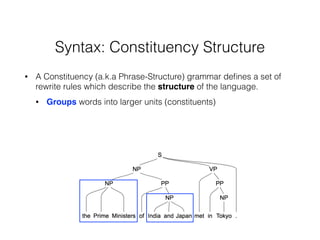
Syntax: Constituency Structure
• A Constituency (a.k.a Phrase-Structure) grammar defines a set of
rewrite rules which describe the structure of the language.
• Groups words into larger units (constituents)
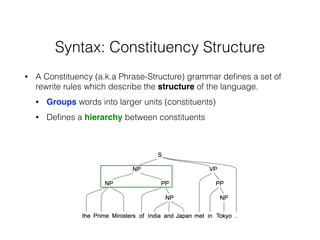
Syntax: Constituency Structure
• A Constituency (a.k.a Phrase-Structure) grammar defines a set of
rewrite rules which describe the structure of the language.
• Groups words into larger units (constituents)
• Defines a hierarchy between constituents
Syntax: Constituency Structure
• A Constituency (a.k.a Phrase-Structure) grammar defines a set of
rewrite rules which describe the structure of the language.
• Groups words into larger units (constituents)
• Defines a hierarchy between constituents
• Draws relations between different constituents (words, phrases,
clauses…)
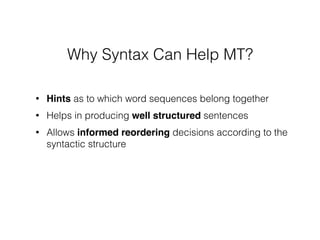
Why Syntax Can Help MT?
• Hints as to which word sequences belong together
Why Syntax Can Help MT?
• Hints as to which word sequences belong together
• Helps in producing well structured sentences
Why Syntax Can Help MT?
• Hints as to which word sequences belong together
• Helps in producing well structured sentences
• Allows informed reordering decisions according to the
syntactic structure
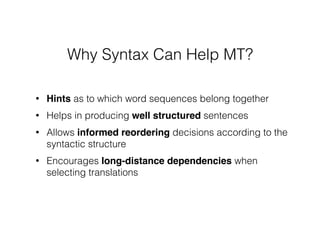
Why Syntax Can Help MT?
• Hints as to which word sequences belong together
• Helps in producing well structured sentences
• Allows informed reordering decisions according to the
syntactic structure
• Encourages long-distance dependencies when
selecting translations
Why Syntax Can Help MT?
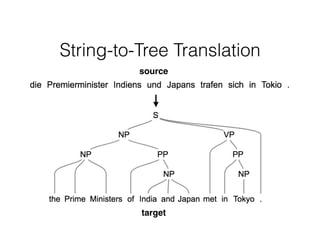
String-to-Tree Translation
source
target
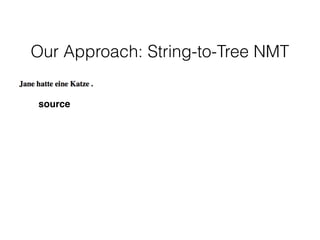
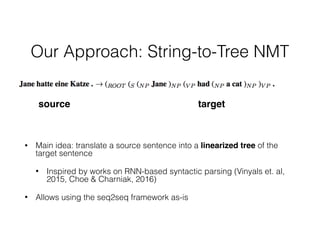
Our Approach: String-to-Tree NMT
source
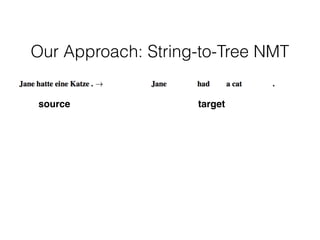
Our Approach: String-to-Tree NMT
source target
Our Approach: String-to-Tree NMT
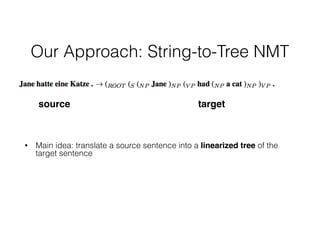
• Main idea: translate a source sentence into a linearized tree of the
target sentence
source target
Our Approach: String-to-Tree NMT
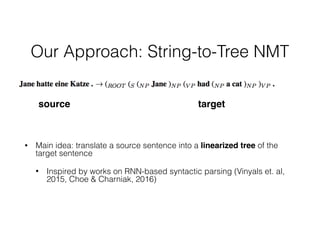
• Main idea: translate a source sentence into a linearized tree of the
target sentence
• Inspired by works on RNN-based syntactic parsing (Vinyals et. al, 

2015, Choe & Charniak, 2016)
source target
Our Approach: String-to-Tree NMT
• Main idea: translate a source sentence into a linearized tree of the
target sentence
• Inspired by works on RNN-based syntactic parsing (Vinyals et. al, 

2015, Choe & Charniak, 2016)
• Allows using the seq2seq framework as-is
source target
Experimental Details
• We used the Nematus toolkit (Sennrich et al. 2017)

• Joint BPE segmentation (Sennrich et al. 2016)
• For training, we parse the target side using the BLLIP parser
(McClosky, Charniak and Johnson, 2006)
• Requires some care about making BPE, Tokenization and Parser
work together
Experiments - Large Scale
• German to English, 4.5 million parallel training sentences from WMT16
Experiments - Large Scale
• German to English, 4.5 million parallel training sentences from WMT16
• Train two NMT models using the same setup (same settings as the SOTA neural
system in WMT16)
Experiments - Large Scale
• German to English, 4.5 million parallel training sentences from WMT16
• Train two NMT models using the same setup (same settings as the SOTA neural
system in WMT16)
• syntax-aware (bpe2tree)
Experiments - Large Scale
• German to English, 4.5 million parallel training sentences from WMT16
• Train two NMT models using the same setup (same settings as the SOTA neural
system in WMT16)
• syntax-aware (bpe2tree)
• syntax-agnostic baseline (bpe2bpe)
Experiments - Large Scale
• German to English, 4.5 million parallel training sentences from WMT16
• Train two NMT models using the same setup (same settings as the SOTA neural
system in WMT16)
• syntax-aware (bpe2tree)
• syntax-agnostic baseline (bpe2bpe)
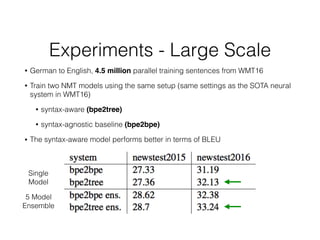
• The syntax-aware model performs better in terms of BLEU
Single
Model
5 Model
Ensemble
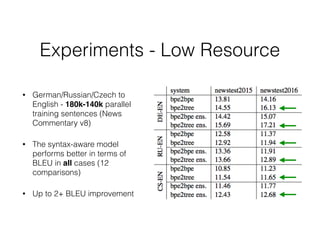
Experiments - Low Resource
• German/Russian/Czech to
English - 180k-140k parallel
training sentences (News
Commentary v8)
• The syntax-aware model
performs better in terms of
BLEU in all cases (12
comparisons)
• Up to 2+ BLEU improvement
Looking Beyond BLEU
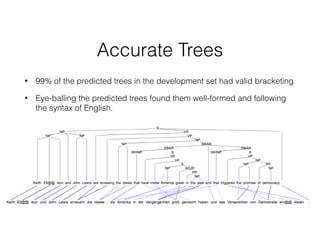
Accurate Trees
• 99% of the predicted trees in the development set had valid bracketing
• Eye-balling the predicted trees found them well-formed and following
the syntax of English.
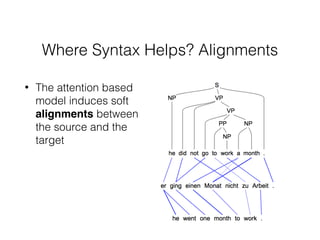
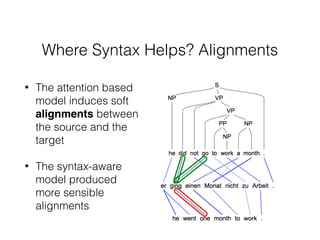
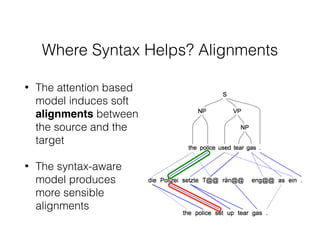
Where Syntax Helps? Alignments
• The attention based
model induces soft
alignments between
the source and the
target
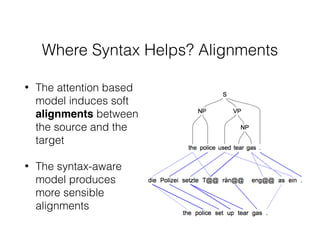
Where Syntax Helps? Alignments
• The attention based
model induces soft
alignments between
the source and the
target
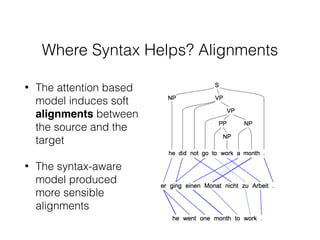
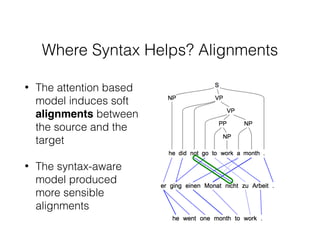
• The syntax-aware
model produced
more sensible
alignments
Where Syntax Helps? Alignments
• The attention based
model induces soft
alignments between
the source and the
target
• The syntax-aware
model produced
more sensible
alignments
Where Syntax Helps? Alignments
• The attention based
model induces soft
alignments between
the source and the
target
• The syntax-aware
model produced
more sensible
alignments
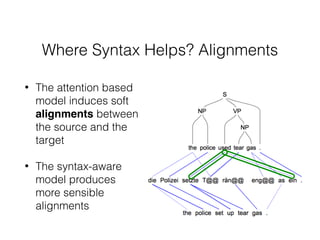
Where Syntax Helps? Alignments
• The attention based
model induces soft
alignments between
the source and the
target
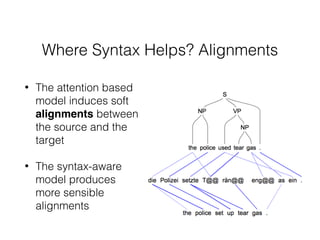
• The syntax-aware
model produces
more sensible
alignments
Where Syntax Helps? Alignments
• The attention based
model induces soft
alignments between
the source and the
target
• The syntax-aware
model produces
more sensible
alignments
Where Syntax Helps? Alignments
• The attention based
model induces soft
alignments between
the source and the
target
• The syntax-aware
model produces
more sensible
alignments
Where Syntax Helps? Alignments
• The attention based
model induces soft
alignments between
the source and the
target
• The syntax-aware
model produces
more sensible
alignments
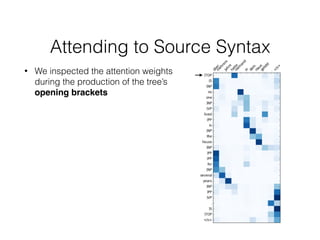
Attending to Source Syntax
• We inspected the attention weights
during the production of the tree’s
opening brackets
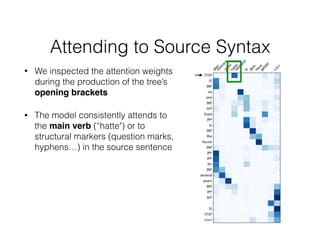
Attending to Source Syntax
• We inspected the attention weights
during the production of the tree’s
opening brackets
• The model consistently attends to
the main verb (“hatte") or to
structural markers (question marks,
hyphens…) in the source sentence
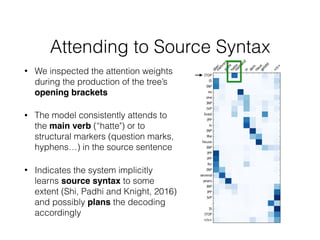
Attending to Source Syntax
• We inspected the attention weights
during the production of the tree’s
opening brackets
• The model consistently attends to
the main verb (“hatte") or to
structural markers (question marks,
hyphens…) in the source sentence
• Indicates the system implicitly
learns source syntax to some
extent (Shi, Padhi and Knight, 2016)
and possibly plans the decoding
accordingly
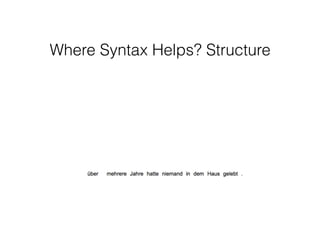
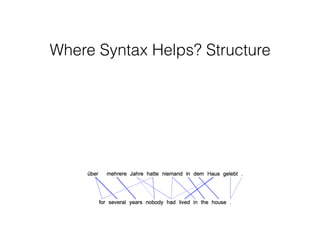
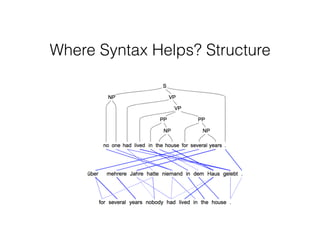
Where Syntax Helps? Structure
Structure (I) - Reordering
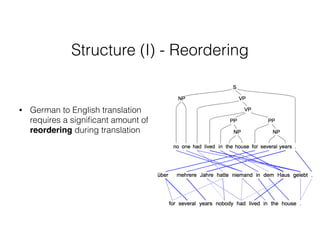
• German to English translation
requires a significant amount of
reordering during translation
Structure (I) - Reordering
• German to English translation
requires a significant amount of
reordering during translation
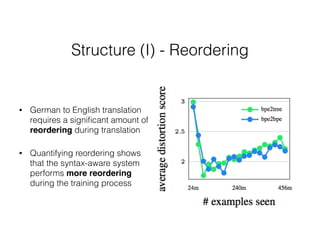
• Quantifying reordering shows
that the syntax-aware system
performs more reordering
during the training process
Structure (I) - Reordering
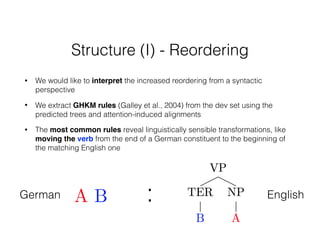
• We would like to interpret the increased reordering from a syntactic
perspective
Structure (I) - Reordering
• We would like to interpret the increased reordering from a syntactic
perspective
• We extract GHKM rules (Galley et al., 2004) from the dev set using the
predicted trees and attention-induced alignments
Structure (I) - Reordering
• We would like to interpret the increased reordering from a syntactic
perspective
• We extract GHKM rules (Galley et al., 2004) from the dev set using the
predicted trees and attention-induced alignments
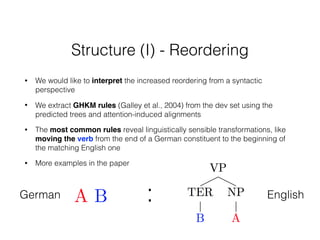
• The most common rules reveal linguistically sensible transformations, like
moving the verb from the end of a German constituent to the beginning of
the matching English one
German English:
Structure (I) - Reordering
• We would like to interpret the increased reordering from a syntactic
perspective
• We extract GHKM rules (Galley et al., 2004) from the dev set using the
predicted trees and attention-induced alignments
• The most common rules reveal linguistically sensible transformations, like
moving the verb from the end of a German constituent to the beginning of
the matching English one
• More examples in the paper
German English:
Structure (II) - Relative Constructions
• A common linguistic structure is relative constructions, i.e. “The XXX which

YYY”, “A XXX whose YYY”…
Structure (II) - Relative Constructions
• A common linguistic structure is relative constructions, i.e. “The XXX which
YYY”, “A XXX whose YYY”…
• The words that connect the clauses in such constructions are called relative
pronouns, i.e. “who”, “which”, “whom”…
Structure (II) - Relative Constructions
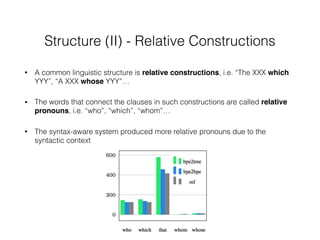
• A common linguistic structure is relative constructions, i.e. “The XXX which
YYY”, “A XXX whose YYY”…
• The words that connect the clauses in such constructions are called relative
pronouns, i.e. “who”, “which”, “whom”…
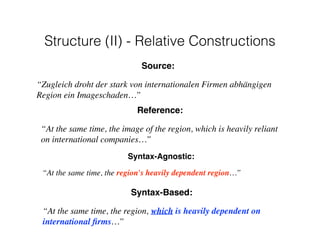
• The syntax-aware system produced more relative pronouns due to the
syntactic context
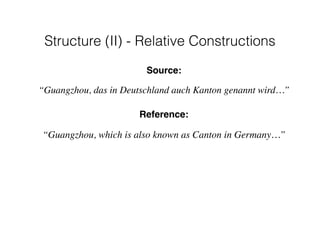
Structure (II) - Relative Constructions
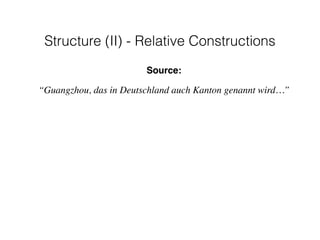
Source:
“Guangzhou, das in Deutschland auch Kanton genannt wird…”
Structure (II) - Relative Constructions
Source:
“Guangzhou, das in Deutschland auch Kanton genannt wird…”
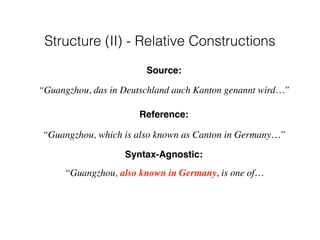
Reference:
“Guangzhou, which is also known as Canton in Germany…”
Structure (II) - Relative Constructions
Syntax-Agnostic:
“Guangzhou, also known in Germany, is one of…
Source:
“Guangzhou, das in Deutschland auch Kanton genannt wird…”
Reference:
“Guangzhou, which is also known as Canton in Germany…”
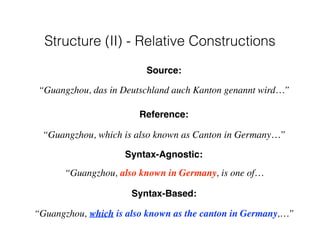
Structure (II) - Relative Constructions
Syntax-Agnostic:
“Guangzhou, also known in Germany, is one of…
Syntax-Based:
“Guangzhou, which is also known as the canton in Germany,…”
Source:
“Guangzhou, das in Deutschland auch Kanton genannt wird…”
Reference:
“Guangzhou, which is also known as Canton in Germany…”
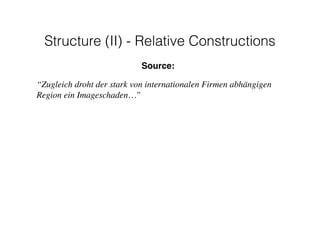
Structure (II) - Relative Constructions
Source:
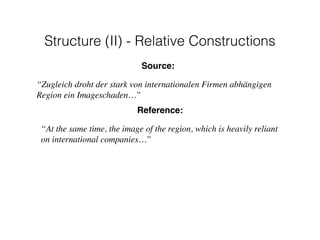
“Zugleich droht der stark von internationalen Firmen abhängigen
Region ein Imageschaden…”
Structure (II) - Relative Constructions
Reference:
“At the same time, the image of the region, which is heavily reliant
on international companies…”
Source:
“Zugleich droht der stark von internationalen Firmen abhängigen
Region ein Imageschaden…”
Structure (II) - Relative Constructions
Syntax-Agnostic:
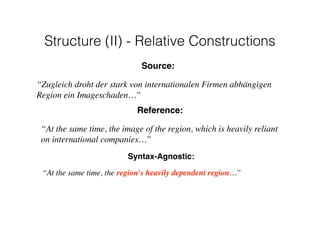
“At the same time, the region's heavily dependent region…”
Reference:
“At the same time, the image of the region, which is heavily reliant
on international companies…”
Source:
“Zugleich droht der stark von internationalen Firmen abhängigen
Region ein Imageschaden…”
Structure (II) - Relative Constructions
Syntax-Agnostic:
“At the same time, the region's heavily dependent region…”
Syntax-Based:
“At the same time, the region, which is heavily dependent on
international firms…”
Reference:
“At the same time, the image of the region, which is heavily reliant
on international companies…”
Source:
“Zugleich droht der stark von internationalen Firmen abhängigen
Region ein Imageschaden…”
Structure (II) - Relative Constructions
Human Evaluation
Human Evaluation
• We performed a small-scale human-evaluation using mechanical
turk on the first 500 sentences in newstest 2015
Human Evaluation
• We performed a small-scale human-evaluation using mechanical
turk on the first 500 sentences in newstest 2015
• Two turkers per sentence
Human Evaluation
• We performed a small-scale human-evaluation using mechanical
turk on the first 500 sentences in newstest 2015
• Two turkers per sentence
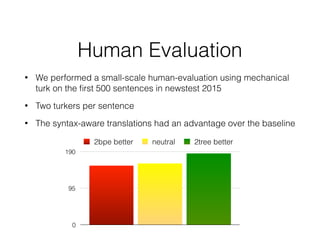
• The syntax-aware translations had an advantage over the baseline
0
95
190
2bpe better neutral 2tree better
Conclusions
Conclusions
• Neural machine translation can clearly benefit from target-side
syntax 


Other recent work include:
Conclusions
• Neural machine translation can clearly benefit from target-side
syntax 


Other recent work include:
• Eriguchi et al., 2017, Wu et al., 2017 (Dependency)
Conclusions
• Neural machine translation can clearly benefit from target-side
syntax 


Other recent work include:
• Eriguchi et al., 2017, Wu et al., 2017 (Dependency)
• Nadejde et al., 2017 (CCG)
Conclusions
• Neural machine translation can clearly benefit from target-side
syntax 


Other recent work include:
• Eriguchi et al., 2017, Wu et al., 2017 (Dependency)
• Nadejde et al., 2017 (CCG)
• A general approach - can be easily incorporated into other neural
language generation tasks like summarization, image caption
generation…
Conclusions
• Neural machine translation can clearly benefit from target-side
syntax 


Other recent work include:
• Eriguchi et al., 2017, Wu et al., 2017 (Dependency)
• Nadejde et al., 2017 (CCG)
• A general approach - can be easily incorporated into other neural
language generation tasks like summarization, image caption
generation…
• Larger picture: don’t throw away your linguistics! Neural systems
can also leverage symbolic linguistic information
Roee Aharoni - 2017 - Towards String-to-Tree Neural Machine Translation

Roee Aharoni - 2017 - Towards String-to-Tree Neural Machine Translation

  • 1.
    Towards String-to-Tree Neural MachineTranslation Roee Aharoni & Yoav Goldberg NLP Lab, Bar Ilan University ACL 2017
  • 2.
    NMT is allthe rage!
  • 3.
    NMT is allthe rage!
  • 4.
    NMT is allthe rage! • Driving the current state-of-the-art (Sennrich et al., 2016)
  • 5.
    NMT is allthe rage! • Driving the current state-of-the-art (Sennrich et al., 2016) • Widely adopted by the industry
  • 6.
  • 7.
    Seq2Seq with Attention f= argmax f0 p(f0 |e) Bahdanau et al. (2015)
  • 8.
    Syntax was allthe rage!
  • 9.
    Syntax was allthe rage! • The “previous” state-of-the- art was syntax-based SMT From Rico Sennrich, “NMT: Breaking the Performance Plateau”, 2016
  • 10.
    From Williams, Sennrich,Post & Koehn (2016), “Syntax-based Statistical Machine Translation” Syntax was all the rage! • The “previous” state-of-the- art was syntax-based SMT • i.e. systems that used linguistic information (usually represented as parse trees)
  • 11.
    Syntax was allthe rage! • The “previous” state-of-the- art was syntax-based SMT • i.e. systems that used linguistic information (usually represented as parse trees) • “Beaten” by NMT in 2016 From Rico Sennrich, “NMT: Breaking the Performance Plateau”, 2016
  • 12.
    Syntax was allthe rage! • The “previous” state-of-the- art was syntax-based SMT • i.e. systems that used linguistic information (usually represented as parse trees) • “Beaten” by NMT in 2016 • Can we bring the benefits of syntax into the recent neural systems? From Rico Sennrich, “NMT: Breaking the Performance Plateau”, 2016
  • 13.
  • 14.
    Syntax: Constituency Structure •A Constituency (a.k.a Phrase-Structure) grammar defines a set of rewrite rules which describe the structure of the language.
  • 15.
    Syntax: Constituency Structure •A Constituency (a.k.a Phrase-Structure) grammar defines a set of rewrite rules which describe the structure of the language. • Groups words into larger units (constituents)
  • 16.
    Syntax: Constituency Structure •A Constituency (a.k.a Phrase-Structure) grammar defines a set of rewrite rules which describe the structure of the language. • Groups words into larger units (constituents) • Defines a hierarchy between constituents
  • 17.
    Syntax: Constituency Structure •A Constituency (a.k.a Phrase-Structure) grammar defines a set of rewrite rules which describe the structure of the language. • Groups words into larger units (constituents) • Defines a hierarchy between constituents • Draws relations between different constituents (words, phrases, clauses…)
  • 18.
  • 19.
    • Hints asto which word sequences belong together Why Syntax Can Help MT?
  • 20.
    • Hints asto which word sequences belong together • Helps in producing well structured sentences Why Syntax Can Help MT?
  • 21.
    • Hints asto which word sequences belong together • Helps in producing well structured sentences • Allows informed reordering decisions according to the syntactic structure Why Syntax Can Help MT?
  • 22.
    • Hints asto which word sequences belong together • Helps in producing well structured sentences • Allows informed reordering decisions according to the syntactic structure • Encourages long-distance dependencies when selecting translations Why Syntax Can Help MT?
  • 23.
  • 24.
  • 25.
  • 26.
  • 27.
    Our Approach: String-to-TreeNMT • Main idea: translate a source sentence into a linearized tree of the target sentence source target
  • 28.
    Our Approach: String-to-TreeNMT • Main idea: translate a source sentence into a linearized tree of the target sentence • Inspired by works on RNN-based syntactic parsing (Vinyals et. al, 
 2015, Choe & Charniak, 2016) source target
  • 29.
    Our Approach: String-to-TreeNMT • Main idea: translate a source sentence into a linearized tree of the target sentence • Inspired by works on RNN-based syntactic parsing (Vinyals et. al, 
 2015, Choe & Charniak, 2016) • Allows using the seq2seq framework as-is source target
  • 30.
    Experimental Details • Weused the Nematus toolkit (Sennrich et al. 2017)
 • Joint BPE segmentation (Sennrich et al. 2016) • For training, we parse the target side using the BLLIP parser (McClosky, Charniak and Johnson, 2006) • Requires some care about making BPE, Tokenization and Parser work together
  • 31.
  • 32.
    Experiments - LargeScale • German to English, 4.5 million parallel training sentences from WMT16
  • 33.
    Experiments - LargeScale • German to English, 4.5 million parallel training sentences from WMT16 • Train two NMT models using the same setup (same settings as the SOTA neural system in WMT16)
  • 34.
    Experiments - LargeScale • German to English, 4.5 million parallel training sentences from WMT16 • Train two NMT models using the same setup (same settings as the SOTA neural system in WMT16) • syntax-aware (bpe2tree)
  • 35.
    Experiments - LargeScale • German to English, 4.5 million parallel training sentences from WMT16 • Train two NMT models using the same setup (same settings as the SOTA neural system in WMT16) • syntax-aware (bpe2tree) • syntax-agnostic baseline (bpe2bpe)
  • 36.
    Experiments - LargeScale • German to English, 4.5 million parallel training sentences from WMT16 • Train two NMT models using the same setup (same settings as the SOTA neural system in WMT16) • syntax-aware (bpe2tree) • syntax-agnostic baseline (bpe2bpe) • The syntax-aware model performs better in terms of BLEU Single Model 5 Model Ensemble
  • 37.
    Experiments - LowResource • German/Russian/Czech to English - 180k-140k parallel training sentences (News Commentary v8) • The syntax-aware model performs better in terms of BLEU in all cases (12 comparisons) • Up to 2+ BLEU improvement
  • 38.
  • 39.
    Accurate Trees • 99%of the predicted trees in the development set had valid bracketing • Eye-balling the predicted trees found them well-formed and following the syntax of English.
  • 40.
  • 41.
    Where Syntax Helps?Alignments • The attention based model induces soft alignments between the source and the target
  • 42.
    Where Syntax Helps?Alignments • The attention based model induces soft alignments between the source and the target • The syntax-aware model produced more sensible alignments
  • 43.
    Where Syntax Helps?Alignments • The attention based model induces soft alignments between the source and the target • The syntax-aware model produced more sensible alignments
  • 44.
    Where Syntax Helps?Alignments • The attention based model induces soft alignments between the source and the target • The syntax-aware model produced more sensible alignments
  • 45.
    Where Syntax Helps?Alignments • The attention based model induces soft alignments between the source and the target • The syntax-aware model produces more sensible alignments
  • 46.
    Where Syntax Helps?Alignments • The attention based model induces soft alignments between the source and the target • The syntax-aware model produces more sensible alignments
  • 47.
    Where Syntax Helps?Alignments • The attention based model induces soft alignments between the source and the target • The syntax-aware model produces more sensible alignments
  • 48.
    Where Syntax Helps?Alignments • The attention based model induces soft alignments between the source and the target • The syntax-aware model produces more sensible alignments
  • 49.
  • 50.
    Attending to SourceSyntax • We inspected the attention weights during the production of the tree’s opening brackets
  • 51.
    Attending to SourceSyntax • We inspected the attention weights during the production of the tree’s opening brackets • The model consistently attends to the main verb (“hatte") or to structural markers (question marks, hyphens…) in the source sentence
  • 52.
    Attending to SourceSyntax • We inspected the attention weights during the production of the tree’s opening brackets • The model consistently attends to the main verb (“hatte") or to structural markers (question marks, hyphens…) in the source sentence • Indicates the system implicitly learns source syntax to some extent (Shi, Padhi and Knight, 2016) and possibly plans the decoding accordingly
  • 53.
  • 54.
  • 55.
  • 56.
    Structure (I) -Reordering
  • 57.
    Structure (I) -Reordering • German to English translation requires a significant amount of reordering during translation
  • 58.
    Structure (I) -Reordering • German to English translation requires a significant amount of reordering during translation • Quantifying reordering shows that the syntax-aware system performs more reordering during the training process
  • 59.
    Structure (I) -Reordering
  • 60.
    Structure (I) -Reordering • We would like to interpret the increased reordering from a syntactic perspective
  • 61.
    Structure (I) -Reordering • We would like to interpret the increased reordering from a syntactic perspective • We extract GHKM rules (Galley et al., 2004) from the dev set using the predicted trees and attention-induced alignments
  • 62.
    Structure (I) -Reordering • We would like to interpret the increased reordering from a syntactic perspective • We extract GHKM rules (Galley et al., 2004) from the dev set using the predicted trees and attention-induced alignments • The most common rules reveal linguistically sensible transformations, like moving the verb from the end of a German constituent to the beginning of the matching English one German English:
  • 63.
    Structure (I) -Reordering • We would like to interpret the increased reordering from a syntactic perspective • We extract GHKM rules (Galley et al., 2004) from the dev set using the predicted trees and attention-induced alignments • The most common rules reveal linguistically sensible transformations, like moving the verb from the end of a German constituent to the beginning of the matching English one • More examples in the paper German English:
  • 64.
    Structure (II) -Relative Constructions
  • 65.
    Structure (II) -Relative Constructions • A common linguistic structure is relative constructions, i.e. “The XXX which YYY”, “A XXX whose YYY”…
  • 66.
    Structure (II) -Relative Constructions • A common linguistic structure is relative constructions, i.e. “The XXX which YYY”, “A XXX whose YYY”… • The words that connect the clauses in such constructions are called relative pronouns, i.e. “who”, “which”, “whom”…
  • 67.
    Structure (II) -Relative Constructions • A common linguistic structure is relative constructions, i.e. “The XXX which YYY”, “A XXX whose YYY”… • The words that connect the clauses in such constructions are called relative pronouns, i.e. “who”, “which”, “whom”… • The syntax-aware system produced more relative pronouns due to the syntactic context
  • 68.
    Structure (II) -Relative Constructions
  • 69.
    Source: “Guangzhou, das inDeutschland auch Kanton genannt wird…” Structure (II) - Relative Constructions
  • 70.
    Source: “Guangzhou, das inDeutschland auch Kanton genannt wird…” Reference: “Guangzhou, which is also known as Canton in Germany…” Structure (II) - Relative Constructions
  • 71.
    Syntax-Agnostic: “Guangzhou, also knownin Germany, is one of… Source: “Guangzhou, das in Deutschland auch Kanton genannt wird…” Reference: “Guangzhou, which is also known as Canton in Germany…” Structure (II) - Relative Constructions
  • 72.
    Syntax-Agnostic: “Guangzhou, also knownin Germany, is one of… Syntax-Based: “Guangzhou, which is also known as the canton in Germany,…” Source: “Guangzhou, das in Deutschland auch Kanton genannt wird…” Reference: “Guangzhou, which is also known as Canton in Germany…” Structure (II) - Relative Constructions
  • 73.
    Source: “Zugleich droht derstark von internationalen Firmen abhängigen Region ein Imageschaden…” Structure (II) - Relative Constructions
  • 74.
    Reference: “At the sametime, the image of the region, which is heavily reliant on international companies…” Source: “Zugleich droht der stark von internationalen Firmen abhängigen Region ein Imageschaden…” Structure (II) - Relative Constructions
  • 75.
    Syntax-Agnostic: “At the sametime, the region's heavily dependent region…” Reference: “At the same time, the image of the region, which is heavily reliant on international companies…” Source: “Zugleich droht der stark von internationalen Firmen abhängigen Region ein Imageschaden…” Structure (II) - Relative Constructions
  • 76.
    Syntax-Agnostic: “At the sametime, the region's heavily dependent region…” Syntax-Based: “At the same time, the region, which is heavily dependent on international firms…” Reference: “At the same time, the image of the region, which is heavily reliant on international companies…” Source: “Zugleich droht der stark von internationalen Firmen abhängigen Region ein Imageschaden…” Structure (II) - Relative Constructions
  • 77.
  • 78.
    Human Evaluation • Weperformed a small-scale human-evaluation using mechanical turk on the first 500 sentences in newstest 2015
  • 79.
    Human Evaluation • Weperformed a small-scale human-evaluation using mechanical turk on the first 500 sentences in newstest 2015 • Two turkers per sentence
  • 80.
    Human Evaluation • Weperformed a small-scale human-evaluation using mechanical turk on the first 500 sentences in newstest 2015 • Two turkers per sentence • The syntax-aware translations had an advantage over the baseline 0 95 190 2bpe better neutral 2tree better
  • 81.
  • 82.
    Conclusions • Neural machinetranslation can clearly benefit from target-side syntax 
 
 Other recent work include:
  • 83.
    Conclusions • Neural machinetranslation can clearly benefit from target-side syntax 
 
 Other recent work include: • Eriguchi et al., 2017, Wu et al., 2017 (Dependency)
  • 84.
    Conclusions • Neural machinetranslation can clearly benefit from target-side syntax 
 
 Other recent work include: • Eriguchi et al., 2017, Wu et al., 2017 (Dependency) • Nadejde et al., 2017 (CCG)
  • 85.
    Conclusions • Neural machinetranslation can clearly benefit from target-side syntax 
 
 Other recent work include: • Eriguchi et al., 2017, Wu et al., 2017 (Dependency) • Nadejde et al., 2017 (CCG) • A general approach - can be easily incorporated into other neural language generation tasks like summarization, image caption generation…
  • 86.
    Conclusions • Neural machinetranslation can clearly benefit from target-side syntax 
 
 Other recent work include: • Eriguchi et al., 2017, Wu et al., 2017 (Dependency) • Nadejde et al., 2017 (CCG) • A general approach - can be easily incorporated into other neural language generation tasks like summarization, image caption generation… • Larger picture: don’t throw away your linguistics! Neural systems can also leverage symbolic linguistic information