•Radiation injury causes changes in the
living tissues causing radiation sickness

•Somatic effects -harmful to the person
•genetic effects - reflected in the offspring.
1.   Radiation decomposition i.e. splitting of
     water into H+ and OH- and also splitting
     of other solvents of the body.

2. kinetic energy of the incident photons
   heats up the molecules of the living
   tissues
3. Incident radiation when traveling
   through the body tissues knock out the
   bound electrons free from their parent
   atoms or molecules. These free electrons
   are highly unstable and interact with
   other atoms and molecules within the
   irradiated system.
 Ionization is another process where the radiations
  interact with matter to form ions;
 High-energy electromagnetic radiation and particle
  radiation are capable of producing ions in their
  passage through matter.
 Types of ionizing radiation include alpha and beta
  particles, X-Rays, gamma rays, etc. X-Ray machines
  and Radioisotopes are the two important and potential
  sources of ionizing radiation.
 Indirect effects:
 Since 80% of the biological tissue is water
 Most of the incident radiation Energy is absorbed by the water
  molecules and these are broken into very unstable and reactive
  components. These then react with body molecules and cause
  the cell damage.
 Due to generation of H and OH radicals , subsequent to many
  series of reactions hydrogen peroxide is formed which is highly
  reactive oxidizing compound and break chemical bonds in
  macromolecules of the body such as proteins, lipids and other
  nucleic acids etc causing cellular damage, cell death and
  mutations.
 The biological effects are enhanced by the presence of oxygen
  which is always present in the cells.
Lymphoid cells, Epithelial cells of the small
              intestine, Haemopoietic cells, Germinal
  cells, Epithelial cells of the skin, Connective tissue
  cells, Cartilage and growing bone cells, Cells of the
  brain and spinal cord, Cells of the skeletal muscles
                                       and mature bone
      •The early effect of radiation is a result of direct
injury to the tissues. Simultaneous and considerable
         destruction to the radiosensitive cells lead to
    radiation sickness. These effects appear within
             days or weeks after exposure and include
          nausea, vomitions, malaise, diarrhea, fever;
  hemorrhage, loss of appetite, fall of hair and death
            etc are the dangerous effects of radiation.
            •The delayed effects of radiation includes
Shortening of life span, leukemia, malignant tumors
     and cataract. These appear after months or even
                                many years of exposure.
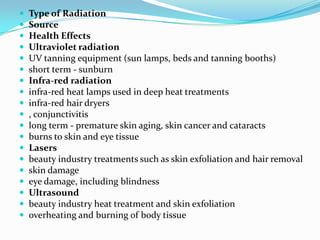
   Type of Radiation
   Source
   Health Effects
   Ultraviolet radiation
   UV tanning equipment (sun lamps, beds and tanning booths)
   short term - sunburn
   Infra-red radiation
   infra-red heat lamps used in deep heat treatments
   infra-red hair dryers
   , conjunctivitis
   long term - premature skin aging, skin cancer and cataracts
   burns to skin and eye tissue
   Lasers
   beauty industry treatments such as skin exfoliation and hair removal
   skin damage
   eye damage, including blindness
   Ultrasound
   beauty industry heat treatment and skin exfoliation
   overheating and burning of body tissue
 The unit Rad (radiation absorbed dose) is used as the
  unit of absorbed dose following exposure to any type
  of ionizing radiation. One rad is equal to the radiation
  necessary to deposit energy of 100 ergs in 1 g of
  irradiated material (100ergs/g).
 The radiation dose is measured in terms of Roentgen, -
  It is the quantity of X-Rays or gamma radiation
  which produces one electrostatic unit in one C.C. of
  dry air after its ionization at 0 degree centigrade and
  760 mm Hg pressure..
•The soft tissues exposed to X-Rays or gamma
       rays, rad and R are nearly equivalent. The
 biological effects of various types of radiations
                                       differ a lot.
     •To equate all types of radiation in terms of
       biological effects, the unit Rem (roentgen
 equivalent man) was evolved. One rem = radx
      quality factor. Quality factor relates to the
 biological effectiveness of the given radiation.
The quality factor for X-Rays and gamma rays is
                   one and for alpha particles 20.
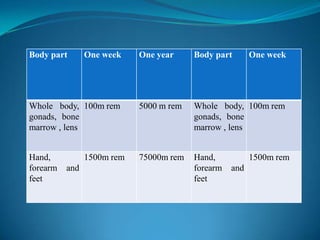
     •Maximum Permissible dose: It is a level at
       which appreciable injury is unlikely to be
 manifested in the lifetime of an individual. For
    the veterinarians and radiographic staff it is
Body part part One week
      Body                     One week
                                   One year      One year
                                                Body part           One week
      Whole body, gonads, bone 100m rem          5000 m rem
      marrow , lens


Whole body, 100m rem               5000 m rem   Whole body, 100m rem
gonads, bone                                    gonads, bone
marrow , lens                                   marrow , lens


Hand,           1500m rem          75000m rem   Hand,               1500m rem
forearm   and                                   forearm       and
feet                                            feet
 Principles of radiation safety:

   The distance between the radiation source and
    personnel exposed should be increased. Usually
    doubling the distance from the source will reduce
    the radiation exposure by a factor of four.
 Allow only the operator in the x- ray room when
    exposures are made
   Always try to restraint the animal or subject by
    anaesthesia
   Always use a cassette holding device especially in large
    animal radiography.
   Behind the Shielding screen or atleast 6 feet away from
    the source the exposure should be made.
   Fluoroscopy should never be used as a substitute for a
    non motion radiographic procedure as amount of
    radiations is extremely large in fluoroscopy.
Use of protective barriers

 The lead shielding material in the gloves and aprons reduces the dose
    of scatter radiation well below 1/12th of the scatter radiation dose.
   Aprons should have a minimum of 0.25 mm lead equivalent for
    voltages upto 100 KV. Check the shielding material periodically for
    cracks etc. Never fold the protective aprons.
   Gloves and goggles should be used during exposure
   X-Ray room should be located away from the traffic and public places
    to prevent the inadvertent exposure of the public.
   Make sure workers display signs warning other persons that radiation-
    emitting equipment is in use
   Check the equipment periodically for possible leakage.
   Display warning signs near the location of X-Ray unit regarding
    potential hazards. The wall of the X-Ray room should be atleast 22 cm
    thick and should be of concrete in to which iron may be introduced .
and reduction of unnecessary
radiography

 Use of intensifying screens minimizes the factors.
 Provide workers with instruction and training on the
 health effects associated with radiation exposure and
 the safe use of equipment.
Use of the radiation monitoring
devices

 Users may receive a dosimeter badge or ring to monitor
  radiation exposure.
 Two film badges should be used one at the belt level to
  monitor whole body exposure and the other above the
  protective apparel, at the neckline, to estimate exposure to
  the skin of the head, neck and eyes.
 Film badges or thermo luminescent dosimeters can be
  obtained from BARC, Division of Radiation
  Safety, Mumbai, India, and at periodic intervals these
  monitoring devices should be sent back to this research
  institute for calculating radiation dose.
 Regular testing for radioactive contamination must be
  conducted.
Pregnant woman and persons
under 18 years of age
   Pregnant woman and persons under 18 years of age
    should not be involved in radiographic work as it
    may adversely affect the growing fetus and the
    gonads of the persons exposed which may cause
    sterility or infertility.
 Following with great precaution with all the safety
 procedures we can reduce a significant amount of
 radiation in a large number of individuals.

Radiation hazards

  • 1.
    •Radiation injury causeschanges in the living tissues causing radiation sickness •Somatic effects -harmful to the person •genetic effects - reflected in the offspring.
  • 2.
    1. Radiation decomposition i.e. splitting of water into H+ and OH- and also splitting of other solvents of the body. 2. kinetic energy of the incident photons heats up the molecules of the living tissues 3. Incident radiation when traveling through the body tissues knock out the bound electrons free from their parent atoms or molecules. These free electrons are highly unstable and interact with other atoms and molecules within the irradiated system.
  • 3.
     Ionization isanother process where the radiations interact with matter to form ions;  High-energy electromagnetic radiation and particle radiation are capable of producing ions in their passage through matter.  Types of ionizing radiation include alpha and beta particles, X-Rays, gamma rays, etc. X-Ray machines and Radioisotopes are the two important and potential sources of ionizing radiation.
  • 4.
     Indirect effects: Since 80% of the biological tissue is water  Most of the incident radiation Energy is absorbed by the water molecules and these are broken into very unstable and reactive components. These then react with body molecules and cause the cell damage.  Due to generation of H and OH radicals , subsequent to many series of reactions hydrogen peroxide is formed which is highly reactive oxidizing compound and break chemical bonds in macromolecules of the body such as proteins, lipids and other nucleic acids etc causing cellular damage, cell death and mutations.  The biological effects are enhanced by the presence of oxygen which is always present in the cells.
  • 5.
    Lymphoid cells, Epithelialcells of the small intestine, Haemopoietic cells, Germinal cells, Epithelial cells of the skin, Connective tissue cells, Cartilage and growing bone cells, Cells of the brain and spinal cord, Cells of the skeletal muscles and mature bone •The early effect of radiation is a result of direct injury to the tissues. Simultaneous and considerable destruction to the radiosensitive cells lead to radiation sickness. These effects appear within days or weeks after exposure and include nausea, vomitions, malaise, diarrhea, fever; hemorrhage, loss of appetite, fall of hair and death etc are the dangerous effects of radiation. •The delayed effects of radiation includes Shortening of life span, leukemia, malignant tumors and cataract. These appear after months or even many years of exposure.
  • 6.
    Type of Radiation  Source  Health Effects  Ultraviolet radiation  UV tanning equipment (sun lamps, beds and tanning booths)  short term - sunburn  Infra-red radiation  infra-red heat lamps used in deep heat treatments  infra-red hair dryers  , conjunctivitis  long term - premature skin aging, skin cancer and cataracts  burns to skin and eye tissue  Lasers  beauty industry treatments such as skin exfoliation and hair removal  skin damage  eye damage, including blindness  Ultrasound  beauty industry heat treatment and skin exfoliation  overheating and burning of body tissue
  • 7.
     The unitRad (radiation absorbed dose) is used as the unit of absorbed dose following exposure to any type of ionizing radiation. One rad is equal to the radiation necessary to deposit energy of 100 ergs in 1 g of irradiated material (100ergs/g).  The radiation dose is measured in terms of Roentgen, - It is the quantity of X-Rays or gamma radiation which produces one electrostatic unit in one C.C. of dry air after its ionization at 0 degree centigrade and 760 mm Hg pressure..
  • 8.
    •The soft tissuesexposed to X-Rays or gamma rays, rad and R are nearly equivalent. The biological effects of various types of radiations differ a lot. •To equate all types of radiation in terms of biological effects, the unit Rem (roentgen equivalent man) was evolved. One rem = radx quality factor. Quality factor relates to the biological effectiveness of the given radiation. The quality factor for X-Rays and gamma rays is one and for alpha particles 20. •Maximum Permissible dose: It is a level at which appreciable injury is unlikely to be manifested in the lifetime of an individual. For the veterinarians and radiographic staff it is
  • 9.
    Body part partOne week Body One week One year One year Body part One week Whole body, gonads, bone 100m rem 5000 m rem marrow , lens Whole body, 100m rem 5000 m rem Whole body, 100m rem gonads, bone gonads, bone marrow , lens marrow , lens Hand, 1500m rem 75000m rem Hand, 1500m rem forearm and forearm and feet feet
  • 10.
     Principles ofradiation safety:  The distance between the radiation source and personnel exposed should be increased. Usually doubling the distance from the source will reduce the radiation exposure by a factor of four.
  • 11.
     Allow onlythe operator in the x- ray room when exposures are made  Always try to restraint the animal or subject by anaesthesia  Always use a cassette holding device especially in large animal radiography.  Behind the Shielding screen or atleast 6 feet away from the source the exposure should be made.  Fluoroscopy should never be used as a substitute for a non motion radiographic procedure as amount of radiations is extremely large in fluoroscopy.
  • 12.
    Use of protectivebarriers  The lead shielding material in the gloves and aprons reduces the dose of scatter radiation well below 1/12th of the scatter radiation dose.  Aprons should have a minimum of 0.25 mm lead equivalent for voltages upto 100 KV. Check the shielding material periodically for cracks etc. Never fold the protective aprons.  Gloves and goggles should be used during exposure  X-Ray room should be located away from the traffic and public places to prevent the inadvertent exposure of the public.  Make sure workers display signs warning other persons that radiation- emitting equipment is in use  Check the equipment periodically for possible leakage.  Display warning signs near the location of X-Ray unit regarding potential hazards. The wall of the X-Ray room should be atleast 22 cm thick and should be of concrete in to which iron may be introduced .
  • 13.
    and reduction ofunnecessary radiography  Use of intensifying screens minimizes the factors.  Provide workers with instruction and training on the health effects associated with radiation exposure and the safe use of equipment.
  • 14.
    Use of theradiation monitoring devices  Users may receive a dosimeter badge or ring to monitor radiation exposure.  Two film badges should be used one at the belt level to monitor whole body exposure and the other above the protective apparel, at the neckline, to estimate exposure to the skin of the head, neck and eyes.  Film badges or thermo luminescent dosimeters can be obtained from BARC, Division of Radiation Safety, Mumbai, India, and at periodic intervals these monitoring devices should be sent back to this research institute for calculating radiation dose.  Regular testing for radioactive contamination must be conducted.
  • 15.
    Pregnant woman andpersons under 18 years of age  Pregnant woman and persons under 18 years of age should not be involved in radiographic work as it may adversely affect the growing fetus and the gonads of the persons exposed which may cause sterility or infertility.  Following with great precaution with all the safety procedures we can reduce a significant amount of radiation in a large number of individuals.