RADIATION
PROTECTION
SUBRATA ROY
RTT HCG
AIM OF RADIATION PROTECTION
“To provide an appropriate
standard of protection for
man without unduly limiting
the beneficial practices
giving rise to radiation
exposure”.
Radiation protection can be defined as the protection
of people against exposure to ionizing radiation or radioactive
substances and the safety of radioactive sources,
including the means for achieving such protection and
safety. It encompasses the various procedures and devices
for keeping people’s doses and risks as low as can
be reasonably achieved and below prescribed dose
constraints,
as well as the means for preventing accidents
and for mitigating the consequences of accidents, should
they occur.
RADIATION QUANTITIES
 Dose Equivalent:- Factors affectinng the biological
effects of radiation.
 Dose.
 Types of radiation.
Dose Equivalent(H)
The dosemetric quality relevent to radiation.
H=D.Q
D= Absorbed dose.
Q= Quality Factor.
Units=sievert, 1 Sievert=1j/kg..[S.I
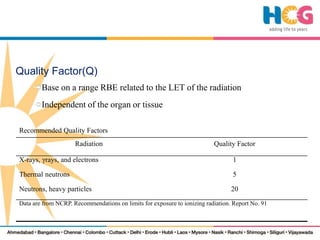
Quality Factor(Q)
Base on a range RBE related to the LET of the radiation
Independent of the organ or tissue
Recommended Quality Factors
Radiation Quality Factor
X-rays, γrays, and electrons 1
Thermal neutrons 5
Neutrons, heavy particles 20
Data are from NCRP. Recommendations on limits for exposure to ionizing radiation. Report No. 91
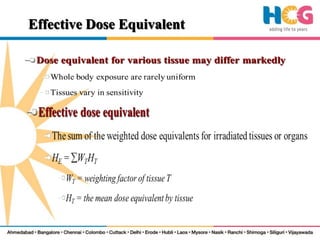
Effective Dose Equivalent
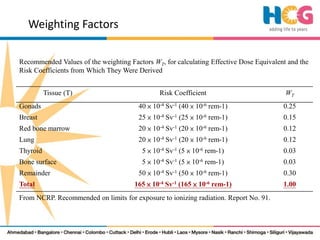
Weighting Factors
Recommended Values of the weighting Factors WT, for calculating Effective Dose Equivalent and the
Risk Coefficients from Which They Were Derived
Tissue (T) Risk Coefficient WT
Gonads 40 × 10-4 Sv-1 (40 × 10-6 rem-1) 0.25
Breast 25 × 10-4 Sv-1 (25 × 10-6 rem-1) 0.15
Red bone marrow 20 × 10-4 Sv-1 (20 × 10-6 rem-1) 0.12
Lung 20 × 10-4 Sv-1 (20 × 10-6 rem-1) 0.12
Thyroid 5 × 10⁻⁴ Sv-1 (5 × 10⁻⁶ rem-1) 0.03
Bone surface 5 × 10⁻⁴ Sv-1 (5 × 10⁻⁶ rem-1) 0.03
Remainder 50 × 10-4 Sv-1 (50 × 10-6 rem-1) 0.30
Total 165 × 10-4 Sv-1 (165 × 10-6 rem-1) 1.00
From NCRP. Recommended on limits for exposure to ionizing radiation. Report No. 91.
Background Radiation
 Low Level Radiation Effects.
 Effective Dose Equivalent limits.
 Structural Shielding Design.
Background Radiation
Radiation from the natural environment
Terrestrial radiation
e.g. elevation level of radon in many building
Emitted by naturally ocurring 238U in soil
Annual dose equivalent to bronchial epithelium = 24 mSv (2.4 rem)
Cosmic radiation
e.g. air travel
At 30,000 feet, the dose equivalent is about 0.5 mrem/h
Radiation element in our bodies
e.g. mainly from 40K
Emits β, γrays; T1/2 = 1.3 × 10⁹ years
Estimated Total Dose Equivalent Rate for a Member of the Population in the United States and
Canada from Various Sources of Natural Background
Source
Dose Equivalent Rate (mSv/y)
Bronchial
Epithelium
Other Soft
Tissues
Bone Surfaces Bone Marrow
Cosmic 0.27 0.27 0.27 0.27
Cosmogenic 0.01 0.01 0.01 0.03
Terrestrial 0.28 0.28 0.28 0.28
Inhaled 24 - - -
In the body 0.35 0.35 1.1 0.50
Rounded totals 25 0.9 1.7 1.1
From NCRP. Exposure of the population in United States and Canada from national background radiation.
Radiation from various medical procedures
The average annual genetically significant dose equivalent in 1970 =
20 mrem/year
Occupational exposure excluded exposure from
Natural background
Medical procedures
Low-Level Radiation Effects
Effective Dose Equivalent limits
Structural Shielding Design
A.Primary Radiation Barrier
B.Secondary Barrier for Scattered Radiation
C.Secondary Barrier for Leakage Radiation
D.Door Shielding
E.Protection against Neotrons.
Low-Level Radiation Effect
Low level radiation
< Dose required to produce acute radiation syndrome
> Dose limits recommended by the standards
Low-Level Radiation Effects
Genetic effects
Radiation-induced gene mutation
Chromosome breaks and anomalies
Neoplastic disease
e.g. Leukemia, thyroid tumors, skin lesions
Effect on growth and development
Adverse effects on fetus and young children
Effect on life span
Diminishing of life span
Premature aging
Cataracts – opacification of the eye lens
Stochastic & Non Stochastic Effect
• Stochastic Effect:-Radiation effect which
has no threshold dose limits are called stochastic
effect
• Example:- incident of cancer due to radiation .
Non Stochastic/Deterministic Effect
• Non Stochastic Effect:-The harmful effect of
radiation Which has threshold dose limit for
occurence is called Diterministic effect.
• Example:-Formation Of Cataract in eye due to
Radiation.
Effective Dose Equivalent limits
Structural Shielding Design
A.Primary Radiation Barrier
B.Secondary Barrier for Scattered Radiation
C.Secondary Barrier for Leakage Radiation
D.Door Shielding
E.Protection Against Neutrons
Effective Dose Equivalent limits
The criteria for recommendations on exposure limits of
radiation workers
At low radiation levels, the nonstochastic effects are essentially
avoided
The predicted risk for stochastic effects should not be greater then
the average risk of accidental death among worker in “safe”
industries
ALARA principles should be followed
The risk are kept as low as reasonably achievable, taking into account,
social and economic factors
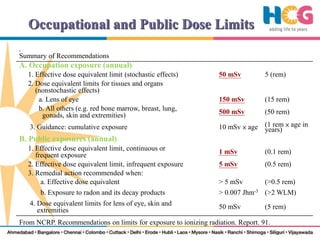
Occupational and Public Dose Limits
.
Summary of Recommendations
A. Occupation exposure (annual)
1. Effective dose equivalent limit (stochastic effects) 50 mSv 5 (rem)
2. Dose equivalent limits for tissues and organs
(nonstochastic effects)
a. Lens of eye 150 mSv (15 rem)
b. All others (e.g. red bone marrow, breast, lung,
gonads, skin and extremities) 500 mSv (50 rem)
3. Guidance: cumulative exposure 10 mSv × age (1 rem × age in
years)
B. Public exposures (annual)
1. Effective dose equivalent limit, continuous or
frequent exposure 1 mSv (0.1 rem)
2. Effective dose equivalent limit, infrequent exposure 5 mSv (0.5 rem)
3. Remedial action recommended when:
a. Effective dose equivalent > 5 mSv (>0.5 rem)
b. Exposure to radon and its decay products > 0.007 Jhm-3 (>2 WLM)
4. Dose equivalent limits for lens of eye, skin and
extremities 50 mSv (5 rem)
From NCRP. Recommendations on limits for exposure to ionizing radiation. Report. 91.
Occupational and Public Dose Limits
Summary of Recommendations
C. Education and training exposures (annual)
1. Effective dose equivalent 1 mSv (0.1 rem)
2. Dose equivalent limits for lens of eye, skin and
extremities 50 mSv (5 rem)
D. Embryo-fetus exposures
1. Total dose equivalent limit 5 mSv (0.5 rem)
2. Dose equivalent limit in a month 0.5 mSv (0.05 rem)
E. Negligible Individual Risk Level (annnual)
Effective dose equivalent per source or practice 0.01 mSv (0.001 rem)
From NCRP. Recommendations on limits for exposure to ionizing radiation. Report No 91.
Structural Shielding Design
A.Primary Radiation Barrier
B.Secondary Barrier for Scattered Radiation
C.Secondary Barrier for Leakage Radiation
D.Door Shielding
E.Protection Against Neutrons
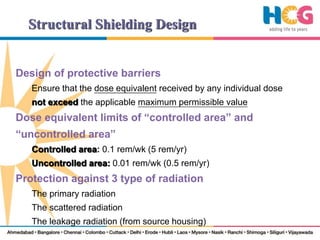
Structural Shielding Design
Design of protective barriers
Ensure that the dose equivalent received by any individual dose
not exceed the applicable maximum permissible value
Dose equivalent limits of “controlled area” and
“uncontrolled area”
Controlled area: 0.1 rem/wk (5 rem/yr)
Uncontrolled area: 0.01 rem/wk (0.5 rem/yr)
Protection against 3 type of radiation
The primary radiation
The scattered radiation
The leakage radiation (from source housing)
Factors associated with the calculation of barrier thickness
 Workload (W)
 Use factor (U)
 Occupancy factor (T)
 Distance (d)
Workload (W)
For <500 kVp x-ray machine
W = Maximum mA × beam “on” time
= min/week
For MV machine
W = weekly dose delivered at 1 m from the source
= no. of patient treated/wk × dose delivered/p’t at 1 m
= rad/wk (at 1m)
Use Factor (U)
U = Fraction of operation time that radiation is directed toward
a
particular barrier
Depending on technique use
Typical Use Factor for Primary Protective Barriers
Location Use Factor
Floor 1
Walls ¼
Ceiling ¼ - ½ , depending on equipment and techniques
Occupancy Factor (T)
T = Fraction of operating time during which the area of interest
is occupied by the individualTable
Typical Occupancy Factors
Full occupancy (T = 1)
Work areas, offices, nurses’ stations
Partial occupancy (T = ¼ )
Corridors, rest rooms, elevators with operators
Occasional occupancy (T = 1/8 – 1/16)
Waiting rooms, toilets, stairways, unattended elevators,
outside areas used only for pedestrians or vehicular traffic
Distance
d = distance from the radiation source to the area to be protected
Applied inverse square law
A. Primary Radiation Barrier
Determine the thickness of the primary radiation barrier
P = Maximum permissible dose equivalent for the area to be
protected
Controlled area: 0.1 rad/wk
Non-controlled area: 0.01 rad/wk
B = transmission factor
Determining the barrier thickness by consulting broad beam
attenuation curves for the given beam energy
B
d
WUT
P  2
WUT
dP
B
2


B. Secondary Barrier for Scattered Radiation
Energy of the scatter
For orthovoltage radiation
Beam energy: Scatter = incident (assumed)
For MV beams
Beam energy at 90° scattered photon = 500 keV
Transmission of 500 kVp useful beam
Relatively lower energy in compare with the incident energy
Beam softening by Compton effect
C. Secondary Barrier for Leakage Radiation
The recommended leakage exposure rate for different
energy of the beams (< 500 kVp)
5-50 kVp
<0.1 R (in any h at any point 5 cm from the source)
> 50 kVp, < 500 kVp
< 1 R (in 1 h, at 1 m from the source)
< 30 R/h at 5 cm
C. Secondary Barrier for Leakage Radiation
The recommended absorbed dose rate for different
energy of the beam (> 500 kVp)
> 500 kVp
< 0.2% of the useful beam dose rate
(any point outside the max field size, within a circular plane of radius 2 m)
Cobalt teletherapy
Beam “off” position
< 2mrad/h (on average direction, 1m from the source)
< 10 mrad/h (in any direction, 1m from the source)
Beam “on” position
< 0.1% of the useful beam dose rate (1 m from the source)
D. Door Shielding
Advantages of the maze arrangement in treatment
room
Reduces the shielding requirement of the door
Expose mainly to multiply scattered radiation
E. Protection against Neutrons
Neutron contamination
High energy photon (> 10 MV) or electrons incident on the various
materials of target, flattening filter, collimators and other shielding
components
Increase rapidly in the range of 10 – 20 MV beam energy
The energy spectrum of emitted neutrons
Within the beam : range 1 MeV
Inside of the maze: few fast neutrons (> 0.1 MeV)
RADIATION PROTECTION

RADIATION PROTECTION

  • 1.
  • 2.
    AIM OF RADIATIONPROTECTION “To provide an appropriate standard of protection for man without unduly limiting the beneficial practices giving rise to radiation exposure”.
  • 3.
    Radiation protection canbe defined as the protection of people against exposure to ionizing radiation or radioactive substances and the safety of radioactive sources, including the means for achieving such protection and safety. It encompasses the various procedures and devices for keeping people’s doses and risks as low as can be reasonably achieved and below prescribed dose constraints, as well as the means for preventing accidents and for mitigating the consequences of accidents, should they occur.
  • 4.
    RADIATION QUANTITIES  DoseEquivalent:- Factors affectinng the biological effects of radiation.  Dose.  Types of radiation. Dose Equivalent(H) The dosemetric quality relevent to radiation. H=D.Q D= Absorbed dose. Q= Quality Factor. Units=sievert, 1 Sievert=1j/kg..[S.I
  • 5.
    Quality Factor(Q) Base ona range RBE related to the LET of the radiation Independent of the organ or tissue Recommended Quality Factors Radiation Quality Factor X-rays, γrays, and electrons 1 Thermal neutrons 5 Neutrons, heavy particles 20 Data are from NCRP. Recommendations on limits for exposure to ionizing radiation. Report No. 91
  • 6.
  • 7.
    Weighting Factors Recommended Valuesof the weighting Factors WT, for calculating Effective Dose Equivalent and the Risk Coefficients from Which They Were Derived Tissue (T) Risk Coefficient WT Gonads 40 × 10-4 Sv-1 (40 × 10-6 rem-1) 0.25 Breast 25 × 10-4 Sv-1 (25 × 10-6 rem-1) 0.15 Red bone marrow 20 × 10-4 Sv-1 (20 × 10-6 rem-1) 0.12 Lung 20 × 10-4 Sv-1 (20 × 10-6 rem-1) 0.12 Thyroid 5 × 10⁻⁴ Sv-1 (5 × 10⁻⁶ rem-1) 0.03 Bone surface 5 × 10⁻⁴ Sv-1 (5 × 10⁻⁶ rem-1) 0.03 Remainder 50 × 10-4 Sv-1 (50 × 10-6 rem-1) 0.30 Total 165 × 10-4 Sv-1 (165 × 10-6 rem-1) 1.00 From NCRP. Recommended on limits for exposure to ionizing radiation. Report No. 91.
  • 8.
    Background Radiation  LowLevel Radiation Effects.  Effective Dose Equivalent limits.  Structural Shielding Design.
  • 9.
    Background Radiation Radiation fromthe natural environment Terrestrial radiation e.g. elevation level of radon in many building Emitted by naturally ocurring 238U in soil Annual dose equivalent to bronchial epithelium = 24 mSv (2.4 rem) Cosmic radiation e.g. air travel At 30,000 feet, the dose equivalent is about 0.5 mrem/h Radiation element in our bodies e.g. mainly from 40K Emits β, γrays; T1/2 = 1.3 × 10⁹ years
  • 10.
    Estimated Total DoseEquivalent Rate for a Member of the Population in the United States and Canada from Various Sources of Natural Background Source Dose Equivalent Rate (mSv/y) Bronchial Epithelium Other Soft Tissues Bone Surfaces Bone Marrow Cosmic 0.27 0.27 0.27 0.27 Cosmogenic 0.01 0.01 0.01 0.03 Terrestrial 0.28 0.28 0.28 0.28 Inhaled 24 - - - In the body 0.35 0.35 1.1 0.50 Rounded totals 25 0.9 1.7 1.1 From NCRP. Exposure of the population in United States and Canada from national background radiation.
  • 11.
    Radiation from variousmedical procedures The average annual genetically significant dose equivalent in 1970 = 20 mrem/year Occupational exposure excluded exposure from Natural background Medical procedures
  • 12.
    Low-Level Radiation Effects EffectiveDose Equivalent limits Structural Shielding Design A.Primary Radiation Barrier B.Secondary Barrier for Scattered Radiation C.Secondary Barrier for Leakage Radiation D.Door Shielding E.Protection against Neotrons.
  • 13.
    Low-Level Radiation Effect Lowlevel radiation < Dose required to produce acute radiation syndrome > Dose limits recommended by the standards
  • 14.
    Low-Level Radiation Effects Geneticeffects Radiation-induced gene mutation Chromosome breaks and anomalies Neoplastic disease e.g. Leukemia, thyroid tumors, skin lesions Effect on growth and development Adverse effects on fetus and young children Effect on life span Diminishing of life span Premature aging Cataracts – opacification of the eye lens
  • 15.
    Stochastic & NonStochastic Effect • Stochastic Effect:-Radiation effect which has no threshold dose limits are called stochastic effect • Example:- incident of cancer due to radiation .
  • 16.
    Non Stochastic/Deterministic Effect •Non Stochastic Effect:-The harmful effect of radiation Which has threshold dose limit for occurence is called Diterministic effect. • Example:-Formation Of Cataract in eye due to Radiation.
  • 18.
    Effective Dose Equivalentlimits Structural Shielding Design A.Primary Radiation Barrier B.Secondary Barrier for Scattered Radiation C.Secondary Barrier for Leakage Radiation D.Door Shielding E.Protection Against Neutrons
  • 19.
    Effective Dose Equivalentlimits The criteria for recommendations on exposure limits of radiation workers At low radiation levels, the nonstochastic effects are essentially avoided The predicted risk for stochastic effects should not be greater then the average risk of accidental death among worker in “safe” industries ALARA principles should be followed The risk are kept as low as reasonably achievable, taking into account, social and economic factors
  • 20.
    Occupational and PublicDose Limits . Summary of Recommendations A. Occupation exposure (annual) 1. Effective dose equivalent limit (stochastic effects) 50 mSv 5 (rem) 2. Dose equivalent limits for tissues and organs (nonstochastic effects) a. Lens of eye 150 mSv (15 rem) b. All others (e.g. red bone marrow, breast, lung, gonads, skin and extremities) 500 mSv (50 rem) 3. Guidance: cumulative exposure 10 mSv × age (1 rem × age in years) B. Public exposures (annual) 1. Effective dose equivalent limit, continuous or frequent exposure 1 mSv (0.1 rem) 2. Effective dose equivalent limit, infrequent exposure 5 mSv (0.5 rem) 3. Remedial action recommended when: a. Effective dose equivalent > 5 mSv (>0.5 rem) b. Exposure to radon and its decay products > 0.007 Jhm-3 (>2 WLM) 4. Dose equivalent limits for lens of eye, skin and extremities 50 mSv (5 rem) From NCRP. Recommendations on limits for exposure to ionizing radiation. Report. 91.
  • 21.
    Occupational and PublicDose Limits Summary of Recommendations C. Education and training exposures (annual) 1. Effective dose equivalent 1 mSv (0.1 rem) 2. Dose equivalent limits for lens of eye, skin and extremities 50 mSv (5 rem) D. Embryo-fetus exposures 1. Total dose equivalent limit 5 mSv (0.5 rem) 2. Dose equivalent limit in a month 0.5 mSv (0.05 rem) E. Negligible Individual Risk Level (annnual) Effective dose equivalent per source or practice 0.01 mSv (0.001 rem) From NCRP. Recommendations on limits for exposure to ionizing radiation. Report No 91.
  • 22.
    Structural Shielding Design A.PrimaryRadiation Barrier B.Secondary Barrier for Scattered Radiation C.Secondary Barrier for Leakage Radiation D.Door Shielding E.Protection Against Neutrons
  • 23.
    Structural Shielding Design Designof protective barriers Ensure that the dose equivalent received by any individual dose not exceed the applicable maximum permissible value Dose equivalent limits of “controlled area” and “uncontrolled area” Controlled area: 0.1 rem/wk (5 rem/yr) Uncontrolled area: 0.01 rem/wk (0.5 rem/yr) Protection against 3 type of radiation The primary radiation The scattered radiation The leakage radiation (from source housing)
  • 24.
    Factors associated withthe calculation of barrier thickness  Workload (W)  Use factor (U)  Occupancy factor (T)  Distance (d)
  • 25.
    Workload (W) For <500kVp x-ray machine W = Maximum mA × beam “on” time = min/week For MV machine W = weekly dose delivered at 1 m from the source = no. of patient treated/wk × dose delivered/p’t at 1 m = rad/wk (at 1m) Use Factor (U) U = Fraction of operation time that radiation is directed toward a particular barrier Depending on technique use
  • 26.
    Typical Use Factorfor Primary Protective Barriers Location Use Factor Floor 1 Walls ¼ Ceiling ¼ - ½ , depending on equipment and techniques
  • 27.
    Occupancy Factor (T) T= Fraction of operating time during which the area of interest is occupied by the individualTable Typical Occupancy Factors Full occupancy (T = 1) Work areas, offices, nurses’ stations Partial occupancy (T = ¼ ) Corridors, rest rooms, elevators with operators Occasional occupancy (T = 1/8 – 1/16) Waiting rooms, toilets, stairways, unattended elevators, outside areas used only for pedestrians or vehicular traffic
  • 28.
    Distance d = distancefrom the radiation source to the area to be protected Applied inverse square law
  • 29.
    A. Primary RadiationBarrier Determine the thickness of the primary radiation barrier P = Maximum permissible dose equivalent for the area to be protected Controlled area: 0.1 rad/wk Non-controlled area: 0.01 rad/wk B = transmission factor Determining the barrier thickness by consulting broad beam attenuation curves for the given beam energy B d WUT P  2 WUT dP B 2  
  • 30.
    B. Secondary Barrierfor Scattered Radiation Energy of the scatter For orthovoltage radiation Beam energy: Scatter = incident (assumed) For MV beams Beam energy at 90° scattered photon = 500 keV Transmission of 500 kVp useful beam Relatively lower energy in compare with the incident energy Beam softening by Compton effect
  • 31.
    C. Secondary Barrierfor Leakage Radiation The recommended leakage exposure rate for different energy of the beams (< 500 kVp) 5-50 kVp <0.1 R (in any h at any point 5 cm from the source) > 50 kVp, < 500 kVp < 1 R (in 1 h, at 1 m from the source) < 30 R/h at 5 cm
  • 32.
    C. Secondary Barrierfor Leakage Radiation The recommended absorbed dose rate for different energy of the beam (> 500 kVp) > 500 kVp < 0.2% of the useful beam dose rate (any point outside the max field size, within a circular plane of radius 2 m) Cobalt teletherapy Beam “off” position < 2mrad/h (on average direction, 1m from the source) < 10 mrad/h (in any direction, 1m from the source) Beam “on” position < 0.1% of the useful beam dose rate (1 m from the source)
  • 33.
    D. Door Shielding Advantagesof the maze arrangement in treatment room Reduces the shielding requirement of the door Expose mainly to multiply scattered radiation
  • 34.
    E. Protection againstNeutrons Neutron contamination High energy photon (> 10 MV) or electrons incident on the various materials of target, flattening filter, collimators and other shielding components Increase rapidly in the range of 10 – 20 MV beam energy The energy spectrum of emitted neutrons Within the beam : range 1 MeV Inside of the maze: few fast neutrons (> 0.1 MeV)