Patent Ductus Arteriosus
in
Preterm Infants
http://www.youtube.com/watch?feature=player_embedded&v=MvbIhb
63brk
Incidence
most common form of congenital cardiac abnormality in newborn
Frequency of 31% in very low birth weight (VLBW) infants
Best left untreated
Therapeutic interventions for PDA have significant complications
 If PDA is left untreated in preterm infants, there is a high likelihood
of spontaneous closure
 Treat when required
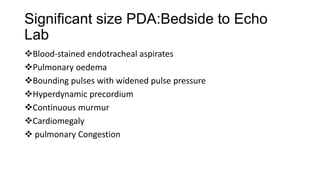
Significant size PDA:Bedside to Echo
Lab
Blood-stained endotracheal aspirates
Pulmonary oedema
Bounding pulses with widened pulse pressure
Hyperdynamic precordium
Continuous murmur
Cardiomegaly
 pulmonary Congestion
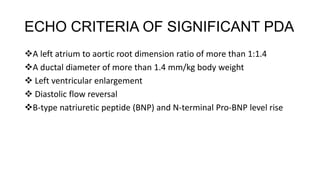
ECHO CRITERIA OF SIGNIFICANT PDA
A left atrium to aortic root dimension ratio of more than 1:1.4
A ductal diameter of more than 1.4 mm/kg body weight
 Left ventricular enlargement
 Diastolic flow reversal
B-type natriuretic peptide (BNP) and N-terminal Pro-BNP level rise
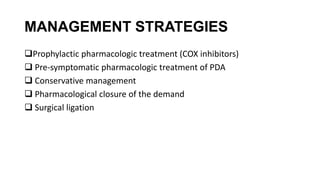
MANAGEMENT STRATEGIES
Prophylactic pharmacologic treatment (COX inhibitors)
 Pre-symptomatic pharmacologic treatment of PDA
 Conservative management
 Pharmacological closure of the demand
 Surgical ligation
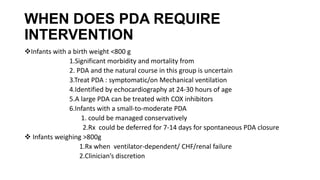
WHEN DOES PDA REQUIRE
INTERVENTION
Infants with a birth weight <800 g
1.Significant morbidity and mortality from
2. PDA and the natural course in this group is uncertain
3.Treat PDA : symptomatic/on Mechanical ventilation
4.Identified by echocardiography at 24-30 hours of age
5.A large PDA can be treated with COX inhibitors
6.Infants with a small-to-moderate PDA
1. could be managed conservatively
2.Rx could be deferred for 7-14 days for spontaneous PDA closure
 Infants weighing >800g
1.Rx when ventilator-dependent/ CHF/renal failure
2.Clinician’s discretion
WHEN DOES PDA REQUIRE
INTERVENTION
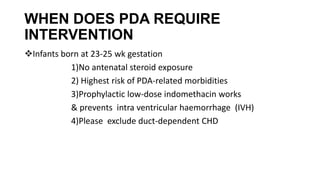
Infants born at 23-25 wk gestation
1)No antenatal steroid exposure
2) Highest risk of PDA-related morbidities
3)Prophylactic low-dose indomethacin works
& prevents intra ventricular haemorrhage (IVH)
4)Please exclude duct-dependent CHD
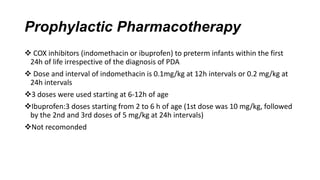
Prophylactic Pharmacotherapy
 COX inhibitors (indomethacin or ibuprofen) to preterm infants within the first
24h of life irrespective of the diagnosis of PDA
 Dose and interval of indomethacin is 0.1mg/kg at 12h intervals or 0.2 mg/kg at
24h intervals
3 doses were used starting at 6-12h of age
Ibuprofen:3 doses starting from 2 to 6 h of age (1st dose was 10 mg/kg, followed
by the 2nd and 3rd doses of 5 mg/kg at 24h intervals)
Not recomonded
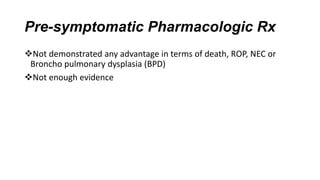
Pre-symptomatic Pharmacologic Rx
Not demonstrated any advantage in terms of death, ROP, NEC or
Broncho pulmonary dysplasia (BPD)
Not enough evidence
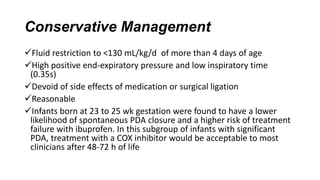
Conservative Management
Fluid restriction to <130 mL/kg/d of more than 4 days of age
High positive end-expiratory pressure and low inspiratory time
(0.35s)
Devoid of side effects of medication or surgical ligation
Reasonable
Infants born at 23 to 25 wk gestation were found to have a lower
likelihood of spontaneous PDA closure and a higher risk of treatment
failure with ibuprofen. In this subgroup of infants with significant
PDA, treatment with a COX inhibitor would be acceptable to most
clinicians after 48-72 h of life
Pharmacological Closure
 The mainstay of treatment if conservative measures fail
 Indomethacin, ibuprofen and mefenamic acid
 Indomethacin and ibuprofen have been extensively studied
 Indomethacin is of proven efficacy in the management of PDA
 Short-course regimens (≤3 doses) of indomethacin to treat PDA
 A prolonged course has been shown to increase the incidence of NEC
 Doses of indomethacin are lower when used for the prevention of IVH (0.1mg/kg/dose
intravenously at 6-12h of postnatal age and at 24h intervals for 2 additional doses)
 Due to concerns about the adverse effects of indomethacin, Ibuprofen has received the most
attention: ibuprofen lysine and ibuprofen THAM………contd
Contd…
 Data support the use of either drug for the treatment of PDA
 VLBW infants has shown that oral ibuprofen is as good as intravenous ibuprofen
in terms of ductal closure, and is associated with fewer side effects
 paracetamol is in Q
Surgical Ligation
Surgical ligation is contemplated only when pharmacological closure
is ineffective or is contraindicated in a preterm infant who is
hemodynamically unstable due to PDA
 surgery is associated with increased incidence of neurodevelop-
mental impairment and BPD
 Secondary surgical closure (indomethacin treatment followed by
ligation) was associated with decreased death death
NOVEL
A novel approach by Sperandio et al. is of escalating the dose of
indomethacin stepwise every 12h to reach a maximum single dose of
1mg/kg has shown an overall closure rate of 98.5%. Adverse effects
were comparable to initial non-responders. Study results were limited
due to the retrospective nature of the study and lack of long term
follow up
Endoscopic and catheter closure
Video-assisted thoracic surgery
Transcatheter management of PDA in VLBW is still a dark
RESEARCH ISSUES
• The most compelling question in the management of significant PDA
in preterm infants is the outcome of untreated or conservatively
managed infants with a birth weight <800 g compared to outcome
with pharmacological and/or surgical closure
• RCT may help looking into all the five approaches in detail with head
to head collision, to choose the best : A very difficult task and of
ethical concern
CONCLUSION
Infants with a birth weight of <800g are at risk of significant
morbidity and mortality from PDA, and it would be reasonable to
treat the PDA in such infants when they are clinically symptomatic
and require positive pressure ventilatory support
 However, infants born at a gestational age of 23-25 wk without
antenatal steroid exposure are at a higher risk of PDA-related
morbidities and would benefit from prophylactic low-dose
indomethacin for prevention of IVH
 Preterm infants with a birth weight >800g are unlikely to need
treatment for PDA unless they are ventilator-dependent and showing
evidence of congestive heart failure or renal impairment
http://www.indianpediatrics.net/apr2014/2
89.pdf
Marriage is not always that funny as it looks
Especially if the Preterm has cursed with large PDA

Patent Ductus Arteriosus in Preterm Infants

  • 1.
    Patent Ductus Arteriosus in PretermInfants http://www.youtube.com/watch?feature=player_embedded&v=MvbIhb 63brk
  • 2.
    Incidence most common formof congenital cardiac abnormality in newborn Frequency of 31% in very low birth weight (VLBW) infants
  • 3.
    Best left untreated Therapeuticinterventions for PDA have significant complications  If PDA is left untreated in preterm infants, there is a high likelihood of spontaneous closure  Treat when required
  • 4.
    Significant size PDA:Bedsideto Echo Lab Blood-stained endotracheal aspirates Pulmonary oedema Bounding pulses with widened pulse pressure Hyperdynamic precordium Continuous murmur Cardiomegaly  pulmonary Congestion
  • 5.
    ECHO CRITERIA OFSIGNIFICANT PDA A left atrium to aortic root dimension ratio of more than 1:1.4 A ductal diameter of more than 1.4 mm/kg body weight  Left ventricular enlargement  Diastolic flow reversal B-type natriuretic peptide (BNP) and N-terminal Pro-BNP level rise
  • 6.
    MANAGEMENT STRATEGIES Prophylactic pharmacologictreatment (COX inhibitors)  Pre-symptomatic pharmacologic treatment of PDA  Conservative management  Pharmacological closure of the demand  Surgical ligation
  • 7.
    WHEN DOES PDAREQUIRE INTERVENTION Infants with a birth weight <800 g 1.Significant morbidity and mortality from 2. PDA and the natural course in this group is uncertain 3.Treat PDA : symptomatic/on Mechanical ventilation 4.Identified by echocardiography at 24-30 hours of age 5.A large PDA can be treated with COX inhibitors 6.Infants with a small-to-moderate PDA 1. could be managed conservatively 2.Rx could be deferred for 7-14 days for spontaneous PDA closure  Infants weighing >800g 1.Rx when ventilator-dependent/ CHF/renal failure 2.Clinician’s discretion
  • 8.
    WHEN DOES PDAREQUIRE INTERVENTION Infants born at 23-25 wk gestation 1)No antenatal steroid exposure 2) Highest risk of PDA-related morbidities 3)Prophylactic low-dose indomethacin works & prevents intra ventricular haemorrhage (IVH) 4)Please exclude duct-dependent CHD
  • 9.
    Prophylactic Pharmacotherapy  COXinhibitors (indomethacin or ibuprofen) to preterm infants within the first 24h of life irrespective of the diagnosis of PDA  Dose and interval of indomethacin is 0.1mg/kg at 12h intervals or 0.2 mg/kg at 24h intervals 3 doses were used starting at 6-12h of age Ibuprofen:3 doses starting from 2 to 6 h of age (1st dose was 10 mg/kg, followed by the 2nd and 3rd doses of 5 mg/kg at 24h intervals) Not recomonded
  • 10.
    Pre-symptomatic Pharmacologic Rx Notdemonstrated any advantage in terms of death, ROP, NEC or Broncho pulmonary dysplasia (BPD) Not enough evidence
  • 11.
    Conservative Management Fluid restrictionto <130 mL/kg/d of more than 4 days of age High positive end-expiratory pressure and low inspiratory time (0.35s) Devoid of side effects of medication or surgical ligation Reasonable Infants born at 23 to 25 wk gestation were found to have a lower likelihood of spontaneous PDA closure and a higher risk of treatment failure with ibuprofen. In this subgroup of infants with significant PDA, treatment with a COX inhibitor would be acceptable to most clinicians after 48-72 h of life
  • 12.
    Pharmacological Closure  Themainstay of treatment if conservative measures fail  Indomethacin, ibuprofen and mefenamic acid  Indomethacin and ibuprofen have been extensively studied  Indomethacin is of proven efficacy in the management of PDA  Short-course regimens (≤3 doses) of indomethacin to treat PDA  A prolonged course has been shown to increase the incidence of NEC  Doses of indomethacin are lower when used for the prevention of IVH (0.1mg/kg/dose intravenously at 6-12h of postnatal age and at 24h intervals for 2 additional doses)  Due to concerns about the adverse effects of indomethacin, Ibuprofen has received the most attention: ibuprofen lysine and ibuprofen THAM………contd
  • 13.
    Contd…  Data supportthe use of either drug for the treatment of PDA  VLBW infants has shown that oral ibuprofen is as good as intravenous ibuprofen in terms of ductal closure, and is associated with fewer side effects  paracetamol is in Q
  • 14.
    Surgical Ligation Surgical ligationis contemplated only when pharmacological closure is ineffective or is contraindicated in a preterm infant who is hemodynamically unstable due to PDA  surgery is associated with increased incidence of neurodevelop- mental impairment and BPD  Secondary surgical closure (indomethacin treatment followed by ligation) was associated with decreased death death
  • 15.
    NOVEL A novel approachby Sperandio et al. is of escalating the dose of indomethacin stepwise every 12h to reach a maximum single dose of 1mg/kg has shown an overall closure rate of 98.5%. Adverse effects were comparable to initial non-responders. Study results were limited due to the retrospective nature of the study and lack of long term follow up Endoscopic and catheter closure Video-assisted thoracic surgery Transcatheter management of PDA in VLBW is still a dark
  • 16.
    RESEARCH ISSUES • Themost compelling question in the management of significant PDA in preterm infants is the outcome of untreated or conservatively managed infants with a birth weight <800 g compared to outcome with pharmacological and/or surgical closure • RCT may help looking into all the five approaches in detail with head to head collision, to choose the best : A very difficult task and of ethical concern
  • 17.
    CONCLUSION Infants with abirth weight of <800g are at risk of significant morbidity and mortality from PDA, and it would be reasonable to treat the PDA in such infants when they are clinically symptomatic and require positive pressure ventilatory support  However, infants born at a gestational age of 23-25 wk without antenatal steroid exposure are at a higher risk of PDA-related morbidities and would benefit from prophylactic low-dose indomethacin for prevention of IVH  Preterm infants with a birth weight >800g are unlikely to need treatment for PDA unless they are ventilator-dependent and showing evidence of congestive heart failure or renal impairment
  • 18.
    http://www.indianpediatrics.net/apr2014/2 89.pdf Marriage is notalways that funny as it looks Especially if the Preterm has cursed with large PDA