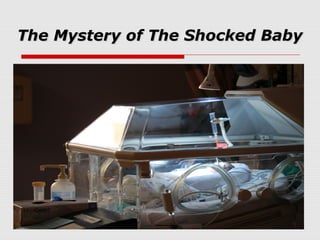
The Mystery of The Shocked BabyThe Mystery of The Shocked Baby
History
 A 10-day-old female infant born at 39 weeks of
gestation. She was born by normal spontaneous
vaginal delivery and was discharged home.
 The mother has a history of primary infertility
3 years.
 The mother’s pregnancy, labor were
unremarkable.
History
 This infant was feeding and voiding appropriately
in first days of life.
 But parental account that their infant became
progressively “fussy”. She breathed faster and
required a longer time for each bottle-feeding.
 On the day of presentation she fed no more than
30ml of formula and hadn’t voided since the night
before.
Vital signs
 Temperature 36.8 C
 Heart rate 190 b/min
 CRT = 5 Sec
 RR = 69 b/min
 Blood pressure from the right arm 78/50 mmHg
 Sao2 from the right hand is 96%
 Weight is 3.3 kg
Examination
 CNS: conscious but confused with decreased
spontaneous movements and weak crying.
 CVS: precordium is hyperdynamic, pulmonary
component S2 is loud, no murmurs and Lower
extremity pulses are difficult to palpate.
 Chest: RD Grade ІІ, Equal breath sounds bilaterally
with fine rales at both lung bases.
Examination
 The liver is palpable 4 cm below the right costal
margin.
 Her feet are cool to touch.
 Baby was pale.
 There are no skin lesions.
What is the problem with
this baby ?
Shock:Shock:
Shock is the inadequate perfusionShock is the inadequate perfusion
of the body’s vital organsof the body’s vital organs
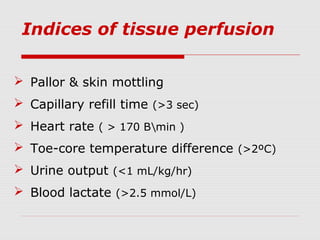
Indices of tissue perfusion
 Pallor & skin mottling
 Capillary refill time (>3 sec)
 Heart rate ( > 170 Bmin )
 Toe-core temperature difference (>2ºC)
 Urine output (<1 mL/kg/hr)
 Blood lactate (>2.5 mmol/L)
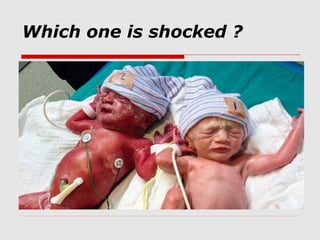
Which one is shocked ?
Causes of neonatal shock
O2
Pump
Pipes
Circulation
Tank
Non
Vital
Vital
organs
Remember !!
Once shock is suspected start supportive
measures as soon as possible:
 airway and assuring its patency.
 providing oxygen or positive pressure
ventilation.
 achieving intravascular ( peripheral or central )
or intraosseous access.
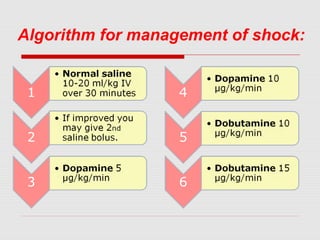
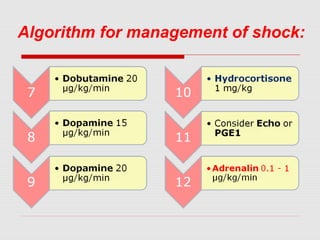
Algorithm for management of shock:
Fluid Boluse
 Excessive volume expansion may be
potentially harmful in Cardiogenic Shock.
 Preterm babies can not deal with
Excessive volume expansion which
increase likelihood of PDA & NEC.
Why not more than 20ml/kg ?
Clinical signs of hypovolemic shock depend on the
degree of intravascular volume depletion:
 25% in compensated shock
 25-40% in uncompensated shock
( But with myocardial depression)
 more than 40% in irreversible shock.
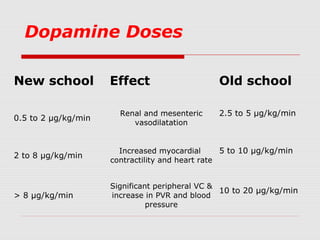
Dopamine Doses
New school Effect Old school
0.5 to 2 μg/kg/min
Renal and mesenteric
vasodilatation
2.5 to 5 μg/kg/min
2 to 8 μg/kg/min
Increased myocardial
contractility and heart rate
5 to 10 μg/kg/min
> 8 μg/kg/min
Significant peripheral VC &
increase in PVR and blood
pressure
10 to 20 μg/kg/min
Dobutamine
Mech: produces vasodilation and increases
Cardiac muscle contration.
1st line in:
 Preterm < 48 hrs
 PPHN
 Heart failure
Adrenalin (The most potent inotrope)
Adrenalin results in significant
increases in:
 Myocardial contractility
 Cardiac output
 Peripheral vascular resistance
 Blood pressure
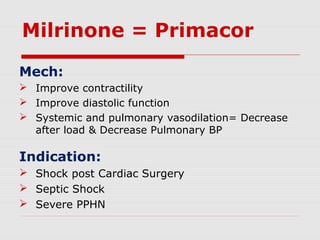
Milrinone = Primacor
Mech:
 Improve contractility
 Improve diastolic function
 Systemic and pulmonary vasodilation= Decrease
after load & Decrease Pulmonary BP
Indication:
 Shock post Cardiac Surgery
 Septic Shock
 Severe PPHN
When to response ??
Reassess within 10 min
of fluid bolus
Reassess every 15–20 min of new dose
of Inotropes
Caution !!
Inotropic agents: contraindicated in
hypertrophic cardiomyopathy
Hypertrophic cardiomyopathy is
common in IDMs
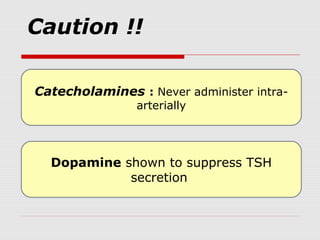
Caution !!
Catecholamines : Never administer intra-
arterially
Dopamine shown to suppress TSH
secretion
Remember !!
Correction of negative inotropic
factors:
as hypoxia, hypoglycemia, hypocalcemia, acidosis
and electrolytes imbalance,
if present.
Digoxin is used in non-critically ill infants.
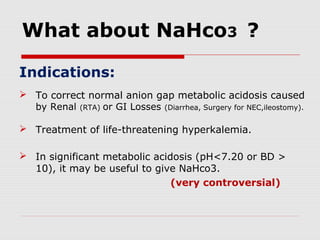
What about NaHco3 ?
Indications:
 To correct normal anion gap metabolic acidosis caused
by Renal (RTA) or GI Losses (Diarrhea, Surgery for NEC,ileostomy).
 Treatment of life-threatening hyperkalemia.
 In significant metabolic acidosis (pH<7.20 or BD >
10), it may be useful to give NaHco3.
(very controversial)
Textbook of Neonatal
Resuscitation, 7th Edition
NaHco3 Dose
 Dose (in mEq) based on Base Deficit = 0.3 X Base deficit
(mEq/L) X weight (kg).
 Give ½ dose then assess need for remainder
 Dose is given over 30 minutes at least.
 Sodium Bicarbonate 8.4 % contains 1 mEq NaHCO3 / mL
 Incompatible with dobutamine, dopamine,
epinephrine, midazolam.
NaHco3 side effects
 IVH (with rapid infusion)
 Increase PCO2 so decrease pH
(if given during inadequate ventilation)
 Local tissue necrosis
 Hypocalcemia
 Hypernatremia and hypokalemia
Caution !!
Do not treat metabolic acidosis with
hyperventilation.
NaHCO3 is not a recommended therapy in
NRP
It is best to correct the underlying cause of the
metabolic acidosis.
Corticosteroid therapy
Mech: up-regulate adrenergic receptor & as replacement
in adrenal insufficiency.
When: in extremely PT with hypotension refractory to
volume & vasopressors (high dose dopamine or
epinephrine).
Hydrocortisone: 1 mg/kg every 8-12 hrs for
2-3 days.
Dexamethasone: 0.1 mg/kg followed by 0.05 mg/kg
IV every 12 H for 5 doses.
Back to our case
Baby was placed on O2 and
received one fluid bolus plus
Dopamine 10 μg/kg/min +
Dobutamine 10 μg/kg/min
without any improvement in
perfusion.
This bad news was told to the parents in an
appropriate way.
Investigations
 Serum glucose
 Blood gases
 Hematocrit (Hct)
 Electrolyte
 CBC, CRP, and cultures
 Chest x-ray
 Echocardiography & ECG
 Renal functions & Liver function tests
Investigations
 CBC: Hct 41%, WBC 15 × 103,
platelet count 23 × 103.
 PH 7.18, CO2 30, NaHCO3 10 mEq/L, BE -16.
 Na 145 mEq/L, K 5 mEq/L, Ca 9 mg/dl.
 RBS = 69 mg/dl.
 CRP -Ve
 Urea 40 mg/dl, Creatinine 1.0 mg/dl.
Chest X-ray: Cardiomegaly, increased
pulmonary vascularity.
Case progression
 Dopamine increased to 20 μg/kg/min +
Dobutamine 20 μg/kg/min without any
improvement in perfusion.
 After senior consultant PGE1 infusion was
started and Echocardiogram was being
arranged.
Duct dependent systemic circulation
 Neonates who present with shock within
the first 3 weeks of life are likely to
have CHD with duct dependent systemic
flow.
 It is appropriate to begin PGE-1, even if
before A diagnosis made by
echocardiography.
PGE1 infusion:
 Dose: 0.05-0.1μg/kg/min, start with
0.05μg/kg/min, if no improvement increase to
0.1 μg/kg/min.
 Adverse effects: Hypotension, flushing,
tachycardia, apnea, fever, and Hypokalemia.
When Baby respond to PGE-1 ?
Maximum effect seen within 30 min
in cyanotic lesions,
may take several hours in acyanotic
lesions
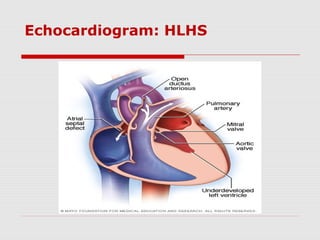
Echocardiogram: HLHS
Left-sided obstructive heart disease
(Duct-dependent systemic circulation)
These diseases include:
 Hypoplastic left heart syndrome (HLHS)
(most common and severe)
 Critical aortic stenosis (AS)
 Co-arctation of the aorta (COA)
 Interrupted aortic arch (IAA)
Approaches to HLHS
What about Entral feeding ?
 Infants in shock should not be fed.
 Intestines will require 2 days or more for
recovery before small feedings can be
attempted.
 Initiate total parenteral nutrition as soon
as possible.
Shock & Assisted Ventilation
NCPAP is Contraindicated in Severe
cardiovascular instability.
Ventilation is an excellent inotrope
Shock & Ventilatory setting
Refractory Shock
 Hypopituitarism
 Hypoadrenalism (Congenital adrenal hyperplasia, Addison disease)
 Large PDA
 Central line leakage
 GIT problems (e.g. NEC, perforation)
 Drugs ( e.g. muscle relaxants )
 Poor myocardial contractility (e.g. cardiomyopathy)
 Inborn errors of metabolism (e.g. Organic acidemia )
Refractory Shock:
Hidden Hemorrhage
Subgaleal HemorrhageAdrenal hemorrhage
Refractory Shock:
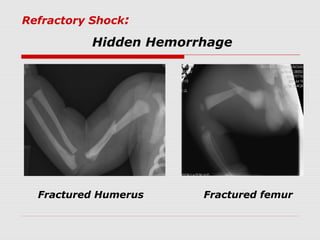
Hidden Hemorrhage
Fractured Humerus Fractured femur
Refractory Shock:
Periventricular hemorrhage / intraventricular hemorrhage
Refractory Shock:
Pneumothorax
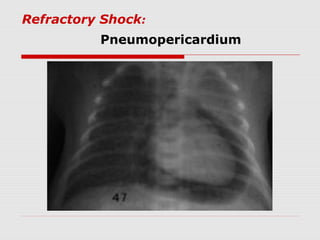
Refractory Shock:
Pneumopericardium
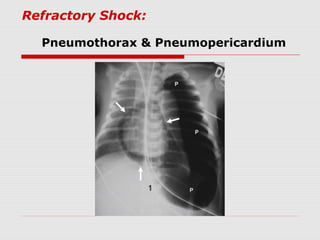
Refractory Shock:
Pneumothorax & Pneumopericardium
Recent Approach :Recent Approach :
Functional Echocardiography and
Doppler Flow Velocimetry:
 Assessment of global heart contractility
 Assessment of superior vena cava flow
Take Home Massage
Once shock is suspected start
supportive measures as soon as
possible.
Thereafter, treatment is directed by
the underlying pathology.
Take Home Massage
In Shock: Obtain vascular access
including arterial line, better through
umbilical vessels.
BP is maintained until very late
Hypotension is a pre-terminal sign
Take Home Massage
PGE1 is considered before diagnosis is
confirmed if duct-dependent systemic
blood flow is suspected.
NaHCO3 is not a recommended
therapy in NRP.
Thank youThank you
Neonatal shock

Neonatal shock

  • 1.
    The Mystery ofThe Shocked BabyThe Mystery of The Shocked Baby
  • 2.
    History  A 10-day-oldfemale infant born at 39 weeks of gestation. She was born by normal spontaneous vaginal delivery and was discharged home.  The mother has a history of primary infertility 3 years.  The mother’s pregnancy, labor were unremarkable.
  • 3.
    History  This infantwas feeding and voiding appropriately in first days of life.  But parental account that their infant became progressively “fussy”. She breathed faster and required a longer time for each bottle-feeding.  On the day of presentation she fed no more than 30ml of formula and hadn’t voided since the night before.
  • 4.
    Vital signs  Temperature36.8 C  Heart rate 190 b/min  CRT = 5 Sec  RR = 69 b/min  Blood pressure from the right arm 78/50 mmHg  Sao2 from the right hand is 96%  Weight is 3.3 kg
  • 5.
    Examination  CNS: consciousbut confused with decreased spontaneous movements and weak crying.  CVS: precordium is hyperdynamic, pulmonary component S2 is loud, no murmurs and Lower extremity pulses are difficult to palpate.  Chest: RD Grade ІІ, Equal breath sounds bilaterally with fine rales at both lung bases.
  • 6.
    Examination  The liveris palpable 4 cm below the right costal margin.  Her feet are cool to touch.  Baby was pale.  There are no skin lesions.
  • 7.
    What is theproblem with this baby ?
  • 8.
    Shock:Shock: Shock is theinadequate perfusionShock is the inadequate perfusion of the body’s vital organsof the body’s vital organs
  • 9.
    Indices of tissueperfusion  Pallor & skin mottling  Capillary refill time (>3 sec)  Heart rate ( > 170 Bmin )  Toe-core temperature difference (>2ºC)  Urine output (<1 mL/kg/hr)  Blood lactate (>2.5 mmol/L)
  • 10.
    Which one isshocked ?
  • 11.
    Causes of neonatalshock O2 Pump Pipes Circulation Tank Non Vital Vital organs
  • 12.
    Remember !! Once shockis suspected start supportive measures as soon as possible:  airway and assuring its patency.  providing oxygen or positive pressure ventilation.  achieving intravascular ( peripheral or central ) or intraosseous access.
  • 13.
  • 14.
  • 15.
    Fluid Boluse  Excessivevolume expansion may be potentially harmful in Cardiogenic Shock.  Preterm babies can not deal with Excessive volume expansion which increase likelihood of PDA & NEC.
  • 16.
    Why not morethan 20ml/kg ? Clinical signs of hypovolemic shock depend on the degree of intravascular volume depletion:  25% in compensated shock  25-40% in uncompensated shock ( But with myocardial depression)  more than 40% in irreversible shock.
  • 17.
    Dopamine Doses New schoolEffect Old school 0.5 to 2 μg/kg/min Renal and mesenteric vasodilatation 2.5 to 5 μg/kg/min 2 to 8 μg/kg/min Increased myocardial contractility and heart rate 5 to 10 μg/kg/min > 8 μg/kg/min Significant peripheral VC & increase in PVR and blood pressure 10 to 20 μg/kg/min
  • 18.
    Dobutamine Mech: produces vasodilationand increases Cardiac muscle contration. 1st line in:  Preterm < 48 hrs  PPHN  Heart failure
  • 19.
    Adrenalin (The mostpotent inotrope) Adrenalin results in significant increases in:  Myocardial contractility  Cardiac output  Peripheral vascular resistance  Blood pressure
  • 20.
    Milrinone = Primacor Mech: Improve contractility  Improve diastolic function  Systemic and pulmonary vasodilation= Decrease after load & Decrease Pulmonary BP Indication:  Shock post Cardiac Surgery  Septic Shock  Severe PPHN
  • 21.
    When to response?? Reassess within 10 min of fluid bolus Reassess every 15–20 min of new dose of Inotropes
  • 22.
    Caution !! Inotropic agents:contraindicated in hypertrophic cardiomyopathy Hypertrophic cardiomyopathy is common in IDMs
  • 23.
    Caution !! Catecholamines :Never administer intra- arterially Dopamine shown to suppress TSH secretion
  • 24.
    Remember !! Correction ofnegative inotropic factors: as hypoxia, hypoglycemia, hypocalcemia, acidosis and electrolytes imbalance, if present. Digoxin is used in non-critically ill infants.
  • 25.
    What about NaHco3? Indications:  To correct normal anion gap metabolic acidosis caused by Renal (RTA) or GI Losses (Diarrhea, Surgery for NEC,ileostomy).  Treatment of life-threatening hyperkalemia.  In significant metabolic acidosis (pH<7.20 or BD > 10), it may be useful to give NaHco3. (very controversial)
  • 26.
  • 27.
    NaHco3 Dose  Dose(in mEq) based on Base Deficit = 0.3 X Base deficit (mEq/L) X weight (kg).  Give ½ dose then assess need for remainder  Dose is given over 30 minutes at least.  Sodium Bicarbonate 8.4 % contains 1 mEq NaHCO3 / mL  Incompatible with dobutamine, dopamine, epinephrine, midazolam.
  • 28.
    NaHco3 side effects IVH (with rapid infusion)  Increase PCO2 so decrease pH (if given during inadequate ventilation)  Local tissue necrosis  Hypocalcemia  Hypernatremia and hypokalemia
  • 29.
    Caution !! Do nottreat metabolic acidosis with hyperventilation. NaHCO3 is not a recommended therapy in NRP It is best to correct the underlying cause of the metabolic acidosis.
  • 30.
    Corticosteroid therapy Mech: up-regulateadrenergic receptor & as replacement in adrenal insufficiency. When: in extremely PT with hypotension refractory to volume & vasopressors (high dose dopamine or epinephrine). Hydrocortisone: 1 mg/kg every 8-12 hrs for 2-3 days. Dexamethasone: 0.1 mg/kg followed by 0.05 mg/kg IV every 12 H for 5 doses.
  • 31.
    Back to ourcase Baby was placed on O2 and received one fluid bolus plus Dopamine 10 μg/kg/min + Dobutamine 10 μg/kg/min without any improvement in perfusion. This bad news was told to the parents in an appropriate way.
  • 32.
    Investigations  Serum glucose Blood gases  Hematocrit (Hct)  Electrolyte  CBC, CRP, and cultures  Chest x-ray  Echocardiography & ECG  Renal functions & Liver function tests
  • 33.
    Investigations  CBC: Hct41%, WBC 15 × 103, platelet count 23 × 103.  PH 7.18, CO2 30, NaHCO3 10 mEq/L, BE -16.  Na 145 mEq/L, K 5 mEq/L, Ca 9 mg/dl.  RBS = 69 mg/dl.  CRP -Ve  Urea 40 mg/dl, Creatinine 1.0 mg/dl.
  • 34.
    Chest X-ray: Cardiomegaly,increased pulmonary vascularity.
  • 35.
    Case progression  Dopamineincreased to 20 μg/kg/min + Dobutamine 20 μg/kg/min without any improvement in perfusion.  After senior consultant PGE1 infusion was started and Echocardiogram was being arranged.
  • 36.
    Duct dependent systemiccirculation  Neonates who present with shock within the first 3 weeks of life are likely to have CHD with duct dependent systemic flow.  It is appropriate to begin PGE-1, even if before A diagnosis made by echocardiography.
  • 37.
    PGE1 infusion:  Dose:0.05-0.1μg/kg/min, start with 0.05μg/kg/min, if no improvement increase to 0.1 μg/kg/min.  Adverse effects: Hypotension, flushing, tachycardia, apnea, fever, and Hypokalemia.
  • 38.
    When Baby respondto PGE-1 ? Maximum effect seen within 30 min in cyanotic lesions, may take several hours in acyanotic lesions
  • 39.
  • 40.
    Left-sided obstructive heartdisease (Duct-dependent systemic circulation) These diseases include:  Hypoplastic left heart syndrome (HLHS) (most common and severe)  Critical aortic stenosis (AS)  Co-arctation of the aorta (COA)  Interrupted aortic arch (IAA)
  • 41.
  • 42.
    What about Entralfeeding ?  Infants in shock should not be fed.  Intestines will require 2 days or more for recovery before small feedings can be attempted.  Initiate total parenteral nutrition as soon as possible.
  • 43.
    Shock & AssistedVentilation NCPAP is Contraindicated in Severe cardiovascular instability. Ventilation is an excellent inotrope
  • 44.
  • 45.
    Refractory Shock  Hypopituitarism Hypoadrenalism (Congenital adrenal hyperplasia, Addison disease)  Large PDA  Central line leakage  GIT problems (e.g. NEC, perforation)  Drugs ( e.g. muscle relaxants )  Poor myocardial contractility (e.g. cardiomyopathy)  Inborn errors of metabolism (e.g. Organic acidemia )
  • 46.
  • 47.
  • 48.
    Refractory Shock: Periventricular hemorrhage/ intraventricular hemorrhage
  • 49.
  • 50.
  • 51.
  • 52.
    Recent Approach :RecentApproach : Functional Echocardiography and Doppler Flow Velocimetry:  Assessment of global heart contractility  Assessment of superior vena cava flow
  • 53.
    Take Home Massage Onceshock is suspected start supportive measures as soon as possible. Thereafter, treatment is directed by the underlying pathology.
  • 54.
    Take Home Massage InShock: Obtain vascular access including arterial line, better through umbilical vessels. BP is maintained until very late Hypotension is a pre-terminal sign
  • 55.
    Take Home Massage PGE1is considered before diagnosis is confirmed if duct-dependent systemic blood flow is suspected. NaHCO3 is not a recommended therapy in NRP.
  • 56.

Editor's Notes

  • #12 Causes of neonatal shock include the following: Hypovolemic shock is caused by acute blood loss or fluid/electrolyte losses. Distributive shock is caused by sepsis, vasodilators, myocardial depression, or endothelial injury. Cardiogenic shock is caused by cardiomyopathy, heart failure, arrhythmias, or myocardial ischemia. Obstructive shock is caused by tension pneumothorax or cardiac tamponade. Dissociative shock is caused by profound anemia or methemoglobinemia.