Downloaded 3,458 times






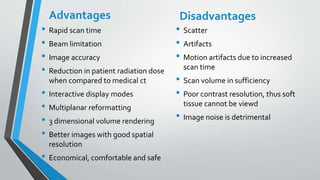







This document provides an overview of cone beam computed tomography (CBCT) including its history, components, principles, and applications in dentistry. Some key points: - CBCT was first introduced in the 1990s and provides 3D imaging with lower radiation dose than medical CT. It works by generating a cone-shaped X-ray beam and using a detector to record attenuation data, which is then reconstructed into 3D images. - Components include an X-ray generator, image sensor, and software for image reconstruction. Images are stored in DICOM format. - Advantages include rapid scan time, interactive display modes, and ability to view structures in multiple planes. Disadvantages include potential artifacts and inability to view


