MRI
(MAGNETIC
RESONANCE
IMAGING)
Prepared by-
DIVYA PANDAY
Under the guidance of –
• Dr. Sunita
• Dr. Sujoy Ghosh
• Dr. Meera chaudhary
• Dr. khushboo
CONTENTS
 Introduction
 Protons
 Precession
 Resonance
 Magnetic resonance signal
 T1 and T2 relaxation
 Radiofrequency pulse sequence
 Tissue contrast
 Scanner gradient
 Advantages
 Disadvantages
 Applications
 references
PROTONS
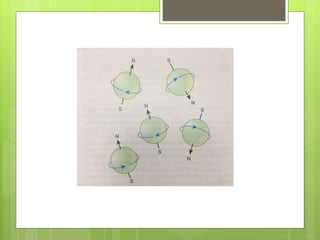
 Proton – spin – angular momentum
 Spin – associated with charge – B generated in
nuclei – act as magnet– magnet dipole has
magnetic moment.
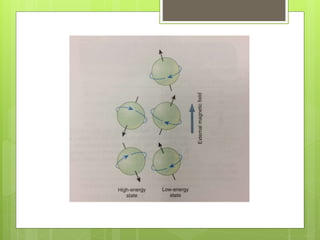
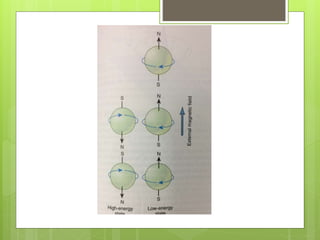
 Magnetic dipoles randomly oriented –Bext -
SPIN UP
SPIN
DOWN
PRECESSION
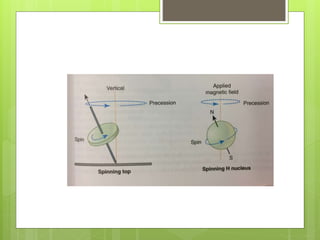
 Magnetic moment of H+ in a Bext – do not align
exactly with the direction of Bext
– TILT from a
position exactly parallel to Bext
 Bext – axis of spinning of H+ to wobble(precess) around
the lines of B ext.
 This frequency of precession
• PRECESSION FREQUENCY/
• RESONANCE FREQUENCY/
• LARMOR FREQUENCY
 Depends on
• Atom
• Strength of Bext- 0.1-4 Tesla
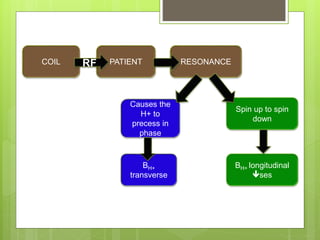
RESONANCE
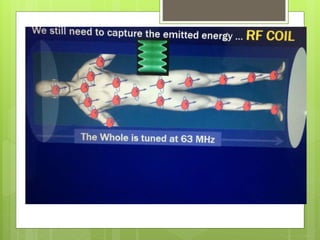
 Energy to energy –
provided by radiofrequency(RF) spectrum of
EM spectrum.
 When RF = larmor frequency  resonance.
COIL PATIENT RESONANCE
Spin up to spin
down
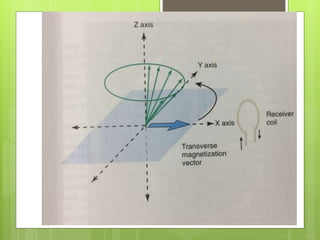
BH+ longitudinal
ses
RF
Causes the
H+ to
precess in
phase
BH+
transverse
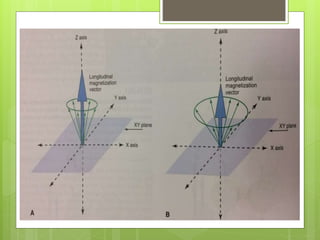
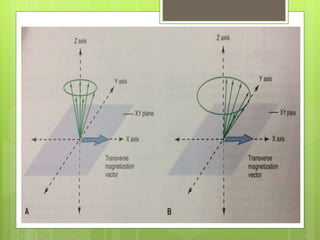
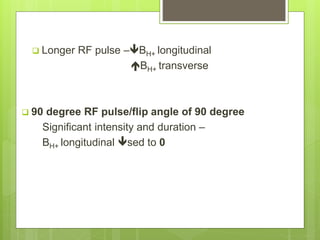
 Longer RF pulse –BH+ longitudinal
BH+ transverse
 90 degree RF pulse/flip angle of 90 degree
Significant intensity and duration –
BH+ longitudinal sed to 0
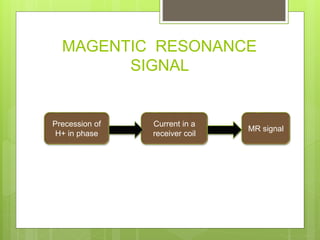
MAGENTIC RESONANCE
SIGNAL
Current in a
receiver coil
Precession of
H+ in phase
MR signal
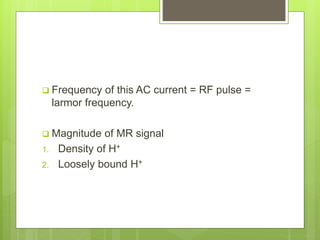
 Frequency of this AC current = RF pulse =
larmor frequency.
 Magnitude of MR signal
1. Density of H+
2. Loosely bound H+
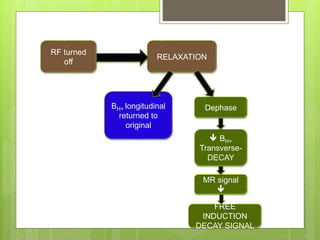
BH+ longitudinal
returned to
original
Dephase
RELAXATION
RF turned
off
 BH+
Transverse-
DECAY
MR signal

FREE
INDUCTION
DECAY SIGNAL
BH+ longitudinal
returned to
original
Dephase
RELAXATION
RF turned
off
 BH+
Transverse-
DECAY
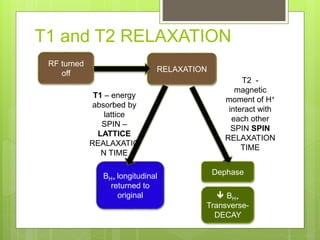
T2 -
magnetic
moment of H+
interact with
each other
SPIN SPIN
RELAXATION
TIME
T1 – energy
absorbed by
lattice
SPIN –
LATTICE
REALAXATIO
N TIME
T1 and T2 RELAXATION
T1 RELAXATION TIME
 It is an exponential process and the time
required for 63% of the magnetization to
return to equilibrium (the time constant) by
this transfer of energy.
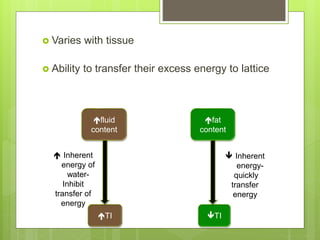
 Varies with tissue
 Ability to transfer their excess energy to lattice
fluid
content
TI TI
fat
content
 Inherent
energy of
water-
Inhibit
transfer of
energy
 Inherent
energy-
quickly
transfer
energy
T2 RELAXATION TIME
 Time constant that describes the exponential
rate of loss of transverse magnetization.
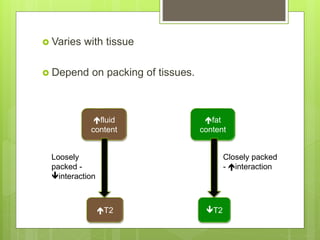
 Varies with tissue
 Depend on packing of tissues.
fluid
content
T2 T2
fat
content
Closely packed
- interaction
Loosely
packed -
interaction
 T2 occurs more rapidly then T1
RF PULSE SEQUENCE
Components of RF pulse sequence are set by
the operator.
Can be used to emphasize various features of
tissue being examined
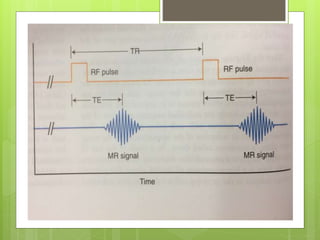
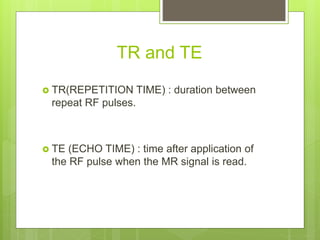
TR and TE
 TR(REPETITION TIME) : duration between
repeat RF pulses.
 TE (ECHO TIME) : time after application of
the RF pulse when the MR signal is read.
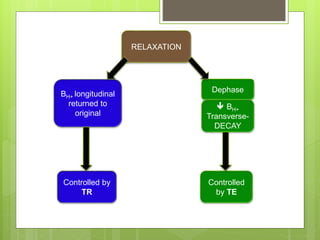
BH+ longitudinal
returned to
original
Dephase
RELAXATION
 BH+
Transverse-
DECAY
Controlled
by TE
Controlled by
TR
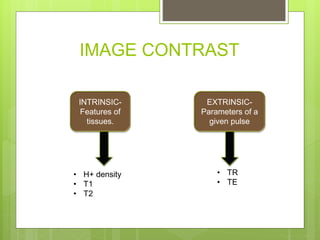
IMAGE CONTRAST
INTRINSIC-
Features of
tissues.
EXTRINSIC-
Parameters of a
given pulse
• H+ density
• T1
• T2
• TR
• TE
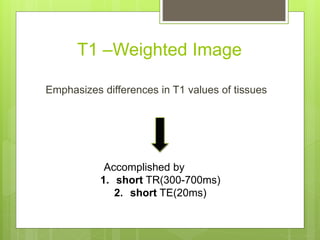
T1 –Weighted Image
Emphasizes differences in T1 values of tissues
Accomplished by
1. short TR(300-700ms)
2. short TE(20ms)
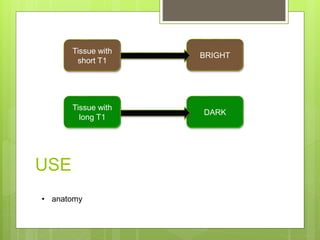
Tissue with
short T1
Tissue with
long T1
BRIGHT
DARK
• anatomy
USE
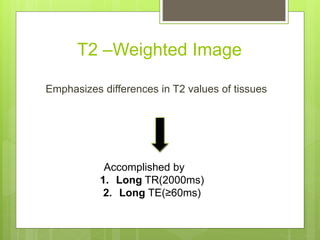
T2 –Weighted Image
Emphasizes differences in T2 values of tissues
Accomplished by
1. Long TR(2000ms)
2. Long TE(≥60ms)
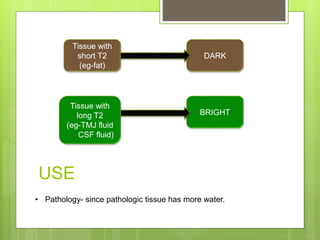
Tissue with
short T2
(eg-fat)
Tissue with
long T2
(eg-TMJ fluid
CSF fluid)
DARK
BRIGHT
USE
• Pathology- since pathologic tissue has more water.
OTHER METHODS
 STIR(short tau inversion recovery) – dec signal
from fat(FAT SATURATION) – better visualization
of adjacent structures.
 FLAIR(fluid attenuation inversion recovery) - dec
signal from fluid – better visualization of
pathology.
 CONTRAST AGENT – gadolinium.
It dec T1 of enhancing tissue – they appear
bright.
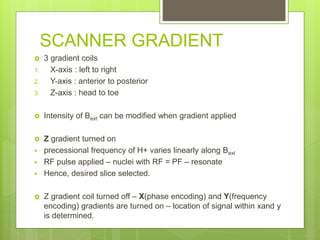
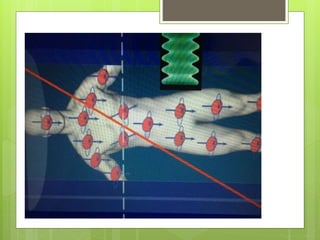
SCANNER GRADIENT
 3 gradient coils
1. X-axis : left to right
2. Y-axis : anterior to posterior
3. Z-axis : head to toe
 Intensity of Bext can be modified when gradient applied
 Z gradient turned on
 precessional frequency of H+ varies linearly along Bext
 RF pulse applied – nuclei with RF = PF – resonate
 Hence, desired slice selected.
 Z gradient coil turned off – X(phase encoding) and Y(frequency
encoding) gradients are turned on – location of signal within xand y
is determined.
ADVANTAGES
Time
Presence of ferromagnetic material
Claustrophobic patient
Best contrast resolution of soft tissues
No ionizing radiation
Multiplanar image without reorienting the patient
DISADVANTAGES
APPLICATIONS
 Soft tissue condition – position and integrity of disk of
TMJ
 Soft tissue disease –
 tongue, cheek, salivary gland, neck – neoplasia
 lymph nodes - malignant involvement
 Perineural invasion - by malignant neoplasia
 Extent of penetration of carcinoma- in cortex of mandible
– SWIFT
 Neoplasia - Gadolinium enhanced
 Osteomyelitis – edematous change in marrow
and surrounding tissue
 Location of mandibular nerve
 MR angiography
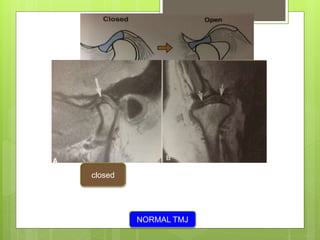
closed
NORMAL TMJ
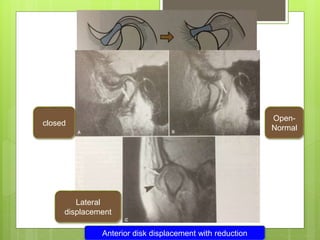
Anterior disk displacement with reduction
closed
Lateral
displacement
Open-
Normal
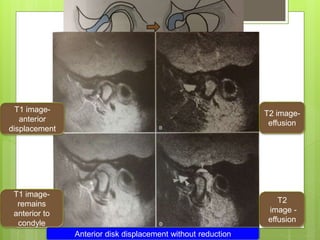
T2
image -
effusion
Anterior disk displacement without reduction
T2 image-
effusion
T1 image-
anterior
displacement
T1 image-
remains
anterior to
condyle
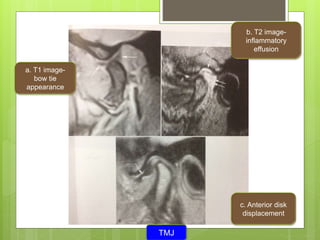
a. T1 image-
bow tie
appearance
b. T2 image-
inflammatory
effusion
c. Anterior disk
displacement
TMJ
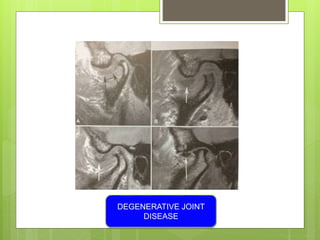
DEGENERATIVE JOINT
DISEASE
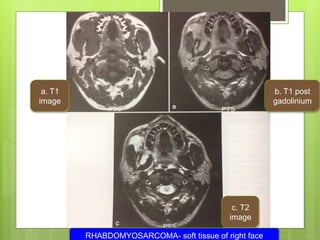
a. T1
image
b. T1 post
gadolinium
c. T2
image
RHABDOMYOSARCOMA- soft tissue of right face
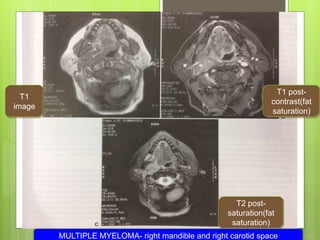
MULTIPLE MYELOMA- right mandible and right carotid space
T1 post-
contrast(fat
saturation)
T1
image
T2 post-
saturation(fat
saturation)
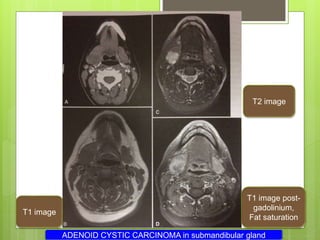
T1 image post-
gadolinium,
Fat saturation
T2 image
T1 image
ADENOID CYSTIC CARCINOMA in submandibular gland
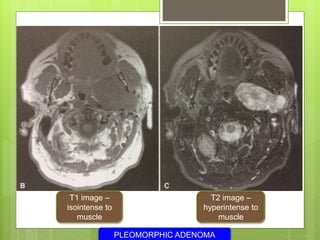
T2 image –
hyperintense to
muscle
T1 image –
isointense to
muscle
PLEOMORPHIC ADENOMA
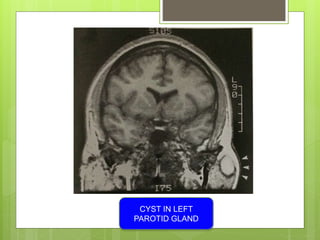
CYST IN LEFT
PAROTID GLAND
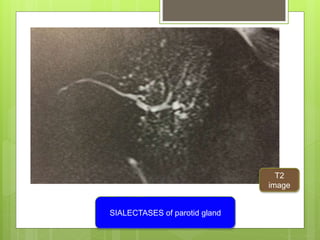
SIALECTASES of parotid gland
T2
image
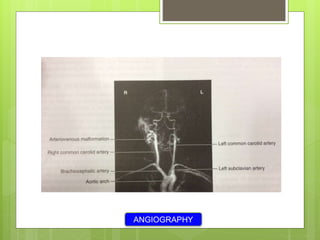
ANGIOGRAPHY
1. RF pulse causes
a. B transverse
b. B longitudinal
c. Both
d. None
2. T1 weighted image is used for studying
a. Anatomy
b. pathology
3. T1 weighted image uses
a. Short TR, short TE
b. Long TR, long TE
c. Short TR, long TE
d. Long TR, short TE
4. In T2 weighted image, tissue with long T2 (eg- TMJ fluid) appears
a. Bright
b. Dark
c. Both
d. None
5. Which diagnostic method would you prefer for diagnosing collection of effusion in
TMJ
a. T1
b. T2
c. Both
d. None
6. Which diagnostic method would you prefer for diagnosing disk displacement in
TMJ?
a. T1
b. T2
c. Both
d. none
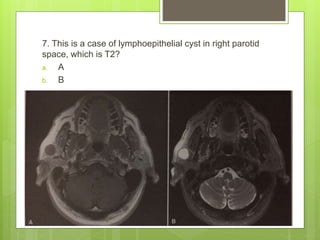
7. This is a case of lymphoepithelial cyst in right parotid
space, which is T2?
a. A
b. B
8. MRI uses
a. Ionizing radiation
b. Non-ionizing radiation
c. Both
d. None
9. MRI is used for-
a. Neoplasia of soft tissue
b. Mallignant involvement of lymph nodes
c. Both
d. none
10. Contrast agent used is ________?
REFERENCES
 White and pharaoh – 1st South Asian edition
THANKYOU

MRI in dentistry

  • 1.
    MRI (MAGNETIC RESONANCE IMAGING) Prepared by- DIVYA PANDAY Underthe guidance of – • Dr. Sunita • Dr. Sujoy Ghosh • Dr. Meera chaudhary • Dr. khushboo
  • 2.
    CONTENTS  Introduction  Protons Precession  Resonance  Magnetic resonance signal  T1 and T2 relaxation  Radiofrequency pulse sequence  Tissue contrast  Scanner gradient  Advantages  Disadvantages  Applications  references
  • 4.
    PROTONS  Proton –spin – angular momentum  Spin – associated with charge – B generated in nuclei – act as magnet– magnet dipole has magnetic moment.
  • 8.
     Magnetic dipolesrandomly oriented –Bext - SPIN UP SPIN DOWN
  • 9.
    PRECESSION  Magnetic momentof H+ in a Bext – do not align exactly with the direction of Bext – TILT from a position exactly parallel to Bext
  • 11.
     Bext –axis of spinning of H+ to wobble(precess) around the lines of B ext.  This frequency of precession • PRECESSION FREQUENCY/ • RESONANCE FREQUENCY/ • LARMOR FREQUENCY  Depends on • Atom • Strength of Bext- 0.1-4 Tesla
  • 12.
    RESONANCE  Energy toenergy – provided by radiofrequency(RF) spectrum of EM spectrum.  When RF = larmor frequency  resonance.
  • 13.
    COIL PATIENT RESONANCE Spinup to spin down BH+ longitudinal ses RF Causes the H+ to precess in phase BH+ transverse
  • 16.
     Longer RFpulse –BH+ longitudinal BH+ transverse  90 degree RF pulse/flip angle of 90 degree Significant intensity and duration – BH+ longitudinal sed to 0
  • 17.
    MAGENTIC RESONANCE SIGNAL Current ina receiver coil Precession of H+ in phase MR signal
  • 19.
     Frequency ofthis AC current = RF pulse = larmor frequency.  Magnitude of MR signal 1. Density of H+ 2. Loosely bound H+
  • 20.
    BH+ longitudinal returned to original Dephase RELAXATION RFturned off  BH+ Transverse- DECAY MR signal  FREE INDUCTION DECAY SIGNAL
  • 22.
    BH+ longitudinal returned to original Dephase RELAXATION RFturned off  BH+ Transverse- DECAY T2 - magnetic moment of H+ interact with each other SPIN SPIN RELAXATION TIME T1 – energy absorbed by lattice SPIN – LATTICE REALAXATIO N TIME T1 and T2 RELAXATION
  • 23.
    T1 RELAXATION TIME It is an exponential process and the time required for 63% of the magnetization to return to equilibrium (the time constant) by this transfer of energy.
  • 24.
     Varies withtissue  Ability to transfer their excess energy to lattice fluid content TI TI fat content  Inherent energy of water- Inhibit transfer of energy  Inherent energy- quickly transfer energy
  • 25.
    T2 RELAXATION TIME Time constant that describes the exponential rate of loss of transverse magnetization.
  • 26.
     Varies withtissue  Depend on packing of tissues. fluid content T2 T2 fat content Closely packed - interaction Loosely packed - interaction
  • 27.
     T2 occursmore rapidly then T1
  • 28.
    RF PULSE SEQUENCE Componentsof RF pulse sequence are set by the operator. Can be used to emphasize various features of tissue being examined
  • 30.
    TR and TE TR(REPETITION TIME) : duration between repeat RF pulses.  TE (ECHO TIME) : time after application of the RF pulse when the MR signal is read.
  • 31.
    BH+ longitudinal returned to original Dephase RELAXATION BH+ Transverse- DECAY Controlled by TE Controlled by TR
  • 32.
    IMAGE CONTRAST INTRINSIC- Features of tissues. EXTRINSIC- Parametersof a given pulse • H+ density • T1 • T2 • TR • TE
  • 33.
    T1 –Weighted Image Emphasizesdifferences in T1 values of tissues Accomplished by 1. short TR(300-700ms) 2. short TE(20ms)
  • 34.
    Tissue with short T1 Tissuewith long T1 BRIGHT DARK • anatomy USE
  • 35.
    T2 –Weighted Image Emphasizesdifferences in T2 values of tissues Accomplished by 1. Long TR(2000ms) 2. Long TE(≥60ms)
  • 36.
    Tissue with short T2 (eg-fat) Tissuewith long T2 (eg-TMJ fluid CSF fluid) DARK BRIGHT USE • Pathology- since pathologic tissue has more water.
  • 37.
    OTHER METHODS  STIR(shorttau inversion recovery) – dec signal from fat(FAT SATURATION) – better visualization of adjacent structures.  FLAIR(fluid attenuation inversion recovery) - dec signal from fluid – better visualization of pathology.  CONTRAST AGENT – gadolinium. It dec T1 of enhancing tissue – they appear bright.
  • 38.
    SCANNER GRADIENT  3gradient coils 1. X-axis : left to right 2. Y-axis : anterior to posterior 3. Z-axis : head to toe  Intensity of Bext can be modified when gradient applied  Z gradient turned on  precessional frequency of H+ varies linearly along Bext  RF pulse applied – nuclei with RF = PF – resonate  Hence, desired slice selected.  Z gradient coil turned off – X(phase encoding) and Y(frequency encoding) gradients are turned on – location of signal within xand y is determined.
  • 40.
    ADVANTAGES Time Presence of ferromagneticmaterial Claustrophobic patient Best contrast resolution of soft tissues No ionizing radiation Multiplanar image without reorienting the patient DISADVANTAGES
  • 41.
    APPLICATIONS  Soft tissuecondition – position and integrity of disk of TMJ  Soft tissue disease –  tongue, cheek, salivary gland, neck – neoplasia  lymph nodes - malignant involvement  Perineural invasion - by malignant neoplasia  Extent of penetration of carcinoma- in cortex of mandible – SWIFT  Neoplasia - Gadolinium enhanced
  • 42.
     Osteomyelitis –edematous change in marrow and surrounding tissue  Location of mandibular nerve  MR angiography
  • 43.
  • 44.
    Anterior disk displacementwith reduction closed Lateral displacement Open- Normal
  • 45.
    T2 image - effusion Anterior diskdisplacement without reduction T2 image- effusion T1 image- anterior displacement T1 image- remains anterior to condyle
  • 46.
    a. T1 image- bowtie appearance b. T2 image- inflammatory effusion c. Anterior disk displacement TMJ
  • 47.
  • 48.
    a. T1 image b. T1post gadolinium c. T2 image RHABDOMYOSARCOMA- soft tissue of right face
  • 49.
    MULTIPLE MYELOMA- rightmandible and right carotid space T1 post- contrast(fat saturation) T1 image T2 post- saturation(fat saturation)
  • 50.
    T1 image post- gadolinium, Fatsaturation T2 image T1 image ADENOID CYSTIC CARCINOMA in submandibular gland
  • 51.
    T2 image – hyperintenseto muscle T1 image – isointense to muscle PLEOMORPHIC ADENOMA
  • 52.
  • 53.
    SIALECTASES of parotidgland T2 image
  • 54.
  • 55.
    1. RF pulsecauses a. B transverse b. B longitudinal c. Both d. None 2. T1 weighted image is used for studying a. Anatomy b. pathology 3. T1 weighted image uses a. Short TR, short TE b. Long TR, long TE c. Short TR, long TE d. Long TR, short TE
  • 56.
    4. In T2weighted image, tissue with long T2 (eg- TMJ fluid) appears a. Bright b. Dark c. Both d. None 5. Which diagnostic method would you prefer for diagnosing collection of effusion in TMJ a. T1 b. T2 c. Both d. None 6. Which diagnostic method would you prefer for diagnosing disk displacement in TMJ? a. T1 b. T2 c. Both d. none
  • 57.
    7. This isa case of lymphoepithelial cyst in right parotid space, which is T2? a. A b. B
  • 58.
    8. MRI uses a.Ionizing radiation b. Non-ionizing radiation c. Both d. None 9. MRI is used for- a. Neoplasia of soft tissue b. Mallignant involvement of lymph nodes c. Both d. none 10. Contrast agent used is ________?
  • 59.
    REFERENCES  White andpharaoh – 1st South Asian edition
  • 60.