ACCURACY OF COMPUTER-
AIDED IMPLANT PLACEMENT
N. Van Assche, M. Vercruyssen, W. Coucke,
W. Teughels, R. Jacobs and M. Quirynen
Clin. Oral Implants Res. 23 (Suppl. 6), 2012, 112–123
AAMIR ZAHID GODIL
FIRST YEAR P.G.
DEPARTMENT OF PROSTHODONTICS
M.A.R.D.C.
OUTLINE
• INTRODUCTION
• GUIDED IMPLANT SURGERY
– STEREOLITHOGRAPHIC SURGICAL GUIDES
• STEPS IN COMPUTER- AIDED IMPLANT
PLACEMENT
• ADVANTAGES AND DISADVANTAGES OF
FLAPLESS GUIDED SURGERY
• CLINICAL CASE
• RESEARCHES AND REVIEWS
• CONCLUSION
• CRITIQUE
INTRODUCTION
GUIDED IMPLANT SURGERY
• During the last decade, special attention was given to a “prosthesis
driven” implant placement, to optimize the aesthetic outcome of
the final restoration with optimal loading conditions and good
access for cleaning.
• Three-dimensional imaging (showing the alveolar bone in relation to
the ideal tooth position), obtainable with relative low radiation
dosages especially when CBCT are used (Loubele et al. 2009;
Pauwels et al. 2012) in combination with planning software opened
the possibility for preoperative planning and proper
communication among the patient, the surgeon and the
prosthodontist.
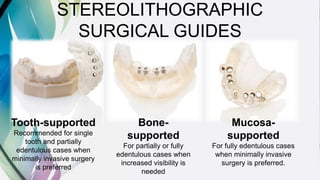
STEREOLITHOGRAPHIC
SURGICAL GUIDES
Tooth-supported
Recommended for single
tooth and partially
edentulous cases when
minimally invasive surgery
is preferred
Bone-
supported
For partially or fully
edentulous cases when
increased visibility is
needed
Mucosa-
supported
For fully edentulous cases
when minimally invasive
surgery is preferred.
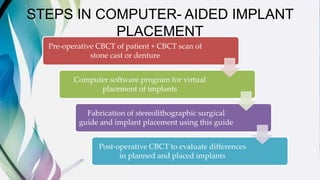
STEPS IN COMPUTER- AIDED IMPLANT
PLACEMENT
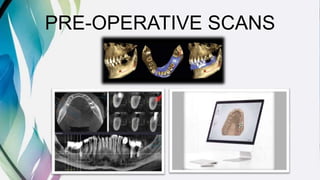
Pre-operative CBCT of patient + CBCT scan of
stone cast or denture
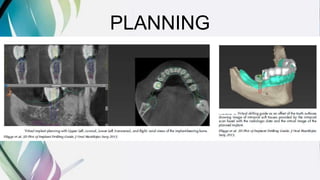
Computer software program for virtual
placement of implants
Fabrication of stereolithographic surgical
guide and implant placement using this guide
Post-operative CBCT to evaluate differences
in planned and placed implants
PRE-OPERATIVE SCANS
PLANNING
POST-OPERATIVE
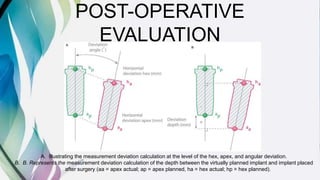
EVALUATION
A. Illustrating the measurement deviation calculation at the level of the hex, apex, and angular deviation.
B. B. Represents the measurement deviation calculation of the depth between the virtually planned implant and implant placed
after surgery (aa = apex actual; ap = apex planned, ha = hex actual; hp = hex planned).
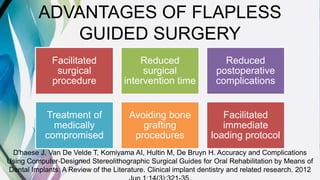
ADVANTAGES OF FLAPLESS
GUIDED SURGERY
Facilitated
surgical
procedure
Reduced
surgical
intervention time
Reduced
postoperative
complications
Treatment of
medically
compromised
Avoiding bone
grafting
procedures
Facilitated
immediate
loading protocol
D'haese J, Van De Velde T, Komiyama AI, Hultin M, De Bruyn H. Accuracy and Complications
Using Computer‐Designed Stereolithographic Surgical Guides for Oral Rehabilitation by Means of
Dental Implants: A Review of the Literature. Clinical implant dentistry and related research. 2012
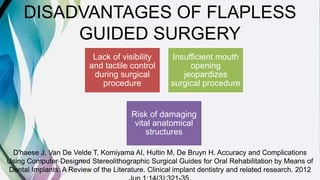
DISADVANTAGES OF FLAPLESS
GUIDED SURGERY
Lack of visibility
and tactile control
during surgical
procedure
Insufficient mouth
opening
jeopardizes
surgical procedure
Risk of damaging
vital anatomical
structures
D'haese J, Van De Velde T, Komiyama AI, Hultin M, De Bruyn H. Accuracy and Complications
Using Computer‐Designed Stereolithographic Surgical Guides for Oral Rehabilitation by Means of
Dental Implants: A Review of the Literature. Clinical implant dentistry and related research. 2012
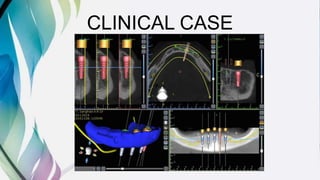
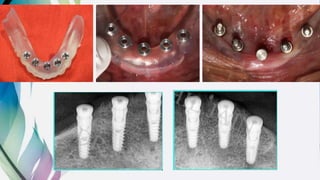
CLINICAL CASE
RESEARCHES AND
REVIEWS
PAIN EXPERIENCED AND SURGICAL TRAUMA
FOR RESORBED RIDGES
DURATION OF TREATMENT AND COST-EFFECTIVENESS
COMPLICATIONS
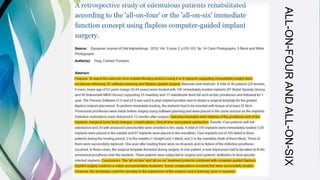
ALL ON FOUR AND ALL ON SIX
EXPERIENCED V/S INEXPERIENCED SURGEONS
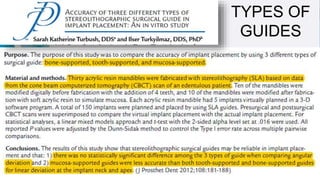
TYPES OF GUIDES
SYSTEMATIC REVIEW
FROM THE CHOSEN ARTICLE
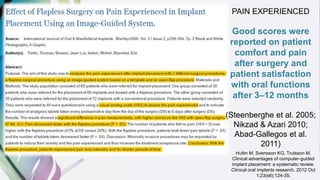
PAIN EXPERIENCED
Good scores were
reported on patient
comfort and pain
after surgery and
patient satisfaction
with oral functions
after 3–12 months
(Steenberghe et al. 2005;
Nikzad & Azari 2010;
Abad-Gallegos et al.
2011)
Hultin M, Svensson KG, Trulsson M.
Clinical advantages of computer‐guided
implant placement: a systematic review.
Clinical oral implants research. 2012 Oct
1;23(s6):124-35.
Fortin et al. 2006; Nkenke et al.
2007; Arisan et al. 2010
• Statistically significant reduction in immediate
postoperative pain, use of analgesics, swelling,
edema, hematoma, hemorrhage, and trismus
when flapless guided surgery was performed.
• Arisan et al. (2010) also compared guided flapless
surgery with guided open flap surgery and
demonstrated consistently better outcome
measures for the flapless guided technique
FOR RESORBED RIDGES
• The study by Barter (2010) was based on patients
previously treated with extensive onlay bone
grafting of severely resorbed maxillas.
• They reported 98% implant survival rate and 100%
prosthesis survival rate after more than 4 years.
Barter, S. (2010) Computer-aided implant placement in the reconstruction of a severely resorbed maxilla-
a 5-year clinical study. The International Journal of Periodontics & Restorative Dentistry 30: 627–637.
DURATION OF TREATMENT AND COST-
EFFECTIVENESS
• Arisan et al (2010) found the flapless guided
surgery technique to be significantly faster
(24 min) compared to both open flap guided
surgery (61 min) and conventional surgery (69
min).
• No study has reported on cost-effectiveness
measurements.
Hultin M, Svensson KG, Trulsson M. Clinical advantages of computer‐guided implant placement: a
systematic review. Clinical oral implants research. 2012 Oct 1;23(s6):124-35.
COMPLICATIONS
• The most common surgical complication was
fracture of the surgical guide
• Implant survival after 1 year ranged between 89
and 100% (study mean 97%) and the
corresponding prosthesis survival between 62
and 100% (study mean 95%).
• No obvious difference in implant survival rate
was observed between studies using an
immediate or delayed loading protocol
ALL-ON-FOURANDALL-ON-SIX
Van de Wiele G, Teughels W, Vercruyssen M, Coucke W, Temmerman A, Quirynen M. The accuracy of guided surgery via mucosa-
supported stereolithographic surgical templates in the hands of surgeons with little experience. Clin. Oral Impl. Res. 00, 2014, 1–6
EXPERIENCED V/S INEXPERIENCED
SURGEONS
TYPES OF
GUIDES
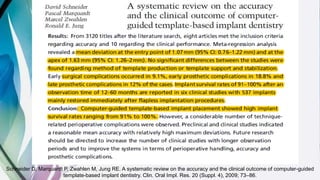
Schneider D, Marquardt P, Zwahlen M, Jung RE. A systematic review on the accuracy and the clinical outcome of computer-guided
template-based implant dentistry. Clin. Oral Impl. Res. 20 (Suppl. 4), 2009; 73–86.
GUIDED V/S UNGUIDED
• The mean deviation at the entry point in vivo was
0.87 mm (SE 0.11, max 3) when the implant
placement was guided, vs., 1.34 mm (SE 0.06,
max 6.5) when unguided.
• Deviation parameters (entry, apical and angle)
were significantly lower for implants, which
were guided during the insertion.
Assche N, Vercruyssen M, Coucke W, Teughels W, Jacobs R, Quirynen M. Accuracy of computer‐aided implant
placement. Clinical oral implants research. 2012 Oct 1;23(s6):112-23.
INCONSISTENCY IN
OBSERVATIONS• When comparing the data of the maxilla with
the mandible:
– Some publications reported no differences (Ersoy
et al. 2008; Arisan et al. 2010)
– Pettersson and co-workers (2010) and Vasak et al.
(2011) observed significant difference between
both jaws (in favour of the mandible)
– Di Giacomo et al. (2011) observed significant
higher deviations in the maxilla
Assche N, Vercruyssen M, Coucke W, Teughels W, Jacobs R, Quirynen M. Accuracy of computer‐aided implant
placement. Clinical oral implants research. 2012 Oct 1;23(s6):112-23.
• When comparing the data of implants placed
in anterior and posterior regions:
– Di Giacomo et al. (2011) found a significant
lower angular deviation for anterior implants
– A study by Vasak et al. (2011) found significant
lower deviations for anterior implants
compared to posterior ones
– D’haese et al. (2009) found no difference
Assche N, Vercruyssen M, Coucke W, Teughels W, Jacobs R, Quirynen M. Accuracy of computer‐aided implant
placement. Clinical oral implants research. 2012 Oct 1;23(s6):112-23.
CONCLUSION
• Irrespective of the study design the mean deviation of implants
inserted using guided surgery techniques was: 1.09mm at
entry, a mean deviation of 1.28 mm at the apex and 3.9° in
angulation.
• The importance of this value becomes more understandable
when compared to the accuracy of mental navigation (with or
without a surgical template)
• However, to find the best guiding system and most important
parameters for optimal accuracy, more RCTs are necessary.
Assche N, Vercruyssen M, Coucke W, Teughels W, Jacobs R, Quirynen M. Accuracy of computer‐aided implant
placement. Clinical oral implants research. 2012 Oct 1;23(s6):112-23.
CRITIQUE
• The current systematic review highlights
all necessary evidence based updates and
is an excellent article for reference
Thank You

Accuracy of computer aided implant placement

  • 1.
    ACCURACY OF COMPUTER- AIDEDIMPLANT PLACEMENT N. Van Assche, M. Vercruyssen, W. Coucke, W. Teughels, R. Jacobs and M. Quirynen Clin. Oral Implants Res. 23 (Suppl. 6), 2012, 112–123 AAMIR ZAHID GODIL FIRST YEAR P.G. DEPARTMENT OF PROSTHODONTICS M.A.R.D.C.
  • 2.
    OUTLINE • INTRODUCTION • GUIDEDIMPLANT SURGERY – STEREOLITHOGRAPHIC SURGICAL GUIDES • STEPS IN COMPUTER- AIDED IMPLANT PLACEMENT • ADVANTAGES AND DISADVANTAGES OF FLAPLESS GUIDED SURGERY • CLINICAL CASE • RESEARCHES AND REVIEWS • CONCLUSION • CRITIQUE
  • 3.
  • 4.
    GUIDED IMPLANT SURGERY •During the last decade, special attention was given to a “prosthesis driven” implant placement, to optimize the aesthetic outcome of the final restoration with optimal loading conditions and good access for cleaning. • Three-dimensional imaging (showing the alveolar bone in relation to the ideal tooth position), obtainable with relative low radiation dosages especially when CBCT are used (Loubele et al. 2009; Pauwels et al. 2012) in combination with planning software opened the possibility for preoperative planning and proper communication among the patient, the surgeon and the prosthodontist.
  • 5.
    STEREOLITHOGRAPHIC SURGICAL GUIDES Tooth-supported Recommended forsingle tooth and partially edentulous cases when minimally invasive surgery is preferred Bone- supported For partially or fully edentulous cases when increased visibility is needed Mucosa- supported For fully edentulous cases when minimally invasive surgery is preferred.
  • 6.
    STEPS IN COMPUTER-AIDED IMPLANT PLACEMENT Pre-operative CBCT of patient + CBCT scan of stone cast or denture Computer software program for virtual placement of implants Fabrication of stereolithographic surgical guide and implant placement using this guide Post-operative CBCT to evaluate differences in planned and placed implants
  • 7.
  • 8.
  • 10.
    POST-OPERATIVE EVALUATION A. Illustrating themeasurement deviation calculation at the level of the hex, apex, and angular deviation. B. B. Represents the measurement deviation calculation of the depth between the virtually planned implant and implant placed after surgery (aa = apex actual; ap = apex planned, ha = hex actual; hp = hex planned).
  • 11.
    ADVANTAGES OF FLAPLESS GUIDEDSURGERY Facilitated surgical procedure Reduced surgical intervention time Reduced postoperative complications Treatment of medically compromised Avoiding bone grafting procedures Facilitated immediate loading protocol D'haese J, Van De Velde T, Komiyama AI, Hultin M, De Bruyn H. Accuracy and Complications Using Computer‐Designed Stereolithographic Surgical Guides for Oral Rehabilitation by Means of Dental Implants: A Review of the Literature. Clinical implant dentistry and related research. 2012
  • 12.
    DISADVANTAGES OF FLAPLESS GUIDEDSURGERY Lack of visibility and tactile control during surgical procedure Insufficient mouth opening jeopardizes surgical procedure Risk of damaging vital anatomical structures D'haese J, Van De Velde T, Komiyama AI, Hultin M, De Bruyn H. Accuracy and Complications Using Computer‐Designed Stereolithographic Surgical Guides for Oral Rehabilitation by Means of Dental Implants: A Review of the Literature. Clinical implant dentistry and related research. 2012
  • 13.
  • 15.
    RESEARCHES AND REVIEWS PAIN EXPERIENCEDAND SURGICAL TRAUMA FOR RESORBED RIDGES DURATION OF TREATMENT AND COST-EFFECTIVENESS COMPLICATIONS ALL ON FOUR AND ALL ON SIX EXPERIENCED V/S INEXPERIENCED SURGEONS TYPES OF GUIDES SYSTEMATIC REVIEW FROM THE CHOSEN ARTICLE
  • 16.
    PAIN EXPERIENCED Good scoreswere reported on patient comfort and pain after surgery and patient satisfaction with oral functions after 3–12 months (Steenberghe et al. 2005; Nikzad & Azari 2010; Abad-Gallegos et al. 2011) Hultin M, Svensson KG, Trulsson M. Clinical advantages of computer‐guided implant placement: a systematic review. Clinical oral implants research. 2012 Oct 1;23(s6):124-35.
  • 17.
    Fortin et al.2006; Nkenke et al. 2007; Arisan et al. 2010 • Statistically significant reduction in immediate postoperative pain, use of analgesics, swelling, edema, hematoma, hemorrhage, and trismus when flapless guided surgery was performed. • Arisan et al. (2010) also compared guided flapless surgery with guided open flap surgery and demonstrated consistently better outcome measures for the flapless guided technique
  • 18.
    FOR RESORBED RIDGES •The study by Barter (2010) was based on patients previously treated with extensive onlay bone grafting of severely resorbed maxillas. • They reported 98% implant survival rate and 100% prosthesis survival rate after more than 4 years. Barter, S. (2010) Computer-aided implant placement in the reconstruction of a severely resorbed maxilla- a 5-year clinical study. The International Journal of Periodontics & Restorative Dentistry 30: 627–637.
  • 19.
    DURATION OF TREATMENTAND COST- EFFECTIVENESS • Arisan et al (2010) found the flapless guided surgery technique to be significantly faster (24 min) compared to both open flap guided surgery (61 min) and conventional surgery (69 min). • No study has reported on cost-effectiveness measurements.
  • 20.
    Hultin M, SvenssonKG, Trulsson M. Clinical advantages of computer‐guided implant placement: a systematic review. Clinical oral implants research. 2012 Oct 1;23(s6):124-35. COMPLICATIONS • The most common surgical complication was fracture of the surgical guide • Implant survival after 1 year ranged between 89 and 100% (study mean 97%) and the corresponding prosthesis survival between 62 and 100% (study mean 95%). • No obvious difference in implant survival rate was observed between studies using an immediate or delayed loading protocol
  • 21.
  • 22.
    Van de WieleG, Teughels W, Vercruyssen M, Coucke W, Temmerman A, Quirynen M. The accuracy of guided surgery via mucosa- supported stereolithographic surgical templates in the hands of surgeons with little experience. Clin. Oral Impl. Res. 00, 2014, 1–6 EXPERIENCED V/S INEXPERIENCED SURGEONS
  • 23.
  • 24.
    Schneider D, MarquardtP, Zwahlen M, Jung RE. A systematic review on the accuracy and the clinical outcome of computer-guided template-based implant dentistry. Clin. Oral Impl. Res. 20 (Suppl. 4), 2009; 73–86.
  • 25.
    GUIDED V/S UNGUIDED •The mean deviation at the entry point in vivo was 0.87 mm (SE 0.11, max 3) when the implant placement was guided, vs., 1.34 mm (SE 0.06, max 6.5) when unguided. • Deviation parameters (entry, apical and angle) were significantly lower for implants, which were guided during the insertion. Assche N, Vercruyssen M, Coucke W, Teughels W, Jacobs R, Quirynen M. Accuracy of computer‐aided implant placement. Clinical oral implants research. 2012 Oct 1;23(s6):112-23.
  • 26.
    INCONSISTENCY IN OBSERVATIONS• Whencomparing the data of the maxilla with the mandible: – Some publications reported no differences (Ersoy et al. 2008; Arisan et al. 2010) – Pettersson and co-workers (2010) and Vasak et al. (2011) observed significant difference between both jaws (in favour of the mandible) – Di Giacomo et al. (2011) observed significant higher deviations in the maxilla Assche N, Vercruyssen M, Coucke W, Teughels W, Jacobs R, Quirynen M. Accuracy of computer‐aided implant placement. Clinical oral implants research. 2012 Oct 1;23(s6):112-23.
  • 27.
    • When comparingthe data of implants placed in anterior and posterior regions: – Di Giacomo et al. (2011) found a significant lower angular deviation for anterior implants – A study by Vasak et al. (2011) found significant lower deviations for anterior implants compared to posterior ones – D’haese et al. (2009) found no difference Assche N, Vercruyssen M, Coucke W, Teughels W, Jacobs R, Quirynen M. Accuracy of computer‐aided implant placement. Clinical oral implants research. 2012 Oct 1;23(s6):112-23.
  • 28.
    CONCLUSION • Irrespective ofthe study design the mean deviation of implants inserted using guided surgery techniques was: 1.09mm at entry, a mean deviation of 1.28 mm at the apex and 3.9° in angulation. • The importance of this value becomes more understandable when compared to the accuracy of mental navigation (with or without a surgical template) • However, to find the best guiding system and most important parameters for optimal accuracy, more RCTs are necessary. Assche N, Vercruyssen M, Coucke W, Teughels W, Jacobs R, Quirynen M. Accuracy of computer‐aided implant placement. Clinical oral implants research. 2012 Oct 1;23(s6):112-23.
  • 29.
    CRITIQUE • The currentsystematic review highlights all necessary evidence based updates and is an excellent article for reference
  • 30.

Editor's Notes

  • #12 Treatment of medically compromised (anticoagulantia, bisfosfonates, etc.) or anxious patients
  • #20 Conventional implant treatment with both delayed and immediate loading has shown successful long-term results with implant survival rates exceeding 95% after more than 5 years (Albrektsson et al. 1988; Lekholm et al. 1999; Ekelund et al. 2003; Pjetursson et al. 2004; Jemt & Johansson 2006; Jung et al. 2008; Romanos et al. 2010).