PERSONALITY
TEAM MEMBERS	Neelam Darji                  9112Animesh Dubey             9114	Premal Gangar              9116Harshal Ghanekar         9118Vinod Gupta                   9120
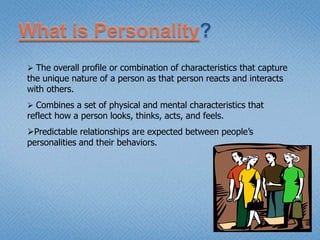
What is Personality?The overall profile or combination of characteristics that capture the unique nature of a person as that person reacts and interacts with others.
Combines a set of physical and mental characteristics that reflect how a person looks, thinks, acts, and feels.
Predictable relationships are expected between people’s        personalities and their behaviors.Nature of Personality Personality refers to the set of traits & behaviors that     characterize an individual. It refers to the relatively stable pattern of behavior &    consistent internal state & explains an individual’s    behavioral tendencies. Personality has both internal (thoughts, values & genetic    characteristics that is inferred from observable behaviors)    & external (observable behaviors) elements. Personality of an individual is relatively stable in nature.
 Personality is both inherited as well as it can be shaped    by the environment.
Importance of Personality in OB Law of Behavior: “People are different”
 To ensure high performing employees in an     organization. To manage workforce diversity.
 Summarizing person’s behaviors & attitudes in     relation to a wide range of events. Personality consists of characteristics or traits that     describe how people are likely to behave in a given   situation.
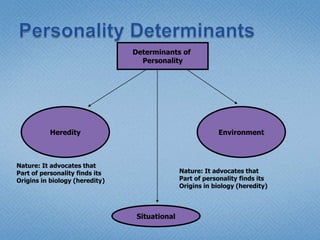
Importance of Personality in OB Personality is useful in predicting & understanding     the general feelings, thoughts and behaviors of     individuals at the workplace.Contribution of various personality theories.Personality DeterminantsDeterminants of PersonalityHeredityEnvironmentNature: It advocates thatPart of personality finds itsOrigins in biology (heredity)Nature: It advocates thatPart of personality finds itsOrigins in biology (heredity)Situational
Heredity and environment Heredity sets the limits on the development of personality characteristics.
 Environment determines development within these limits. 
 About a 50-50 heredity-environment split.
 Cultural values and norms play a substantial role in the development of personality.
 Social factors include family life, religion, and many kinds of formal and informal groups.
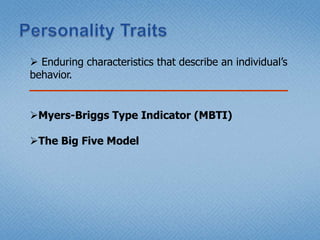
 Situational factors reflect the opportunities or constraints imposed by the operational context.Personality Traits Enduring characteristics that describe an individual’s behavior.
Myers-Briggs Type Indicator (MBTI)
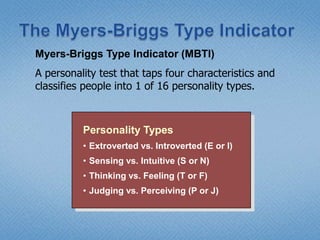
The Big Five ModelThe Myers-Briggs Type IndicatorMyers-Briggs Type Indicator (MBTI)A personality test that taps four characteristics and classifies people into 1 of 16 personality types.Personality TypesExtroverted vs. Introverted (E or I)
Sensing vs. Intuitive (S or N)
Thinking vs. Feeling (T or F)
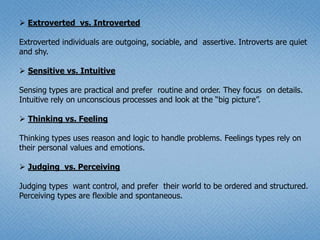
Judging vs. Perceiving (P or J)Extroverted  vs. IntrovertedExtroverted individuals are outgoing, sociable, and  assertive. Introverts are quiet and shy.Sensitive vs. IntuitiveSensing types are practical and prefer  routine and order. They focus  on details. Intuitive rely on unconscious processes and look at the “big picture”.Thinking vs. FeelingThinking types uses reason and logic to handle problems. Feelings types rely on their personal values and emotions.Judging  vs. PerceivingJudging types  want control, and prefer  their world to be ordered and structured. Perceiving types are flexible and spontaneous.
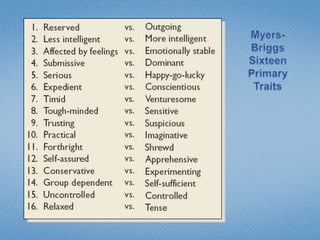
Myers-Briggs Sixteen Primary Traits
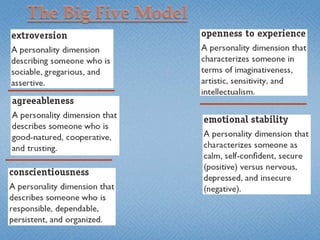
The Big Five Model
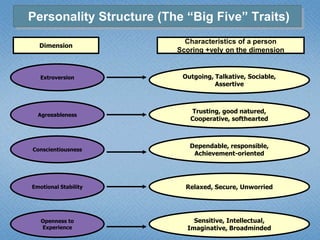
4–13Personality Structure (The “Big Five” Traits)DimensionCharacteristics of a personScoring +vely on the dimensionExtroversionOutgoing, Talkative, Sociable,AssertiveAgreeablenessTrusting, good natured,Cooperative, softheartedDependable, responsible,Achievement-orientedConscientiousnessEmotional StabilityRelaxed, Secure, UnworriedSensitive, Intellectual,Imaginative, BroadmindedOpenness toExperience
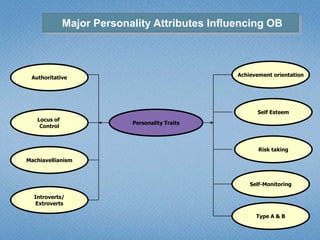
Major Personality Attributes Influencing OBAchievement orientationAuthoritativeSelf EsteemPersonality TraitsLocus of ControlRisk takingMachiavellianismSelf-MonitoringIntroverts/ExtrovertsType A & B
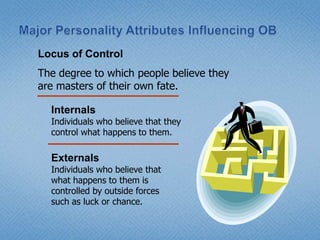
Major Personality Attributes Influencing OBLocus of ControlThe degree to which people believe they are masters of their own fate.InternalsIndividuals who believe that they control what happens to them. ExternalsIndividuals who believe that what happens to them is controlled by outside forces such as luck or chance.
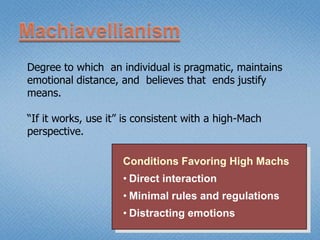
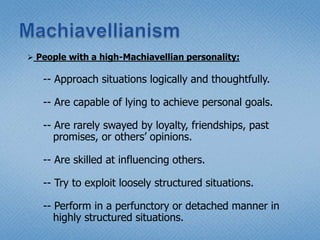
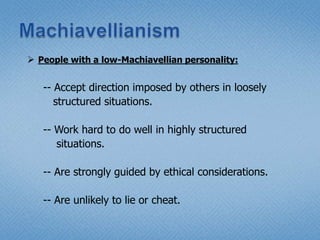
MachiavellianismDegree to which  an individual is pragmatic, maintains emotional distance, and  believes that  ends justify  means.“If it works, use it” is consistent with a high-Mach perspective.Conditions Favoring High MachsDirect interaction
Minimal rules and regulations

Personality

  • 1.
  • 2.
    TEAM MEMBERS Neelam Darji 9112Animesh Dubey 9114 Premal Gangar 9116Harshal Ghanekar 9118Vinod Gupta 9120
  • 3.
    What is Personality?Theoverall profile or combination of characteristics that capture the unique nature of a person as that person reacts and interacts with others.
  • 4.
    Combines a setof physical and mental characteristics that reflect how a person looks, thinks, acts, and feels.
  • 5.
    Predictable relationships areexpected between people’s personalities and their behaviors.Nature of Personality Personality refers to the set of traits & behaviors that characterize an individual. It refers to the relatively stable pattern of behavior & consistent internal state & explains an individual’s behavioral tendencies. Personality has both internal (thoughts, values & genetic characteristics that is inferred from observable behaviors) & external (observable behaviors) elements. Personality of an individual is relatively stable in nature.
  • 6.
    Personality isboth inherited as well as it can be shaped by the environment.
  • 7.
    Importance of Personalityin OB Law of Behavior: “People are different”
  • 8.
    To ensurehigh performing employees in an organization. To manage workforce diversity.
  • 9.
    Summarizing person’sbehaviors & attitudes in relation to a wide range of events. Personality consists of characteristics or traits that describe how people are likely to behave in a given situation.
  • 10.
    Importance of Personalityin OB Personality is useful in predicting & understanding the general feelings, thoughts and behaviors of individuals at the workplace.Contribution of various personality theories.Personality DeterminantsDeterminants of PersonalityHeredityEnvironmentNature: It advocates thatPart of personality finds itsOrigins in biology (heredity)Nature: It advocates thatPart of personality finds itsOrigins in biology (heredity)Situational
  • 11.
    Heredity and environmentHeredity sets the limits on the development of personality characteristics.
  • 12.
    Environment determinesdevelopment within these limits. 
  • 13.
    About a50-50 heredity-environment split.
  • 14.
    Cultural valuesand norms play a substantial role in the development of personality.
  • 15.
    Social factorsinclude family life, religion, and many kinds of formal and informal groups.
  • 16.
    Situational factorsreflect the opportunities or constraints imposed by the operational context.Personality Traits Enduring characteristics that describe an individual’s behavior.
  • 17.
  • 18.
    The Big FiveModelThe Myers-Briggs Type IndicatorMyers-Briggs Type Indicator (MBTI)A personality test that taps four characteristics and classifies people into 1 of 16 personality types.Personality TypesExtroverted vs. Introverted (E or I)
  • 19.
  • 20.
  • 21.
    Judging vs. Perceiving(P or J)Extroverted vs. IntrovertedExtroverted individuals are outgoing, sociable, and assertive. Introverts are quiet and shy.Sensitive vs. IntuitiveSensing types are practical and prefer routine and order. They focus on details. Intuitive rely on unconscious processes and look at the “big picture”.Thinking vs. FeelingThinking types uses reason and logic to handle problems. Feelings types rely on their personal values and emotions.Judging vs. PerceivingJudging types want control, and prefer their world to be ordered and structured. Perceiving types are flexible and spontaneous.
  • 22.
  • 23.
  • 24.
    4–13Personality Structure (The“Big Five” Traits)DimensionCharacteristics of a personScoring +vely on the dimensionExtroversionOutgoing, Talkative, Sociable,AssertiveAgreeablenessTrusting, good natured,Cooperative, softheartedDependable, responsible,Achievement-orientedConscientiousnessEmotional StabilityRelaxed, Secure, UnworriedSensitive, Intellectual,Imaginative, BroadmindedOpenness toExperience
  • 25.
    Major Personality AttributesInfluencing OBAchievement orientationAuthoritativeSelf EsteemPersonality TraitsLocus of ControlRisk takingMachiavellianismSelf-MonitoringIntroverts/ExtrovertsType A & B
  • 26.
    Major Personality AttributesInfluencing OBLocus of ControlThe degree to which people believe they are masters of their own fate.InternalsIndividuals who believe that they control what happens to them. ExternalsIndividuals who believe that what happens to them is controlled by outside forces such as luck or chance.
  • 27.
    MachiavellianismDegree to which an individual is pragmatic, maintains emotional distance, and believes that ends justify means.“If it works, use it” is consistent with a high-Mach perspective.Conditions Favoring High MachsDirect interaction
  • 28.