Personality
“I am driven by fear of failure. It is a strong motivator for me”
—Dennis Manning, CEO of Guardian Life Insurance Co.
D.N Abeyayaka student of NIBM Galle
Content
1. What is Personality
2. Measuring personality
3. Personality determines
4. Personality traits
5. The Myers-Briggs Type Indicator
6. The Big Five Personality Model
7. Other Personality Traits Relevant to OB
“personality is the dynamic organization
within the individual of those
psychophysical systems that determine his
unique adjustments to his environment”
What is Personality
• sum total of ways in which an individual reacts
to and interacts with others.
Gordon Allport
Defining Personality
“How people affect others and how they
understand and view themselves, as well as their
pattern of inner and outer measurable traits and
the person-situation interaction.”
Luthans
Defining Personality
What is Personality
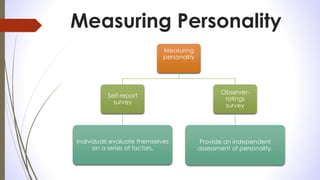
Measuring Personality
Measuring
personality
Self-report
survey
Individuals evaluate themselves
on a series of factors.
Observer-
ratings
survey
Provide an independent
assessment of personality.
Self-report survey
Advantages & Disadvantages
Advantages Disadvantages
A good sometime it only makes sense
to measure something by asking the
participant about it (opinions, for
instance)
The person may not be able to give an
accurate response due to cognitive
biases, poor memory.
Quick and simple to administer in many
Situations.
People may lie or skew their answer to
make themselves .
You get the respondents views directly Impression management, Accuracy
(eg. bad mood)
Personality Determinants
Heredity or of Environment??
Heredity
 Physical stature
 Facial attractiveness
 Gender
 temperament
 Muscle composition and reflexes
 Energy Level
 Biological rhythm
Environment
 Relationships
 Interaction
 Environment in the family
 Organizations
 Workplaces
 Communities
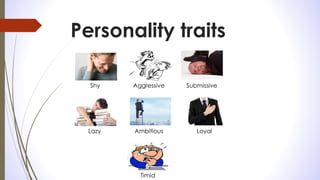
Personality traits
Shy Aggressive Submissive
Lazy Ambitious Loyal
Timid
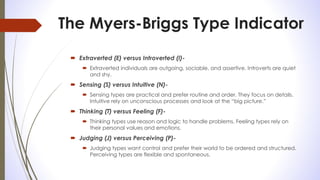
 Extraverted (E) versus Introverted (I)-
 Extraverted individuals are outgoing, sociable, and assertive. Introverts are quiet
and shy.
 Sensing (S) versus Intuitive (N)-
 Sensing types are practical and prefer routine and order. They focus on details.
Intuitive rely on unconscious processes and look at the “big picture.”
 Thinking (T) versus Feeling (F)-
 Thinking types use reason and logic to handle problems. Feeling types rely on
their personal values and emotions.
 Judging (J) versus Perceiving (P)-
 Judging types want control and prefer their world to be ordered and structured.
Perceiving types are flexible and spontaneous.
The Myers-Briggs Type Indicator
 INTJs (Introverted/Intuitive/Thinking/Judging people)
 They are visionaries with original minds and great drive.
 Skeptical
 critical
 independent
 determined
 often stubborn
The Myers-Briggs Type Indicator
 ESTJs (Extraverted/Sensing/Thinking/Judging people)
 They are organizers.
 realistic
 logical
 analytical
 decisive
 have a natural head for business or mechanics
The Myers-Briggs Type Indicator
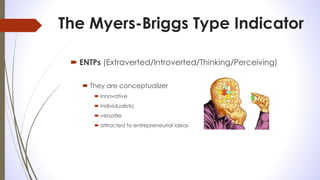
 ENTPs (Extraverted/Introverted/Thinking/Perceiving)
 They are conceptualizer
 innovative
 individualistic
 versatile
 attracted to entrepreneurial ideas
The Myers-Briggs Type Indicator
The Big Five Personality Model
 Extraversion
 The extraversion dimension captures our comfort level with relationships.
The Big Five Personality Model
Extraverts Introverts
Gregarious Reserved
Assertive Timid
Sociable Quiet
 Agreeableness
 The agreeableness dimension refers to an individual’s propensity
to defer to others.
The Big Five Personality Model
Highly
Agreeable
Low on
Agreeablenes
s
Cooperative Cold
Warm Disagreeable
Trusting Antagonistic
 Conscientiousness
 The conscientiousness dimension is a measure of reliability.
Highly
Conscientious
low on
Conscientious
Responsible Easily distracted
Organized Disorganized
Dependable Unreliable
The Big Five Personality Model
 Emotional stability
 The emotional stability dimension—often labeled by its converse,
neuroticism—taps a person’s ability to withstand stress.
The Big Five Personality Model
Positive Emotional
Stability
Negative
Emotional Stability
Calm Nervous
Self-confident Depressed
Secure Insecure
 Openness to experience
 The openness to experience dimension addresses range of
interests and fascination with novelty.
The Big Five Personality Model
Extremely open
people
No Openness
to Experience
Creative Conventional
Curious Find Comfort in
the Familiar
Artistically
Sensitive
How Do the Big Five Traits Predict Behavior at
Work?
Emotional stability
Conscientiousness
Extroversion
Openness
Agreeableness
• Less negative thinking and
fewer negative emotions
• Less hyper-vigilant
• Better interpersonal skills
• Greater social dominance
• More emotionally
expressive
• Better liked
• More compliant and
conforming
• Increased learning
• More creative
• More flexible &
autonomous
• Greater effort & persistence
• More drive and discipline
• Better organized & planning
• Higher job & life satisfaction
• Lower stress levels
• Higher performance
• Enhanced leadership
• Greater longevity
• Higher performance*
• Lower levels of deviant
behavior
• Training performance
• Enhanced leadership
• More adaptable to change
• Higher performance*
• Enhanced leadership
• Higher job & life satisfaction
BIG FIVE TRAITS WHY IS IT RELEVANT? WHAT DOES IT AFFECT?
Other Personality Traits Relevant to OB
 Core Self-Evaluation
 self-evaluations
 Locus of control
 Machiavellianism
 Self-Monitoring
 Risk Taking
 Narcissism
 Proactive Personality
 Type A vs. Type B Personality
 Self-Evaluation
Other Personality Traits Relevant to OB
Positive Core Self-Evaluations Negative Core Self-Evaluations
Effective Dislike Themselves
Capable Question Their Capabilities
Control of their Environment View Themselves as Powerless Over Their
Environment
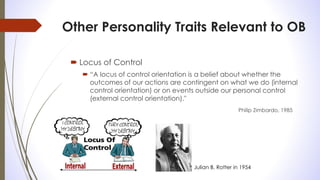
 Locus of Control
 “A locus of control orientation is a belief about whether the
outcomes of our actions are contingent on what we do (internal
control orientation) or on events outside our personal control
(external control orientation)."
Philip Zimbardo, 1985
Other Personality Traits Relevant to OB
Julian B. Rotter in 1954
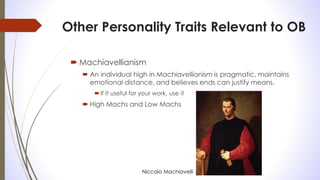
 Machiavellianism
 An individual high in Machiavellianism is pragmatic, maintains
emotional distance, and believes ends can justify means.
If it useful for your work, use it
 High Machs and Low Machs
Other Personality Traits Relevant to OB
Niccolo Machiavelli
 Self-Monitoring
 Self monitoring is a personality characteristic that makes an
individual pay closer attention to a social situation so that they
can change there behavior to fit that situation.
 High self monitors-
easily blend into social situation .knowing what to do or say with
each person.
They tend to use situational factors to explain their behavior.
Better performance rating
 Low self monitors-
On the other hand, at themselves regardless of the situation, so they
rarely conform to the norms of the social setting.
Other Personality Traits Relevant to OB
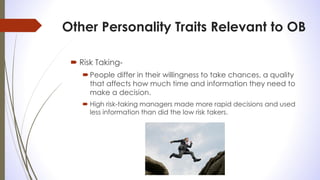
 Risk Taking-
People differ in their willingness to take chances, a quality
that affects how much time and information they need to
make a decision.
 High risk-taking managers made more rapid decisions and used
less information than did the low risk takers.
Other Personality Traits Relevant to OB
 Narcissism-
Narcissism describes a person who has a grandiose sense
of self-importance, requires excessive admiration, has a
sense of entitlement, and is arrogant.
Other Personality Traits Relevant to OB
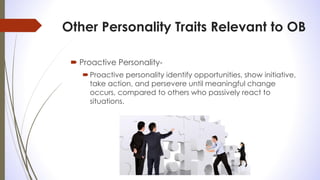
 Proactive Personality-
Proactive personality identify opportunities, show initiative,
take action, and persevere until meaningful change
occurs, compared to others who passively react to
situations.
Other Personality Traits Relevant to OB
 Type A vs. Type B Personality
Type A Type B
Is always moving Its not concerned about time
Walks rapidly Is patient
Eats rapidly Doesn't brag
Talks rapidly Plays for fun, not to win
Is impatient Relaxes without guilt
Dose two things at once Has no pressing deadlines
Can’t cope with leisure time Is mild-mannered
Is obsessed with numbers Is never in a hurry
Other Personality Traits Relevant to OB
personality

personality

  • 1.
    Personality “I am drivenby fear of failure. It is a strong motivator for me” —Dennis Manning, CEO of Guardian Life Insurance Co. D.N Abeyayaka student of NIBM Galle
  • 2.
    Content 1. What isPersonality 2. Measuring personality 3. Personality determines 4. Personality traits 5. The Myers-Briggs Type Indicator 6. The Big Five Personality Model 7. Other Personality Traits Relevant to OB
  • 3.
    “personality is thedynamic organization within the individual of those psychophysical systems that determine his unique adjustments to his environment” What is Personality • sum total of ways in which an individual reacts to and interacts with others. Gordon Allport Defining Personality
  • 4.
    “How people affectothers and how they understand and view themselves, as well as their pattern of inner and outer measurable traits and the person-situation interaction.” Luthans Defining Personality What is Personality
  • 5.
    Measuring Personality Measuring personality Self-report survey Individuals evaluatethemselves on a series of factors. Observer- ratings survey Provide an independent assessment of personality.
  • 6.
    Self-report survey Advantages &Disadvantages Advantages Disadvantages A good sometime it only makes sense to measure something by asking the participant about it (opinions, for instance) The person may not be able to give an accurate response due to cognitive biases, poor memory. Quick and simple to administer in many Situations. People may lie or skew their answer to make themselves . You get the respondents views directly Impression management, Accuracy (eg. bad mood)
  • 7.
  • 8.
    Heredity  Physical stature Facial attractiveness  Gender  temperament  Muscle composition and reflexes  Energy Level  Biological rhythm
  • 9.
    Environment  Relationships  Interaction Environment in the family  Organizations  Workplaces  Communities
  • 10.
    Personality traits Shy AggressiveSubmissive Lazy Ambitious Loyal Timid
  • 11.
     Extraverted (E)versus Introverted (I)-  Extraverted individuals are outgoing, sociable, and assertive. Introverts are quiet and shy.  Sensing (S) versus Intuitive (N)-  Sensing types are practical and prefer routine and order. They focus on details. Intuitive rely on unconscious processes and look at the “big picture.”  Thinking (T) versus Feeling (F)-  Thinking types use reason and logic to handle problems. Feeling types rely on their personal values and emotions.  Judging (J) versus Perceiving (P)-  Judging types want control and prefer their world to be ordered and structured. Perceiving types are flexible and spontaneous. The Myers-Briggs Type Indicator
  • 12.
     INTJs (Introverted/Intuitive/Thinking/Judgingpeople)  They are visionaries with original minds and great drive.  Skeptical  critical  independent  determined  often stubborn The Myers-Briggs Type Indicator
  • 13.
     ESTJs (Extraverted/Sensing/Thinking/Judgingpeople)  They are organizers.  realistic  logical  analytical  decisive  have a natural head for business or mechanics The Myers-Briggs Type Indicator
  • 14.
     ENTPs (Extraverted/Introverted/Thinking/Perceiving) They are conceptualizer  innovative  individualistic  versatile  attracted to entrepreneurial ideas The Myers-Briggs Type Indicator
  • 15.
    The Big FivePersonality Model
  • 16.
     Extraversion  Theextraversion dimension captures our comfort level with relationships. The Big Five Personality Model Extraverts Introverts Gregarious Reserved Assertive Timid Sociable Quiet
  • 17.
     Agreeableness  Theagreeableness dimension refers to an individual’s propensity to defer to others. The Big Five Personality Model Highly Agreeable Low on Agreeablenes s Cooperative Cold Warm Disagreeable Trusting Antagonistic
  • 18.
     Conscientiousness  Theconscientiousness dimension is a measure of reliability. Highly Conscientious low on Conscientious Responsible Easily distracted Organized Disorganized Dependable Unreliable The Big Five Personality Model
  • 19.
     Emotional stability The emotional stability dimension—often labeled by its converse, neuroticism—taps a person’s ability to withstand stress. The Big Five Personality Model Positive Emotional Stability Negative Emotional Stability Calm Nervous Self-confident Depressed Secure Insecure
  • 20.
     Openness toexperience  The openness to experience dimension addresses range of interests and fascination with novelty. The Big Five Personality Model Extremely open people No Openness to Experience Creative Conventional Curious Find Comfort in the Familiar Artistically Sensitive
  • 21.
    How Do theBig Five Traits Predict Behavior at Work? Emotional stability Conscientiousness Extroversion Openness Agreeableness • Less negative thinking and fewer negative emotions • Less hyper-vigilant • Better interpersonal skills • Greater social dominance • More emotionally expressive • Better liked • More compliant and conforming • Increased learning • More creative • More flexible & autonomous • Greater effort & persistence • More drive and discipline • Better organized & planning • Higher job & life satisfaction • Lower stress levels • Higher performance • Enhanced leadership • Greater longevity • Higher performance* • Lower levels of deviant behavior • Training performance • Enhanced leadership • More adaptable to change • Higher performance* • Enhanced leadership • Higher job & life satisfaction BIG FIVE TRAITS WHY IS IT RELEVANT? WHAT DOES IT AFFECT?
  • 22.
    Other Personality TraitsRelevant to OB  Core Self-Evaluation  self-evaluations  Locus of control  Machiavellianism  Self-Monitoring  Risk Taking  Narcissism  Proactive Personality  Type A vs. Type B Personality
  • 23.
     Self-Evaluation Other PersonalityTraits Relevant to OB Positive Core Self-Evaluations Negative Core Self-Evaluations Effective Dislike Themselves Capable Question Their Capabilities Control of their Environment View Themselves as Powerless Over Their Environment
  • 24.
     Locus ofControl  “A locus of control orientation is a belief about whether the outcomes of our actions are contingent on what we do (internal control orientation) or on events outside our personal control (external control orientation)." Philip Zimbardo, 1985 Other Personality Traits Relevant to OB Julian B. Rotter in 1954
  • 25.
     Machiavellianism  Anindividual high in Machiavellianism is pragmatic, maintains emotional distance, and believes ends can justify means. If it useful for your work, use it  High Machs and Low Machs Other Personality Traits Relevant to OB Niccolo Machiavelli
  • 26.
     Self-Monitoring  Selfmonitoring is a personality characteristic that makes an individual pay closer attention to a social situation so that they can change there behavior to fit that situation.  High self monitors- easily blend into social situation .knowing what to do or say with each person. They tend to use situational factors to explain their behavior. Better performance rating  Low self monitors- On the other hand, at themselves regardless of the situation, so they rarely conform to the norms of the social setting. Other Personality Traits Relevant to OB
  • 27.
     Risk Taking- Peoplediffer in their willingness to take chances, a quality that affects how much time and information they need to make a decision.  High risk-taking managers made more rapid decisions and used less information than did the low risk takers. Other Personality Traits Relevant to OB
  • 28.
     Narcissism- Narcissism describesa person who has a grandiose sense of self-importance, requires excessive admiration, has a sense of entitlement, and is arrogant. Other Personality Traits Relevant to OB
  • 29.
     Proactive Personality- Proactivepersonality identify opportunities, show initiative, take action, and persevere until meaningful change occurs, compared to others who passively react to situations. Other Personality Traits Relevant to OB
  • 30.
     Type Avs. Type B Personality Type A Type B Is always moving Its not concerned about time Walks rapidly Is patient Eats rapidly Doesn't brag Talks rapidly Plays for fun, not to win Is impatient Relaxes without guilt Dose two things at once Has no pressing deadlines Can’t cope with leisure time Is mild-mannered Is obsessed with numbers Is never in a hurry Other Personality Traits Relevant to OB