Biomedical Waste Management
Mr. Gunjal Prasad N.
Assistant Professor
Dept. of Microbiology
Introduction
 What is Biomedical Waste ?
 Infectious wastes (also called biomedical waste) include
–
 Human waste,
 Animal waste and
 Objects and materials contaminated with blood and body
fluids containing disease-causing micro-organisms or
viruses.
 OR 8/23/20182
What is Biomedical Waste ?
 It is defined as
 “Any solid and/or liquid waste including
its container and any intermediate
product, which is generated during the
diagnosis, treatment or immunization of
human beings or animals or in research
activities pertaining there to or in the
production or testing of biologicals and
including categories mentioned ”.
8/23/20183
8/23/20184
WHO GENERATES BMW?
5
 Waste generated by –
 Healthcare facilities
 Research facilities
 Laboratories
8/23/2018
What is Infectious Medical Waste
 Infectious Medical Waste is defined as medical
waste capable of producing an infectious disease.
 Waste is considered Infectious when it is:
 Contaminated by an organism that is pathogenic to
healthy humans;
 The organism is not routinely available in the
environment; and
 The organism is in significant quantity and capable of
transmitting the disease to community.
8/23/20186
India to Relook into Safe Practices
 Bio-medical or infectious waste has not received its
due attention in developing countries like India.
 It is being collected and disposed off along with the
municipal solid waste (MSW).
 Therefore, infectious waste management schemes
should be designed carefully by taking in account the
correct factors and giving them due weight age.
8/23/20187
8/23/20188
HEALTHCARE WASTE CHARACTERIZATION
9
Healthcare Waste
80% Non-
infectious
15% Infectious 5% Hazardous
8/23/2018
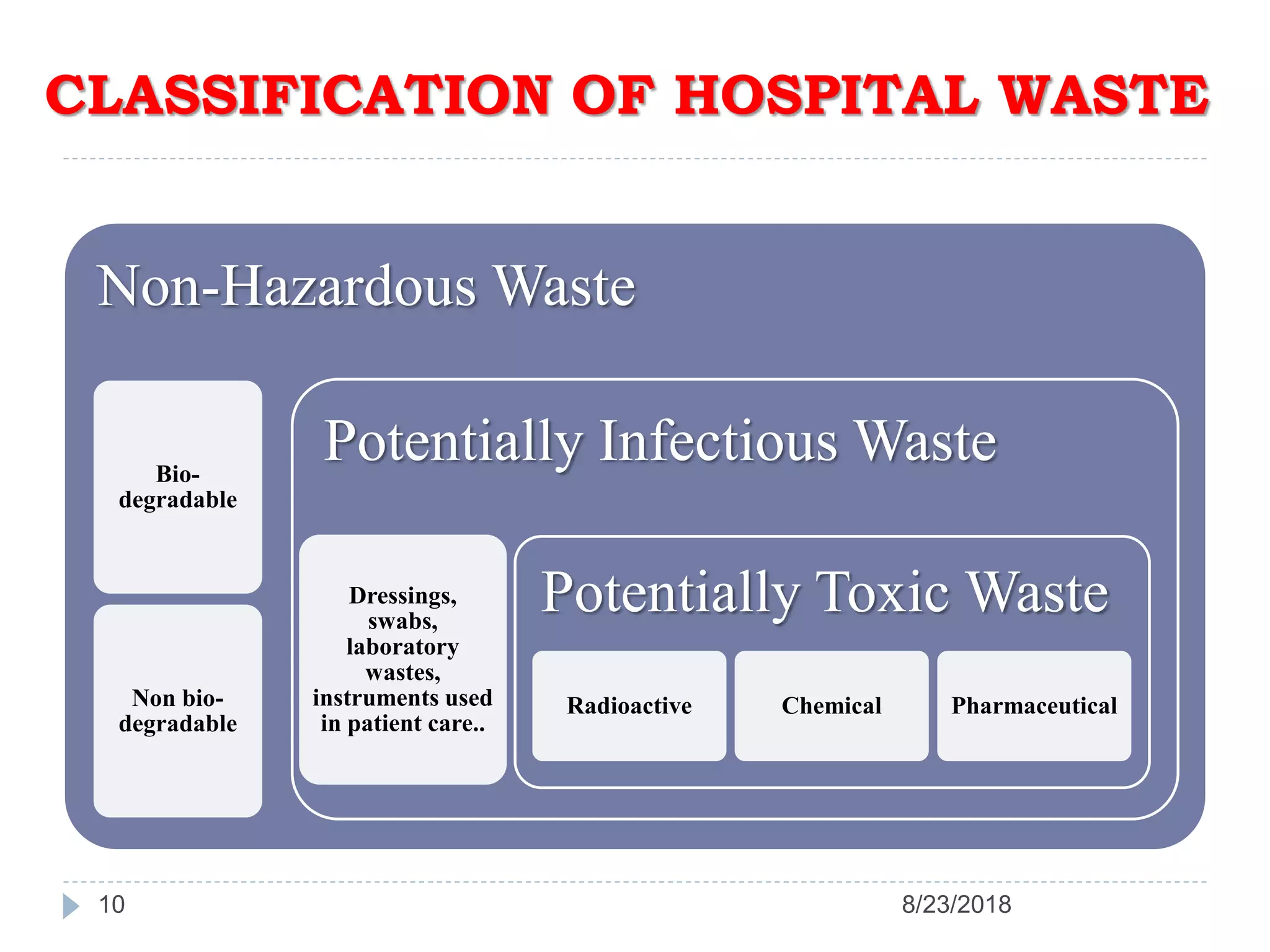
CLASSIFICATION OF HOSPITAL WASTE
Non-Hazardous Waste
Bio-
degradable
Non bio-
degradable
Potentially Infectious Waste
Dressings,
swabs,
laboratory
wastes,
instruments used
in patient care..
Potentially Toxic Waste
Radioactive Chemical Pharmaceutical
10 8/23/2018
8/23/201811
 According to Ministry of Environment and Forests
(MoEF) –
 Biomedical waste generated in India / day =
4,05,702 kg.
 Off which properly disposed waste is only =
2,91,983/kg/day.
 Almost 28% waste is left untreated and not disposed
and mixed with community waste ( dump, water
bodies).
 Karnataka tops the chart in generating Biomedical
waste.
Categories of Persons Exposed to Risk of
Infection
Sanitation
workers
Medical &
Paramedical
staff
Patients
12 8/23/2018
Diseases Caused by Blood borne Pathogens
 Malaria
 Rabies
 Syphilis
 Tularemia
 Viral Hemorrhagic
Fevers
 Arbovirus infections
 Brucellosis
 Creutzfeldt-Jakob
Disease
 Leptospirosis
 HIV / AIDS
 Hepatitis B & C
13 8/23/2018
Can we handle ???
14 8/23/2018
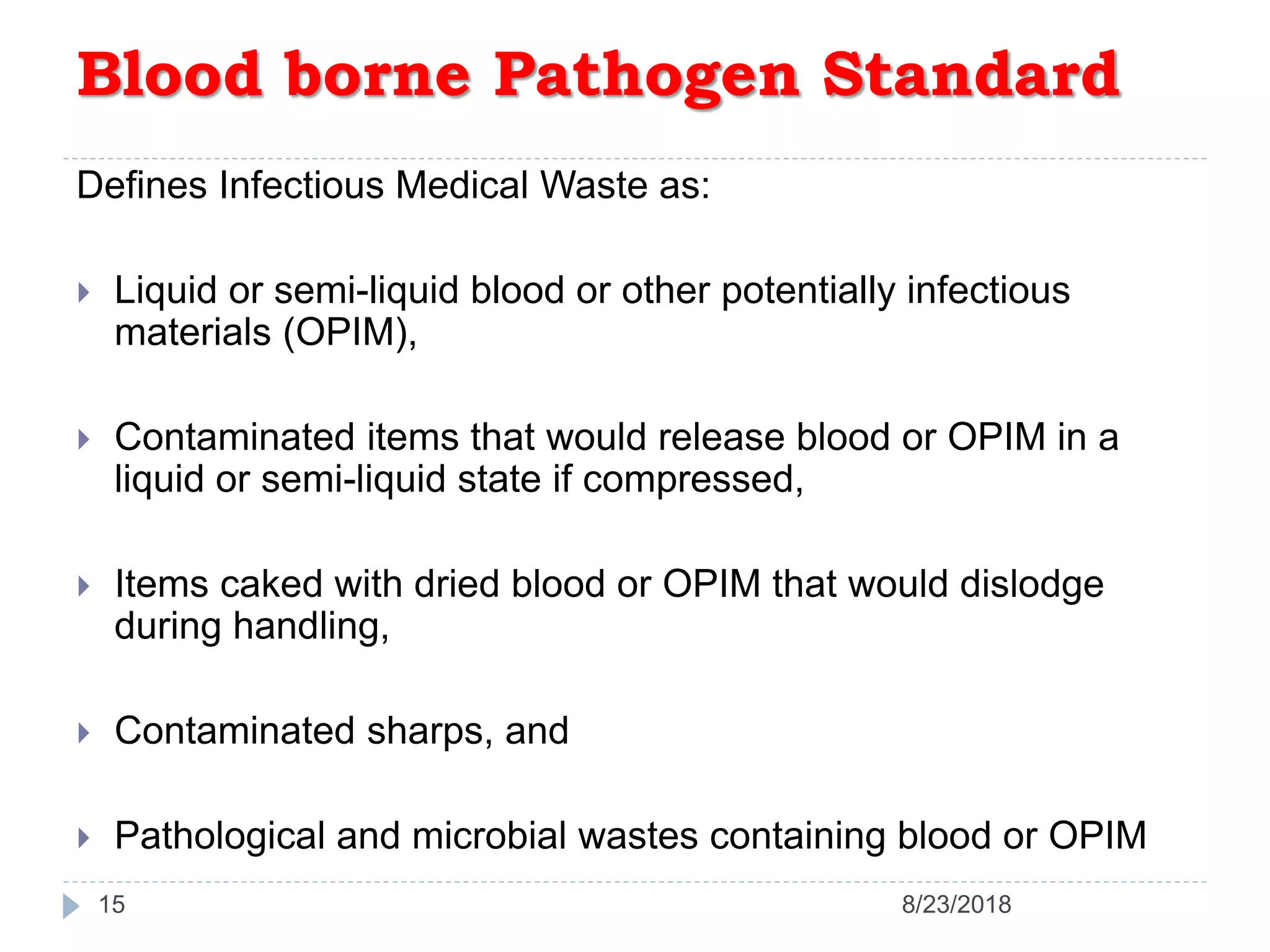
Blood borne Pathogen Standard
Defines Infectious Medical Waste as:
 Liquid or semi-liquid blood or other potentially infectious
materials (OPIM),
 Contaminated items that would release blood or OPIM in a
liquid or semi-liquid state if compressed,
 Items caked with dried blood or OPIM that would dislodge
during handling,
 Contaminated sharps, and
 Pathological and microbial wastes containing blood or OPIM
15 8/23/2018
Other Potentially Infectious Material
OPIM
 Any body fluid with visible blood
 Amniotic fluid
 Cerebrospinal fluid
 Pericardial fluid
 Peritoneal fluid
 Pleural fluid
 Saliva in dental procedures
 Semen/vaginal secretions
 Synovial fluid
16 8/23/2018
Routes of Transmission
By ingestion
(contaminated
unwashed hands,
contaminated food
stuffs, water etc)
Intact or non
intact skin,
mucous
membranes
Inhalation of
dust particles
containing
germs
17 8/23/2018
Transmission of Blood and Fluid
Borne Pathogens
An exposure incident does not guarantee disease
transmission.
Several factors affect transmission:
 Infected Source – the disease stage of the source.
 Means of Entry - severity or depth of the: puncture
wound, broken skin, or direct contact with mucus
membrane.
 Infective Dose - the amount and type of fluid, as well
as the amount of infectious agent in the fluid Blood is
the fluid of greatest concern.
 Susceptible Host - immunocompromised
18 8/23/2018
Blood-borne Pathogens (BBP)
 Blood-borne pathogens (BBP) are specific
microorganisms transmitted in human blood or bodily
fluids, which can cause disease in people.
 There are three major BBPs:
 Hepatitis B (HBV)
 causes inflammation of the liver that might lead to liver
failure
 completely preventable by a vaccine
 Hepatitis C (HCV)
 also causes inflammation of the liver,
 no vaccine to prevent infection
 Human Immunodeficiency Virus (HIV)
 HIV is a human retrovirus that causes AIDS (Acquired
Immune Deficiency Syndrome).
 There is no vaccine to prevent HIV
infection.
19 8/23/2018
Routes of exposure
 Blood-borne Pathogens such as HBV, HCV and HIV are
transmitted through contact with human blood and bodily
fluids.
 Contacts include:
 “Sharps” exposures in occupational settings.
 Sexual activity
 Sharing of needles
 Mother-to-child exposures at birth
20 8/23/2018
Never forget to take Hepatitis B Vaccine
if You are a HCW
Universal (Standard) Precautions
“Precautions to protect against exposure must be
taken when there is any potential for exposure to
bodily fluids. It is assumed that all bodily fluids
have the potential to transmit disease”
The Universal Precaution Rule:
Treat all human blood, bodily fluids and other
potentially infectious materials as if they are
infectious.
22 8/23/2018
Universal Safety Precautions
8/23/201823
Universal Safety Precautions
Medical & Paramedical staff should be
vaccinated against Hepatitis B
Using heavy duty gloves especially
while dealing with infectious wastes
Recapping needles should be
discouraged. In case, if unavoidable
single handed method should be used
24 8/23/2018
 BMW Rules have been adopted and
notified with the objective to stop the
indiscriminate disposal of hospital waste/
bio-medical waste and ensure that such
waste is handled without any adverse
effect on the human health and
environment.
25 8/23/2018
BIO-MEDICAL WASTE (MANAGEMENT &
HANDLING) RULES 1998
Steps for Effective BMW Management
26 8/23/2018
Waste Survey
Waste survey is an important component of
the waste management scheme.
A survey helps in evaluation both the type
and quantity of waste generated in
hospitals.
Aims:
• Differentiate the types of waste.
• Quantify the waste generated.
• Determine the points of generation &
type of waste generated at each point.
• Determine the level of generation &
disinfection within the hospital.
• To find out the type of disposal carried
out.
27 8/23/2018
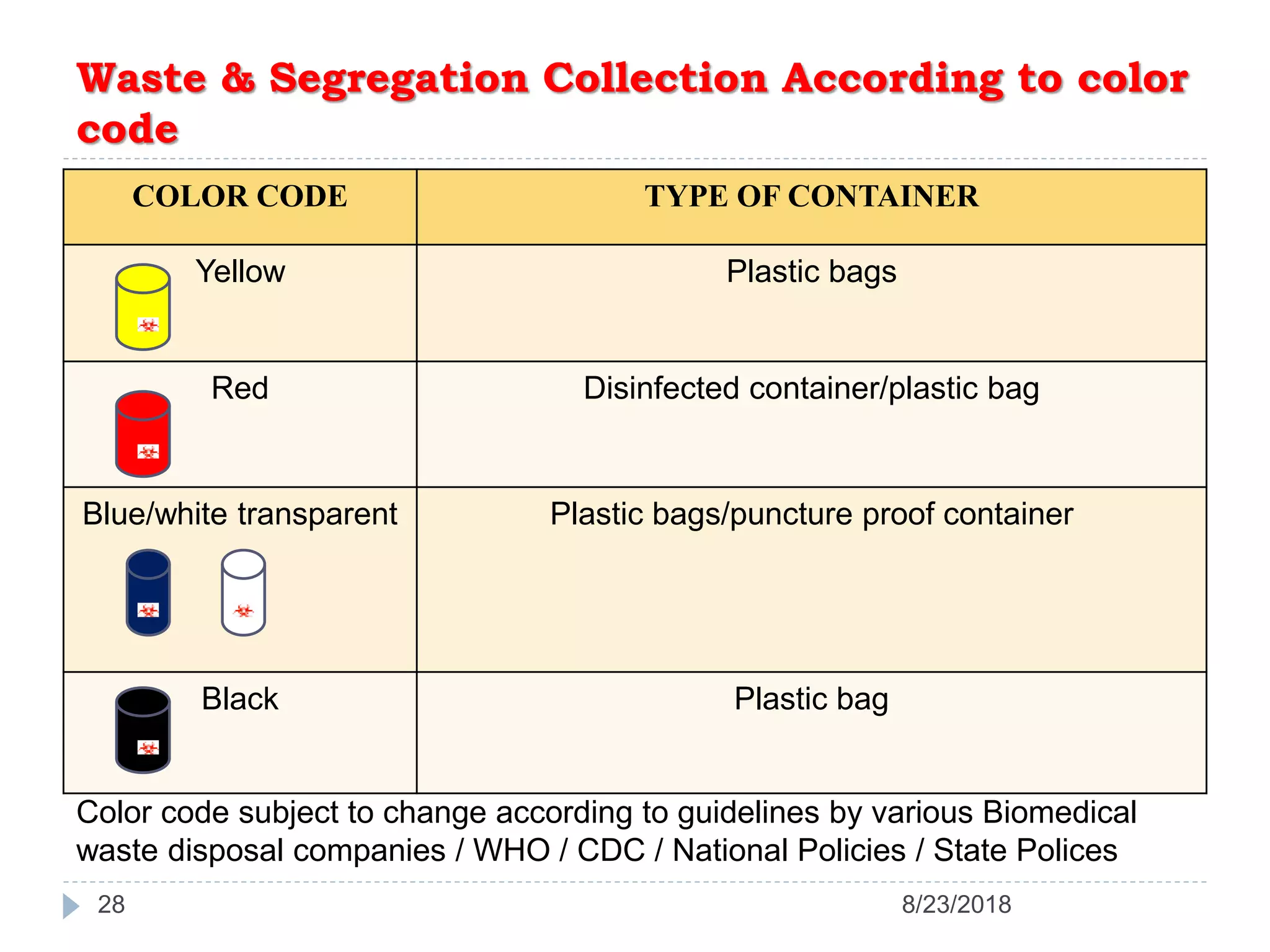
Waste & Segregation Collection According to color
code
8/23/201828
COLOR CODE TYPE OF CONTAINER
Yellow Plastic bags
Red Disinfected container/plastic bag
Blue/white transparent Plastic bags/puncture proof container
Black Plastic bag
Color code subject to change according to guidelines by various Biomedical
waste disposal companies / WHO / CDC / National Policies / State Polices
Segregation
 Segregation refers to the basic separation of different
categories of waste generated at source and thereby reducing
the risks as well as cost of handling and disposal.
 Segregation is the most crucial step in bio-medical waste
management.
 Effective segregation alone can ensure effective bio-medical
waste management.
 The BMWs must be segregated in accordance to guidelines
laid down under schedule 1 of BMW Rules, 1998.
29 8/23/2018
Collection of Infectious Waste
 Infectious medical wastes must be collected at the
point of generation in the appropriate color coded
bags.
 Biohazard bags must be labeled with the
international biohazard symbol and appropriate
wording; “biohazard,” “biomedical waste,” “infectious
medical waste,” or “regulated medical waste”.
30 8/23/2018
Storage
31
Once collection occurs then biomedical
waste is stored in a proper place.
Segregated wastes of different
categories need to be collected in
identifiable containers.
The duration of storage should not
exceed for 8-10 hrs in big hospitals
(more than 250 bedded) and 24 hrs in
nursing homes.
Each container may be clearly labeled to
show the ward or room where it is kept.
8/23/2018
Handling Devices
 Trolleys
 Wheelbarrows
 Channels / Chute - sloping channel through which
things can descend.
32 8/23/2018
Transport
33 8/23/2018
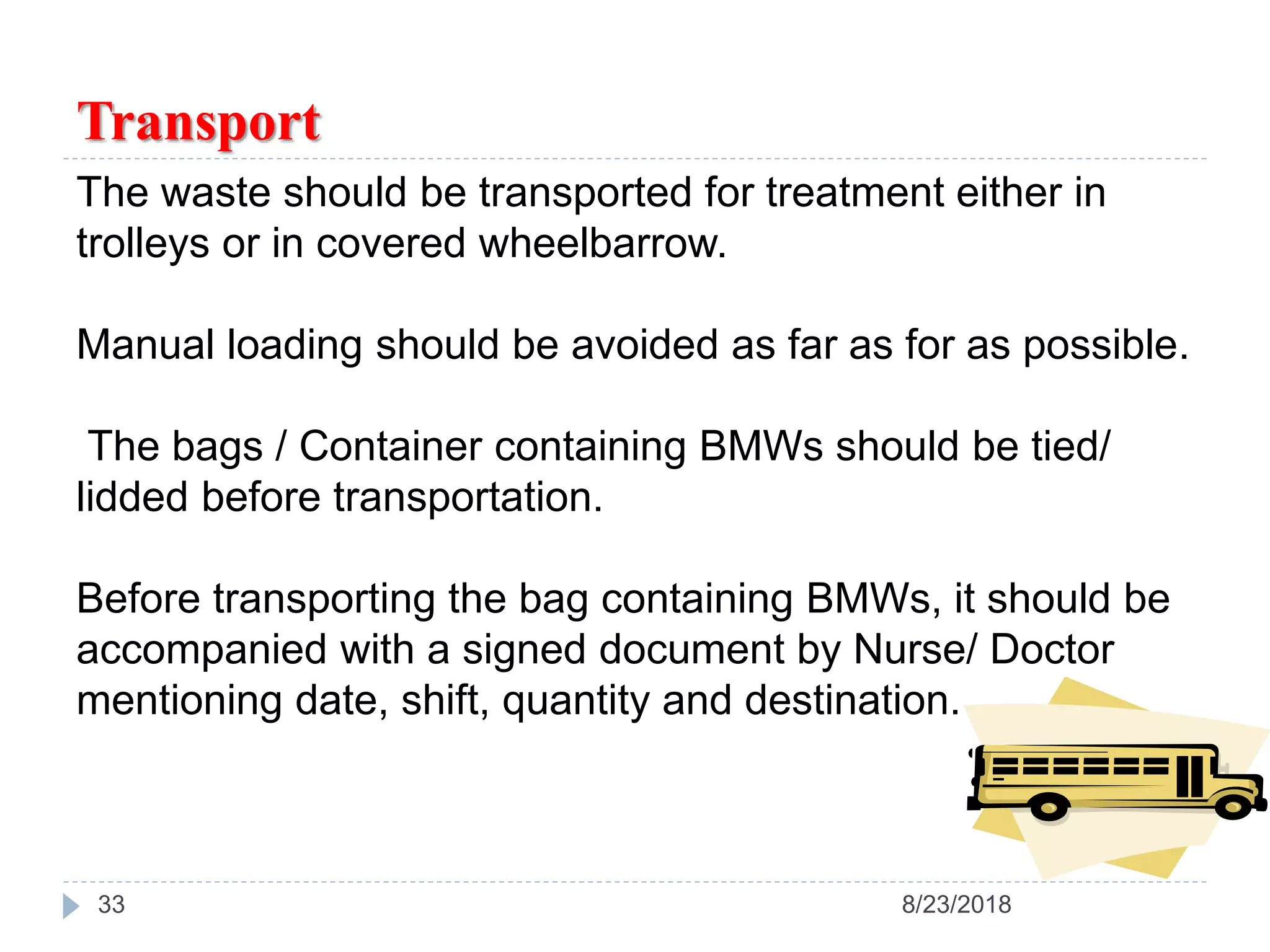
The waste should be transported for treatment either in
trolleys or in covered wheelbarrow.
Manual loading should be avoided as far as for as possible.
The bags / Container containing BMWs should be tied/
lidded before transportation.
Before transporting the bag containing BMWs, it should be
accompanied with a signed document by Nurse/ Doctor
mentioning date, shift, quantity and destination.
Transport
34
Special vehicles must be used so as to prevent access
to, and direct contact with, the waste by the
transportation operators, the scavengers and the public.
The transport containers should be properly enclosed
and the driver must be trained in the procedures he must
follow in case of an accidental spillage.
It should also be possible to wash the interior of the
containers thoroughly.
Chemical Processes
8/23/201835
 These processes use chemical that act as disinfectants.
 Sodium hypochlorite, dissolved chlorine dioxide, per
acetic acid, hydrogen peroxide, dry inorganic chemical
and ozone are examples of such chemical.
Thermal Processes
36 8/23/2018
Autoclaving,
Microwaving,
Incinerator &
Hydroclaving
Mechanical Processes
37 8/23/2018
These processes are used to change the physical form or
characteristics of the waste either to facilitate waste
handling or to process the waste.
The two primary mechanical processes are –
Compaction - used to reduce the volume of the waste.
Shredding - used to destroy plastic and paper waste to
prevent their reuse. Only the disinfected waste can be
used in a shredder.
Irradiation Processes
 Exposes wastes to ultraviolet or ionizing radiation in
an enclosed chamber.
 These systems require post shredding to render the
waste unrecognizable.
38 8/23/2018
Categories of BMW
CATEGORY TYPE OF WASTE TREATMENT &
DISPOSAL
Category 1 Human anatomical wastes Incineration/ deep burial
Category 2 Animal wastes Incineration/ deep burial
Category 3 Microbiology & biotechnology
waste
Local autoclaving/
microwaving/incineratio
n
Category 4 Waste sharps like needles,
syringes, scalpels, blades, glass
etc
Disinfection
(Chemical/autoclaving/m
icro waving &
mutilation/shredding)
Category 5 Discarded Medicines & cytotoxic
drugs
Incineration/destruction
& disposal in land fills
39 8/23/2018
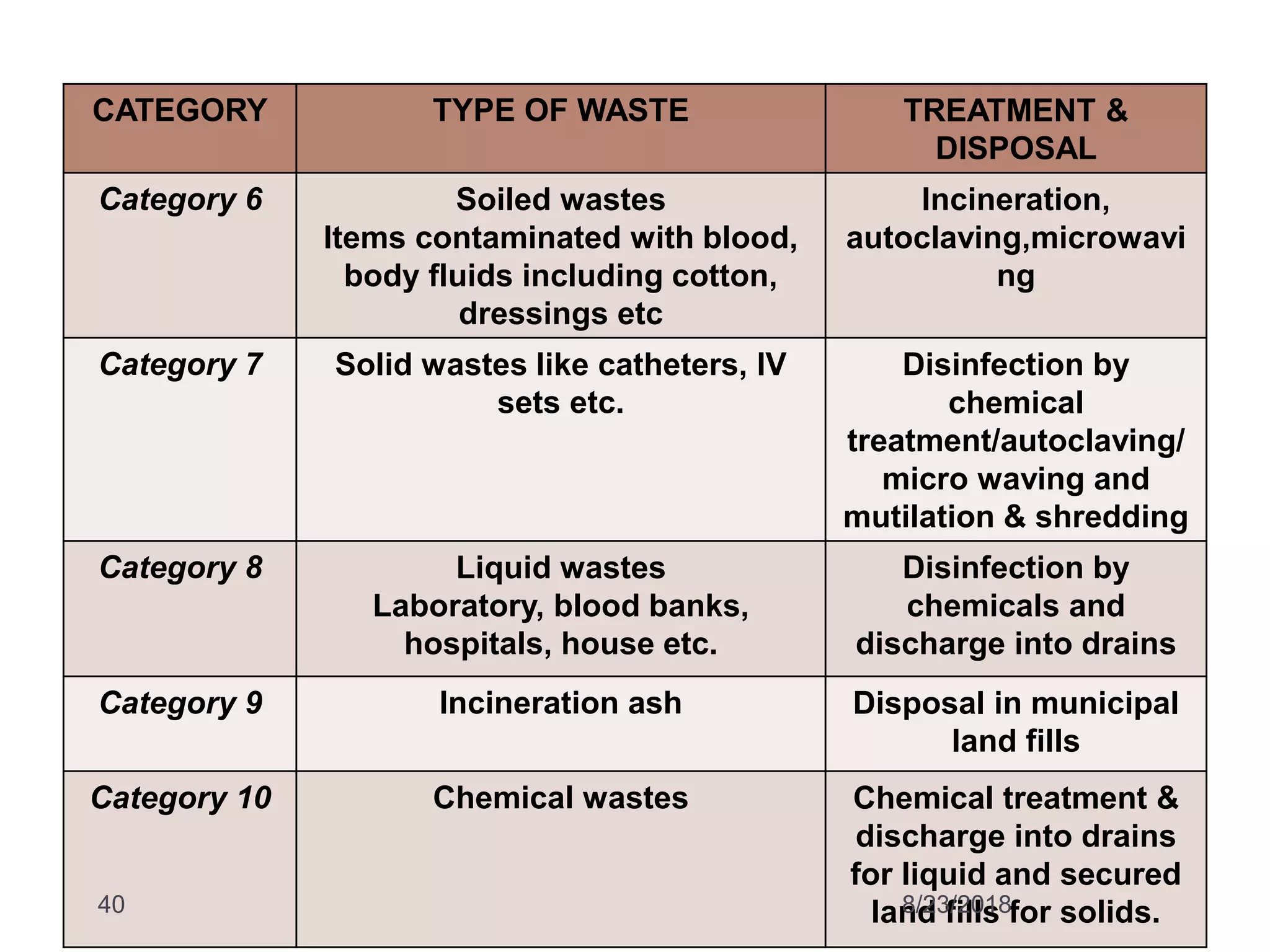
CATEGORY TYPE OF WASTE TREATMENT &
DISPOSAL
Category 6 Soiled wastes
Items contaminated with blood,
body fluids including cotton,
dressings etc
Incineration,
autoclaving,microwavi
ng
Category 7 Solid wastes like catheters, IV
sets etc.
Disinfection by
chemical
treatment/autoclaving/
micro waving and
mutilation & shredding
Category 8 Liquid wastes
Laboratory, blood banks,
hospitals, house etc.
Disinfection by
chemicals and
discharge into drains
Category 9 Incineration ash Disposal in municipal
land fills
Category 10 Chemical wastes Chemical treatment &
discharge into drains
for liquid and secured
land fills for solids.40 8/23/2018
COLOR
CODE
TYPE OF CONTAINER WASTE
CATEGORY
TREATMENT
OPTIONS
Yellow Plastic bags 1, 2, 3 and 6 Incineration/deep burial
Red Disinfected container/plastic
bag
3, 6 & 7 Autoclaving/Micro
Waving/Chemical
treatment
Blue/white
transparent
Plastic bags/puncture proof
container
4 & 7 Autoclaving/Micro
waving/chemical
treatment, Destruction &
shredding
Black Plastic bag 5, 8 & 9 Disposal in secured land
fills
41 8/23/2018
Hopefully as these environmental health hazards
are exposed, changes will be made to protect the
future of our 'Earth' and the living beings that
inhabit it!
42 8/23/2018

Biomedical waste management

  • 1.
    Biomedical Waste Management Mr.Gunjal Prasad N. Assistant Professor Dept. of Microbiology
  • 2.
    Introduction  What isBiomedical Waste ?  Infectious wastes (also called biomedical waste) include –  Human waste,  Animal waste and  Objects and materials contaminated with blood and body fluids containing disease-causing micro-organisms or viruses.  OR 8/23/20182
  • 3.
    What is BiomedicalWaste ?  It is defined as  “Any solid and/or liquid waste including its container and any intermediate product, which is generated during the diagnosis, treatment or immunization of human beings or animals or in research activities pertaining there to or in the production or testing of biologicals and including categories mentioned ”. 8/23/20183
  • 4.
  • 5.
    WHO GENERATES BMW? 5 Waste generated by –  Healthcare facilities  Research facilities  Laboratories 8/23/2018
  • 6.
    What is InfectiousMedical Waste  Infectious Medical Waste is defined as medical waste capable of producing an infectious disease.  Waste is considered Infectious when it is:  Contaminated by an organism that is pathogenic to healthy humans;  The organism is not routinely available in the environment; and  The organism is in significant quantity and capable of transmitting the disease to community. 8/23/20186
  • 7.
    India to Relookinto Safe Practices  Bio-medical or infectious waste has not received its due attention in developing countries like India.  It is being collected and disposed off along with the municipal solid waste (MSW).  Therefore, infectious waste management schemes should be designed carefully by taking in account the correct factors and giving them due weight age. 8/23/20187
  • 8.
  • 9.
    HEALTHCARE WASTE CHARACTERIZATION 9 HealthcareWaste 80% Non- infectious 15% Infectious 5% Hazardous 8/23/2018
  • 10.
    CLASSIFICATION OF HOSPITALWASTE Non-Hazardous Waste Bio- degradable Non bio- degradable Potentially Infectious Waste Dressings, swabs, laboratory wastes, instruments used in patient care.. Potentially Toxic Waste Radioactive Chemical Pharmaceutical 10 8/23/2018
  • 11.
    8/23/201811  According toMinistry of Environment and Forests (MoEF) –  Biomedical waste generated in India / day = 4,05,702 kg.  Off which properly disposed waste is only = 2,91,983/kg/day.  Almost 28% waste is left untreated and not disposed and mixed with community waste ( dump, water bodies).  Karnataka tops the chart in generating Biomedical waste.
  • 12.
    Categories of PersonsExposed to Risk of Infection Sanitation workers Medical & Paramedical staff Patients 12 8/23/2018
  • 13.
    Diseases Caused byBlood borne Pathogens  Malaria  Rabies  Syphilis  Tularemia  Viral Hemorrhagic Fevers  Arbovirus infections  Brucellosis  Creutzfeldt-Jakob Disease  Leptospirosis  HIV / AIDS  Hepatitis B & C 13 8/23/2018
  • 14.
    Can we handle??? 14 8/23/2018
  • 15.
    Blood borne PathogenStandard Defines Infectious Medical Waste as:  Liquid or semi-liquid blood or other potentially infectious materials (OPIM),  Contaminated items that would release blood or OPIM in a liquid or semi-liquid state if compressed,  Items caked with dried blood or OPIM that would dislodge during handling,  Contaminated sharps, and  Pathological and microbial wastes containing blood or OPIM 15 8/23/2018
  • 16.
    Other Potentially InfectiousMaterial OPIM  Any body fluid with visible blood  Amniotic fluid  Cerebrospinal fluid  Pericardial fluid  Peritoneal fluid  Pleural fluid  Saliva in dental procedures  Semen/vaginal secretions  Synovial fluid 16 8/23/2018
  • 17.
    Routes of Transmission Byingestion (contaminated unwashed hands, contaminated food stuffs, water etc) Intact or non intact skin, mucous membranes Inhalation of dust particles containing germs 17 8/23/2018
  • 18.
    Transmission of Bloodand Fluid Borne Pathogens An exposure incident does not guarantee disease transmission. Several factors affect transmission:  Infected Source – the disease stage of the source.  Means of Entry - severity or depth of the: puncture wound, broken skin, or direct contact with mucus membrane.  Infective Dose - the amount and type of fluid, as well as the amount of infectious agent in the fluid Blood is the fluid of greatest concern.  Susceptible Host - immunocompromised 18 8/23/2018
  • 19.
    Blood-borne Pathogens (BBP) Blood-borne pathogens (BBP) are specific microorganisms transmitted in human blood or bodily fluids, which can cause disease in people.  There are three major BBPs:  Hepatitis B (HBV)  causes inflammation of the liver that might lead to liver failure  completely preventable by a vaccine  Hepatitis C (HCV)  also causes inflammation of the liver,  no vaccine to prevent infection  Human Immunodeficiency Virus (HIV)  HIV is a human retrovirus that causes AIDS (Acquired Immune Deficiency Syndrome).  There is no vaccine to prevent HIV infection. 19 8/23/2018
  • 20.
    Routes of exposure Blood-borne Pathogens such as HBV, HCV and HIV are transmitted through contact with human blood and bodily fluids.  Contacts include:  “Sharps” exposures in occupational settings.  Sexual activity  Sharing of needles  Mother-to-child exposures at birth 20 8/23/2018
  • 21.
    Never forget totake Hepatitis B Vaccine if You are a HCW
  • 22.
    Universal (Standard) Precautions “Precautionsto protect against exposure must be taken when there is any potential for exposure to bodily fluids. It is assumed that all bodily fluids have the potential to transmit disease” The Universal Precaution Rule: Treat all human blood, bodily fluids and other potentially infectious materials as if they are infectious. 22 8/23/2018
  • 23.
  • 24.
    Universal Safety Precautions Medical& Paramedical staff should be vaccinated against Hepatitis B Using heavy duty gloves especially while dealing with infectious wastes Recapping needles should be discouraged. In case, if unavoidable single handed method should be used 24 8/23/2018
  • 25.
     BMW Ruleshave been adopted and notified with the objective to stop the indiscriminate disposal of hospital waste/ bio-medical waste and ensure that such waste is handled without any adverse effect on the human health and environment. 25 8/23/2018 BIO-MEDICAL WASTE (MANAGEMENT & HANDLING) RULES 1998
  • 26.
    Steps for EffectiveBMW Management 26 8/23/2018
  • 27.
    Waste Survey Waste surveyis an important component of the waste management scheme. A survey helps in evaluation both the type and quantity of waste generated in hospitals. Aims: • Differentiate the types of waste. • Quantify the waste generated. • Determine the points of generation & type of waste generated at each point. • Determine the level of generation & disinfection within the hospital. • To find out the type of disposal carried out. 27 8/23/2018
  • 28.
    Waste & SegregationCollection According to color code 8/23/201828 COLOR CODE TYPE OF CONTAINER Yellow Plastic bags Red Disinfected container/plastic bag Blue/white transparent Plastic bags/puncture proof container Black Plastic bag Color code subject to change according to guidelines by various Biomedical waste disposal companies / WHO / CDC / National Policies / State Polices
  • 29.
    Segregation  Segregation refersto the basic separation of different categories of waste generated at source and thereby reducing the risks as well as cost of handling and disposal.  Segregation is the most crucial step in bio-medical waste management.  Effective segregation alone can ensure effective bio-medical waste management.  The BMWs must be segregated in accordance to guidelines laid down under schedule 1 of BMW Rules, 1998. 29 8/23/2018
  • 30.
    Collection of InfectiousWaste  Infectious medical wastes must be collected at the point of generation in the appropriate color coded bags.  Biohazard bags must be labeled with the international biohazard symbol and appropriate wording; “biohazard,” “biomedical waste,” “infectious medical waste,” or “regulated medical waste”. 30 8/23/2018
  • 31.
    Storage 31 Once collection occursthen biomedical waste is stored in a proper place. Segregated wastes of different categories need to be collected in identifiable containers. The duration of storage should not exceed for 8-10 hrs in big hospitals (more than 250 bedded) and 24 hrs in nursing homes. Each container may be clearly labeled to show the ward or room where it is kept. 8/23/2018
  • 32.
    Handling Devices  Trolleys Wheelbarrows  Channels / Chute - sloping channel through which things can descend. 32 8/23/2018
  • 33.
    Transport 33 8/23/2018 The wasteshould be transported for treatment either in trolleys or in covered wheelbarrow. Manual loading should be avoided as far as for as possible. The bags / Container containing BMWs should be tied/ lidded before transportation. Before transporting the bag containing BMWs, it should be accompanied with a signed document by Nurse/ Doctor mentioning date, shift, quantity and destination.
  • 34.
    Transport 34 Special vehicles mustbe used so as to prevent access to, and direct contact with, the waste by the transportation operators, the scavengers and the public. The transport containers should be properly enclosed and the driver must be trained in the procedures he must follow in case of an accidental spillage. It should also be possible to wash the interior of the containers thoroughly.
  • 35.
    Chemical Processes 8/23/201835  Theseprocesses use chemical that act as disinfectants.  Sodium hypochlorite, dissolved chlorine dioxide, per acetic acid, hydrogen peroxide, dry inorganic chemical and ozone are examples of such chemical.
  • 36.
  • 37.
    Mechanical Processes 37 8/23/2018 Theseprocesses are used to change the physical form or characteristics of the waste either to facilitate waste handling or to process the waste. The two primary mechanical processes are – Compaction - used to reduce the volume of the waste. Shredding - used to destroy plastic and paper waste to prevent their reuse. Only the disinfected waste can be used in a shredder.
  • 38.
    Irradiation Processes  Exposeswastes to ultraviolet or ionizing radiation in an enclosed chamber.  These systems require post shredding to render the waste unrecognizable. 38 8/23/2018
  • 39.
    Categories of BMW CATEGORYTYPE OF WASTE TREATMENT & DISPOSAL Category 1 Human anatomical wastes Incineration/ deep burial Category 2 Animal wastes Incineration/ deep burial Category 3 Microbiology & biotechnology waste Local autoclaving/ microwaving/incineratio n Category 4 Waste sharps like needles, syringes, scalpels, blades, glass etc Disinfection (Chemical/autoclaving/m icro waving & mutilation/shredding) Category 5 Discarded Medicines & cytotoxic drugs Incineration/destruction & disposal in land fills 39 8/23/2018
  • 40.
    CATEGORY TYPE OFWASTE TREATMENT & DISPOSAL Category 6 Soiled wastes Items contaminated with blood, body fluids including cotton, dressings etc Incineration, autoclaving,microwavi ng Category 7 Solid wastes like catheters, IV sets etc. Disinfection by chemical treatment/autoclaving/ micro waving and mutilation & shredding Category 8 Liquid wastes Laboratory, blood banks, hospitals, house etc. Disinfection by chemicals and discharge into drains Category 9 Incineration ash Disposal in municipal land fills Category 10 Chemical wastes Chemical treatment & discharge into drains for liquid and secured land fills for solids.40 8/23/2018
  • 41.
    COLOR CODE TYPE OF CONTAINERWASTE CATEGORY TREATMENT OPTIONS Yellow Plastic bags 1, 2, 3 and 6 Incineration/deep burial Red Disinfected container/plastic bag 3, 6 & 7 Autoclaving/Micro Waving/Chemical treatment Blue/white transparent Plastic bags/puncture proof container 4 & 7 Autoclaving/Micro waving/chemical treatment, Destruction & shredding Black Plastic bag 5, 8 & 9 Disposal in secured land fills 41 8/23/2018
  • 42.
    Hopefully as theseenvironmental health hazards are exposed, changes will be made to protect the future of our 'Earth' and the living beings that inhabit it! 42 8/23/2018