
Biomedical waste
management
Anju Rana
• BIOMEDICAL WASTE MANAGEMENT
Bio medical waste (BMW) is generated in the form of solid,
liquid or tissues from humans or animal origin.
It also includes containers, packings or any other product
generated while short term or long term patient care like
observational, diagnostic, therapeutic or rehabilitative
services provided to a person who is suffering or is
suspected to be suffering from some disease or injury.
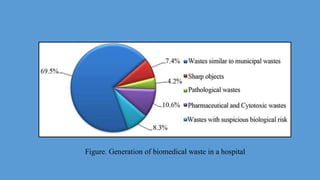
Figure. Generation of biomedical waste in a hospital
Biomedical waste includes the waste originating from
minor or scattered sources such as that produced in the
course of health care undertaken at the home e.g.
dialysis, insulin injections, etc.
The management of biomedical waste is a crucial challenge
faced by all hospitals.
With expansion of health care facilities as well as the recent
trend of using disposables there has been increase in burden of
health care related waste.
Since the last three decades, unregulated handling of biomedical
waste is emerging as a serious threat to human health and
safety.
If bio-medical waste is not managed properly, it could cause
environmental, occupational and public health hazard.
Environmental Hazard
Inappropriate treatment and disposal of bio-medical
waste contributes to environmental pollution,
uncontrolled incineration causes air pollution, dumping
in tanks and other water sources cause water pollution
and unscientific land filling causes soil pollution.
Occupational Hazard
It is a risk to all those who generate, collect, segregate,
handle, package, store, transport, treat and dispose
biomedical waste. Children and rag pickers are
particularly at risk who come in contact with infectious
waste. Occupational exposure to blood can result from
percutaneous injury
Public Health Hazard
Poor management of bio-medical waste can cause
serious disease to health-care personnel, to waste
workers, patients and to the general public. The greatest
risk posed by infectious waste is accidental needle stick
injuries, which can cause hepatitis B and hepatitis C and
HIV infection.
Why do we need to manage BMW
With the introduction of Biomedical Waste Management and
Handling Rules, 1998 and emergence of various diseases due to
mismanagement of bio-medical waste, it has become important
in health care settings to manage the waste properly. The concern
over human immunodeficiency virus (HIV), transmission of
hepatitis B virus (HBV) and other blood borne infections has led
to an increased professional and environmental concern towards
this issue.
Universal precautions followed in BMWM
 Assume that all patients and specimens are a potential source of infections like HIV,
HBV and other blood borne microorganisms.
 There should not be leakage while storing body fluids and blood samples. Care must
be taken to place these in leak-proof impervious bag or containers for transportation
to the labs from the site of collection.
 Use gloves while handling blood, body fluids and other suspected infectious samples.
To avoid splashes or spattering use face masks, gloves and goggles.
 The personal protective equipment like laboratory coat should be worn by the person
handling specimens. The laboratory coat should not be taken out of the laboratory.
 Biological safety hoods should be used for laboratory works.
 Mechanical pipetting devices should be used for making various dilutions or working
with infectious materials. Pipetting by mouth must not be tried.
 After finishing the procedures and experiments with laboratory samples,
decontaminate the surfaces with an appropriate disinfectant.
 Limit use of needles and syringes to situations for which there is no alternative left.
 Before sending contaminated material of the labs for disposal or reprocessing, it
should be decontaminated.
 Wash hands after completing lab work and remove PPE before leaving the laboratory.
Identify the source of waste generation
The first step is to identify the areas of waste
generation in the hospitals. In almost all the units i.e.
out-patient, wards, operation theatre, labour room,
pathology labs, intensive care units etc., waste is
generated, the only difference is in quantity and
category.
Categorisation
The second step is to categorize the waste according to
Bio-Medical Waste management and handling Rules.
The categorisation helps in placing the different bins
with coloured codes at the appropriate places as close to
the waste generation site as possible.
Category 1: The anatomical waste such as human tissues, organs and
body parts.
Category 2: Waste generated in animal houses and veterinary hospitals,
colleges and clinics like animal tissues, organs, body parts, fluid, blood.
The tissues and carcases are also generated as waste during research.
Category 3: Microbiology and biotechnology waste like wastes from
laboratory cultures, stocks or specimens of bacteria, live or attenuated
vaccines, cell cultures, wastes from production of toxins, vaccine and
sera from institutes, dishes and devices used in the labs, pharmaceutical
industries and hospitals.
Category 4: Waste Sharps both used and unused needles, syringes, scalpels, blades, glass, etc.
that may cause puncture and cuts.
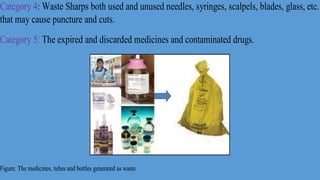
Category 5: The expired and discarded medicines and contaminated drugs.
Figure. The medicines, tubes and bottles generated as waste
Category 6: Soiled Waste such as items contaminated with blood and
body fluid including cotton, and dressings; soiled plaster casts, linens,
bedding, other material contaminated with blood.
Category 7: Solid wastes like waste generated from disposable item
other than waste sharp such as tubings, catheters, intravenous sets etc.
Category 8: Liquid Waste such as waste generated from laboratory and
washing, cleaning, housekeeping and disinfection activities.
Category 9: Incineration ash from any biomedical waste.
Category 10: Chemical waste from the chemicals utilised in
production of biologicals, insecticides and disinfectants used in a
healthcare setting.
Segregation
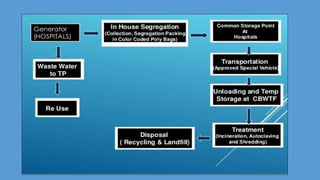
The segregation of waste generated in a hospital is a
very important factor in bio-medical waste
management system. Depending on the categories of
biomedical waste, specific colour coded containers are
used for proper segregation and storage of wastes for
further appropriate treatment and disposal.
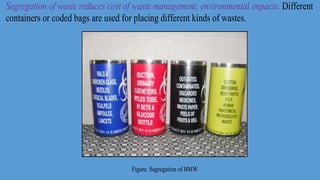
Segregation of waste reduces cost of waste management, environmental impacts. Different
containers or coded bags are used for placing different kinds of wastes.
Figure. Segregation of BMW
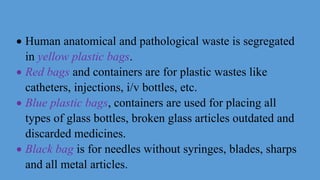
 Human anatomical and pathological waste is segregated
in yellow plastic bags.
 Red bags and containers are for plastic wastes like
catheters, injections, i/v bottles, etc.
 Blue plastic bags, containers are used for placing all
types of glass bottles, broken glass articles outdated and
discarded medicines.
 Black bag is for needles without syringes, blades, sharps
and all metal articles.
Handling of BMW
The bio-medical waste should be segregated into colour
coded containers, bins, bags as soon as it is generated.
When these containers are three quarter full, the bags
should be picked up from the neck and placed in the
trolley and should be transported to the temporary storage
area or waste disposal sites. Manual handling of waste
bags should be minimized to reduce the risk of needle
prick injury and infection.
On-site biomedical waste disposal
Autoclave: This is mostly used in laboratories and clinics
for treating infectious wastes being generated in clinical
and research labs. It is a process of steam sterilization
under pressure. When steam comes in contact with the
waste material it kills the infectious microorganisms.
Microbiological and biotechnological waste, waste sharps,
soiled and solid waste is treated in an autoclave.
Chemical treatment: It is a useful method to deactivate liquid waste
and is useful in small places like clinics. Depending on the type of
waste various chemicals can be used for treatment of waste like
chlorine, sodium hydroxide or calcium hydroxide.
Microwave treatment: Microwaves of the frequency of about 2450
MHz are used to decontaminate medical waste. The waste to be
treated must be humid as in presence of moisture microwaves
penetrate and sterilises the material. Before starting the process,
medical waste is changed into shreds and mixed with water to
moisten it. Microwaving is suitable for the treatment of most
infectious waste with the exception of body parts and large metallic
items.
Off- site biomedical waste disposal
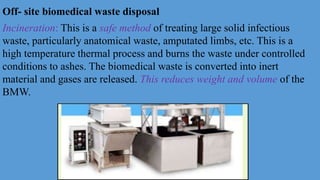
Incineration: This is a safe method of treating large solid infectious
waste, particularly anatomical waste, amputated limbs, etc. This is a
high temperature thermal process and burns the waste under controlled
conditions to ashes. The biomedical waste is converted into inert
material and gases are released. This reduces weight and volume of the
BMW.
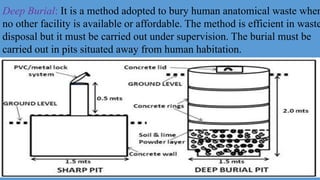
Deep Burial: It is a method adopted to bury human anatomical waste when
no other facility is available or affordable. The method is efficient in waste
disposal but it must be carried out under supervision. The burial must be
carried out in pits situated away from human habitation.
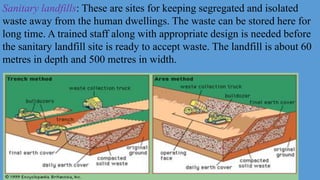
Sanitary landfills: These are sites for keeping segregated and isolated
waste away from the human dwellings. The waste can be stored here for
long time. A trained staff along with appropriate design is needed before
the sanitary landfill site is ready to accept waste. The landfill is about 60
metres in depth and 500 metres in width.
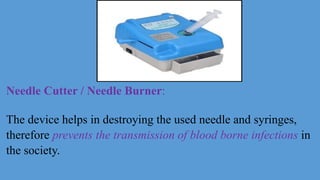
Needle Cutter / Needle Burner:
The device helps in destroying the used needle and syringes,
therefore prevents the transmission of blood borne infections in
the society.
Disinfection of Waste in BMW
Disinfection is an important phenomena in bio-medical waste
management. The aim of disinfection is to eliminate
microorganisms or at least reduce their numbers to a
satisfactory level.
However, selection of disinfectants depends not only on their
effectiveness, but also on their corrosiveness and other
hazards related to their handling.
The types of chemicals used for disinfection of health-care
waste are mostly aldehydes, chlorine compounds, ammonium
salts and phenolic compounds.
Points to remember while managing biomedical waste:
1. Generate waste when it is essential.
2. Segregate waste as soon as it is generated and segregate at the point of
generation into specific categories of waste in specific colour coded
covered bins.
3. Clean the bins regularly with soap and water or disinfectant.
4. Collect the domestic waste/eatables, wrappers, fruit peels, papers etc.,
in green bin.
5. Carry/transport the waste in closed containers.
6. Transport waste through a pre-defined route within the hospital.
7. Mutilate the needle soon after injection.
8. Mutilate plastic waste as soon as it is generated.
9. Disinfect needle and solid waste (plastic) after mutilation.
10. Dispose body parts in yellow bin. If Common Bio-Medical Waste
Treatment Facility is available, hand over to them within 48 hours,
otherwise dispose by incineration or deep burial where population is less
than five lakhs people.
11. Waste sharps should be kept in white translucent bin, ¾ filled with
disinfectant solution.
12. Avoid incinerator for individual establishment.
Role of nurse
A nurse plays a significant role in bio-medical waste
management. A nurse has to determine and implement the
desired standards of any institution. She/he has to work in
coordination with waste management programme of the
healthcare facilities. Collection and disposal of hospital waste is
based on scientific principles. For a proper management of the
biomedical waste a nurse has to follow certain guidelines.
Contd……
1.The head nurse should keep an inventory of materials required such
as bags, bins, containers, mutilating aids, protective aids etc. and
check for the adequate supply.
2.Nursing staff should ensure that waste bags are tightly closed or
sealed when they are about 3/4 full.
3.Matron or senior nursing officer is responsible for training new
nurses and medical assistants in good bio-medical waste handling.
Staff nurse is a first level professional nurse who provides
direct patient care or group of patients assigned to her / him
during duty shift and assist in management of wards / units /
special departments etc. In the whole process a lots of
biomedical waste is generated like wrappers of medicines,
injections, syringes, cotton, plasters, etc.
1.She should see that the reusable items must be disinfected, cleaned,
repacked and sent for sterilisation.
2.Infected material should be discarded and incinerated wherever
possible.
3.Floor wise, one nursing supervisor is responsible for supervision of
segregation. She should perform duty with responsibility.
4. Staff nurse is a first level professional nurse who provides direct
patient care or group of patients assigned to her / him during duty
shift and assist in management of wards / units / special departments
etc. In the whole process a lots of biomedical waste is generated like
wrappers of medicines, injections, syringes, cotton, plasters, etc.
5. The nursing staff must be trained in safe handling of waste and its
procedures.
6. Adherence to the universal precautions while performing surgical
and instrumentation procedures is also very helpful and the
biomedical waste generated should be disposed of according to the
hospital policies.
Thank You

Biomedical waste management ppt

  • 1.
  • 2.
    • BIOMEDICAL WASTEMANAGEMENT Bio medical waste (BMW) is generated in the form of solid, liquid or tissues from humans or animal origin. It also includes containers, packings or any other product generated while short term or long term patient care like observational, diagnostic, therapeutic or rehabilitative services provided to a person who is suffering or is suspected to be suffering from some disease or injury.
  • 3.
    Figure. Generation ofbiomedical waste in a hospital
  • 4.
    Biomedical waste includesthe waste originating from minor or scattered sources such as that produced in the course of health care undertaken at the home e.g. dialysis, insulin injections, etc.
  • 5.
    The management ofbiomedical waste is a crucial challenge faced by all hospitals. With expansion of health care facilities as well as the recent trend of using disposables there has been increase in burden of health care related waste. Since the last three decades, unregulated handling of biomedical waste is emerging as a serious threat to human health and safety. If bio-medical waste is not managed properly, it could cause environmental, occupational and public health hazard.
  • 6.
    Environmental Hazard Inappropriate treatmentand disposal of bio-medical waste contributes to environmental pollution, uncontrolled incineration causes air pollution, dumping in tanks and other water sources cause water pollution and unscientific land filling causes soil pollution.
  • 7.
    Occupational Hazard It isa risk to all those who generate, collect, segregate, handle, package, store, transport, treat and dispose biomedical waste. Children and rag pickers are particularly at risk who come in contact with infectious waste. Occupational exposure to blood can result from percutaneous injury
  • 8.
    Public Health Hazard Poormanagement of bio-medical waste can cause serious disease to health-care personnel, to waste workers, patients and to the general public. The greatest risk posed by infectious waste is accidental needle stick injuries, which can cause hepatitis B and hepatitis C and HIV infection.
  • 9.
    Why do weneed to manage BMW With the introduction of Biomedical Waste Management and Handling Rules, 1998 and emergence of various diseases due to mismanagement of bio-medical waste, it has become important in health care settings to manage the waste properly. The concern over human immunodeficiency virus (HIV), transmission of hepatitis B virus (HBV) and other blood borne infections has led to an increased professional and environmental concern towards this issue.
  • 10.
    Universal precautions followedin BMWM  Assume that all patients and specimens are a potential source of infections like HIV, HBV and other blood borne microorganisms.  There should not be leakage while storing body fluids and blood samples. Care must be taken to place these in leak-proof impervious bag or containers for transportation to the labs from the site of collection.  Use gloves while handling blood, body fluids and other suspected infectious samples. To avoid splashes or spattering use face masks, gloves and goggles.  The personal protective equipment like laboratory coat should be worn by the person handling specimens. The laboratory coat should not be taken out of the laboratory.  Biological safety hoods should be used for laboratory works.  Mechanical pipetting devices should be used for making various dilutions or working with infectious materials. Pipetting by mouth must not be tried.  After finishing the procedures and experiments with laboratory samples, decontaminate the surfaces with an appropriate disinfectant.  Limit use of needles and syringes to situations for which there is no alternative left.  Before sending contaminated material of the labs for disposal or reprocessing, it should be decontaminated.  Wash hands after completing lab work and remove PPE before leaving the laboratory.
  • 11.
    Identify the sourceof waste generation The first step is to identify the areas of waste generation in the hospitals. In almost all the units i.e. out-patient, wards, operation theatre, labour room, pathology labs, intensive care units etc., waste is generated, the only difference is in quantity and category.
  • 13.
    Categorisation The second stepis to categorize the waste according to Bio-Medical Waste management and handling Rules. The categorisation helps in placing the different bins with coloured codes at the appropriate places as close to the waste generation site as possible.
  • 14.
    Category 1: Theanatomical waste such as human tissues, organs and body parts. Category 2: Waste generated in animal houses and veterinary hospitals, colleges and clinics like animal tissues, organs, body parts, fluid, blood. The tissues and carcases are also generated as waste during research. Category 3: Microbiology and biotechnology waste like wastes from laboratory cultures, stocks or specimens of bacteria, live or attenuated vaccines, cell cultures, wastes from production of toxins, vaccine and sera from institutes, dishes and devices used in the labs, pharmaceutical industries and hospitals.
  • 15.
    Category 4: WasteSharps both used and unused needles, syringes, scalpels, blades, glass, etc. that may cause puncture and cuts. Category 5: The expired and discarded medicines and contaminated drugs. Figure. The medicines, tubes and bottles generated as waste
  • 16.
    Category 6: SoiledWaste such as items contaminated with blood and body fluid including cotton, and dressings; soiled plaster casts, linens, bedding, other material contaminated with blood. Category 7: Solid wastes like waste generated from disposable item other than waste sharp such as tubings, catheters, intravenous sets etc. Category 8: Liquid Waste such as waste generated from laboratory and washing, cleaning, housekeeping and disinfection activities. Category 9: Incineration ash from any biomedical waste. Category 10: Chemical waste from the chemicals utilised in production of biologicals, insecticides and disinfectants used in a healthcare setting.
  • 17.
    Segregation The segregation ofwaste generated in a hospital is a very important factor in bio-medical waste management system. Depending on the categories of biomedical waste, specific colour coded containers are used for proper segregation and storage of wastes for further appropriate treatment and disposal.
  • 18.
    Segregation of wastereduces cost of waste management, environmental impacts. Different containers or coded bags are used for placing different kinds of wastes. Figure. Segregation of BMW
  • 19.
     Human anatomicaland pathological waste is segregated in yellow plastic bags.  Red bags and containers are for plastic wastes like catheters, injections, i/v bottles, etc.  Blue plastic bags, containers are used for placing all types of glass bottles, broken glass articles outdated and discarded medicines.  Black bag is for needles without syringes, blades, sharps and all metal articles.
  • 20.
    Handling of BMW Thebio-medical waste should be segregated into colour coded containers, bins, bags as soon as it is generated. When these containers are three quarter full, the bags should be picked up from the neck and placed in the trolley and should be transported to the temporary storage area or waste disposal sites. Manual handling of waste bags should be minimized to reduce the risk of needle prick injury and infection.
  • 21.
    On-site biomedical wastedisposal Autoclave: This is mostly used in laboratories and clinics for treating infectious wastes being generated in clinical and research labs. It is a process of steam sterilization under pressure. When steam comes in contact with the waste material it kills the infectious microorganisms. Microbiological and biotechnological waste, waste sharps, soiled and solid waste is treated in an autoclave.
  • 22.
    Chemical treatment: Itis a useful method to deactivate liquid waste and is useful in small places like clinics. Depending on the type of waste various chemicals can be used for treatment of waste like chlorine, sodium hydroxide or calcium hydroxide. Microwave treatment: Microwaves of the frequency of about 2450 MHz are used to decontaminate medical waste. The waste to be treated must be humid as in presence of moisture microwaves penetrate and sterilises the material. Before starting the process, medical waste is changed into shreds and mixed with water to moisten it. Microwaving is suitable for the treatment of most infectious waste with the exception of body parts and large metallic items.
  • 23.
    Off- site biomedicalwaste disposal Incineration: This is a safe method of treating large solid infectious waste, particularly anatomical waste, amputated limbs, etc. This is a high temperature thermal process and burns the waste under controlled conditions to ashes. The biomedical waste is converted into inert material and gases are released. This reduces weight and volume of the BMW.
  • 24.
    Deep Burial: Itis a method adopted to bury human anatomical waste when no other facility is available or affordable. The method is efficient in waste disposal but it must be carried out under supervision. The burial must be carried out in pits situated away from human habitation.
  • 25.
    Sanitary landfills: Theseare sites for keeping segregated and isolated waste away from the human dwellings. The waste can be stored here for long time. A trained staff along with appropriate design is needed before the sanitary landfill site is ready to accept waste. The landfill is about 60 metres in depth and 500 metres in width.
  • 26.
    Needle Cutter /Needle Burner: The device helps in destroying the used needle and syringes, therefore prevents the transmission of blood borne infections in the society.
  • 27.
    Disinfection of Wastein BMW Disinfection is an important phenomena in bio-medical waste management. The aim of disinfection is to eliminate microorganisms or at least reduce their numbers to a satisfactory level. However, selection of disinfectants depends not only on their effectiveness, but also on their corrosiveness and other hazards related to their handling. The types of chemicals used for disinfection of health-care waste are mostly aldehydes, chlorine compounds, ammonium salts and phenolic compounds.
  • 28.
    Points to rememberwhile managing biomedical waste: 1. Generate waste when it is essential. 2. Segregate waste as soon as it is generated and segregate at the point of generation into specific categories of waste in specific colour coded covered bins. 3. Clean the bins regularly with soap and water or disinfectant. 4. Collect the domestic waste/eatables, wrappers, fruit peels, papers etc., in green bin. 5. Carry/transport the waste in closed containers. 6. Transport waste through a pre-defined route within the hospital.
  • 29.
    7. Mutilate theneedle soon after injection. 8. Mutilate plastic waste as soon as it is generated. 9. Disinfect needle and solid waste (plastic) after mutilation. 10. Dispose body parts in yellow bin. If Common Bio-Medical Waste Treatment Facility is available, hand over to them within 48 hours, otherwise dispose by incineration or deep burial where population is less than five lakhs people. 11. Waste sharps should be kept in white translucent bin, ¾ filled with disinfectant solution. 12. Avoid incinerator for individual establishment.
  • 30.
    Role of nurse Anurse plays a significant role in bio-medical waste management. A nurse has to determine and implement the desired standards of any institution. She/he has to work in coordination with waste management programme of the healthcare facilities. Collection and disposal of hospital waste is based on scientific principles. For a proper management of the biomedical waste a nurse has to follow certain guidelines. Contd……
  • 31.
    1.The head nurseshould keep an inventory of materials required such as bags, bins, containers, mutilating aids, protective aids etc. and check for the adequate supply. 2.Nursing staff should ensure that waste bags are tightly closed or sealed when they are about 3/4 full. 3.Matron or senior nursing officer is responsible for training new nurses and medical assistants in good bio-medical waste handling.
  • 32.
    Staff nurse isa first level professional nurse who provides direct patient care or group of patients assigned to her / him during duty shift and assist in management of wards / units / special departments etc. In the whole process a lots of biomedical waste is generated like wrappers of medicines, injections, syringes, cotton, plasters, etc.
  • 33.
    1.She should seethat the reusable items must be disinfected, cleaned, repacked and sent for sterilisation. 2.Infected material should be discarded and incinerated wherever possible. 3.Floor wise, one nursing supervisor is responsible for supervision of segregation. She should perform duty with responsibility.
  • 34.
    4. Staff nurseis a first level professional nurse who provides direct patient care or group of patients assigned to her / him during duty shift and assist in management of wards / units / special departments etc. In the whole process a lots of biomedical waste is generated like wrappers of medicines, injections, syringes, cotton, plasters, etc. 5. The nursing staff must be trained in safe handling of waste and its procedures. 6. Adherence to the universal precautions while performing surgical and instrumentation procedures is also very helpful and the biomedical waste generated should be disposed of according to the hospital policies.
  • 35.