02/04/18
1
BIO MEDICAL WASTE
MANAGEMENT
DEEPAK CHAUDHARY
Senior Demonstrator
GMC AMBIKAPUR
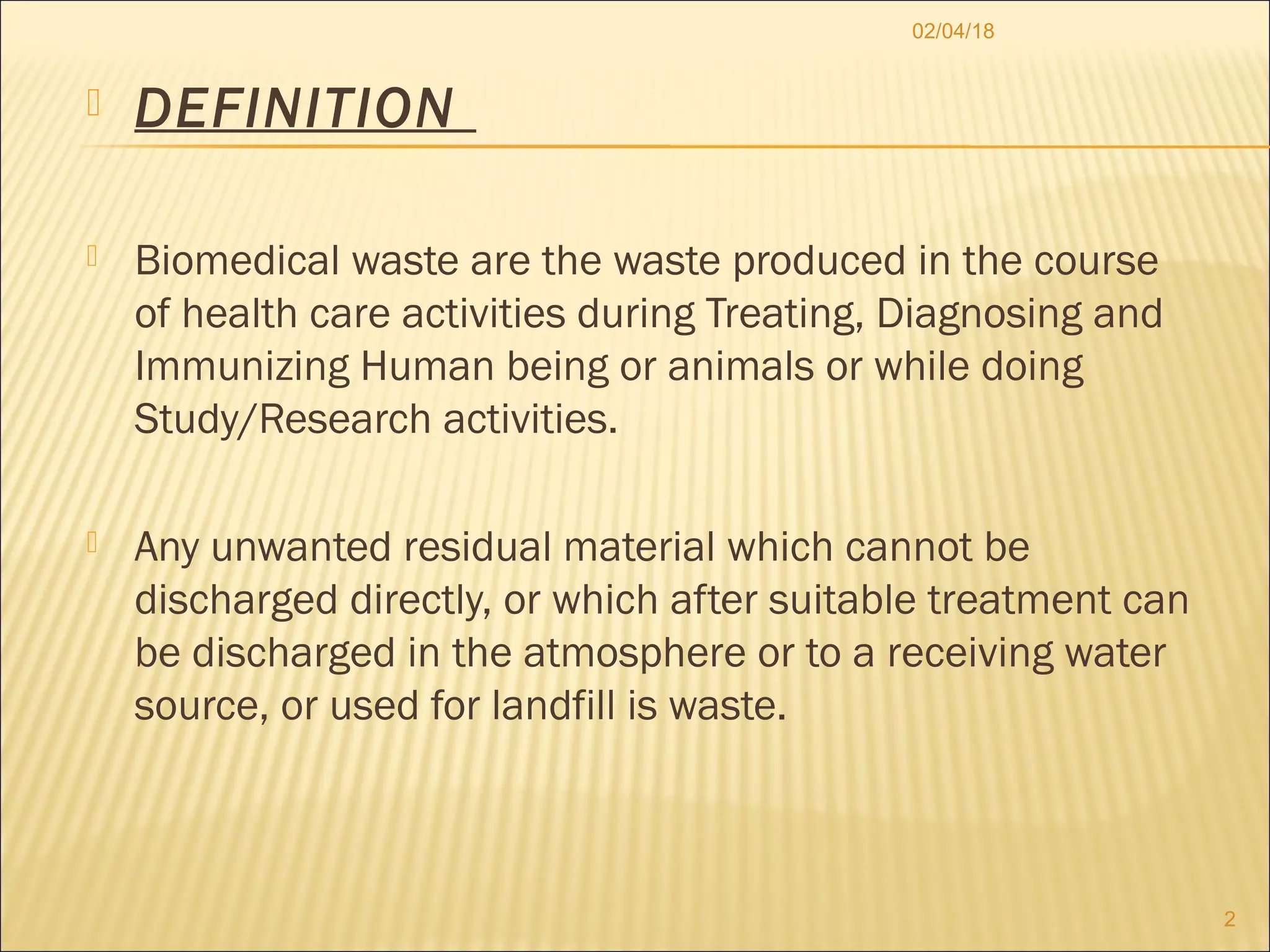
 DEFINITION
 Biomedical waste are the waste produced in the course
of health care activities during Treating, Diagnosing and
Immunizing Human being or animals or while doing
Study/Research activities.
 Any unwanted residual material which cannot be
discharged directly, or which after suitable treatment can
be discharged in the atmosphere or to a receiving water
source, or used for landfill is waste.
02/04/18
2
Need For BMW Management
 The hospital waste, in addition to the risk for patients and
medical personnel poses a threat to public health and
environment.
APPLICATION:
 These rules apply to all persons who generate, collect,
receive, store, transport, treat, dispose, or handle bio-
medical waste in any form including a hospital, nursing
home, clinic, dispensary, veterinary institutions, and
animal house, pathological laboratory, blood bank e.t.c.
02/04/18
3
MAGNITUDE OF THE PROBLEM
 GLOBALLY- Developed countries generate 1 to
5kg/bed/day
 Developing countries: meager data, but figures are
lower. 1-2kg/pt./day
 WHO Report: 85% non hazardous waste
10% infective waste
5% non-infectious but hazardous.
(Chemical, pharmaceutical and radioactive)
02/04/18
4
 It contains infectious or other hazardous materials
that may injure or infect patients, visitors, hospital
personnel, and the public in several ways.
 It may contain ‘sharps’, such as needles or broken
glass and harmful chemicals and radioactive
chemicals, that can cause injury and infection
 If untreated, it undergoes fermentation and attracts
flies, birds and animals rendering the site of
generation and storage unhygienic.
 It can attract rag pickers, who repack disposables or
drugs and sell them.
02/04/18
5
02/04/18
6
 Government/private hospitals
 Nursing homes
 Physician/dentist office or clinic
 Dispensaries
 Primary health care centers
 Medical research and training centers
 animal./slaughter houses
 labs/research organizations
 Vaccinating centers
 Bio tech institutions/production units
02/04/18
7
 Harmless waste includes paper, cardboard, cartons,
flowers and ordinary office or kitchen waste.
 Infectious waste: are the portion of medical waste
that could transmit an ‘infectious disease’ :
 Human or animal tissues or organs removed at biopsy,
sugery or autopsy.
 Placenta and other products of conception
 Any pathological fluid or discharges
 Dressings, swab and other soiled items
 Laboratory samples sent for microbiology, pathology and
biochemical tests
 All microbial cultures
 Used syringes and needles, used scalpel blades and
other sharps.
02/04/18
8
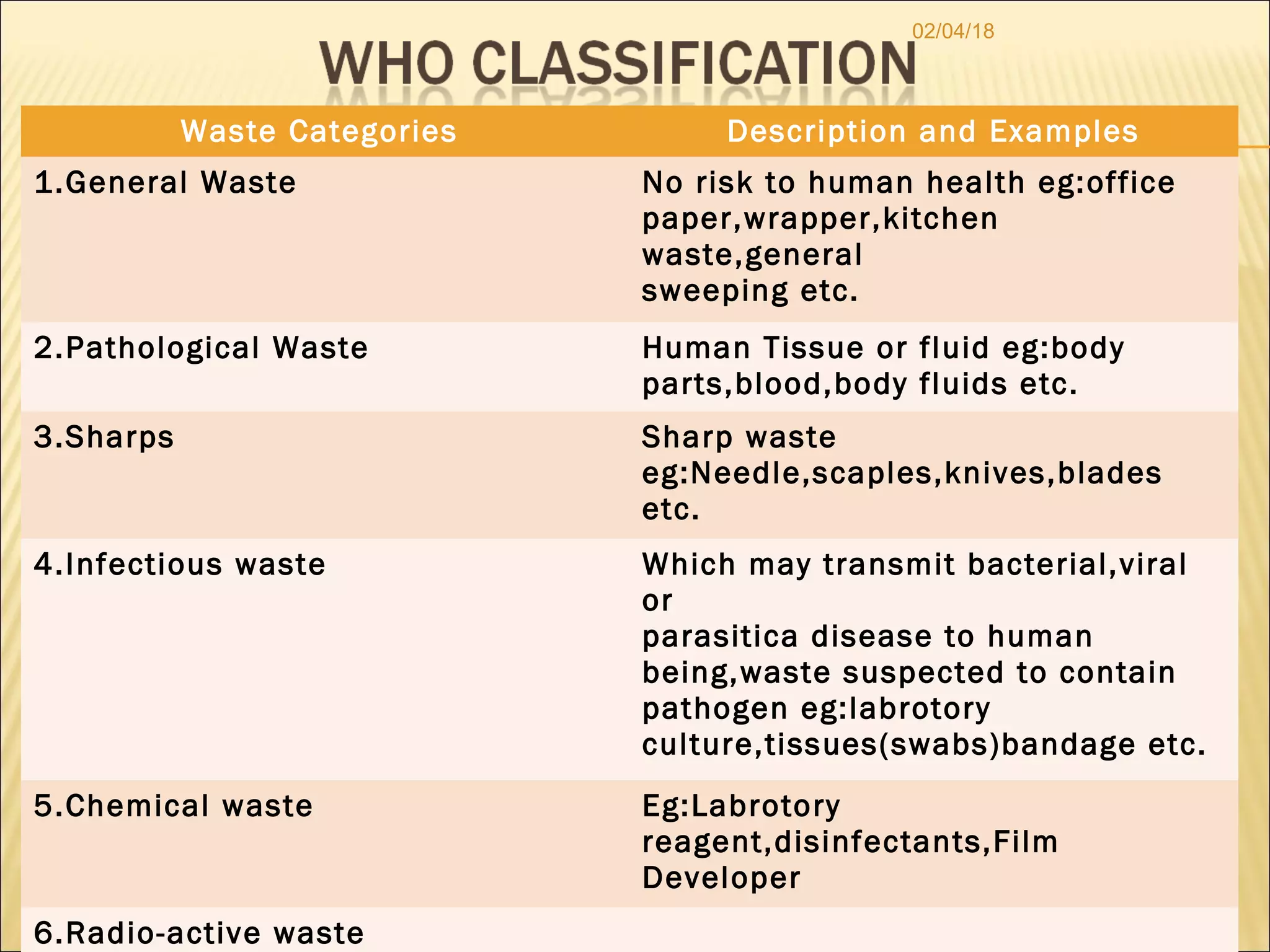
Waste Categories Description and Examples
1.General Waste No risk to human health eg:office
paper,wrapper,kitchen
waste,general
sweeping etc.
2.Pathological Waste Human Tissue or fluid eg:body
parts,blood,body fluids etc.
3.Sharps Sharp waste
eg:Needle,scaples,knives,blades
etc.
4.Infectious waste Which may transmit bacterial,viral
or
parasitica disease to human
being,waste suspected to contain
pathogen eg:labrotory
culture,tissues(swabs)bandage etc.
5.Chemical waste Eg:Labrotory
reagent,disinfectants,Film
Developer
6.Radio-active waste
02/04/18
9
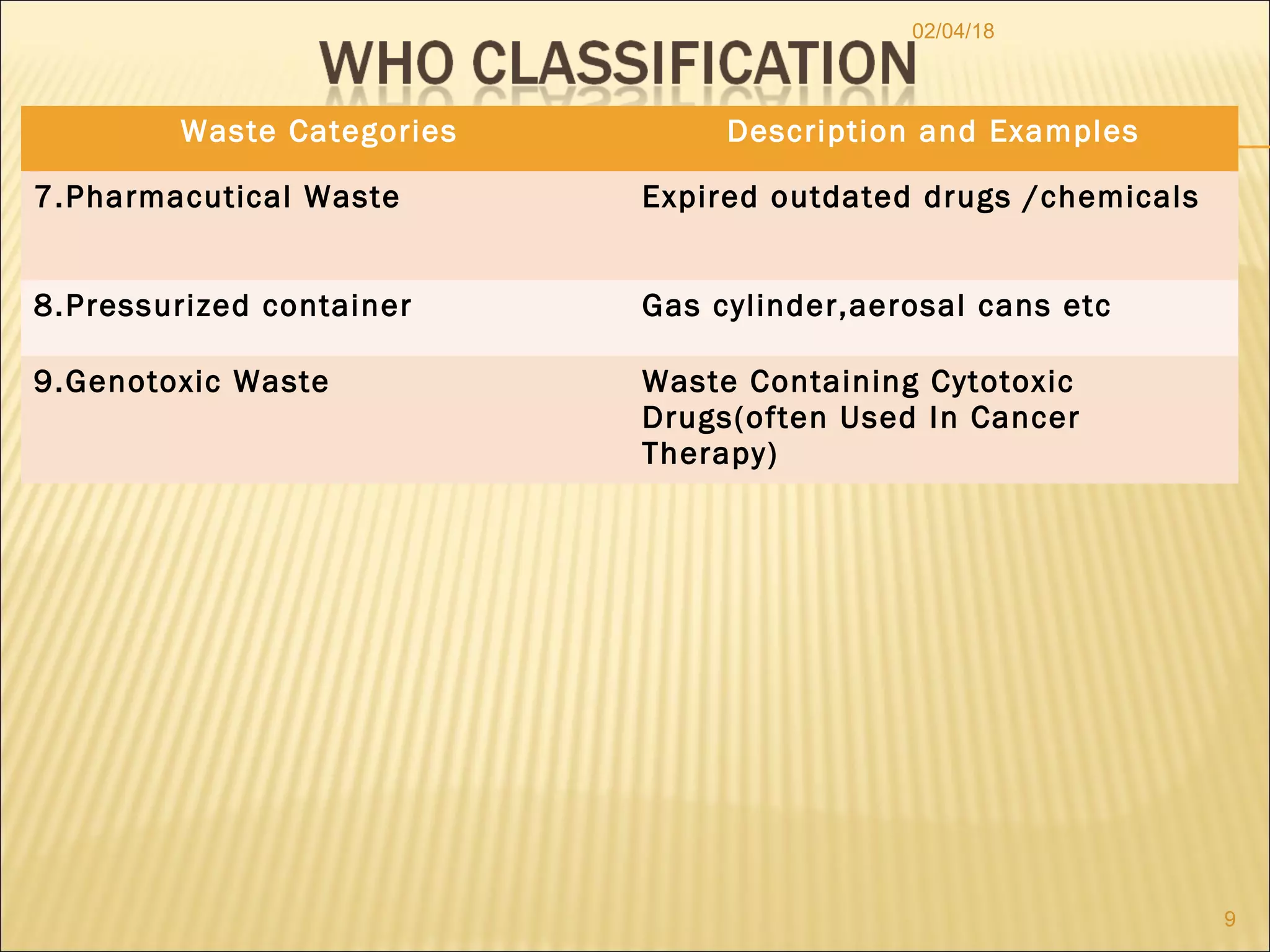
Waste Categories Description and Examples
7.Pharmacutical Waste Expired outdated drugs /chemicals
8.Pressurized container Gas cylinder,aerosal cans etc
9.Genotoxic Waste Waste Containing Cytotoxic
Drugs(often Used In Cancer
Therapy)
02/04/18
10
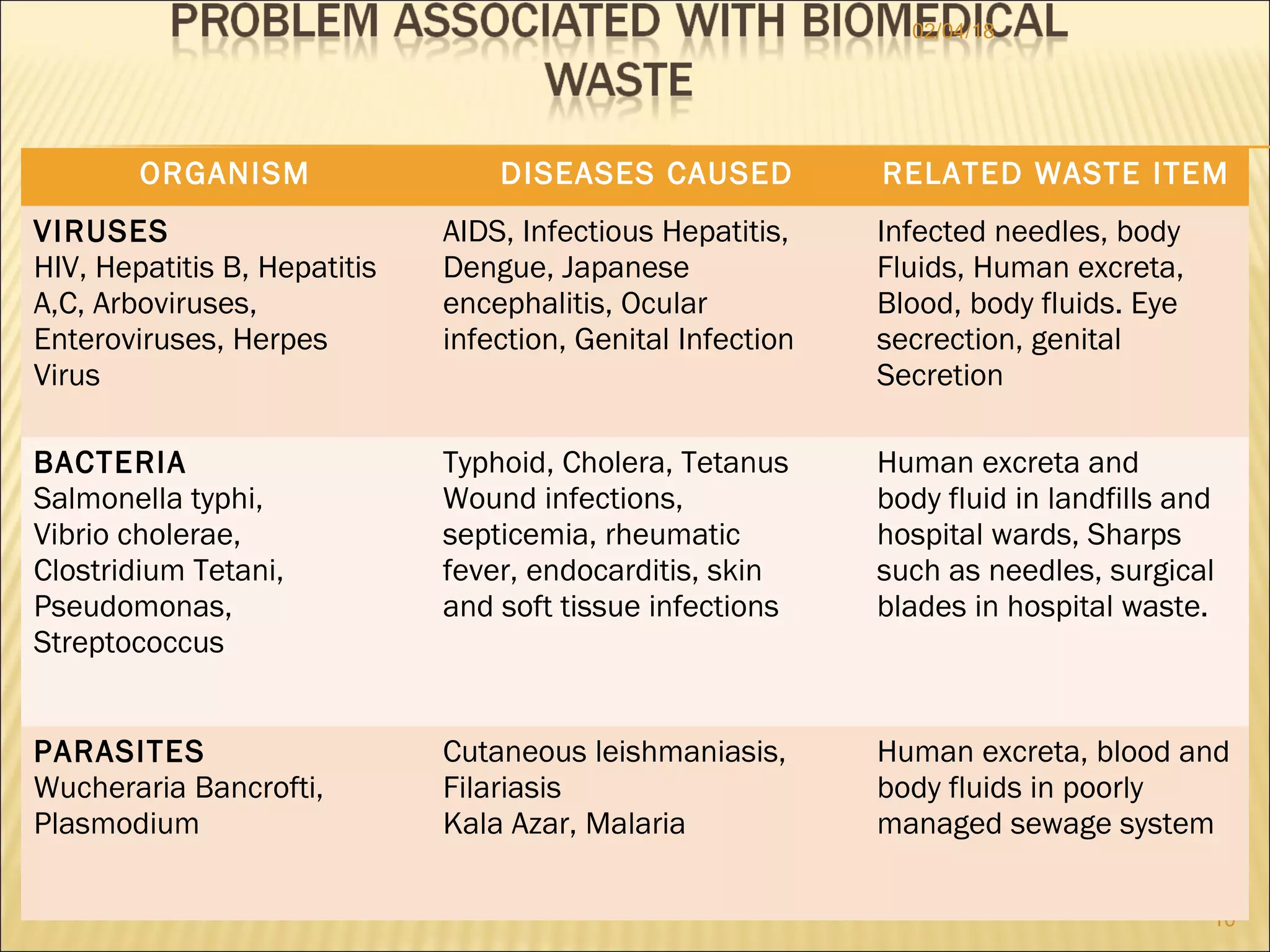
ORGANISM DISEASES CAUSED RELATED WASTE ITEM
VIRUSES
HIV, Hepatitis B, Hepatitis
A,C, Arboviruses,
Enteroviruses, Herpes
Virus
AIDS, Infectious Hepatitis,
Dengue, Japanese
encephalitis, Ocular
infection, Genital Infection
Infected needles, body
Fluids, Human excreta,
Blood, body fluids. Eye
secrection, genital
Secretion
BACTERIA
Salmonella typhi,
Vibrio cholerae,
Clostridium Tetani,
Pseudomonas,
Streptococcus
Typhoid, Cholera, Tetanus
Wound infections,
septicemia, rheumatic
fever, endocarditis, skin
and soft tissue infections
Human excreta and
body fluid in landfills and
hospital wards, Sharps
such as needles, surgical
blades in hospital waste.
PARASITES
Wucheraria Bancrofti,
Plasmodium
Cutaneous leishmaniasis,
Filariasis
Kala Azar, Malaria
Human excreta, blood and
body fluids in poorly
managed sewage system
02/04/18
11
WASTE
CATEGORY
TYPE OF WASTE TREATMENT AND
DISPOSAL OPTION
Category No. 1 Human Anatomical Waste
(Human
tissues, organs, body parts)
Incineration@ / deep
burial*
Category No. 2 Animal Waste
(Animal tissues, organs, body
parts, carcasses, bleeding
parts, fluid, blood and
experimental animals used in
research, waste generated by
veterinary hospitals and
colleges, discharge from
hospitals, animal houses)
Incineration@ / deep
burial*
02/04/18
12
WASTE
CATEGORY
TYPE OF WASTE TREATMENT AND
DISPOSAL OPTION
Category No. 3 Microbiology & Biotechnology Waste
(Wastes from laboratory cultures,
stocks or specimen of live micro
organisms or attenuated vaccines,
human and animal cell cultures used
in research and infectious agents
from research and industrial
laboratories, wastes from production
of biologicals, toxins and devices
used for transfer of cultures)
Local autoclaving/
microwaving /
incineration
Category No. 4 Waste Sharps (Needles, syringes,
scalpels, blades, glass, etc. that may
cause puncture and cuts. This
includes both used and unused
sharps)waste generated by
veterinary hospitals and colleges,
discharge from hospitals, animal
houses)
Disinfecting (chemical
treatment /
autoclaving /
microwaving
and mutilation /
shredding
02/04/18
13
WASTE
CATEGORY
TYPE OF WASTE TREATMENT AND
DISPOSAL OPTION
Category No. 5 Discarded Medicine and Cytotoxic
drugs(Wastes comprising of outdated,
contaminated and discarded
medicines)
Incineration /
destruction
and drugs disposal in
secured landfills
Category No. 6 Soiled Waste (Items contaminated with
body fluids including cotton, dressings,
soiled plaster casts, lines, bedding and
other materials contaminated with
blood.)
Disinfecting (chemical
treatment /
autoclaving /
microwaving
and mutilation /
shredding
Category No. 7 Solid Waste (Waste generated from
disposable items other than the waste
sharps such as tubing, catheters,
intravenous sets, etc.)
Disinfecting by chemical
treatment/
autoclaving /
microwaving
and mutilation /
shredding
Category No. 8 Liquid Waste (Waste generated
fromthe laboratory and washing,
cleaning, house keeping and
disinfectingactivities)
Disinfecting by chemical
treatment and
discharge into drains
02/04/18
14
WASTE
CATEGORY
TYPE OF WASTE TREATMENT AND
DISPOSAL OPTION
Category No. 9 Incineration Ash (Ash from
incineration of any biomedical
waste)
Disposal in municipal
landfill
Category No. 10 Chemical Waste (Chemicals
used in production of
biologicals, chemicals used in
disinfecting, as insecticides,
etc.)
Chemical treatment
and discharge into drains
for liquids and secured
landfill for solids.
02/04/18
15
Type Site of Generation Disposal By
Non-Hazardous
waste/General waste
Office,Kitchen,Admini
stration,Hostels,Store
s,Rest rooms etc
Muncipal/Public
Authority
Hazardous (Infectious
& toxic waste)
Wards,Treatment
room, Dressing room,
OT, ICU,Labour room,
Labrotory, Dialysis
room, CT scan,
Radio-imaging etc
Hospital itself
1.GENERATION
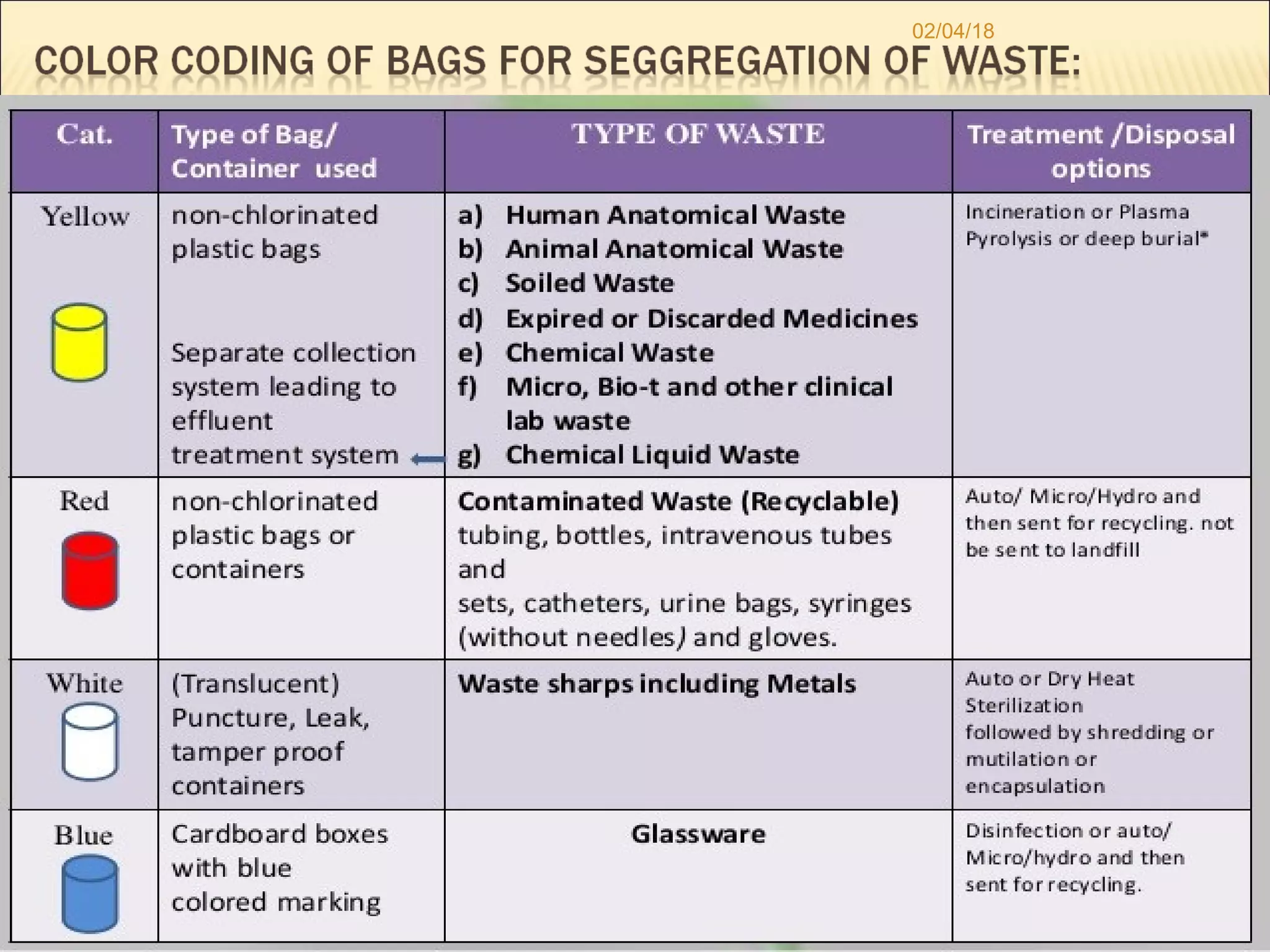
 Done at point of Generation of waste and put in
separate coloured bags. Color coding varies from
nation to nation.
 Color coding of bags for seggregation of biomedical
waste are:
02/04/18
16
02/04/18
17
02/04/18
18
3.Collection of waste:
 Centralized sanitation staffs or any other sanitation staffs
should collect the waste during morning afternoon or
evening under the supervision of nursing staff and
sanitation supervisor; documentation should be done in
register; Garbage bin should be cleaned and disinfected
regularly.
4. Storage of Waste:
 Waste should not be stored in the generation area for more
than a period of 4-6 hours.
 It is responsibility of paramedic/sanitationstaff to check for
segregation
 Waste collected in various areas should be trasported for
disposal/Treatment.
02/04/18
19
5. Transportation:
 Refers to the movement of waste from the point of generation
to the treatment facility.
 There should be separate corridor and lift in hospital to carry
and transport waste.
 Transportation should be done in sealed container/sanitation
supervisor should ensure for leakage.
6. Treatment & Disposal:
 It involves all the procedures and processes intended to
reduce the bulk of the waste and make it non-infectious and
harmless.
 Different methods of waste treatment are:
02/04/18
20
 1.Incineration
 2.Chemical Disinfection
 3.Autoclaving
 4.Deep burial
 5.Microwave irradication
 6.Inertisation
21
 Incineration:
 High tempreture dry oxidation process that reduce
organic and combustible waste into inorganic
incombustible matter. Resulting in significant
reduction in waste volume and weight.
 Body parts, animal waste,microbiological waste and
soiled dressings can be treated with this technique.
 Process is selected to treat waste that cannot be
recycled, reused or can be disposed in land.
 Types if Incinerators:
 Double chambered(for infectious waste)
 Single chambered
02/04/18
22
02/04/18
23
 Chemical disinfection:
 Commonly Used for treatment of liquid infectious waste eg.
blood, urine, stool and hospital sewage.
 Chemicals are added to waste to kill or inactivate the pathogen
it contains.
 Autoclaving
 Widely used in labs and clinics for treating infectious waste
before disposal.
 Deep burial
 After chemical treatment materials are placed in deep trenches
covered with lime and filled with soil.
 It’s a safe method for the disposal of sharps
02/04/18
24
Microwave irradication:
 Microwave of frequency 2450MHZ and wavelength 12.24 cm
used to destroy the microorganism.
 Radiations produced break apart molecular chemical bonds
and disinfect infectious waste.
 There are no hazardous emissions.
 Cannot be used to treat body parts and tissues.
Inertization
 Process of mixing waste with cement and other substances
before disposal in order to minimize the risk of toxic substance
migrating into surface, water or ground water and to prevent
scavenging.
 Proportion of 65% waste 15%lime 15% cement and 5% water is
used.
02/04/18
25
 Assume all specimens/patients are infectious for HIV and
other blood borne pathogens.
 All blood specimens or body fluids should be placed in leak
proof impervious bags for transportation to the lab.
 Always use gloves and masks while handling blood and body
fluid specimens and other objects exposed to them.
 Wear lab coats or gowns while working in the lab.
 Never pipette by mouth.
 Decontaminate laboratory work surfaces after work
procedures are completed.
 Use biological safety hoods for lab work.
 Always wash hands after completing laboratory work and
remove all protective clothing before leaving the lab.
02/04/18
26
02/04/18
27
02/04/18
28

Biomedical waste management

  • 1.
    02/04/18 1 BIO MEDICAL WASTE MANAGEMENT DEEPAKCHAUDHARY Senior Demonstrator GMC AMBIKAPUR
  • 2.
     DEFINITION  Biomedicalwaste are the waste produced in the course of health care activities during Treating, Diagnosing and Immunizing Human being or animals or while doing Study/Research activities.  Any unwanted residual material which cannot be discharged directly, or which after suitable treatment can be discharged in the atmosphere or to a receiving water source, or used for landfill is waste. 02/04/18 2
  • 3.
    Need For BMWManagement  The hospital waste, in addition to the risk for patients and medical personnel poses a threat to public health and environment. APPLICATION:  These rules apply to all persons who generate, collect, receive, store, transport, treat, dispose, or handle bio- medical waste in any form including a hospital, nursing home, clinic, dispensary, veterinary institutions, and animal house, pathological laboratory, blood bank e.t.c. 02/04/18 3
  • 4.
    MAGNITUDE OF THEPROBLEM  GLOBALLY- Developed countries generate 1 to 5kg/bed/day  Developing countries: meager data, but figures are lower. 1-2kg/pt./day  WHO Report: 85% non hazardous waste 10% infective waste 5% non-infectious but hazardous. (Chemical, pharmaceutical and radioactive) 02/04/18 4
  • 5.
     It containsinfectious or other hazardous materials that may injure or infect patients, visitors, hospital personnel, and the public in several ways.  It may contain ‘sharps’, such as needles or broken glass and harmful chemicals and radioactive chemicals, that can cause injury and infection  If untreated, it undergoes fermentation and attracts flies, birds and animals rendering the site of generation and storage unhygienic.  It can attract rag pickers, who repack disposables or drugs and sell them. 02/04/18 5
  • 6.
    02/04/18 6  Government/private hospitals Nursing homes  Physician/dentist office or clinic  Dispensaries  Primary health care centers  Medical research and training centers  animal./slaughter houses  labs/research organizations  Vaccinating centers  Bio tech institutions/production units
  • 7.
    02/04/18 7  Harmless wasteincludes paper, cardboard, cartons, flowers and ordinary office or kitchen waste.  Infectious waste: are the portion of medical waste that could transmit an ‘infectious disease’ :  Human or animal tissues or organs removed at biopsy, sugery or autopsy.  Placenta and other products of conception  Any pathological fluid or discharges  Dressings, swab and other soiled items  Laboratory samples sent for microbiology, pathology and biochemical tests  All microbial cultures  Used syringes and needles, used scalpel blades and other sharps.
  • 8.
    02/04/18 8 Waste Categories Descriptionand Examples 1.General Waste No risk to human health eg:office paper,wrapper,kitchen waste,general sweeping etc. 2.Pathological Waste Human Tissue or fluid eg:body parts,blood,body fluids etc. 3.Sharps Sharp waste eg:Needle,scaples,knives,blades etc. 4.Infectious waste Which may transmit bacterial,viral or parasitica disease to human being,waste suspected to contain pathogen eg:labrotory culture,tissues(swabs)bandage etc. 5.Chemical waste Eg:Labrotory reagent,disinfectants,Film Developer 6.Radio-active waste
  • 9.
    02/04/18 9 Waste Categories Descriptionand Examples 7.Pharmacutical Waste Expired outdated drugs /chemicals 8.Pressurized container Gas cylinder,aerosal cans etc 9.Genotoxic Waste Waste Containing Cytotoxic Drugs(often Used In Cancer Therapy)
  • 10.
    02/04/18 10 ORGANISM DISEASES CAUSEDRELATED WASTE ITEM VIRUSES HIV, Hepatitis B, Hepatitis A,C, Arboviruses, Enteroviruses, Herpes Virus AIDS, Infectious Hepatitis, Dengue, Japanese encephalitis, Ocular infection, Genital Infection Infected needles, body Fluids, Human excreta, Blood, body fluids. Eye secrection, genital Secretion BACTERIA Salmonella typhi, Vibrio cholerae, Clostridium Tetani, Pseudomonas, Streptococcus Typhoid, Cholera, Tetanus Wound infections, septicemia, rheumatic fever, endocarditis, skin and soft tissue infections Human excreta and body fluid in landfills and hospital wards, Sharps such as needles, surgical blades in hospital waste. PARASITES Wucheraria Bancrofti, Plasmodium Cutaneous leishmaniasis, Filariasis Kala Azar, Malaria Human excreta, blood and body fluids in poorly managed sewage system
  • 11.
    02/04/18 11 WASTE CATEGORY TYPE OF WASTETREATMENT AND DISPOSAL OPTION Category No. 1 Human Anatomical Waste (Human tissues, organs, body parts) Incineration@ / deep burial* Category No. 2 Animal Waste (Animal tissues, organs, body parts, carcasses, bleeding parts, fluid, blood and experimental animals used in research, waste generated by veterinary hospitals and colleges, discharge from hospitals, animal houses) Incineration@ / deep burial*
  • 12.
    02/04/18 12 WASTE CATEGORY TYPE OF WASTETREATMENT AND DISPOSAL OPTION Category No. 3 Microbiology & Biotechnology Waste (Wastes from laboratory cultures, stocks or specimen of live micro organisms or attenuated vaccines, human and animal cell cultures used in research and infectious agents from research and industrial laboratories, wastes from production of biologicals, toxins and devices used for transfer of cultures) Local autoclaving/ microwaving / incineration Category No. 4 Waste Sharps (Needles, syringes, scalpels, blades, glass, etc. that may cause puncture and cuts. This includes both used and unused sharps)waste generated by veterinary hospitals and colleges, discharge from hospitals, animal houses) Disinfecting (chemical treatment / autoclaving / microwaving and mutilation / shredding
  • 13.
    02/04/18 13 WASTE CATEGORY TYPE OF WASTETREATMENT AND DISPOSAL OPTION Category No. 5 Discarded Medicine and Cytotoxic drugs(Wastes comprising of outdated, contaminated and discarded medicines) Incineration / destruction and drugs disposal in secured landfills Category No. 6 Soiled Waste (Items contaminated with body fluids including cotton, dressings, soiled plaster casts, lines, bedding and other materials contaminated with blood.) Disinfecting (chemical treatment / autoclaving / microwaving and mutilation / shredding Category No. 7 Solid Waste (Waste generated from disposable items other than the waste sharps such as tubing, catheters, intravenous sets, etc.) Disinfecting by chemical treatment/ autoclaving / microwaving and mutilation / shredding Category No. 8 Liquid Waste (Waste generated fromthe laboratory and washing, cleaning, house keeping and disinfectingactivities) Disinfecting by chemical treatment and discharge into drains
  • 14.
    02/04/18 14 WASTE CATEGORY TYPE OF WASTETREATMENT AND DISPOSAL OPTION Category No. 9 Incineration Ash (Ash from incineration of any biomedical waste) Disposal in municipal landfill Category No. 10 Chemical Waste (Chemicals used in production of biologicals, chemicals used in disinfecting, as insecticides, etc.) Chemical treatment and discharge into drains for liquids and secured landfill for solids.
  • 15.
    02/04/18 15 Type Site ofGeneration Disposal By Non-Hazardous waste/General waste Office,Kitchen,Admini stration,Hostels,Store s,Rest rooms etc Muncipal/Public Authority Hazardous (Infectious & toxic waste) Wards,Treatment room, Dressing room, OT, ICU,Labour room, Labrotory, Dialysis room, CT scan, Radio-imaging etc Hospital itself 1.GENERATION
  • 16.
     Done atpoint of Generation of waste and put in separate coloured bags. Color coding varies from nation to nation.  Color coding of bags for seggregation of biomedical waste are: 02/04/18 16
  • 17.
  • 18.
  • 19.
    3.Collection of waste: Centralized sanitation staffs or any other sanitation staffs should collect the waste during morning afternoon or evening under the supervision of nursing staff and sanitation supervisor; documentation should be done in register; Garbage bin should be cleaned and disinfected regularly. 4. Storage of Waste:  Waste should not be stored in the generation area for more than a period of 4-6 hours.  It is responsibility of paramedic/sanitationstaff to check for segregation  Waste collected in various areas should be trasported for disposal/Treatment. 02/04/18 19
  • 20.
    5. Transportation:  Refersto the movement of waste from the point of generation to the treatment facility.  There should be separate corridor and lift in hospital to carry and transport waste.  Transportation should be done in sealed container/sanitation supervisor should ensure for leakage. 6. Treatment & Disposal:  It involves all the procedures and processes intended to reduce the bulk of the waste and make it non-infectious and harmless.  Different methods of waste treatment are: 02/04/18 20
  • 21.
     1.Incineration  2.ChemicalDisinfection  3.Autoclaving  4.Deep burial  5.Microwave irradication  6.Inertisation 21
  • 22.
     Incineration:  Hightempreture dry oxidation process that reduce organic and combustible waste into inorganic incombustible matter. Resulting in significant reduction in waste volume and weight.  Body parts, animal waste,microbiological waste and soiled dressings can be treated with this technique.  Process is selected to treat waste that cannot be recycled, reused or can be disposed in land.  Types if Incinerators:  Double chambered(for infectious waste)  Single chambered 02/04/18 22
  • 23.
  • 24.
     Chemical disinfection: Commonly Used for treatment of liquid infectious waste eg. blood, urine, stool and hospital sewage.  Chemicals are added to waste to kill or inactivate the pathogen it contains.  Autoclaving  Widely used in labs and clinics for treating infectious waste before disposal.  Deep burial  After chemical treatment materials are placed in deep trenches covered with lime and filled with soil.  It’s a safe method for the disposal of sharps 02/04/18 24
  • 25.
    Microwave irradication:  Microwaveof frequency 2450MHZ and wavelength 12.24 cm used to destroy the microorganism.  Radiations produced break apart molecular chemical bonds and disinfect infectious waste.  There are no hazardous emissions.  Cannot be used to treat body parts and tissues. Inertization  Process of mixing waste with cement and other substances before disposal in order to minimize the risk of toxic substance migrating into surface, water or ground water and to prevent scavenging.  Proportion of 65% waste 15%lime 15% cement and 5% water is used. 02/04/18 25
  • 26.
     Assume allspecimens/patients are infectious for HIV and other blood borne pathogens.  All blood specimens or body fluids should be placed in leak proof impervious bags for transportation to the lab.  Always use gloves and masks while handling blood and body fluid specimens and other objects exposed to them.  Wear lab coats or gowns while working in the lab.  Never pipette by mouth.  Decontaminate laboratory work surfaces after work procedures are completed.  Use biological safety hoods for lab work.  Always wash hands after completing laboratory work and remove all protective clothing before leaving the lab. 02/04/18 26
  • 27.
  • 28.