BIOMEDICAL WASTE MANAGEMENT
By
Dr Noor Mohamed Rasik .B
MBBS ,MD , D.Diab ,FDM ,CPCDM
Assistant Professor Community medicine and Diabetologist
Sri Lalithambigai Medical College and Hospital
Madhuravoyal ,Chennai
SPECIFIC LEARNING OBJECTIVES :
• To Define the term Bio-Medical Waste
• To List out the sources of Bio-Medical Waste
• To Classify the types of Bio-Medical Waste and its Hazards
• To Describe the Bio-Medical Waste Management Process
• To Enumerate the Bio-Medical Waste Management Rule
CONTENTS :
• Definition Bio-Medical waste
• Sources of BMW
• Types of BMW
• Hazards of BMW
• BMW Management Process
• BMW Management Rule,2016
• Spills
• BMW Management and COVID-19
• Benefits of BMW management
• Discussion
Introduction
• Waste of healthcare activities carry higher potential for infection and injury
than any other waste.
• Basic principle: Reduce, Recycle, Reuse
• Definition of Bio-Medical Waste :
“Any waste which is generated during the diagnosis, treatment or
immunization of human beings or animals or in research activities
pertaining thereto or in the production or testing biologicals”.
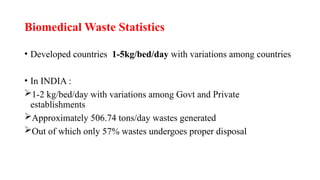
Biomedical Waste Statistics
• Developed countries 1-5kg/bed/day with variations among countries
• In INDIA :
1-2 kg/bed/day with variations among Govt and Private
establishments
Approximately 506.74 tons/day wastes generated
Out of which only 57% wastes undergoes proper disposal
SOURCES OF BIOMEDICAL WASTE
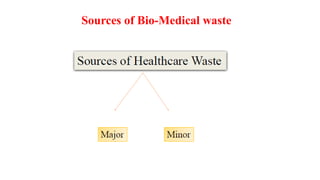
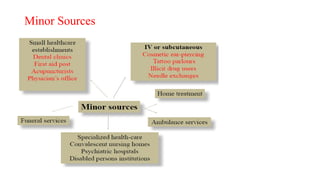
Sources of Bio-Medical waste
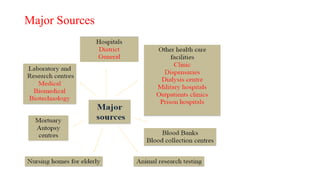
Major Sources
Minor Sources
TYPES OF BIOMEDICAL WASTE
Types of Bio medical waste
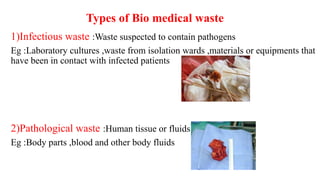
1)Infectious waste :Waste suspected to contain pathogens
Eg :Laboratory cultures ,waste from isolation wards ,materials or equipments that
have been in contact with infected patients
2)Pathological waste :Human tissue or fluids
Eg :Body parts ,blood and other body fluids
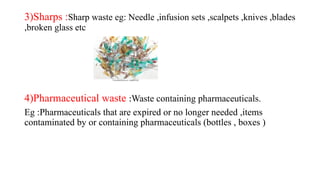
3)Sharps :Sharp waste eg: Needle ,infusion sets ,scalpets ,knives ,blades
,broken glass etc
4)Pharmaceutical waste :Waste containing pharmaceuticals.
Eg :Pharmaceuticals that are expired or no longer needed ,items
contaminated by or containing pharmaceuticals (bottles , boxes )
5)Genotoxic waste:Waste containing substances with genotoxic properties
Eg :Waste containing cytostatic drugs (often used in cancer
therapy),genotoxic chemicals
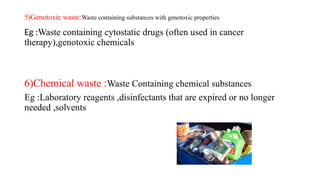
6)Chemical waste :Waste Containing chemical substances
Eg :Laboratory reagents ,disinfectants that are expired or no longer
needed ,solvents
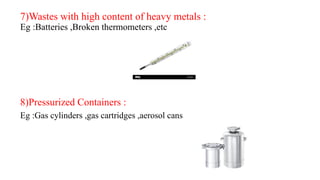
7)Wastes with high content of heavy metals :
Eg :Batteries ,Broken thermometers ,etc
8)Pressurized Containers :
Eg :Gas cylinders ,gas cartridges ,aerosol cans
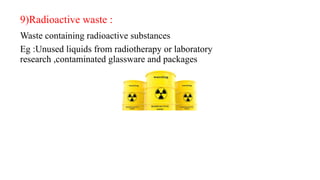
9)Radioactive waste :
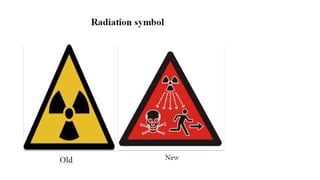
Waste containing radioactive substances
Eg :Unused liquids from radiotherapy or laboratory
research ,contaminated glassware and packages
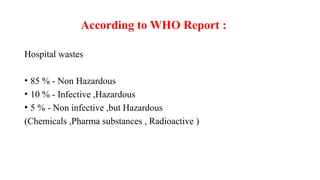
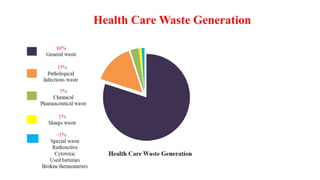
According to WHO Report :
Hospital wastes
• 85 % - Non Hazardous
• 10 % - Infective ,Hazardous
• 5 % - Non infective ,but Hazardous
(Chemicals ,Pharma substances , Radioactive )
Health Care Waste Generation
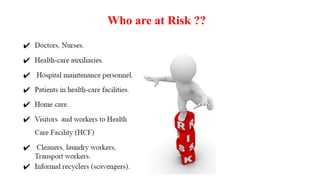
Who are at Risk ??
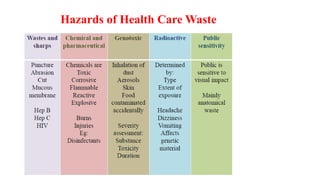
Hazards of Health Care Waste
BMW MANAGEMENT PROCESS
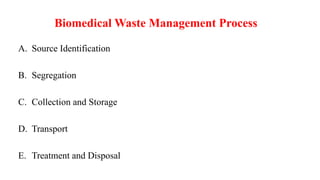
Biomedical Waste Management Process
A. Source Identification
B. Segregation
C. Collection and Storage
D. Transport
E. Treatment and Disposal
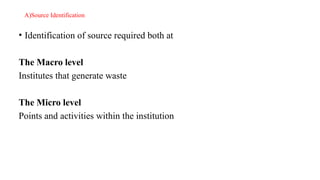
A)Source Identification
• Identification of source required both at
The Macro level
Institutes that generate waste
The Micro level
Points and activities within the institution
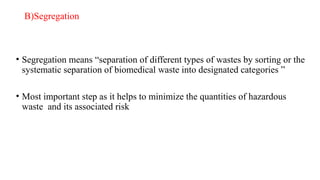
B)Segregation
• Segregation means “separation of different types of wastes by sorting or the
systematic separation of biomedical waste into designated categories ”
• Most important step as it helps to minimize the quantities of hazardous
waste and its associated risk
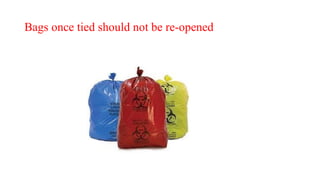
Bags once tied should not be re-opened
C)Collection and Storage
• Storage means “the holding of biomedical waste for period of time ,at the
end of which waste is treated and disposed of ”
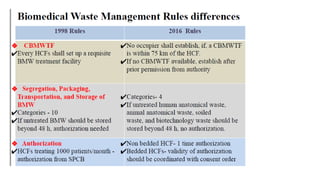
• No untreated biomedical waste shall be kept stored beyond period of 48
hours
• If any reason it is necessary then permission of the prescribed authority is
essential
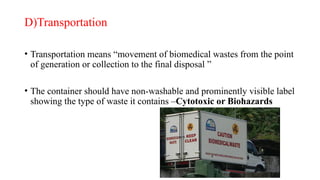
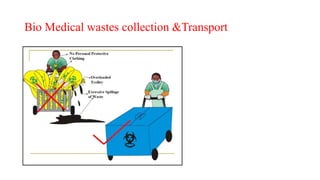
D)Transportation
• Transportation means “movement of biomedical wastes from the point
of generation or collection to the final disposal ”
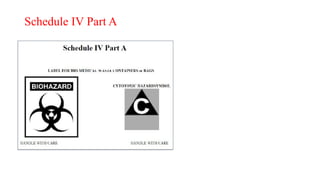
• The container should have non-washable and prominently visible label
showing the type of waste it contains –Cytotoxic or Biohazards
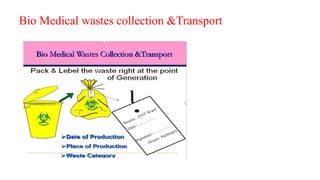
Bio Medical wastes collection &Transport
E)Treatment and Disposal
• The main objectives of treatment are
o Disinfecting and decontaminating the waste and
oVolume reduction
• Broadly two categories
oBurn technology
oNon Burn technology
Treatment and Disposal Methods
1. Incineration
2. Chemical disinfection
3. Wet and dry thermal treatment (Autoclaving )
4. Microwave irradiation
5. Land disposal
6. Inertization
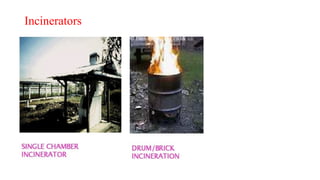
1)Incineration
• Method of choice for most hazardous health care waste
• High temperature dry oxidation process
• Reduces organic and combustible waste to inorganic and incombustible
material
• Significant reduction in waste volume and weight
Incinerators
2)Chemical disinfection
• Most suited for treating liquid waste such as infected blood ,urine ,stools or
hospital sewage
• Chemicals are added to waste to kill pathogens .
3)Wet and dry thermal treatment (Autoclaving )
• Autoclaving is process of steam sterilization under pressure and used for
purpose of disinfecting and treating biomedical waste
• Effective inactivation of all the micro organism and bacterial spore at 121
degree C temperature and 30 pounds per square inch pressure for 3
minutes holding time
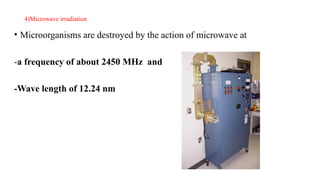
4)Microwave irradiation
• Microorganisms are destroyed by the action of microwave at
-a frequency of about 2450 MHz and
-Wave length of 12.24 nm
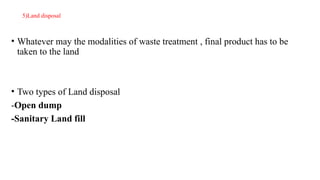
5)Land disposal
• Whatever may the modalities of waste treatment , final product has to be
taken to the land
• Two types of Land disposal
-Open dump
-Sanitary Land fill
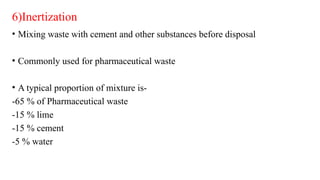
6)Inertization
• Mixing waste with cement and other substances before disposal
• Commonly used for pharmaceutical waste
• A typical proportion of mixture is-
-65 % of Pharmaceutical waste
-15 % lime
-15 % cement
-5 % water
BMW MANAGEMENT RULES
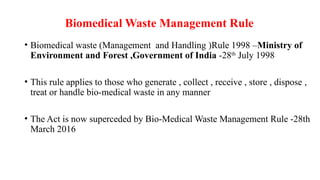
Biomedical Waste Management Rule
• Biomedical waste (Management and Handling )Rule 1998 –Ministry of
Environment and Forest ,Government of India -28th
July 1998
• This rule applies to those who generate , collect , receive , store , dispose ,
treat or handle bio-medical waste in any manner
• The Act is now superceded by Bio-Medical Waste Management Rule -28th
March 2016
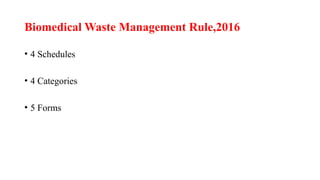
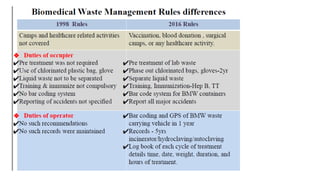
Biomedical Waste Management Rule,2016
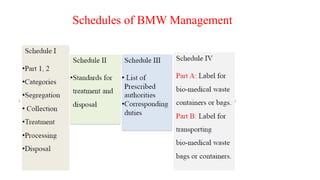
• 4 Schedules
• 4 Categories
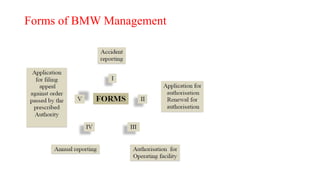
• 5 Forms
Schedules of BMW Management
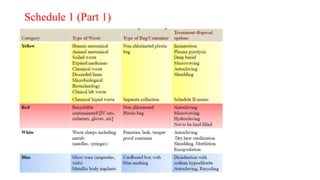
Schedule 1 (Part 1)
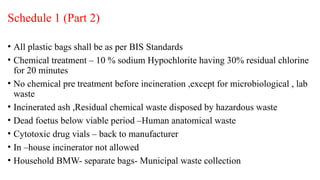
Schedule 1 (Part 2)
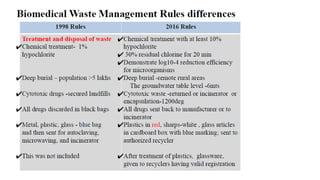
• All plastic bags shall be as per BIS Standards
• Chemical treatment – 10 % sodium Hypochlorite having 30% residual chlorine
for 20 minutes
• No chemical pre treatment before incineration ,except for microbiological , lab
waste
• Incinerated ash ,Residual chemical waste disposed by hazardous waste
• Dead foetus below viable period –Human anatomical waste
• Cytotoxic drug vials – back to manufacturer
• In –house incinerator not allowed
• Household BMW- separate bags- Municipal waste collection
Schedule IV Part A
Forms of BMW Management
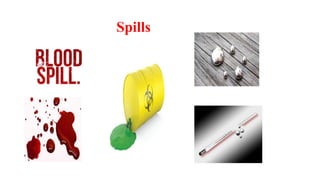
Spills
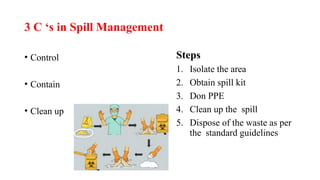
3 C ‘s in Spill Management
• Control
• Contain
• Clean up
Steps
1. Isolate the area
2. Obtain spill kit
3. Don PPE
4. Clean up the spill
5. Dispose of the waste as per
the standard guidelines
Blood spills
• Ensure Gloves are used before handling
• Cover the spill with absorbent cotton or cloth
• Disinfect the surface with 1% sodium hypochlorite solution / 5% phenol for
30 minutes
• Discard to Yellow bin
• Finally use the normal mop
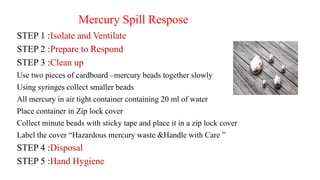
Mercury Spill Respose
STEP 1 :Isolate and Ventilate
STEP 2 :Prepare to Respond
STEP 3 :Clean up
Use two pieces of cardboard –mercury beads together slowly
Using syringes collect smaller beads
All mercury in air tight container containing 20 ml of water
Place container in Zip lock cover
Collect minute beads with sticky tape and place it in a zip lock cover
Label the cover “Hazardous mercury waste &Handle with Care ”
STEP 4 :Disposal
STEP 5 :Hand Hygiene
Occupational Safety Measures :
All workers involved in the handling of hospital waste management must
provide
• PPE
• Conduct health check atleast once a year
• Provide training
• Immunization for protection against diseases like Hepatitis B ,Tetanus
• Report major accidents caused during handling of biomedical waste
• Records relevant thereto to prescribed authority
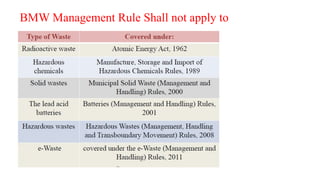
BMW Management Rule Shall not apply to
BMW Management and COVID -19
CPCB Guidelines
CPCB has revised biomedical waste management guidelines which has
specific requirements like:
• Use of double layered bags (using 2 bags) for collection of waste in corona
wards
• Use of dedicated collection bins labelled as “COVID-19” to store COVID-19
waste and kept separately in temporary storage room prior to handing over to
authorized staff
• Maintaining separate record of COVID waste
• Report opening or operation of COVID-19 sample collection centers and
• laboratories to concerned state pollution control board (SPCB)
CPCB Guidelines
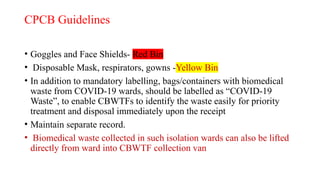
• Goggles and Face Shields- Red Bin
• Disposable Mask, respirators, gowns -Yellow Bin
• In addition to mandatory labelling, bags/containers with biomedical
waste from COVID-19 wards, should be labelled as “COVID-19
Waste”, to enable CBWTFs to identify the waste easily for priority
treatment and disposal immediately upon the receipt
• Maintain separate record.
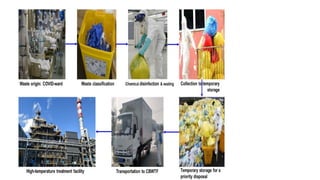
• Biomedical waste collected in such isolation wards can also be lifted
directly from ward into CBWTF collection van
Benefits of BMW Management
1)Positive health and Environment effects
• Reduces or eliminate the potential to transmit disease
• Eliminates dispersal of infectious waste into the environment
2)Enhanced Community image
• Demonstrates environmental consciousness
3)Economic advantages
• Volume reduction
• Savings in reduced cost and handling time
• Less personnel resources and storage space required
REFERENCES
1) k park. park's textbook of preventive and social medicine. 25th edition.
india. bhanot publishers. 2019 pg
2).AM Kadri IAPSM’S Textbook of Community Medicine 1st
Edition.Jaypee
brothers medical Publishers limited .2019 pg
3)Available from
file:///C:/Users/RASIK/AppData/Local/Temp/Pictorial_guide_covid-1.pdf
accessed on 25th
December 2021
BIOMEDICAL WASTE MANAGEMENT BY for practical purpose.pptx

BIOMEDICAL WASTE MANAGEMENT BY for practical purpose.pptx

  • 1.
    BIOMEDICAL WASTE MANAGEMENT By DrNoor Mohamed Rasik .B MBBS ,MD , D.Diab ,FDM ,CPCDM Assistant Professor Community medicine and Diabetologist Sri Lalithambigai Medical College and Hospital Madhuravoyal ,Chennai
  • 2.
    SPECIFIC LEARNING OBJECTIVES: • To Define the term Bio-Medical Waste • To List out the sources of Bio-Medical Waste • To Classify the types of Bio-Medical Waste and its Hazards • To Describe the Bio-Medical Waste Management Process • To Enumerate the Bio-Medical Waste Management Rule
  • 3.
    CONTENTS : • DefinitionBio-Medical waste • Sources of BMW • Types of BMW • Hazards of BMW • BMW Management Process • BMW Management Rule,2016 • Spills • BMW Management and COVID-19 • Benefits of BMW management • Discussion
  • 4.
    Introduction • Waste ofhealthcare activities carry higher potential for infection and injury than any other waste. • Basic principle: Reduce, Recycle, Reuse • Definition of Bio-Medical Waste : “Any waste which is generated during the diagnosis, treatment or immunization of human beings or animals or in research activities pertaining thereto or in the production or testing biologicals”.
  • 5.
    Biomedical Waste Statistics •Developed countries 1-5kg/bed/day with variations among countries • In INDIA : 1-2 kg/bed/day with variations among Govt and Private establishments Approximately 506.74 tons/day wastes generated Out of which only 57% wastes undergoes proper disposal
  • 6.
  • 7.
  • 8.
  • 9.
  • 10.
  • 11.
    Types of Biomedical waste 1)Infectious waste :Waste suspected to contain pathogens Eg :Laboratory cultures ,waste from isolation wards ,materials or equipments that have been in contact with infected patients 2)Pathological waste :Human tissue or fluids Eg :Body parts ,blood and other body fluids
  • 12.
    3)Sharps :Sharp wasteeg: Needle ,infusion sets ,scalpets ,knives ,blades ,broken glass etc 4)Pharmaceutical waste :Waste containing pharmaceuticals. Eg :Pharmaceuticals that are expired or no longer needed ,items contaminated by or containing pharmaceuticals (bottles , boxes )
  • 13.
    5)Genotoxic waste:Waste containingsubstances with genotoxic properties Eg :Waste containing cytostatic drugs (often used in cancer therapy),genotoxic chemicals 6)Chemical waste :Waste Containing chemical substances Eg :Laboratory reagents ,disinfectants that are expired or no longer needed ,solvents
  • 14.
    7)Wastes with highcontent of heavy metals : Eg :Batteries ,Broken thermometers ,etc 8)Pressurized Containers : Eg :Gas cylinders ,gas cartridges ,aerosol cans
  • 15.
    9)Radioactive waste : Wastecontaining radioactive substances Eg :Unused liquids from radiotherapy or laboratory research ,contaminated glassware and packages
  • 16.
    According to WHOReport : Hospital wastes • 85 % - Non Hazardous • 10 % - Infective ,Hazardous • 5 % - Non infective ,but Hazardous (Chemicals ,Pharma substances , Radioactive )
  • 17.
  • 18.
    Who are atRisk ??
  • 20.
  • 21.
  • 22.
    Biomedical Waste ManagementProcess A. Source Identification B. Segregation C. Collection and Storage D. Transport E. Treatment and Disposal
  • 23.
    A)Source Identification • Identificationof source required both at The Macro level Institutes that generate waste The Micro level Points and activities within the institution
  • 24.
    B)Segregation • Segregation means“separation of different types of wastes by sorting or the systematic separation of biomedical waste into designated categories ” • Most important step as it helps to minimize the quantities of hazardous waste and its associated risk
  • 25.
    Bags once tiedshould not be re-opened
  • 26.
    C)Collection and Storage •Storage means “the holding of biomedical waste for period of time ,at the end of which waste is treated and disposed of ” • No untreated biomedical waste shall be kept stored beyond period of 48 hours • If any reason it is necessary then permission of the prescribed authority is essential
  • 27.
    D)Transportation • Transportation means“movement of biomedical wastes from the point of generation or collection to the final disposal ” • The container should have non-washable and prominently visible label showing the type of waste it contains –Cytotoxic or Biohazards
  • 28.
    Bio Medical wastescollection &Transport
  • 29.
    Bio Medical wastescollection &Transport
  • 30.
    E)Treatment and Disposal •The main objectives of treatment are o Disinfecting and decontaminating the waste and oVolume reduction • Broadly two categories oBurn technology oNon Burn technology
  • 31.
    Treatment and DisposalMethods 1. Incineration 2. Chemical disinfection 3. Wet and dry thermal treatment (Autoclaving ) 4. Microwave irradiation 5. Land disposal 6. Inertization
  • 32.
    1)Incineration • Method ofchoice for most hazardous health care waste • High temperature dry oxidation process • Reduces organic and combustible waste to inorganic and incombustible material • Significant reduction in waste volume and weight
  • 33.
  • 34.
    2)Chemical disinfection • Mostsuited for treating liquid waste such as infected blood ,urine ,stools or hospital sewage • Chemicals are added to waste to kill pathogens .
  • 35.
    3)Wet and drythermal treatment (Autoclaving ) • Autoclaving is process of steam sterilization under pressure and used for purpose of disinfecting and treating biomedical waste • Effective inactivation of all the micro organism and bacterial spore at 121 degree C temperature and 30 pounds per square inch pressure for 3 minutes holding time
  • 36.
    4)Microwave irradiation • Microorganismsare destroyed by the action of microwave at -a frequency of about 2450 MHz and -Wave length of 12.24 nm
  • 37.
    5)Land disposal • Whatevermay the modalities of waste treatment , final product has to be taken to the land • Two types of Land disposal -Open dump -Sanitary Land fill
  • 38.
    6)Inertization • Mixing wastewith cement and other substances before disposal • Commonly used for pharmaceutical waste • A typical proportion of mixture is- -65 % of Pharmaceutical waste -15 % lime -15 % cement -5 % water
  • 39.
  • 40.
    Biomedical Waste ManagementRule • Biomedical waste (Management and Handling )Rule 1998 –Ministry of Environment and Forest ,Government of India -28th July 1998 • This rule applies to those who generate , collect , receive , store , dispose , treat or handle bio-medical waste in any manner • The Act is now superceded by Bio-Medical Waste Management Rule -28th March 2016
  • 41.
    Biomedical Waste ManagementRule,2016 • 4 Schedules • 4 Categories • 5 Forms
  • 42.
    Schedules of BMWManagement
  • 43.
  • 44.
    Schedule 1 (Part2) • All plastic bags shall be as per BIS Standards • Chemical treatment – 10 % sodium Hypochlorite having 30% residual chlorine for 20 minutes • No chemical pre treatment before incineration ,except for microbiological , lab waste • Incinerated ash ,Residual chemical waste disposed by hazardous waste • Dead foetus below viable period –Human anatomical waste • Cytotoxic drug vials – back to manufacturer • In –house incinerator not allowed • Household BMW- separate bags- Municipal waste collection
  • 45.
  • 46.
    Forms of BMWManagement
  • 51.
  • 52.
    3 C ‘sin Spill Management • Control • Contain • Clean up Steps 1. Isolate the area 2. Obtain spill kit 3. Don PPE 4. Clean up the spill 5. Dispose of the waste as per the standard guidelines
  • 53.
    Blood spills • EnsureGloves are used before handling • Cover the spill with absorbent cotton or cloth • Disinfect the surface with 1% sodium hypochlorite solution / 5% phenol for 30 minutes • Discard to Yellow bin • Finally use the normal mop
  • 54.
    Mercury Spill Respose STEP1 :Isolate and Ventilate STEP 2 :Prepare to Respond STEP 3 :Clean up Use two pieces of cardboard –mercury beads together slowly Using syringes collect smaller beads All mercury in air tight container containing 20 ml of water Place container in Zip lock cover Collect minute beads with sticky tape and place it in a zip lock cover Label the cover “Hazardous mercury waste &Handle with Care ” STEP 4 :Disposal STEP 5 :Hand Hygiene
  • 55.
    Occupational Safety Measures: All workers involved in the handling of hospital waste management must provide • PPE • Conduct health check atleast once a year • Provide training • Immunization for protection against diseases like Hepatitis B ,Tetanus • Report major accidents caused during handling of biomedical waste • Records relevant thereto to prescribed authority
  • 56.
    BMW Management RuleShall not apply to
  • 57.
  • 58.
    CPCB Guidelines CPCB hasrevised biomedical waste management guidelines which has specific requirements like: • Use of double layered bags (using 2 bags) for collection of waste in corona wards • Use of dedicated collection bins labelled as “COVID-19” to store COVID-19 waste and kept separately in temporary storage room prior to handing over to authorized staff • Maintaining separate record of COVID waste • Report opening or operation of COVID-19 sample collection centers and • laboratories to concerned state pollution control board (SPCB)
  • 59.
    CPCB Guidelines • Gogglesand Face Shields- Red Bin • Disposable Mask, respirators, gowns -Yellow Bin • In addition to mandatory labelling, bags/containers with biomedical waste from COVID-19 wards, should be labelled as “COVID-19 Waste”, to enable CBWTFs to identify the waste easily for priority treatment and disposal immediately upon the receipt • Maintain separate record. • Biomedical waste collected in such isolation wards can also be lifted directly from ward into CBWTF collection van
  • 61.
    Benefits of BMWManagement 1)Positive health and Environment effects • Reduces or eliminate the potential to transmit disease • Eliminates dispersal of infectious waste into the environment 2)Enhanced Community image • Demonstrates environmental consciousness 3)Economic advantages • Volume reduction • Savings in reduced cost and handling time • Less personnel resources and storage space required
  • 62.
    REFERENCES 1) k park.park's textbook of preventive and social medicine. 25th edition. india. bhanot publishers. 2019 pg 2).AM Kadri IAPSM’S Textbook of Community Medicine 1st Edition.Jaypee brothers medical Publishers limited .2019 pg 3)Available from file:///C:/Users/RASIK/AppData/Local/Temp/Pictorial_guide_covid-1.pdf accessed on 25th December 2021