L/O/G/O
ASSESSMENT
TECHNIQUES
Introduction
• Every minute a teacher’s stay in the
learning environment calls for an aspect of
the whole milieu of the teaching- learning
process- that of assessing children’s
progress.
A. Assessment
• Assessment is defined as a process of
gathering information on how an
instructional objective or purpose is being
achieved.
• It is an appraisal system that is based on a
set of criteria.
• Criteria are in turn dependent on the
desired performance level.
• The need for assessment:
1. The information gathered through the
process will definitely guide the teacher in
making decisions. In the long run her
decision-making skill is enhanced.
2. The choice of appropriate assessment
procedures will redound to the improvement
of student performance, especially when
continuous feedback is required.
3. Assessment process make it easy to track
student progress in learning other than
being contented with isolated testing.
4. The teacher’s assessment preferences
become guides to how the students will
prepare for the tests. The method should
jibe with the learning target set.
B. Measurement
• Measurement refers to a process of
determining how much of a particular
knowledge, skill, or characteristic an
individual process.
• There are quantitative measurements such
as percentage of items answered as well as
qualitative measurements such as how
intense or less intense the individuals
feelings is for an object.
• Some of the most commonly used are test
such as multiple choice, completion
type or essay and oral or written
questionnaire.
• Rating scales, informal and formal
observations and interviews are used in
measuring accuracy of performance or the
level of ones involvement in learning
activity.
C. Evaluation
• Evaluation is a process of making judgment,
that is, how good ones performance or
behavior is, based on a pre-determined value
or standards that would indicate quality.
It is also an interpretation of what has been
measured such as what the obtained scores
mean. A good question a teacher may ask is:
“How will I interpret the results?”
• For the specific purposes, evaluation is
undertaken in order to:
1. Analyze the children’s learning style.
2. Diagnose children’s strengths and
weaknesses.
3. Appraise achievement through the
development of learning outcomes, such as
acquisition of knowledge, development of skills
and inculcation of values.
4. Determine the effectiveness of a teaching
methodology.
D. Trends in Classroom
Assessment
Recent trends culled from research
findings could guide us in planning our
assessment methodologies.
1. While in the past assessment is conducted at
the end of an instructional unit, such as after
the completion of lessons included in a chapter,
or after a presentation of a concept, today,
short appraisals are being undertaken during
the lesson.
2. Being recommended today are what is
referred to as alternative assessment
techniques. It is any method that differs from
the traditional paper-and-pencil tests.
Examples are authentic assessment,
performance-based assessment, portfolios,
journals, exhibits, demonstrations and
interviews.
3. An important trend which has been
overlook before is the assessment of
knowledge and skills together.
4. Students are now being encouraged to
“self-assess” and gather feedback rather
than rely on others to discover their own
progress.
5. New techniques of assessment allow
multiple answers rather than only one
correct answer. Performance-based
assessment, student report and journals are
rich sources of information for evaluation.
6. The recent emphasis on authentic
assessment is considered very important in
gathering reliable feedback.
E. Objectives to be assessed.
• An important beginning task in planning
assessment is to identify appropriate
instructional objectives indicating the
outcomes expected and how it is related
the main categories are as follows:
1. Knowledge- this includes knowledge of
subject matter such as simple mastery of
facts and information that can easily be
done through mere recall.
2. Skills- it require knowledge of
procedures and the ability to use such
knowledge in actual performance.
3. Products- it includes the ability to
use knowledge and reasoning in
producing or creating a product such
as an artwork, project and special
reports.
4. Thinking Skills- it includes the ability to
use knowledge in reasoning, solving
problems, analyzing and synthesizing
information and arriving judgments.
5. Values- this objective refers to the
“intangibles,” yet observable behavior such
as feelings, attitudes, and dispositions.
Positive and negative values that are
develop are likewise important outcomes of
instruction. It falls under the affective
objectives.
F. Types of Assessment
Methods
• Instructional objectives tell us what we plan
to achieve, that is, what we like the students
to learn and be able to do.
• The types of assessment methods are:
1. Objective assessment
a. This method presents a question which can
be answered by selecting the correct one from
possible choices.
Examples are multiple choice, matching true or
false and yes or no type.
b. Another type includes items that require
the student to think and produce their own
answers. Examples are completion type,
labeling diagrams, and short sentence
responses. Oral questioning could be in the
form of open-ended and divergent question
which require short sentence answers, brief
reports or instant interviews.
2. Critical Thinking Assessment
The ability to process information in
order to arrive at a deep understanding and
judgment could be assessed by essay test
which call for explanations, solutions to
problems, formulating interferences and
generalizations and making predictions.
Special reports, researches, and
experiments indicate ones ability to make
sound arguments, decisions and
conclusions.
Teacher observations, both formal and
informal can likewise assess the depth and
breath of ones thinking. Intelligent
responses, high motivation and
inquisitiveness are sufficient gauge of
analytic mind.
3. Performance-based assessment
a) Performance is assess in terms of ones
proficiency in a speech, drama, dance, athletic
skill, steps followed in an experiment or a
musical rendition. Adeptness and masterful
execution of the performing act can be assess
using specific criteria and the skill to indicate
level.
b) Product assessment- this method will assess
ones ability to produce create construct or do
something. The quality of the product such as a
painting, a science project, a model or a final
report could be determined by using a checklist,
rating scale, rubrics and portfolio.
4. Values also Termed Affective Assessment
Teacher observation, interviews, journals
and self reports reveal information about ones
attitude perceptions and personality traits
G. Planning Other Types
• Other types of assessment that have
enhance our currently being used
methodologies are the following:
1. Reasoning skills assessment- reasoning goes
beyond mere recall and comprehension. It is a
task that employs knowledge in order to be able
to interpret and analyze information draw
inferences and make decisions. They are called
mental skills. Some of them are recognizing
discriminating, comparing, synthesizing and
making deductions.
2. Problem Solving Assessment
Problem solving requires gathering information for
the purpose of arriving at an answer, a solution or a
decision. It involves a number of steps in order to reach
the best solution.
The steps to be assess are:
• Defining the problem clearly
• Gathering relevant information
• Formulating a hypothesis (tentative solution)
• Determining the likely hypothesis (the best alternative)
• Testing the hypothesis through actual observations,
readings, deductions, or performing experiments.

• Analyzing data gathered.
• Formulating a conclusion (solution)
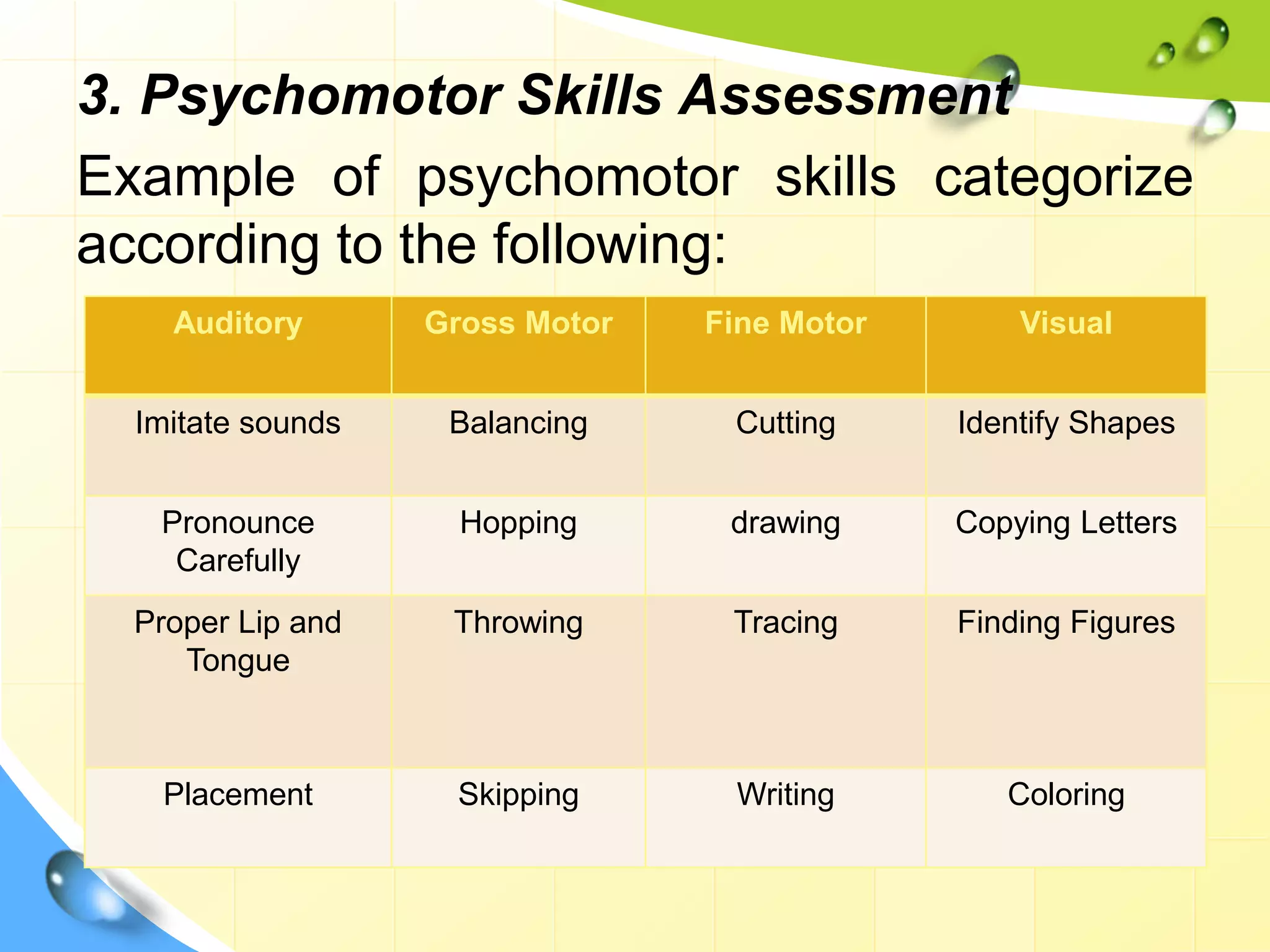
3. Psychomotor Skills Assessment
Example of psychomotor skills categorize
according to the following:
Auditory Gross Motor Fine Motor Visual
Imitate sounds Balancing Cutting Identify Shapes
Pronounce
Carefully
Hopping drawing Copying Letters
Proper Lip and
Tongue
Throwing Tracing Finding Figures
Placement Skipping Writing Coloring
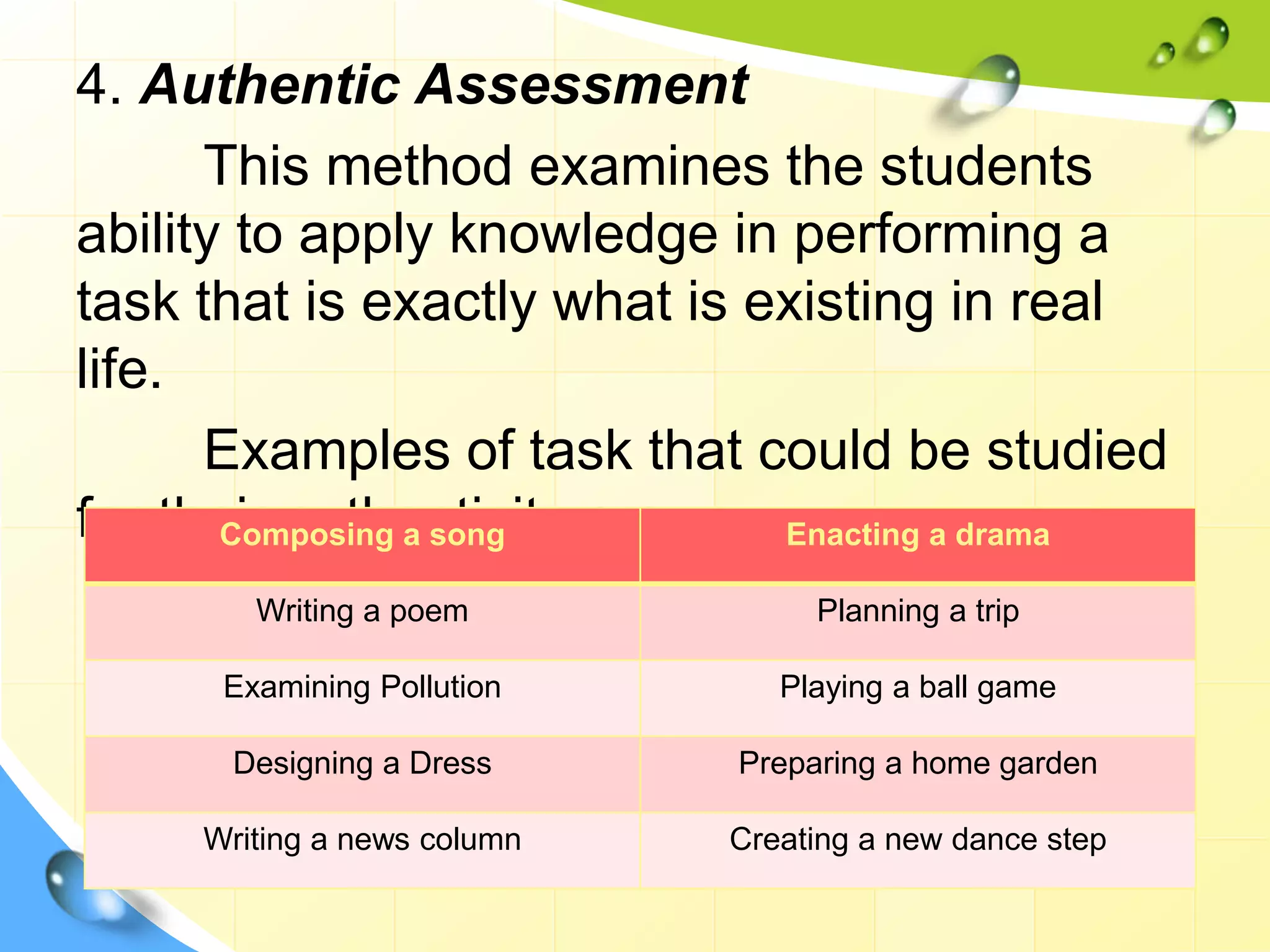
4. Authentic Assessment
This method examines the students
ability to apply knowledge in performing a
task that is exactly what is existing in real
life.
Examples of task that could be studied
for their authenticity are:Composing a song Enacting a drama
Writing a poem Planning a trip
Examining Pollution Playing a ball game
Designing a Dress Preparing a home garden
Writing a news column Creating a new dance step
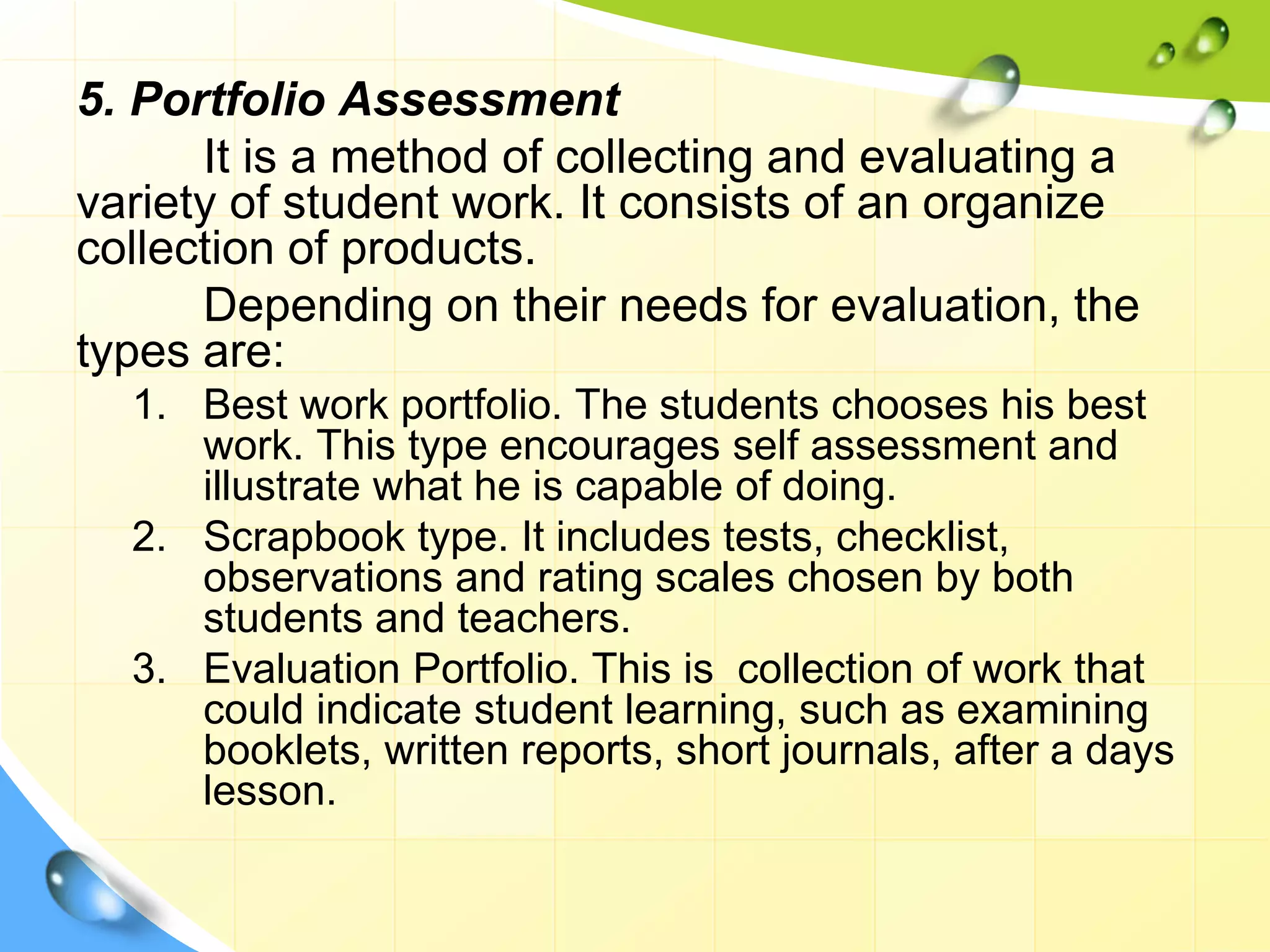
5. Portfolio Assessment
It is a method of collecting and evaluating a
variety of student work. It consists of an organize
collection of products.
Depending on their needs for evaluation, the
types are:
1. Best work portfolio. The students chooses his best
work. This type encourages self assessment and
illustrate what he is capable of doing.
2. Scrapbook type. It includes tests, checklist,
observations and rating scales chosen by both
students and teachers.
3. Evaluation Portfolio. This is collection of work that
could indicate student learning, such as examining
booklets, written reports, short journals, after a days
lesson.
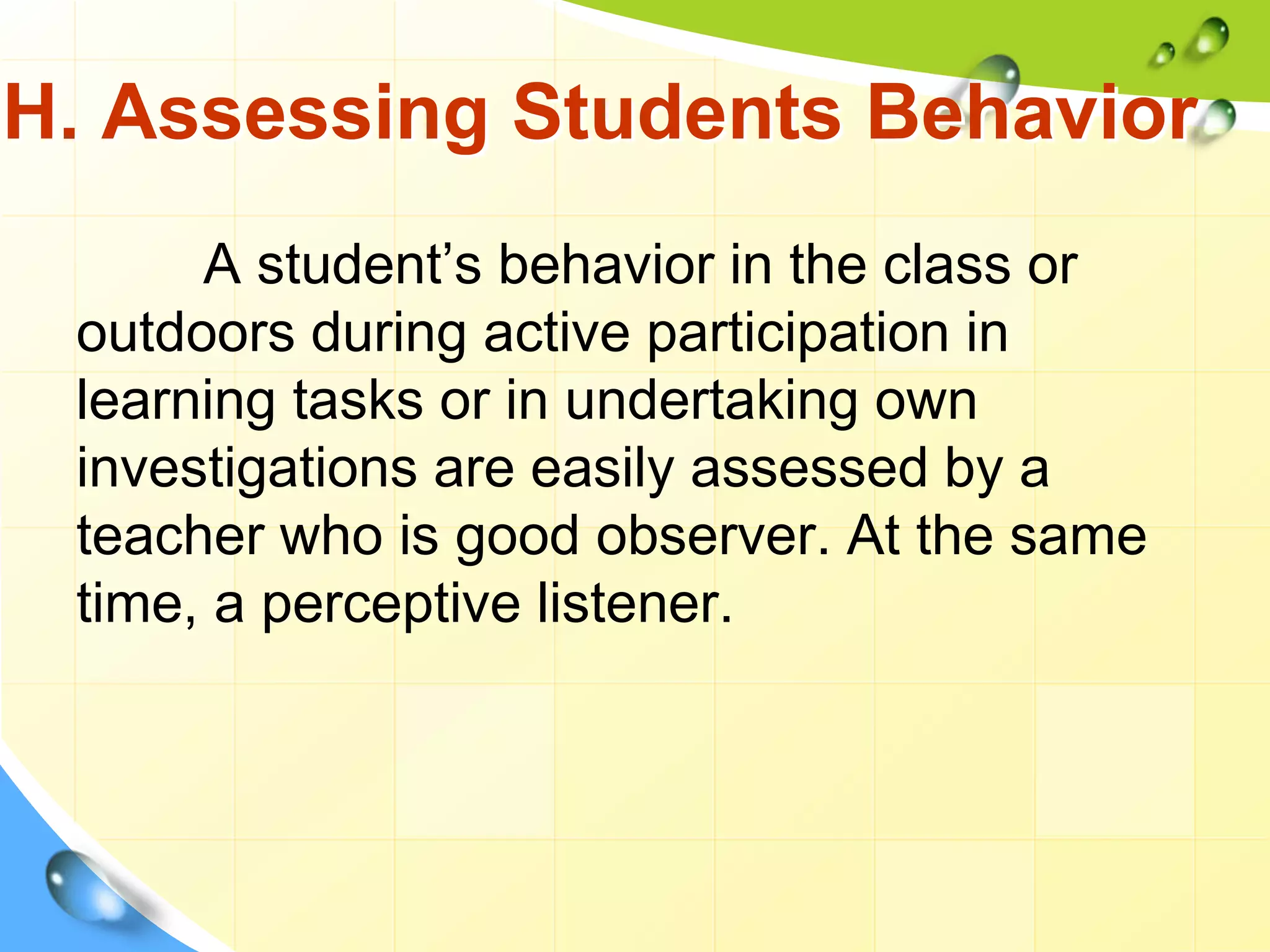
H. Assessing Students Behavior
A student’s behavior in the class or
outdoors during active participation in
learning tasks or in undertaking own
investigations are easily assessed by a
teacher who is good observer. At the same
time, a perceptive listener.
• Some questions that could reveal
meaningful information:
a) Nature of participation
Do they take an active part in discussions,
laboratory investigations and in other class activities?
Do they ask relevant, analytic questions?
b) Interests
What are their specific interests?
What are their hobbies?
What are their recreational activities?
c) Creativity
Can they generate own ideas?
Can they try new procedures?
d) Critical-Mindedness
Are they capable of analyzing and interpreting
data?
Do they employ investigative process and
procedures in finding solutions to daily problems?
e) Open-mindedness
Do they consider all sides or evidences before
arriving at a decision?
Are they free from biases or prejudices?
f) Persistence
Do they pursue a task to completion?
Are they willing to continue working beyond
scheduled time?
Do they give up easily when problems occur?
g) Cooperation and Sharing
Do they cooperate with one another in class
activities?
Do they share learning resources?
I. Observing Teacher Behavior
In order to evaluate teacher effectiveness, formal as well
informal observation of her behavior is a reliable gauge.
The observer could be guide by the following questions:
1. Does she revoke her students to think? This is a dependent
on her tact in asking “why and how” types of questions?
2. Does she allow her students to originate or plan their work
methodology?
3. Does she provide proper motivation and encouragement that
could arouse and sustain interest?
4. Does she involve all students through active participation in
the learning activity by providing proper guidance and
stimulation?
I. Observing Teacher Behavior
5. Is she free from bias and subjective reactions in
dealing with her students?
6. Does she cater the children’s curiosity and
inquisitiveness?
7. Is she objective, just and fair in a rating students?
8. Does she respect students opinion and ideas?
9. Does she inculcate values of humility and open-
mindedness?
10. Is she punctual and does she keep accurate time?
11. Does she demonstrate caring-and-sharing attitude?
J. Classroom Assessment
Progress in classroom work could be assessed
through the following:
1. Classroom observation and recording of:
a) recitations
b) seatwork
c) volunteering
d) review of homework
e) active participation in learning activities
f) questions students’ ask
J. Classroom Assessment
2. Interviews could reveal their difficulties as
well as progress.
3. Short conferences conducted for not-so-
active groups.
Classroom assessment techniques are
useful in providing information on some areas
that are sometimes difficult to assess such as:
appreciation, originality and adaptiveness. They
are valuable in inferring about personal growth.
Thank
You!

Assessment techniques

  • 1.
  • 2.
    Introduction • Every minutea teacher’s stay in the learning environment calls for an aspect of the whole milieu of the teaching- learning process- that of assessing children’s progress.
  • 3.
    A. Assessment • Assessmentis defined as a process of gathering information on how an instructional objective or purpose is being achieved. • It is an appraisal system that is based on a set of criteria. • Criteria are in turn dependent on the desired performance level.
  • 4.
    • The needfor assessment: 1. The information gathered through the process will definitely guide the teacher in making decisions. In the long run her decision-making skill is enhanced. 2. The choice of appropriate assessment procedures will redound to the improvement of student performance, especially when continuous feedback is required.
  • 5.
    3. Assessment processmake it easy to track student progress in learning other than being contented with isolated testing. 4. The teacher’s assessment preferences become guides to how the students will prepare for the tests. The method should jibe with the learning target set.
  • 6.
    B. Measurement • Measurementrefers to a process of determining how much of a particular knowledge, skill, or characteristic an individual process. • There are quantitative measurements such as percentage of items answered as well as qualitative measurements such as how intense or less intense the individuals feelings is for an object.
  • 7.
    • Some ofthe most commonly used are test such as multiple choice, completion type or essay and oral or written questionnaire. • Rating scales, informal and formal observations and interviews are used in measuring accuracy of performance or the level of ones involvement in learning activity.
  • 8.
    C. Evaluation • Evaluationis a process of making judgment, that is, how good ones performance or behavior is, based on a pre-determined value or standards that would indicate quality. It is also an interpretation of what has been measured such as what the obtained scores mean. A good question a teacher may ask is: “How will I interpret the results?”
  • 9.
    • For thespecific purposes, evaluation is undertaken in order to: 1. Analyze the children’s learning style. 2. Diagnose children’s strengths and weaknesses. 3. Appraise achievement through the development of learning outcomes, such as acquisition of knowledge, development of skills and inculcation of values. 4. Determine the effectiveness of a teaching methodology.
  • 10.
    D. Trends inClassroom Assessment Recent trends culled from research findings could guide us in planning our assessment methodologies. 1. While in the past assessment is conducted at the end of an instructional unit, such as after the completion of lessons included in a chapter, or after a presentation of a concept, today, short appraisals are being undertaken during the lesson.
  • 11.
    2. Being recommendedtoday are what is referred to as alternative assessment techniques. It is any method that differs from the traditional paper-and-pencil tests. Examples are authentic assessment, performance-based assessment, portfolios, journals, exhibits, demonstrations and interviews. 3. An important trend which has been overlook before is the assessment of knowledge and skills together.
  • 12.
    4. Students arenow being encouraged to “self-assess” and gather feedback rather than rely on others to discover their own progress. 5. New techniques of assessment allow multiple answers rather than only one correct answer. Performance-based assessment, student report and journals are rich sources of information for evaluation.
  • 13.
    6. The recentemphasis on authentic assessment is considered very important in gathering reliable feedback.
  • 14.
    E. Objectives tobe assessed. • An important beginning task in planning assessment is to identify appropriate instructional objectives indicating the outcomes expected and how it is related the main categories are as follows: 1. Knowledge- this includes knowledge of subject matter such as simple mastery of facts and information that can easily be done through mere recall.
  • 15.
    2. Skills- itrequire knowledge of procedures and the ability to use such knowledge in actual performance. 3. Products- it includes the ability to use knowledge and reasoning in producing or creating a product such as an artwork, project and special reports.
  • 16.
    4. Thinking Skills-it includes the ability to use knowledge in reasoning, solving problems, analyzing and synthesizing information and arriving judgments. 5. Values- this objective refers to the “intangibles,” yet observable behavior such as feelings, attitudes, and dispositions. Positive and negative values that are develop are likewise important outcomes of instruction. It falls under the affective objectives.
  • 17.
    F. Types ofAssessment Methods • Instructional objectives tell us what we plan to achieve, that is, what we like the students to learn and be able to do. • The types of assessment methods are: 1. Objective assessment a. This method presents a question which can be answered by selecting the correct one from possible choices. Examples are multiple choice, matching true or false and yes or no type.
  • 18.
    b. Another typeincludes items that require the student to think and produce their own answers. Examples are completion type, labeling diagrams, and short sentence responses. Oral questioning could be in the form of open-ended and divergent question which require short sentence answers, brief reports or instant interviews.
  • 19.
    2. Critical ThinkingAssessment The ability to process information in order to arrive at a deep understanding and judgment could be assessed by essay test which call for explanations, solutions to problems, formulating interferences and generalizations and making predictions. Special reports, researches, and experiments indicate ones ability to make sound arguments, decisions and conclusions.
  • 20.
    Teacher observations, bothformal and informal can likewise assess the depth and breath of ones thinking. Intelligent responses, high motivation and inquisitiveness are sufficient gauge of analytic mind.
  • 21.
    3. Performance-based assessment a)Performance is assess in terms of ones proficiency in a speech, drama, dance, athletic skill, steps followed in an experiment or a musical rendition. Adeptness and masterful execution of the performing act can be assess using specific criteria and the skill to indicate level. b) Product assessment- this method will assess ones ability to produce create construct or do something. The quality of the product such as a painting, a science project, a model or a final report could be determined by using a checklist, rating scale, rubrics and portfolio.
  • 22.
    4. Values alsoTermed Affective Assessment Teacher observation, interviews, journals and self reports reveal information about ones attitude perceptions and personality traits
  • 23.
    G. Planning OtherTypes • Other types of assessment that have enhance our currently being used methodologies are the following: 1. Reasoning skills assessment- reasoning goes beyond mere recall and comprehension. It is a task that employs knowledge in order to be able to interpret and analyze information draw inferences and make decisions. They are called mental skills. Some of them are recognizing discriminating, comparing, synthesizing and making deductions.
  • 24.
    2. Problem SolvingAssessment Problem solving requires gathering information for the purpose of arriving at an answer, a solution or a decision. It involves a number of steps in order to reach the best solution. The steps to be assess are: • Defining the problem clearly • Gathering relevant information • Formulating a hypothesis (tentative solution) • Determining the likely hypothesis (the best alternative) • Testing the hypothesis through actual observations, readings, deductions, or performing experiments. • Analyzing data gathered. • Formulating a conclusion (solution)
  • 25.
    3. Psychomotor SkillsAssessment Example of psychomotor skills categorize according to the following: Auditory Gross Motor Fine Motor Visual Imitate sounds Balancing Cutting Identify Shapes Pronounce Carefully Hopping drawing Copying Letters Proper Lip and Tongue Throwing Tracing Finding Figures Placement Skipping Writing Coloring
  • 26.
    4. Authentic Assessment Thismethod examines the students ability to apply knowledge in performing a task that is exactly what is existing in real life. Examples of task that could be studied for their authenticity are:Composing a song Enacting a drama Writing a poem Planning a trip Examining Pollution Playing a ball game Designing a Dress Preparing a home garden Writing a news column Creating a new dance step
  • 27.
    5. Portfolio Assessment Itis a method of collecting and evaluating a variety of student work. It consists of an organize collection of products. Depending on their needs for evaluation, the types are: 1. Best work portfolio. The students chooses his best work. This type encourages self assessment and illustrate what he is capable of doing. 2. Scrapbook type. It includes tests, checklist, observations and rating scales chosen by both students and teachers. 3. Evaluation Portfolio. This is collection of work that could indicate student learning, such as examining booklets, written reports, short journals, after a days lesson.
  • 28.
    H. Assessing StudentsBehavior A student’s behavior in the class or outdoors during active participation in learning tasks or in undertaking own investigations are easily assessed by a teacher who is good observer. At the same time, a perceptive listener.
  • 29.
    • Some questionsthat could reveal meaningful information: a) Nature of participation Do they take an active part in discussions, laboratory investigations and in other class activities? Do they ask relevant, analytic questions? b) Interests What are their specific interests? What are their hobbies? What are their recreational activities? c) Creativity Can they generate own ideas? Can they try new procedures?
  • 30.
    d) Critical-Mindedness Are theycapable of analyzing and interpreting data? Do they employ investigative process and procedures in finding solutions to daily problems? e) Open-mindedness Do they consider all sides or evidences before arriving at a decision? Are they free from biases or prejudices? f) Persistence Do they pursue a task to completion? Are they willing to continue working beyond scheduled time? Do they give up easily when problems occur? g) Cooperation and Sharing Do they cooperate with one another in class activities? Do they share learning resources?
  • 31.
    I. Observing TeacherBehavior In order to evaluate teacher effectiveness, formal as well informal observation of her behavior is a reliable gauge. The observer could be guide by the following questions: 1. Does she revoke her students to think? This is a dependent on her tact in asking “why and how” types of questions? 2. Does she allow her students to originate or plan their work methodology? 3. Does she provide proper motivation and encouragement that could arouse and sustain interest? 4. Does she involve all students through active participation in the learning activity by providing proper guidance and stimulation?
  • 32.
    I. Observing TeacherBehavior 5. Is she free from bias and subjective reactions in dealing with her students? 6. Does she cater the children’s curiosity and inquisitiveness? 7. Is she objective, just and fair in a rating students? 8. Does she respect students opinion and ideas? 9. Does she inculcate values of humility and open- mindedness? 10. Is she punctual and does she keep accurate time? 11. Does she demonstrate caring-and-sharing attitude?
  • 33.
    J. Classroom Assessment Progressin classroom work could be assessed through the following: 1. Classroom observation and recording of: a) recitations b) seatwork c) volunteering d) review of homework e) active participation in learning activities f) questions students’ ask
  • 34.
    J. Classroom Assessment 2.Interviews could reveal their difficulties as well as progress. 3. Short conferences conducted for not-so- active groups. Classroom assessment techniques are useful in providing information on some areas that are sometimes difficult to assess such as: appreciation, originality and adaptiveness. They are valuable in inferring about personal growth.
  • 35.