Assessment in Learning 1
Module 1:
Basic Concept in Assessing Students Learning
 O’Neil, et al., 2004 – stated that teaching and
learning include a lot of instructional decisions
to enhance and increase student learning, hence,
quality of instruction is strongly connected to
the structure of information on which these
instructional decisions are made.
 Linn 2003 – stated that student learning
requires the use of a number of techniques for
measuring achievement.
 Cizek 2001- emphasizes that it is necessary to
improve the quality of student thinking by
including the learners into assessment process so
they become integral part of it
Thorndike and Hagen (1986) define measurement as
a “process of quantifying observation and description
about a quality or attribute of thing or person”
 Process of Measurement
1. Identifying and defining the quality or attribute that is to be
measured;
2. Determining a set of operations by which the attribute may be
made manifest and perceivable; and
3. Establishing a set of procedures or definitions for translating
observations into quantitative statement of degree or amount.
Measurement
1. Paper and Pencil- through self-reports, interviews,
questionnaires, test or other instruments.
2. Systematic Observation- researcher looks for
specific actions or activities but is not involved in the
actions being observed.
3. Participant Observation- researcher is actively
involved in the proposal being describe and writes
observation at a later time.
4. Clinical- collected by specialist in the process of
treatment.
Method of Data Collection
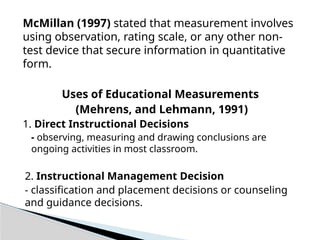
McMillan (1997) stated that measurement involves
using observation, rating scale, or any other non-
test device that secure information in quantitative
form.
Uses of Educational Measurements
(Mehrens, and Lehmann, 1991)
1. Direct Instructional Decisions
- observing, measuring and drawing conclusions are
ongoing activities in most classroom.
2. Instructional Management Decision
- classification and placement decisions or counseling
and guidance decisions.
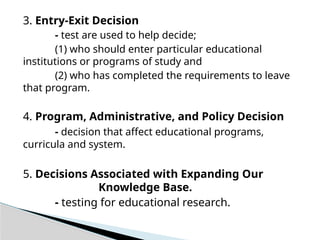
3. Entry-Exit Decision
- test are used to help decide;
(1) who should enter particular educational
institutions or programs of study and
(2) who has completed the requirements to leave
that program.
4. Program, Administrative, and Policy Decision
- decision that affect educational programs,
curricula and system.
5. Decisions Associated with Expanding Our
Knowledge Base.
- testing for educational research.
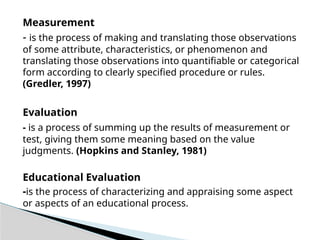
Measurement
- is the process of making and translating those observations
of some attribute, characteristics, or phenomenon and
translating those observations into quantifiable or categorical
form according to clearly specified procedure or rules.
(Gredler, 1997)
Evaluation
- is a process of summing up the results of measurement or
test, giving them some meaning based on the value
judgments. (Hopkins and Stanley, 1981)
Educational Evaluation
-is the process of characterizing and appraising some aspect
or aspects of an educational process.
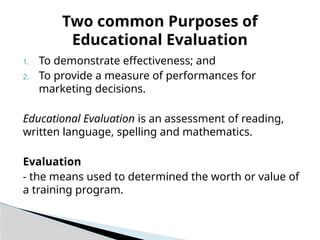
1. To demonstrate effectiveness; and
2. To provide a measure of performances for
marketing decisions.
Educational Evaluation is an assessment of reading,
written language, spelling and mathematics.
Evaluation
- the means used to determined the worth or value of
a training program.
Two common Purposes of
Educational Evaluation
- the process of improving a training process or deciding
whether or not to continue it.
- the process of delineating, collecting and providing
information useful for judging training decision alternative.
In assessment of student learning, the following are
important:
1. Feedback
- provides quality control over the design and delivery of
activities.
2. Control
- relates training policy and practice to organizational goals.
3. Research
- is to add to knowledge of training principles to
improve trainings.
4. Intervention
- is the process of using evaluation to affect the
way the program being evaluated is viewed, and
subsequently using this to redefine the sharing of
learning between trainers, trainees, and employing
management.
5. Power
-is to use evaluation information for a political
agenda.
- is the systematic collection, review and use of
information about educational programs undertaken for
the purpose of improving student learning and
development.
Assessment involves:
1. Setting explicit student learning goals or outcomes for
an academic program;
2. Evaluating the extent to which students are reaching
those goals; and
3. Using the information for program development and
improvement.
Assessment
The purpose of assessment is to
understand how educational programs are
working and to determined whether they are
contributing to student growth and
development. (Quellmalz, 1991)
Oosterhof (2001) defines assessment as “a
related series of measures used to determine
complex attribute of an individual or group of
individuals.
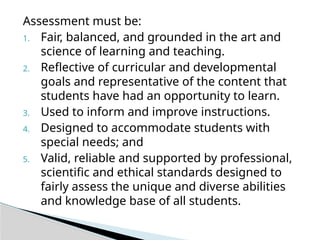
Assessment must be:
1. Fair, balanced, and grounded in the art and
science of learning and teaching.
2. Reflective of curricular and developmental
goals and representative of the content that
students have had an opportunity to learn.
3. Used to inform and improve instructions.
4. Designed to accommodate students with
special needs; and
5. Valid, reliable and supported by professional,
scientific and ethical standards designed to
fairly assess the unique and diverse abilities
and knowledge base of all students.
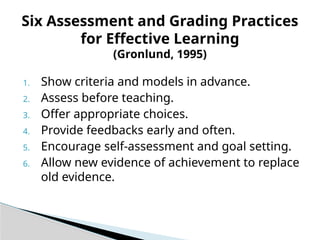
1. Show criteria and models in advance.
2. Assess before teaching.
3. Offer appropriate choices.
4. Provide feedbacks early and often.
5. Encourage self-assessment and goal setting.
6. Allow new evidence of achievement to replace
old evidence.
Six Assessment and Grading Practices
for Effective Learning
(Gronlund, 1995)
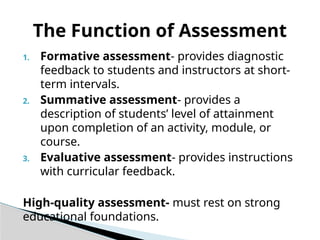
1. Formative assessment- provides diagnostic
feedback to students and instructors at short-
term intervals.
2. Summative assessment- provides a
description of students’ level of attainment
upon completion of an activity, module, or
course.
3. Evaluative assessment- provides instructions
with curricular feedback.
High-quality assessment- must rest on strong
educational foundations.
The Function of Assessment
Principle 1: The Primary Purpose of Assessment is to
Improve Student.
Principle 2: Assessment for Other Purposes Support
Student Learning.
Principle 3: Assessment System are Fair to All
Students.
Principle 4: Professional Collaboration and
Development Support Assessment.
Principle 5: The Broad Community Participates in
Assessment Development.
Principle 6: Communication about Assessment is Regular
and Clear.
Principle 7. Assessment System are Regularly Reviewed and
Improved.
Principles and Indicators of
Assessment of Student Learning
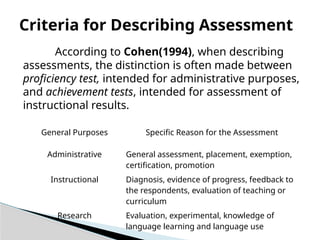
According to Cohen(1994), when describing
assessments, the distinction is often made between
proficiency test, intended for administrative purposes,
and achievement tests, intended for assessment of
instructional results.
Criteria for Describing Assessment
General Purposes Specific Reason for the Assessment
Administrative General assessment, placement, exemption,
certification, promotion
Instructional Diagnosis, evidence of progress, feedback to
the respondents, evaluation of teaching or
curriculum
Research Evaluation, experimental, knowledge of
language learning and language use
- is any type of assessment in which
student create response to a question or task.
Alternate assessment can include:
1. Short-answer questions;
2. Says;
3. Performance assessment;
4. Oral presentation;
5. Demonstrations, exhibitions; and
6. Portfolios.
Alternate Assessment
(Chase,1999)
- is the direct, systematic observation of an actual
student performance and the rating of that
performance according to previously established
performance criteria.
Performance Task
- is a goal directed assessment exercise.
Exhibition
- is a public performance during which a student
showcases learning and competence in particular
areas.
Performance Assessment
- collections of students’ work over time.
Incorporation Portfolio Assessment
(Gronlund, 2003)
Assessment Portfolio
- is a purposeful collection of student work
designed to showcase a student’s progress
toward, and achievement of, course-specific
learning objective.
Portfolios
1. Provides structure for involving students in developing
standards for quality performance.
2. Improves students’ metacognitive ability to understand
their own learning processes.
3. Promotes integration of various learning activities and
assessments.
4. Enhances awareness of strategies for thinking and
producing work.
5. Promotes an integrated assessment process.
Advantages of Using Portfolio
in Assessment
6. Allows assessment of process and progress.
7. Documents time, effort and improvement in students
understanding.
8. Create documentation to submit to authentic
audiences and/or reviewer.
9. Increase student accountability for their own learning.
10. Promotes assessment of a wider range of learning
styles.
11. Encourages students’ active involvement in the
assessment process.
12. Enhances motivation due to the visibility of the final
portfolio.
13. Promotes self-assessment.
14. Encourages the effective use of formative assessment.
15. Promotes creativity, individuality, and uniqueness in
the assessment learning.
16. Shifts instructors’ focus from comparative ranking to
improving understanding via feedback.
17. Promotes authentic assessment of valued knowledge
and skills.
1. Require additional time for planning instructional
activities.
2. Demands considerable time for assessment.
3. Time-intensive for instructors to implement since
students lack familiarity with portfolios.
4. Requires considerable storage space to maintain
portfolios.
5. May require special equipment.
Disadvantages of Using Portfolio in
Assessment
6. Often does not meet requirements for state or national
standards.
7. Subjective nature of grading may be less reliable.
8. May have limited acceptance by parents or administrators.
9. Does not provide standardized numerical scores that are
often needed for institutional reports or accreditation.
10. Students may need traditional scores or evidence of learning
for admission criteria, job placement, or similar events.
11. Development of grading rubrics or criteria takes a
considerable amount of time
12. Performance data from portfolio is difficult to analyze or
aggregate.
1. Documentation
- highlight development and improvement over
time. It showcase the process of learning by
including the full progression of project
development.
2. Process
- to document all stages of the learning process.
3. Product
- highlight a student’s best work by showcasing the
quality and range of student accomplishments.
Types of Assessment Portfolio
(Gronlund, 2000)
1. Planning. Instructors need to determined the function, type
and design of the portfolio.
2. Collection. Students are responsible for assembling
meaningful artifacts that reflect their own educational
progress.
3. Selection. A decision-making process in which collected
artifacts are sorted and elected for inclusion in the portfolio.
4. Reflection. Considered the most important step in portfolio
development; the metacognitive process of students
reflecting on their own learning differentiates a portfolio
from a simple collection.
Stages of Portfolio Development
5. Connection. Student expand on their
reflections to connect acquired knowledge and
skills with course goals and learning objectives.
Elements of a Portfolio
 Personal Statement – should include one or two
paragraphs highlighting relevant personal goals
and experiences of the student in relationship to
the goals and purposes of the portfolio.
 Table of Content- to ensure the portfolio is
functional and readable, include a table of
content with number pages.
 Entries- the type or purpose of the portfolio
will provide guidance in determining the
entries to be included.
 Reflections- may either appear with each
entry or following all entries.
Characteristic of an Effective Portfolio
(McMilla, 1997)
1. Effective portfolios are continuous and ongoing,
providing both formative and summative
opportunities for monitoring students’ progress
towards achieving learning objectives.
2. Portfolios should be multidimensional and
reflect a wide variety of artifacts.
3. Reflection are an essential part of an effective
portfolio.
4. Portfolios should clearly reflect learning
objectives as identified in the course
curriculum.
5. Effective portfolios provide evidence of
performance-based learning experiences as
well as students’ understanding of course-
specific knowledge and skills.
6. Portfolios are a targeted selection of student
work.
7. Quality portfolios must contain an element of
self-assessment.
8. Evaluation criteria for selecting and assessing
the portfolio contents, as well ass their own
learning experiences, students can identify
their personal strengths and weakness.
9. Portfolio should highlight the depth of a
student’s knowledge and skills,
10. While portfolios should be structured to
ensure they meet the goals and purposes of
assessment, it is important to allow a degree
of freedom for student to express their own
individuality and personal strengths.
1. While the instructors provides the portfolio
guidelines and requirements, the should
complete the bulk of portfolio development.
2. Items for conclusion in the portfolio are limited
only by the creativity and ingenuity of the
students.
3. The reiterative nature of portfolio development
can be facilitated through peer-reviews, self-
assessment, or instructor-student dialogues.
Tips for Utilizing Portfolios as a
Means of Classroom Assessment
4. Encourages students to actively reflects on their
own work by providing structured guidelines for
self-evaluation.
5. Keep portfolios in a location that is easily accessible
to both instructor and students.
6. Provide clear guideline as well as ongoing assistance
in the development.
Polakowki (1993) describes the three portfolio
management techniques she uses concurrently for
instruction and individualized assessment:
7. Teacher-directed – timed centers through which
small groups of students rotate for equal amounts
of time.
2. Child-directed – time centers that children
choose for the allotted time.
3. Child-selected – time centers that include
some “must do” task.
Relationship Between Instruction
and Assessment
According to Gronlund (1998), in preparing for
any type of instructional program the teacher’s
main concern is hoe to effectively bring about
student learning.
Instruction is most effective when:
1. Directed toward a clearly defined set of intended
learning outcomes.
2. The methods and materials of instruction are
congruent with the outcome.
3. The instruction is designed to fit the characteristics
and needs of the student.
4. Instructional decisions are based on information that is
meaningful, dependable and relevant.
5. Students are periodically informed concerning their
learning progress.
6. Remediation is provided for students not achieving the
intended learning.
7. Instructional effectiveness is periodically reviewed and
the intended learning outcomes and instruction are
modified as needed.
Assessment is most effective when:
1. Designed to assess a clearly defined set of intended
learning outcomes.
2. The nature and function of the assessment are
congruent with the outcomes.
3. The assessment are designed to fit the relevant
characteristic are fair to everyone.
4. Assessments provide information that is meaningful,
dependable, and relevant.
5. Provision is made for giving the students early
feedback of assessment results.
6. Specific learning weakness are revealed by the
assessment results.
7. Assessment results provide information useful for
evaluating the appropriateness of the objectives, the
methods, and the materials of instructions.