AUTHENTIC ASSESSMENT
(多元評量) METHODS
WORKSHOP
Anita Chiou
Yunlin Elementary School
December 6, 2013
My Background
• Master of Arts in Teaching, University of Southern
California, CA
• Bachelor of Arts in International Relations, Claremont
McKenna College, CA
• Study Abroad at St. Catherine’s College, Oxford
University, UK
• California State Teaching Credential in English
• California State Teaching Credential in Social Science
• Cambridge University CELTA Pass A Certificate
• Proficient in English, Spanish, Mandarin Chinese, and
Hakka
2
(c) 2013 Anita Chiou
What is Authentic Assessment?
• Refers to the measurement of “intellectual
accomplishments that are worthwhile,
significant, and meaningful”.1
• “A form of assessment in which students are
asked to perform real-world tasks that
demonstrate meaningful application of
essential knowledge and skills.” 2
1

Wehlage, G.G., Newmann, F.M., & Secada, W.G. (1996). Standards for Authentic Assessment
and Pedagogy. In F.M. Newmann & Associates (Ed.), Authentic Assessment: Restructuring
Schools for Intellectual Quality (pp. 21-48). San Francisco, CA: Jossey-Bass.
2 Mueller, J., 2011, Authentic Assessment Toolbox at
http://jonathan.mueller.faculty.noctrl.edu/toolbox/index.htm, accessed 29 November 2013.
3
(c) 2013 Anita Chiou
Other Names for “Authentic
Assessment”
• Performance Assessment
• Performance-based Assessment
• Rubric-based Assessment

4
(c) 2013 Anita Chiou
Clarifying the Concept of Authentic
Assessment 多元評量概念澄清
1. Do not eliminate written assessments.
多元評量並非廢除紙筆測驗。

2. Should not be used only for variety’s sake.
多元評量莫為多元而多元。

3. Are not the endpoint of learning.
多元評量並非學習終點。

4. Will not solve all the problems with assessment. 多
元評量並非萬靈丹。

5. Are not the objective of a lesson. 多元評量並非目的。
6. Are not subjective assessments.
多元評量並非主觀評量。
(c) 2013 Anita Chiou

Source: Hsu, M. (2013). “英語教學與多元評量理論與實務; 102年4月27日花蓮
縣工作坊” workshop

5
Why Do You Assess?
• Because our schools say we need to?
• Because the County says we need to?
• MOE?

6
(c) 2013 Anita Chiou
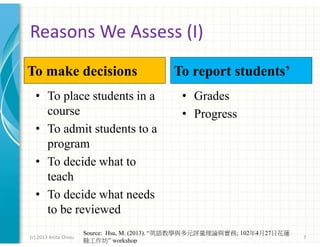
Reasons We Assess (I)
To make decisions
• To place students in a
course
• To admit students to a
program
• To decide what to
teach
• To decide what needs
to be reviewed
(c) 2013 Anita Chiou

To report students’
• Grades
• Progress

Source: Hsu, M. (2013). “英語教學與多元評量理論與實務; 102年4月27日花蓮
縣工作坊” workshop

7
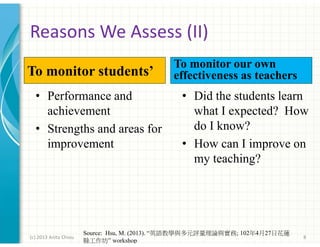
Reasons We Assess (II)
To monitor students’
• Performance and
achievement
• Strengths and areas for
improvement

(c) 2013 Anita Chiou

To monitor our own
effectiveness as teachers

• Did the students learn
what I expected? How
do I know?
• How can I improve on
my teaching?

Source: Hsu, M. (2013). “英語教學與多元評量理論與實務; 102年4月27日花蓮
縣工作坊” workshop

8
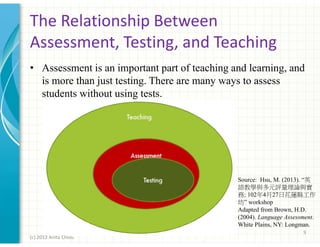
The Relationship Between
Assessment, Testing, and Teaching
• Assessment is an important part of teaching and learning, and
is more than just testing. There are many ways to assess
students without using tests.

Source: Hsu, M. (2013). “英
語教學與多元評量理論與實
務; 102年4月27日花蓮縣工作
坊” workshop
Adapted from Brown, H.D.
(2004). Language Assessment.
White Plains, NY: Longman.
9
(c) 2013 Anita Chiou
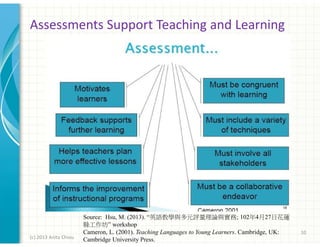
Assessments Support Teaching and Learning

(c) 2013 Anita Chiou

Source: Hsu, M. (2013). “英語教學與多元評量理論與實務; 102年4月27日花蓮
縣工作坊” workshop
Cameron, L. (2001). Teaching Languages to Young Learners. Cambridge, UK:
Cambridge University Press.

10
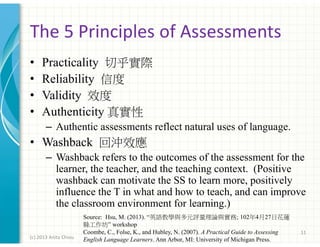
The 5 Principles of Assessments
•
•
•
•

Practicality 切乎實際
Reliability 信度
Validity 效度
Authenticity 真實性
– Authentic assessments reflect natural uses of language.

• Washback 回沖效應
– Washback refers to the outcomes of the assessment for the
learner, the teacher, and the teaching context. (Positive
washback can motivate the SS to learn more, positively
influence the T in what and how to teach, and can improve
the classroom environment for learning.)
(c) 2013 Anita Chiou

Source: Hsu, M. (2013). “英語教學與多元評量理論與實務; 102年4月27日花蓮
縣工作坊” workshop
Coombe, C., Folse, K., and Hubley, N. (2007). A Practical Guide to Assessing
English Language Learners. Ann Arbor, MI: University of Michigan Press.

11
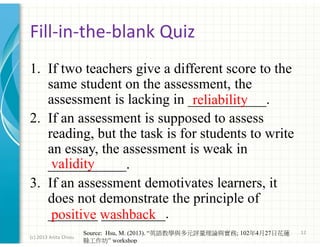
Fill-in-the-blank Quiz
1. If two teachers give a different score to the
same student on the assessment, the
assessment is lacking in ___________.
reliability
2. If an assessment is supposed to assess
reading, but the task is for students to write
an essay, the assessment is weak in
validity
___________.
3. If an assessment demotivates learners, it
does not demonstrate the principle of
_______ washback
positive _________.
(c) 2013 Anita Chiou

Source: Hsu, M. (2013). “英語教學與多元評量理論與實務; 102年4月27日花蓮
縣工作坊” workshop

12
When Should We Assess English
Learners?
In the Beginning (Initial or Diagnostic Assessment)
• Purpose: “to gain information about students’ levels of
English in order to tailor future instruction to meet
students’ specific language needs.”
During Teaching (Formative Assessment Process)
• Purpose: “to strengthen students’ abilities to assess their
progress, to set and evaluate their own learning goals, and
to make adjustments accordingly. [It] also elicits valuable
feedback from students about what teachers are doing
effectively and what they could do better.”
At the End (Summative Assessment)
• Purpose: “mainly used at the end of an instructional
sequence or grading period to measure student learning.”
(c) 2013 Anita Chiou

Source: Ferlazzo, L., Hull Sypnieski, K. (2012). The ESL / ELL Teacher’s Survival
Guide. San Francisco: Jossey-Bass, p. 278-285.

13
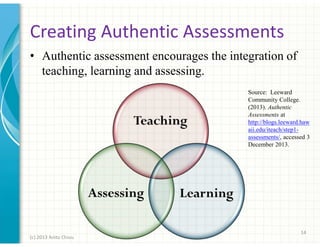
Creating Authentic Assessments
• Authentic assessment encourages the integration of
teaching, learning and assessing.
Source: Leeward
Community College.
(2013). Authentic
Assessments at
http://blogs.leeward.haw
aii.edu/iteach/step1assessments/, accessed 3
December 2013.

14
(c) 2013 Anita Chiou
What is Authentic Assessment?
• An authentic assessment includes:
1. An authentic task for students to
perform,
2. A rubric / scoring guide by which the
performance on the task will be evaluated.

(c) 2013 Anita Chiou

Source: Leeward Community College. (2013). Authentic Assessments at
15
http://blogs.leeward.hawaii.edu/iteach/step1-assessments/, accessed 3 December 2013.
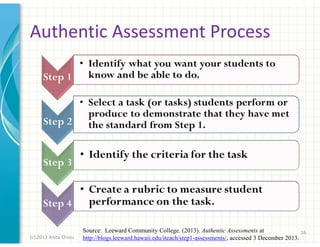
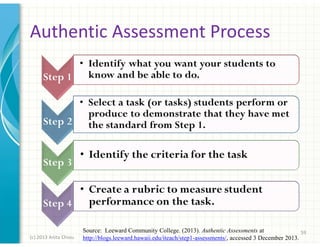
Authentic Assessment Process

(c) 2013 Anita Chiou

Source: Leeward Community College. (2013). Authentic Assessments at
16
http://blogs.leeward.hawaii.edu/iteach/step1-assessments/, accessed 3 December 2013.
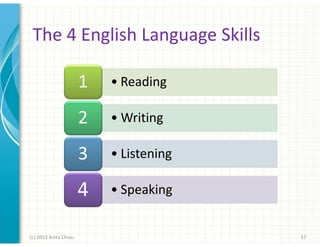
The 4 English Language Skills
1
2

• Writing

3

• Listening

4
(c) 2013 Anita Chiou

• Reading

• Speaking

17
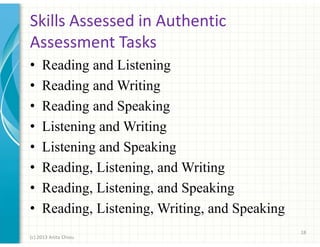
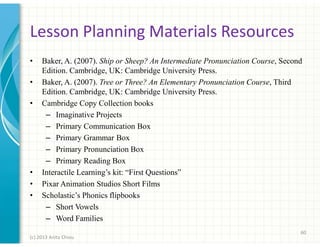
Skills Assessed in Authentic
Assessment Tasks
•
•
•
•
•
•
•
•

Reading and Listening
Reading and Writing
Reading and Speaking
Listening and Writing
Listening and Speaking
Reading, Listening, and Writing
Reading, Listening, and Speaking
Reading, Listening, Writing, and Speaking
18

(c) 2013 Anita Chiou
Methods for Assessing
Reading and Listening

(c) 2013 Anita Chiou

19
Skills Assessed: Reading and Listening
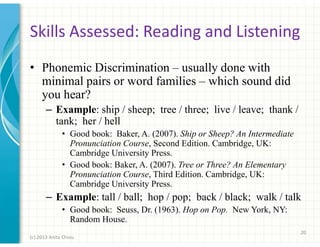
• Phonemic Discrimination – usually done with
minimal pairs or word families – which sound did
you hear?
– Example: ship / sheep; tree / three; live / leave; thank /
tank; her / hell
• Good book: Baker, A. (2007). Ship or Sheep? An Intermediate
Pronunciation Course, Second Edition. Cambridge, UK:
Cambridge University Press.
• Good book: Baker, A. (2007). Tree or Three? An Elementary
Pronunciation Course, Third Edition. Cambridge, UK:
Cambridge University Press.

– Example: tall / ball; hop / pop; back / black; walk / talk
• Good book: Seuss, Dr. (1963). Hop on Pop. New York, NY:
Random House.
20
(c) 2013 Anita Chiou
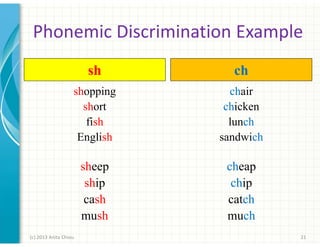
Phonemic Discrimination Example
sh

ch

shopping
short
fish
English

chair
chicken
lunch
sandwich

sheep
ship
cash
mush

cheap
chip
catch
much

(c) 2013 Anita Chiou

21
Skills Assessed: Reading and Listening
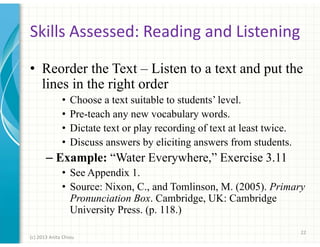
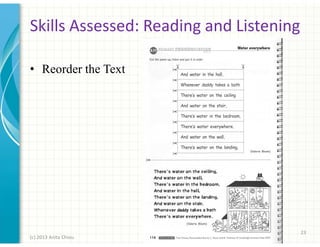
• Reorder the Text – Listen to a text and put the
lines in the right order
•
•
•
•

Choose a text suitable to students’ level.
Pre-teach any new vocabulary words.
Dictate text or play recording of text at least twice.
Discuss answers by eliciting answers from students.

– Example: “Water Everywhere,” Exercise 3.11
• See Appendix 1.
• Source: Nixon, C., and Tomlinson, M. (2005). Primary
Pronunciation Box. Cambridge, UK: Cambridge
University Press. (p. 118.)
22
(c) 2013 Anita Chiou
Skills Assessed: Reading and Listening
• Reorder the Text

23
(c) 2013 Anita Chiou
Methods for Assessing
Reading and Writing

(c) 2013 Anita Chiou

24
Skills Assessed: Reading and Writing
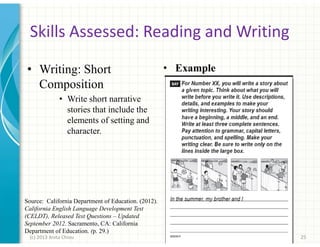
• Writing: Short
Composition

• Example

• Write short narrative
stories that include the
elements of setting and
character.

Source: California Department of Education. (2012).
California English Language Development Test
(CELDT), Released Test Questions – Updated
September 2012. Sacramento, CA: California
Department of Education. (p. 29.)
(c) 2013 Anita Chiou

25
Skills Assessed: Reading and Writing
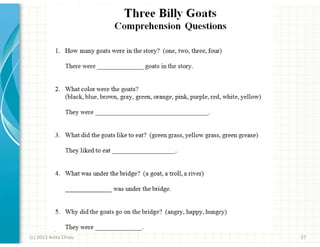
• Writing: Reading Comprehension Questions
• After reading the text, answer questions about the text.
Write the answers in the blanks.

– Example: “Three Billy Goats” reading
comprehension questions
• See Appendix 2.
– Book used: Arengo, S. (1998). Three Billy Goats, Beginner 1
Level, Oxford, UK: Oxford University Press Classic Tales.

26
(c) 2013 Anita Chiou

27
Methods for Assessing
Reading and Speaking

(c) 2013 Anita Chiou

28
Skills Assessed: Reading and Speaking
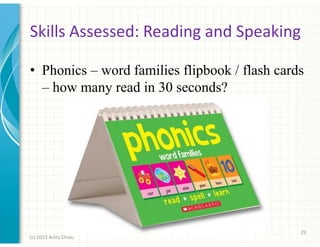
• Phonics – word families flipbook / flash cards
– how many read in 30 seconds?

29
(c) 2013 Anita Chiou
Skills Assessed: Reading and Speaking
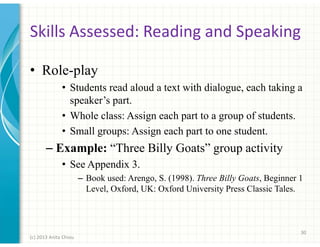
• Role-play
• Students read aloud a text with dialogue, each taking a
speaker’s part.
• Whole class: Assign each part to a group of students.
• Small groups: Assign each part to one student.

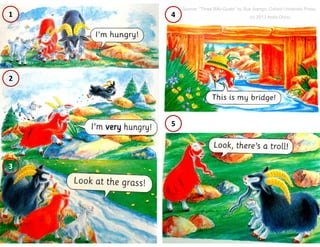
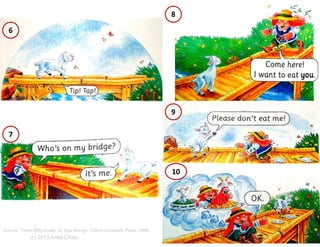
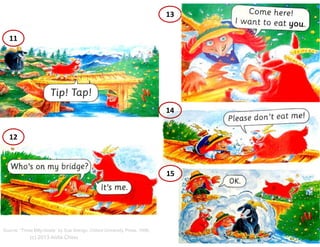
– Example: “Three Billy Goats” group activity
• See Appendix 3.
– Book used: Arengo, S. (1998). Three Billy Goats, Beginner 1
Level, Oxford, UK: Oxford University Press Classic Tales.

30
(c) 2013 Anita Chiou
Source: “Three Billy-Goats” by Sue Arengo, Oxford University Press,

1

4

(c) 2013 Anita Chiou

2

5

3

(c) 2013 Anita Chiou

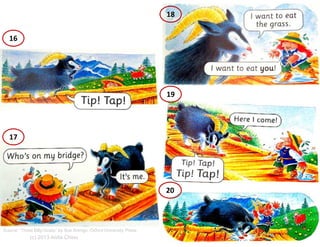
31
8
6

9
7

10

Source: “Three Billy-Goats” by Sue Arengo, Oxford University Press, 1998,

(c) 2013 Anita Chiou

32
13
11

14
12

15

Source: “Three Billy-Goats” by Sue Arengo, Oxford University Press, 1998,

(c) 2013 Anita Chiou

33
18
16

19

17

20

Source: “Three Billy-Goats” by Sue Arengo, Oxford University Press,

(c) 2013 Anita Chiou

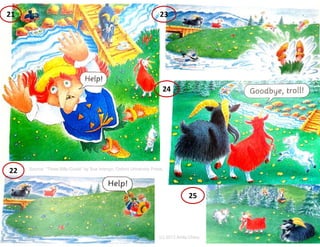
34
21

23

24

22

Source: “Three Billy-Goats” by Sue Arengo, Oxford University Press,

25

(c) 2013 Anita Chiou

(c) 2013 Anita Chiou

35
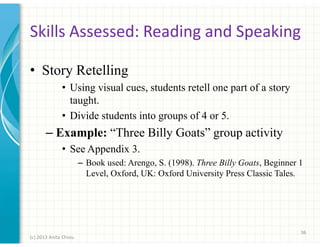
Skills Assessed: Reading and Speaking
• Story Retelling
• Using visual cues, students retell one part of a story
taught.
• Divide students into groups of 4 or 5.

– Example: “Three Billy Goats” group activity
• See Appendix 3.
– Book used: Arengo, S. (1998). Three Billy Goats, Beginner 1
Level, Oxford, UK: Oxford University Press Classic Tales.

36
(c) 2013 Anita Chiou
Skills Assessed: Reading and Speaking
• Reader’s Theater
– Example: “Three Billy Goats” RT Script
• See Appendix 4.
– Book used: Arengo, S. (1998). Three Billy Goats, Beginner 1
Level, Oxford, UK: Oxford University Press Classic Tales.

37
(c) 2013 Anita Chiou
Methods for Assessing
Listening and Writing

(c) 2013 Anita Chiou

38
Skills Assessed: Listening and Writing
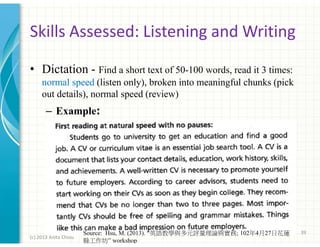
• Dictation - Find a short text of 50-100 words, read it 3 times:
normal speed (listen only), broken into meaningful chunks (pick
out details), normal speed (review)

– Example:

(c) 2013 Anita Chiou

Source: Hsu, M. (2013). “英語教學與多元評量理論與實務; 102年4月27日花蓮
縣工作坊” workshop

39
Skills Assessed: Listening and Writing
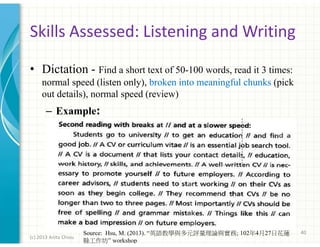
• Dictation - Find a short text of 50-100 words, read it 3 times:
normal speed (listen only), broken into meaningful chunks (pick
out details), normal speed (review)

– Example:

(c) 2013 Anita Chiou

Source: Hsu, M. (2013). “英語教學與多元評量理論與實務; 102年4月27日花蓮
縣工作坊” workshop

40
Skills Assessed: Listening and Writing
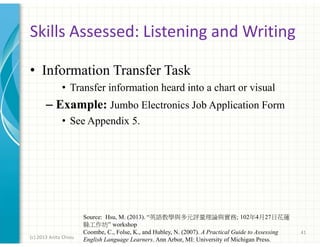
• Information Transfer Task
• Transfer information heard into a chart or visual

– Example: Jumbo Electronics Job Application Form
• See Appendix 5.

(c) 2013 Anita Chiou

Source: Hsu, M. (2013). “英語教學與多元評量理論與實務; 102年4月27日花蓮
縣工作坊” workshop
Coombe, C., Folse, K., and Hubley, N. (2007). A Practical Guide to Assessing
English Language Learners. Ann Arbor, MI: University of Michigan Press.

41
Methods for Assessing
Listening and Speaking

(c) 2013 Anita Chiou

42
Skills Assessed: Listening and
Speaking
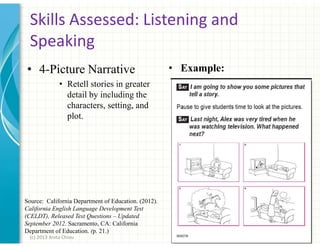
• 4-Picture Narrative

• Example:

• Retell stories in greater
detail by including the
characters, setting, and
plot.

Source: California Department of Education. (2012).
California English Language Development Test
(CELDT), Released Test Questions – Updated
September 2012. Sacramento, CA: California
Department of Education. (p. 21.)
(c) 2013 Anita Chiou

43
Skills Assessed: Listening and
Speaking
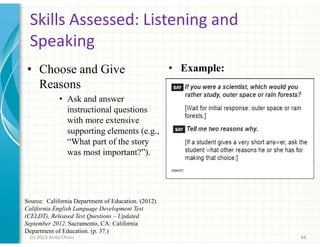
• Choose and Give
Reasons

• Example:

• Ask and answer
instructional questions
with more extensive
supporting elements (e.g.,
“What part of the story
was most important?”).

Source: California Department of Education. (2012).
California English Language Development Test
(CELDT), Released Test Questions – Updated
September 2012. Sacramento, CA: California
Department of Education. (p. 37.)
(c) 2013 Anita Chiou

44
Methods for Assessing
Reading, Listening,
and Writing
(c) 2013 Anita Chiou

45
Skills Assessed: Reading, Listening,
and Writing
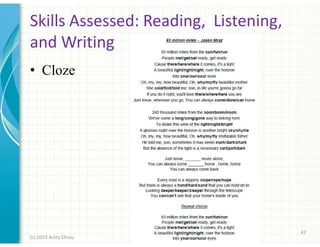
• Cloze – Listen to a song and fill-in-the-blanks
(or gap-fill) of the lyrics
• Choose a song with lyrics suitable to students’ level.
• Pre-teach or discuss gap-fill choices before asking students
to do activity.
• Read aloud lyrics in worksheet with class if desired.
• Play song at least twice.
• Discuss answers by eliciting answers from students.

– Example: “93 Million Miles” by Jason Mraz
(worksheet from busyteacher.org; official video with
lyrics available)
• See Appendix 6.
• Google “ESL songs for teaching English” or “song lyrics
cloze”
46
(c) 2013 Anita Chiou
Skills Assessed: Reading, Listening,
and Writing
• Cloze

47
(c) 2013 Anita Chiou
Methods for Assessing
Reading, Listening,
and Speaking
(c) 2013 Anita Chiou

48
Skills Assessed: Reading, Listening,
and Speaking
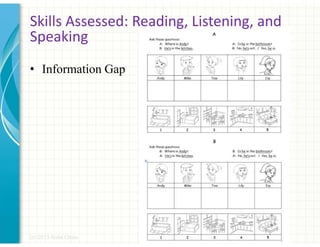
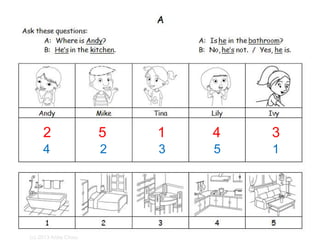
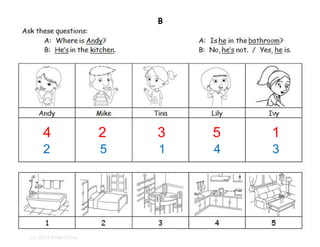
• Information Gap
• An activity where learners are missing the information
they need to complete a task and need to talk to each
other to find it.1

– Example: “Where is Andy?”
• See Appendix 7.

1

British Council. (2012). Teaching English: Information Gap at
http://www.teachingenglish.org.uk/knowledge-database/information-gap, accessed 29
November 2013.
49
(c) 2013 Anita Chiou
Skills Assessed: Reading, Listening, and
Speaking
• Information Gap

(c) 2013 Anita Chiou

50
2

5

1

4

3

4

2

3

5

1

(c) 2013 Anita Chiou

51
B

4

2

3

5

1

2

5

1

4

3

(c) 2013 Anita Chiou

52
Methods for Assessing
Reading, Listening,
Writing, and Speaking
(c) 2013 Anita Chiou

53
Skills Assessed: Reading, Listening,
Writing, and Speaking
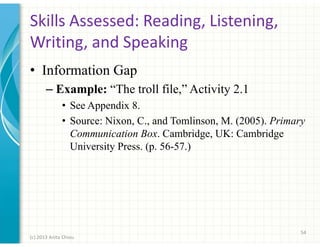
• Information Gap
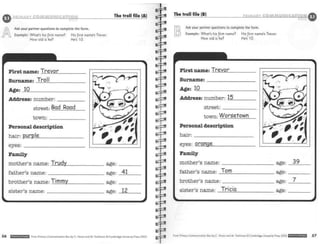
– Example: “The troll file,” Activity 2.1
• See Appendix 8.
• Source: Nixon, C., and Tomlinson, M. (2005). Primary
Communication Box. Cambridge, UK: Cambridge
University Press. (p. 56-57.)

54
(c) 2013 Anita Chiou

55
Skills Assessed: Reading, Listening,
Writing, and Speaking
• Group Project
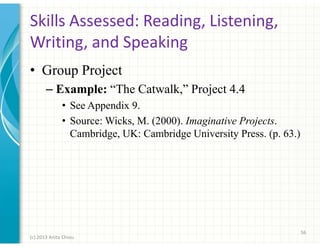
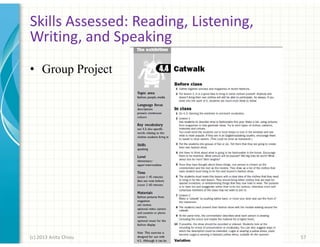
– Example: “The Catwalk,” Project 4.4
• See Appendix 9.
• Source: Wicks, M. (2000). Imaginative Projects.
Cambridge, UK: Cambridge University Press. (p. 63.)

56
(c) 2013 Anita Chiou
Skills Assessed: Reading, Listening,
Writing, and Speaking
• Group Project

(c) 2013 Anita Chiou

57
Now it’s YOUR
turn!
(c) 2013 Anita Chiou

58
Authentic Assessment Process

(c) 2013 Anita Chiou

Source: Leeward Community College. (2013). Authentic Assessments at
59
http://blogs.leeward.hawaii.edu/iteach/step1-assessments/, accessed 3 December 2013.
Lesson Planning Materials Resources
•
•
•

•
•
•

Baker, A. (2007). Ship or Sheep? An Intermediate Pronunciation Course, Second
Edition. Cambridge, UK: Cambridge University Press.
Baker, A. (2007). Tree or Three? An Elementary Pronunciation Course, Third
Edition. Cambridge, UK: Cambridge University Press.
Cambridge Copy Collection books
– Imaginative Projects
– Primary Communication Box
– Primary Grammar Box
– Primary Pronunciation Box
– Primary Reading Box
Interactile Learning’s kit: “First Questions”
Pixar Animation Studios Short Films
Scholastic’s Phonics flipbooks
– Short Vowels
– Word Families
60

(c) 2013 Anita Chiou
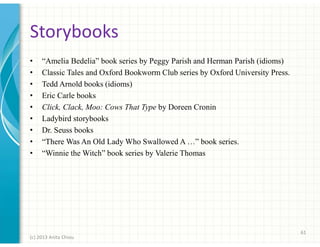
Storybooks
•
•
•
•
•
•
•
•
•

“Amelia Bedelia” book series by Peggy Parish and Herman Parish (idioms)
Classic Tales and Oxford Bookworm Club series by Oxford University Press.
Tedd Arnold books (idioms)
Eric Carle books
Click, Clack, Moo: Cows That Type by Doreen Cronin
Ladybird storybooks
Dr. Seuss books
“There Was An Old Lady Who Swallowed A …” book series.
“Winnie the Witch” book series by Valerie Thomas

61
(c) 2013 Anita Chiou
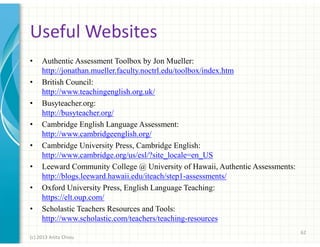
Useful Websites
•
•
•
•
•
•
•
•

Authentic Assessment Toolbox by Jon Mueller:
http://jonathan.mueller.faculty.noctrl.edu/toolbox/index.htm
British Council:
http://www.teachingenglish.org.uk/
Busyteacher.org:
http://busyteacher.org/
Cambridge English Language Assessment:
http://www.cambridgeenglish.org/
Cambridge University Press, Cambridge English:
http://www.cambridge.org/us/esl/?site_locale=en_US
Leeward Community College @ University of Hawaii, Authentic Assessments:
http://blogs.leeward.hawaii.edu/iteach/step1-assessments/
Oxford University Press, English Language Teaching:
https://elt.oup.com/
Scholastic Teachers Resources and Tools:
http://www.scholastic.com/teachers/teaching-resources
62

(c) 2013 Anita Chiou
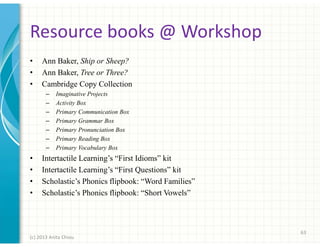
Resource books @ Workshop
•
•
•

Ann Baker, Ship or Sheep?
Ann Baker, Tree or Three?
Cambridge Copy Collection
–
–
–
–
–
–
–

•
•
•
•

Imaginative Projects
Activity Box
Primary Communication Box
Primary Grammar Box
Primary Pronunciation Box
Primary Reading Box
Primary Vocabulary Box

Intertactile Learning’s “First Idioms” kit
Intertactile Learning’s “First Questions” kit
Scholastic’s Phonics flipbook: “Word Families”
Scholastic’s Phonics flipbook: “Short Vowels”

63
(c) 2013 Anita Chiou
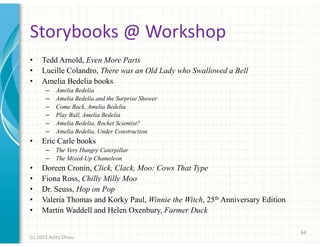
Storybooks @ Workshop
•
•
•

Tedd Arnold, Even More Parts
Lucille Colandro, There was an Old Lady who Swallowed a Bell
Amelia Bedelia books
–
–
–
–
–
–

•

Eric Carle books
–
–

•
•
•
•
•

Amelia Bedelia
Amelia Bedelia and the Surprise Shower
Come Back, Amelia Bedelia
Play Ball, Amelia Bedelia
Amelia Bedelia, Rocket Scientist?
Amelia Bedelia, Under Construction
The Very Hungry Caterpillar
The Mixed-Up Chameleon

Doreen Cronin, Click, Clack, Moo: Cows That Type
Fiona Ross, Chilly Milly Moo
Dr. Seuss, Hop on Pop
Valeria Thomas and Korky Paul, Winnie the Witch, 25th Anniversary Edition
Martin Waddell and Helen Oxenbury, Farmer Duck
64

(c) 2013 Anita Chiou
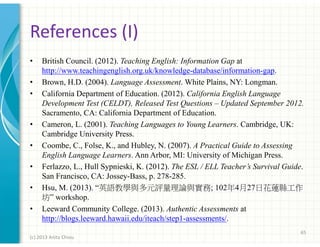
References (I)
•
•
•

•
•
•
•
•

British Council. (2012). Teaching English: Information Gap at
http://www.teachingenglish.org.uk/knowledge-database/information-gap.
Brown, H.D. (2004). Language Assessment. White Plains, NY: Longman.
California Department of Education. (2012). California English Language
Development Test (CELDT), Released Test Questions – Updated September 2012.
Sacramento, CA: California Department of Education.
Cameron, L. (2001). Teaching Languages to Young Learners. Cambridge, UK:
Cambridge University Press.
Coombe, C., Folse, K., and Hubley, N. (2007). A Practical Guide to Assessing
English Language Learners. Ann Arbor, MI: University of Michigan Press.
Ferlazzo, L., Hull Sypnieski, K. (2012). The ESL / ELL Teacher’s Survival Guide.
San Francisco, CA: Jossey-Bass, p. 278-285.
Hsu, M. (2013). “英語教學與多元評量理論與實務; 102年4月27日花蓮縣工作
坊” workshop.
Leeward Community College. (2013). Authentic Assessments at
http://blogs.leeward.hawaii.edu/iteach/step1-assessments/.
65

(c) 2013 Anita Chiou
References (II)
•
•
•
•
•

•

Mueller, J., 2011, Authentic Assessment Toolbox at
http://jonathan.mueller.faculty.noctrl.edu/toolbox/index.htm.
Nixon, C., and Tomlinson, M. (2005). Primary Communication Box. Cambridge,
UK: Cambridge University Press.
Nixon, C., and Tomlinson, M. (2005). Primary Pronunciation Box. Cambridge,
UK: Cambridge University Press.
Sachamedcraft. (n/a). “Song Worksheet: 93 Million Miles by Jason Mraz
[Alternative]” at http://busyteacher.org/14843-93-million-miles.html,
Wehlage, G.G., Newmann, F.M., & Secada, W.G. (1996). Standards for
Authentic Assessment and Pedagogy. In F.M. Newmann & Associates (Ed.),
Authentic Assessment: Restructuring Schools for Intellectual Quality. San
Francisco, CA: Jossey-Bass.
Wicks, M. (2000). Imaginative Projects. Cambridge, UK: Cambridge University
Press.

66
(c) 2013 Anita Chiou
QUESTIONS?

Anita Chiou
anitachiou98@gmail.com
(c) 2013 Anita Chiou

THANK YOU!
67

Authentic Assessment (多元評量) Methods Workshop (12/6/2013)

  • 1.
    AUTHENTIC ASSESSMENT (多元評量) METHODS WORKSHOP AnitaChiou Yunlin Elementary School December 6, 2013
  • 2.
    My Background • Masterof Arts in Teaching, University of Southern California, CA • Bachelor of Arts in International Relations, Claremont McKenna College, CA • Study Abroad at St. Catherine’s College, Oxford University, UK • California State Teaching Credential in English • California State Teaching Credential in Social Science • Cambridge University CELTA Pass A Certificate • Proficient in English, Spanish, Mandarin Chinese, and Hakka 2 (c) 2013 Anita Chiou
  • 3.
    What is AuthenticAssessment? • Refers to the measurement of “intellectual accomplishments that are worthwhile, significant, and meaningful”.1 • “A form of assessment in which students are asked to perform real-world tasks that demonstrate meaningful application of essential knowledge and skills.” 2 1 Wehlage, G.G., Newmann, F.M., & Secada, W.G. (1996). Standards for Authentic Assessment and Pedagogy. In F.M. Newmann & Associates (Ed.), Authentic Assessment: Restructuring Schools for Intellectual Quality (pp. 21-48). San Francisco, CA: Jossey-Bass. 2 Mueller, J., 2011, Authentic Assessment Toolbox at http://jonathan.mueller.faculty.noctrl.edu/toolbox/index.htm, accessed 29 November 2013. 3 (c) 2013 Anita Chiou
  • 4.
    Other Names for“Authentic Assessment” • Performance Assessment • Performance-based Assessment • Rubric-based Assessment 4 (c) 2013 Anita Chiou
  • 5.
    Clarifying the Conceptof Authentic Assessment 多元評量概念澄清 1. Do not eliminate written assessments. 多元評量並非廢除紙筆測驗。 2. Should not be used only for variety’s sake. 多元評量莫為多元而多元。 3. Are not the endpoint of learning. 多元評量並非學習終點。 4. Will not solve all the problems with assessment. 多 元評量並非萬靈丹。 5. Are not the objective of a lesson. 多元評量並非目的。 6. Are not subjective assessments. 多元評量並非主觀評量。 (c) 2013 Anita Chiou Source: Hsu, M. (2013). “英語教學與多元評量理論與實務; 102年4月27日花蓮 縣工作坊” workshop 5
  • 6.
    Why Do YouAssess? • Because our schools say we need to? • Because the County says we need to? • MOE? 6 (c) 2013 Anita Chiou
  • 7.
    Reasons We Assess(I) To make decisions • To place students in a course • To admit students to a program • To decide what to teach • To decide what needs to be reviewed (c) 2013 Anita Chiou To report students’ • Grades • Progress Source: Hsu, M. (2013). “英語教學與多元評量理論與實務; 102年4月27日花蓮 縣工作坊” workshop 7
  • 8.
    Reasons We Assess(II) To monitor students’ • Performance and achievement • Strengths and areas for improvement (c) 2013 Anita Chiou To monitor our own effectiveness as teachers • Did the students learn what I expected? How do I know? • How can I improve on my teaching? Source: Hsu, M. (2013). “英語教學與多元評量理論與實務; 102年4月27日花蓮 縣工作坊” workshop 8
  • 9.
    The Relationship Between Assessment,Testing, and Teaching • Assessment is an important part of teaching and learning, and is more than just testing. There are many ways to assess students without using tests. Source: Hsu, M. (2013). “英 語教學與多元評量理論與實 務; 102年4月27日花蓮縣工作 坊” workshop Adapted from Brown, H.D. (2004). Language Assessment. White Plains, NY: Longman. 9 (c) 2013 Anita Chiou
  • 10.
    Assessments Support Teachingand Learning (c) 2013 Anita Chiou Source: Hsu, M. (2013). “英語教學與多元評量理論與實務; 102年4月27日花蓮 縣工作坊” workshop Cameron, L. (2001). Teaching Languages to Young Learners. Cambridge, UK: Cambridge University Press. 10
  • 11.
    The 5 Principlesof Assessments • • • • Practicality 切乎實際 Reliability 信度 Validity 效度 Authenticity 真實性 – Authentic assessments reflect natural uses of language. • Washback 回沖效應 – Washback refers to the outcomes of the assessment for the learner, the teacher, and the teaching context. (Positive washback can motivate the SS to learn more, positively influence the T in what and how to teach, and can improve the classroom environment for learning.) (c) 2013 Anita Chiou Source: Hsu, M. (2013). “英語教學與多元評量理論與實務; 102年4月27日花蓮 縣工作坊” workshop Coombe, C., Folse, K., and Hubley, N. (2007). A Practical Guide to Assessing English Language Learners. Ann Arbor, MI: University of Michigan Press. 11
  • 12.
    Fill-in-the-blank Quiz 1. Iftwo teachers give a different score to the same student on the assessment, the assessment is lacking in ___________. reliability 2. If an assessment is supposed to assess reading, but the task is for students to write an essay, the assessment is weak in validity ___________. 3. If an assessment demotivates learners, it does not demonstrate the principle of _______ washback positive _________. (c) 2013 Anita Chiou Source: Hsu, M. (2013). “英語教學與多元評量理論與實務; 102年4月27日花蓮 縣工作坊” workshop 12
  • 13.
    When Should WeAssess English Learners? In the Beginning (Initial or Diagnostic Assessment) • Purpose: “to gain information about students’ levels of English in order to tailor future instruction to meet students’ specific language needs.” During Teaching (Formative Assessment Process) • Purpose: “to strengthen students’ abilities to assess their progress, to set and evaluate their own learning goals, and to make adjustments accordingly. [It] also elicits valuable feedback from students about what teachers are doing effectively and what they could do better.” At the End (Summative Assessment) • Purpose: “mainly used at the end of an instructional sequence or grading period to measure student learning.” (c) 2013 Anita Chiou Source: Ferlazzo, L., Hull Sypnieski, K. (2012). The ESL / ELL Teacher’s Survival Guide. San Francisco: Jossey-Bass, p. 278-285. 13
  • 14.
    Creating Authentic Assessments •Authentic assessment encourages the integration of teaching, learning and assessing. Source: Leeward Community College. (2013). Authentic Assessments at http://blogs.leeward.haw aii.edu/iteach/step1assessments/, accessed 3 December 2013. 14 (c) 2013 Anita Chiou
  • 15.
    What is AuthenticAssessment? • An authentic assessment includes: 1. An authentic task for students to perform, 2. A rubric / scoring guide by which the performance on the task will be evaluated. (c) 2013 Anita Chiou Source: Leeward Community College. (2013). Authentic Assessments at 15 http://blogs.leeward.hawaii.edu/iteach/step1-assessments/, accessed 3 December 2013.
  • 16.
    Authentic Assessment Process (c)2013 Anita Chiou Source: Leeward Community College. (2013). Authentic Assessments at 16 http://blogs.leeward.hawaii.edu/iteach/step1-assessments/, accessed 3 December 2013.
  • 17.
    The 4 EnglishLanguage Skills 1 2 • Writing 3 • Listening 4 (c) 2013 Anita Chiou • Reading • Speaking 17
  • 18.
    Skills Assessed inAuthentic Assessment Tasks • • • • • • • • Reading and Listening Reading and Writing Reading and Speaking Listening and Writing Listening and Speaking Reading, Listening, and Writing Reading, Listening, and Speaking Reading, Listening, Writing, and Speaking 18 (c) 2013 Anita Chiou
  • 19.
    Methods for Assessing Readingand Listening (c) 2013 Anita Chiou 19
  • 20.
    Skills Assessed: Readingand Listening • Phonemic Discrimination – usually done with minimal pairs or word families – which sound did you hear? – Example: ship / sheep; tree / three; live / leave; thank / tank; her / hell • Good book: Baker, A. (2007). Ship or Sheep? An Intermediate Pronunciation Course, Second Edition. Cambridge, UK: Cambridge University Press. • Good book: Baker, A. (2007). Tree or Three? An Elementary Pronunciation Course, Third Edition. Cambridge, UK: Cambridge University Press. – Example: tall / ball; hop / pop; back / black; walk / talk • Good book: Seuss, Dr. (1963). Hop on Pop. New York, NY: Random House. 20 (c) 2013 Anita Chiou
  • 21.
  • 22.
    Skills Assessed: Readingand Listening • Reorder the Text – Listen to a text and put the lines in the right order • • • • Choose a text suitable to students’ level. Pre-teach any new vocabulary words. Dictate text or play recording of text at least twice. Discuss answers by eliciting answers from students. – Example: “Water Everywhere,” Exercise 3.11 • See Appendix 1. • Source: Nixon, C., and Tomlinson, M. (2005). Primary Pronunciation Box. Cambridge, UK: Cambridge University Press. (p. 118.) 22 (c) 2013 Anita Chiou
  • 23.
    Skills Assessed: Readingand Listening • Reorder the Text 23 (c) 2013 Anita Chiou
  • 24.
    Methods for Assessing Readingand Writing (c) 2013 Anita Chiou 24
  • 25.
    Skills Assessed: Readingand Writing • Writing: Short Composition • Example • Write short narrative stories that include the elements of setting and character. Source: California Department of Education. (2012). California English Language Development Test (CELDT), Released Test Questions – Updated September 2012. Sacramento, CA: California Department of Education. (p. 29.) (c) 2013 Anita Chiou 25
  • 26.
    Skills Assessed: Readingand Writing • Writing: Reading Comprehension Questions • After reading the text, answer questions about the text. Write the answers in the blanks. – Example: “Three Billy Goats” reading comprehension questions • See Appendix 2. – Book used: Arengo, S. (1998). Three Billy Goats, Beginner 1 Level, Oxford, UK: Oxford University Press Classic Tales. 26 (c) 2013 Anita Chiou
  • 27.
  • 28.
    Methods for Assessing Readingand Speaking (c) 2013 Anita Chiou 28
  • 29.
    Skills Assessed: Readingand Speaking • Phonics – word families flipbook / flash cards – how many read in 30 seconds? 29 (c) 2013 Anita Chiou
  • 30.
    Skills Assessed: Readingand Speaking • Role-play • Students read aloud a text with dialogue, each taking a speaker’s part. • Whole class: Assign each part to a group of students. • Small groups: Assign each part to one student. – Example: “Three Billy Goats” group activity • See Appendix 3. – Book used: Arengo, S. (1998). Three Billy Goats, Beginner 1 Level, Oxford, UK: Oxford University Press Classic Tales. 30 (c) 2013 Anita Chiou
  • 31.
    Source: “Three Billy-Goats”by Sue Arengo, Oxford University Press, 1 4 (c) 2013 Anita Chiou 2 5 3 (c) 2013 Anita Chiou 31
  • 32.
    8 6 9 7 10 Source: “Three Billy-Goats”by Sue Arengo, Oxford University Press, 1998, (c) 2013 Anita Chiou 32
  • 33.
    13 11 14 12 15 Source: “Three Billy-Goats”by Sue Arengo, Oxford University Press, 1998, (c) 2013 Anita Chiou 33
  • 34.
    18 16 19 17 20 Source: “Three Billy-Goats”by Sue Arengo, Oxford University Press, (c) 2013 Anita Chiou 34
  • 35.
    21 23 24 22 Source: “Three Billy-Goats”by Sue Arengo, Oxford University Press, 25 (c) 2013 Anita Chiou (c) 2013 Anita Chiou 35
  • 36.
    Skills Assessed: Readingand Speaking • Story Retelling • Using visual cues, students retell one part of a story taught. • Divide students into groups of 4 or 5. – Example: “Three Billy Goats” group activity • See Appendix 3. – Book used: Arengo, S. (1998). Three Billy Goats, Beginner 1 Level, Oxford, UK: Oxford University Press Classic Tales. 36 (c) 2013 Anita Chiou
  • 37.
    Skills Assessed: Readingand Speaking • Reader’s Theater – Example: “Three Billy Goats” RT Script • See Appendix 4. – Book used: Arengo, S. (1998). Three Billy Goats, Beginner 1 Level, Oxford, UK: Oxford University Press Classic Tales. 37 (c) 2013 Anita Chiou
  • 38.
    Methods for Assessing Listeningand Writing (c) 2013 Anita Chiou 38
  • 39.
    Skills Assessed: Listeningand Writing • Dictation - Find a short text of 50-100 words, read it 3 times: normal speed (listen only), broken into meaningful chunks (pick out details), normal speed (review) – Example: (c) 2013 Anita Chiou Source: Hsu, M. (2013). “英語教學與多元評量理論與實務; 102年4月27日花蓮 縣工作坊” workshop 39
  • 40.
    Skills Assessed: Listeningand Writing • Dictation - Find a short text of 50-100 words, read it 3 times: normal speed (listen only), broken into meaningful chunks (pick out details), normal speed (review) – Example: (c) 2013 Anita Chiou Source: Hsu, M. (2013). “英語教學與多元評量理論與實務; 102年4月27日花蓮 縣工作坊” workshop 40
  • 41.
    Skills Assessed: Listeningand Writing • Information Transfer Task • Transfer information heard into a chart or visual – Example: Jumbo Electronics Job Application Form • See Appendix 5. (c) 2013 Anita Chiou Source: Hsu, M. (2013). “英語教學與多元評量理論與實務; 102年4月27日花蓮 縣工作坊” workshop Coombe, C., Folse, K., and Hubley, N. (2007). A Practical Guide to Assessing English Language Learners. Ann Arbor, MI: University of Michigan Press. 41
  • 42.
    Methods for Assessing Listeningand Speaking (c) 2013 Anita Chiou 42
  • 43.
    Skills Assessed: Listeningand Speaking • 4-Picture Narrative • Example: • Retell stories in greater detail by including the characters, setting, and plot. Source: California Department of Education. (2012). California English Language Development Test (CELDT), Released Test Questions – Updated September 2012. Sacramento, CA: California Department of Education. (p. 21.) (c) 2013 Anita Chiou 43
  • 44.
    Skills Assessed: Listeningand Speaking • Choose and Give Reasons • Example: • Ask and answer instructional questions with more extensive supporting elements (e.g., “What part of the story was most important?”). Source: California Department of Education. (2012). California English Language Development Test (CELDT), Released Test Questions – Updated September 2012. Sacramento, CA: California Department of Education. (p. 37.) (c) 2013 Anita Chiou 44
  • 45.
    Methods for Assessing Reading,Listening, and Writing (c) 2013 Anita Chiou 45
  • 46.
    Skills Assessed: Reading,Listening, and Writing • Cloze – Listen to a song and fill-in-the-blanks (or gap-fill) of the lyrics • Choose a song with lyrics suitable to students’ level. • Pre-teach or discuss gap-fill choices before asking students to do activity. • Read aloud lyrics in worksheet with class if desired. • Play song at least twice. • Discuss answers by eliciting answers from students. – Example: “93 Million Miles” by Jason Mraz (worksheet from busyteacher.org; official video with lyrics available) • See Appendix 6. • Google “ESL songs for teaching English” or “song lyrics cloze” 46 (c) 2013 Anita Chiou
  • 47.
    Skills Assessed: Reading,Listening, and Writing • Cloze 47 (c) 2013 Anita Chiou
  • 48.
    Methods for Assessing Reading,Listening, and Speaking (c) 2013 Anita Chiou 48
  • 49.
    Skills Assessed: Reading,Listening, and Speaking • Information Gap • An activity where learners are missing the information they need to complete a task and need to talk to each other to find it.1 – Example: “Where is Andy?” • See Appendix 7. 1 British Council. (2012). Teaching English: Information Gap at http://www.teachingenglish.org.uk/knowledge-database/information-gap, accessed 29 November 2013. 49 (c) 2013 Anita Chiou
  • 50.
    Skills Assessed: Reading,Listening, and Speaking • Information Gap (c) 2013 Anita Chiou 50
  • 51.
  • 52.
  • 53.
    Methods for Assessing Reading,Listening, Writing, and Speaking (c) 2013 Anita Chiou 53
  • 54.
    Skills Assessed: Reading,Listening, Writing, and Speaking • Information Gap – Example: “The troll file,” Activity 2.1 • See Appendix 8. • Source: Nixon, C., and Tomlinson, M. (2005). Primary Communication Box. Cambridge, UK: Cambridge University Press. (p. 56-57.) 54 (c) 2013 Anita Chiou
  • 55.
  • 56.
    Skills Assessed: Reading,Listening, Writing, and Speaking • Group Project – Example: “The Catwalk,” Project 4.4 • See Appendix 9. • Source: Wicks, M. (2000). Imaginative Projects. Cambridge, UK: Cambridge University Press. (p. 63.) 56 (c) 2013 Anita Chiou
  • 57.
    Skills Assessed: Reading,Listening, Writing, and Speaking • Group Project (c) 2013 Anita Chiou 57
  • 58.
    Now it’s YOUR turn! (c)2013 Anita Chiou 58
  • 59.
    Authentic Assessment Process (c)2013 Anita Chiou Source: Leeward Community College. (2013). Authentic Assessments at 59 http://blogs.leeward.hawaii.edu/iteach/step1-assessments/, accessed 3 December 2013.
  • 60.
    Lesson Planning MaterialsResources • • • • • • Baker, A. (2007). Ship or Sheep? An Intermediate Pronunciation Course, Second Edition. Cambridge, UK: Cambridge University Press. Baker, A. (2007). Tree or Three? An Elementary Pronunciation Course, Third Edition. Cambridge, UK: Cambridge University Press. Cambridge Copy Collection books – Imaginative Projects – Primary Communication Box – Primary Grammar Box – Primary Pronunciation Box – Primary Reading Box Interactile Learning’s kit: “First Questions” Pixar Animation Studios Short Films Scholastic’s Phonics flipbooks – Short Vowels – Word Families 60 (c) 2013 Anita Chiou
  • 61.
    Storybooks • • • • • • • • • “Amelia Bedelia” bookseries by Peggy Parish and Herman Parish (idioms) Classic Tales and Oxford Bookworm Club series by Oxford University Press. Tedd Arnold books (idioms) Eric Carle books Click, Clack, Moo: Cows That Type by Doreen Cronin Ladybird storybooks Dr. Seuss books “There Was An Old Lady Who Swallowed A …” book series. “Winnie the Witch” book series by Valerie Thomas 61 (c) 2013 Anita Chiou
  • 62.
    Useful Websites • • • • • • • • Authentic AssessmentToolbox by Jon Mueller: http://jonathan.mueller.faculty.noctrl.edu/toolbox/index.htm British Council: http://www.teachingenglish.org.uk/ Busyteacher.org: http://busyteacher.org/ Cambridge English Language Assessment: http://www.cambridgeenglish.org/ Cambridge University Press, Cambridge English: http://www.cambridge.org/us/esl/?site_locale=en_US Leeward Community College @ University of Hawaii, Authentic Assessments: http://blogs.leeward.hawaii.edu/iteach/step1-assessments/ Oxford University Press, English Language Teaching: https://elt.oup.com/ Scholastic Teachers Resources and Tools: http://www.scholastic.com/teachers/teaching-resources 62 (c) 2013 Anita Chiou
  • 63.
    Resource books @Workshop • • • Ann Baker, Ship or Sheep? Ann Baker, Tree or Three? Cambridge Copy Collection – – – – – – – • • • • Imaginative Projects Activity Box Primary Communication Box Primary Grammar Box Primary Pronunciation Box Primary Reading Box Primary Vocabulary Box Intertactile Learning’s “First Idioms” kit Intertactile Learning’s “First Questions” kit Scholastic’s Phonics flipbook: “Word Families” Scholastic’s Phonics flipbook: “Short Vowels” 63 (c) 2013 Anita Chiou
  • 64.
    Storybooks @ Workshop • • • TeddArnold, Even More Parts Lucille Colandro, There was an Old Lady who Swallowed a Bell Amelia Bedelia books – – – – – – • Eric Carle books – – • • • • • Amelia Bedelia Amelia Bedelia and the Surprise Shower Come Back, Amelia Bedelia Play Ball, Amelia Bedelia Amelia Bedelia, Rocket Scientist? Amelia Bedelia, Under Construction The Very Hungry Caterpillar The Mixed-Up Chameleon Doreen Cronin, Click, Clack, Moo: Cows That Type Fiona Ross, Chilly Milly Moo Dr. Seuss, Hop on Pop Valeria Thomas and Korky Paul, Winnie the Witch, 25th Anniversary Edition Martin Waddell and Helen Oxenbury, Farmer Duck 64 (c) 2013 Anita Chiou
  • 65.
    References (I) • • • • • • • • British Council.(2012). Teaching English: Information Gap at http://www.teachingenglish.org.uk/knowledge-database/information-gap. Brown, H.D. (2004). Language Assessment. White Plains, NY: Longman. California Department of Education. (2012). California English Language Development Test (CELDT), Released Test Questions – Updated September 2012. Sacramento, CA: California Department of Education. Cameron, L. (2001). Teaching Languages to Young Learners. Cambridge, UK: Cambridge University Press. Coombe, C., Folse, K., and Hubley, N. (2007). A Practical Guide to Assessing English Language Learners. Ann Arbor, MI: University of Michigan Press. Ferlazzo, L., Hull Sypnieski, K. (2012). The ESL / ELL Teacher’s Survival Guide. San Francisco, CA: Jossey-Bass, p. 278-285. Hsu, M. (2013). “英語教學與多元評量理論與實務; 102年4月27日花蓮縣工作 坊” workshop. Leeward Community College. (2013). Authentic Assessments at http://blogs.leeward.hawaii.edu/iteach/step1-assessments/. 65 (c) 2013 Anita Chiou
  • 66.
    References (II) • • • • • • Mueller, J.,2011, Authentic Assessment Toolbox at http://jonathan.mueller.faculty.noctrl.edu/toolbox/index.htm. Nixon, C., and Tomlinson, M. (2005). Primary Communication Box. Cambridge, UK: Cambridge University Press. Nixon, C., and Tomlinson, M. (2005). Primary Pronunciation Box. Cambridge, UK: Cambridge University Press. Sachamedcraft. (n/a). “Song Worksheet: 93 Million Miles by Jason Mraz [Alternative]” at http://busyteacher.org/14843-93-million-miles.html, Wehlage, G.G., Newmann, F.M., & Secada, W.G. (1996). Standards for Authentic Assessment and Pedagogy. In F.M. Newmann & Associates (Ed.), Authentic Assessment: Restructuring Schools for Intellectual Quality. San Francisco, CA: Jossey-Bass. Wicks, M. (2000). Imaginative Projects. Cambridge, UK: Cambridge University Press. 66 (c) 2013 Anita Chiou
  • 67.