PortfoliosPortfolios
Helping to tell the complete story about
what students know and can do
Assessment OverviewAssessment Overview
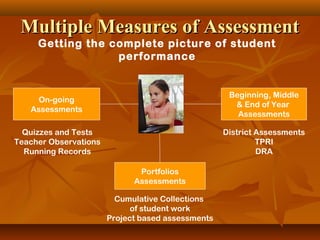
Multiple Measures of AssessmentMultiple Measures of Assessment
District Assessments
TPRI
DRA
Quizzes and Tests
Teacher Observations
Running Records
Cumulative Collections
of student work
Project based assessments
Beginning, Middle
& End of Year
Assessments
Portfolios
Assessments
On-going
Assessments
Getting the complete picture of student
performance
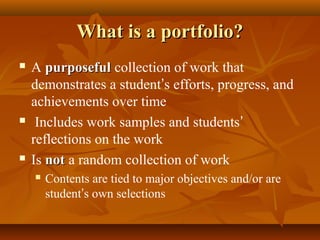
What is a portfolio?What is a portfolio?
 A purposefulpurposeful collection of work that
demonstrates a student’s efforts, progress, and
achievements over time
 Includes work samples and students’
reflections on the work
 Is notnot a random collection of work
 Contents are tied to major objectives and/or are
student’s own selections
How a Portfolio is DevelopedHow a Portfolio is Developed
Standard (TEKS)
What student should know or be able to do
Design a performance task that allows students
to show what they know
What does good performance look like?
Set criteria
Use a rubric (scoring guide) to assess student
Performance.
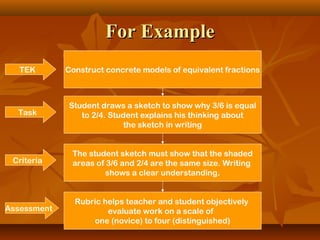
For ExampleFor Example
Construct concrete models of equivalent fractions
Student draws a sketch to show why 3/6 is equal
to 2/4. Student explains his thinking about
the sketch in writing
The student sketch must show that the shaded
areas of 3/6 and 2/4 are the same size. Writing
shows a clear understanding.
Rubric helps teacher and student objectively
evaluate work on a scale of
one (novice) to four (distinguished)
TEK
Task
Criteria
Assessment
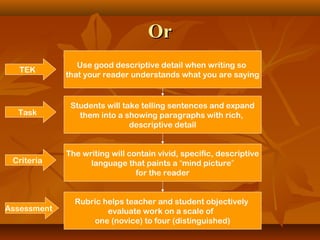
OrOr
Use good descriptive detail when writing so
that your reader understands what you are saying
Students will take telling sentences and expand
them into a showing paragraphs with rich,
descriptive detail
The writing will contain vivid, specific, descriptive
language that paints a “mind picture”
for the reader
Rubric helps teacher and student objectively
evaluate work on a scale of
one (novice) to four (distinguished)
TEK
Task
Criteria
Assessment
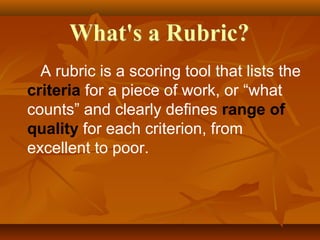
A rubric is a scoring tool that lists the
criteria for a piece of work, or “what
counts” and clearly defines range of
quality for each criterion, from
excellent to poor.
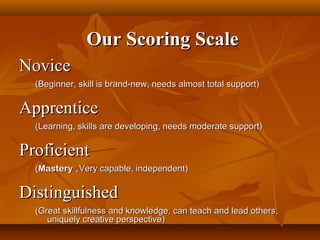
Our Scoring ScaleOur Scoring Scale
NoviceNovice
(Beginner, skill is brand-new, needs almost total support)(Beginner, skill is brand-new, needs almost total support)
ApprenticeApprentice
(Learning, skills are developing, needs moderate support)(Learning, skills are developing, needs moderate support)
ProficientProficient
((MasteryMastery ..Very capable, independent)Very capable, independent)
DistinguishedDistinguished
(Great skillfulness and knowledge, can teach and lead others,(Great skillfulness and knowledge, can teach and lead others,
uniquely creative perspective)uniquely creative perspective)
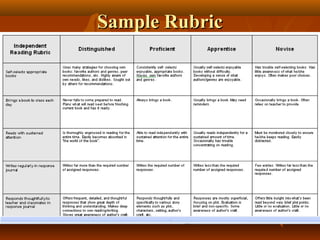
Sample RubricSample Rubric
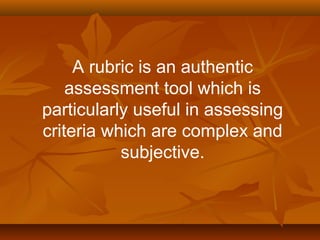
A rubric is an authentic
assessment tool which is
particularly useful in assessing
criteria which are complex and
subjective.
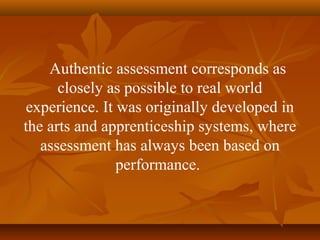
Authentic assessment corresponds as
closely as possible to real world
experience. It was originally developed in
the arts and apprenticeship systems, where
assessment has always been based on
performance.
•How will the work be assessed?
•What’s the difference between novice work
and proficient work?
•How can we make sure our scores are valid?
Rubrics:Rubrics:
•Make expectations clearMake expectations clear
•Help students judge their own workHelp students judge their own work
•Easy to use and explainEasy to use and explain
•Make scoring fair and consistentMake scoring fair and consistent
Portfolio ContentsPortfolio Contents
 Includes work samples that show mastery ofIncludes work samples that show mastery of
or progress toward mastery of the TEKSor progress toward mastery of the TEKS
 StudentsStudents’’ reflections on their own learningreflections on their own learning
 Could be:Could be:
 Photos and or videos ofPhotos and or videos of
performances/projectsperformances/projects
 Teacher observationsTeacher observations
 Lists (such asLists (such as ““books readbooks read””))
 Student-selectedStudent-selected ““best piecesbest pieces””
 Drawings, journals, any work that is aDrawings, journals, any work that is a
window into student thinking and learningwindow into student thinking and learning
 Drafts and finished piecesDrafts and finished pieces
Research supports that portfolios:Research supports that portfolios:
 Engage students in learning contentEngage students in learning content
 Help students learn the skills of reflectionHelp students learn the skills of reflection
and self evaluationand self evaluation
 Document student learning in areas thatDocument student learning in areas that
do not lend themselves to traditionaldo not lend themselves to traditional
assessmentassessment
 Facilitate communication with parentsFacilitate communication with parents
 Three-way portfolio conferences led byThree-way portfolio conferences led by
student to share portfolio with teacher,student to share portfolio with teacher,
parents at end of yearparents at end of year
Ownership and Goal SettingOwnership and Goal Setting
““When I look at how much I have improved, it makesWhen I look at how much I have improved, it makes
me feel good.me feel good.”” Jackie, grade 4Jackie, grade 4
““When I evaluate a piece, I see what I have to do for theWhen I evaluate a piece, I see what I have to do for the
next piece.next piece.”” Lauren, grade 5Lauren, grade 5
““I will improve my spelling by putting words from myI will improve my spelling by putting words from my
own writing on my spelling list.own writing on my spelling list.”” Aaron, grade 2Aaron, grade 2
From An Introduction to Using Portfolios in the Classroom by Danielson and Abrutyn
Portfolio ConferencesPortfolio Conferences
 First two weeks in OctoberFirst two weeks in October
 45 minute slots45 minute slots
 January 29th – February 9thJanuary 29th – February 9th
 30 minutes planned30 minutes planned
 End of Year Portfolio celebrationEnd of Year Portfolio celebration
 May 14-25thMay 14-25th
 Student ledStudent led
SummarySummary
 Adding portfolios to current assessments willAdding portfolios to current assessments will
give a complete picture what students knowgive a complete picture what students know
and can doand can do
 Parents will review portfolios at conferencesParents will review portfolios at conferences
and see detailed feedback about strengths andand see detailed feedback about strengths and
areas needing improvementareas needing improvement
 Students will learn to evaluate their own workStudents will learn to evaluate their own work
and examine their thinkingand examine their thinking
We are excited about portfolios!We are excited about portfolios!
Questions?Questions?

Portfolio Assessment Basics

  • 1.
    PortfoliosPortfolios Helping to tellthe complete story about what students know and can do
  • 2.
  • 3.
    Multiple Measures ofAssessmentMultiple Measures of Assessment District Assessments TPRI DRA Quizzes and Tests Teacher Observations Running Records Cumulative Collections of student work Project based assessments Beginning, Middle & End of Year Assessments Portfolios Assessments On-going Assessments Getting the complete picture of student performance
  • 4.
    What is aportfolio?What is a portfolio?  A purposefulpurposeful collection of work that demonstrates a student’s efforts, progress, and achievements over time  Includes work samples and students’ reflections on the work  Is notnot a random collection of work  Contents are tied to major objectives and/or are student’s own selections
  • 5.
    How a Portfoliois DevelopedHow a Portfolio is Developed Standard (TEKS) What student should know or be able to do Design a performance task that allows students to show what they know What does good performance look like? Set criteria Use a rubric (scoring guide) to assess student Performance.
  • 6.
    For ExampleFor Example Constructconcrete models of equivalent fractions Student draws a sketch to show why 3/6 is equal to 2/4. Student explains his thinking about the sketch in writing The student sketch must show that the shaded areas of 3/6 and 2/4 are the same size. Writing shows a clear understanding. Rubric helps teacher and student objectively evaluate work on a scale of one (novice) to four (distinguished) TEK Task Criteria Assessment
  • 7.
    OrOr Use good descriptivedetail when writing so that your reader understands what you are saying Students will take telling sentences and expand them into a showing paragraphs with rich, descriptive detail The writing will contain vivid, specific, descriptive language that paints a “mind picture” for the reader Rubric helps teacher and student objectively evaluate work on a scale of one (novice) to four (distinguished) TEK Task Criteria Assessment
  • 8.
    A rubric isa scoring tool that lists the criteria for a piece of work, or “what counts” and clearly defines range of quality for each criterion, from excellent to poor.
  • 9.
    Our Scoring ScaleOurScoring Scale NoviceNovice (Beginner, skill is brand-new, needs almost total support)(Beginner, skill is brand-new, needs almost total support) ApprenticeApprentice (Learning, skills are developing, needs moderate support)(Learning, skills are developing, needs moderate support) ProficientProficient ((MasteryMastery ..Very capable, independent)Very capable, independent) DistinguishedDistinguished (Great skillfulness and knowledge, can teach and lead others,(Great skillfulness and knowledge, can teach and lead others, uniquely creative perspective)uniquely creative perspective)
  • 10.
  • 11.
    A rubric isan authentic assessment tool which is particularly useful in assessing criteria which are complex and subjective.
  • 12.
    Authentic assessment correspondsas closely as possible to real world experience. It was originally developed in the arts and apprenticeship systems, where assessment has always been based on performance.
  • 13.
    •How will thework be assessed? •What’s the difference between novice work and proficient work? •How can we make sure our scores are valid?
  • 14.
    Rubrics:Rubrics: •Make expectations clearMakeexpectations clear •Help students judge their own workHelp students judge their own work •Easy to use and explainEasy to use and explain •Make scoring fair and consistentMake scoring fair and consistent
  • 15.
    Portfolio ContentsPortfolio Contents Includes work samples that show mastery ofIncludes work samples that show mastery of or progress toward mastery of the TEKSor progress toward mastery of the TEKS  StudentsStudents’’ reflections on their own learningreflections on their own learning  Could be:Could be:  Photos and or videos ofPhotos and or videos of performances/projectsperformances/projects  Teacher observationsTeacher observations  Lists (such asLists (such as ““books readbooks read””))  Student-selectedStudent-selected ““best piecesbest pieces””  Drawings, journals, any work that is aDrawings, journals, any work that is a window into student thinking and learningwindow into student thinking and learning  Drafts and finished piecesDrafts and finished pieces
  • 16.
    Research supports thatportfolios:Research supports that portfolios:  Engage students in learning contentEngage students in learning content  Help students learn the skills of reflectionHelp students learn the skills of reflection and self evaluationand self evaluation  Document student learning in areas thatDocument student learning in areas that do not lend themselves to traditionaldo not lend themselves to traditional assessmentassessment  Facilitate communication with parentsFacilitate communication with parents  Three-way portfolio conferences led byThree-way portfolio conferences led by student to share portfolio with teacher,student to share portfolio with teacher, parents at end of yearparents at end of year
  • 17.
    Ownership and GoalSettingOwnership and Goal Setting ““When I look at how much I have improved, it makesWhen I look at how much I have improved, it makes me feel good.me feel good.”” Jackie, grade 4Jackie, grade 4 ““When I evaluate a piece, I see what I have to do for theWhen I evaluate a piece, I see what I have to do for the next piece.next piece.”” Lauren, grade 5Lauren, grade 5 ““I will improve my spelling by putting words from myI will improve my spelling by putting words from my own writing on my spelling list.own writing on my spelling list.”” Aaron, grade 2Aaron, grade 2 From An Introduction to Using Portfolios in the Classroom by Danielson and Abrutyn
  • 18.
    Portfolio ConferencesPortfolio Conferences First two weeks in OctoberFirst two weeks in October  45 minute slots45 minute slots  January 29th – February 9thJanuary 29th – February 9th  30 minutes planned30 minutes planned  End of Year Portfolio celebrationEnd of Year Portfolio celebration  May 14-25thMay 14-25th  Student ledStudent led
  • 19.
    SummarySummary  Adding portfoliosto current assessments willAdding portfolios to current assessments will give a complete picture what students knowgive a complete picture what students know and can doand can do  Parents will review portfolios at conferencesParents will review portfolios at conferences and see detailed feedback about strengths andand see detailed feedback about strengths and areas needing improvementareas needing improvement  Students will learn to evaluate their own workStudents will learn to evaluate their own work and examine their thinkingand examine their thinking
  • 20.
    We are excitedabout portfolios!We are excited about portfolios!
  • 21.