

Soft Contact Lens Fitting


1
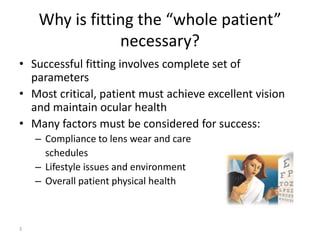
Why is fitting the “whole patient”
                necessary?
• Successful fitting involves complete set of
  parameters
• Most critical, patient must achieve excellent vision
  and maintain ocular health
• Many factors must be considered for success:
    – Compliance to lens wear and care
      schedules
    – Lifestyle issues and environment
    – Overall patient physical health


3
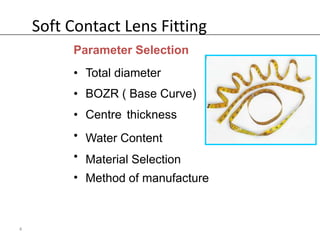
Soft Contact Lens Fitting
         Parameter Selection
         • Total diameter
         • BOZR ( Base Curve)
         • Centre thickness
         • Water Content
         • Material Selection
         • Method of manufacture


4
Contact Lens Fitting Guidelines

    •   Selection of lens type –Conventional/ Disposable
    •   Determine Lens Power
    •   Total Diameter Selection
    •   Base Curve selection (if required)
    •   Trial fitting


5
Lens Power Determination
• Subjective refraction
 e.g - -4.00/-1.00 X 180
• Spherical equivalent
• Vertex distance compensation


6
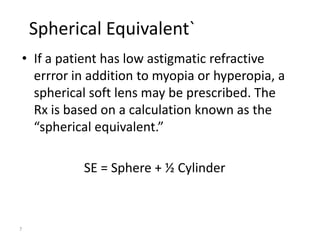
Spherical Equivalent`
• If a patient has low astigmatic refractive
  errror in addition to myopia or hyperopia, a
  spherical soft lens may be prescribed. The
  Rx is based on a calculation known as the
  “spherical equivalent.”

          SE = Sphere + ½ Cylinder


7
Vertex Distance Compensation
    • Effective lens power changes depending on
      the distance from the cornea; e.g.spectacle
      vs. contact lens
    • Utilize vertex distance compensation chart
      to determine proper contact lens power
      from spectacle refraction


8
Soft Contact Lens Fitting
              Total Diameter Selection
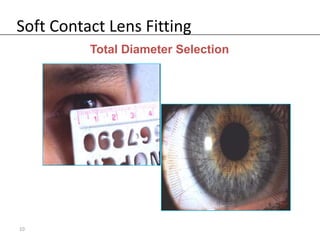
         • Measure HVID (Horizontal Visible Iris Diameter)
           Then either:

         • Add 2mm to HVID and select trial lens
           set with nearest diameter or

         • Follow manufacture's recommendation
           and select suggested diameter

9
Soft Contact Lens Fitting
          Total Diameter Selection


10
Soft Contact Lens Fitting
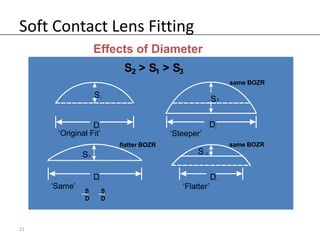
                       Effects of Diameter
                                     S2 > S1 > S3
                                                                           same BOZR

                       S   1
                                                                   S2


                       D
                       1
                                                                   D2


      ‘Original Fit’                               ‘Steeper’
                                    flatter BOZR                           same BOZR
              S   4
                                                           S   3


                       D
                       4                                           D   3


     ‘Same’                                           ‘Flatter’
              S11          S   44


              D   11       D   44


11
Soft Contact Lens Fitting
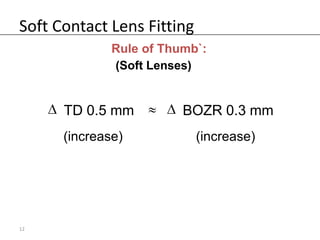
              Rule of Thumb`:
              (Soft Lenses)


      TD 0.5 mm          BOZR 0.3 mm
      (increase)            (increase)


12
Soft Contact Lens Fitting
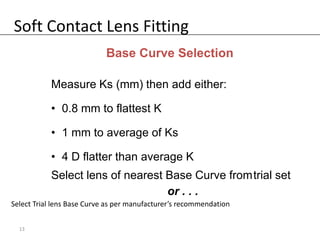
                            Base Curve Selection

           Measure Ks (mm) then add either:

           • 0.8 mm to flattest K

           • 1 mm to average of Ks

           • 4 D flatter than average K
           Select lens of nearest Base Curve from trial set
                                  or . . .
Select Trial lens Base Curve as per manufacturer’s recommendation


  13
Soft Contact Lens Fitting
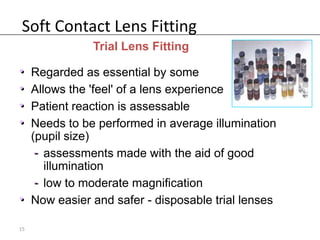
             Trial Lens Fitting

• Regarded as essential by some
• Allows the 'feel' of a lens experience
• Patient reaction is assessable
• Needs to be performed in average illumination
  (pupil size)
   - assessments made with the aid of good
     illumination
   - low to moderate magnification
• Now easier and safer - disposable trial lenses

15
Soft Contact Lens Fitting
                 Trial Lens Fitting

     • Select trial BVP nearest to vertex corrected
       spectacle Rx result
     • If only ± 3.00 D (or similar) available use
       appropriate type ( ie plus or minus)
     • If Rx high but only low Rx trial lenses available,
       consider getting more appropriate trial lenses )
     • If large difference between trial and Rx, remember
       to correct over-Rx for vertex distance

16
Soft Contact Lens Fitting
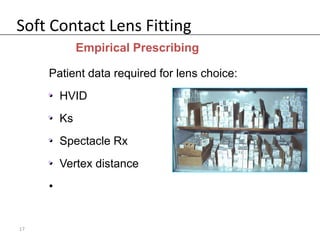
            Empirical Prescribing

     Patient data required for lens choice:
     • HVID
     •
     • Ks
     •
     • Spectacle Rx
     •
     • Vertex distance
     •
     •


17
Optimizing On-Eye Performance
     • Trial Lens is placed on the eye and allowed to
       settle 10-15 minutes
     • On-eye lens performance is evaluated based on
       the universal fitting criteria:
        –   Corneal Coverage
        –   Centration
        –   Lens movement
        –   Comfort
        –   Vision


18
SOFT LENS FITTING

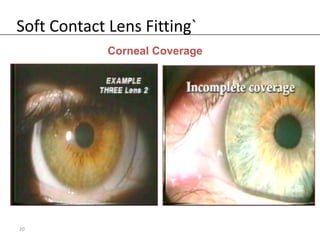
     The need for Corneal Coverage

     • Mechanical, prevention of trauma
     •
     • Physiological

        - corneal exposure

       - corneal dessication

        - tear film disturbance, lens & eye wettability

     • About 1 mm symmetrical overlap is ideal
19
Soft Contact Lens Fitting`
             Corneal Coverage


20
Soft Contact Lens Fitting
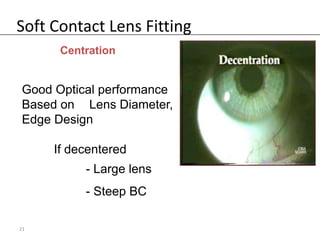
      Centration


Good Optical performance
Based on Lens Diameter,
Edge Design

     If decentered
          - Large lens
          - Steep BC

21
Soft Contact Lens Fitting
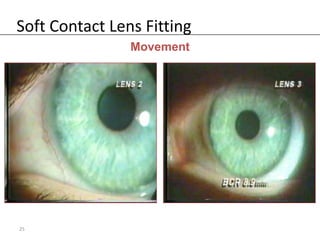
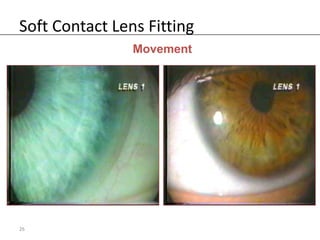
         Why is Movement Required?

                   Movement
       • Removes and disperses ocular debris
       •

       • Promotes tear exchange (minimal)
       •

       • Possibly aids epithelial wetting by
       •
         mucin spreading and smoothing


23
Soft Contact Lens Fitting
           Assessment of Mobility?

          • Movement on a blink

          • Lag following eye movement

          • Movement on up-gaze blink

          • Lower lid push-up test


24
Soft Contact Lens Fitting
                Movement


25
Soft Contact Lens Fitting
                Movement


26
Soft Contact Lens Fitting
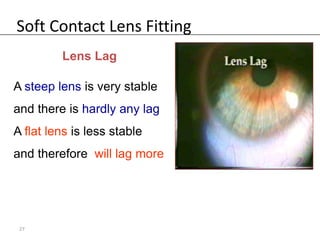
         Lens Lag

A steep lens is very stable
and there is hardly any lag
A flat lens is less stable
and therefore will lag more


 27
Comfort
     • A critical factor of contact lens success

     • Steeper (tighter) fitting lenses may be more
       comfortable

     • Flat (loose) fitting lenses may cause lid
       sensation and discomfort


28
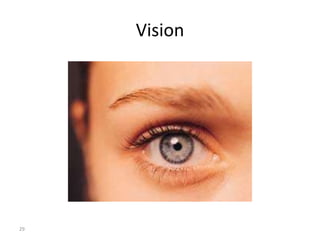
Vision


29
Soft Contact Lens Fitting
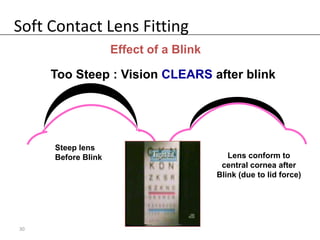
                    Effect of a Blink

     Too Steep : Vision CLEARS after blink


     Steep lens
     Before Blink                          Lens conform to
                                         central cornea after
                                        Blink (due to lid force)


30
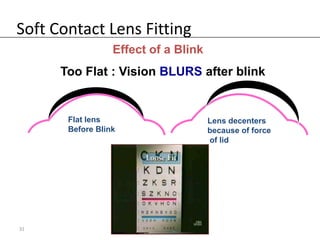
Soft Contact Lens Fitting
                  Effect of a Blink
      Too Flat : Vision BLURS after blink


       Flat lens                      Lens decenters
       Before Blink                   because of force
                                      of lid


31
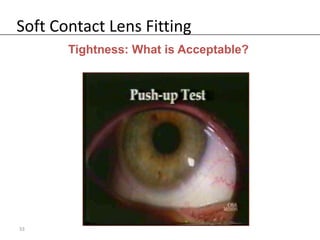
Soft Contact Lens Fitting
       Tightness: What is Acceptable?


33
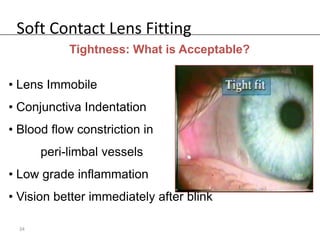
Soft Contact Lens Fitting
            Tightness: What is Acceptable?

• Lens Immobile
• Conjunctiva Indentation
• Blood flow constriction in
       peri-limbal vessels
• Low grade inflammation
• Vision better immediately after blink

  34
Soft Contact Lens Fitting

               Summary


        Choose lens that gives...


35
Optimum vision
36
Good comfort
37
No ocular insult
38

Soft Contact Lens Fitting

  • 1.
  • 2.
    Why is fittingthe “whole patient” necessary? • Successful fitting involves complete set of parameters • Most critical, patient must achieve excellent vision and maintain ocular health • Many factors must be considered for success: – Compliance to lens wear and care schedules – Lifestyle issues and environment – Overall patient physical health 3
  • 3.
    Soft Contact LensFitting Parameter Selection • Total diameter • BOZR ( Base Curve) • Centre thickness • Water Content • Material Selection • Method of manufacture 4
  • 4.
    Contact Lens FittingGuidelines • Selection of lens type –Conventional/ Disposable • Determine Lens Power • Total Diameter Selection • Base Curve selection (if required) • Trial fitting 5
  • 5.
    Lens Power Determination •Subjective refraction e.g - -4.00/-1.00 X 180 • Spherical equivalent • Vertex distance compensation 6
  • 6.
    Spherical Equivalent` • Ifa patient has low astigmatic refractive errror in addition to myopia or hyperopia, a spherical soft lens may be prescribed. The Rx is based on a calculation known as the “spherical equivalent.” SE = Sphere + ½ Cylinder 7
  • 7.
    Vertex Distance Compensation • Effective lens power changes depending on the distance from the cornea; e.g.spectacle vs. contact lens • Utilize vertex distance compensation chart to determine proper contact lens power from spectacle refraction 8
  • 8.
    Soft Contact LensFitting Total Diameter Selection • Measure HVID (Horizontal Visible Iris Diameter) Then either: • Add 2mm to HVID and select trial lens set with nearest diameter or • Follow manufacture's recommendation and select suggested diameter 9
  • 9.
    Soft Contact LensFitting Total Diameter Selection 10
  • 10.
    Soft Contact LensFitting Effects of Diameter S2 > S1 > S3 same BOZR S 1 S2 D 1 D2 ‘Original Fit’ ‘Steeper’ flatter BOZR same BOZR S 4 S 3 D 4 D 3 ‘Same’ ‘Flatter’ S11 S 44 D 11 D 44 11
  • 11.
    Soft Contact LensFitting Rule of Thumb`: (Soft Lenses) TD 0.5 mm BOZR 0.3 mm (increase) (increase) 12
  • 12.
    Soft Contact LensFitting Base Curve Selection Measure Ks (mm) then add either: • 0.8 mm to flattest K • 1 mm to average of Ks • 4 D flatter than average K Select lens of nearest Base Curve from trial set or . . . Select Trial lens Base Curve as per manufacturer’s recommendation 13
  • 13.
    Soft Contact LensFitting Trial Lens Fitting • Regarded as essential by some • Allows the 'feel' of a lens experience • Patient reaction is assessable • Needs to be performed in average illumination (pupil size) - assessments made with the aid of good illumination - low to moderate magnification • Now easier and safer - disposable trial lenses 15
  • 14.
    Soft Contact LensFitting Trial Lens Fitting • Select trial BVP nearest to vertex corrected spectacle Rx result • If only ± 3.00 D (or similar) available use appropriate type ( ie plus or minus) • If Rx high but only low Rx trial lenses available, consider getting more appropriate trial lenses ) • If large difference between trial and Rx, remember to correct over-Rx for vertex distance 16
  • 15.
    Soft Contact LensFitting Empirical Prescribing Patient data required for lens choice: • HVID • • Ks • • Spectacle Rx • • Vertex distance • • 17
  • 16.
    Optimizing On-Eye Performance • Trial Lens is placed on the eye and allowed to settle 10-15 minutes • On-eye lens performance is evaluated based on the universal fitting criteria: – Corneal Coverage – Centration – Lens movement – Comfort – Vision 18
  • 17.
    SOFT LENS FITTING The need for Corneal Coverage • Mechanical, prevention of trauma • • Physiological - corneal exposure - corneal dessication - tear film disturbance, lens & eye wettability • About 1 mm symmetrical overlap is ideal 19
  • 18.
    Soft Contact LensFitting` Corneal Coverage 20
  • 19.
    Soft Contact LensFitting Centration Good Optical performance Based on Lens Diameter, Edge Design If decentered - Large lens - Steep BC 21
  • 20.
    Soft Contact LensFitting Why is Movement Required? Movement • Removes and disperses ocular debris • • Promotes tear exchange (minimal) • • Possibly aids epithelial wetting by • mucin spreading and smoothing 23
  • 21.
    Soft Contact LensFitting Assessment of Mobility? • Movement on a blink • Lag following eye movement • Movement on up-gaze blink • Lower lid push-up test 24
  • 22.
    Soft Contact LensFitting Movement 25
  • 23.
    Soft Contact LensFitting Movement 26
  • 24.
    Soft Contact LensFitting Lens Lag A steep lens is very stable and there is hardly any lag A flat lens is less stable and therefore will lag more 27
  • 25.
    Comfort • A critical factor of contact lens success • Steeper (tighter) fitting lenses may be more comfortable • Flat (loose) fitting lenses may cause lid sensation and discomfort 28
  • 26.
  • 27.
    Soft Contact LensFitting Effect of a Blink Too Steep : Vision CLEARS after blink Steep lens Before Blink Lens conform to central cornea after Blink (due to lid force) 30
  • 28.
    Soft Contact LensFitting Effect of a Blink Too Flat : Vision BLURS after blink Flat lens Lens decenters Before Blink because of force of lid 31
  • 29.
    Soft Contact LensFitting Tightness: What is Acceptable? 33
  • 30.
    Soft Contact LensFitting Tightness: What is Acceptable? • Lens Immobile • Conjunctiva Indentation • Blood flow constriction in peri-limbal vessels • Low grade inflammation • Vision better immediately after blink 34
  • 31.
    Soft Contact LensFitting Summary Choose lens that gives... 35
  • 32.
  • 33.
  • 34.