Identify and describe the landform.
• Fold mountain [1]
• Snow covered areas along the
folds of the mountain [1]
• Folding shows synclines and the
anticlines [1]
• Sharp jagged edges of mountain
[1]
Explain how the landform may have
formed.
• However, both plates have similar
densities and hence, resist
subduction [1]
• As a resist of the compressional
force put against both plates, the
plates break and slide along
fractures in the crust [1].
• They will buckle and fold, forming
fold mountains. [1]
Explain how Cerro Negro volcano was formed.
• The Cocos plate and Caribbean plate
converged towards each other. (1m)
• Subduction occurs with the oceanic Cocos
plate under the continental Caribbean plate
as Cocos plate is denser than the Caribbean
plate (1m)
• Sinking crust of the Cocos plate melts to
form magma as it approaches the mantle
(1m)
• Magma rises through the crust of the
Caribbean plate. Lava builds up around the
vent and solidifies over time to form Cerro
Negro volcano (1m)
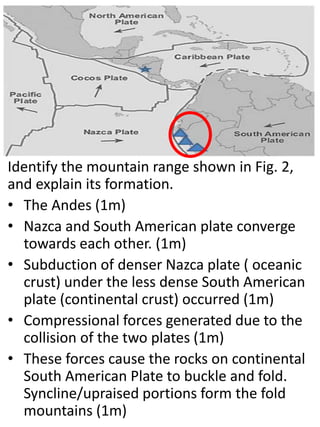
Identify the mountain range shown in Fig. 2,
and explain its formation.
• The Andes (1m)
• Nazca and South American plate converge
towards each other. (1m)
• Subduction of denser Nazca plate ( oceanic
crust) under the less dense South American
plate (continental crust) occurred (1m)
• Compressional forces generated due to the
collision of the two plates (1m)
• These forces cause the rocks on continental
South American Plate to buckle and fold.
Syncline/upraised portions form the fold
mountains (1m)
What type of volcano is Mt Krakatoa?
Explain your answer with reference to Fig.
3. [4]
Mt Krakatoa is a stratovolcano (1m)
• Reasons to be explained:- (3m)
• Located at convergent plate boundary
• Gentle then steep slope of volcano as
it go up to the peak.
• It has narrow base.
• Ash plume from stratovolcano
With the help of diagrams, explain how Mt
Krakatoa is formed.
• When the oceanic Indo-Australian plate
and continental Eurasian plate converge,
the oceanic plate subducts under the
continental.
• The subduction of the oceanic plate causes
the solid mantle material to melt and
magma is formed.
• The magma rises through the mantle and
ocean floor to emerge as volcanoes. Over
many years, lava, ash and rock fragments
will continue to build up the volcano
• Sometimes, the crater may be blocked and
the magma may find another exit route to
the surface, forming a secondary cone.
With a well labelled diagram,
explain why tectonic plates
move.
• Tectonic plates float on molten mantle,
driven by convection currents. As the
molten mantle materials is heated by the
core, mantle expands, rises and spreads
out, dragging the plates away from each
other.
• Subsequently, the hot molten mantle cools
slightly and sinks, pulling the plates along.
Hence plates move towards each other.
• The sinking mantle material heats up again
as it nears the core and the whole process
repeats.
• Subduction occurs with the difference in
density. An oceanic plate (denser) subducts
under a less dense plate and pulls the rest
of the plate along.
• The subducting plate drives the downward-
moving of the crust.
Mechanism of Plate
tectonic
Plates moving away from each other
Plates
Ocean floor

Homework on plate tectonic

  • 1.
    Identify and describethe landform. • Fold mountain [1] • Snow covered areas along the folds of the mountain [1] • Folding shows synclines and the anticlines [1] • Sharp jagged edges of mountain [1]
  • 2.
    Explain how thelandform may have formed. • However, both plates have similar densities and hence, resist subduction [1] • As a resist of the compressional force put against both plates, the plates break and slide along fractures in the crust [1]. • They will buckle and fold, forming fold mountains. [1]
  • 3.
    Explain how CerroNegro volcano was formed. • The Cocos plate and Caribbean plate converged towards each other. (1m) • Subduction occurs with the oceanic Cocos plate under the continental Caribbean plate as Cocos plate is denser than the Caribbean plate (1m) • Sinking crust of the Cocos plate melts to form magma as it approaches the mantle (1m) • Magma rises through the crust of the Caribbean plate. Lava builds up around the vent and solidifies over time to form Cerro Negro volcano (1m)
  • 4.
    Identify the mountainrange shown in Fig. 2, and explain its formation. • The Andes (1m) • Nazca and South American plate converge towards each other. (1m) • Subduction of denser Nazca plate ( oceanic crust) under the less dense South American plate (continental crust) occurred (1m) • Compressional forces generated due to the collision of the two plates (1m) • These forces cause the rocks on continental South American Plate to buckle and fold. Syncline/upraised portions form the fold mountains (1m)
  • 5.
    What type ofvolcano is Mt Krakatoa? Explain your answer with reference to Fig. 3. [4] Mt Krakatoa is a stratovolcano (1m) • Reasons to be explained:- (3m) • Located at convergent plate boundary • Gentle then steep slope of volcano as it go up to the peak. • It has narrow base. • Ash plume from stratovolcano
  • 6.
    With the helpof diagrams, explain how Mt Krakatoa is formed. • When the oceanic Indo-Australian plate and continental Eurasian plate converge, the oceanic plate subducts under the continental. • The subduction of the oceanic plate causes the solid mantle material to melt and magma is formed. • The magma rises through the mantle and ocean floor to emerge as volcanoes. Over many years, lava, ash and rock fragments will continue to build up the volcano • Sometimes, the crater may be blocked and the magma may find another exit route to the surface, forming a secondary cone.
  • 7.
    With a welllabelled diagram, explain why tectonic plates move. • Tectonic plates float on molten mantle, driven by convection currents. As the molten mantle materials is heated by the core, mantle expands, rises and spreads out, dragging the plates away from each other. • Subsequently, the hot molten mantle cools slightly and sinks, pulling the plates along. Hence plates move towards each other. • The sinking mantle material heats up again as it nears the core and the whole process repeats. • Subduction occurs with the difference in density. An oceanic plate (denser) subducts under a less dense plate and pulls the rest of the plate along. • The subducting plate drives the downward- moving of the crust.
  • 8.
    Mechanism of Plate tectonic Platesmoving away from each other Plates Ocean floor