First Order Ordinary Linear
Differential Equations
• Ordinary Differential equations does not
include partial derivatives.
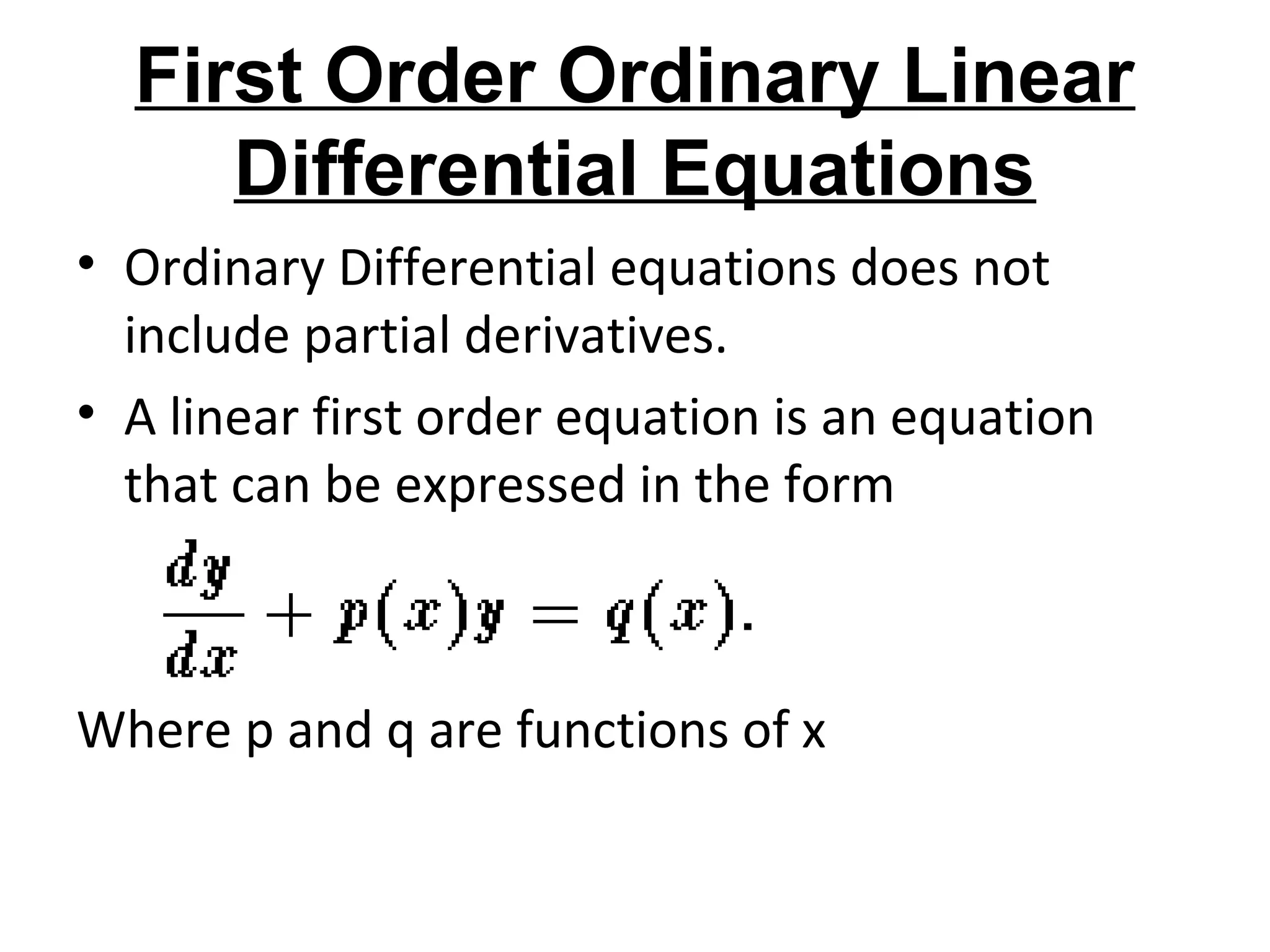
• A linear first order equation is an equation
that can be expressed in the form
Where p and q are functions of x
Types Of Linear DE:
1. Separable Variable
2. Homogeneous Equation
3. Exact Equation
4. Linear Equation
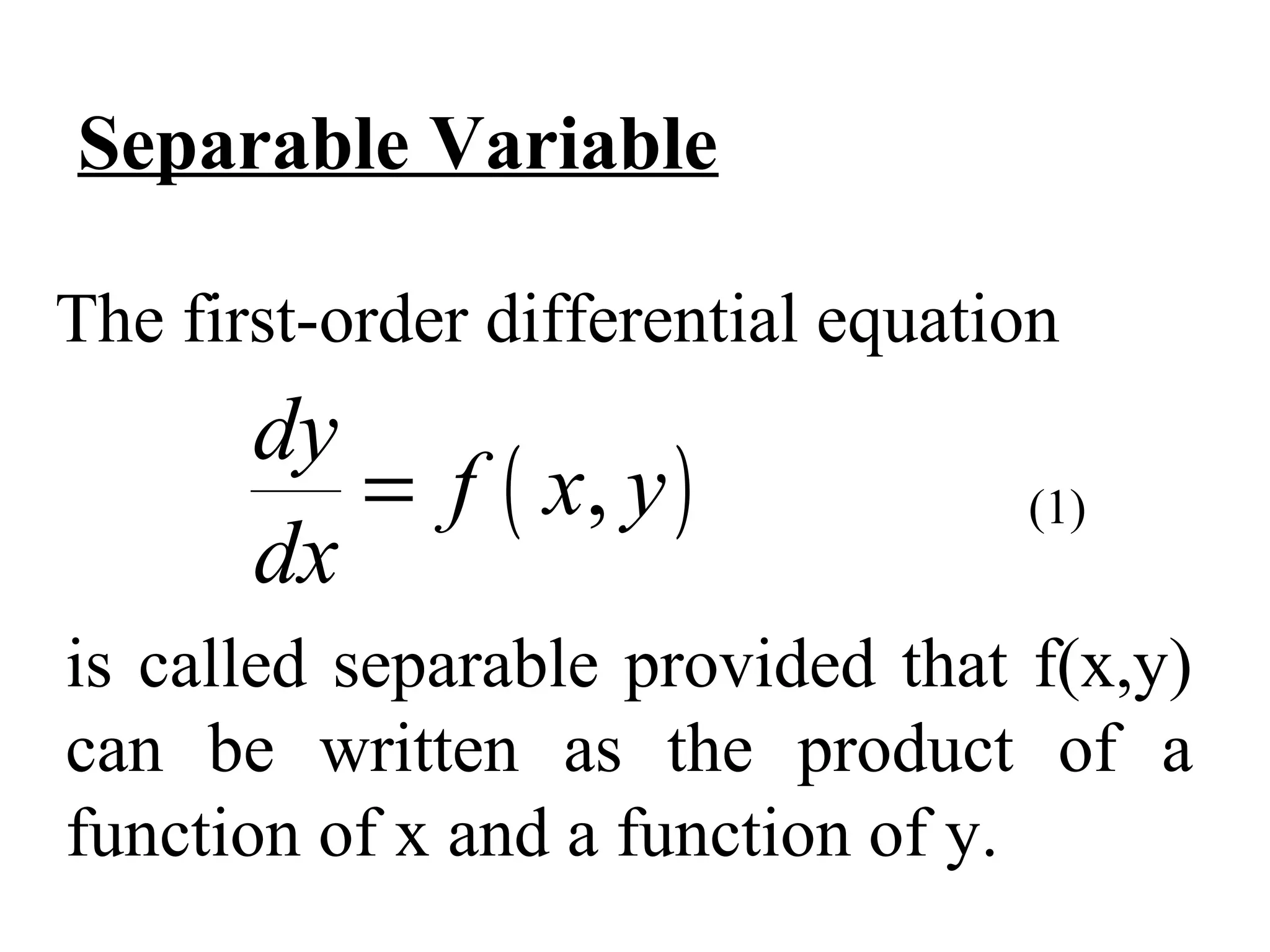
The first-order differential equation
( ),
dy
f x y
dx
=
is called separable provided that f(x,y)
can be written as the product of a
function of x and a function of y.
(1)
Separable Variable
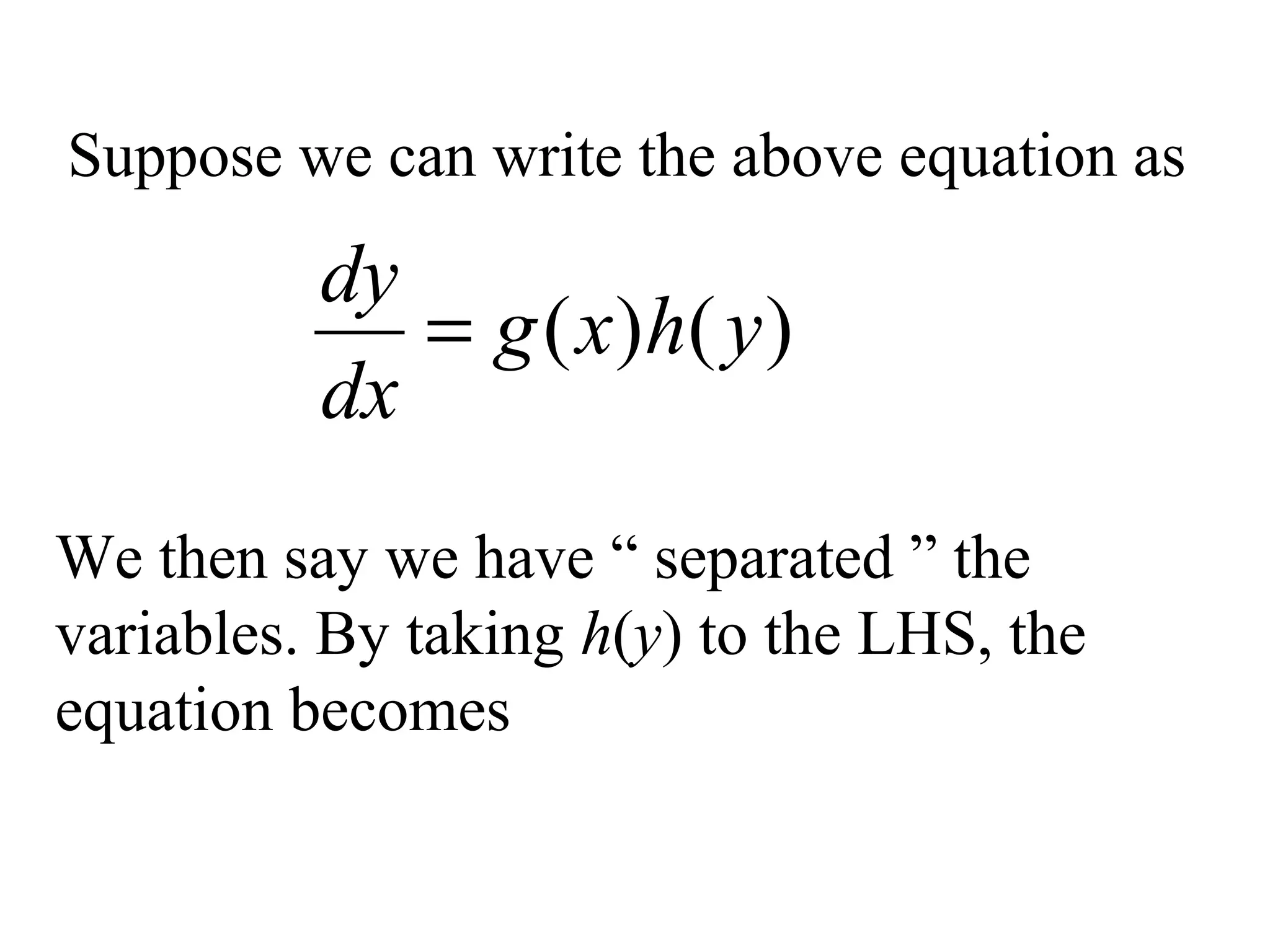
Suppose we can write the above equation as
)()( yhxg
dx
dy
=
We then say we have “ separated ” the
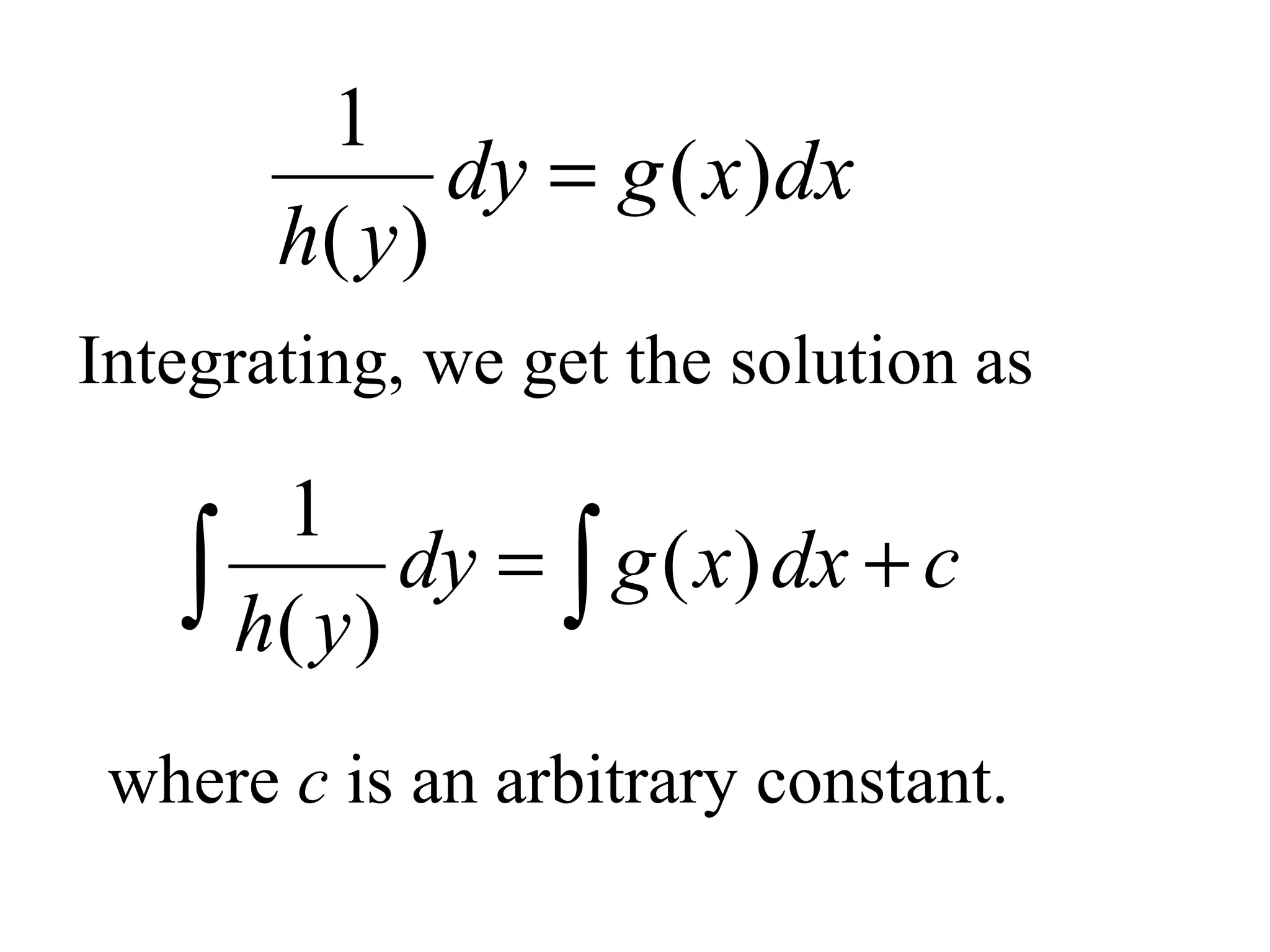
variables. By taking h(y) to the LHS, the
equation becomes
1
( )
( )
dy g x dx
h y
=
Integrating, we get the solution as
1
( )
( )
dy g x dx c
h y
= +∫ ∫
where c is an arbitrary constant.
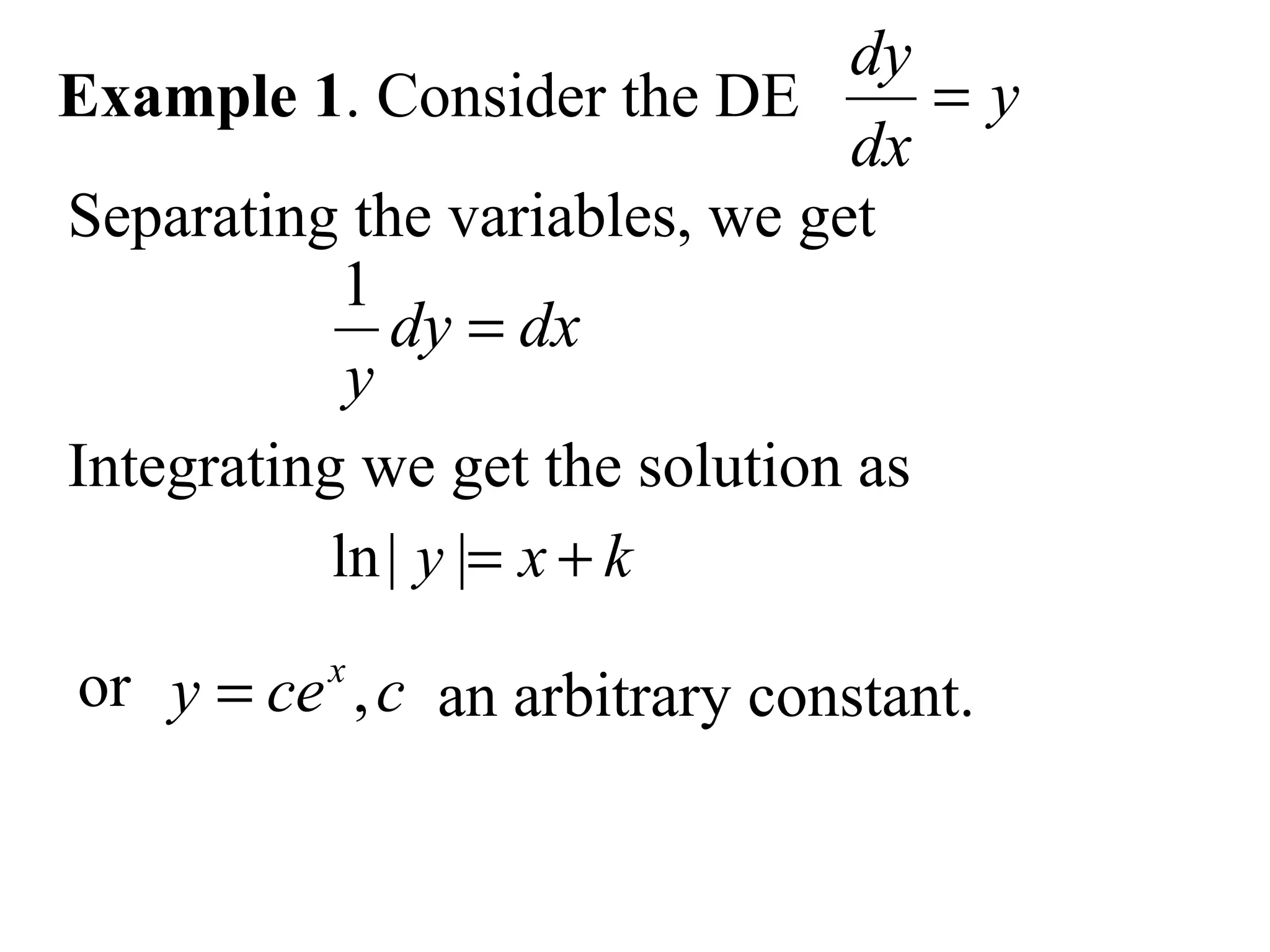
Example 1. Consider the DE y
dx
dy
=
Separating the variables, we get
dxdy
y
=
1
Integrating we get the solution as
kxy +=||ln
or ccey x
,= an arbitrary constant.
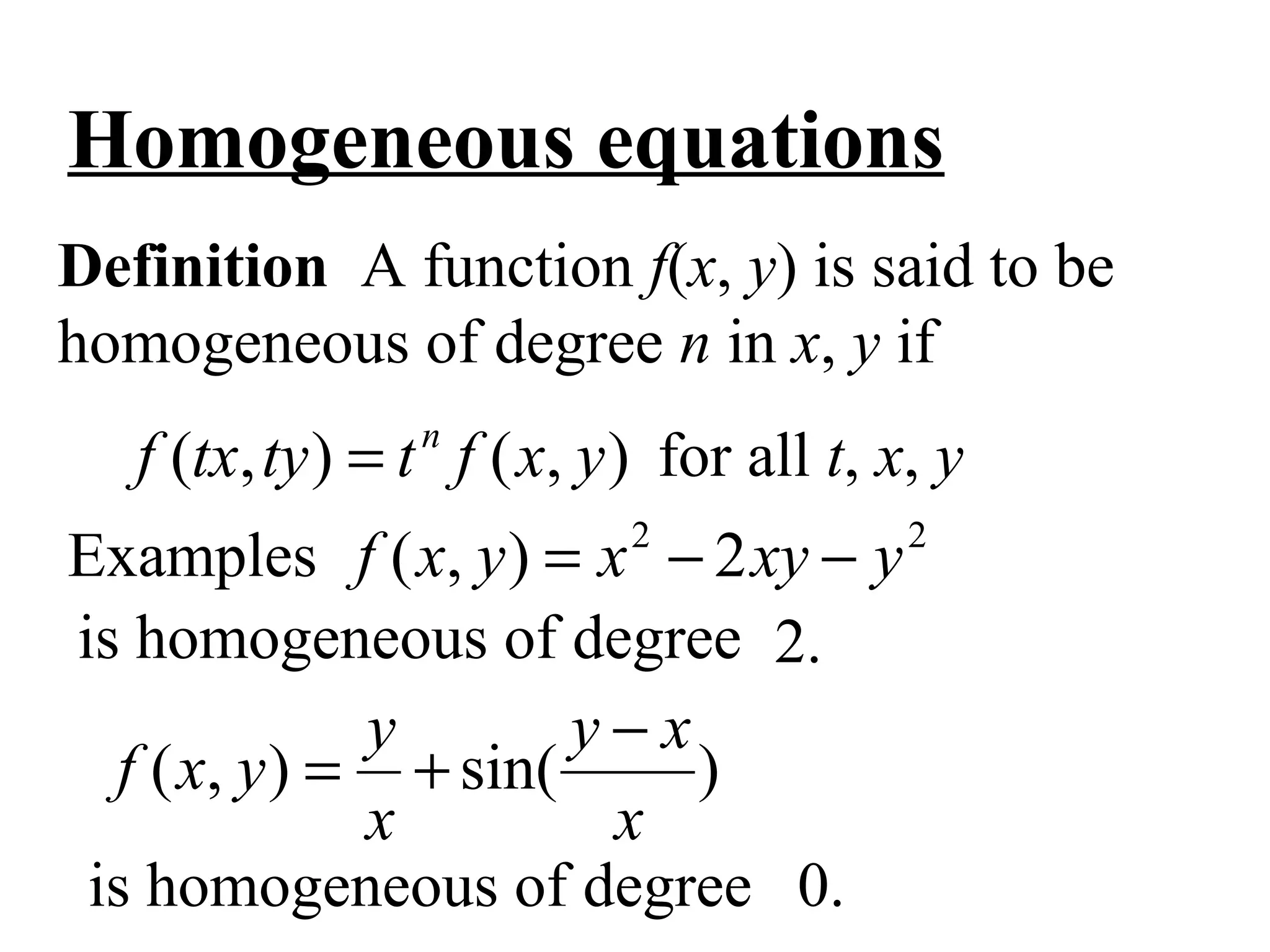
Homogeneous equations
Definition A function f(x, y) is said to be
homogeneous of degree n in x, y if
),(),( yxfttytxf n
= for all t, x, y
Examples 22
2),( yxyxyxf −−=
is homogeneous of degree
)sin(),(
x
xy
x
y
yxf
−
+=
is homogeneous of degree
2.
0.
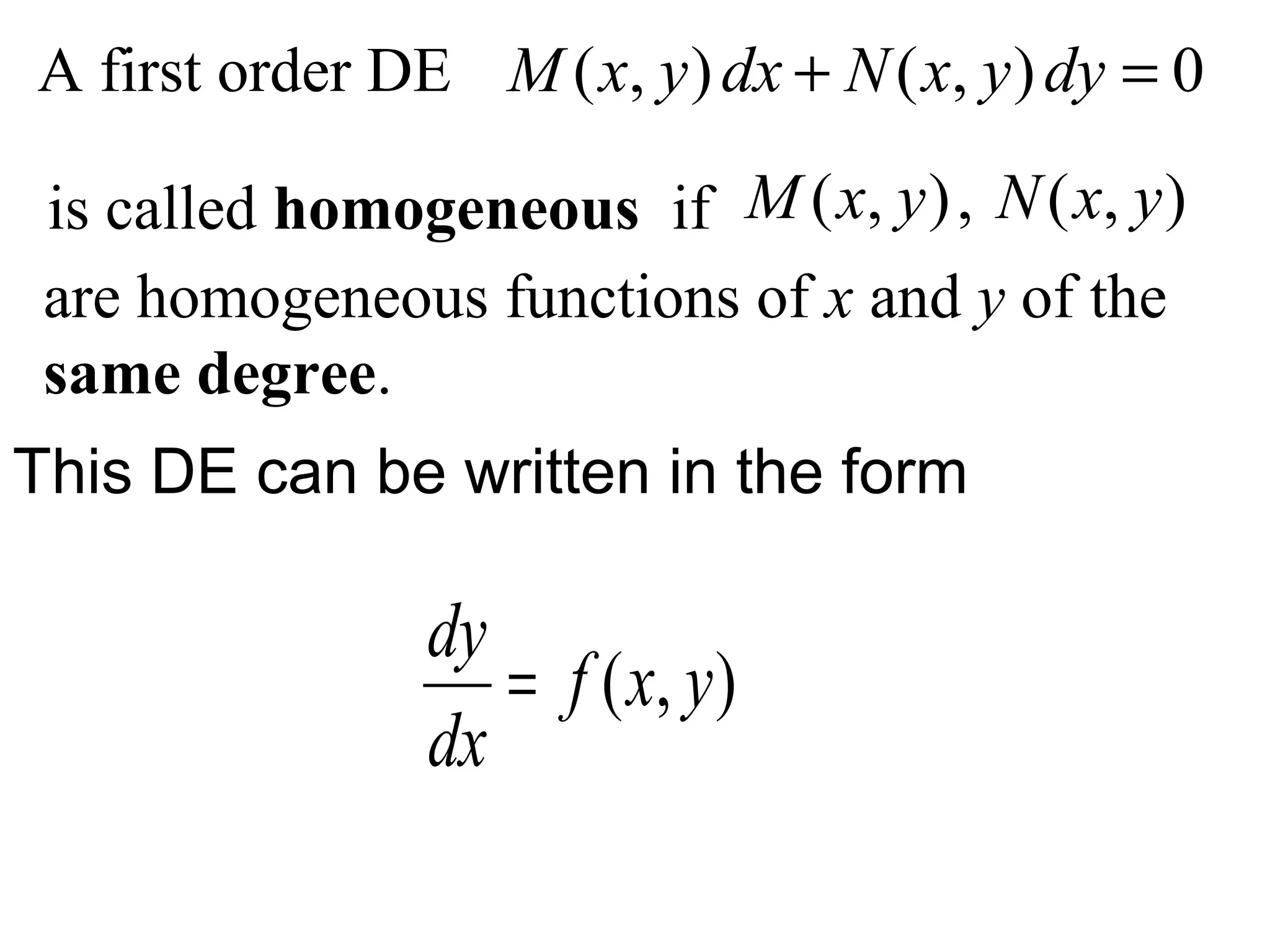
A first order DE 0),(),( =+ dyyxNdxyxM
is called homogeneous if ),(,),( yxNyxM
are homogeneous functions of x and y of the
same degree.
This DE can be written in the form
),( yxf
dx
dy
=
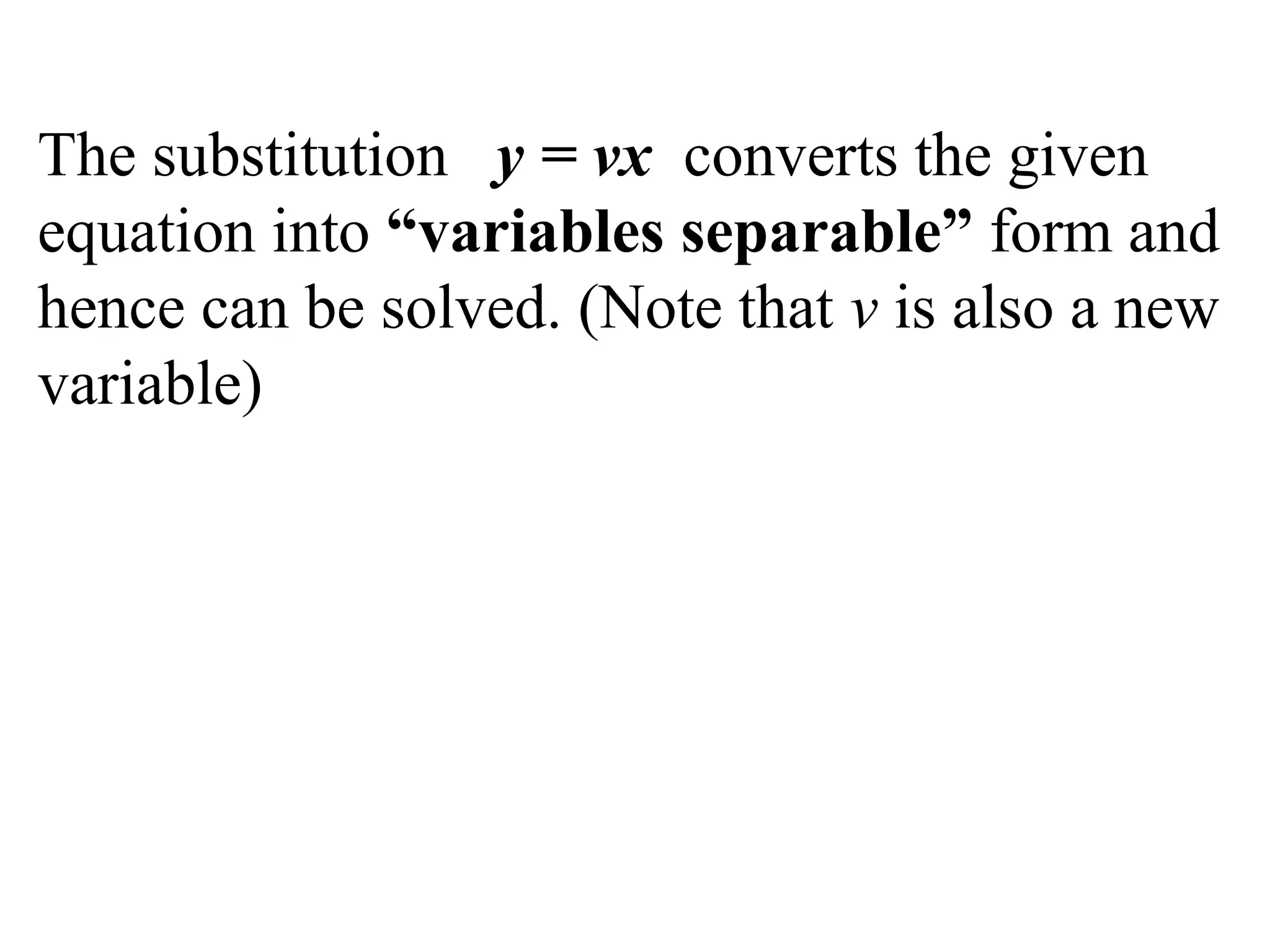
The substitution y = vx converts the given
equation into “variables separable” form and
hence can be solved. (Note that v is also a new
variable)
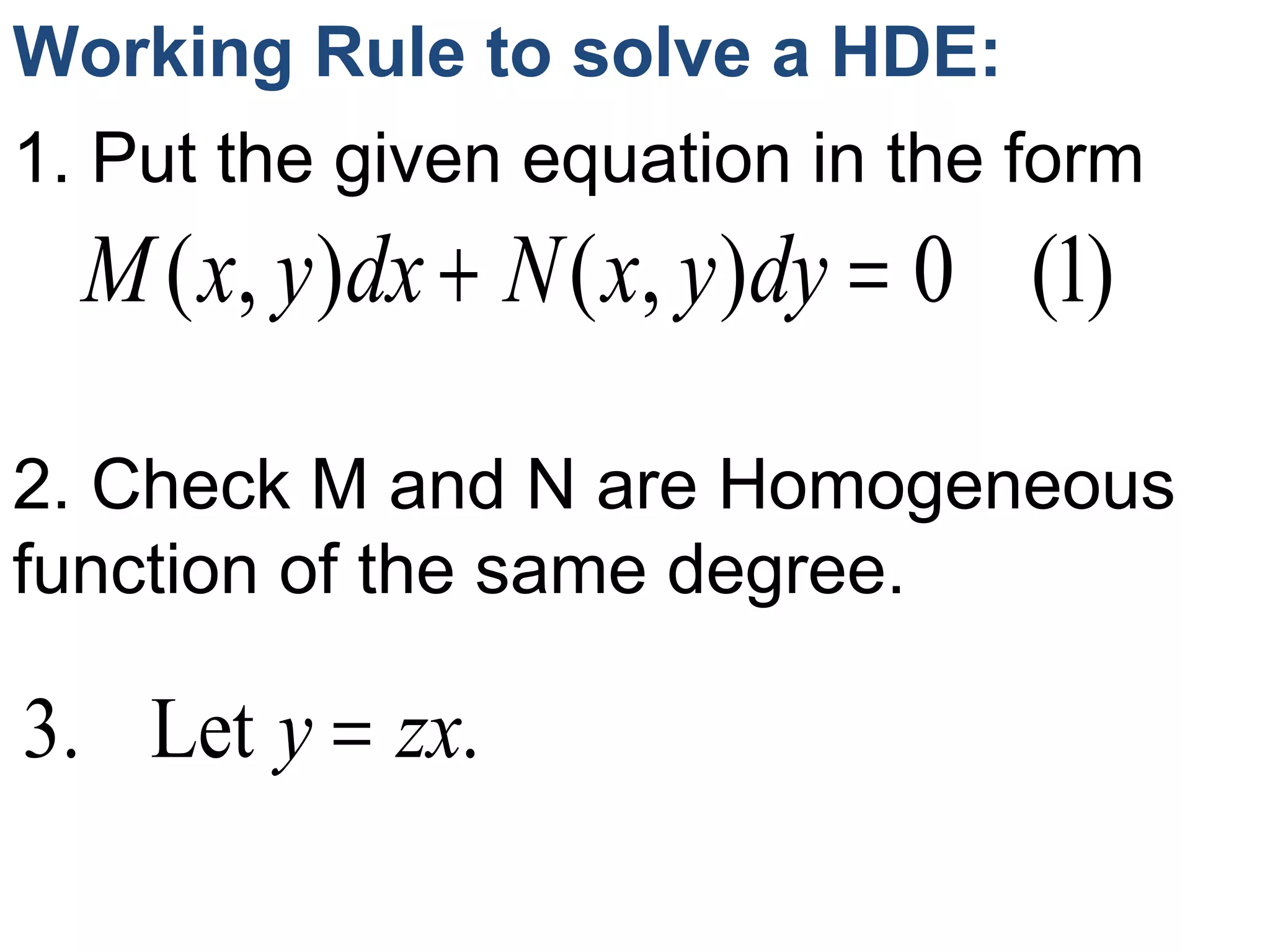
Working Rule to solve a HDE:
1. Put the given equation in the form
.Let.3 zxy =
)1(0),(),( =+ dyyxNdxyxM
2. Check M and N are Homogeneous
function of the same degree.
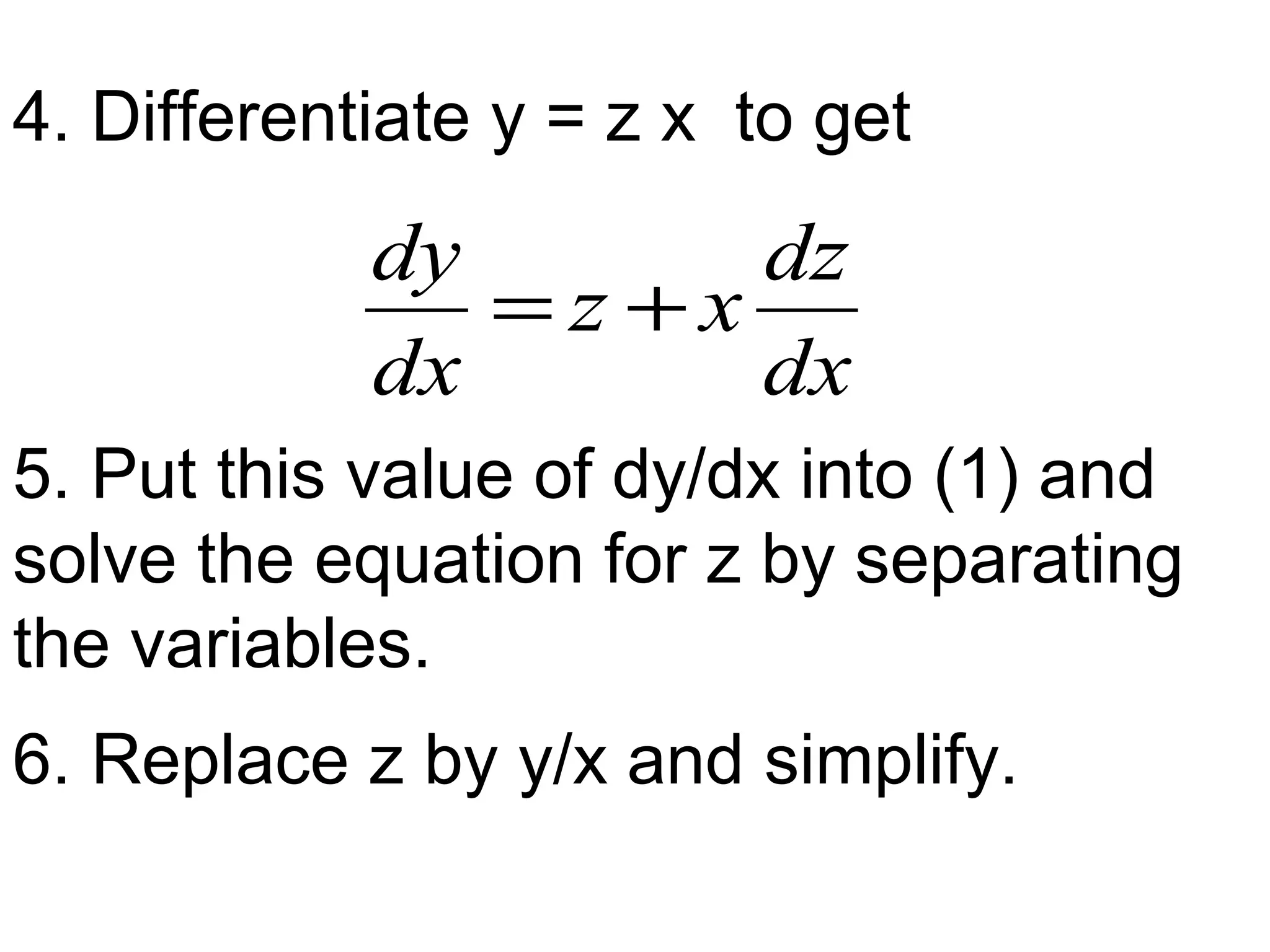
5. Put this value of dy/dx into (1) and
solve the equation for z by separating
the variables.
6. Replace z by y/x and simplify.
dx
dz
xz
dx
dy
+=
4. Differentiate y = z x to get
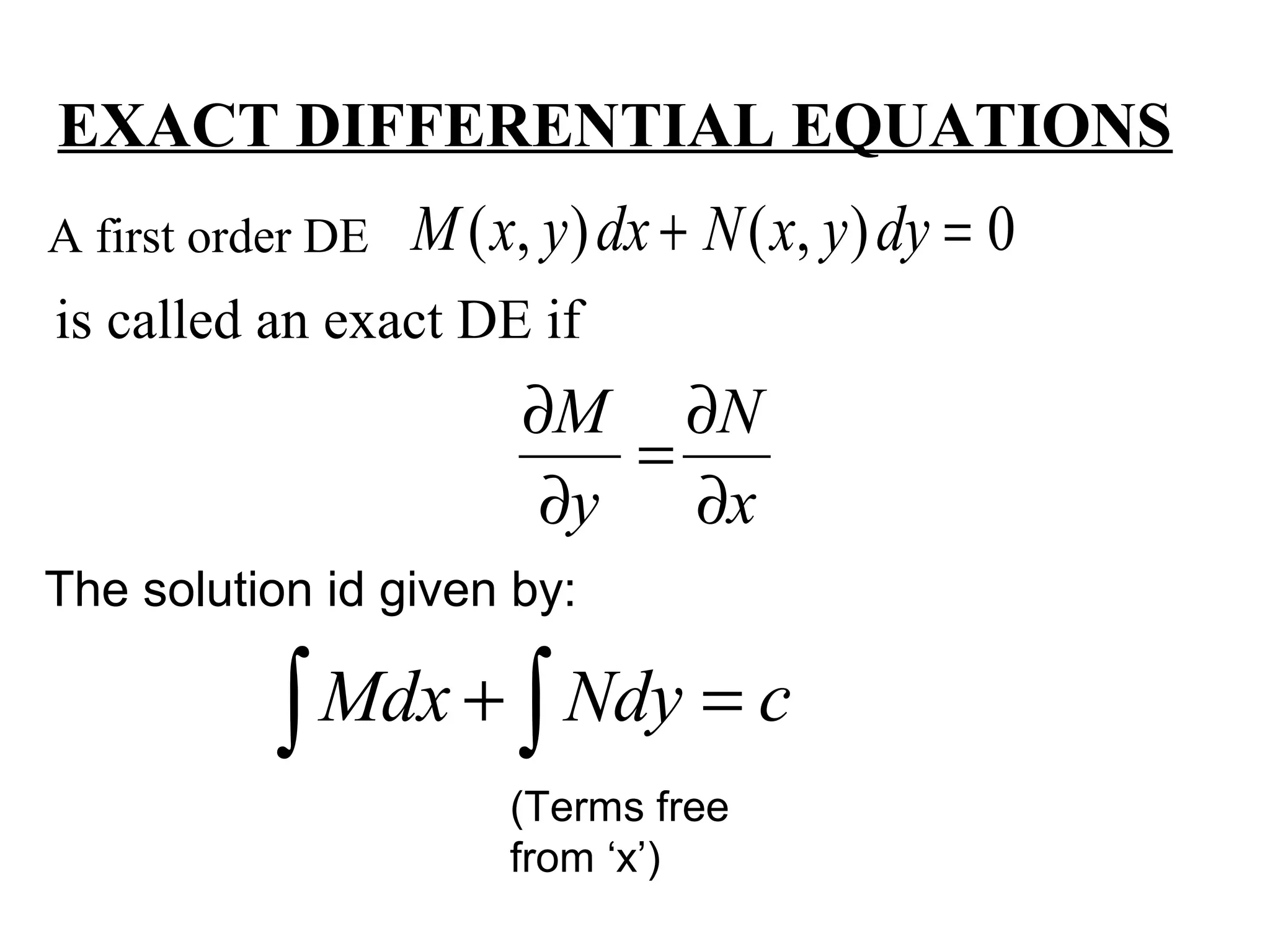
EXACT DIFFERENTIAL EQUATIONS
A first order DE 0),(),( =+ dyyxNdxyxM
is called an exact DE if
M N
y x
∂ ∂
=
∂ ∂
The solution id given by:
∫ ∫ =+ cNdyMdx
(Terms free
from ‘x’)
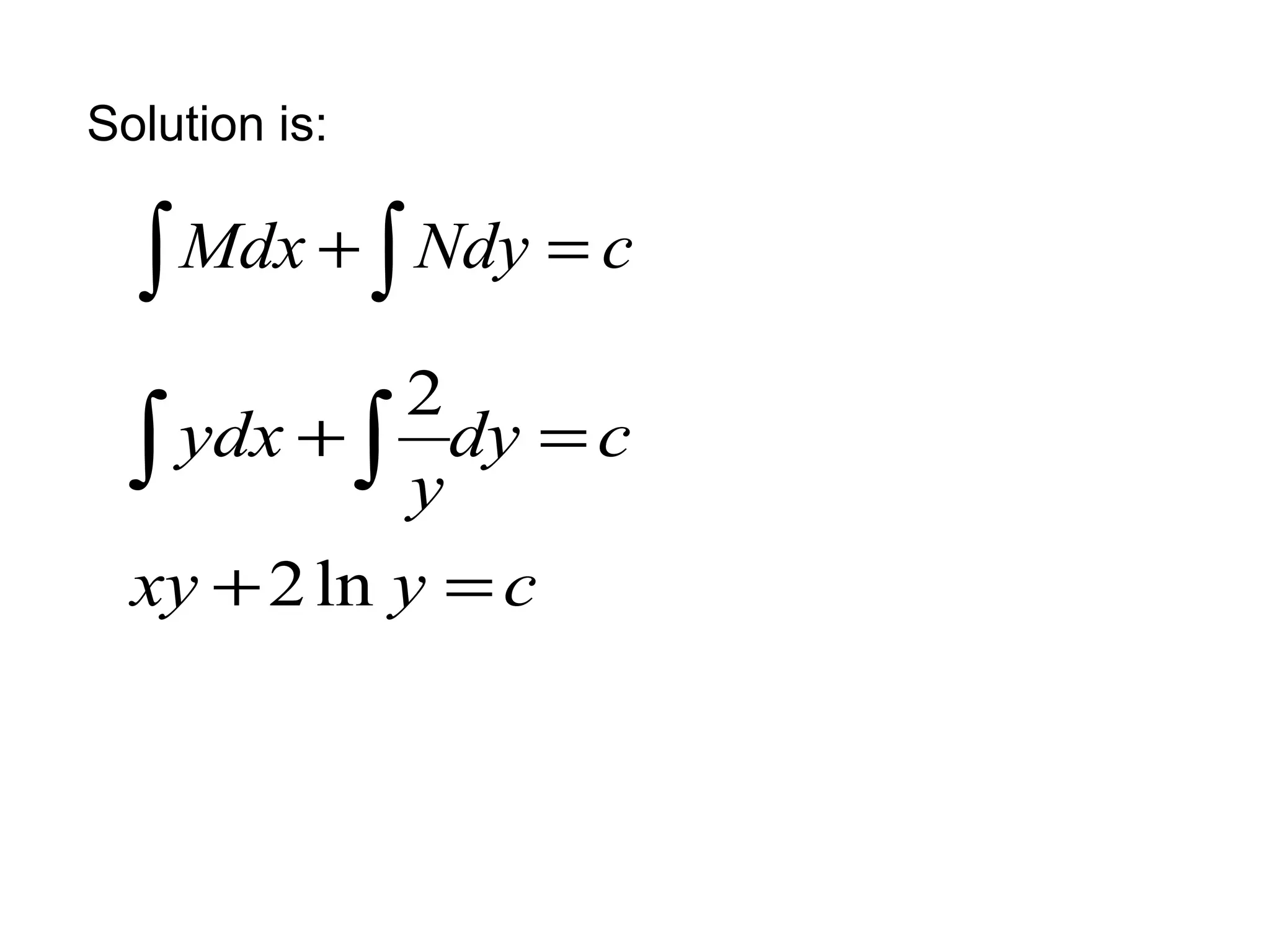
Solution is:
cyxy
cdy
y
ydx
=+
=+∫ ∫
ln2
2
∫ ∫ =+ cNdyMdx
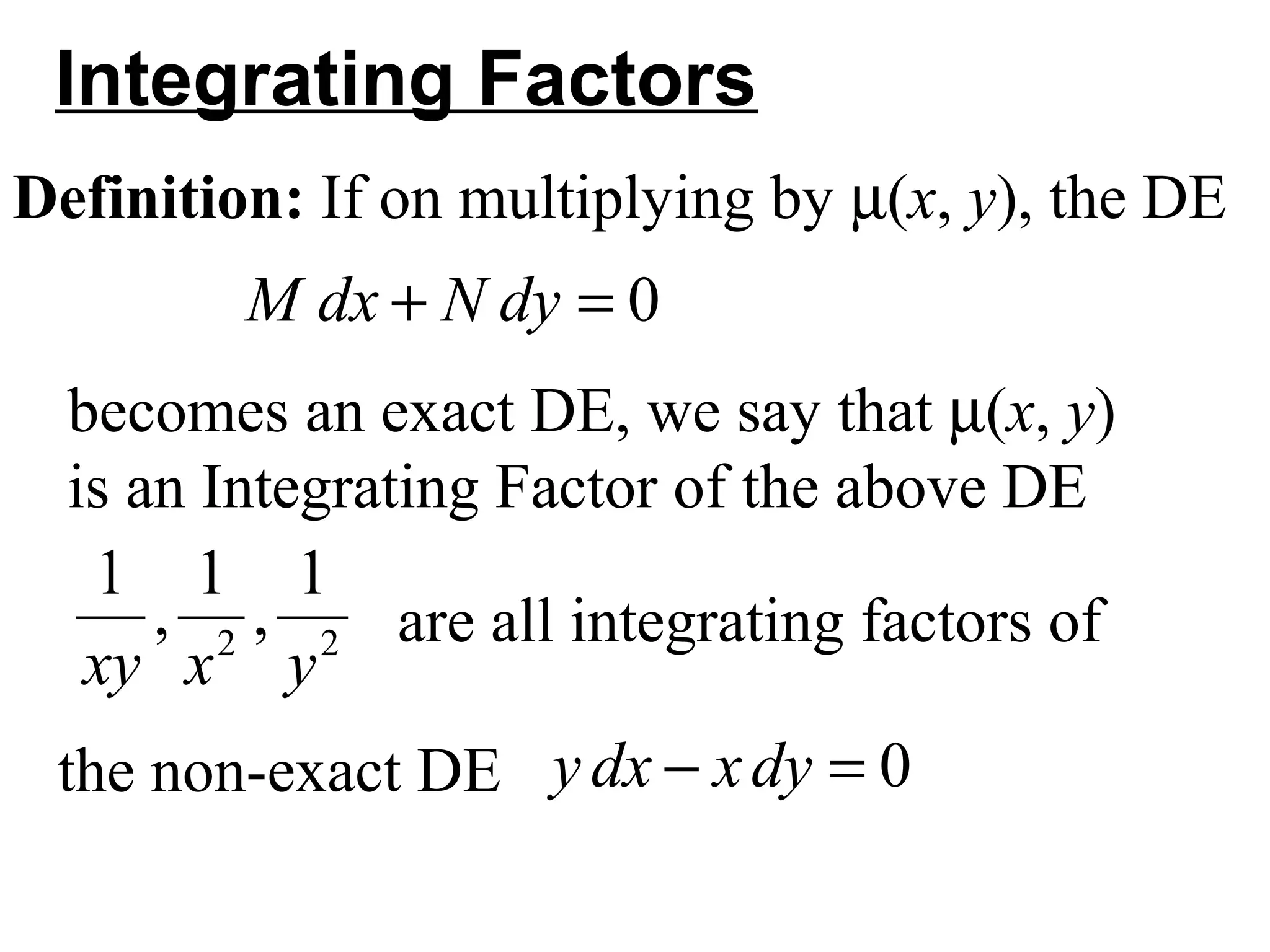
Integrating Factors
Definition: If on multiplying by µ(x, y), the DE
0M dx N dy+ =
becomes an exact DE, we say that µ(x, y)
is an Integrating Factor of the above DE
2 2
1 1 1
, ,
xy x y
are all integrating factors of
the non-exact DE 0y dx xdy− =
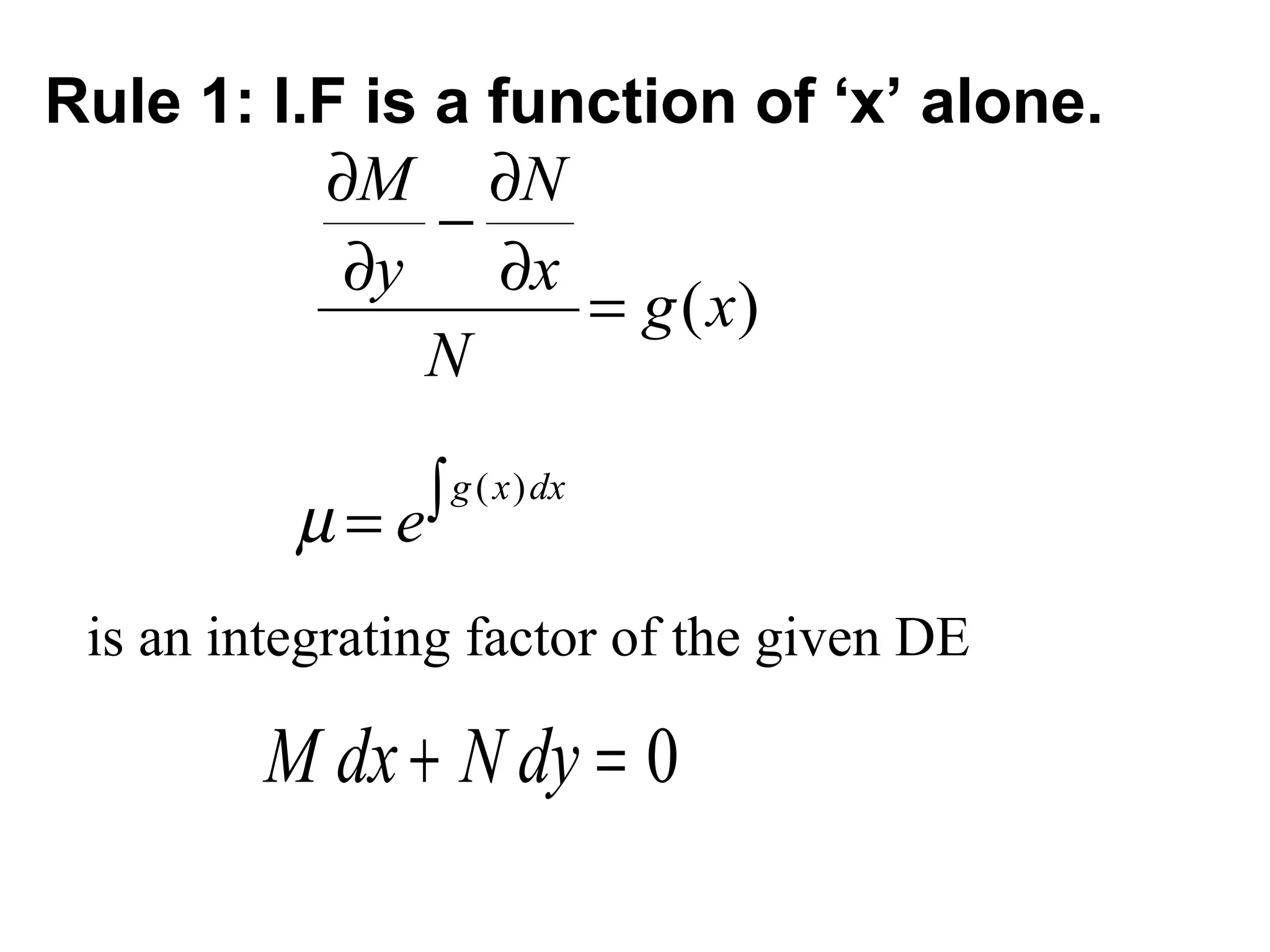
( )
M N
y x
g x
N
∂ ∂
−
∂ ∂
=
( )g x dx
eµ ∫=
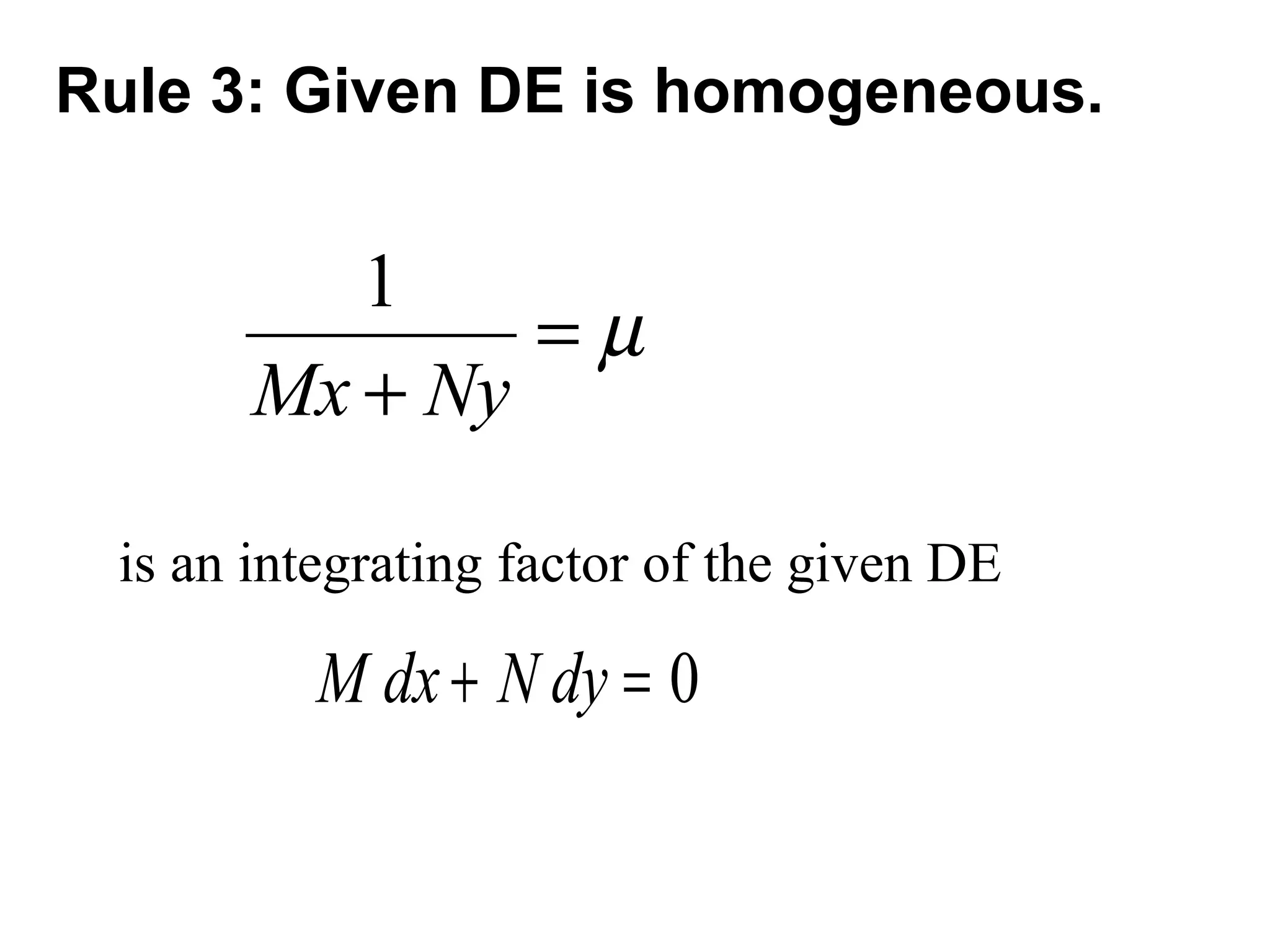
is an integrating factor of the given DE
0M dx N dy+ =
Rule 1: I.F is a function of ‘x’ alone.
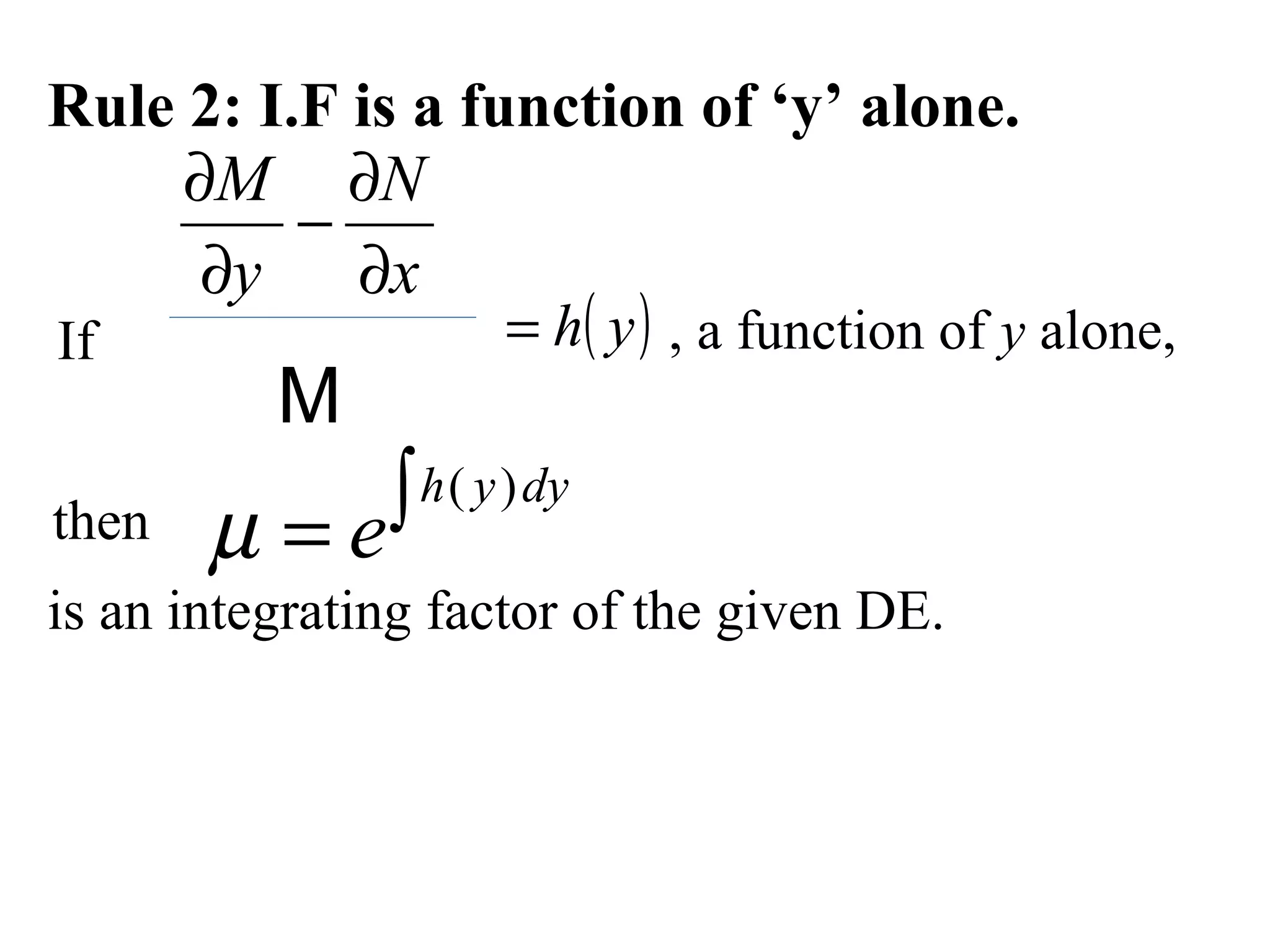
Rule 2: I.F is a function of ‘y’ alone.
If , a function of y alone,
then
( )h y dy
eµ ∫=
is an integrating factor of the given DE.
x
N
y
M
∂
∂
−
∂
∂
M
( )yh=
is an integrating factor of the given DE
0M dx N dy+ =
Rule 3: Given DE is homogeneous.
µ=
+ NyMx
1
Rule 4: Equation is of the form of
( ) ( ) 021 =+ xdyxyfydxxyf
Then,
NyMx −
=
1
µ
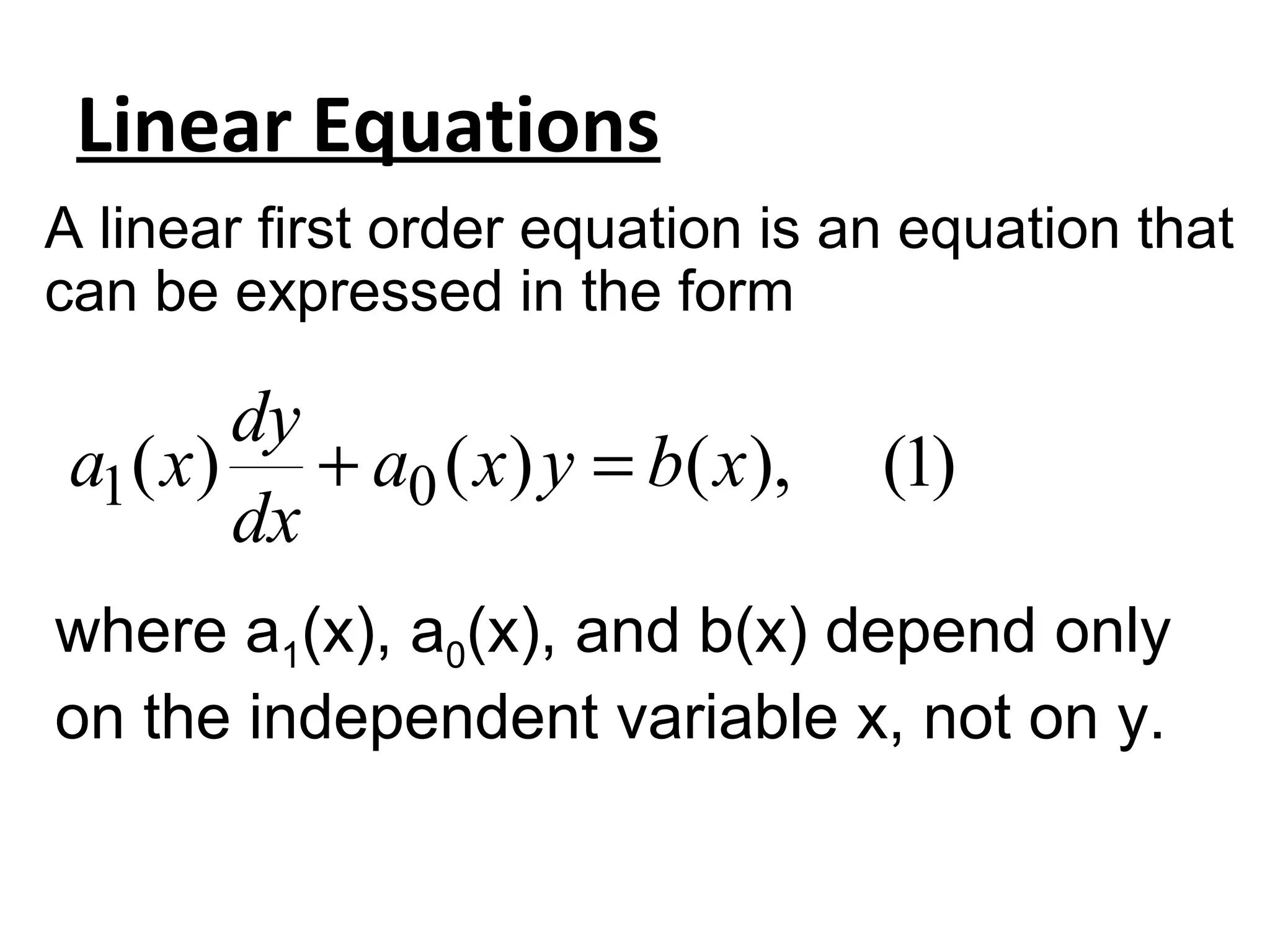
Linear Equations
A linear first order equation is an equation that
can be expressed in the form
1 0( ) ( ) ( ), (1)
dy
a x a x y b x
dx
+ =
where a1(x), a0(x), and b(x) depend only
on the independent variable x, not on y.
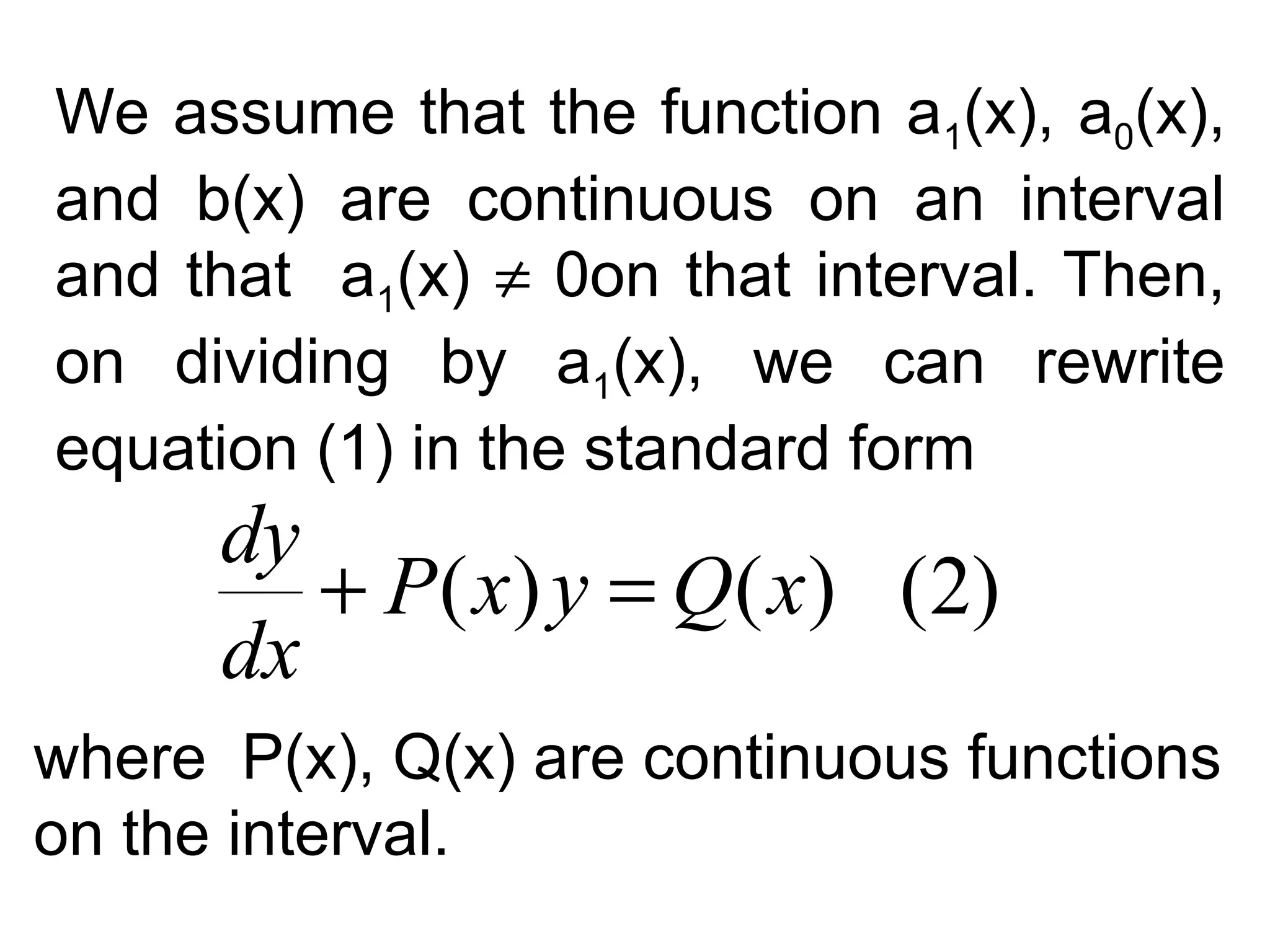
We assume that the function a1(x), a0(x),
and b(x) are continuous on an interval
and that a1(x) ≠ 0on that interval. Then,
on dividing by a1(x), we can rewrite
equation (1) in the standard form
( ) ( ) (2)
dy
P x y Q x
dx
+ =
where P(x), Q(x) are continuous functions
on the interval.
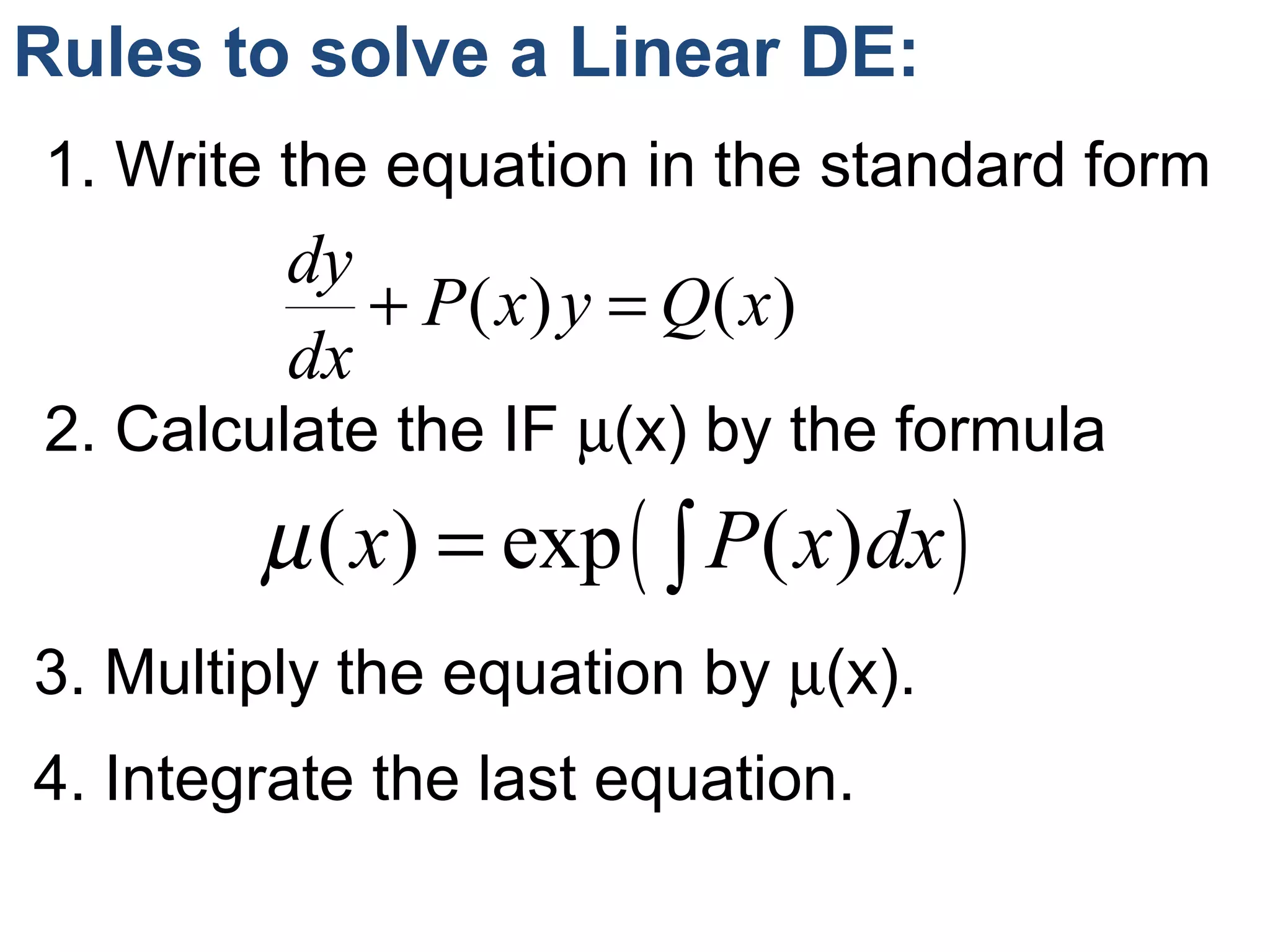
Rules to solve a Linear DE:
1. Write the equation in the standard form
( ) ( )
dy
P x y Q x
dx
+ =
2. Calculate the IF µ(x) by the formula
( )( ) exp ( )x P x dxµ = ∫
3. Multiply the equation by µ(x).
4. Integrate the last equation.
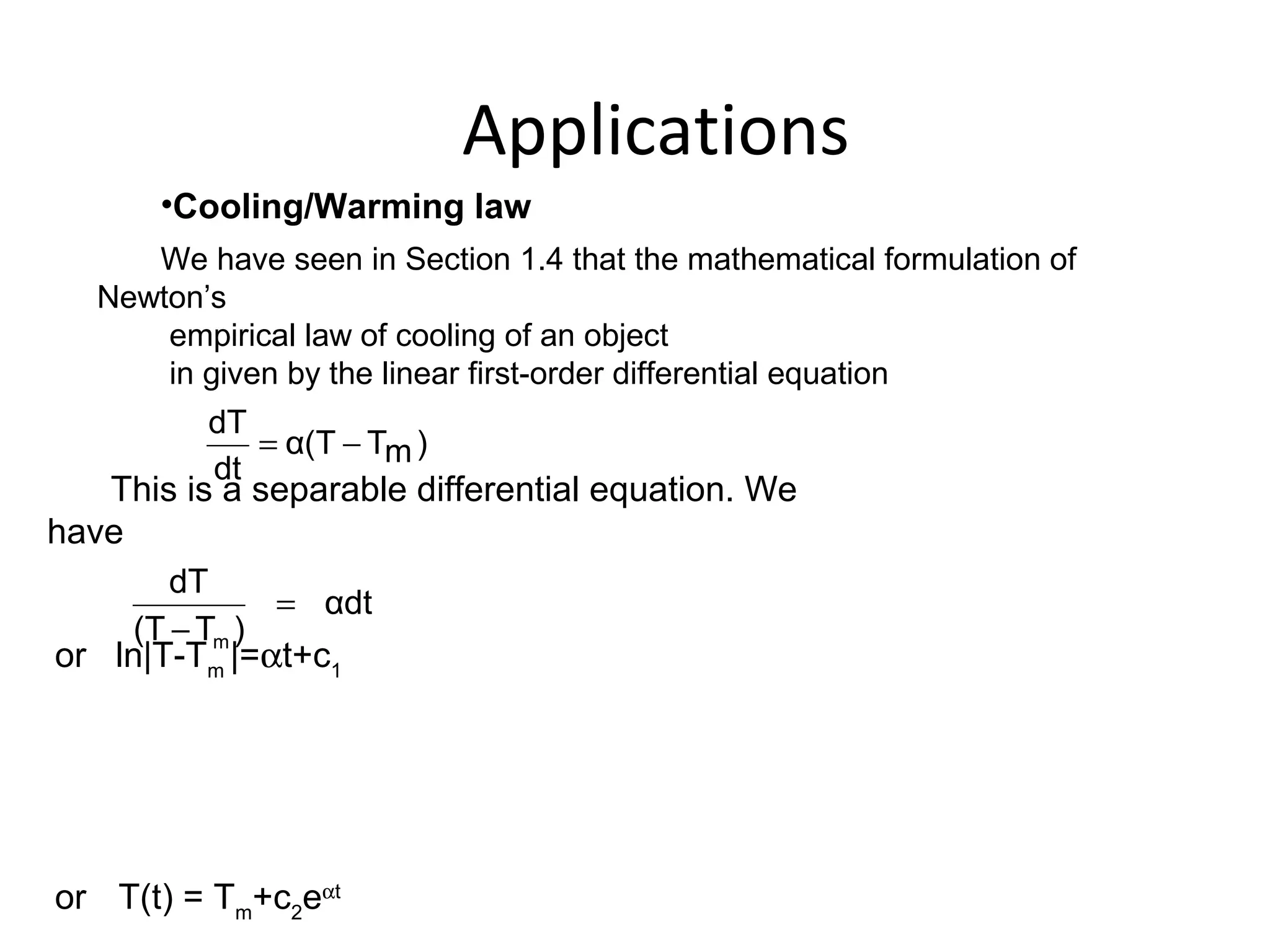
Applications
)mTα(T
dt
dT
−=
αdt
)T(T
dT
m
=
−
•Cooling/Warming law
We have seen in Section 1.4 that the mathematical formulation of
Newton’s
empirical law of cooling of an object
in given by the linear first-order differential equation
This is a separable differential equation. We
have
or ln|T-Tm
|=αt+c1
or T(t) = Tm
+c2
eαt
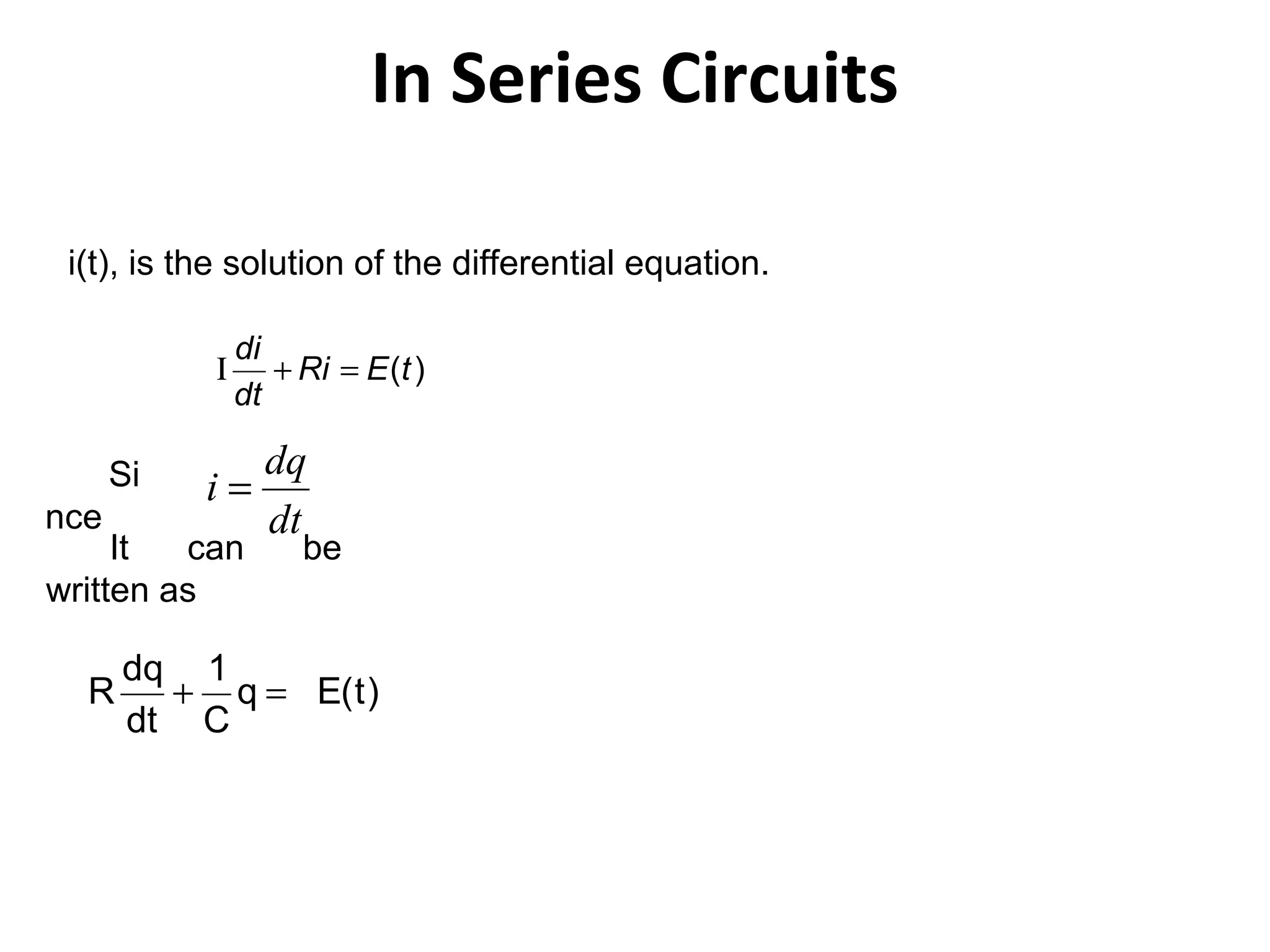
In Series Circuits
i(t), is the solution of the differential equation.
)(tERi
dt
di
=+Ι
dt
dq
i =
)t(Eq
C
1
dt
dq
R =+
Si
nce
It can be
written as

1st order differential equations

  • 1.
    First Order OrdinaryLinear Differential Equations • Ordinary Differential equations does not include partial derivatives. • A linear first order equation is an equation that can be expressed in the form Where p and q are functions of x
  • 2.
    Types Of LinearDE: 1. Separable Variable 2. Homogeneous Equation 3. Exact Equation 4. Linear Equation
  • 3.
    The first-order differentialequation ( ), dy f x y dx = is called separable provided that f(x,y) can be written as the product of a function of x and a function of y. (1) Separable Variable
  • 4.
    Suppose we canwrite the above equation as )()( yhxg dx dy = We then say we have “ separated ” the variables. By taking h(y) to the LHS, the equation becomes
  • 5.
    1 ( ) ( ) dyg x dx h y = Integrating, we get the solution as 1 ( ) ( ) dy g x dx c h y = +∫ ∫ where c is an arbitrary constant.
  • 6.
    Example 1. Considerthe DE y dx dy = Separating the variables, we get dxdy y = 1 Integrating we get the solution as kxy +=||ln or ccey x ,= an arbitrary constant.
  • 7.
    Homogeneous equations Definition Afunction f(x, y) is said to be homogeneous of degree n in x, y if ),(),( yxfttytxf n = for all t, x, y Examples 22 2),( yxyxyxf −−= is homogeneous of degree )sin(),( x xy x y yxf − += is homogeneous of degree 2. 0.
  • 8.
    A first orderDE 0),(),( =+ dyyxNdxyxM is called homogeneous if ),(,),( yxNyxM are homogeneous functions of x and y of the same degree. This DE can be written in the form ),( yxf dx dy =
  • 9.
    The substitution y= vx converts the given equation into “variables separable” form and hence can be solved. (Note that v is also a new variable)
  • 10.
    Working Rule tosolve a HDE: 1. Put the given equation in the form .Let.3 zxy = )1(0),(),( =+ dyyxNdxyxM 2. Check M and N are Homogeneous function of the same degree.
  • 11.
    5. Put thisvalue of dy/dx into (1) and solve the equation for z by separating the variables. 6. Replace z by y/x and simplify. dx dz xz dx dy += 4. Differentiate y = z x to get
  • 12.
    EXACT DIFFERENTIAL EQUATIONS Afirst order DE 0),(),( =+ dyyxNdxyxM is called an exact DE if M N y x ∂ ∂ = ∂ ∂ The solution id given by: ∫ ∫ =+ cNdyMdx (Terms free from ‘x’)
  • 13.
  • 14.
    Integrating Factors Definition: Ifon multiplying by µ(x, y), the DE 0M dx N dy+ = becomes an exact DE, we say that µ(x, y) is an Integrating Factor of the above DE 2 2 1 1 1 , , xy x y are all integrating factors of the non-exact DE 0y dx xdy− =
  • 15.
    ( ) M N yx g x N ∂ ∂ − ∂ ∂ = ( )g x dx eµ ∫= is an integrating factor of the given DE 0M dx N dy+ = Rule 1: I.F is a function of ‘x’ alone.
  • 16.
    Rule 2: I.Fis a function of ‘y’ alone. If , a function of y alone, then ( )h y dy eµ ∫= is an integrating factor of the given DE. x N y M ∂ ∂ − ∂ ∂ M ( )yh=
  • 17.
    is an integratingfactor of the given DE 0M dx N dy+ = Rule 3: Given DE is homogeneous. µ= + NyMx 1
  • 18.
    Rule 4: Equationis of the form of ( ) ( ) 021 =+ xdyxyfydxxyf Then, NyMx − = 1 µ
  • 19.
    Linear Equations A linearfirst order equation is an equation that can be expressed in the form 1 0( ) ( ) ( ), (1) dy a x a x y b x dx + = where a1(x), a0(x), and b(x) depend only on the independent variable x, not on y.
  • 20.
    We assume thatthe function a1(x), a0(x), and b(x) are continuous on an interval and that a1(x) ≠ 0on that interval. Then, on dividing by a1(x), we can rewrite equation (1) in the standard form ( ) ( ) (2) dy P x y Q x dx + = where P(x), Q(x) are continuous functions on the interval.
  • 21.
    Rules to solvea Linear DE: 1. Write the equation in the standard form ( ) ( ) dy P x y Q x dx + = 2. Calculate the IF µ(x) by the formula ( )( ) exp ( )x P x dxµ = ∫ 3. Multiply the equation by µ(x). 4. Integrate the last equation.
  • 22.
    Applications )mTα(T dt dT −= αdt )T(T dT m = − •Cooling/Warming law We haveseen in Section 1.4 that the mathematical formulation of Newton’s empirical law of cooling of an object in given by the linear first-order differential equation This is a separable differential equation. We have or ln|T-Tm |=αt+c1 or T(t) = Tm +c2 eαt
  • 23.
    In Series Circuits i(t),is the solution of the differential equation. )(tERi dt di =+Ι dt dq i = )t(Eq C 1 dt dq R =+ Si nce It can be written as