FILAMENT WINDING
Neslihan Yağmur
11/12/2012 1
What is Filament Winding?
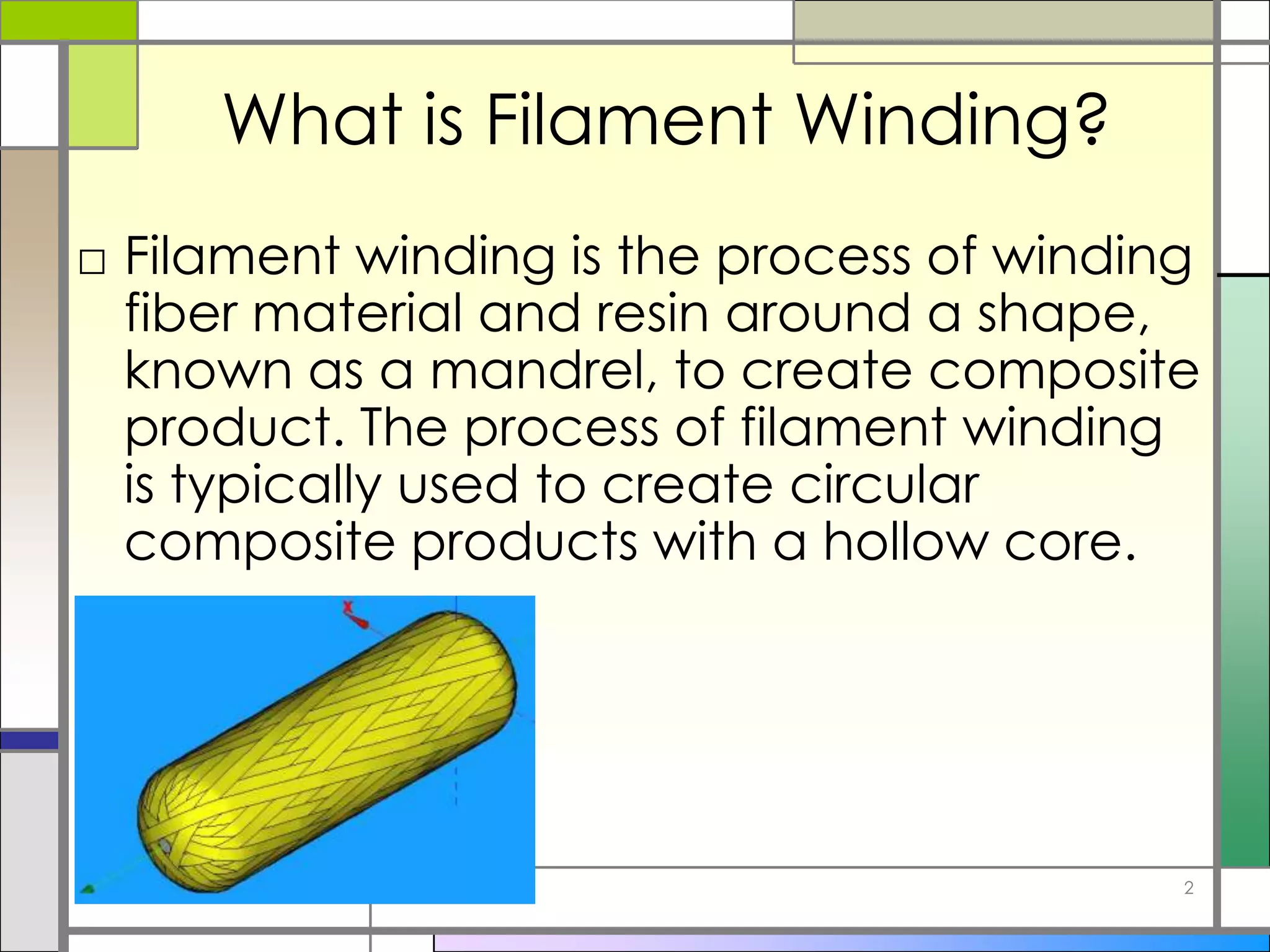
□ Filament winding is the process of winding
fiber material and resin around a shape,
known as a mandrel, to create composite
product. The process of filament winding
is typically used to create circular
composite products with a hollow core.
2
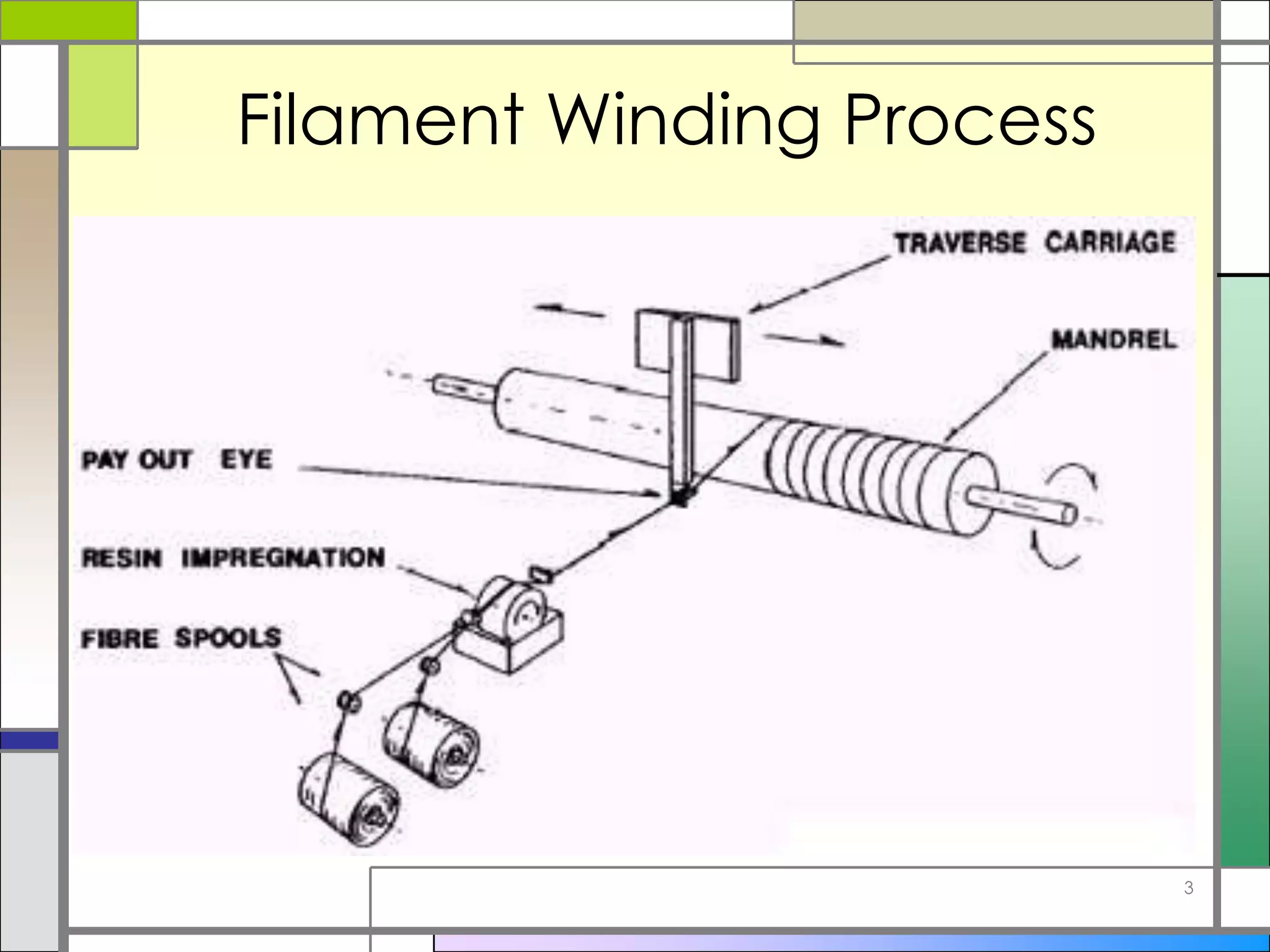
Filament Winding Process
3
Process
 Precision high-speed positioning of
continuous fiber in a pre-determined
pattern is the basis of the filament winding
process .
 There is a mandrel that the fiber and resin
wound upon, is cured in room temp or in
oven. After cure mandrel is removed
leaving a hallow composite structure.
4
Tension
□ fibre tension is critical to the operation of a
filament winding machine,
□ tension required depends on
□ type of fibre
□ part diameter
□ winding pattern
5
Tension
□ fibre tension directly affects:
□ fibre volume fraction,
□ void content,
□ strength and stiffness of the composite part.
6
Winding Patterns
Circumferential: helical:
polar:
7
Materials
fiber (in roving form):
□ E-glass, S-glass,
□ Carbon / Graphite,
□ Aramid,
□ Borons.
8
Materials
Resins:
□ Epoxy,
□ Vinyl ester,
□ Polyester,
□ Polyurethane,
□ Phenolics,
□ Furans,
□ Polyimides.
9
Factors Affecting Properties
□ Fabrication variables
□ Processing variables
□ Winding variables
□ Material's variables
□ Environmental variables
10
Advantages of Filament
Winding
□ highly reproducible nature of the process
□ continuous fiber over the entire part
□ high fiber volume is obtainable
□ ability to orient fibers in the load direction (10°
minimum winding angle)
□ fiber and resin used in lowest cost form
□ size of component not restricted by oven or
autoclave size
□ process automation (particularly with high volume)
results in cost savings
11
Disadvantages of Filament
Winding
□ part configuration must facilitate mandrel
extraction
□ mandrel could be complex and expensive
□ inability to wind reverse curvature
□ inability to easily change fiber path within one layer
□ wound external surface may not be satisfactory for
some applications
12
Application
□ Storage tank
□ Railway tank car
□ Pipe
13
Application
□ Aerospace Parts
□ Sporting Goods
□ Gas Tanks
14
References
□ Filament Winding Compositions for
Fiber/Resin Composites, P. Klemarczyk,
1996
□ Thermoplastic Filament Winding,
Composites Manufacturing, J.
Romagna,1995
15

Filament winding

  • 1.
  • 2.
    What is FilamentWinding? □ Filament winding is the process of winding fiber material and resin around a shape, known as a mandrel, to create composite product. The process of filament winding is typically used to create circular composite products with a hollow core. 2
  • 3.
  • 4.
    Process  Precision high-speedpositioning of continuous fiber in a pre-determined pattern is the basis of the filament winding process .  There is a mandrel that the fiber and resin wound upon, is cured in room temp or in oven. After cure mandrel is removed leaving a hallow composite structure. 4
  • 5.
    Tension □ fibre tensionis critical to the operation of a filament winding machine, □ tension required depends on □ type of fibre □ part diameter □ winding pattern 5
  • 6.
    Tension □ fibre tensiondirectly affects: □ fibre volume fraction, □ void content, □ strength and stiffness of the composite part. 6
  • 7.
  • 8.
    Materials fiber (in rovingform): □ E-glass, S-glass, □ Carbon / Graphite, □ Aramid, □ Borons. 8
  • 9.
    Materials Resins: □ Epoxy, □ Vinylester, □ Polyester, □ Polyurethane, □ Phenolics, □ Furans, □ Polyimides. 9
  • 10.
    Factors Affecting Properties □Fabrication variables □ Processing variables □ Winding variables □ Material's variables □ Environmental variables 10
  • 11.
    Advantages of Filament Winding □highly reproducible nature of the process □ continuous fiber over the entire part □ high fiber volume is obtainable □ ability to orient fibers in the load direction (10° minimum winding angle) □ fiber and resin used in lowest cost form □ size of component not restricted by oven or autoclave size □ process automation (particularly with high volume) results in cost savings 11
  • 12.
    Disadvantages of Filament Winding □part configuration must facilitate mandrel extraction □ mandrel could be complex and expensive □ inability to wind reverse curvature □ inability to easily change fiber path within one layer □ wound external surface may not be satisfactory for some applications 12
  • 13.
    Application □ Storage tank □Railway tank car □ Pipe 13
  • 14.
    Application □ Aerospace Parts □Sporting Goods □ Gas Tanks 14
  • 15.
    References □ Filament WindingCompositions for Fiber/Resin Composites, P. Klemarczyk, 1996 □ Thermoplastic Filament Winding, Composites Manufacturing, J. Romagna,1995 15