

TAMPONS
TE552
NonwovenProductDevelopment
Neslihan
Yagmur
A tampon is a mass of absorbent material
inserted into a body cavity or wound to absorb
bodily fluid.
Gives freedom during the days
Do not hurt skin
Do not disturb
New tampon desing with applicators
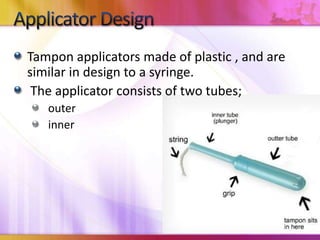
Tampon applicators made of plastic , and are
similar in design to a syringe.
The applicator consists of two tubes;
outer
inner
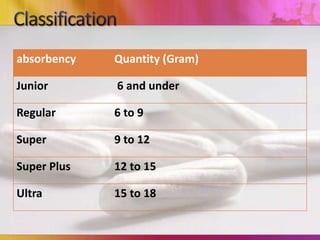
absorbency Quantity (Gram)
Junior 6 and under
Regular 6 to 9
Super 9 to 12
Super Plus 12 to 15
Ultra 15 to 18
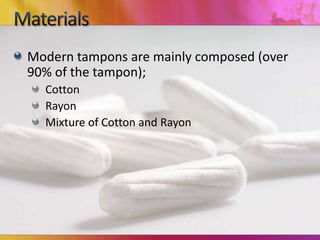
Modern tampons are mainly composed (over
90% of the tampon);
Cotton
Rayon
Mixture of Cotton and Rayon
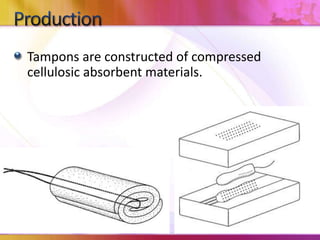
Tampons are constructed of compressed
cellulosic absorbent materials.
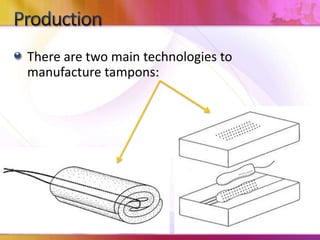
There are two main technologies to
manufacture tampons:
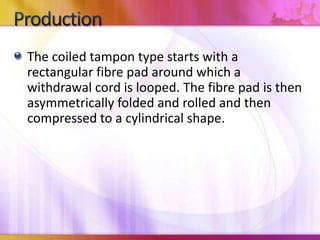
The coiled tampon type starts with a
rectangular fibre pad around which a
withdrawal cord is looped. The fibre pad is then
asymmetrically folded and rolled and then
compressed to a cylindrical shape.
A number of longitudinal or helical grooves are
formed by the compressing operation. This type
of tampon expands radially. Most digital
tampons are coiled tampons.
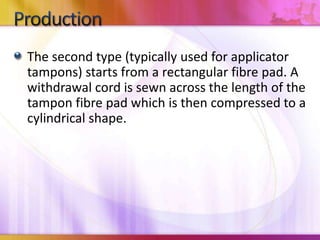
The second type (typically used for applicator
tampons) starts from a rectangular fibre pad. A
withdrawal cord is sewn across the length of the
tampon fibre pad which is then compressed to a
cylindrical shape.
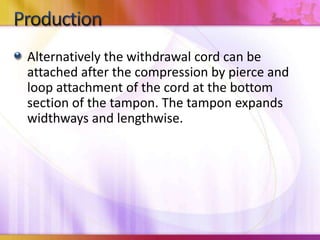
Alternatively the withdrawal cord can be
attached after the compression by pierce and
loop attachment of the cord at the bottom
section of the tampon. The tampon expands
widthways and lengthwise.
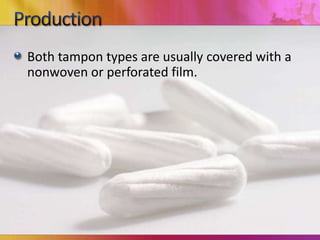
Both tampon types are usually covered with a
nonwoven or perforated film.
Do not use tampons more than 8 hours…
Materials used in most modern tampons are so
highly absorbent that they pose the risk of
absorbing the vagina's natural discharge and
upsetting its natural moisture balance, which is
what enables toxic shock syndrome to occur.
To Avoid TSS;
Follow package directions for insertion
Choose the lowest absorbency needed for one's
flow
Consider using cotton or cloth tampons rather than
rayon
To Avoid TSS;
Change the tampon at least every 4 to 6 hours
Alternate between tampons and pads
Avoid tampon usage overnight or when sleeping
Edana, Tampons for menstrual hygiene, Modern products with
ancient roots
Davis, D., Kim, T.L., Toxic Shock Syndrome: Case Report Of a
Postpartum Female And a Literature Review, The Journal of
Emergency Medicine, Vol 16, No. 4, pp. 607-614, 1998
Edana, Tampon Absorbencies, February, 2002
United States Patent 7124483, Process for producing stabilized
tampons, 2006
United States Patent 6953456, Tampon having an oval form
after expansion and process for producing the same, 2000
Thank You For Your Attention

Tampons

  • 1.
  • 2.
    A tampon isa mass of absorbent material inserted into a body cavity or wound to absorb bodily fluid.
  • 3.
    Gives freedom duringthe days Do not hurt skin Do not disturb
  • 4.
    New tampon desingwith applicators
  • 5.
    Tampon applicators madeof plastic , and are similar in design to a syringe. The applicator consists of two tubes; outer inner
  • 6.
    absorbency Quantity (Gram) Junior6 and under Regular 6 to 9 Super 9 to 12 Super Plus 12 to 15 Ultra 15 to 18
  • 7.
    Modern tampons aremainly composed (over 90% of the tampon); Cotton Rayon Mixture of Cotton and Rayon
  • 8.
    Tampons are constructedof compressed cellulosic absorbent materials.
  • 9.
    There are twomain technologies to manufacture tampons:
  • 10.
    The coiled tampontype starts with a rectangular fibre pad around which a withdrawal cord is looped. The fibre pad is then asymmetrically folded and rolled and then compressed to a cylindrical shape.
  • 11.
    A number oflongitudinal or helical grooves are formed by the compressing operation. This type of tampon expands radially. Most digital tampons are coiled tampons.
  • 12.
    The second type(typically used for applicator tampons) starts from a rectangular fibre pad. A withdrawal cord is sewn across the length of the tampon fibre pad which is then compressed to a cylindrical shape.
  • 13.
    Alternatively the withdrawalcord can be attached after the compression by pierce and loop attachment of the cord at the bottom section of the tampon. The tampon expands widthways and lengthwise.
  • 14.
    Both tampon typesare usually covered with a nonwoven or perforated film.
  • 15.
    Do not usetampons more than 8 hours…
  • 16.
    Materials used inmost modern tampons are so highly absorbent that they pose the risk of absorbing the vagina's natural discharge and upsetting its natural moisture balance, which is what enables toxic shock syndrome to occur.
  • 17.
    To Avoid TSS; Followpackage directions for insertion Choose the lowest absorbency needed for one's flow Consider using cotton or cloth tampons rather than rayon
  • 18.
    To Avoid TSS; Changethe tampon at least every 4 to 6 hours Alternate between tampons and pads Avoid tampon usage overnight or when sleeping
  • 19.
    Edana, Tampons formenstrual hygiene, Modern products with ancient roots Davis, D., Kim, T.L., Toxic Shock Syndrome: Case Report Of a Postpartum Female And a Literature Review, The Journal of Emergency Medicine, Vol 16, No. 4, pp. 607-614, 1998 Edana, Tampon Absorbencies, February, 2002 United States Patent 7124483, Process for producing stabilized tampons, 2006 United States Patent 6953456, Tampon having an oval form after expansion and process for producing the same, 2000
  • 20.
    Thank You ForYour Attention