Drug distribution
Dr Naser
Objectives
1. Overview of drug distribution
2. Explain apparent volume of distribution
with clinical implications
3Discuss drug binding to plasma proteins and
tissues with clinical implications
4. Explain redistribution
5. Discuss blood brain barrier and Placental
barrier
Drug Distribution refers to the Reversible
Transfer of a Drug between the Blood and the
Extra Vascular Fluids and Tissues of the body
(for example, fat, muscle, and brain tissue).
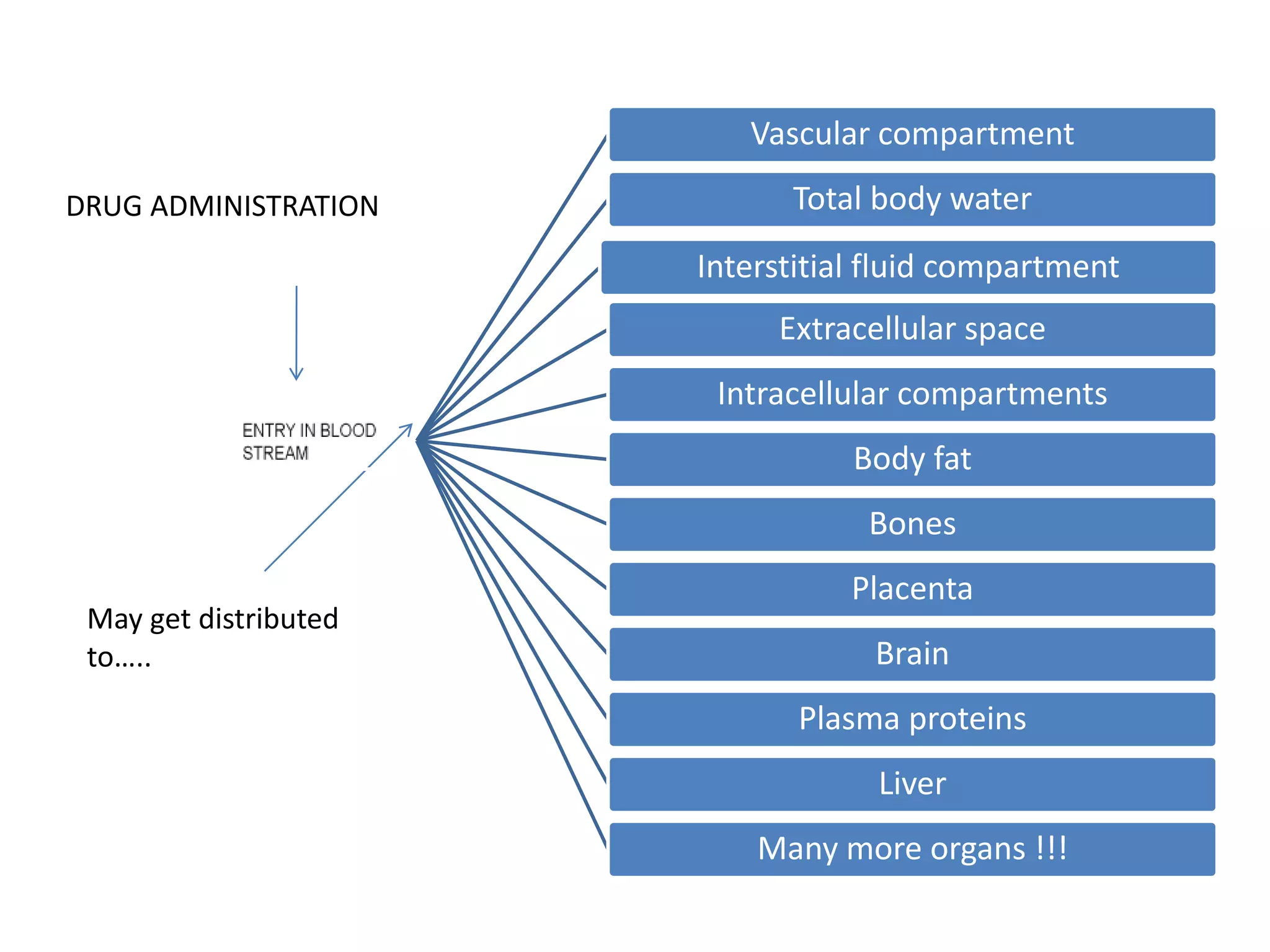
DRUG ADMINISTRATION
May get distributed
to…..
Vascular compartment
Total body water
Interstitial fluid compartment
Extracellular space
Intracellular compartments
Body fat
Bones
Placenta
Brain
Plasma proteins
Liver
Many more organs !!!
Factors
affecting
distribution
Lipid
solubility
(lipophilicit
y) &
ionization
Capillary
permeability
Binding of
drugs to
plasma
proteins &
tissues
Presence of
tissue
specific
transporters
Cardiac
output and
local blood
flow.
Volume of distribution
• Fluid volume that is required to contain the entire
drug in the body at the same concentration
measured in the plasma.
• Calculated by dividing the dose that ultimately gets
into the systemic circulation by the plasma
concentration at time zero (C0)
Which means
• If 500 mg of drug reaches circulation…(total amount of drug )
• And if plasma concentration is 0.5 mg/ml
• Vd will be 500/0.5 = 1000 ml.
• Which means you require 1000 ml of fluid to accommodate total 500 mg
of drug at concentration of 0.5 mg/ml.
• At times it can be larger than total blood volume. (when drug
has been stored in peripheral tissues so lower blood concentration).
• At times it can be smaller than or equal to total blood
volume( when drug remains in vascular compartment).
Vd(L) =
Total amount administered
Plasma concentration
Total amount administered
Plasma concentration
Vd(L) =
When plasma
concentration
is high….
Vd is low….
Vd(L) =
Total amount administered
Plasma concentration
When plasma
concentration
is low….
Vd is high….
Distribution into the water
compartments of body
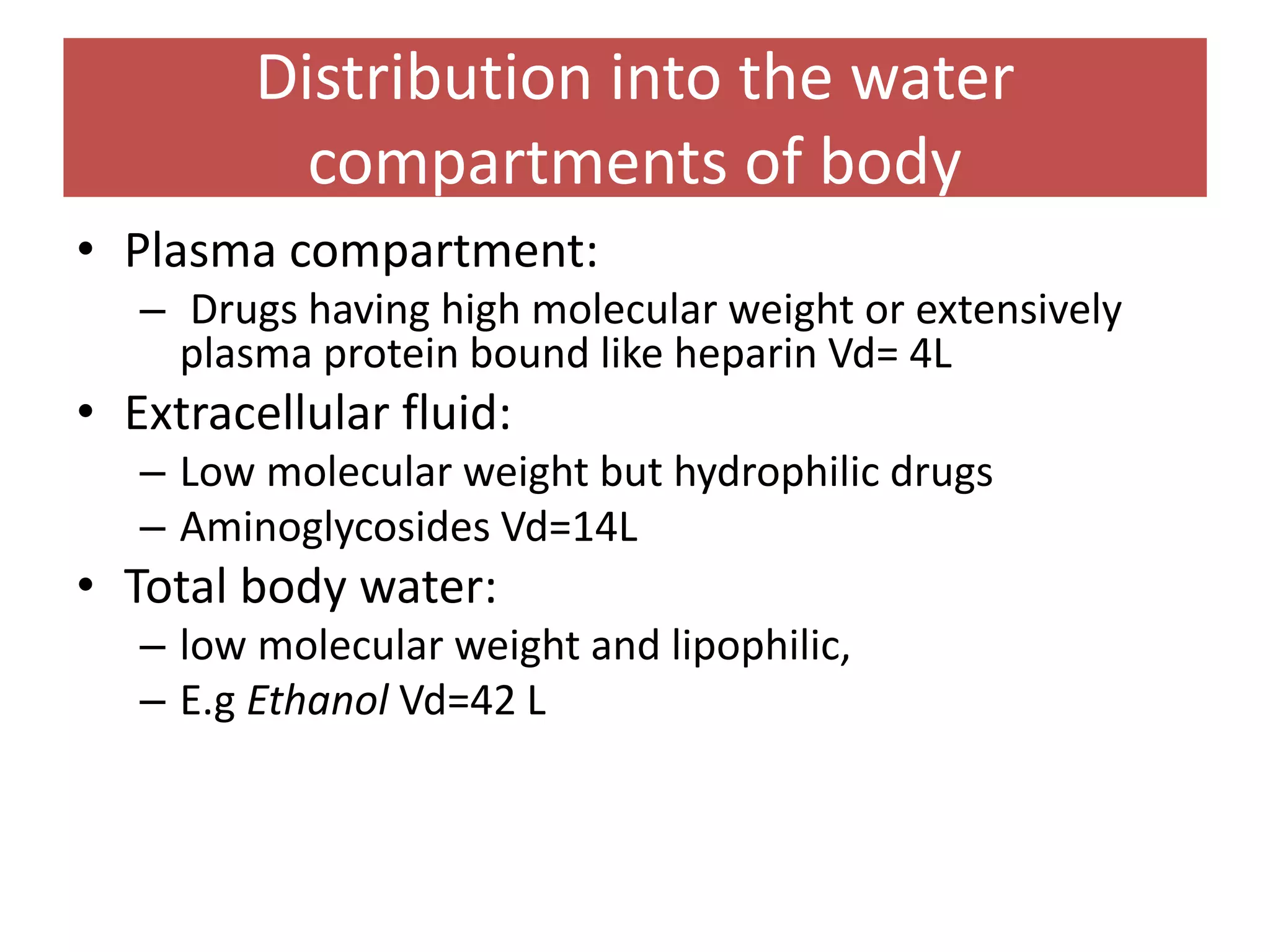
• Plasma compartment:
– Drugs having high molecular weight or extensively
plasma protein bound like heparin Vd= 4L
• Extracellular fluid:
– Low molecular weight but hydrophilic drugs
– Aminoglycosides Vd=14L
• Total body water:
– low molecular weight and lipophilic,
– E.g Ethanol Vd=42 L
Apparent Volume of distribution
• A drug rarely associates exclusively with only one
of the water compartments of the body.
• Vast majority of drugs distribute into several
compartments, often avidly binding cellular
components, such as lipids, proteins, and nucleic
acids.
• Thus, the volume into which drugs distribute is
called the apparent volume of distribution (Vd).
Plasma protein binding
• Most drugs posses physicochemical affinity for
plasma proteins
– Acidic drugs bind to plasma albumin, basic drugs
bind to 1 acid glycoprotein
– Reversible manner
– Extensive binding serves as a circulating drug
reservoir
– Other proteins to which drugs can bind: globulins,
transferrin, ceruloplasmin, tissue proteins &
nucleoproteins
Clinical implications of plasma protein
binding
1. Highly plasma protein bound drugs does not
cross membranes so largely restricted to
vascular compartments (smaller Vd).
2. Temporary storage of the drug which is not
available for any action.
3. High degree of protein binding generally
makes the drug long acting
4. Plasma concentrations of the drug refer to
bound as well as free drug.
5. One drug can bind to many sites on the albumin molecule.
Conversely, more than one drug can bind to the same site.
6. Displacement reactions- (Drug interactions)
– Salicylates displace sulfonylureas & methotrexate.
– Indomethacin, phenytoin displace warfarin.
– Sulfonamides and vit K displace bilirubin(kernicterus in neonates) .
7. In hypoalbuminemia, reduced binding leads to high
concentrations of free drug e.g. phenytoin and furosemide.
8. Other diseases: e.g. phenytoin and pethidine binding is
reduced in uraemia;
Clinical implications of plasma protein
binding
Drugs highly bound to plasma proteins
• To albumin
• Barbiturates
• Benzodiazepines
• NSAIDs
• Valproic acid
• Phenytoin
• Penicillins
• Sulfonamides
• Tetracyclines
• Warfarin
• To α1 acid glycoprotein
• β-blockers
• Bupivacaine
• Lidocaine
• Disopyramide ,
• Imipramine
• Methadone
• Prazosin
• Quinidine
• Verapamil
Clinical implications of volume of distribution
• Dialysis is not very useful for drugs with high
Vd e.g digoxin, imipramine
• It helps in estimating the total amount of drug
at any time
amount of drug = Vd X plasma conc of drug at
certain time
• Vd is important to determine the loading dose
Loading dose = Vd X desired concentration
Drugs concentrated in body tissues
• Digoxin, emetine: Skeletal muscles, heart,
liver, kidney
• Chloroquine: retina and liver
• Iodine: Thyroid
• Chlorpromazine: eye
• Atropine: iris
• Tetracyclines: Bone and teeth
• Thiopentone , DDT: Adipose tissue
Redistribution
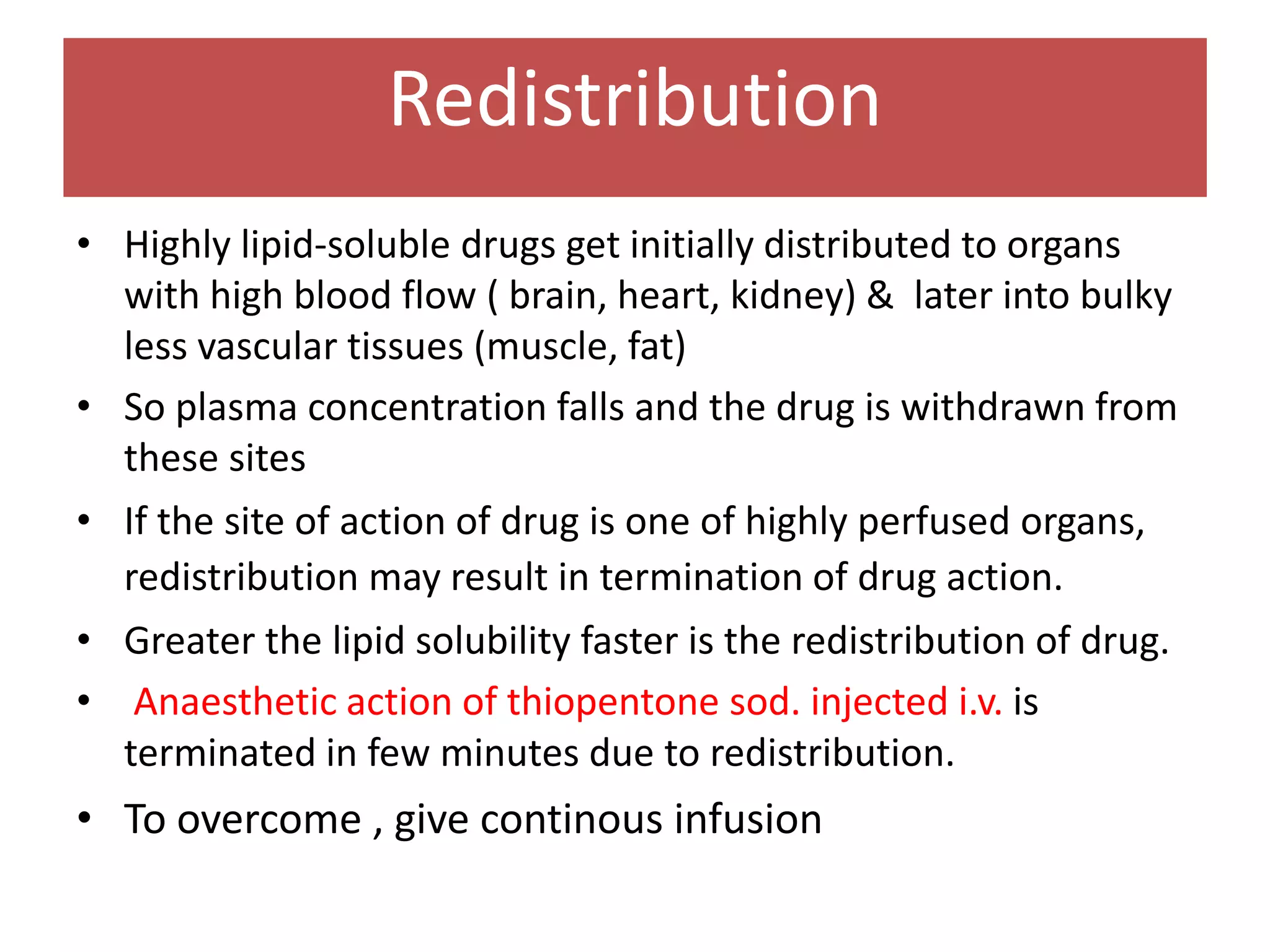
• Highly lipid-soluble drugs get initially distributed to organs
with high blood flow ( brain, heart, kidney) & later into bulky
less vascular tissues (muscle, fat)
• So plasma concentration falls and the drug is withdrawn from
these sites
• If the site of action of drug is one of highly perfused organs,
redistribution may result in termination of drug action.
• Greater the lipid solubility faster is the redistribution of drug.
• Anaesthetic action of thiopentone sod. injected i.v. is
terminated in few minutes due to redistribution.
• To overcome , give continous infusion
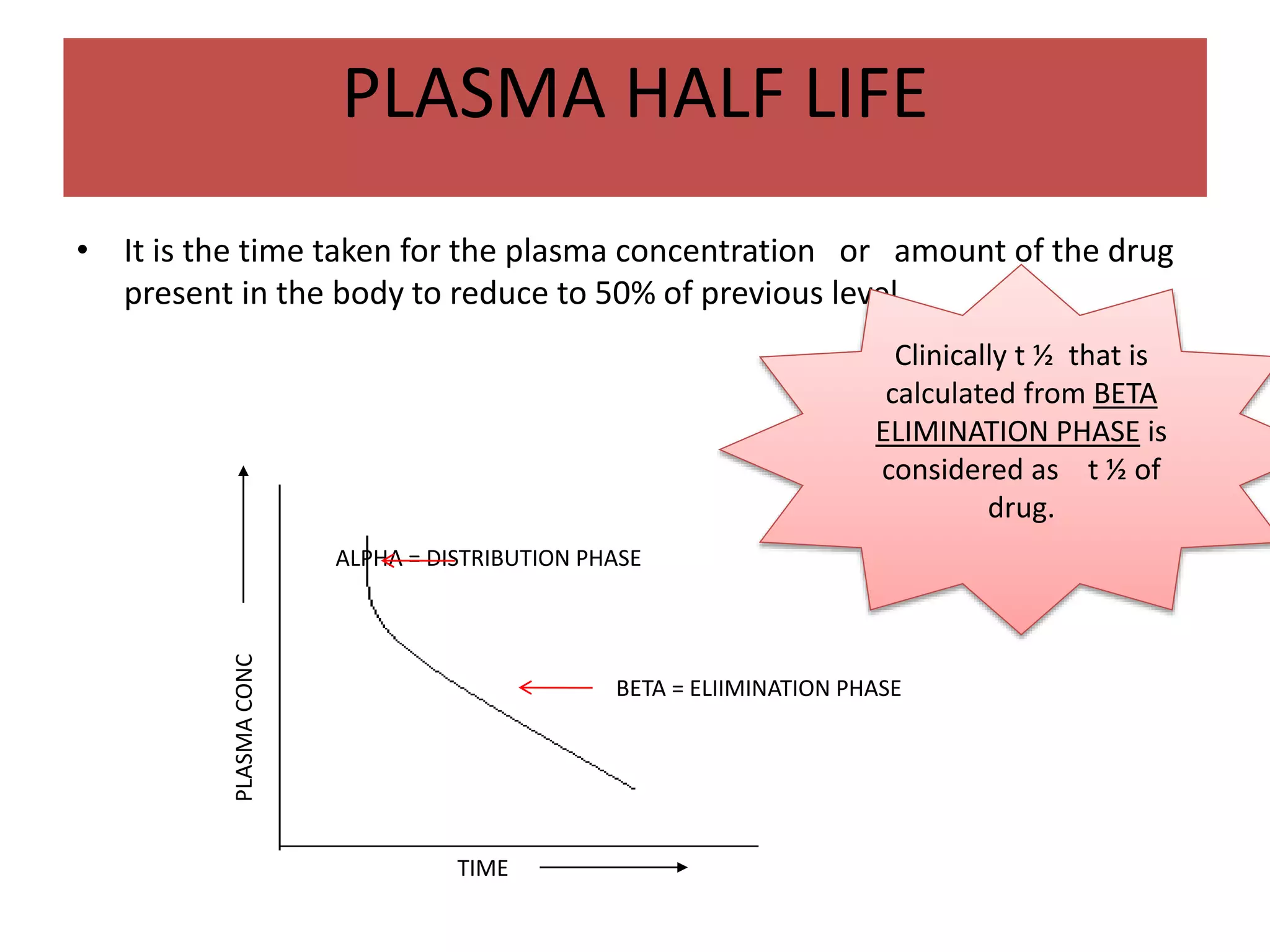
PLASMA HALF LIFE
• It is the time taken for the plasma concentration or amount of the drug
present in the body to reduce to 50% of previous level.
PLASMACONC
TIME
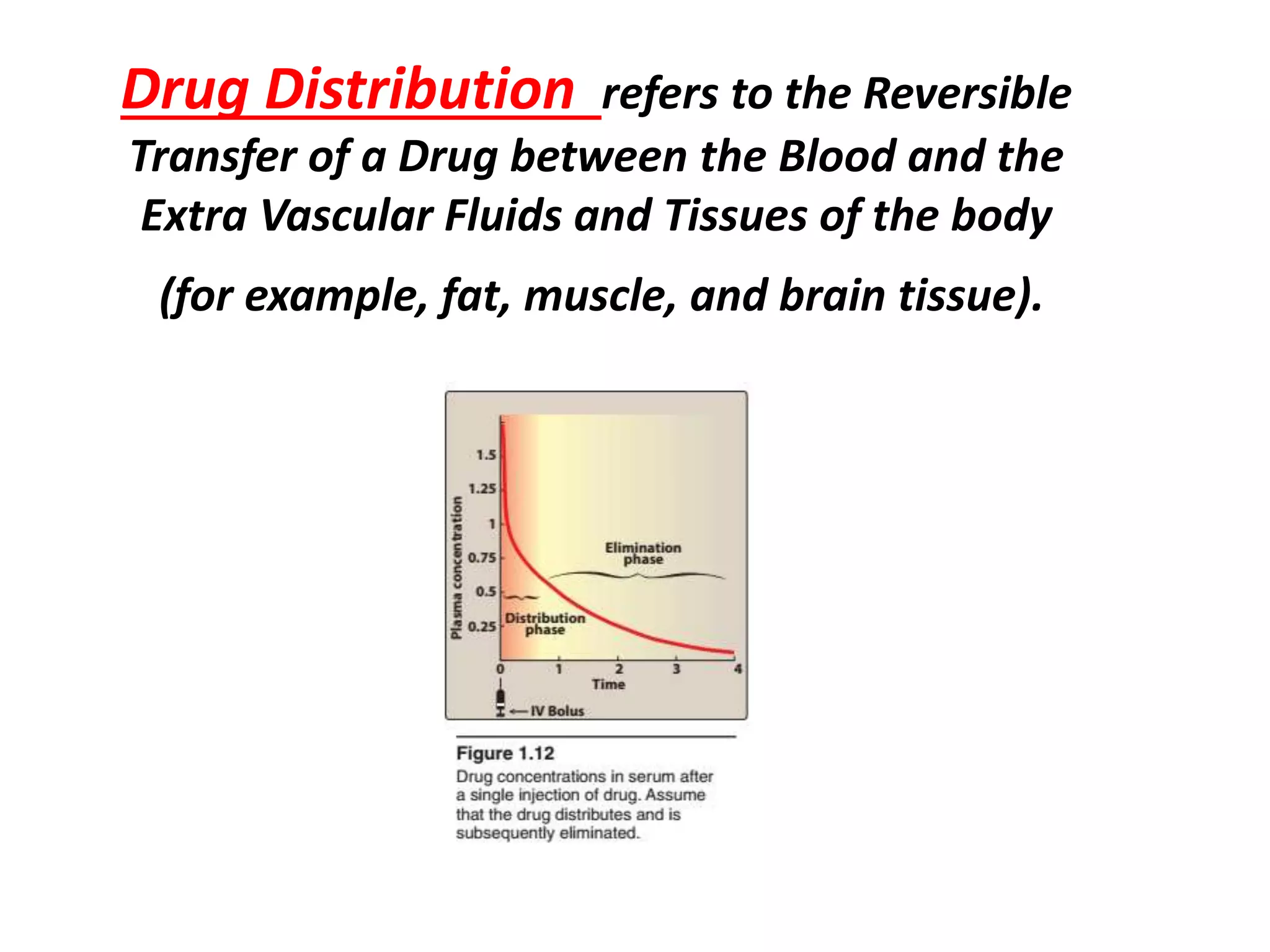
ALPHA = DISTRIBUTION PHASE
BETA = ELIIMINATION PHASE
Clinically t ½ that is
calculated from BETA
ELIMINATION PHASE is
considered as t ½ of
drug.
At peak  blood concentration will be 100 %
After 1 half life  blood concentration will be 50 %
After 2 half lives  blood concentration will be 25 %
After 3 half lives  blood concentration will be 12.5 %
After 4 half lives  blood concentration will be 6.25 %
After 5 half lives  blood concentration will be 3.125 %
So after 4-5 half lives
drug will be almost
completely eliminated
from the body
If you administer a
drug before that
there will be
accumulation of
the drug in the
body.
Blood brain barrier
Functions and Properties of the BBB
• Protects the brain from "foreign substances"
in the blood that may injure the brain.
• Protects the brain from hormones and
neurotransmitters in the rest of the body.
• Maintains a constant environment for the
brain.
Properties of drugs that can cross BBB
• low molecular weight
• High degree of lipid solubility
• Non ionized
• Tertiary structure and
• Free drug
Placental Barrier
• Lipoidal and allows free passage of lipophilic
drugs
• P Glycoprotein limits exposure to maternally
administered drugs
• Also placenta is site of metabolism- lowers
exposure to drugs
• Incomplete barrier
• Congenital anomalies
Summary
1. Overview of drug distribution
2. Apparent volume of distribution with clinical
implications
3 Drug binding to plasma proteins and tissues
with clinical implications
4. Redistribution
5. BBB and Placental barrier

Drug distribution

  • 1.
  • 2.
    Objectives 1. Overview ofdrug distribution 2. Explain apparent volume of distribution with clinical implications 3Discuss drug binding to plasma proteins and tissues with clinical implications 4. Explain redistribution 5. Discuss blood brain barrier and Placental barrier
  • 3.
    Drug Distribution refersto the Reversible Transfer of a Drug between the Blood and the Extra Vascular Fluids and Tissues of the body (for example, fat, muscle, and brain tissue).
  • 4.
    DRUG ADMINISTRATION May getdistributed to….. Vascular compartment Total body water Interstitial fluid compartment Extracellular space Intracellular compartments Body fat Bones Placenta Brain Plasma proteins Liver Many more organs !!!
  • 5.
    Factors affecting distribution Lipid solubility (lipophilicit y) & ionization Capillary permeability Binding of drugsto plasma proteins & tissues Presence of tissue specific transporters Cardiac output and local blood flow.
  • 6.
    Volume of distribution •Fluid volume that is required to contain the entire drug in the body at the same concentration measured in the plasma. • Calculated by dividing the dose that ultimately gets into the systemic circulation by the plasma concentration at time zero (C0)
  • 7.
    Which means • If500 mg of drug reaches circulation…(total amount of drug ) • And if plasma concentration is 0.5 mg/ml • Vd will be 500/0.5 = 1000 ml. • Which means you require 1000 ml of fluid to accommodate total 500 mg of drug at concentration of 0.5 mg/ml. • At times it can be larger than total blood volume. (when drug has been stored in peripheral tissues so lower blood concentration). • At times it can be smaller than or equal to total blood volume( when drug remains in vascular compartment).
  • 8.
    Vd(L) = Total amountadministered Plasma concentration Total amount administered Plasma concentration Vd(L) = When plasma concentration is high…. Vd is low….
  • 9.
    Vd(L) = Total amountadministered Plasma concentration When plasma concentration is low…. Vd is high….
  • 10.
    Distribution into thewater compartments of body • Plasma compartment: – Drugs having high molecular weight or extensively plasma protein bound like heparin Vd= 4L • Extracellular fluid: – Low molecular weight but hydrophilic drugs – Aminoglycosides Vd=14L • Total body water: – low molecular weight and lipophilic, – E.g Ethanol Vd=42 L
  • 12.
    Apparent Volume ofdistribution • A drug rarely associates exclusively with only one of the water compartments of the body. • Vast majority of drugs distribute into several compartments, often avidly binding cellular components, such as lipids, proteins, and nucleic acids. • Thus, the volume into which drugs distribute is called the apparent volume of distribution (Vd).
  • 13.
    Plasma protein binding •Most drugs posses physicochemical affinity for plasma proteins – Acidic drugs bind to plasma albumin, basic drugs bind to 1 acid glycoprotein – Reversible manner – Extensive binding serves as a circulating drug reservoir – Other proteins to which drugs can bind: globulins, transferrin, ceruloplasmin, tissue proteins & nucleoproteins
  • 14.
    Clinical implications ofplasma protein binding 1. Highly plasma protein bound drugs does not cross membranes so largely restricted to vascular compartments (smaller Vd). 2. Temporary storage of the drug which is not available for any action. 3. High degree of protein binding generally makes the drug long acting 4. Plasma concentrations of the drug refer to bound as well as free drug.
  • 15.
    5. One drugcan bind to many sites on the albumin molecule. Conversely, more than one drug can bind to the same site. 6. Displacement reactions- (Drug interactions) – Salicylates displace sulfonylureas & methotrexate. – Indomethacin, phenytoin displace warfarin. – Sulfonamides and vit K displace bilirubin(kernicterus in neonates) . 7. In hypoalbuminemia, reduced binding leads to high concentrations of free drug e.g. phenytoin and furosemide. 8. Other diseases: e.g. phenytoin and pethidine binding is reduced in uraemia; Clinical implications of plasma protein binding
  • 16.
    Drugs highly boundto plasma proteins • To albumin • Barbiturates • Benzodiazepines • NSAIDs • Valproic acid • Phenytoin • Penicillins • Sulfonamides • Tetracyclines • Warfarin • To α1 acid glycoprotein • β-blockers • Bupivacaine • Lidocaine • Disopyramide , • Imipramine • Methadone • Prazosin • Quinidine • Verapamil
  • 17.
    Clinical implications ofvolume of distribution • Dialysis is not very useful for drugs with high Vd e.g digoxin, imipramine • It helps in estimating the total amount of drug at any time amount of drug = Vd X plasma conc of drug at certain time • Vd is important to determine the loading dose Loading dose = Vd X desired concentration
  • 18.
    Drugs concentrated inbody tissues • Digoxin, emetine: Skeletal muscles, heart, liver, kidney • Chloroquine: retina and liver • Iodine: Thyroid • Chlorpromazine: eye • Atropine: iris • Tetracyclines: Bone and teeth • Thiopentone , DDT: Adipose tissue
  • 19.
    Redistribution • Highly lipid-solubledrugs get initially distributed to organs with high blood flow ( brain, heart, kidney) & later into bulky less vascular tissues (muscle, fat) • So plasma concentration falls and the drug is withdrawn from these sites • If the site of action of drug is one of highly perfused organs, redistribution may result in termination of drug action. • Greater the lipid solubility faster is the redistribution of drug. • Anaesthetic action of thiopentone sod. injected i.v. is terminated in few minutes due to redistribution. • To overcome , give continous infusion
  • 21.
    PLASMA HALF LIFE •It is the time taken for the plasma concentration or amount of the drug present in the body to reduce to 50% of previous level. PLASMACONC TIME ALPHA = DISTRIBUTION PHASE BETA = ELIIMINATION PHASE Clinically t ½ that is calculated from BETA ELIMINATION PHASE is considered as t ½ of drug.
  • 22.
    At peak blood concentration will be 100 % After 1 half life  blood concentration will be 50 % After 2 half lives  blood concentration will be 25 % After 3 half lives  blood concentration will be 12.5 % After 4 half lives  blood concentration will be 6.25 % After 5 half lives  blood concentration will be 3.125 % So after 4-5 half lives drug will be almost completely eliminated from the body If you administer a drug before that there will be accumulation of the drug in the body.
  • 23.
  • 24.
    Functions and Propertiesof the BBB • Protects the brain from "foreign substances" in the blood that may injure the brain. • Protects the brain from hormones and neurotransmitters in the rest of the body. • Maintains a constant environment for the brain.
  • 25.
    Properties of drugsthat can cross BBB • low molecular weight • High degree of lipid solubility • Non ionized • Tertiary structure and • Free drug
  • 26.
    Placental Barrier • Lipoidaland allows free passage of lipophilic drugs • P Glycoprotein limits exposure to maternally administered drugs • Also placenta is site of metabolism- lowers exposure to drugs • Incomplete barrier • Congenital anomalies
  • 27.
    Summary 1. Overview ofdrug distribution 2. Apparent volume of distribution with clinical implications 3 Drug binding to plasma proteins and tissues with clinical implications 4. Redistribution 5. BBB and Placental barrier

Editor's Notes

  • #4 For drugs administered IV, absorption is not a factor, and the initial phase (from immediately after administration through the rapid fall in concentration) represents the distribution phase, during which the drug rapidly leaves the circulation and enters the tissues
  • #6 The distribution of a drug from the plasma to the interstitium depends on cardiac output and local blood flow, capillary permeability, the tissue volume, the degree of binding of the drug to plasma and tissue proteins, and the relative lipophilicity of the drug.
  • #7 Volume of distribution is the measure of the apparent space in the body available to contain the drug. Volume of distribution (V) relates the amount of drug in the body to the concentration of drug (C) in blood or plasma:
  • #8 Drugs with very high volumes of distribution have much higher concentrations in extravascular tissue than in the vascular compartment, ie, they are not homogeneously distributed.
  • #10 The apparent volume of distribution reflects a balance between binding to tissues, which decreases plasma concentration and makes the apparent volume larger, and binding to plasma proteins, which increases plasma concentration and makes the apparent volume smaller. Changes in either tissue or plasma binding can change the apparent volume of distribution determined from plasma concentration measurements. Older people have a relative decrease in skeletal muscle mass and tend to have a smaller apparent volume of distribution of digoxin (which binds to muscle proteins). The volume of distribution may be overestimated in obese patients if based on body weight and the drug does not enter fatty tissues well, as is the case with digoxin. In contrast, theophylline has a volume of distribution similar to that of total body water. Adipose tissue has almost as much water in it as other tissues, so that the apparent total volume of distribution of theophylline is proportional to body weight even in obese patients. Abnormal accumulation of fluid—edema, ascites, pleural effusion—can markedly increase the volume of distribution of drugs such as gentamicin that are hydrophilic and have small volumes of distribution
  • #11 Plasma compartment: If a drug has a high molecular weight or is extensively protein bound, it is too large to pass through the slit junctions of the capillaries and, thus, is effectively trapped within the plasma (vascular) compartment. As a result, it has a low Vd that approximates the plasma volume or about 4 L in a 70-kg individual. Heparin shows this type of distribution.
  • #13 lipids (abundant in adipocytes and cell membranes), proteins (abundant in plasma and cells), and nucleic acids (abundant in cell nuclei).
  • #15 unless it is actively extracted by liver or kidney tubules.
  • #20 Equilibrium (drug movement will continue till the equilibrium is reached Redistribution depends upon regional blood flow & diffusibility of drug