FIRST AID &
   BANDAGING


Maybelle B. Animas, R.N
   Nurse II- Imus I
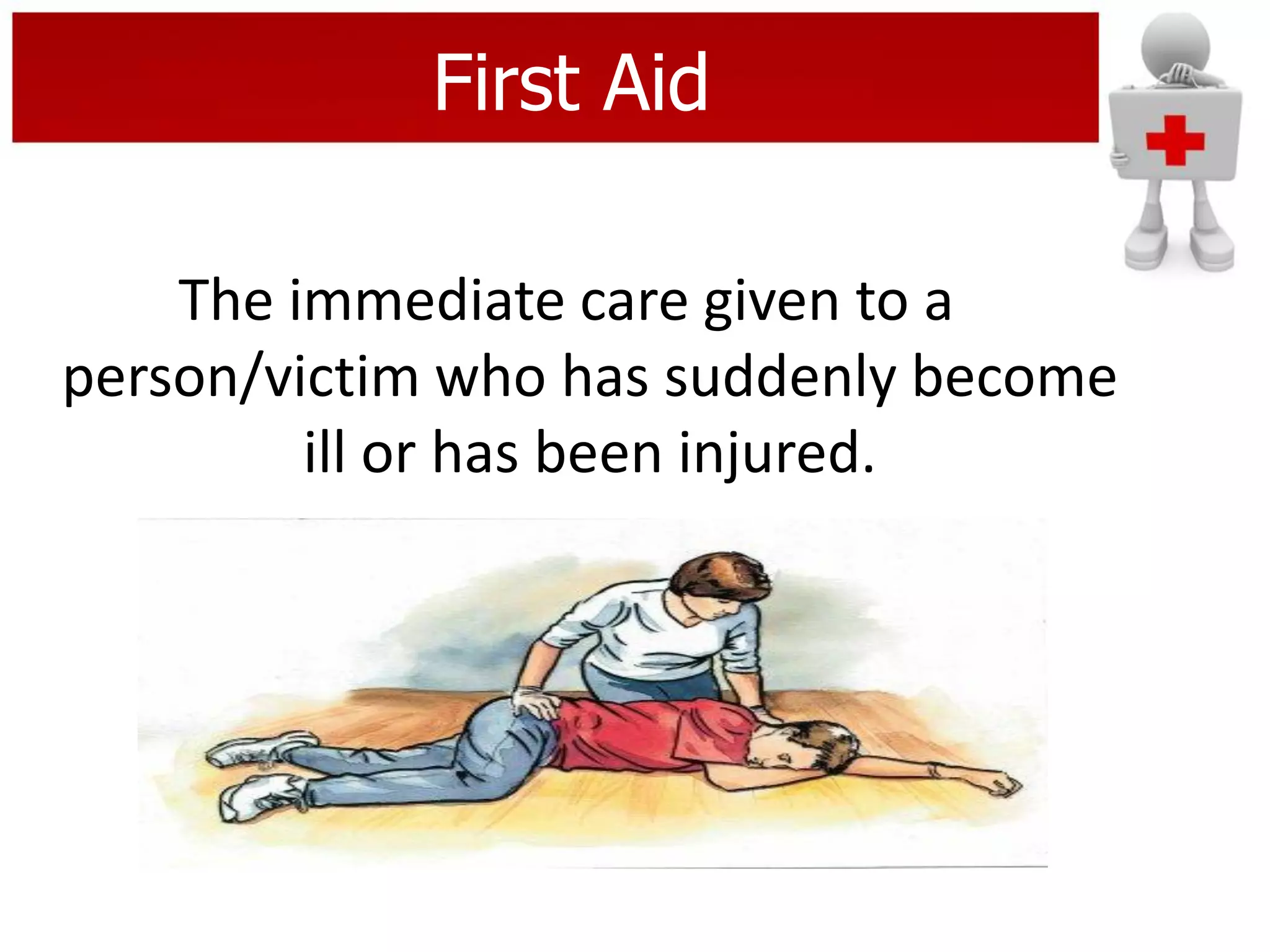
First Aid

    The immediate care given to a
person/victim who has suddenly become
         ill or has been injured.
Role of First Aider

• Bridge the gap between the time of the accident
  and the arrival of the physician.
• Ends when medical assistance begins.
• Doesn’t intend to compete with or take place of
  the physician.
Objectives of First Aid
• To prolong life
• To alleviate suffering
• To prevent further or added injury
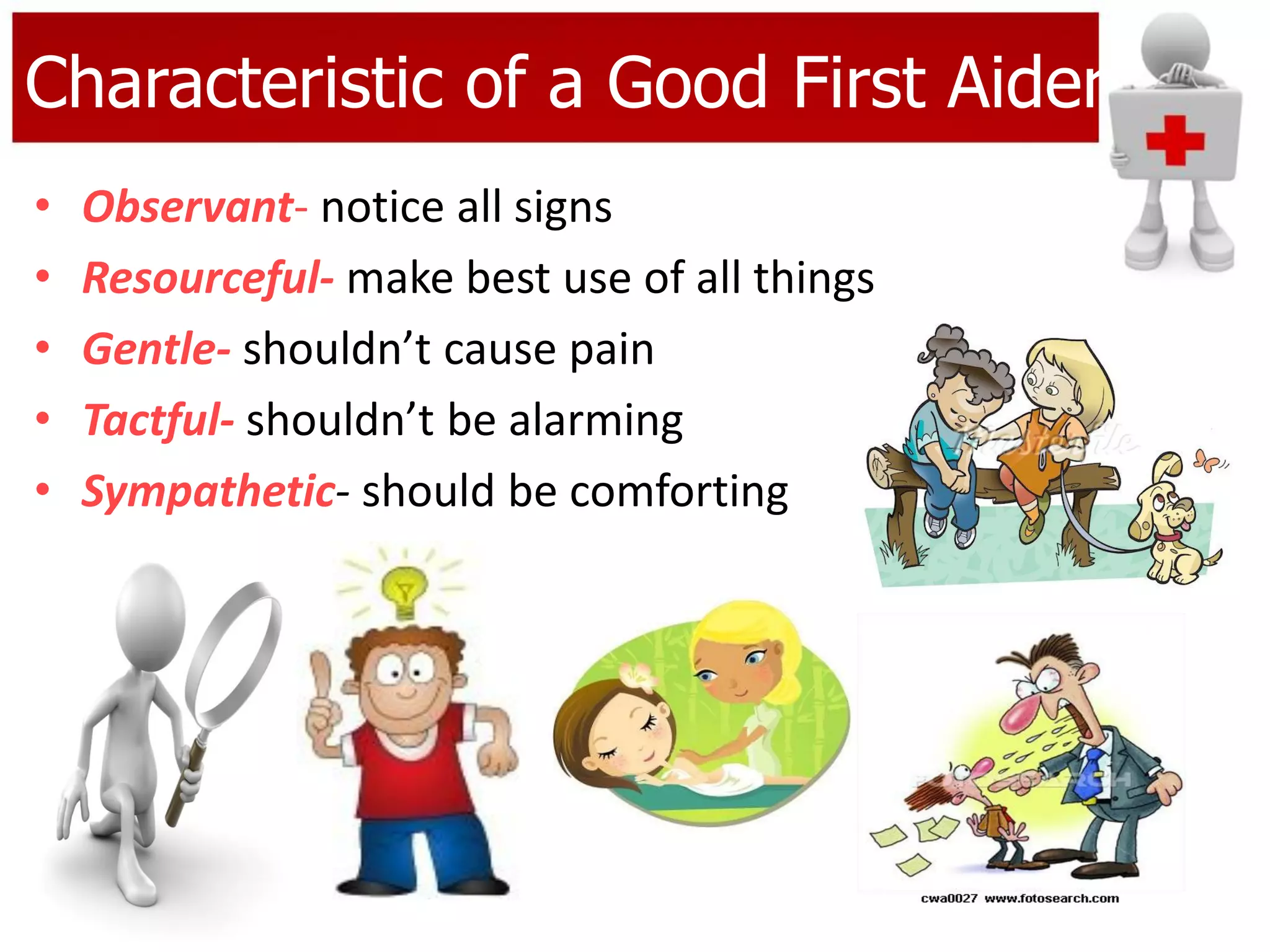
Characteristic of a Good First Aider
•   Observant- notice all signs
•   Resourceful- make best use of all things
•   Gentle- shouldn’t cause pain
•   Tactful- shouldn’t be alarming
•   Sympathetic- should be comforting
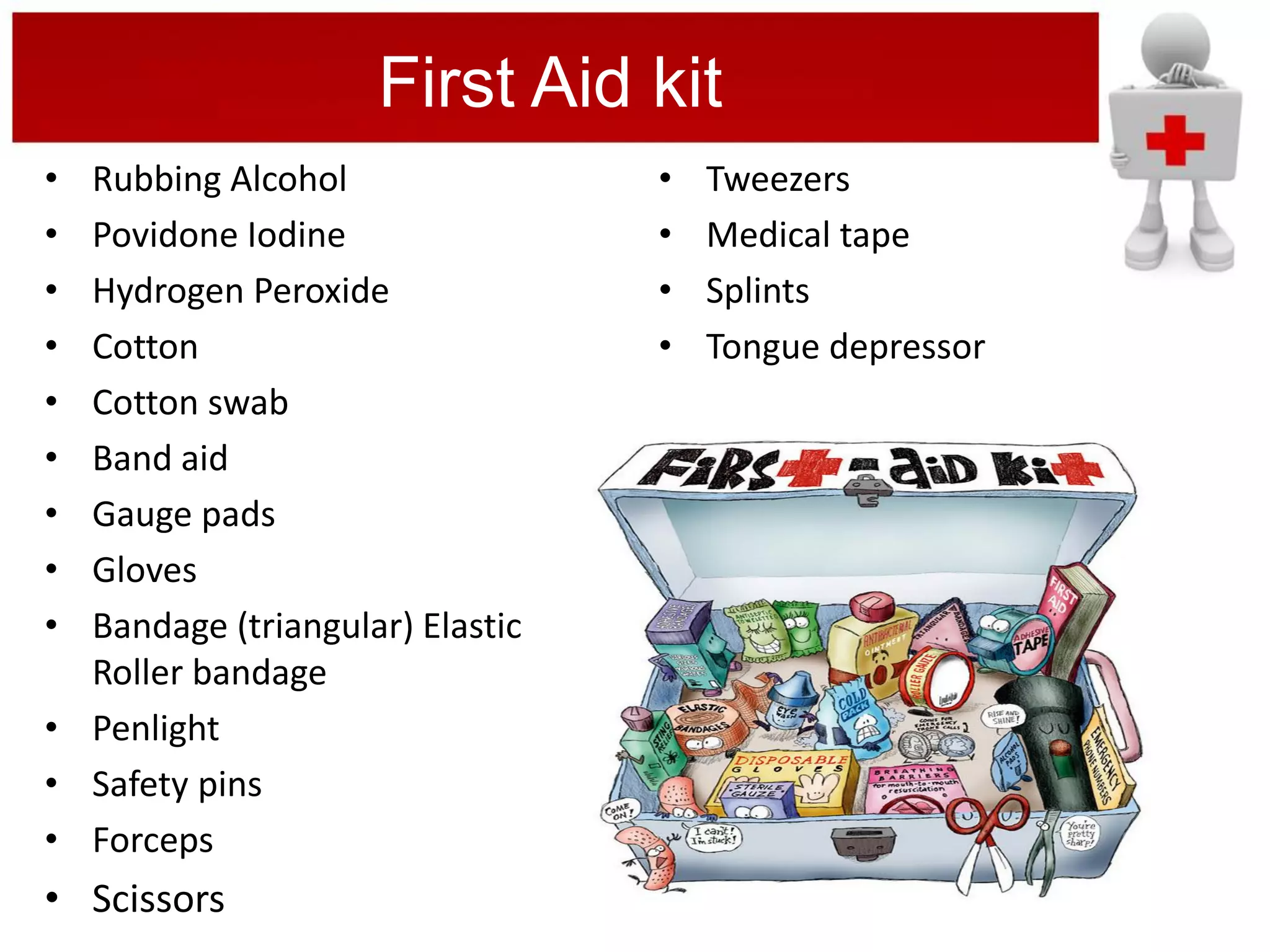
First Aid kit
• Rubbing Alcohol                •   Tweezers
• Povidone Iodine                •   Medical tape
• Hydrogen Peroxide              •   Splints
• Cotton                         •   Tongue depressor
• Cotton swab
• Band aid
• Gauge pads
• Gloves
• Bandage (triangular) Elastic
  Roller bandage
• Penlight
• Safety pins
• Forceps
• Scissors
Conditions Requiring First Aid
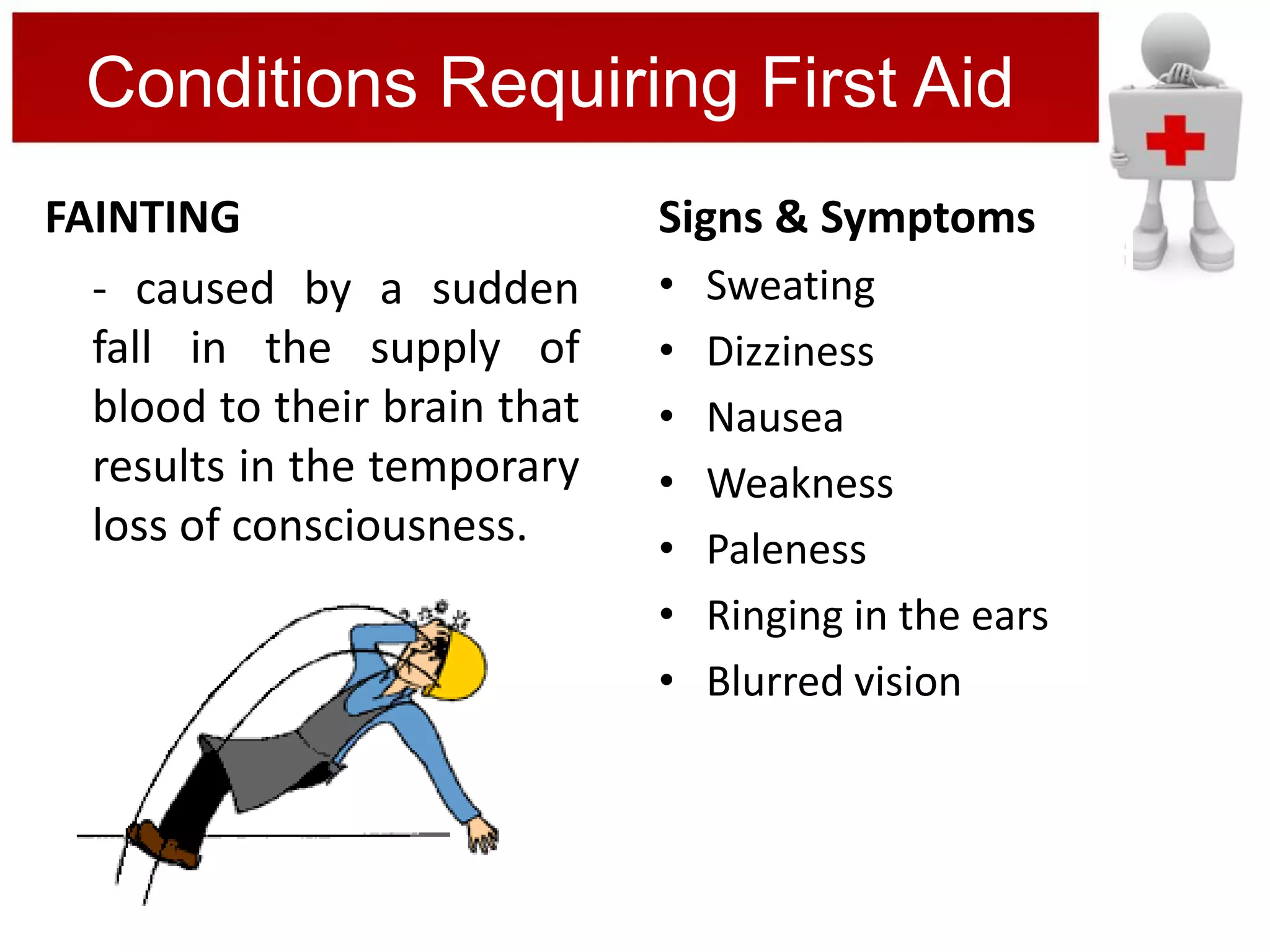
FAINTING                    Signs & Symptoms
  - Conditions Requiring First Aid
    caused by a sudden      • Sweating
  fall in the supply of     • Dizziness
  blood to their brain that • Nausea
  results in the temporary  • Weakness
  loss of consciousness.    • Paleness
                        • Ringing in the ears
                        • Blurred vision
First Aid
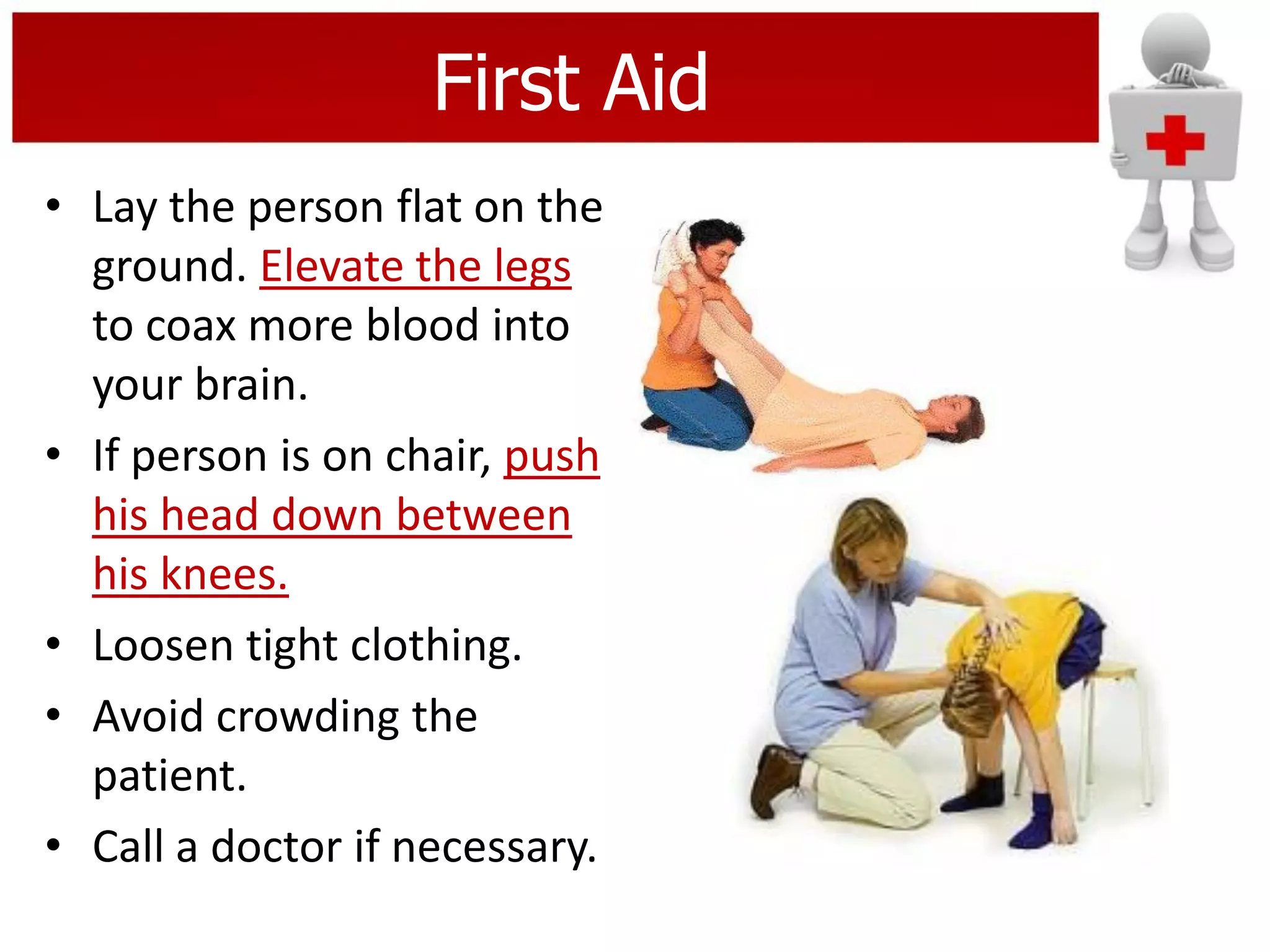
• Lay the person flat on the
  ground. Elevate the legs
  to coax more blood into
  your brain.
• If person is on chair, push
  his head down between
  his knees.
• Loosen tight clothing.
• Avoid crowding the
  patient.
• Call a doctor if necessary.
Conditions Requiring First Aid
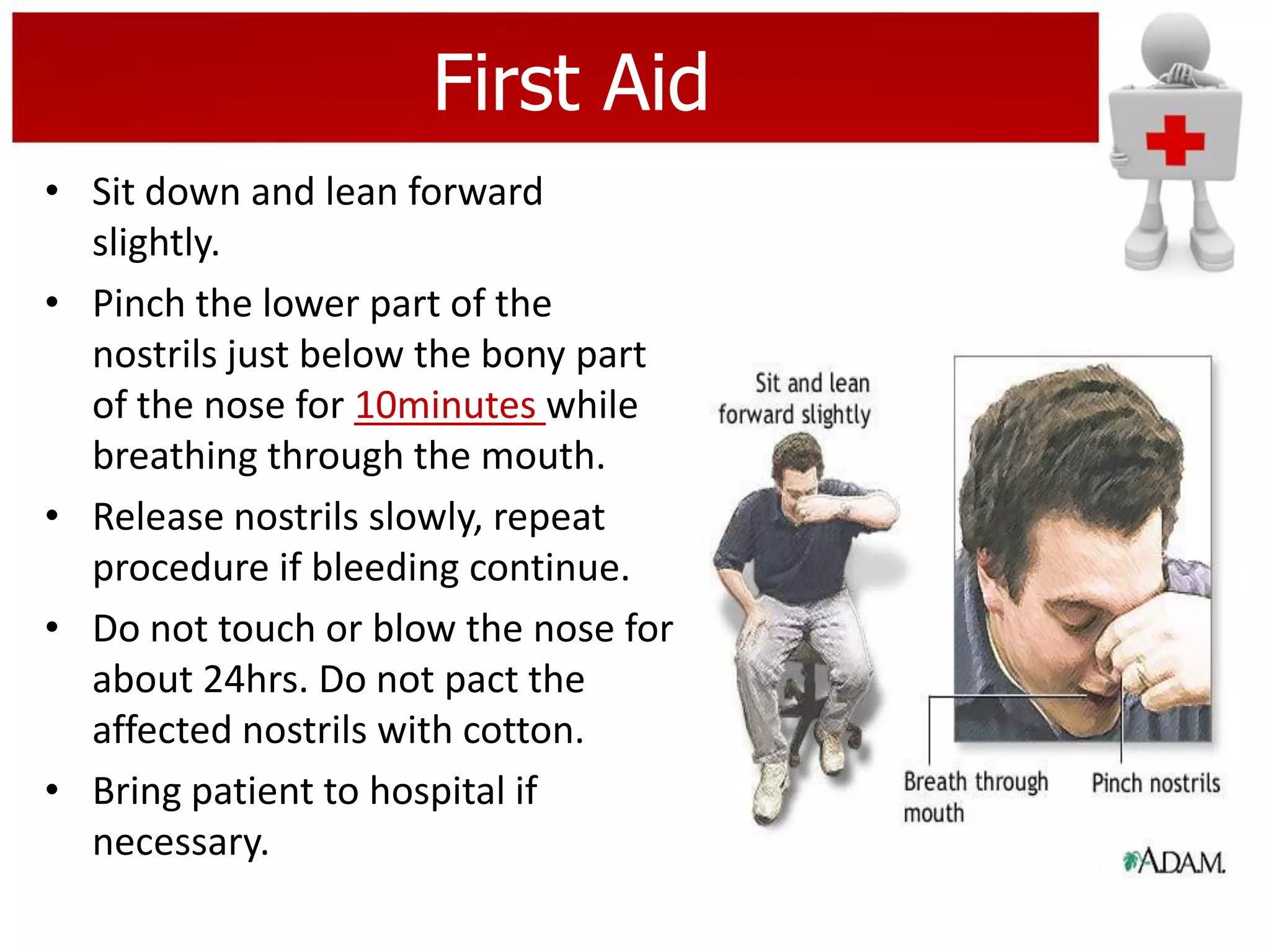
NOSE BLEED
 -occurs when a small blood
 vessel in the lining of the
 nose bursts. It very common
 in children and often result
 from harmless activities such
 as your child picking their
 nose, blowing it too hard or
 too often or from getting
 knocked on the nose during
 play.
First Aid
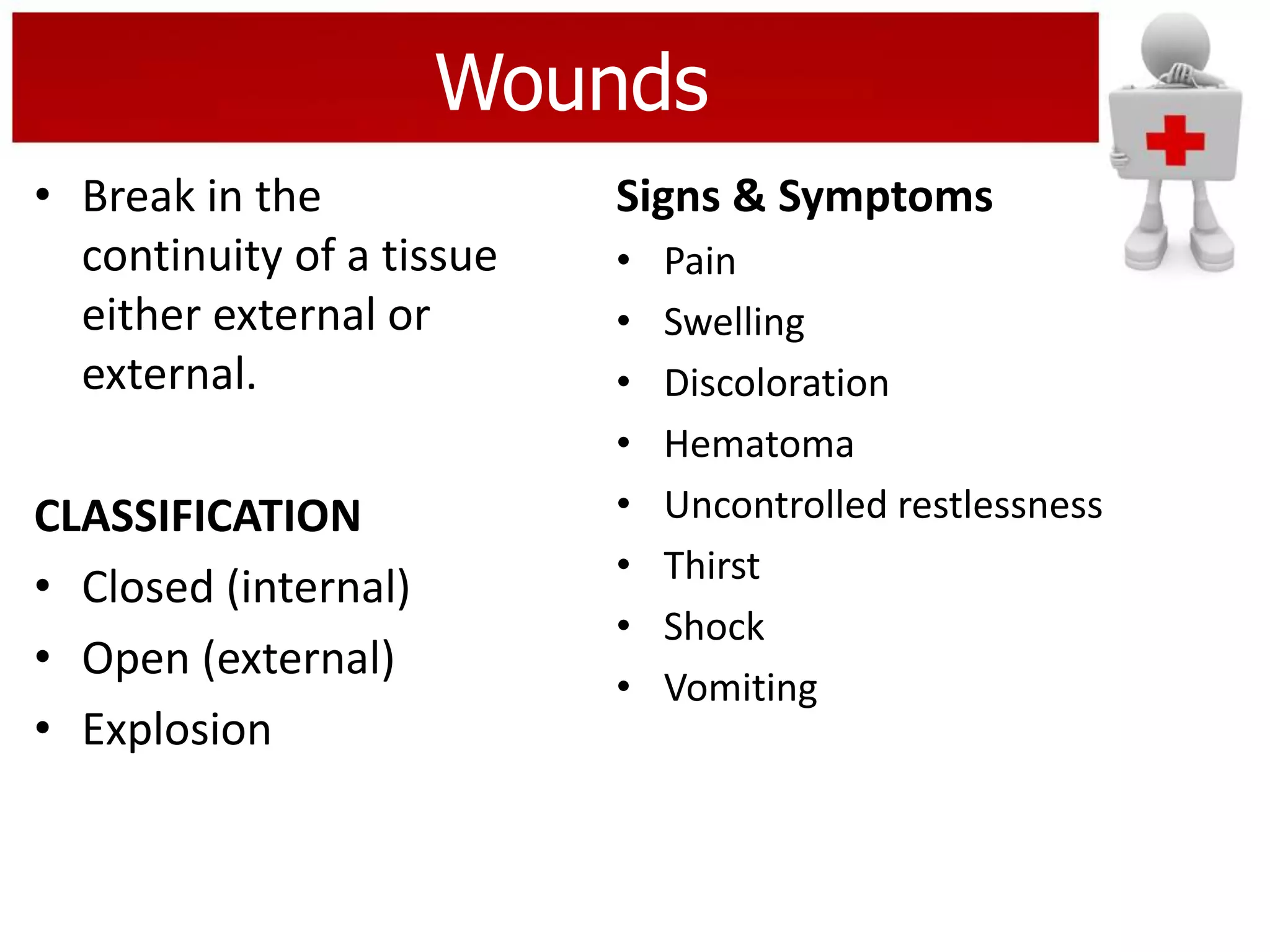
• Sit down and lean forward
  slightly.
• Pinch the lower part of the
  nostrils just below the bony part
  of the nose for 10minutes while
  breathing through the mouth.
• Release nostrils slowly, repeat
  procedure if bleeding continue.
• Do not touch or blow the nose for
  about 24hrs. Do not pact the
  affected nostrils with cotton.
• Bring patient to hospital if
  necessary.
Wounds
• Break in the             Signs & Symptoms
  continuity of a tissue   •   Pain
  either external or       •   Swelling
  external.                •   Discoloration
                           •   Hematoma
CLASSIFICATION             •   Uncontrolled restlessness
                           •   Thirst
• Closed (internal)
                           •   Shock
• Open (external)
                           •   Vomiting
• Explosion
Closed Wound
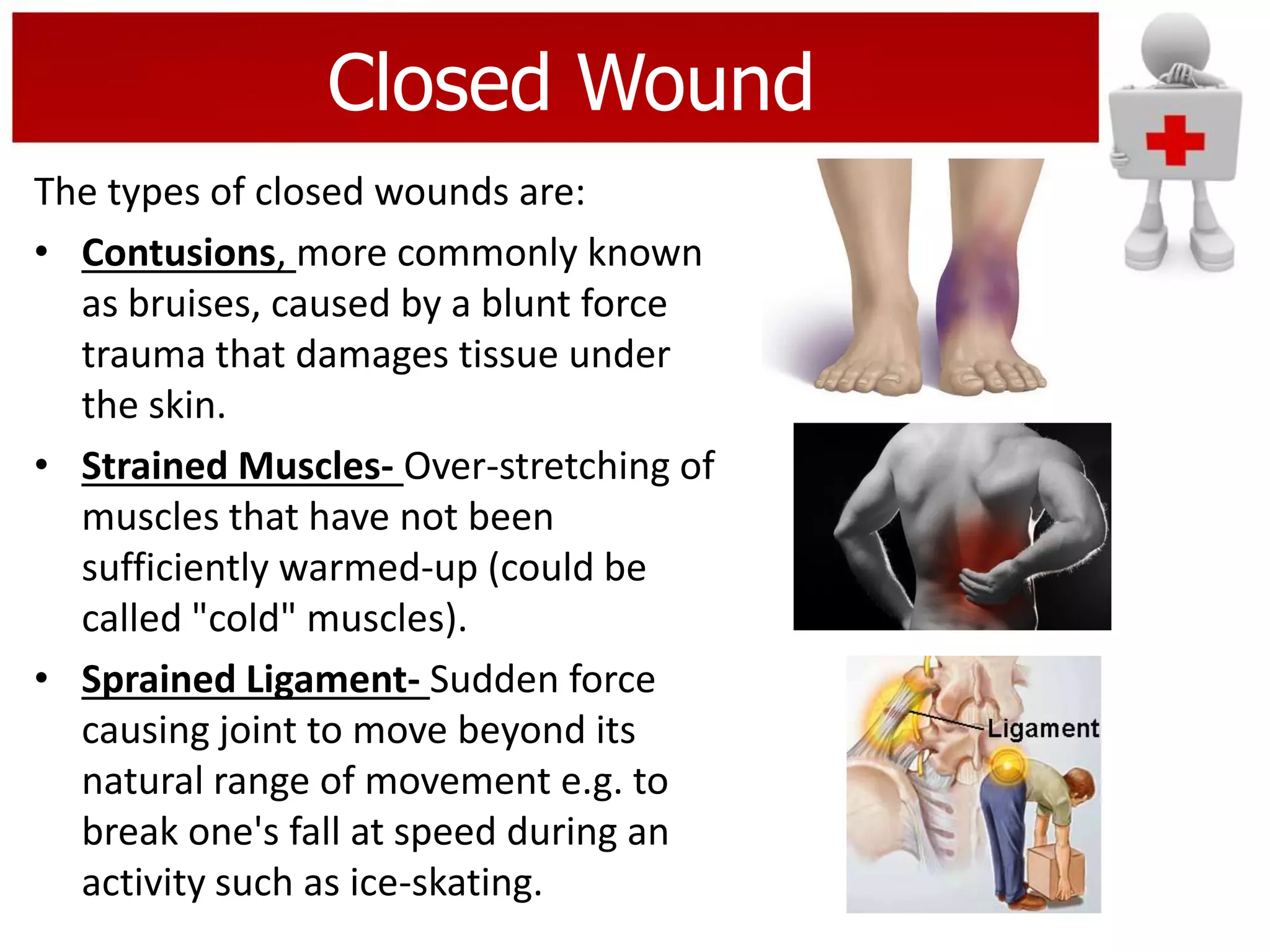
The types of closed wounds are:
• Contusions, more commonly known
  as bruises, caused by a blunt force
  trauma that damages tissue under
  the skin.
• Strained Muscles- Over-stretching of
  muscles that have not been
  sufficiently warmed-up (could be
  called "cold" muscles).
• Sprained Ligament- Sudden force
  causing joint to move beyond its
  natural range of movement e.g. to
  break one's fall at speed during an
  activity such as ice-skating.
First Aid

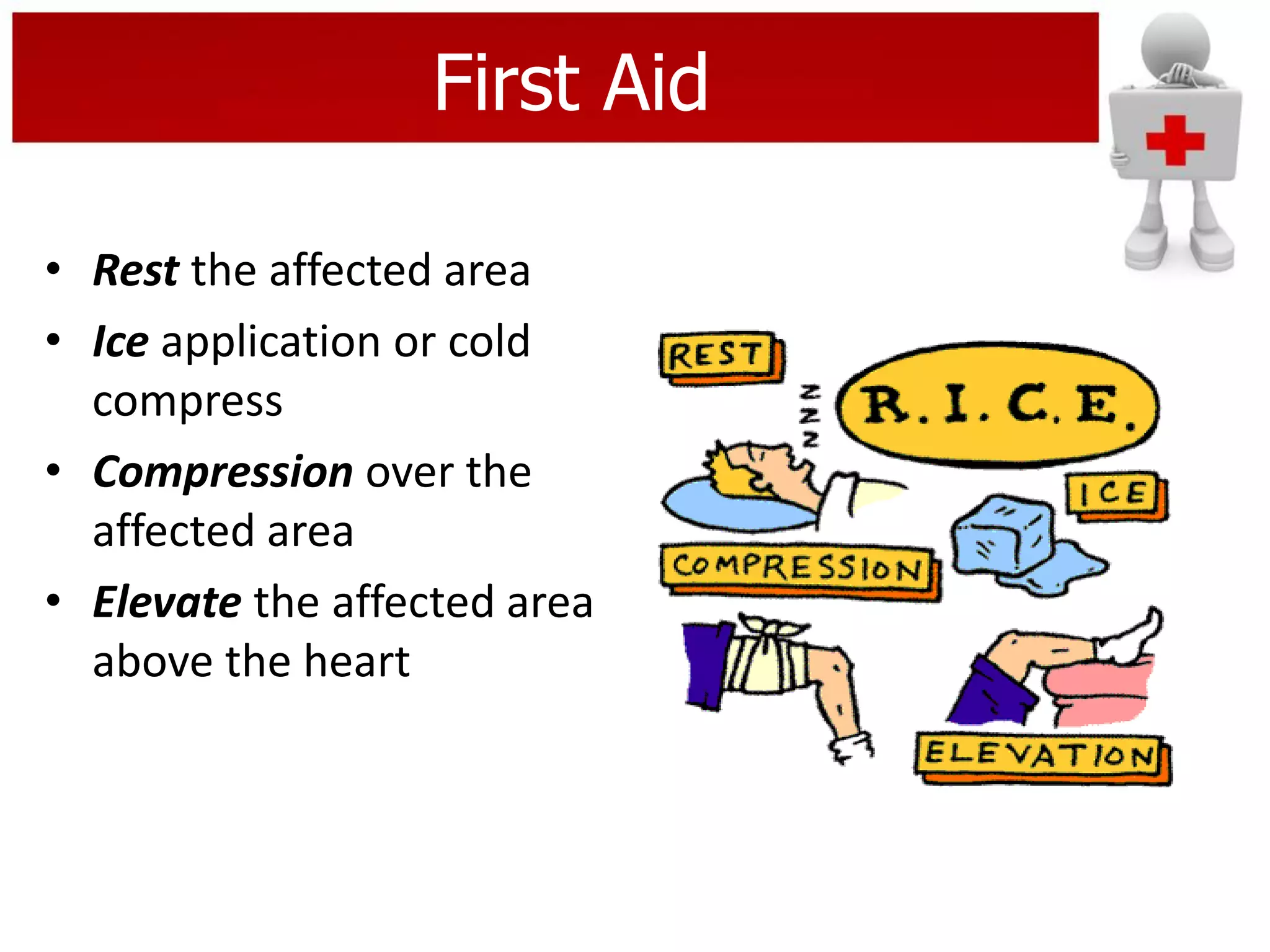
• Rest the affected area
• Ice application or cold
  compress
• Compression over the
  affected area
• Elevate the affected area
  above the heart
Open Wound
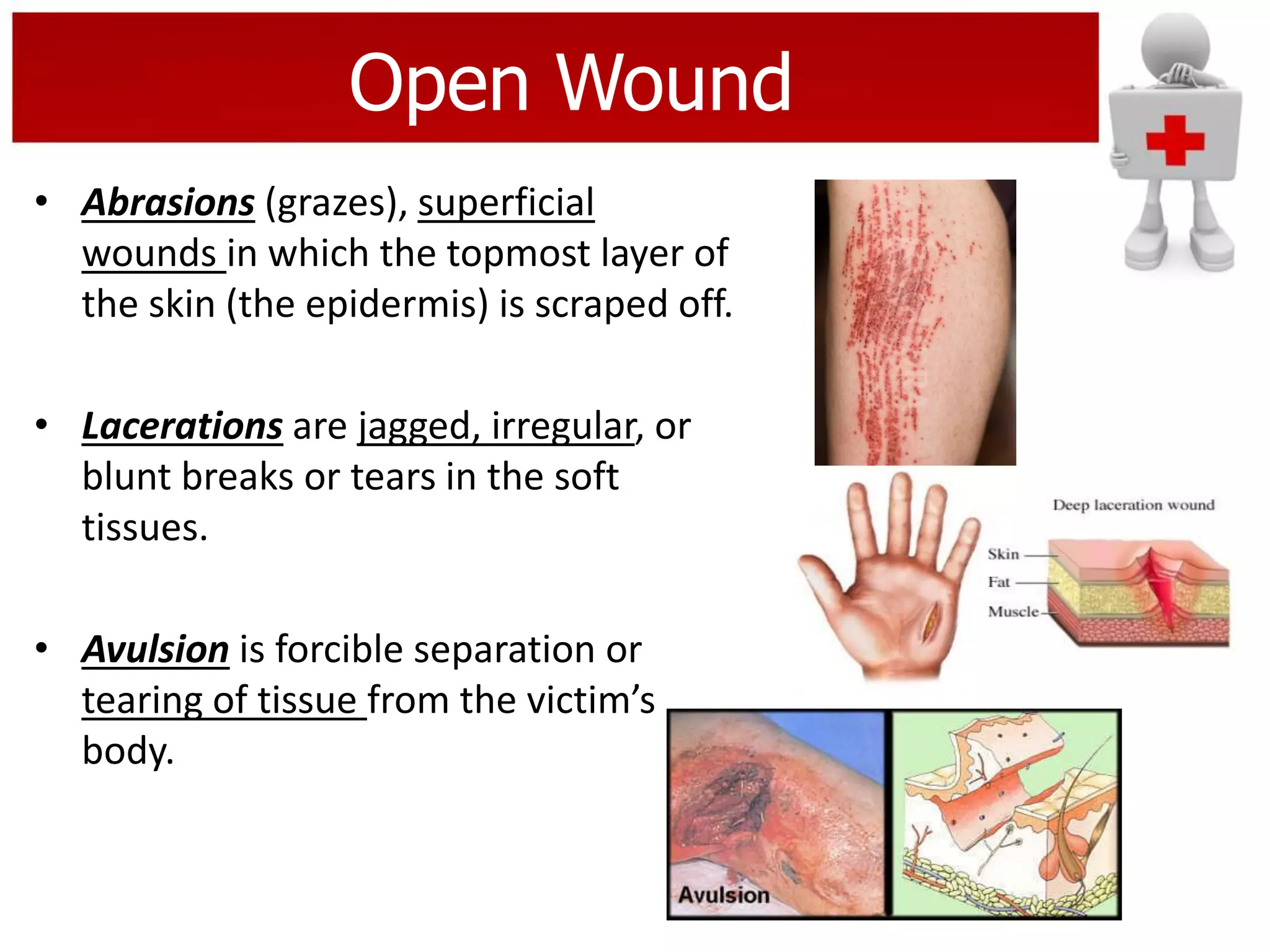
• Abrasions (grazes), superficial
  wounds in which the topmost layer of
  the skin (the epidermis) is scraped off.

• Lacerations are jagged, irregular, or
  blunt breaks or tears in the soft
  tissues.

• Avulsion is forcible separation or
  tearing of tissue from the victim’s
  body.
Open Wound
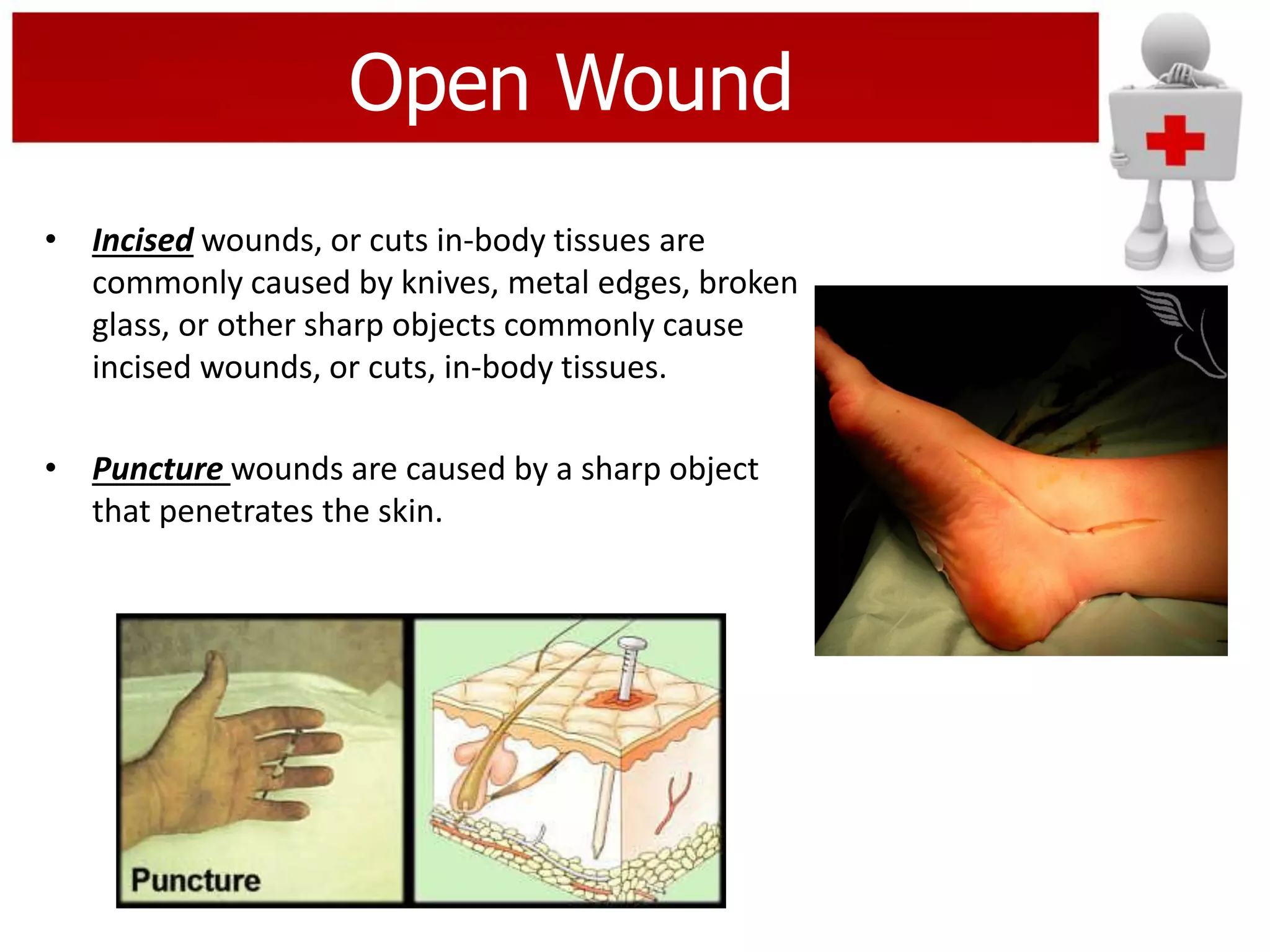
• Incised wounds, or cuts in-body tissues are
  commonly caused by knives, metal edges, broken
  glass, or other sharp objects commonly cause
  incised wounds, or cuts, in-body tissues.

• Puncture wounds are caused by a sharp object
  that penetrates the skin.
First Aid

The major principles of open-wound
  treatment are to:
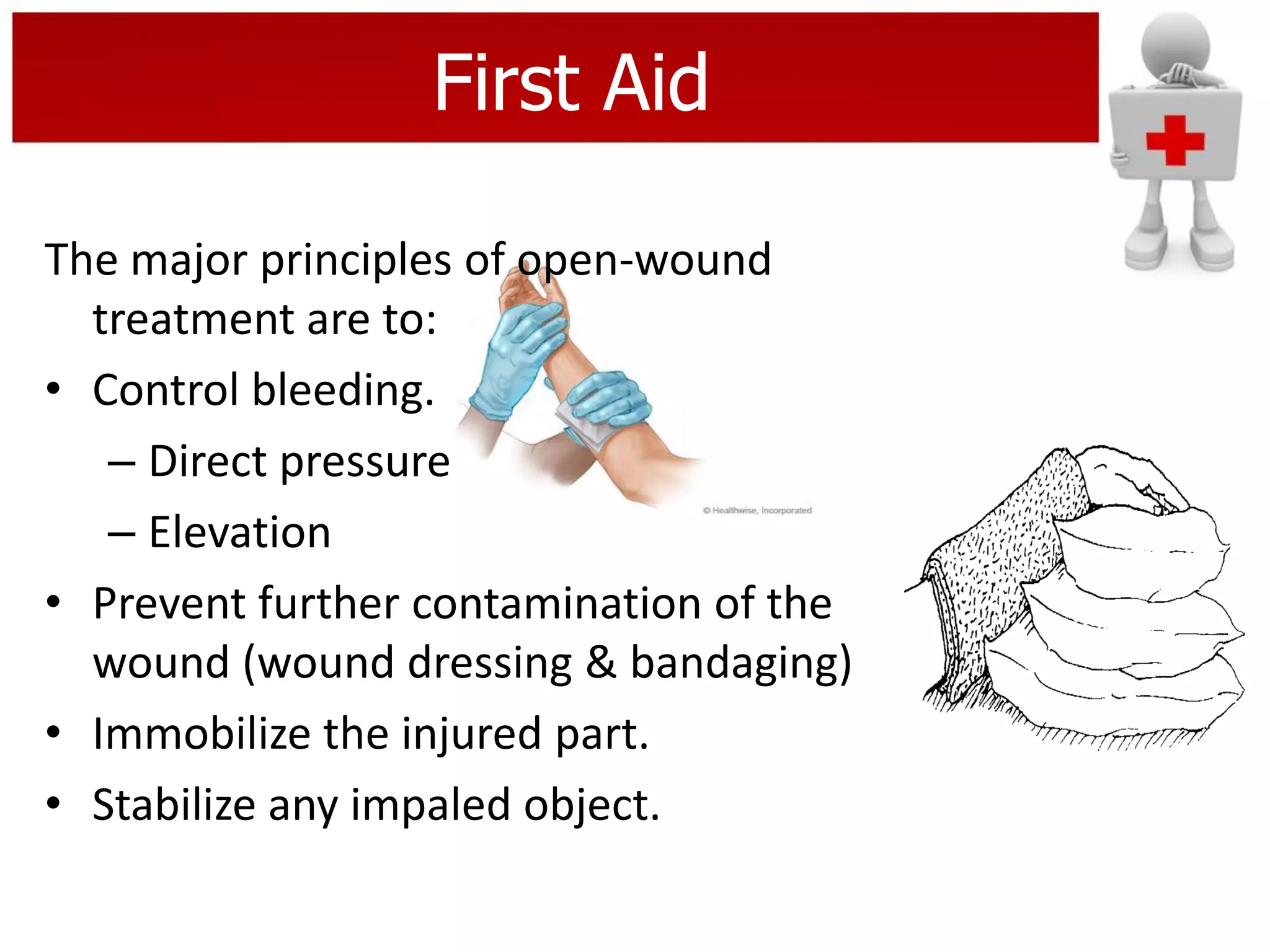
• Control bleeding.
   – Direct pressure
   – Elevation
• Prevent further contamination of the
  wound (wound dressing & bandaging)
• Immobilize the injured part.
• Stabilize any impaled object.
Fracture

• a medical condition in which there is a break in the
  continuity of the bone. A bone fracture can be the
  result of high force impact or stress, or trivial injury
  as a result of certain medical conditions that weaken
  the bones
Types of Fracture
• Greenstick fracture: an incomplete
  fracture in which the bone is bent.
• Transverse fracture: a fracture at a
  right angle to the bone's axis.
• Spiral fracture: a fracture in which
  the break has a curved or sloped
  pattern.
• Comminuted fracture: a fracture in
  which the bone fragments into
  several pieces.
• Compound fracture - meaning the
  bone ends are no longer touching.
Signs and Symptoms
• Pain and swelling at the fracture site.
• Tenderness close to the fracture.
• Paleness and deformity (sometimes).
• Loss of pulse below the fracture, usually in an extremity (this
  is an emergency).
• Numbness, tingling or paralysis below the fracture (rare; this
  is an emergency).
• Bleeding or bruising at the site.
• Weakness and inability to bear weight.
First Aid
• Initial treatment for fractures of the arms, legs, hands
  and feet in the field include splinting the extremity in
  the position it is found, elevation and ice.
  Immobilization will be very helpful with initial pain
  control.
BANDAGING
Bandaging
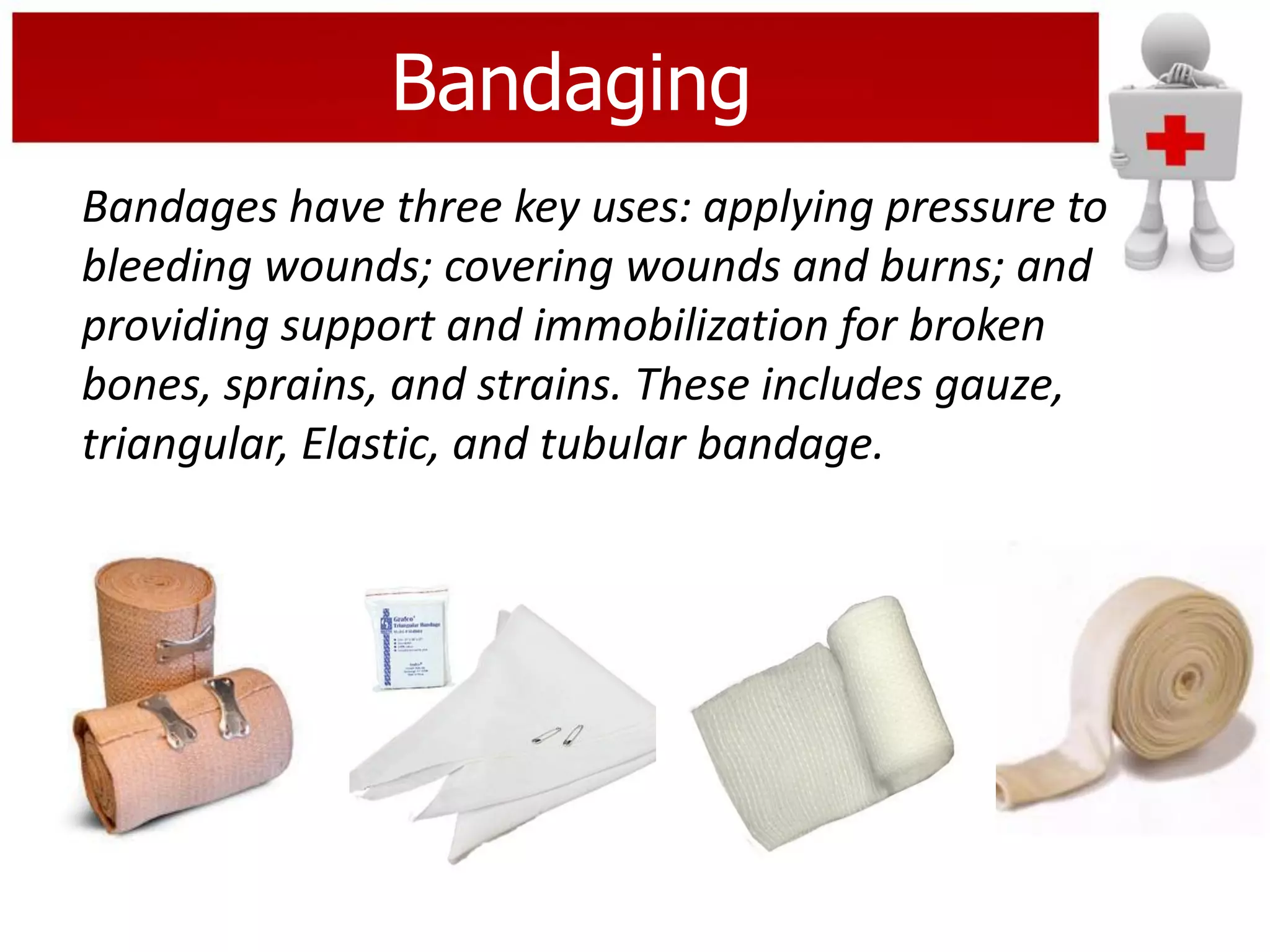
Bandages have three key uses: applying pressure to
bleeding wounds; covering wounds and burns; and
providing support and immobilization for broken
bones, sprains, and strains. These includes gauze,
triangular, Elastic, and tubular bandage.
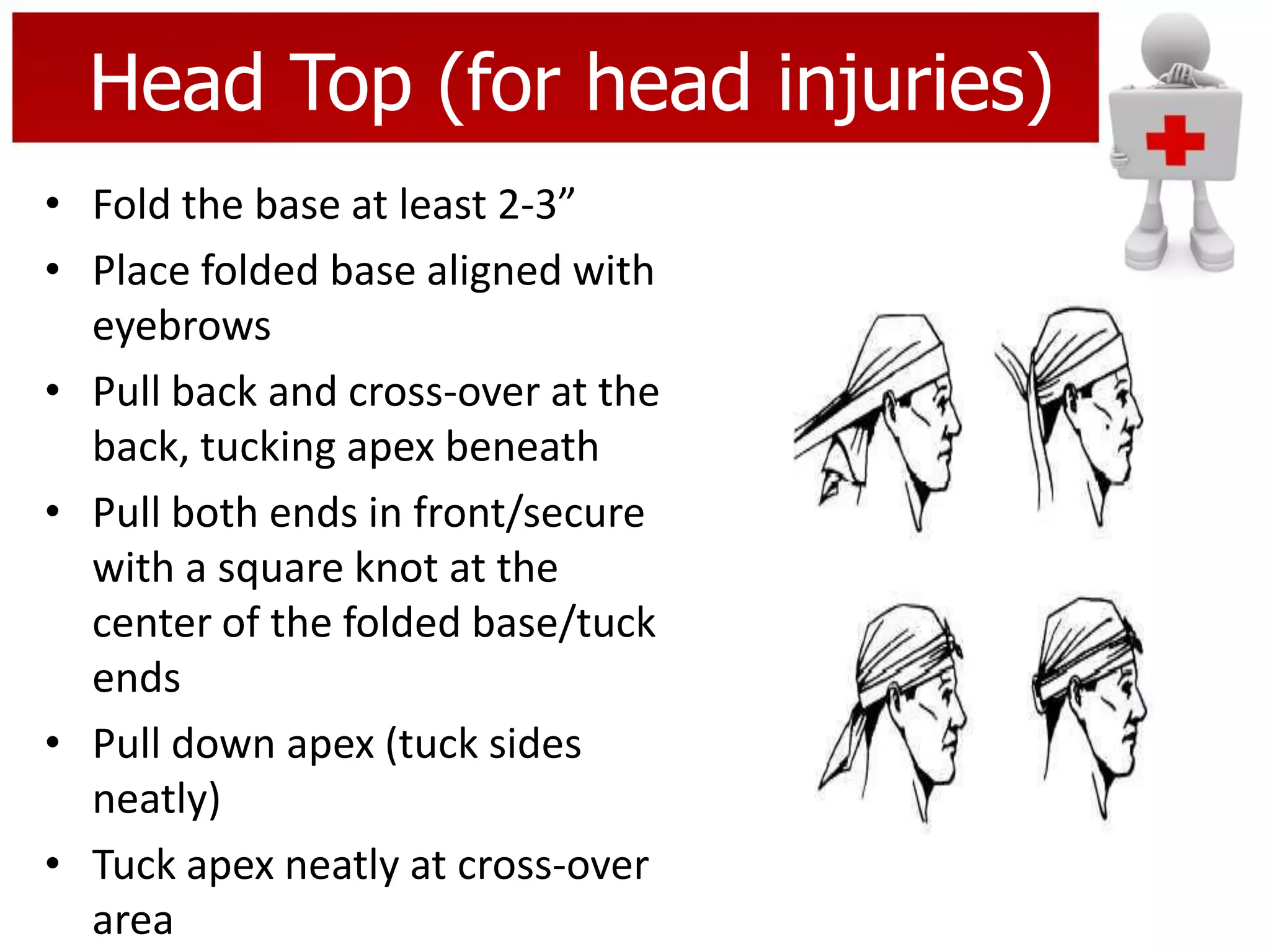
Head Top (for head injuries)
• Fold the base at least 2-3”
• Place folded base aligned with
  eyebrows
• Pull back and cross-over at the
  back, tucking apex beneath
• Pull both ends in front/secure
  with a square knot at the
  center of the folded base/tuck
  ends
• Pull down apex (tuck sides
  neatly)
• Tuck apex neatly at cross-over
  area
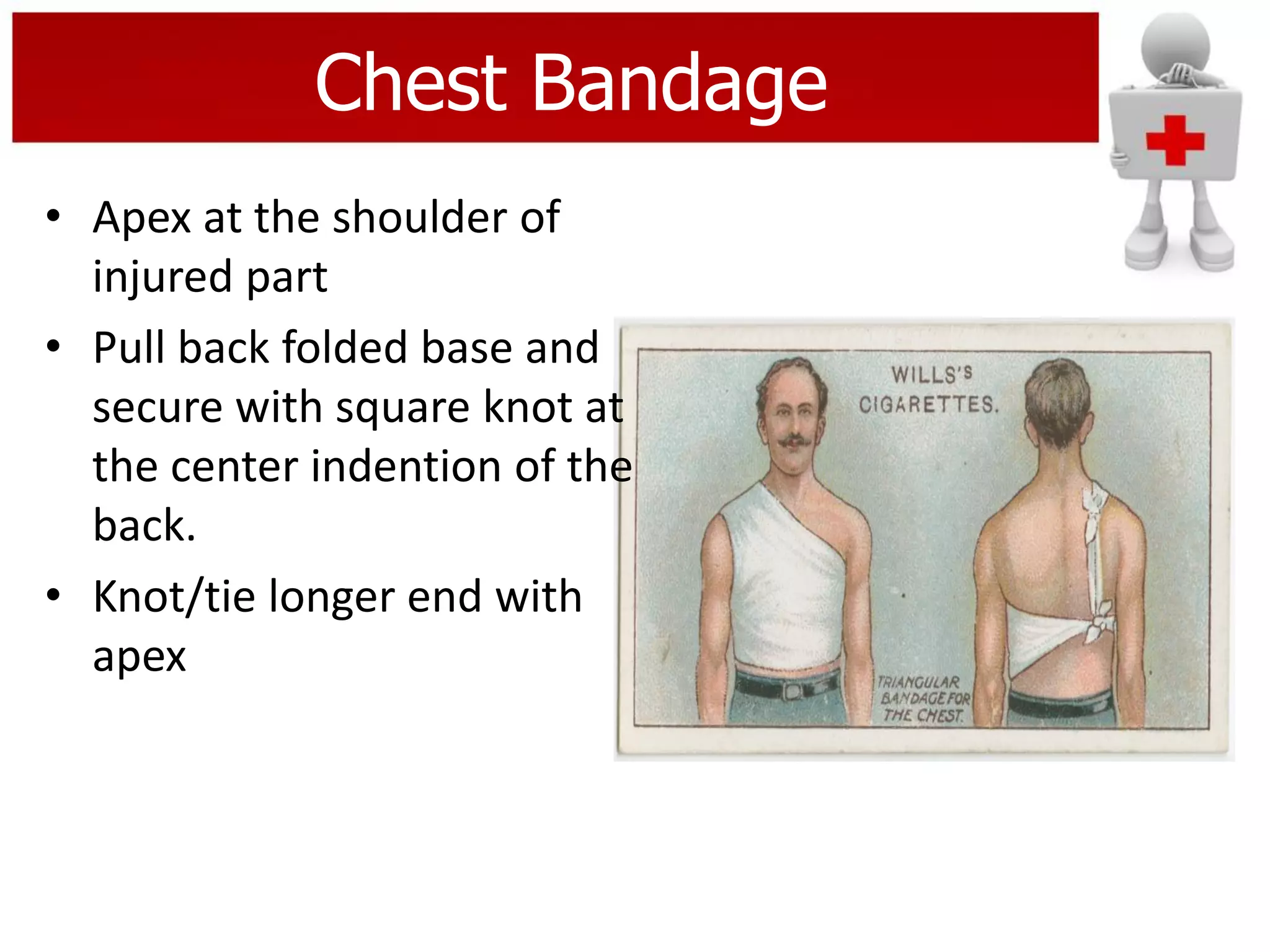
Chest Bandage
• Apex at the shoulder of
  injured part
• Pull back folded base and
  secure with square knot at
  the center indention of the
  back.
• Knot/tie longer end with
  apex
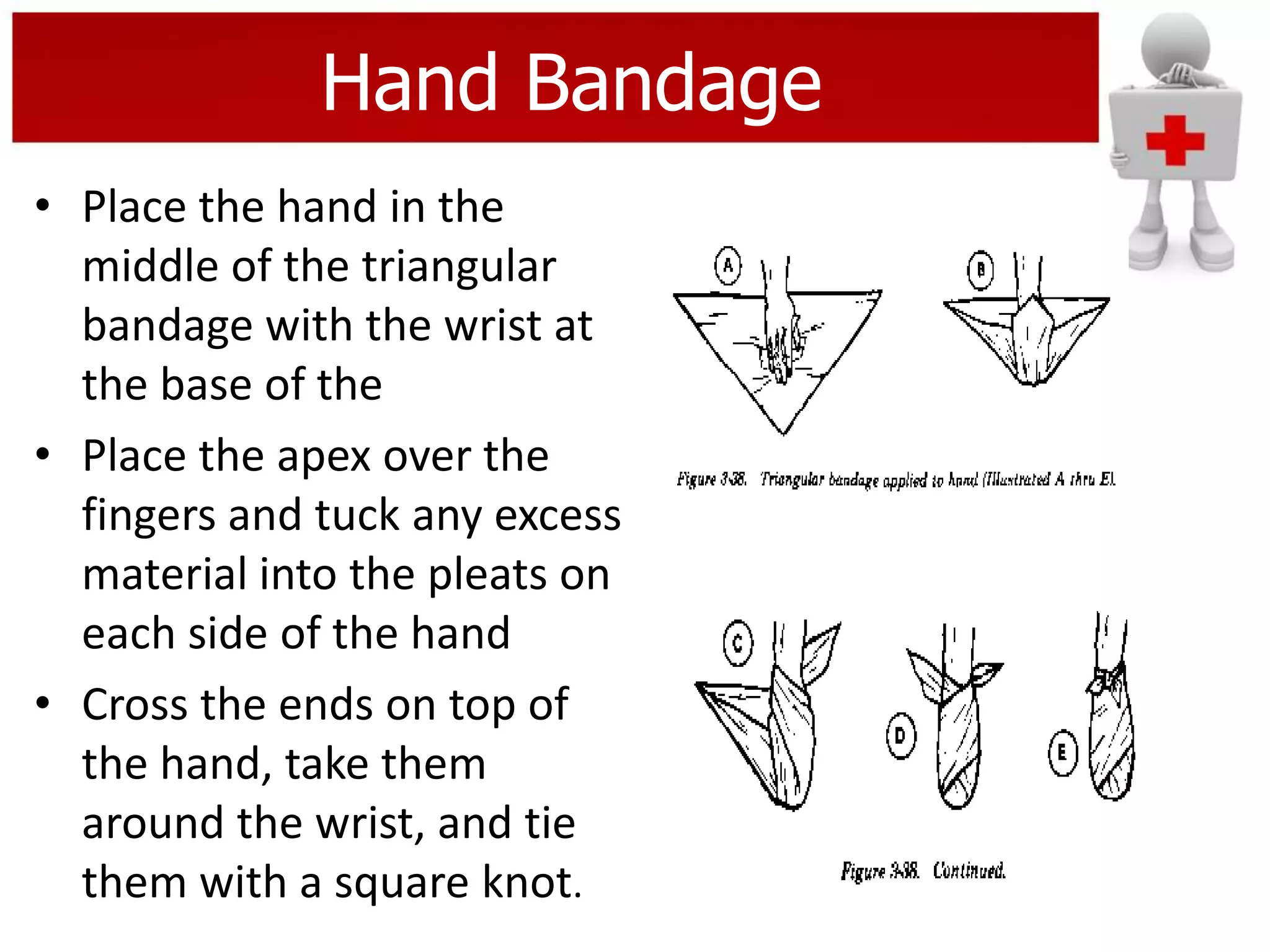
Hand Bandage
• Place the hand in the
  middle of the triangular
  bandage with the wrist at
  the base of the
• Place the apex over the
  fingers and tuck any excess
  material into the pleats on
  each side of the hand
• Cross the ends on top of
  the hand, take them
  around the wrist, and tie
  them with a square knot.
Arm Sling
• Place folded base vertically
  over
• One arm, with pointed
  directly under the elbow of
  injured arm
• Lower ends of base at the
  side of the neck using a
  square knot
• Make several twist with
  apex and tie a knot
• Hide the knot
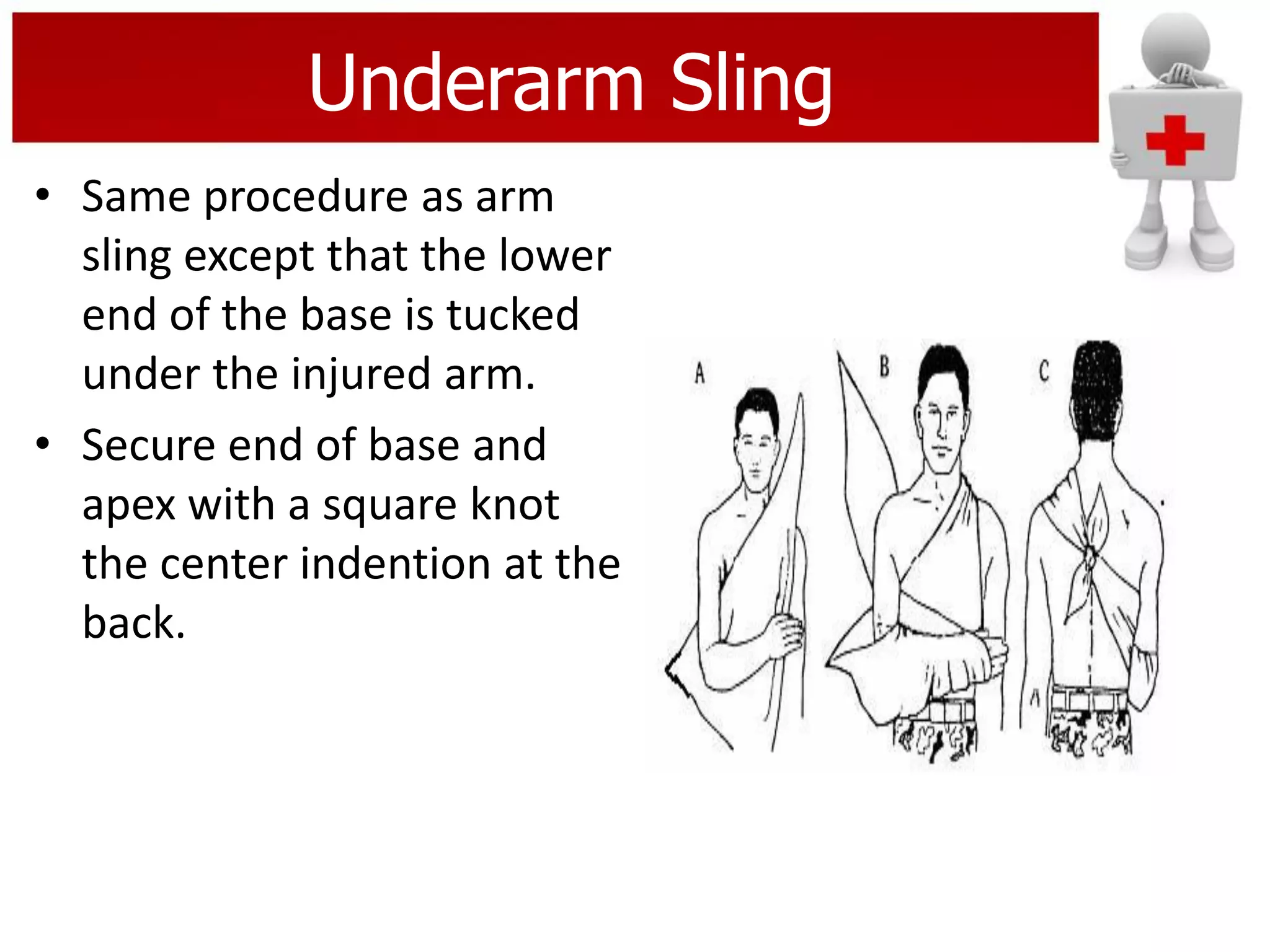
Underarm Sling
• Same procedure as arm
  sling except that the lower
  end of the base is tucked
  under the injured arm.
• Secure end of base and
  apex with a square knot
  the center indention at the
  back.
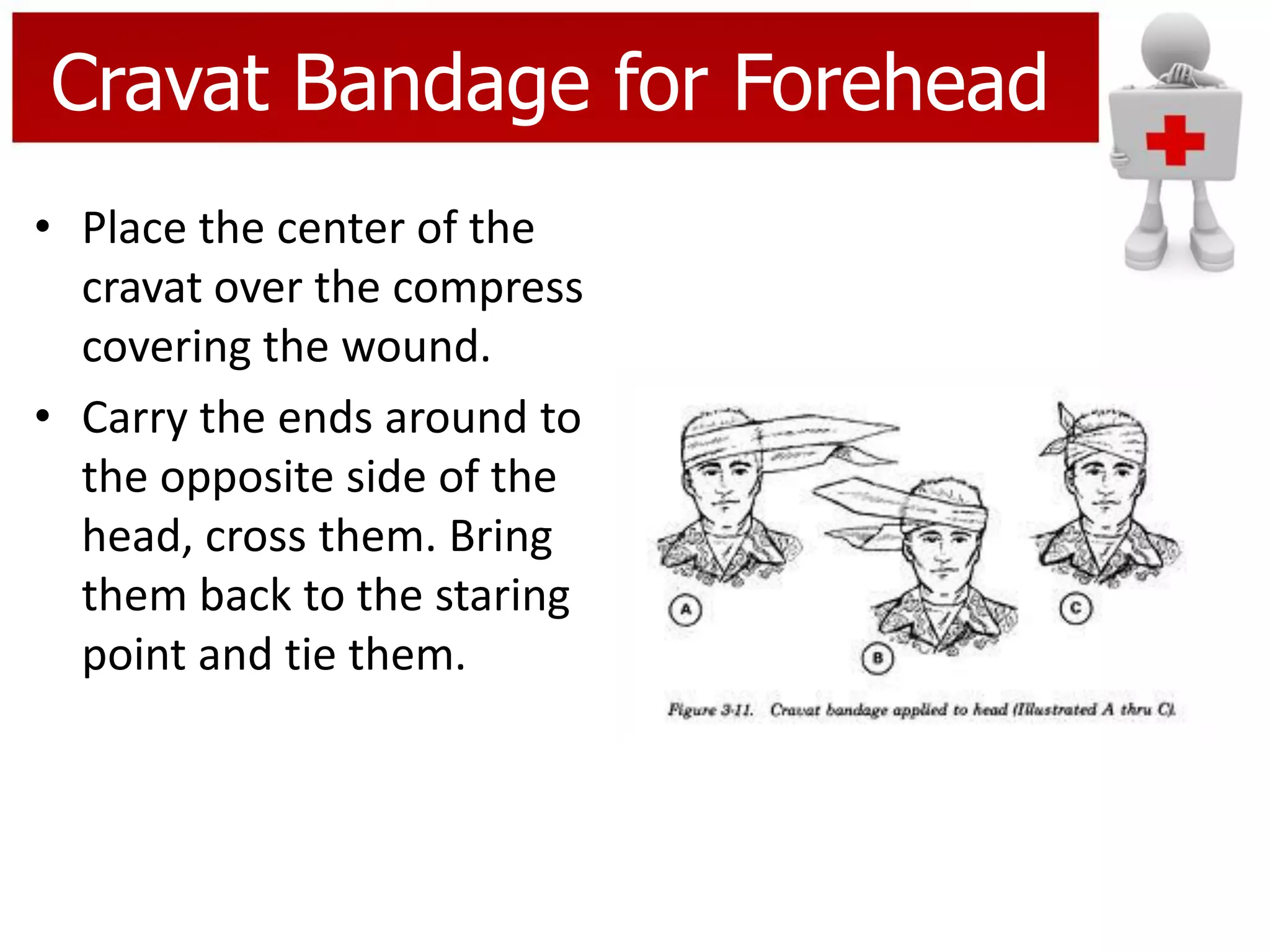
Cravat Bandage for Forehead
• Place the center of the
  cravat over the compress
  covering the wound.
• Carry the ends around to
  the opposite side of the
  head, cross them. Bring
  them back to the staring
  point and tie them.
Cravat Bandage for the Neck

 • Place the center of the cravat over the
   compress covering the wound.
 • Carry the ends around to the neck, cross
   them. Bring them back to the starting point
   and tie them loosely.
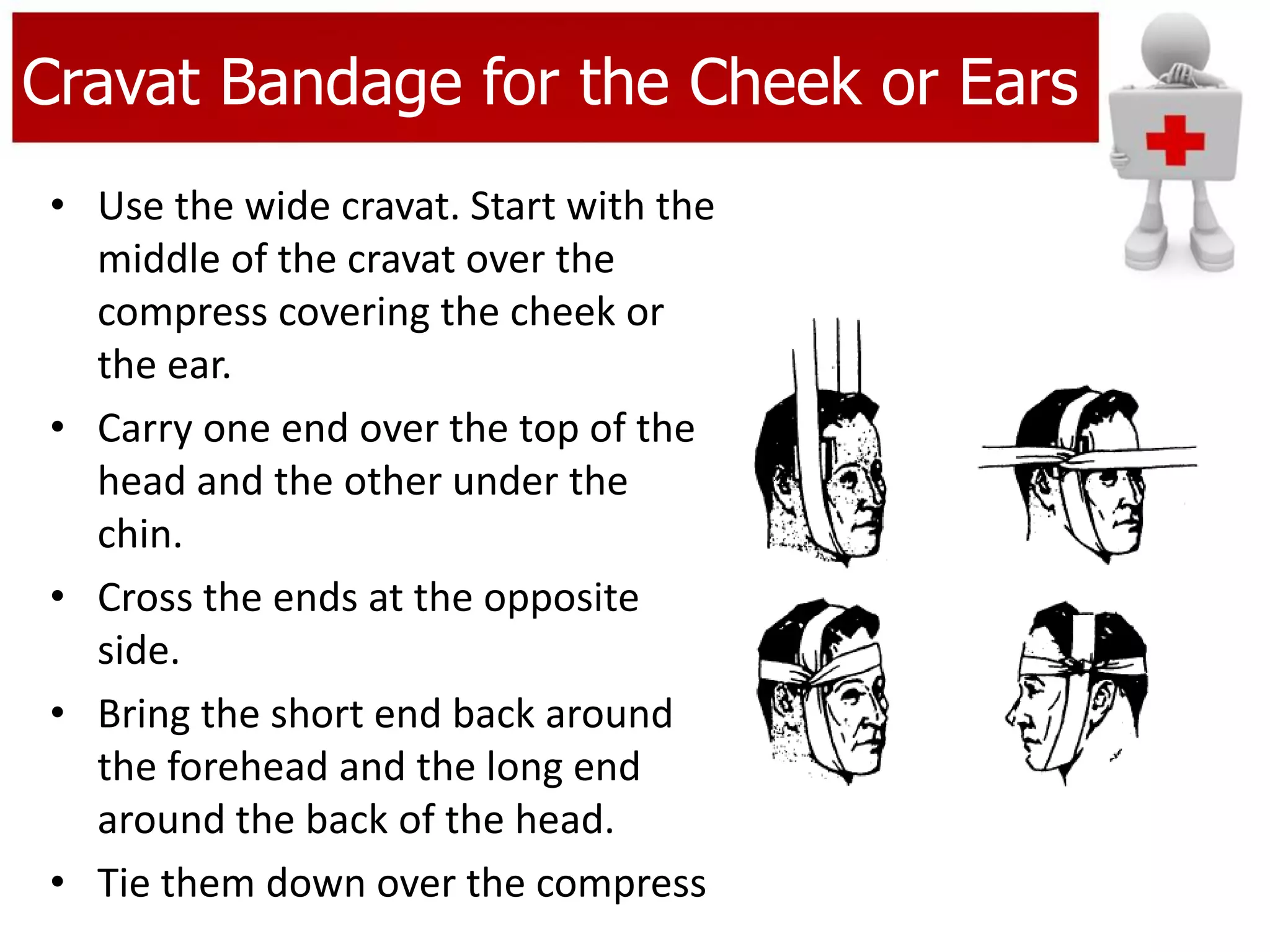
Cravat Bandage for the Cheek or Ears
• Use the wide cravat. Start with the
  middle of the cravat over the
  compress covering the cheek or
  the ear.
• Carry one end over the top of the
  head and the other under the
  chin.
• Cross the ends at the opposite
  side.
• Bring the short end back around
  the forehead and the long end
  around the back of the head.
• Tie them down over the compress
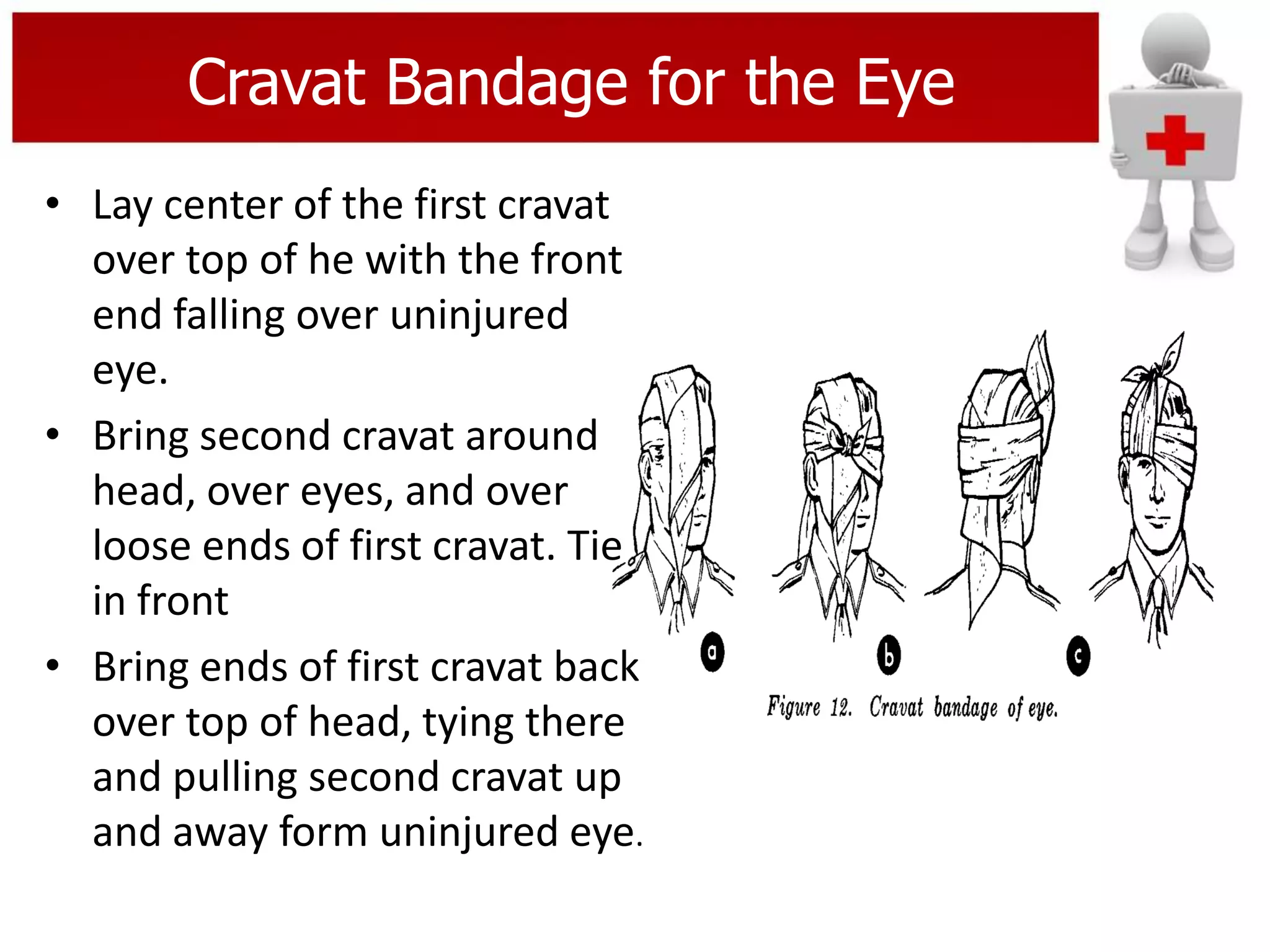
Cravat Bandage for the Eye
• Lay center of the first cravat
  over top of he with the front
  end falling over uninjured
  eye.
• Bring second cravat around
  head, over eyes, and over
  loose ends of first cravat. Tie
  in front
• Bring ends of first cravat back
  over top of head, tying there
  and pulling second cravat up
  and away form uninjured eye.
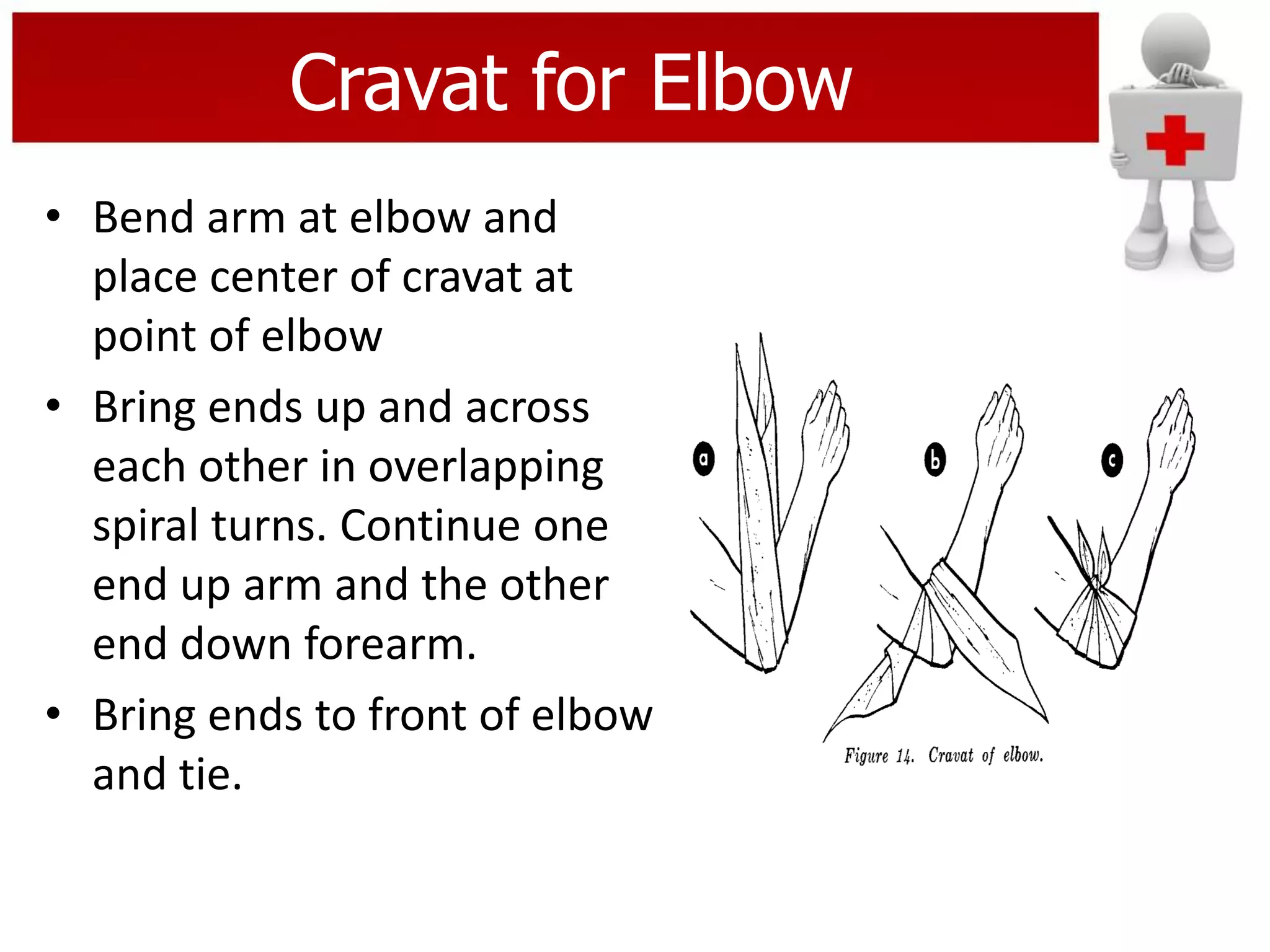
Cravat for Elbow
• Bend arm at elbow and
  place center of cravat at
  point of elbow
• Bring ends up and across
  each other in overlapping
  spiral turns. Continue one
  end up arm and the other
  end down forearm.
• Bring ends to front of elbow
  and tie.
Cravat for the Knee
• Start on top of the knees.
• Cross over and twist 2-3
  times under the knee.
• Cross over on top/pull
  ends to opposite sides.
• Secure with a square knot
  under the knee
Cravat for the Forearm, Arm, Leg and
                Thigh
• Place center of cravat over the
  dressing
• Begin ascending turns wit
  upper end and descending
  turns with lower end, with
  each turn covering two-third
  of preceding turn until
  dressing is covered.
• Terminate by tying both ends
  in square knot.
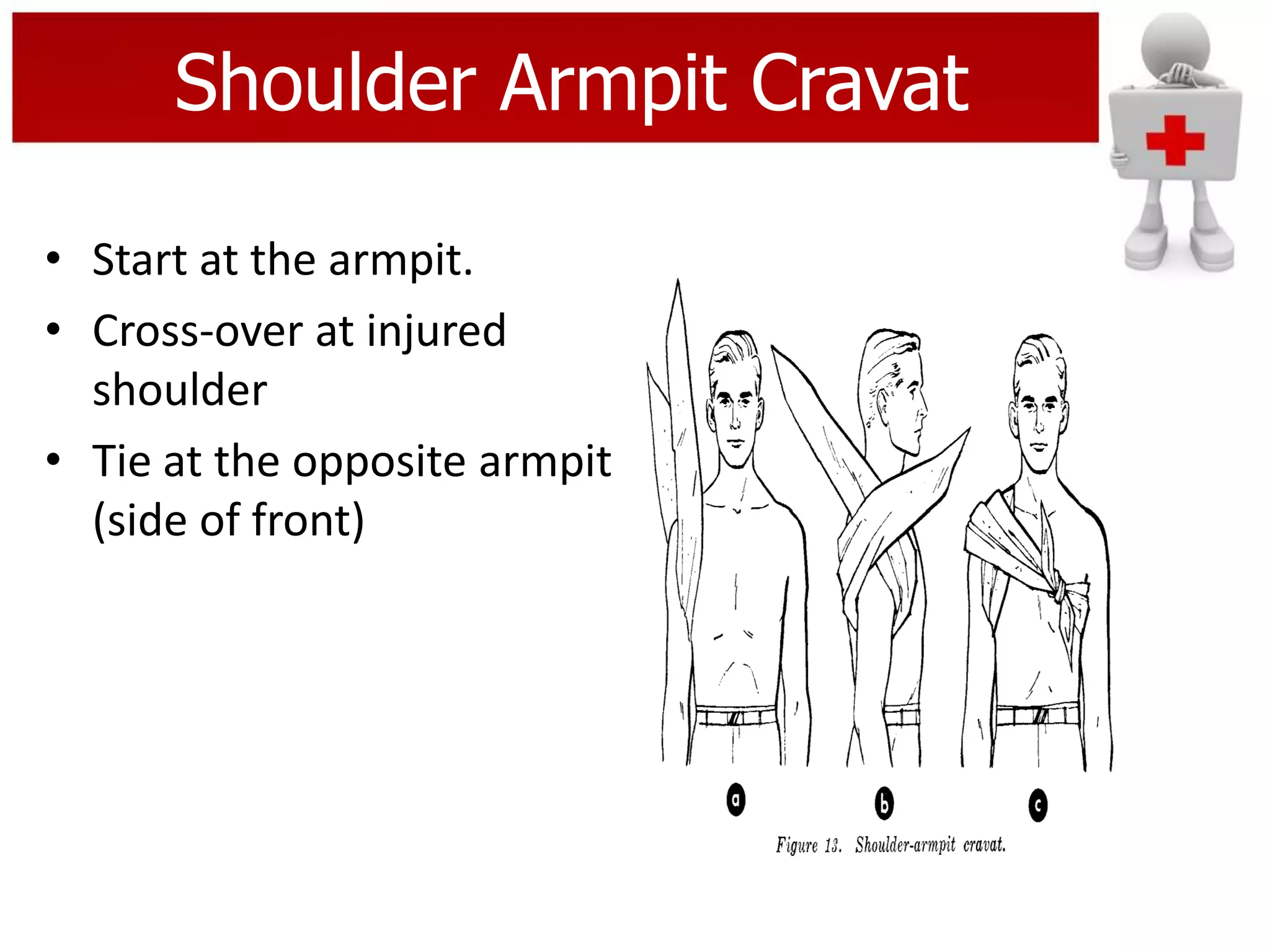
Shoulder Armpit Cravat

• Start at the armpit.
• Cross-over at injured
  shoulder
• Tie at the opposite armpit
  (side of front)

First aid & bandaging

  • 1.
    FIRST AID & BANDAGING Maybelle B. Animas, R.N Nurse II- Imus I
  • 2.
    First Aid The immediate care given to a person/victim who has suddenly become ill or has been injured.
  • 3.
    Role of FirstAider • Bridge the gap between the time of the accident and the arrival of the physician. • Ends when medical assistance begins. • Doesn’t intend to compete with or take place of the physician.
  • 4.
    Objectives of FirstAid • To prolong life • To alleviate suffering • To prevent further or added injury
  • 5.
    Characteristic of aGood First Aider • Observant- notice all signs • Resourceful- make best use of all things • Gentle- shouldn’t cause pain • Tactful- shouldn’t be alarming • Sympathetic- should be comforting
  • 6.
    First Aid kit •Rubbing Alcohol • Tweezers • Povidone Iodine • Medical tape • Hydrogen Peroxide • Splints • Cotton • Tongue depressor • Cotton swab • Band aid • Gauge pads • Gloves • Bandage (triangular) Elastic Roller bandage • Penlight • Safety pins • Forceps • Scissors
  • 7.
    Conditions Requiring FirstAid FAINTING Signs & Symptoms - Conditions Requiring First Aid caused by a sudden • Sweating fall in the supply of • Dizziness blood to their brain that • Nausea results in the temporary • Weakness loss of consciousness. • Paleness • Ringing in the ears • Blurred vision
  • 8.
    First Aid • Laythe person flat on the ground. Elevate the legs to coax more blood into your brain. • If person is on chair, push his head down between his knees. • Loosen tight clothing. • Avoid crowding the patient. • Call a doctor if necessary.
  • 9.
    Conditions Requiring FirstAid NOSE BLEED -occurs when a small blood vessel in the lining of the nose bursts. It very common in children and often result from harmless activities such as your child picking their nose, blowing it too hard or too often or from getting knocked on the nose during play.
  • 10.
    First Aid • Sitdown and lean forward slightly. • Pinch the lower part of the nostrils just below the bony part of the nose for 10minutes while breathing through the mouth. • Release nostrils slowly, repeat procedure if bleeding continue. • Do not touch or blow the nose for about 24hrs. Do not pact the affected nostrils with cotton. • Bring patient to hospital if necessary.
  • 11.
    Wounds • Break inthe Signs & Symptoms continuity of a tissue • Pain either external or • Swelling external. • Discoloration • Hematoma CLASSIFICATION • Uncontrolled restlessness • Thirst • Closed (internal) • Shock • Open (external) • Vomiting • Explosion
  • 12.
    Closed Wound The typesof closed wounds are: • Contusions, more commonly known as bruises, caused by a blunt force trauma that damages tissue under the skin. • Strained Muscles- Over-stretching of muscles that have not been sufficiently warmed-up (could be called "cold" muscles). • Sprained Ligament- Sudden force causing joint to move beyond its natural range of movement e.g. to break one's fall at speed during an activity such as ice-skating.
  • 13.
    First Aid • Restthe affected area • Ice application or cold compress • Compression over the affected area • Elevate the affected area above the heart
  • 14.
    Open Wound • Abrasions(grazes), superficial wounds in which the topmost layer of the skin (the epidermis) is scraped off. • Lacerations are jagged, irregular, or blunt breaks or tears in the soft tissues. • Avulsion is forcible separation or tearing of tissue from the victim’s body.
  • 15.
    Open Wound • Incisedwounds, or cuts in-body tissues are commonly caused by knives, metal edges, broken glass, or other sharp objects commonly cause incised wounds, or cuts, in-body tissues. • Puncture wounds are caused by a sharp object that penetrates the skin.
  • 16.
    First Aid The majorprinciples of open-wound treatment are to: • Control bleeding. – Direct pressure – Elevation • Prevent further contamination of the wound (wound dressing & bandaging) • Immobilize the injured part. • Stabilize any impaled object.
  • 17.
    Fracture • a medicalcondition in which there is a break in the continuity of the bone. A bone fracture can be the result of high force impact or stress, or trivial injury as a result of certain medical conditions that weaken the bones
  • 18.
    Types of Fracture •Greenstick fracture: an incomplete fracture in which the bone is bent. • Transverse fracture: a fracture at a right angle to the bone's axis. • Spiral fracture: a fracture in which the break has a curved or sloped pattern. • Comminuted fracture: a fracture in which the bone fragments into several pieces. • Compound fracture - meaning the bone ends are no longer touching.
  • 19.
    Signs and Symptoms •Pain and swelling at the fracture site. • Tenderness close to the fracture. • Paleness and deformity (sometimes). • Loss of pulse below the fracture, usually in an extremity (this is an emergency). • Numbness, tingling or paralysis below the fracture (rare; this is an emergency). • Bleeding or bruising at the site. • Weakness and inability to bear weight.
  • 20.
    First Aid • Initialtreatment for fractures of the arms, legs, hands and feet in the field include splinting the extremity in the position it is found, elevation and ice. Immobilization will be very helpful with initial pain control.
  • 21.
  • 22.
    Bandaging Bandages have threekey uses: applying pressure to bleeding wounds; covering wounds and burns; and providing support and immobilization for broken bones, sprains, and strains. These includes gauze, triangular, Elastic, and tubular bandage.
  • 23.
    Head Top (forhead injuries) • Fold the base at least 2-3” • Place folded base aligned with eyebrows • Pull back and cross-over at the back, tucking apex beneath • Pull both ends in front/secure with a square knot at the center of the folded base/tuck ends • Pull down apex (tuck sides neatly) • Tuck apex neatly at cross-over area
  • 24.
    Chest Bandage • Apexat the shoulder of injured part • Pull back folded base and secure with square knot at the center indention of the back. • Knot/tie longer end with apex
  • 25.
    Hand Bandage • Placethe hand in the middle of the triangular bandage with the wrist at the base of the • Place the apex over the fingers and tuck any excess material into the pleats on each side of the hand • Cross the ends on top of the hand, take them around the wrist, and tie them with a square knot.
  • 26.
    Arm Sling • Placefolded base vertically over • One arm, with pointed directly under the elbow of injured arm • Lower ends of base at the side of the neck using a square knot • Make several twist with apex and tie a knot • Hide the knot
  • 27.
    Underarm Sling • Sameprocedure as arm sling except that the lower end of the base is tucked under the injured arm. • Secure end of base and apex with a square knot the center indention at the back.
  • 28.
    Cravat Bandage forForehead • Place the center of the cravat over the compress covering the wound. • Carry the ends around to the opposite side of the head, cross them. Bring them back to the staring point and tie them.
  • 29.
    Cravat Bandage forthe Neck • Place the center of the cravat over the compress covering the wound. • Carry the ends around to the neck, cross them. Bring them back to the starting point and tie them loosely.
  • 30.
    Cravat Bandage forthe Cheek or Ears • Use the wide cravat. Start with the middle of the cravat over the compress covering the cheek or the ear. • Carry one end over the top of the head and the other under the chin. • Cross the ends at the opposite side. • Bring the short end back around the forehead and the long end around the back of the head. • Tie them down over the compress
  • 31.
    Cravat Bandage forthe Eye • Lay center of the first cravat over top of he with the front end falling over uninjured eye. • Bring second cravat around head, over eyes, and over loose ends of first cravat. Tie in front • Bring ends of first cravat back over top of head, tying there and pulling second cravat up and away form uninjured eye.
  • 32.
    Cravat for Elbow •Bend arm at elbow and place center of cravat at point of elbow • Bring ends up and across each other in overlapping spiral turns. Continue one end up arm and the other end down forearm. • Bring ends to front of elbow and tie.
  • 33.
    Cravat for theKnee • Start on top of the knees. • Cross over and twist 2-3 times under the knee. • Cross over on top/pull ends to opposite sides. • Secure with a square knot under the knee
  • 34.
    Cravat for theForearm, Arm, Leg and Thigh • Place center of cravat over the dressing • Begin ascending turns wit upper end and descending turns with lower end, with each turn covering two-third of preceding turn until dressing is covered. • Terminate by tying both ends in square knot.
  • 35.
    Shoulder Armpit Cravat •Start at the armpit. • Cross-over at injured shoulder • Tie at the opposite armpit (side of front)