STOICHIOMETRY
STOICHIOMETRY
2H2 + O2  2H2O
2 molecules of H2
1 molecule of O2
2 molecules of H2O
Now that you know the mole…
2H2 + O2  2H2O
2 moles of H2
1 mole of O2
2 moles of H2O
STOICHIOMETRY
Think of a reaction as a ratio…
2H2 + O2  2H2O
2 moles of H2
1 mole of O2
2 moles of H2O
2 moles H2 : 1 mole O2 : 2 moles H2O
Multiply by 2 = 4 moles H2 : 2 mole O2 : 4 moles H2O
This is called a mole ratio
STOICHIOMETRY
How many molecules of water are formed
when 3.5 moles of O2 react with H2?
2 moles H2 : 1 mole O2 : 2 moles H2O
= [2 moles H2 : 1 mole O2 : 2 moles H2O] x 3.5
= 7 moles H2 : 3.5 moles O2 : 7 moles H2O
 7 moles of water
N = n x NA
= 7 mol water x 6.02x10²³
molecules/mol
= 4.21x1024
molecules of water
Therefore 4.21x1024
molecules of water are formed.
STOICHIOMETRY
A) How many moles of O2 are required to
react with 13.9mol of C2H6 (ethane)?
B)What volume of H2O would be produced
by 1.40 mol of O2 and sufficient ethane
C2H6 + O2  CO2 + H2O
STOICHIOMETRY
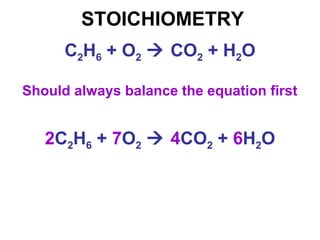
Should always balance the equation first
C2H6 + O2  CO2 + H2O
2C2H6 + 7O2  4CO2 + 6H2O
STOICHIOMETRY
2C2H6 + 7O2  4CO2 + 6H2O
A) How many moles of O2 are required to react with 13.9mol of C2H6 (ethane)?
iven: mole ratio of C2H6:O2 = 2:7
moles of C2H6 = 13.9mol
2 mol C2H6 = 13.9 mol C2H6
7 mol O2 x
0.2857 = 13.9
x
x = 13.9
0.2857
= 48.6 mol of O2
Therefore 48.6 mol of O2 are required
STOICHIOMETRY
2C2H6 + 7O2  4CO2 + 6H2O
What volume of H2O would be produced by 1.40 mol of O2 and sufficient ethane
iven: mole ratio of O2:H2O = 7:6
moles of O2 = 1.40mol
6 mol H2O = x
7 mol O2 1.40 mol O2
0.8571 = x
1.40
x = 0.8571 x 1.40
= 1.20 mol of H2O
But the question asked for volume!!!
STOICHIOMETRY
2C2H6 + 7O2  4CO2 + 6H2O
What volume of H2O would be produced by 1.40 mol of O2 and sufficient ethane
x = 1.20 mol of H2O
Given: n = 1.20 mol
MH2O = 18.016 g/mol
m = ?
m = nxM
= 1.20 mol x 18.016 g/mol
= 21.6 g
1 gram of water = 1mL at room temperature
Therefore the volume of water produced is 21.6mL
STOICHIOMETRY
General rules for solving problems…
STEP 1: Write a balanced chemical equation
STEP 2: If you’re given m or N of a substance, convert it
to the number of moles
STEP 3: Calculate the number of moles of the required
substance based on the number of moles of the given
substance (using the appropriate mole ratio)
STEP 4: Convert the number of moles of the required
substance to mass or number of particles, as directed
by the question
STOICHIOMETRY
Passing chlorine gas through molten
sulfur produces liquid disulfur dichloride.
How many molecules of chlorine react to
produce 50.0g of disulfur dichloride?
STOICHIOMETRY
Passing chlorine gas through molten sulfur produces liquid
disulfur dichloride. How many molecules of chlorine react to
produce 50.0g of disulfur dichloride?
STEP 1: Write the balanced equation
2S + Cl2  S2Cl2
STEP 2: Convert the given mass of disulfur dichloride
to the number of moles
MS2Cl2
= 135.04g/mol
n = m/M
= 50.0g/135.04g/mol
= 0.37026mol
STOICHIOMETRY
Passing chlorine gas through molten sulfur produces liquid
disulfur dichloride. How many molecules of chlorine react to
produce 50.0g of disulfur dichloride?
STEP 3: Calculate the number of moles of the required
substance using your mole ratio
2S + Cl2  S2Cl2
Given: mole ratio of S2Cl2:Cl2 = 1:1
1 mol S2Cl2 = 0.37026 mol S2Cl2
1 mol Cl2 x
x = 0.37026 mol Cl2
STOICHIOMETRY
Passing chlorine gas through molten sulfur produces liquid
disulfur dichloride. How many molecules of chlorine react to
produce 50.0g of disulfur dichloride?
STEP 4: Convert the number of moles of chlorine gas to the
number of particles
x = 0.37026 mol Cl2
N = n x NA
= 0.37026mol x 6.02x1023
molecules/mol
= 2.23 x 10²³
molecules
Therefore the number of molecules of chlorine is 2.23 x 10²³
STOICHIOMETRY
THE LIMITING REACTANT…
STOICHIOMETRY
Normally, we assume that all reactants are
consumed in a reaction…
THE LIMITING REACTANT…
2C2H6 + 7O2  4CO2 + 6H2O
Reactants are said to be in stoichiometic
amounts when all reactants are consumed in
the ratios predicted
STOICHIOMETRY
THE LIMITING REACTANT…
2C2H6 + 7O2  4CO2 + 6H2O
But there are often reactants that remain
“unreacted”…
GAS
GAS
O2
O2
O2
O2
O2
STOICHIOMETRY
THE LIMITING REACTANT…
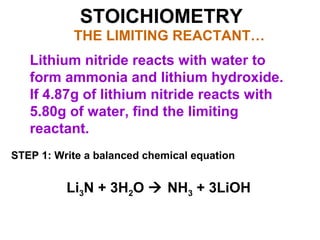
Lithium nitride reacts with water to
form ammonia and lithium hydroxide.
If 4.87g of lithium nitride reacts with
5.80g of water, find the limiting
reactant.
STOICHIOMETRY
THE LIMITING REACTANT…
Lithium nitride reacts with water to
form ammonia and lithium hydroxide.
If 4.87g of lithium nitride reacts with
5.80g of water, find the limiting
reactant.
STEP 1: Write a balanced chemical equation
Li3N + 3H2O  NH3 + 3LiOH
STOICHIOMETRY
THE LIMITING REACTANT…
Lithium nitride reacts with water to form ammonia and lithium hydroxide.
If 4.87g of lithium nitride reacts with 5.80g of water, find the limiting
reactant.
STEP 1: Write a balanced chemical equation
Li3N + 3H2O  NH3 + 3LiOH
STEP 2: Convert the given masses to the number of
moles
nLi3N = m/M
= 4.87g/34.8g/mol
= 0.140mol
nH2O = m/M
= 5.80g/18.0g/mol
= 0.322mol
STOICHIOMETRY
THE LIMITING REACTANT…
Lithium nitride reacts with water to form ammonia and lithium hydroxide.
If 4.87g of lithium nitride reacts with 5.80g of water, find the limiting
reactant.
Li3N + 3H2O  NH3 + 3LiOH
nLi3N = 0.140mol
nH2O = 0.322mol
STEP 3: Calculate the number of moles of NH3 produced
by both amounts of reactants
1 mol Li3N = 0.140 mol Li3N
1 mol NH3 x
x = 0.140 mol NH3
STOICHIOMETRY
THE LIMITING REACTANT…
Lithium nitride reacts with water to form ammonia and lithium hydroxide.
If 4.87g of lithium nitride reacts with 5.80g of water, find the limiting
reactant.
Li3N + 3H2O  NH3 + 3LiOH
nLi3N = 0.140mol
nH2O = 0.322mol
STEP 3: Calculate the number of moles of NH3 produced
by both amounts of reactants
3 mol H2O = 0.322 mol H2O
1 mol NH3 x
x = 0.107 mol NH3
5.80g water makes less ammonia than 4.87g lithium nitride
STOICHIOMETRY
THE LIMITING REACTANT…
Lithium nitride reacts with water to form ammonia and lithium hydroxide.
If 4.87g of lithium nitride reacts with 5.80g of water, find the limiting
reactant.
Li3N + 3H2O  NH3 + 3LiOH
Therefore water is the limiting reactant
STOICHIOMETRY
THE LIMITING REACTANT…
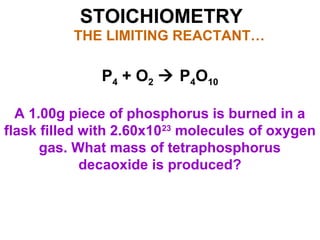
P4 + O2  P4O10
A 1.00g piece of phosphorus is burned in a
flask filled with 2.60x10²³
molecules of oxygen
gas. What mass of tetraphosphorus
decaoxide is produced?
STOICHIOMETRY
THE LIMITING REACTANT…
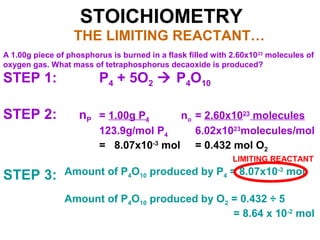
STEP 1: P4 + 5O2  P4O10
STEP 2: nP = 1.00g P4 no = 2.60x10²³
molecules
123.9g/mol P4 6.02x10²³
molecules/mol
= 8.07x10⁻³
mol = 0.432 mol O2
STEP 3:
A 1.00g piece of phosphorus is burned in a flask filled with 2.60x10²³
molecules of
oxygen gas. What mass of tetraphosphorus decaoxide is produced?
Amount of P4O10 produced by P4 = 8.07x10⁻³
mol
Amount of P4O10 produced by O2 = 0.432 ÷ 5
= 8.64 x 10⁻²
mol
LIMITING REACTANT
STOICHIOMETRY
THE LIMITING REACTANT…
A 1.00g piece of phosphorus is burned in a flask filled with 2.60x10²³
molecules of
oxygen gas. What mass of tetraphosphorus decaoxide is produced?
Amount of P4O10 produced by P4 = 8.07x10⁻³
mol
m= n x M
= 0.00807mol x 284g/mol P4O10
= 2.29g P4O10
Therefore 2.29g of P4O10 is produced.
STOICHIOMETRY
THE LIMITING REACTANT…
circuitry iphone 4batteryempty case
1 + 1 + 1  1
STOICHIOMETRY
THE LIMITING REACTANT…
circuitry iphone 4batteryempty case
What if you were given…
3 + 6 + 1  ?
How many iphones can you make?
Limiting ingredient
1
STOICHIOMETRY
THE LIMITING REACTANT…
circuitry iphone 4batteryempty case
What if you were given…
101 + 64 + 97  ?
How many iphones can you make?
Limiting ingredient
64

17 stoichiometry

  • 1.
  • 2.
    STOICHIOMETRY 2H2 + O2 2H2O 2 molecules of H2 1 molecule of O2 2 molecules of H2O Now that you know the mole… 2H2 + O2  2H2O 2 moles of H2 1 mole of O2 2 moles of H2O
  • 3.
    STOICHIOMETRY Think of areaction as a ratio… 2H2 + O2  2H2O 2 moles of H2 1 mole of O2 2 moles of H2O 2 moles H2 : 1 mole O2 : 2 moles H2O Multiply by 2 = 4 moles H2 : 2 mole O2 : 4 moles H2O This is called a mole ratio
  • 4.
    STOICHIOMETRY How many moleculesof water are formed when 3.5 moles of O2 react with H2? 2 moles H2 : 1 mole O2 : 2 moles H2O = [2 moles H2 : 1 mole O2 : 2 moles H2O] x 3.5 = 7 moles H2 : 3.5 moles O2 : 7 moles H2O  7 moles of water N = n x NA = 7 mol water x 6.02x10²³ molecules/mol = 4.21x1024 molecules of water Therefore 4.21x1024 molecules of water are formed.
  • 5.
    STOICHIOMETRY A) How manymoles of O2 are required to react with 13.9mol of C2H6 (ethane)? B)What volume of H2O would be produced by 1.40 mol of O2 and sufficient ethane C2H6 + O2  CO2 + H2O
  • 6.
    STOICHIOMETRY Should always balancethe equation first C2H6 + O2  CO2 + H2O 2C2H6 + 7O2  4CO2 + 6H2O
  • 7.
    STOICHIOMETRY 2C2H6 + 7O2 4CO2 + 6H2O A) How many moles of O2 are required to react with 13.9mol of C2H6 (ethane)? iven: mole ratio of C2H6:O2 = 2:7 moles of C2H6 = 13.9mol 2 mol C2H6 = 13.9 mol C2H6 7 mol O2 x 0.2857 = 13.9 x x = 13.9 0.2857 = 48.6 mol of O2 Therefore 48.6 mol of O2 are required
  • 8.
    STOICHIOMETRY 2C2H6 + 7O2 4CO2 + 6H2O What volume of H2O would be produced by 1.40 mol of O2 and sufficient ethane iven: mole ratio of O2:H2O = 7:6 moles of O2 = 1.40mol 6 mol H2O = x 7 mol O2 1.40 mol O2 0.8571 = x 1.40 x = 0.8571 x 1.40 = 1.20 mol of H2O But the question asked for volume!!!
  • 9.
    STOICHIOMETRY 2C2H6 + 7O2 4CO2 + 6H2O What volume of H2O would be produced by 1.40 mol of O2 and sufficient ethane x = 1.20 mol of H2O Given: n = 1.20 mol MH2O = 18.016 g/mol m = ? m = nxM = 1.20 mol x 18.016 g/mol = 21.6 g 1 gram of water = 1mL at room temperature Therefore the volume of water produced is 21.6mL
  • 10.
    STOICHIOMETRY General rules forsolving problems… STEP 1: Write a balanced chemical equation STEP 2: If you’re given m or N of a substance, convert it to the number of moles STEP 3: Calculate the number of moles of the required substance based on the number of moles of the given substance (using the appropriate mole ratio) STEP 4: Convert the number of moles of the required substance to mass or number of particles, as directed by the question
  • 11.
    STOICHIOMETRY Passing chlorine gasthrough molten sulfur produces liquid disulfur dichloride. How many molecules of chlorine react to produce 50.0g of disulfur dichloride?
  • 12.
    STOICHIOMETRY Passing chlorine gasthrough molten sulfur produces liquid disulfur dichloride. How many molecules of chlorine react to produce 50.0g of disulfur dichloride? STEP 1: Write the balanced equation 2S + Cl2  S2Cl2 STEP 2: Convert the given mass of disulfur dichloride to the number of moles MS2Cl2 = 135.04g/mol n = m/M = 50.0g/135.04g/mol = 0.37026mol
  • 13.
    STOICHIOMETRY Passing chlorine gasthrough molten sulfur produces liquid disulfur dichloride. How many molecules of chlorine react to produce 50.0g of disulfur dichloride? STEP 3: Calculate the number of moles of the required substance using your mole ratio 2S + Cl2  S2Cl2 Given: mole ratio of S2Cl2:Cl2 = 1:1 1 mol S2Cl2 = 0.37026 mol S2Cl2 1 mol Cl2 x x = 0.37026 mol Cl2
  • 14.
    STOICHIOMETRY Passing chlorine gasthrough molten sulfur produces liquid disulfur dichloride. How many molecules of chlorine react to produce 50.0g of disulfur dichloride? STEP 4: Convert the number of moles of chlorine gas to the number of particles x = 0.37026 mol Cl2 N = n x NA = 0.37026mol x 6.02x1023 molecules/mol = 2.23 x 10²³ molecules Therefore the number of molecules of chlorine is 2.23 x 10²³
  • 15.
  • 16.
    STOICHIOMETRY Normally, we assumethat all reactants are consumed in a reaction… THE LIMITING REACTANT… 2C2H6 + 7O2  4CO2 + 6H2O Reactants are said to be in stoichiometic amounts when all reactants are consumed in the ratios predicted
  • 17.
    STOICHIOMETRY THE LIMITING REACTANT… 2C2H6+ 7O2  4CO2 + 6H2O But there are often reactants that remain “unreacted”… GAS GAS O2 O2 O2 O2 O2
  • 18.
    STOICHIOMETRY THE LIMITING REACTANT… Lithiumnitride reacts with water to form ammonia and lithium hydroxide. If 4.87g of lithium nitride reacts with 5.80g of water, find the limiting reactant.
  • 19.
    STOICHIOMETRY THE LIMITING REACTANT… Lithiumnitride reacts with water to form ammonia and lithium hydroxide. If 4.87g of lithium nitride reacts with 5.80g of water, find the limiting reactant. STEP 1: Write a balanced chemical equation Li3N + 3H2O  NH3 + 3LiOH
  • 20.
    STOICHIOMETRY THE LIMITING REACTANT… Lithiumnitride reacts with water to form ammonia and lithium hydroxide. If 4.87g of lithium nitride reacts with 5.80g of water, find the limiting reactant. STEP 1: Write a balanced chemical equation Li3N + 3H2O  NH3 + 3LiOH STEP 2: Convert the given masses to the number of moles nLi3N = m/M = 4.87g/34.8g/mol = 0.140mol nH2O = m/M = 5.80g/18.0g/mol = 0.322mol
  • 21.
    STOICHIOMETRY THE LIMITING REACTANT… Lithiumnitride reacts with water to form ammonia and lithium hydroxide. If 4.87g of lithium nitride reacts with 5.80g of water, find the limiting reactant. Li3N + 3H2O  NH3 + 3LiOH nLi3N = 0.140mol nH2O = 0.322mol STEP 3: Calculate the number of moles of NH3 produced by both amounts of reactants 1 mol Li3N = 0.140 mol Li3N 1 mol NH3 x x = 0.140 mol NH3
  • 22.
    STOICHIOMETRY THE LIMITING REACTANT… Lithiumnitride reacts with water to form ammonia and lithium hydroxide. If 4.87g of lithium nitride reacts with 5.80g of water, find the limiting reactant. Li3N + 3H2O  NH3 + 3LiOH nLi3N = 0.140mol nH2O = 0.322mol STEP 3: Calculate the number of moles of NH3 produced by both amounts of reactants 3 mol H2O = 0.322 mol H2O 1 mol NH3 x x = 0.107 mol NH3 5.80g water makes less ammonia than 4.87g lithium nitride
  • 23.
    STOICHIOMETRY THE LIMITING REACTANT… Lithiumnitride reacts with water to form ammonia and lithium hydroxide. If 4.87g of lithium nitride reacts with 5.80g of water, find the limiting reactant. Li3N + 3H2O  NH3 + 3LiOH Therefore water is the limiting reactant
  • 24.
    STOICHIOMETRY THE LIMITING REACTANT… P4+ O2  P4O10 A 1.00g piece of phosphorus is burned in a flask filled with 2.60x10²³ molecules of oxygen gas. What mass of tetraphosphorus decaoxide is produced?
  • 25.
    STOICHIOMETRY THE LIMITING REACTANT… STEP1: P4 + 5O2  P4O10 STEP 2: nP = 1.00g P4 no = 2.60x10²³ molecules 123.9g/mol P4 6.02x10²³ molecules/mol = 8.07x10⁻³ mol = 0.432 mol O2 STEP 3: A 1.00g piece of phosphorus is burned in a flask filled with 2.60x10²³ molecules of oxygen gas. What mass of tetraphosphorus decaoxide is produced? Amount of P4O10 produced by P4 = 8.07x10⁻³ mol Amount of P4O10 produced by O2 = 0.432 ÷ 5 = 8.64 x 10⁻² mol LIMITING REACTANT
  • 26.
    STOICHIOMETRY THE LIMITING REACTANT… A1.00g piece of phosphorus is burned in a flask filled with 2.60x10²³ molecules of oxygen gas. What mass of tetraphosphorus decaoxide is produced? Amount of P4O10 produced by P4 = 8.07x10⁻³ mol m= n x M = 0.00807mol x 284g/mol P4O10 = 2.29g P4O10 Therefore 2.29g of P4O10 is produced.
  • 27.
    STOICHIOMETRY THE LIMITING REACTANT… circuitryiphone 4batteryempty case 1 + 1 + 1  1
  • 28.
    STOICHIOMETRY THE LIMITING REACTANT… circuitryiphone 4batteryempty case What if you were given… 3 + 6 + 1  ? How many iphones can you make? Limiting ingredient 1
  • 29.
    STOICHIOMETRY THE LIMITING REACTANT… circuitryiphone 4batteryempty case What if you were given… 101 + 64 + 97  ? How many iphones can you make? Limiting ingredient 64

Editor's Notes

  • #30 http://www.youtube.com/watch?v=wyrFWbGiGOc