TheBetterBusinessCasesisatrademarkofHerMajesty'sTreasury.
DSDM,Atern,AgilePM,AgilePgM,AgilePFareRegisteredTradeMarksofDynamicSystemsDevelopmentMethodLimited.
M00 - Course introduction 2/10 | 2/228
Start and finish Course style
LunchCoffee and breaks
 Importance of the business case
 Types of Business Cases
 The Five Case Model
 Fit with best practice assurance and
approvals
 Preparing for Better Business Cases
Foundation exam
Main goal
 Attempt Foundation exam with confidence
 Begin to apply the method, tailoring it to
your own projects’ needs
Secondary goal
 Benefits and value of Better Business Cases
M00 - Course introduction 2/9 | 2/194
 Please share with the class:
 Your name and surname
 Your organization
 Your profession
 Title, function, job responsibilities
 Your experience with business case
development
 Your experience with project and
programme management
 Your personal session expectations
M00 - Course introduction 3/9 | 3/194
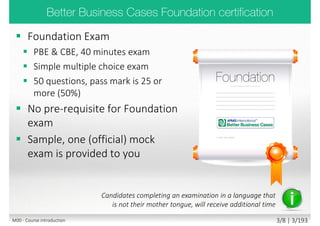
 Foundation Exam
 PBE & CBE, 40 minutes exam
 Simple multiple choice exam
 50 questions, pass mark is 25 or
more (50%)
 No pre-requisite for Foundation
exam
 Sample, one (official) mock
exam is provided to you
Candidates completing an examination in a language that
is not their mother tongue, will receive additional time
M00 - Course introduction 4/9 | 4/194
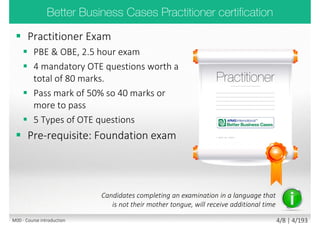
 Practitioner Exam
 PBE & OBE, 2.5 hour exam
 4 mandatory OTE questions worth a
total of 80 marks.
 Pass mark of 50% so 40 marks or
more to pass
 5 Types of OTE questions
 Pre-requisite: Foundation exam
Candidates completing an examination in a language that
is not their mother tongue, will receive additional time
M00 - Course introduction 5/9 | 5/194
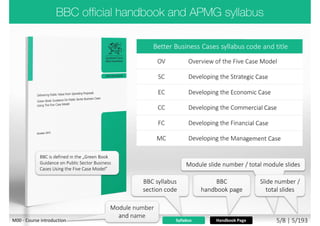
Better Business Cases syllabus code and title
OV Overview of the Five Case Model
SC Developing the Strategic Case
EC Developing the Economic Case
CC Developing the Commercial Case
FC Developing the Financial Case
MC Developing the Management Case
Syllabus Handbook Page
Module slide number / total module slides
Slide number /
total slides
Module number
and name
BBC
handbook page
BBC syllabus
section code
M00 - Course introduction 6/9 | 6/194
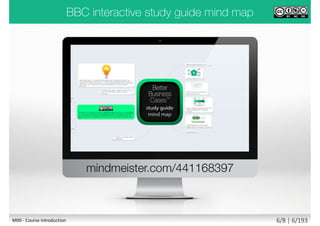
M00 - Course introduction 7/9 | 7/194
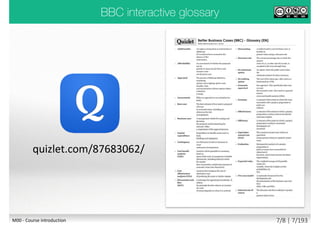
quizlet.com/87683062/
M00 - Course introduction 8/9 | 8/194
twitter.com/mirodabrowski
linkedin.com/in/miroslawdabrowski
google.com/+miroslawdabrowski
miroslaw_dabrowski
www.miroslawdabrowski.com
Mirosław Dąbrowski
Agile Coach, Trainer, Consultant
(former JEE/PHP developer, UX/UI designer, BA/SA)
Creator Writer / Translator Trainer / Coach
• Creator of 50+ mind maps from PPM and related
topics (2mln views): miroslawdabrowski.com
• Lead author of more than 50+ accredited materials
from PRINCE2, PRINCE2 Agile, MSP, MoP, P3O, ITIL,
M_o_R, MoV, PMP, Scrum, AgilePM, DSDM, CISSP,
CISA, CISM, CRISC, CGEIT, TOGAF, COBIT5 etc.
• Creator of 50+ interactive mind maps from PPM
topics: mindmeister.com/users/channel/2757050
• Product Owner of biggest Polish project
management portal: 4PM: 4pm.pl (15.000+ views
each month)
• Editorial Board Member of Official PMI Poland
Chapter magazine: “Strefa PMI”: strefapmi.pl
• Official PRINCE2 Agile, AgilePM, ASL2, BiSL methods
translator for Polish language
• English speaking, international, independent
trainer and coach from multiple domains.
• Master Lead Trainer
• 11+ years in training and coaching / 15.000+ hours
• 100+ certifications
• 5000+ people trained and coached
• 25+ trainers trained and coached
linkedin.com/in/miroslawdabrowski
Agile Coach / Scrum Master PM / IT architect Notable clients
• 8+ years of experience with Agile projects as a
Scrum Master, Product Owner and Agile Coach
• Coached 25+ teams from Agile and Scrum
• Agile Coach coaching C-level executives
• Scrum Master facilitating multiple teams
experienced with UX/UI + Dev teams
• Experience multiple Agile methods
• Author of AgilePM/DSDM Project Health Check
Questionnaire (PHCQ) audit tool
• Dozens of mobile and ecommerce projects
• IT architect experienced in IT projects with budget
above 10mln PLN and timeline of 3+ years
• Experienced with (“traditional”) projects under high
security, audit and compliance requirements based
on ISO/EIC 27001
• 25+ web portal design and development and
mobile application projects with iterative,
incremental and adaptive approach
ABB, AGH, Aiton Caldwell, Asseco, Capgemini, Deutsche Bank,
Descom, Ericsson, Ericpol, Euler Hermes, General Electric,
Glencore, HP Global Business Center, Ideo, Infovide-Matrix,
Interia, Kemira, Lufthansa Systems, Media-Satrun Group,
Ministry of Defense (Poland), Ministry of Justice (Poland),
Nokia Siemens Networks, Oracle, Orange, Polish Air Force,
Proama, Roche, Sabre Holdings, Samsung Electronics, Sescom,
Scania, Sopra Steria, Sun Microsystems, Tauron Polish Energy,
Tieto, University of Wroclaw, UBS Service Centre, Volvo IT…
miroslawdabrowski.com/about-me/clients-and-references/
Accreditations/certifications (selected): CISA, CISM, CRISC, CASP, Security+, Project+, Network+, Server+, Approved Trainer:
(MoP, MSP, PRINCE2, PRINCE2 Agile, M_o_R, MoV, P3O, ITIL Expert, RESILIA), ASL2, BiSL, Change Management,
Facilitation, Managing Benefits, COBIT5, TOGAF 8/9L2, OBASHI, CAPM, PSM I, SDC, SMC, ESMC, SPOC, AEC, DSDM Atern,
DSDM Agile Professional, DSDM Agile Trainer-Coach, AgilePM, OCUP Advanced, SCWCD, SCBCD, SCDJWS, SCMAD, ZCE 5.0,
ZCE 5.3, MCT, MCP, MCITP, MCSE-S, MCSA-S, MCS, MCSA, ISTQB, IQBBA, REQB, CIW Web Design / Web Development /
Web Security Professional, Playing Lean Facilitator, DISC D3 Consultant, SDI Facilitator, Certified Trainer Apollo 13 ITSM
Simulation …
M00 - Course introduction 9/9 | 9/194
1. Introduction to BBC and Five Case
Model
2. Overview of the Five Case Model
3. Different types of spending
proposals and supporting business
cases
4. Fit with other recommended best
practice
5. Unpacking the 5 Case Model
6. Approvals and Assurance
7. Economic Appraisal – Common
Errors
M01 - Introduction to BBC and 5 Case Model 2/13 | 11/194
 The Better Business Cases (BBC)
Programme has been jointly
developed by:
 HM Treasury
 Welsh Government
 The scheme and exam are based on
the HM Treasury’s “Green Book
Guidance on Public Sector Business
Cases Using the Five Case Model”
 The accreditation scheme has been
developed by the BBC Programme
with APMG International
M01 - Introduction to BBC and 5 Case Model 3/13 | 12/194
M01 - Introduction to BBC and 5 Case Model 4/13 | 13/194
M01 - Introduction to BBC and 5 Case Model 5/13 | 14/194
 Provides a framework for scoping and planning spending
proposals leading to efficient and effective spend
 Internal and external approval
 Accountability for public funds
 Recognised best practice (PRINCE2®, PRINCE2® Agile,
MSP®, AgilePM®, AgilePgM®)
 Repository for information and evidence base
 Post evaluation
M01 - Introduction to BBC and 5 Case Model 6/13 | 15/194
 A lot of new £ spend unsupported by an adequate
business case (non valid, not monitored)
 Too often poorly presented, inherently optimistic and
offering sub-optimal VfM
 Expensive use of (external) consultancy (lacking of internal
know-how)
 No common standard or methodology (difficulties in
monitoring and information aggregation)
 Could achieve more for less through use of proven tools
and techniques
M01 - Introduction to BBC and 5 Case Model 7/13 | 16/194
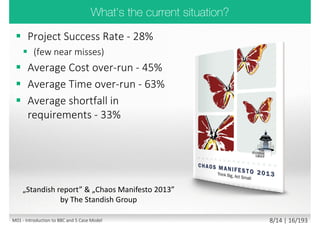
 Project Success Rate - 28%
 (few near misses)
 Average Cost over-run - 45%
 Average Time over-run - 63%
 Average shortfall in
requirements - 33%
„Standish report” & „Chaos Manifesto 2013”
by The Standish Group
M01 - Introduction to BBC and 5 Case Model 8/13 | 17/194
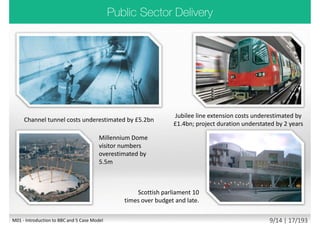
Channel tunnel costs underestimated by £5.2bn
Jubilee line extension costs underestimated by
£1.4bn; project duration understated by 2 years
Millennium Dome
visitor numbers
overestimated by
5.5m
Scottish parliament 10
times over budget and late.
M01 - Introduction to BBC and 5 Case Model 9/13 | 18/194
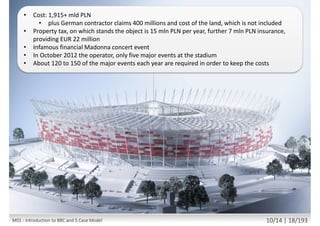
• Cost: 1,915+ mld PLN
• plus German contractor claims 400 millions and cost of the land, which is not included
• Property tax, on which stands the object is 15 mln PLN per year, further 7 mln PLN insurance,
providing EUR 22 million
• Infamous financial Madonna concert event
• In October 2012 the operator, only five major events at the stadium
• About 120 to 150 of the major events each year are required in order to keep the costs
M01 - Introduction to BBC and 5 Case Model 10/13 | 19/194
What are the most common causes of project failure?
M01 - Introduction to BBC and 5 Case Model 11/13 | 20/194
 Lack of clear link to the organisation’s key strategic priorities
 Lack of clear senior management ownership and leadership
 Lack of effective engagement with stakeholders
 Lack of skills and proven approach to project and risk management
 Project not broken down into manageable steps
 Evaluation of proposals linked to short term affordability rather than
longer term value for money
 Lack of understanding of and contact with suppliers
 Lack of effective integration between the client, supplier and supply
chain
Reported by OGC in respect of Gateway Reviews
M01 - Introduction to BBC and 5 Case Model 12/13 | 21/194
M01 - Introduction to BBC and 5 Case Model 13/13 | 22/194
1. Introduction to BBC and Five Case
Model
2. Overview of the Five Case Model
3. Different types of spending
proposals and supporting business
cases
4. Fit with other recommended best
practice
5. Unpacking the 5 Case Model
6. Approvals and Assurance
7. Economic Appraisal – Common
Errors
M02 - Overview of the Five Case Model 2/21 | 24/194
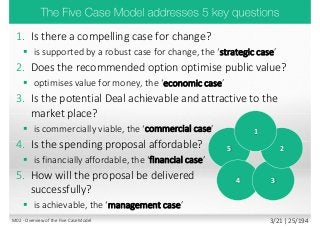
1. Is there a compelling case for change?
 is supported by a robust case for change, the ‘strategic case’
2. Does the recommended option optimise public value?
 optimises value for money, the ‘economic case’
3. Is the potential Deal achievable and attractive to the
market place?
 is commercially viable, the ‘commercial case’
4. Is the spending proposal affordable?
 is financially affordable, the ‘financial case’
5. How will the proposal be delivered
successfully?
 is achievable, the ‘management case’
5
4 3
2
1
M02 - Overview of the Five Case Model 3/21 | 25/194
Demonstrates:
 That the spending proposal provides business
synergy and strategic fit and is predicated upon a
robust and evidence based case for change.
 Strategic fit - how the proposal fits with wider public
sector policy and furthers more immediate objectives.
 Rationale of why intervention is required.
 Clear definition of outcomes and the potential
scope for what is to be achieved.
 Robust Case for Change - a clear rationale for
intervention.
This strategic case requires the spending
authority to demonstrate how the spending
proposal fits in relation to national, regional and
local policies, strategies and plans and furthers
the required outcomes.
It also requires the spending authority to
demonstrate that the spending proposal has
clear and concise spending objectives, which are
specific, measurable, achievable, relevant and
time constrained (SMART).
M02 - Overview of the Five Case Model 4/21 | 26/194
 Strategic Context
 Organisational Overview
 Current Business Strategies
 The Case for Change
 Spending Objectives
 Existing Arrangements
 Business Needs – current and future
 Potential Scope
 Benefits and Risks
 Constraints and Dependencies
M02 - Overview of the Five Case Model 5/21 | 27/194
Demonstrates:
 Selection of the “long list”, the use of the “Options
Framework” – a tool which helps identify the
potential scope or range of services for the scheme
is recommended, and in response to these, the
potential service solutions, methods of service
delivery and main choices for implementation and
funding.
 Choice - a wide range of options has been appraised
 The “preferred option” is then subjected to
sensitivity analysis in order to test its robustness.
The output of the economic case should never be a
one number answer;
 Preferred option - offers optimum value for money in
relation to associated costs, benefits, dis-benefits and
risks.
M02 - Overview of the Five Case Model 6/21 | 28/194
 Critical Success Factors
 Long listed Options
 Short Listed Options (including do minimum, 3 or 4
is the recommended number)
 Status quo
 Do nothing option (unless this is not credible)
 Economic Appraisals of Costs and Benefits with CBA
 Distributional Analysis (where relevant)
 Optimism Bias adjustment
 Risk Assessment
 Sensitivity Analysis
 The Preferred Option
M02 - Overview of the Five Case Model 7/21 | 29/194
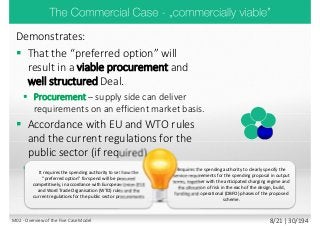
Demonstrates:
 That the “preferred option” will
result in a viable procurement and
well structured Deal.
 Procurement – supply side can deliver
requirements on an efficient market basis.
 Accordance with EU and WTO rules
and the current regulations for the
public sector (if required).
 Potential Deal - contractual arrangements
for specified goods and services
It requires the spending authority to set how the
“preferred option” for spend will be procured
competitively, in accordance with European Union (EU)
and Word Trade Organisation (WTO) rules and the
current regulations for the public sector procurements
Requires the spending authority to clearly specify the
service requirements for the spending proposal in output
terms, together with the anticipated charging regime and
the allocation of risk in the each of the design, build,
funding and operational (DBFO) phases of the proposed
scheme.
M02 - Overview of the Five Case Model 8/21 | 30/194
 Procurement Strategy
 Service Requirements
 Charging Mechanism
 Risk Transfer
 Key Contractual Arrangements
 Personnel (TUPE) Implications
 Accountancy Treatment
M02 - Overview of the Five Case Model 9/21 | 31/194
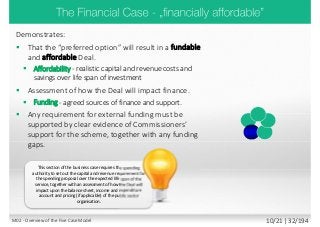
Demonstrates:
 That the “preferred option” will result in a fundable
and affordable Deal.
 Affordability - realistic capital and revenue costs and
savings over life span of investment
 Assessment of how the Deal will impact finance.
 Funding - agreed sources of finance and support.
 Any requirement for external funding must be
supported by clear evidence of Commissioners’
support for the scheme, together with any funding
gaps.
This section of the business case requires the spending
authority to set out the capital and revenue requirement for
the spending proposal over the expected life span of the
service, together with an assessment of how the Deal will
impact upon the balance sheet, income and expenditure
account and pricing (if applicable) of the public sector
organisation.
M02 - Overview of the Five Case Model 10/21 | 32/194
 Public Capital and Revenue
Requirements
 Net Effect on Prices (if applicable)
 Impact on Balance Sheet
 Impact on Income and Expenditure
Account (if applicable)
 Overall Funding and Affordability
 Commissioner Support (if applicable)
M02 - Overview of the Five Case Model 11/21 | 33/194
Demonstrates:
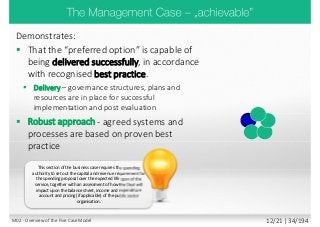
 That the “preferred option” is capable of
being delivered successfully, in accordance
with recognised best practice.
 Delivery – governance structures, plans and
resources are in place for successful
implementation and post evaluation
 Robust approach - agreed systems and
processes are based on proven best
practice
This section of the business case requires the spending
authority to set out the capital and revenue requirement for
the spending proposal over the expected life span of the
service, together with an assessment of how the Deal will
impact upon the balance sheet, income and expenditure
account and pricing (if applicable) of the public sector
organisation.
M02 - Overview of the Five Case Model 12/21 | 34/194
 Programme and Project Management Methodology (PPM)
and Structure
 Programme and Project Management Plans
 Use of Specialist Advisers
 Change and Contract Management
Arrangements
 Benefits Realisation
 Risk Management
 Monitoring during implementation
(proportionate)
 Post Implementation Evaluation Arrangements
 Contingency Arrangements
M02 - Overview of the Five Case Model 13/21 | 35/194
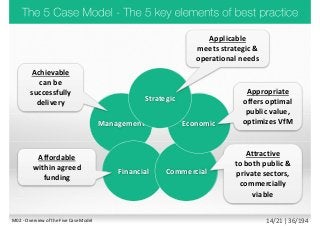
Management
Financial Commercial
Economic
Strategic
Applicable
meets strategic &
operational needs
Appropriate
offers optimal
public value,
optimizes VfM
Attractive
to both public &
private sectors,
commercially
viable
Affordable
within agreed
funding
Achievable
can be
successfully
delivery
M02 - Overview of the Five Case Model 14/21 | 36/194
BBC is a structured way that stakeholders can work and think together to provide a business
case, with fit for purpose analysis, which gives confidence to decision makers that investing in
a proposed programme or project is justified following the five case model
 A structured way of thinking
 A step-by-step approach
 A way of working together
 A way to bring convergence, coherence and cohesion
 A tool of international good practice (UK, Australia, New Zealand)
The supporting principles are:
 Quality analysis
 Thinking not writing
 Fit for purpose effort
 No surprises
 Governance and ownership
 Alignment with other management processes
M02 - Overview of the Five Case Model 15/21 | 37/194
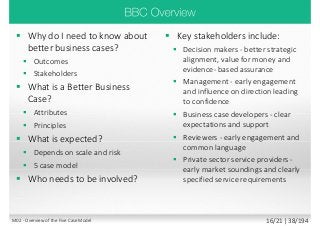
 Why do I need to know about
better business cases?
 Outcomes
 Stakeholders
 What is a Better Business
Case?
 Attributes
 Principles
 What is expected?
 Depends on scale and risk
 5 case model
 Who needs to be involved?
 Key stakeholders include:
 Decision makers - better strategic
alignment, value for money and
evidence- based assurance
 Management - early engagement
and influence on direction leading
to confidence
 Business case developers - clear
expectations and support
 Reviewers - early engagement and
common language
 Private sector service providers -
early market soundings and clearly
specified service requirements
M02 - Overview of the Five Case Model 16/21 | 38/194
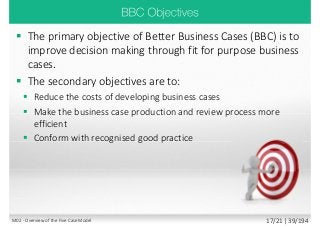
 The primary objective of Better Business Cases (BBC) is to
improve decision making through fit for purpose business
cases.
 The secondary objectives are to:
 Reduce the costs of developing business cases
 Make the business case production and review process more
efficient
 Conform with recognised good practice
M02 - Overview of the Five Case Model 17/21 | 39/194
 For Organizations
 Reduction in unnecessary spending and consultancy costs
 A process and guidance designed to optimize value from
change initiatives
 A clear, proportionate approval process and improved,
more informed decision making
 Complements existing best practice
 Short courses minimize disruption to business as usual
 For Individuals
 Understanding of an established and proven
methodology which can be applied at both strategic
(macro) and tactical (micro) levels
 Recognized certification for a core business competency
for so many in mid and senior management roles
M02 - Overview of the Five Case Model 18/21 | 40/194
 BBC is an approach that looks to maximise value for money from
programme/project investments
 A Better Business Case includes analysis of 5 cases
 The process is scalable – with expectations set during scoping
 The process is collaborative, with some of the key work done in
workshops that are supported by accredited facilitators
 Stakeholders in the programme/project should be engaged and
involved as early as possible
 Better Business Cases lead to:
 better informed decisions
 better value for money
 achievement of better outcomes
M02 - Overview of the Five Case Model 19/21 | 41/194
M02 - Overview of the Five Case Model 20/21 | 42/194
I hope you enjoyed
this presentation. If so,
please like, share and
leave a comment
below.
Endorsements on
LinkedIn are also
highly appreciated! 
(your feedback = more free stuff)

MIROSLAWDABROWSKI.COM/downloads

BBC - Better Business Cases - Foundation

  • 1.
  • 2.
    M00 - Courseintroduction 2/10 | 2/228 Start and finish Course style LunchCoffee and breaks
  • 3.
     Importance ofthe business case  Types of Business Cases  The Five Case Model  Fit with best practice assurance and approvals  Preparing for Better Business Cases Foundation exam Main goal  Attempt Foundation exam with confidence  Begin to apply the method, tailoring it to your own projects’ needs Secondary goal  Benefits and value of Better Business Cases M00 - Course introduction 2/9 | 2/194
  • 4.
     Please sharewith the class:  Your name and surname  Your organization  Your profession  Title, function, job responsibilities  Your experience with business case development  Your experience with project and programme management  Your personal session expectations M00 - Course introduction 3/9 | 3/194
  • 5.
     Foundation Exam PBE & CBE, 40 minutes exam  Simple multiple choice exam  50 questions, pass mark is 25 or more (50%)  No pre-requisite for Foundation exam  Sample, one (official) mock exam is provided to you Candidates completing an examination in a language that is not their mother tongue, will receive additional time M00 - Course introduction 4/9 | 4/194
  • 6.
     Practitioner Exam PBE & OBE, 2.5 hour exam  4 mandatory OTE questions worth a total of 80 marks.  Pass mark of 50% so 40 marks or more to pass  5 Types of OTE questions  Pre-requisite: Foundation exam Candidates completing an examination in a language that is not their mother tongue, will receive additional time M00 - Course introduction 5/9 | 5/194
  • 7.
    Better Business Casessyllabus code and title OV Overview of the Five Case Model SC Developing the Strategic Case EC Developing the Economic Case CC Developing the Commercial Case FC Developing the Financial Case MC Developing the Management Case Syllabus Handbook Page Module slide number / total module slides Slide number / total slides Module number and name BBC handbook page BBC syllabus section code M00 - Course introduction 6/9 | 6/194
  • 8.
    M00 - Courseintroduction 7/9 | 7/194
  • 9.
    quizlet.com/87683062/ M00 - Courseintroduction 8/9 | 8/194
  • 10.
    twitter.com/mirodabrowski linkedin.com/in/miroslawdabrowski google.com/+miroslawdabrowski miroslaw_dabrowski www.miroslawdabrowski.com Mirosław Dąbrowski Agile Coach,Trainer, Consultant (former JEE/PHP developer, UX/UI designer, BA/SA) Creator Writer / Translator Trainer / Coach • Creator of 50+ mind maps from PPM and related topics (2mln views): miroslawdabrowski.com • Lead author of more than 50+ accredited materials from PRINCE2, PRINCE2 Agile, MSP, MoP, P3O, ITIL, M_o_R, MoV, PMP, Scrum, AgilePM, DSDM, CISSP, CISA, CISM, CRISC, CGEIT, TOGAF, COBIT5 etc. • Creator of 50+ interactive mind maps from PPM topics: mindmeister.com/users/channel/2757050 • Product Owner of biggest Polish project management portal: 4PM: 4pm.pl (15.000+ views each month) • Editorial Board Member of Official PMI Poland Chapter magazine: “Strefa PMI”: strefapmi.pl • Official PRINCE2 Agile, AgilePM, ASL2, BiSL methods translator for Polish language • English speaking, international, independent trainer and coach from multiple domains. • Master Lead Trainer • 11+ years in training and coaching / 15.000+ hours • 100+ certifications • 5000+ people trained and coached • 25+ trainers trained and coached linkedin.com/in/miroslawdabrowski Agile Coach / Scrum Master PM / IT architect Notable clients • 8+ years of experience with Agile projects as a Scrum Master, Product Owner and Agile Coach • Coached 25+ teams from Agile and Scrum • Agile Coach coaching C-level executives • Scrum Master facilitating multiple teams experienced with UX/UI + Dev teams • Experience multiple Agile methods • Author of AgilePM/DSDM Project Health Check Questionnaire (PHCQ) audit tool • Dozens of mobile and ecommerce projects • IT architect experienced in IT projects with budget above 10mln PLN and timeline of 3+ years • Experienced with (“traditional”) projects under high security, audit and compliance requirements based on ISO/EIC 27001 • 25+ web portal design and development and mobile application projects with iterative, incremental and adaptive approach ABB, AGH, Aiton Caldwell, Asseco, Capgemini, Deutsche Bank, Descom, Ericsson, Ericpol, Euler Hermes, General Electric, Glencore, HP Global Business Center, Ideo, Infovide-Matrix, Interia, Kemira, Lufthansa Systems, Media-Satrun Group, Ministry of Defense (Poland), Ministry of Justice (Poland), Nokia Siemens Networks, Oracle, Orange, Polish Air Force, Proama, Roche, Sabre Holdings, Samsung Electronics, Sescom, Scania, Sopra Steria, Sun Microsystems, Tauron Polish Energy, Tieto, University of Wroclaw, UBS Service Centre, Volvo IT… miroslawdabrowski.com/about-me/clients-and-references/ Accreditations/certifications (selected): CISA, CISM, CRISC, CASP, Security+, Project+, Network+, Server+, Approved Trainer: (MoP, MSP, PRINCE2, PRINCE2 Agile, M_o_R, MoV, P3O, ITIL Expert, RESILIA), ASL2, BiSL, Change Management, Facilitation, Managing Benefits, COBIT5, TOGAF 8/9L2, OBASHI, CAPM, PSM I, SDC, SMC, ESMC, SPOC, AEC, DSDM Atern, DSDM Agile Professional, DSDM Agile Trainer-Coach, AgilePM, OCUP Advanced, SCWCD, SCBCD, SCDJWS, SCMAD, ZCE 5.0, ZCE 5.3, MCT, MCP, MCITP, MCSE-S, MCSA-S, MCS, MCSA, ISTQB, IQBBA, REQB, CIW Web Design / Web Development / Web Security Professional, Playing Lean Facilitator, DISC D3 Consultant, SDI Facilitator, Certified Trainer Apollo 13 ITSM Simulation … M00 - Course introduction 9/9 | 9/194
  • 12.
    1. Introduction toBBC and Five Case Model 2. Overview of the Five Case Model 3. Different types of spending proposals and supporting business cases 4. Fit with other recommended best practice 5. Unpacking the 5 Case Model 6. Approvals and Assurance 7. Economic Appraisal – Common Errors M01 - Introduction to BBC and 5 Case Model 2/13 | 11/194
  • 13.
     The BetterBusiness Cases (BBC) Programme has been jointly developed by:  HM Treasury  Welsh Government  The scheme and exam are based on the HM Treasury’s “Green Book Guidance on Public Sector Business Cases Using the Five Case Model”  The accreditation scheme has been developed by the BBC Programme with APMG International M01 - Introduction to BBC and 5 Case Model 3/13 | 12/194
  • 14.
    M01 - Introductionto BBC and 5 Case Model 4/13 | 13/194
  • 15.
    M01 - Introductionto BBC and 5 Case Model 5/13 | 14/194
  • 16.
     Provides aframework for scoping and planning spending proposals leading to efficient and effective spend  Internal and external approval  Accountability for public funds  Recognised best practice (PRINCE2®, PRINCE2® Agile, MSP®, AgilePM®, AgilePgM®)  Repository for information and evidence base  Post evaluation M01 - Introduction to BBC and 5 Case Model 6/13 | 15/194
  • 17.
     A lotof new £ spend unsupported by an adequate business case (non valid, not monitored)  Too often poorly presented, inherently optimistic and offering sub-optimal VfM  Expensive use of (external) consultancy (lacking of internal know-how)  No common standard or methodology (difficulties in monitoring and information aggregation)  Could achieve more for less through use of proven tools and techniques M01 - Introduction to BBC and 5 Case Model 7/13 | 16/194
  • 18.
     Project SuccessRate - 28%  (few near misses)  Average Cost over-run - 45%  Average Time over-run - 63%  Average shortfall in requirements - 33% „Standish report” & „Chaos Manifesto 2013” by The Standish Group M01 - Introduction to BBC and 5 Case Model 8/13 | 17/194
  • 19.
    Channel tunnel costsunderestimated by £5.2bn Jubilee line extension costs underestimated by £1.4bn; project duration understated by 2 years Millennium Dome visitor numbers overestimated by 5.5m Scottish parliament 10 times over budget and late. M01 - Introduction to BBC and 5 Case Model 9/13 | 18/194
  • 20.
    • Cost: 1,915+mld PLN • plus German contractor claims 400 millions and cost of the land, which is not included • Property tax, on which stands the object is 15 mln PLN per year, further 7 mln PLN insurance, providing EUR 22 million • Infamous financial Madonna concert event • In October 2012 the operator, only five major events at the stadium • About 120 to 150 of the major events each year are required in order to keep the costs M01 - Introduction to BBC and 5 Case Model 10/13 | 19/194
  • 21.
    What are themost common causes of project failure? M01 - Introduction to BBC and 5 Case Model 11/13 | 20/194
  • 22.
     Lack ofclear link to the organisation’s key strategic priorities  Lack of clear senior management ownership and leadership  Lack of effective engagement with stakeholders  Lack of skills and proven approach to project and risk management  Project not broken down into manageable steps  Evaluation of proposals linked to short term affordability rather than longer term value for money  Lack of understanding of and contact with suppliers  Lack of effective integration between the client, supplier and supply chain Reported by OGC in respect of Gateway Reviews M01 - Introduction to BBC and 5 Case Model 12/13 | 21/194
  • 23.
    M01 - Introductionto BBC and 5 Case Model 13/13 | 22/194
  • 25.
    1. Introduction toBBC and Five Case Model 2. Overview of the Five Case Model 3. Different types of spending proposals and supporting business cases 4. Fit with other recommended best practice 5. Unpacking the 5 Case Model 6. Approvals and Assurance 7. Economic Appraisal – Common Errors M02 - Overview of the Five Case Model 2/21 | 24/194
  • 26.
    1. Is therea compelling case for change?  is supported by a robust case for change, the ‘strategic case’ 2. Does the recommended option optimise public value?  optimises value for money, the ‘economic case’ 3. Is the potential Deal achievable and attractive to the market place?  is commercially viable, the ‘commercial case’ 4. Is the spending proposal affordable?  is financially affordable, the ‘financial case’ 5. How will the proposal be delivered successfully?  is achievable, the ‘management case’ 5 4 3 2 1 M02 - Overview of the Five Case Model 3/21 | 25/194
  • 27.
    Demonstrates:  That thespending proposal provides business synergy and strategic fit and is predicated upon a robust and evidence based case for change.  Strategic fit - how the proposal fits with wider public sector policy and furthers more immediate objectives.  Rationale of why intervention is required.  Clear definition of outcomes and the potential scope for what is to be achieved.  Robust Case for Change - a clear rationale for intervention. This strategic case requires the spending authority to demonstrate how the spending proposal fits in relation to national, regional and local policies, strategies and plans and furthers the required outcomes. It also requires the spending authority to demonstrate that the spending proposal has clear and concise spending objectives, which are specific, measurable, achievable, relevant and time constrained (SMART). M02 - Overview of the Five Case Model 4/21 | 26/194
  • 28.
     Strategic Context Organisational Overview  Current Business Strategies  The Case for Change  Spending Objectives  Existing Arrangements  Business Needs – current and future  Potential Scope  Benefits and Risks  Constraints and Dependencies M02 - Overview of the Five Case Model 5/21 | 27/194
  • 29.
    Demonstrates:  Selection ofthe “long list”, the use of the “Options Framework” – a tool which helps identify the potential scope or range of services for the scheme is recommended, and in response to these, the potential service solutions, methods of service delivery and main choices for implementation and funding.  Choice - a wide range of options has been appraised  The “preferred option” is then subjected to sensitivity analysis in order to test its robustness. The output of the economic case should never be a one number answer;  Preferred option - offers optimum value for money in relation to associated costs, benefits, dis-benefits and risks. M02 - Overview of the Five Case Model 6/21 | 28/194
  • 30.
     Critical SuccessFactors  Long listed Options  Short Listed Options (including do minimum, 3 or 4 is the recommended number)  Status quo  Do nothing option (unless this is not credible)  Economic Appraisals of Costs and Benefits with CBA  Distributional Analysis (where relevant)  Optimism Bias adjustment  Risk Assessment  Sensitivity Analysis  The Preferred Option M02 - Overview of the Five Case Model 7/21 | 29/194
  • 31.
    Demonstrates:  That the“preferred option” will result in a viable procurement and well structured Deal.  Procurement – supply side can deliver requirements on an efficient market basis.  Accordance with EU and WTO rules and the current regulations for the public sector (if required).  Potential Deal - contractual arrangements for specified goods and services It requires the spending authority to set how the “preferred option” for spend will be procured competitively, in accordance with European Union (EU) and Word Trade Organisation (WTO) rules and the current regulations for the public sector procurements Requires the spending authority to clearly specify the service requirements for the spending proposal in output terms, together with the anticipated charging regime and the allocation of risk in the each of the design, build, funding and operational (DBFO) phases of the proposed scheme. M02 - Overview of the Five Case Model 8/21 | 30/194
  • 32.
     Procurement Strategy Service Requirements  Charging Mechanism  Risk Transfer  Key Contractual Arrangements  Personnel (TUPE) Implications  Accountancy Treatment M02 - Overview of the Five Case Model 9/21 | 31/194
  • 33.
    Demonstrates:  That the“preferred option” will result in a fundable and affordable Deal.  Affordability - realistic capital and revenue costs and savings over life span of investment  Assessment of how the Deal will impact finance.  Funding - agreed sources of finance and support.  Any requirement for external funding must be supported by clear evidence of Commissioners’ support for the scheme, together with any funding gaps. This section of the business case requires the spending authority to set out the capital and revenue requirement for the spending proposal over the expected life span of the service, together with an assessment of how the Deal will impact upon the balance sheet, income and expenditure account and pricing (if applicable) of the public sector organisation. M02 - Overview of the Five Case Model 10/21 | 32/194
  • 34.
     Public Capitaland Revenue Requirements  Net Effect on Prices (if applicable)  Impact on Balance Sheet  Impact on Income and Expenditure Account (if applicable)  Overall Funding and Affordability  Commissioner Support (if applicable) M02 - Overview of the Five Case Model 11/21 | 33/194
  • 35.
    Demonstrates:  That the“preferred option” is capable of being delivered successfully, in accordance with recognised best practice.  Delivery – governance structures, plans and resources are in place for successful implementation and post evaluation  Robust approach - agreed systems and processes are based on proven best practice This section of the business case requires the spending authority to set out the capital and revenue requirement for the spending proposal over the expected life span of the service, together with an assessment of how the Deal will impact upon the balance sheet, income and expenditure account and pricing (if applicable) of the public sector organisation. M02 - Overview of the Five Case Model 12/21 | 34/194
  • 36.
     Programme andProject Management Methodology (PPM) and Structure  Programme and Project Management Plans  Use of Specialist Advisers  Change and Contract Management Arrangements  Benefits Realisation  Risk Management  Monitoring during implementation (proportionate)  Post Implementation Evaluation Arrangements  Contingency Arrangements M02 - Overview of the Five Case Model 13/21 | 35/194
  • 37.
    Management Financial Commercial Economic Strategic Applicable meets strategic& operational needs Appropriate offers optimal public value, optimizes VfM Attractive to both public & private sectors, commercially viable Affordable within agreed funding Achievable can be successfully delivery M02 - Overview of the Five Case Model 14/21 | 36/194
  • 38.
    BBC is astructured way that stakeholders can work and think together to provide a business case, with fit for purpose analysis, which gives confidence to decision makers that investing in a proposed programme or project is justified following the five case model  A structured way of thinking  A step-by-step approach  A way of working together  A way to bring convergence, coherence and cohesion  A tool of international good practice (UK, Australia, New Zealand) The supporting principles are:  Quality analysis  Thinking not writing  Fit for purpose effort  No surprises  Governance and ownership  Alignment with other management processes M02 - Overview of the Five Case Model 15/21 | 37/194
  • 39.
     Why doI need to know about better business cases?  Outcomes  Stakeholders  What is a Better Business Case?  Attributes  Principles  What is expected?  Depends on scale and risk  5 case model  Who needs to be involved?  Key stakeholders include:  Decision makers - better strategic alignment, value for money and evidence- based assurance  Management - early engagement and influence on direction leading to confidence  Business case developers - clear expectations and support  Reviewers - early engagement and common language  Private sector service providers - early market soundings and clearly specified service requirements M02 - Overview of the Five Case Model 16/21 | 38/194
  • 40.
     The primaryobjective of Better Business Cases (BBC) is to improve decision making through fit for purpose business cases.  The secondary objectives are to:  Reduce the costs of developing business cases  Make the business case production and review process more efficient  Conform with recognised good practice M02 - Overview of the Five Case Model 17/21 | 39/194
  • 41.
     For Organizations Reduction in unnecessary spending and consultancy costs  A process and guidance designed to optimize value from change initiatives  A clear, proportionate approval process and improved, more informed decision making  Complements existing best practice  Short courses minimize disruption to business as usual  For Individuals  Understanding of an established and proven methodology which can be applied at both strategic (macro) and tactical (micro) levels  Recognized certification for a core business competency for so many in mid and senior management roles M02 - Overview of the Five Case Model 18/21 | 40/194
  • 42.
     BBC isan approach that looks to maximise value for money from programme/project investments  A Better Business Case includes analysis of 5 cases  The process is scalable – with expectations set during scoping  The process is collaborative, with some of the key work done in workshops that are supported by accredited facilitators  Stakeholders in the programme/project should be engaged and involved as early as possible  Better Business Cases lead to:  better informed decisions  better value for money  achievement of better outcomes M02 - Overview of the Five Case Model 19/21 | 41/194
  • 43.
    M02 - Overviewof the Five Case Model 20/21 | 42/194
  • 44.
    I hope youenjoyed this presentation. If so, please like, share and leave a comment below. Endorsements on LinkedIn are also highly appreciated!  (your feedback = more free stuff)  MIROSLAWDABROWSKI.COM/downloads