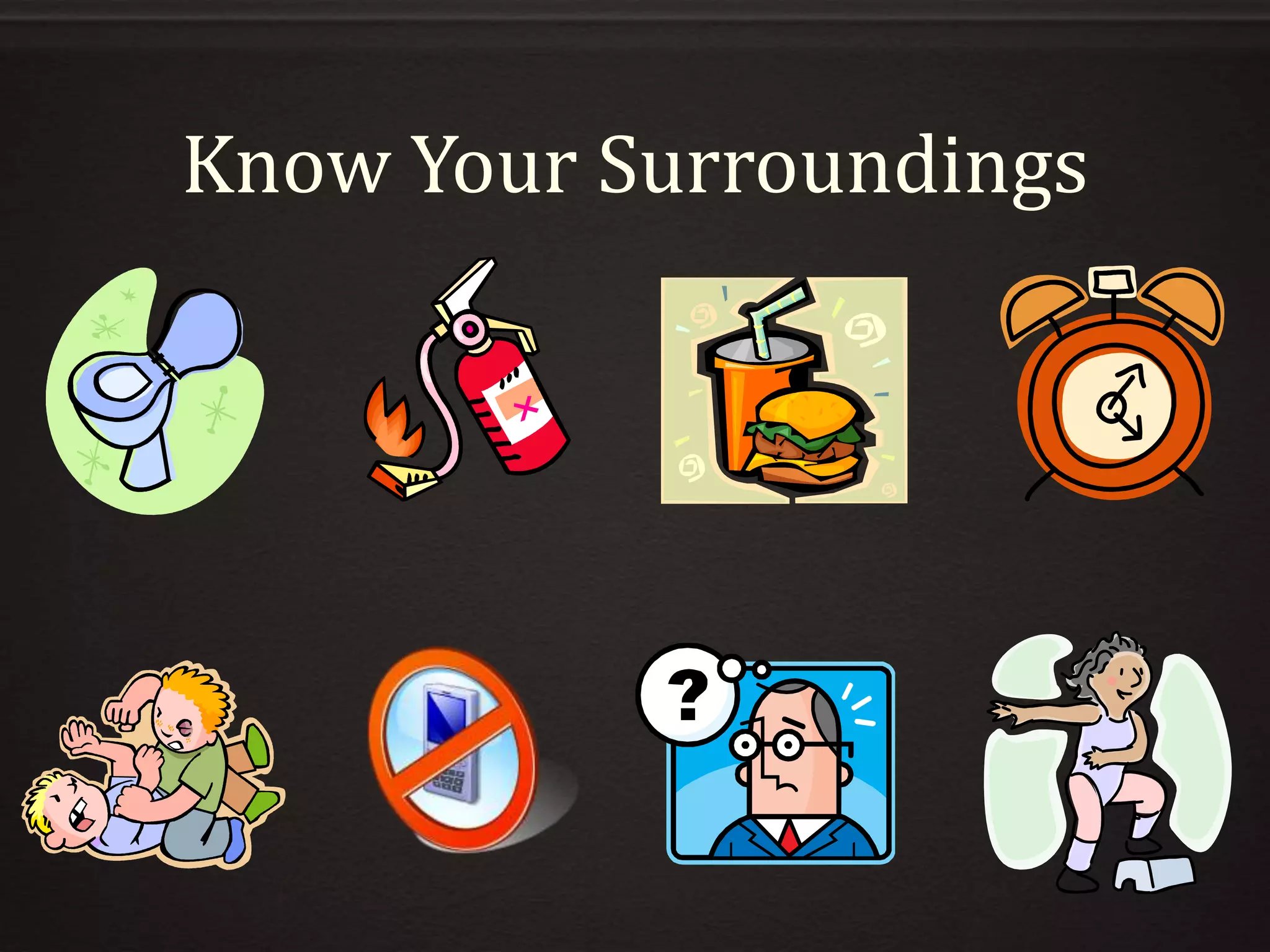
Know Your Surroundings
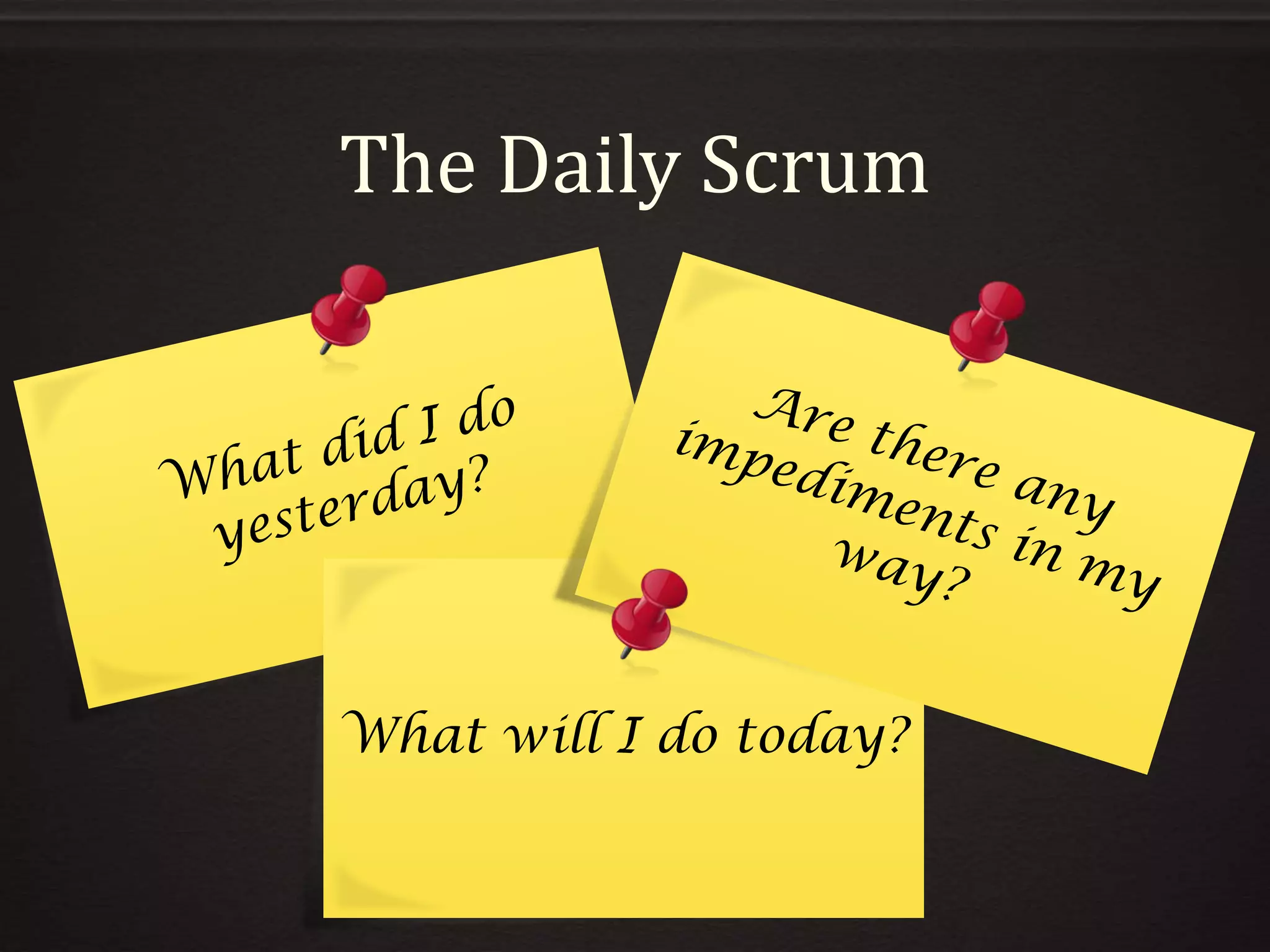
The Daily Scrum
What will I do today?
Traditional Geometry
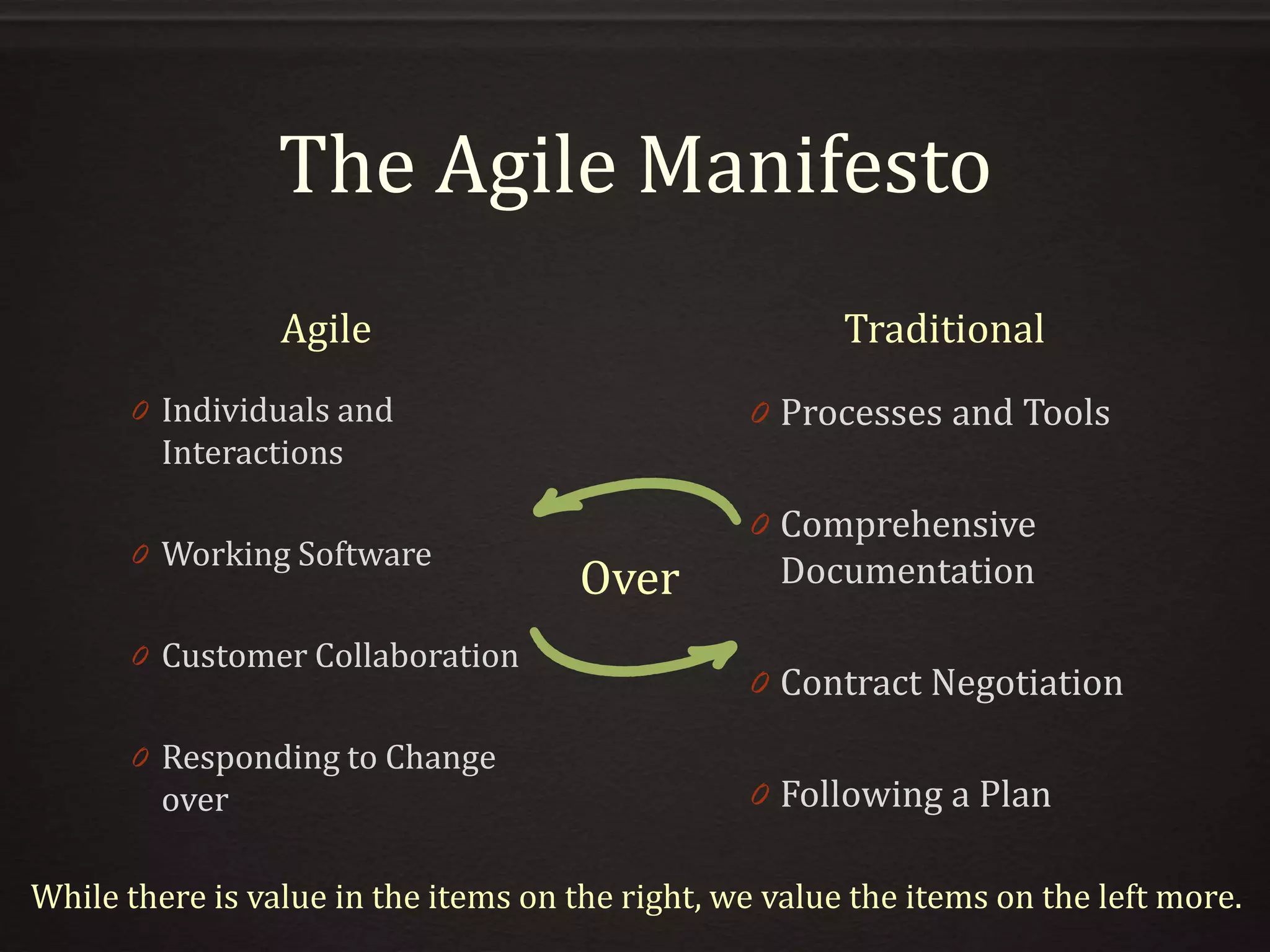
The Agile Manifesto
Agile Traditional
0 Individuals and
Interactions
0 Working Software
0 Customer Collaboration
0 Responding to Change
over
0 Processes and Tools
0 Comprehensive
Documentation
0 Contract Negotiation
0 Following a Plan
Over
While there is value in the items on the right, we value the items on the left more.
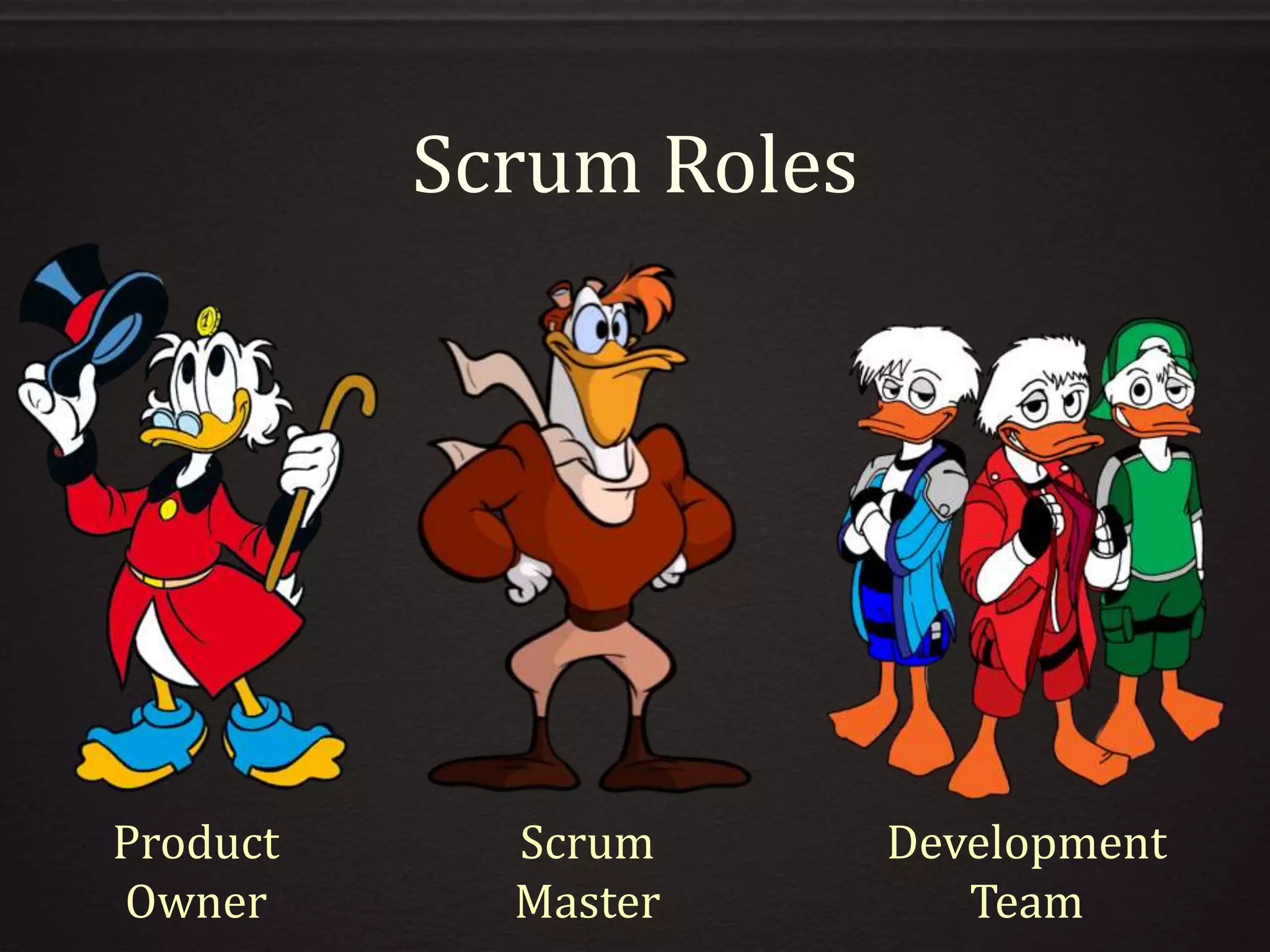
Scrum Roles
Product
Owner
Scrum
Master
Development
Team
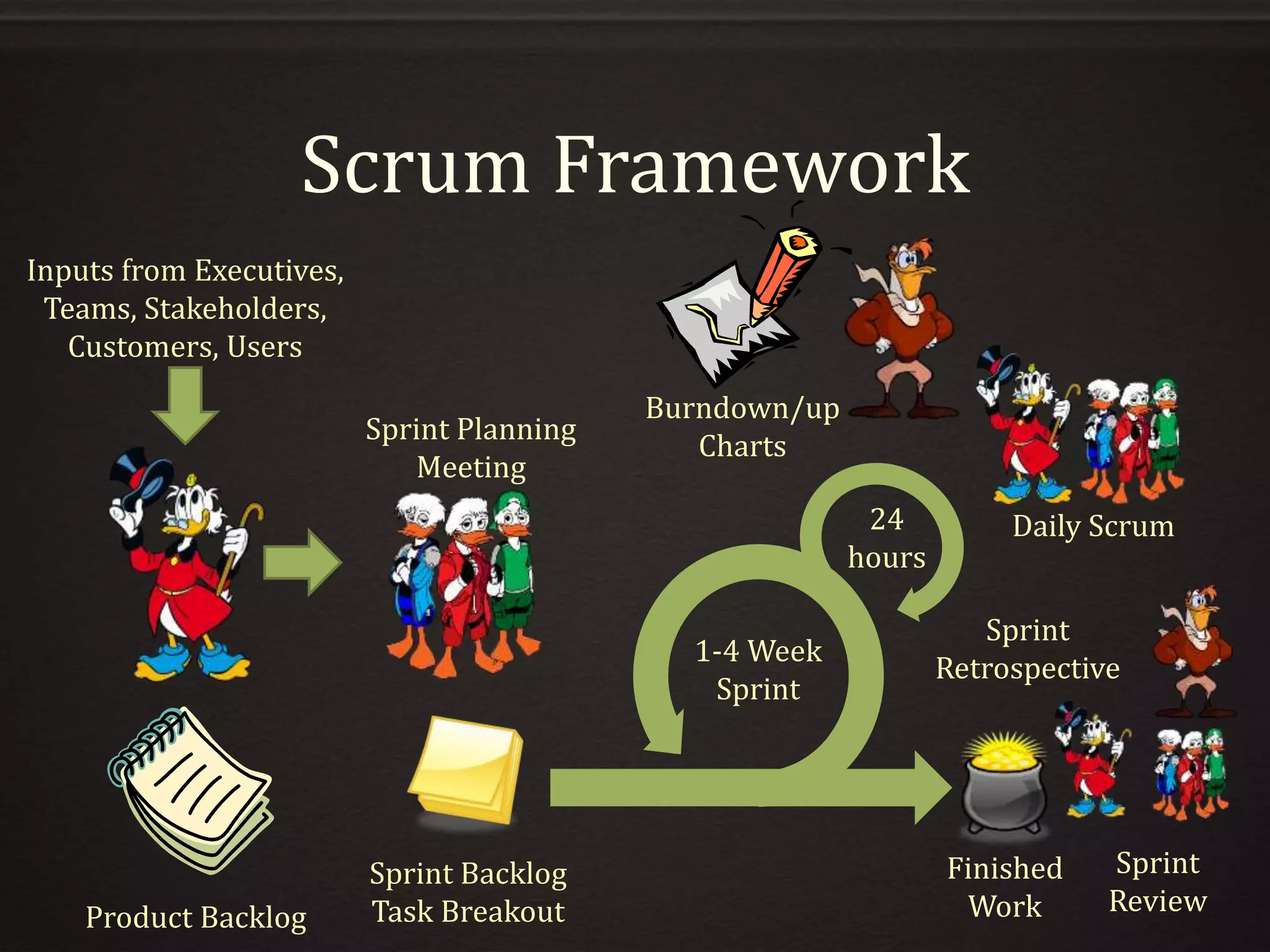
Scrum Framework
Inputs from Executives,
Teams, Stakeholders,
Customers, Users
Product Backlog
Sprint Backlog
Task Breakout
Sprint Planning
Meeting
Burndown/up
Charts
Daily Scrum
1-4 Week
Sprint
24
hours
Finished
Work
Sprint
Review
Sprint
Retrospective
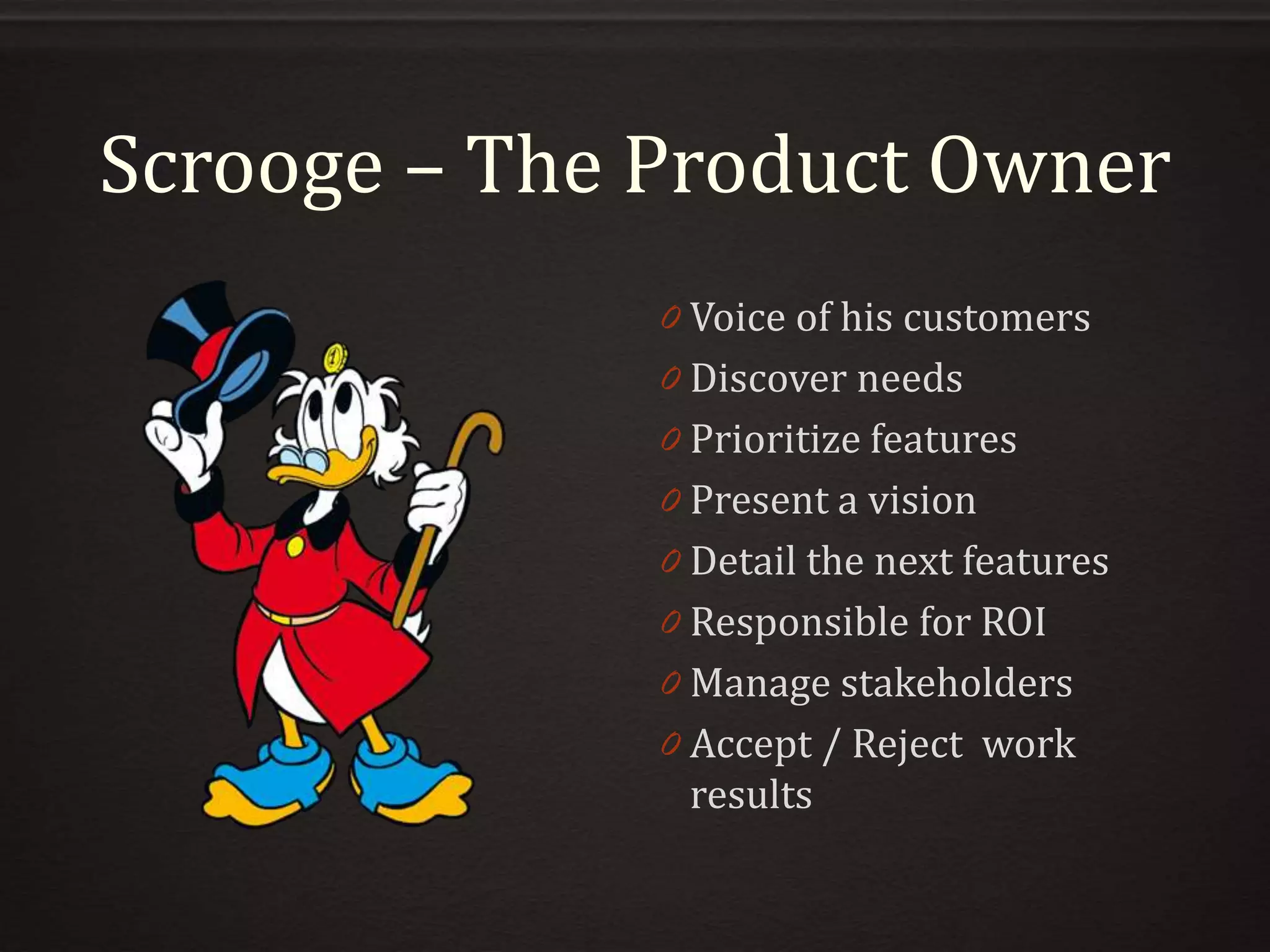
Scrooge – The Product Owner
0 Voice of his customers
0 Discover needs
0 Prioritize features
0 Present a vision
0 Detail the next features
0 Responsible for ROI
0 Manage stakeholders
0 Accept / Reject work
results
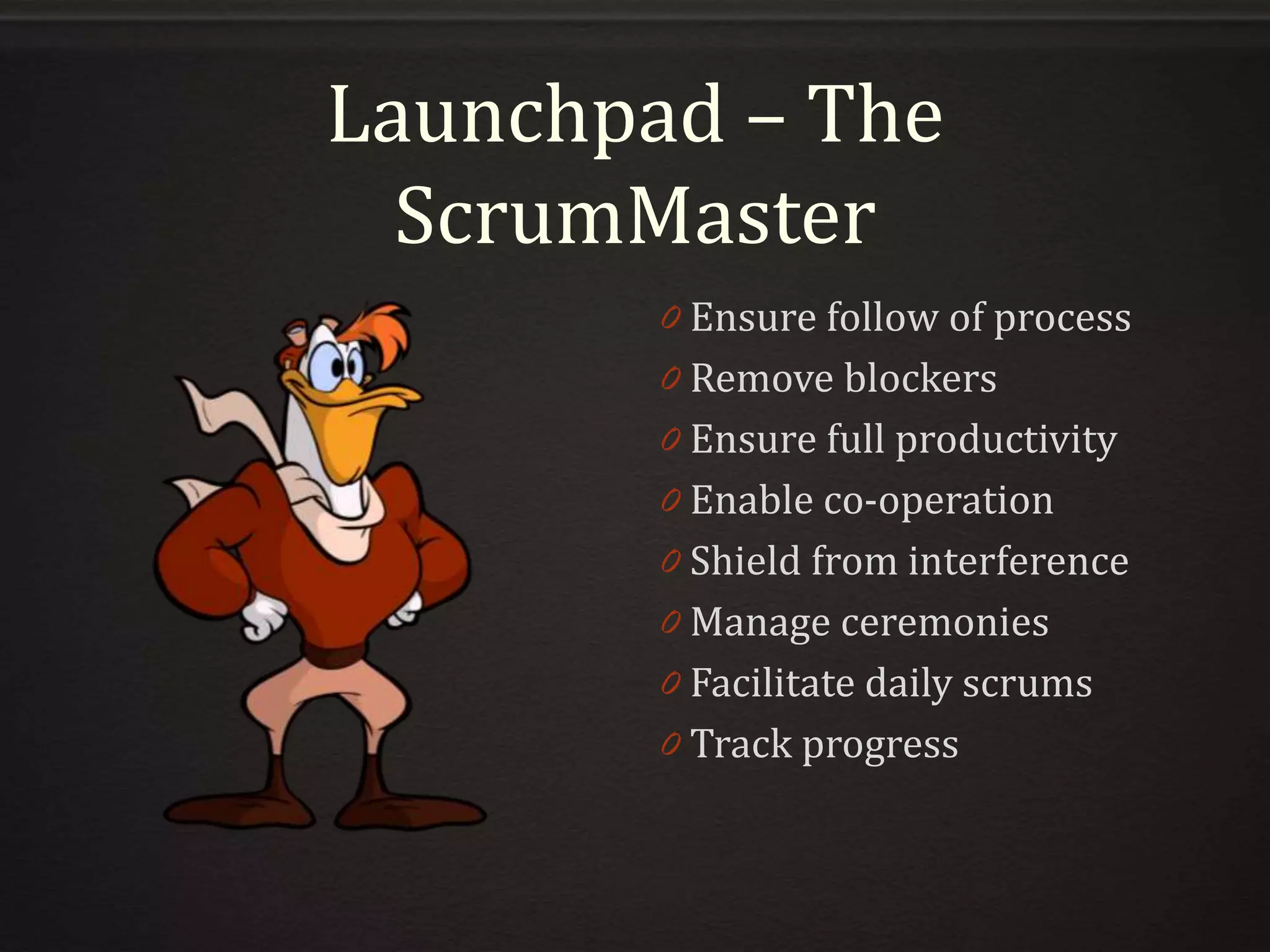
Launchpad – The
ScrumMaster
0 Ensure follow of process
0 Remove blockers
0 Ensure full productivity
0 Enable co-operation
0 Shield from interference
0 Manage ceremonies
0 Facilitate daily scrums
0 Track progress
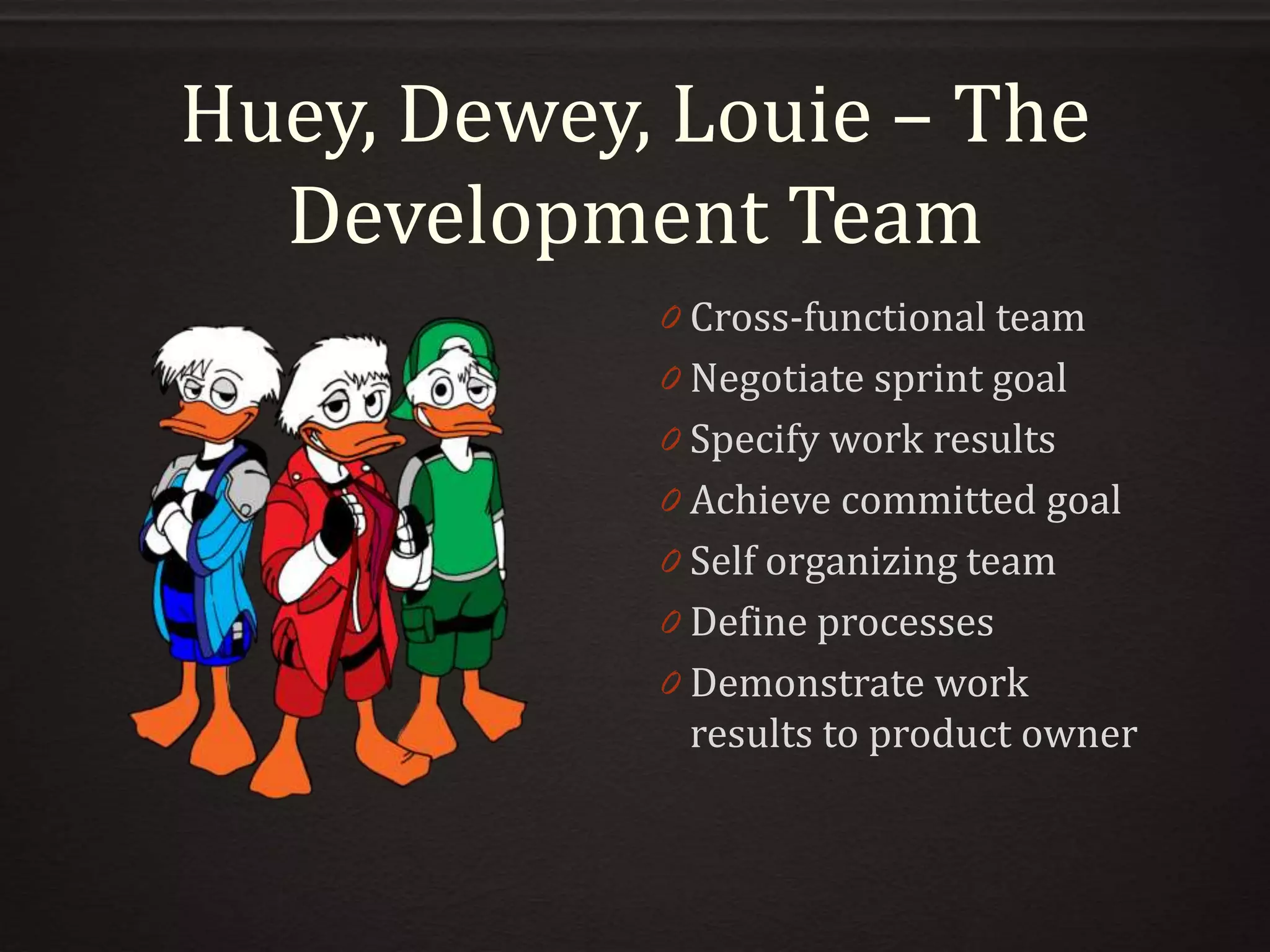
Huey, Dewey, Louie – The
Development Team
0 Cross-functional team
0 Negotiate sprint goal
0 Specify work results
0 Achieve committed goal
0 Self organizing team
0 Define processes
0 Demonstrate work
results to product owner
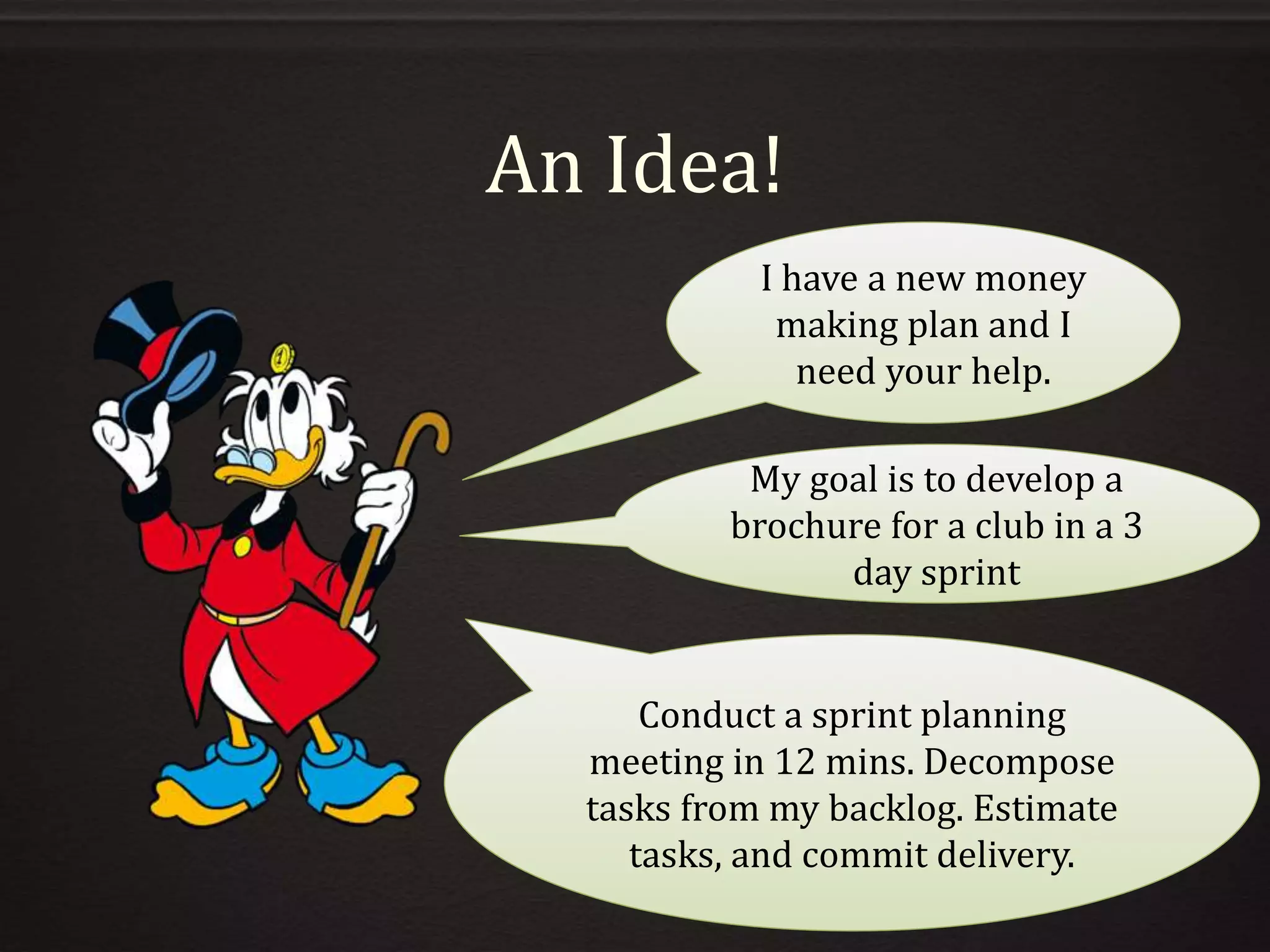
An Idea!
I have a new money
making plan and I
need your help.
My goal is to develop a
brochure for a club in a 3
day sprint
Conduct a sprint planning
meeting in 12 mins. Decompose
tasks from my backlog. Estimate
tasks, and commit delivery.
Scrooge’s Backlog
0 Create cover art, brand,
and/or logo
0 Provide contact details
0 Outline full week lunch
menu
0 Outline minimum
requirements
0 Define service offerings
0 Write testimonials
Mini Scrum
0 Conduct a Sprint Day 1 – 8 minutes – deliver!
0 Conduct a Daily Scrum – 3 minutes
0 Conduct a Sprint Day 2 – 8 minutes – deliver!
0 Conduct a Daily Scrum – 3 minutes
0 Conduct a Sprint Day 3 – 8 minutes – deliver!
0 Conduct a Sprint Review and Demo – 13 minutes
0 Debrief as a group – 5 minutes
0 Make it creative and fun!
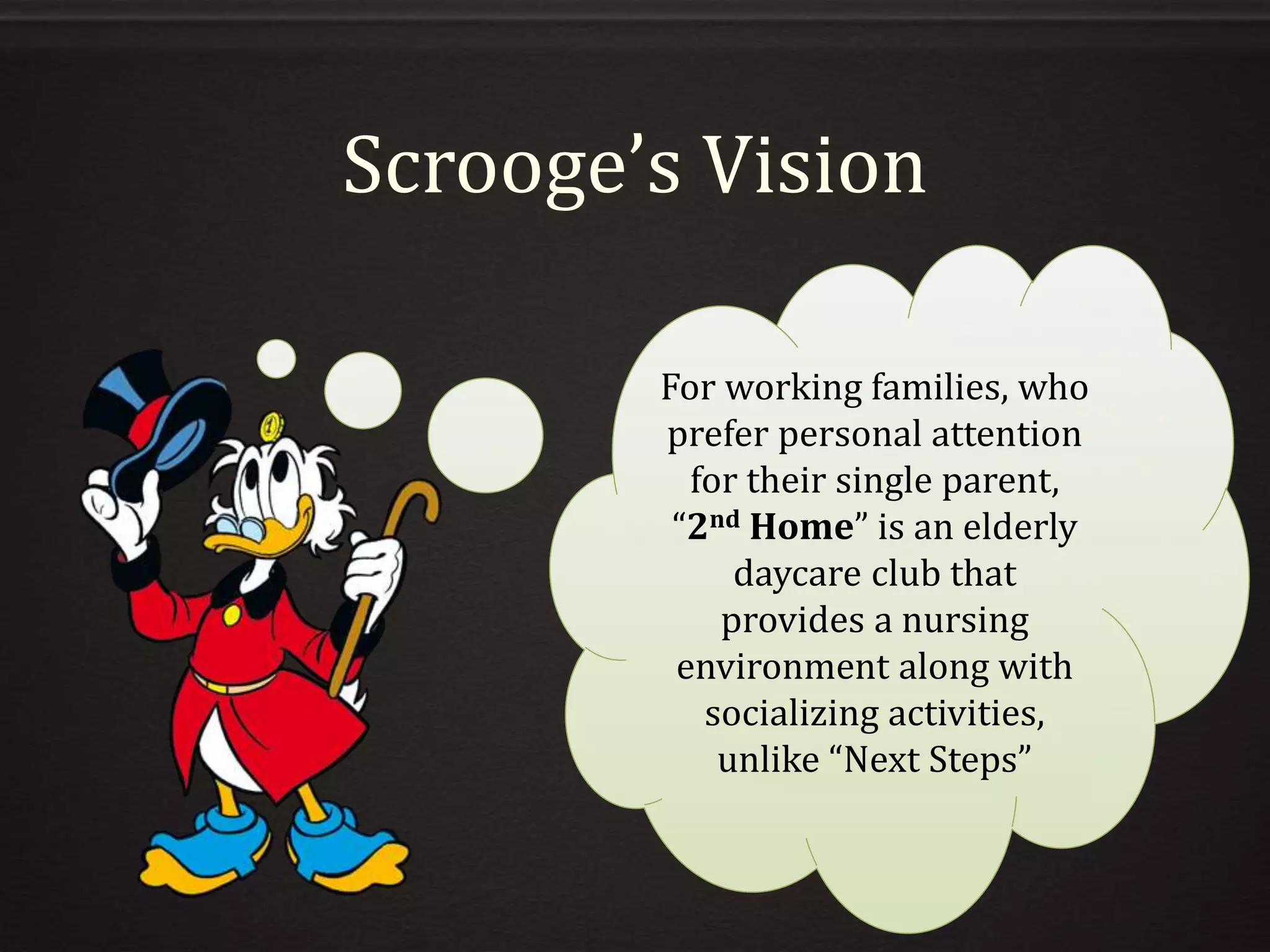
Scrooge’s Vision
For working families, who
prefer personal attention
for their single parent,
“2nd Home” is an elderly
daycare club that
provides a nursing
environment along with
socializing activities,
unlike “Next Steps”
Scrooge’s Acceptance Criteria
0 Cover art, brand, & logo
0 Pink / Gold
0 Must have the two word
brand name
0 Must contain a happy
picture of an elderly
person
0 Lunch menu
0 7 different “themed
buffet” with pictures
0 Services offered
0 5 different services out
of 39 including
transport
0 Must include our new
“Foot Spa” service
0 Architectural conformance
0 Max A4 size
0 No loose sheets
0 Must fit in a handbag
Peer Consensus
0 Each member write their view of the vision
0 Highlight 3 keywords each
0 Write one word per post-it
0 Re-arrange words to come up with a vision statement
0 Add / Change words as needed
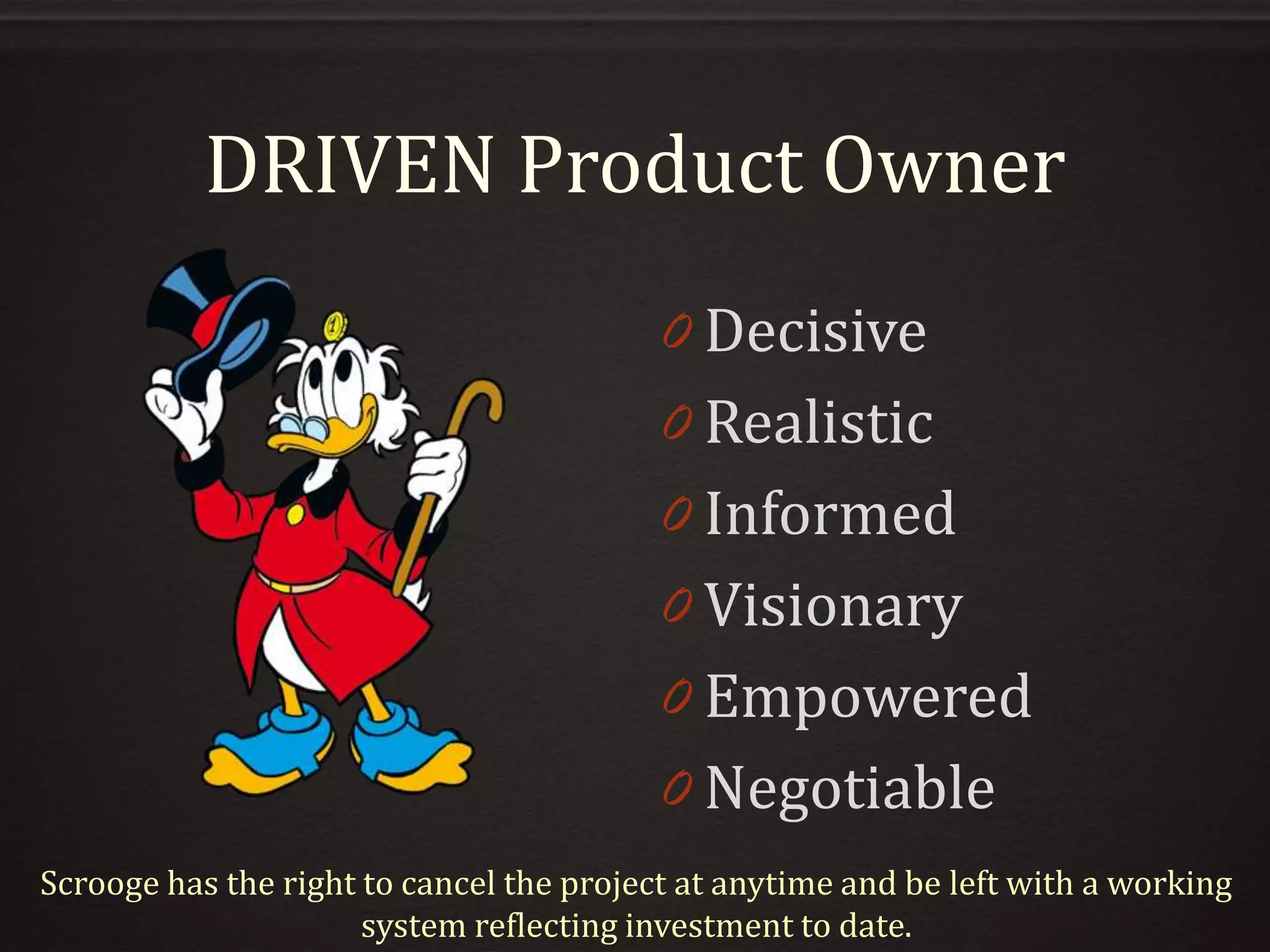
DRIVEN Product Owner
0 Decisive
0 Realistic
0 Informed
0 Visionary
0 Empowered
0 Negotiable
Scrooge has the right to cancel the project at anytime and be left with a working
system reflecting investment to date.
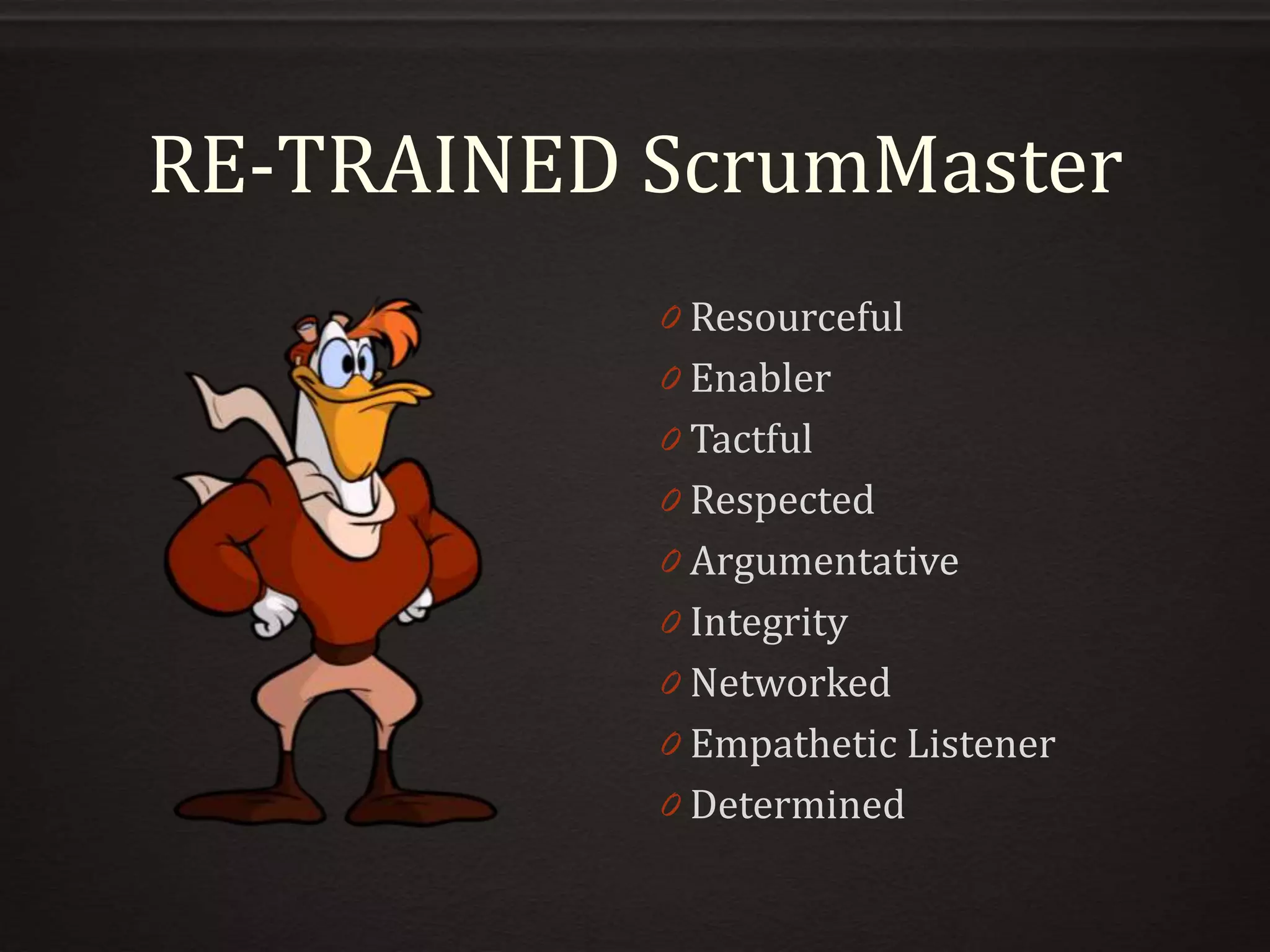
RE-TRAINED ScrumMaster
0 Resourceful
0 Enabler
0 Tactful
0 Respected
0 Argumentative
0 Integrity
0 Networked
0 Empathetic Listener
0 Determined
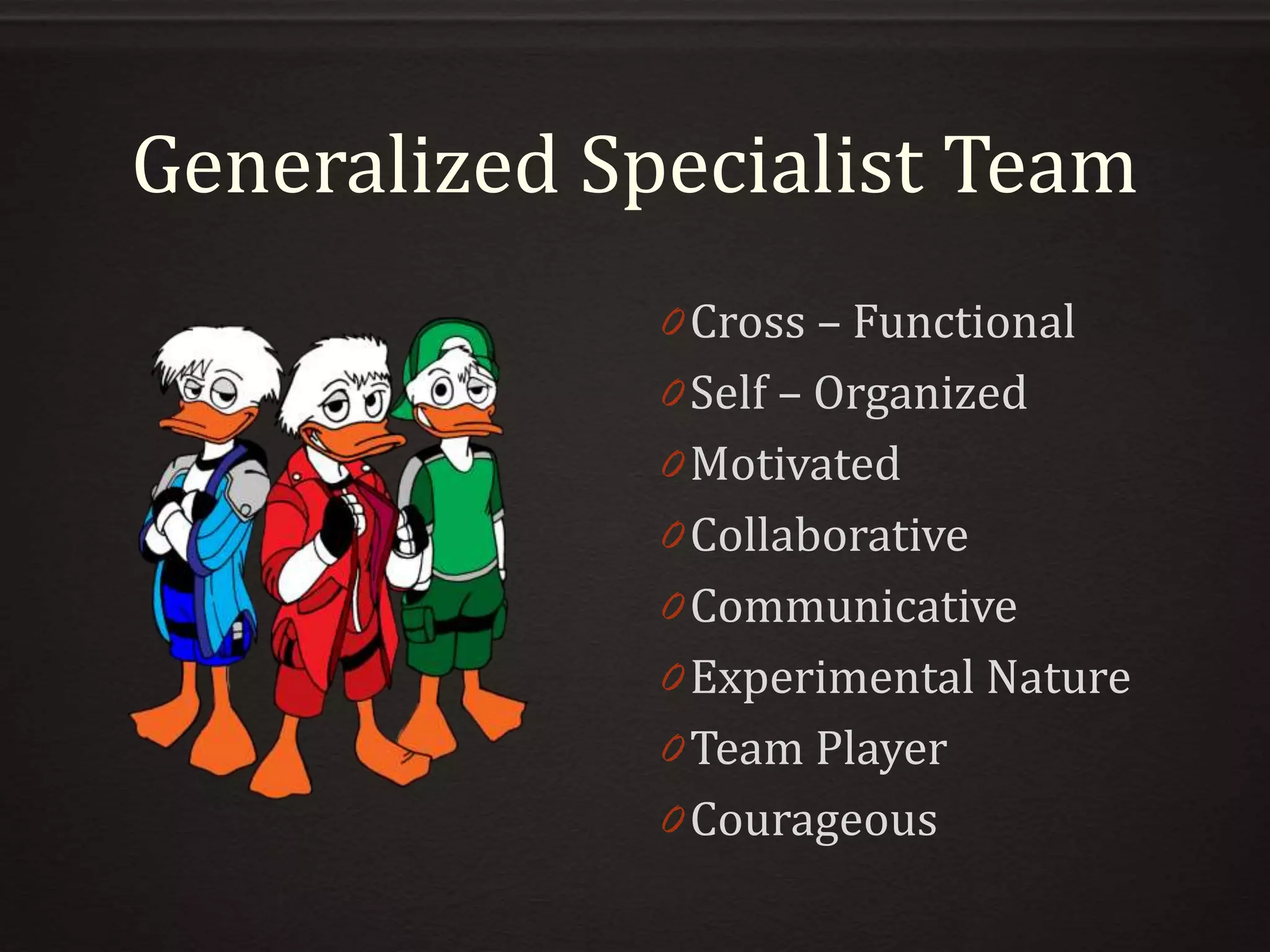
Generalized Specialist Team
0 Cross – Functional
0 Self – Organized
0 Motivated
0 Collaborative
0 Communicative
0 Experimental Nature
0 Team Player
0 Courageous
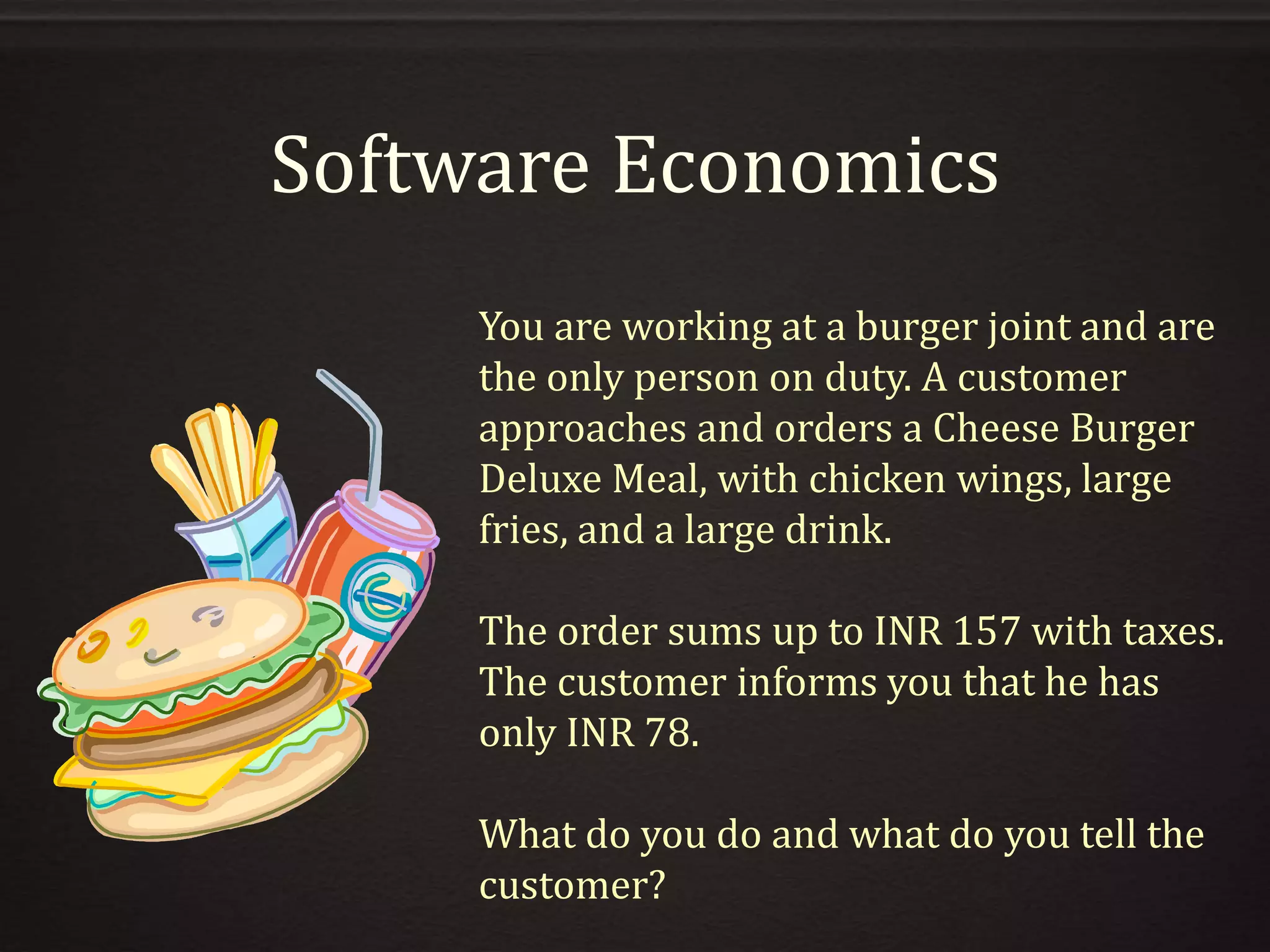
Software Economics
You are working at a burger joint and are
the only person on duty. A customer
approaches and orders a Cheese Burger
Deluxe Meal, with chicken wings, large
fries, and a large drink.
The order sums up to INR 157 with taxes.
The customer informs you that he has
only INR 78.
What do you do and what do you tell the
customer?
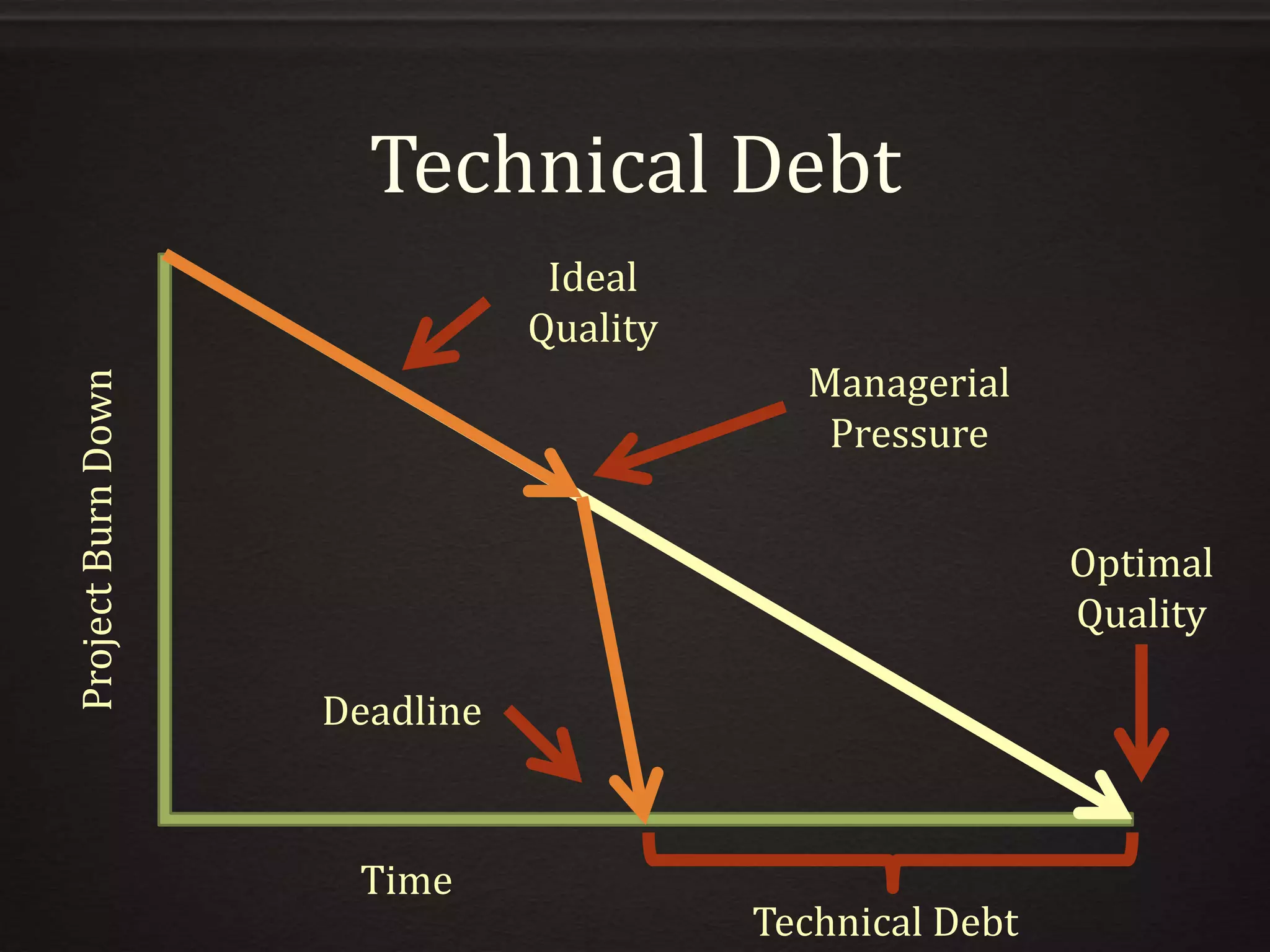
Technical Debt
ProjectBurnDown
Time
Technical Debt
Deadline
Optimal
Quality
Managerial
Pressure
Ideal
Quality
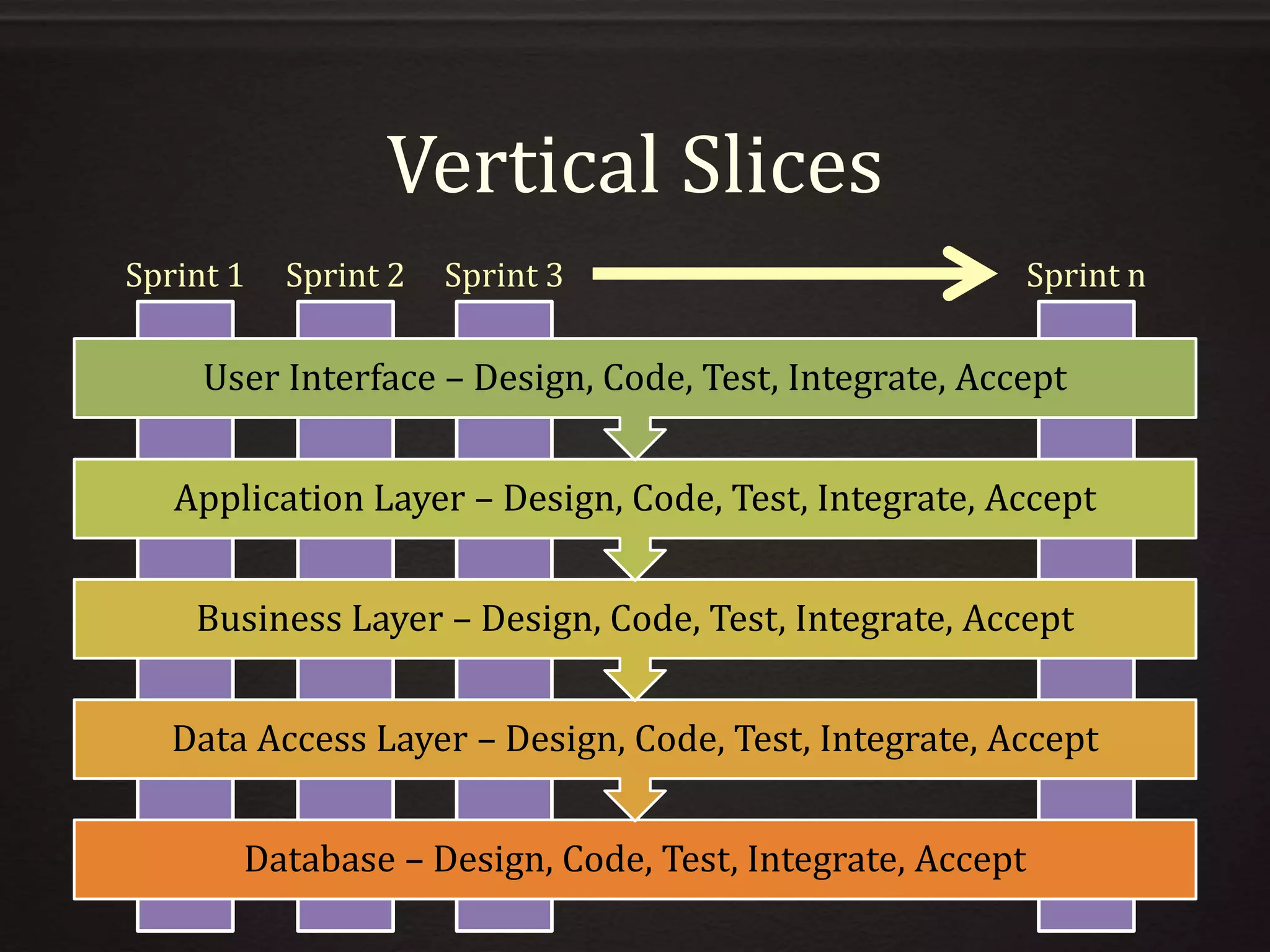
Sprint n
Vertical Slices
Database – Design, Code, Test, Integrate, Accept
Data Access Layer – Design, Code, Test, Integrate, Accept
Business Layer – Design, Code, Test, Integrate, Accept
Application Layer – Design, Code, Test, Integrate, Accept
User Interface – Design, Code, Test, Integrate, Accept
Sprint 1 Sprint 2 Sprint 3
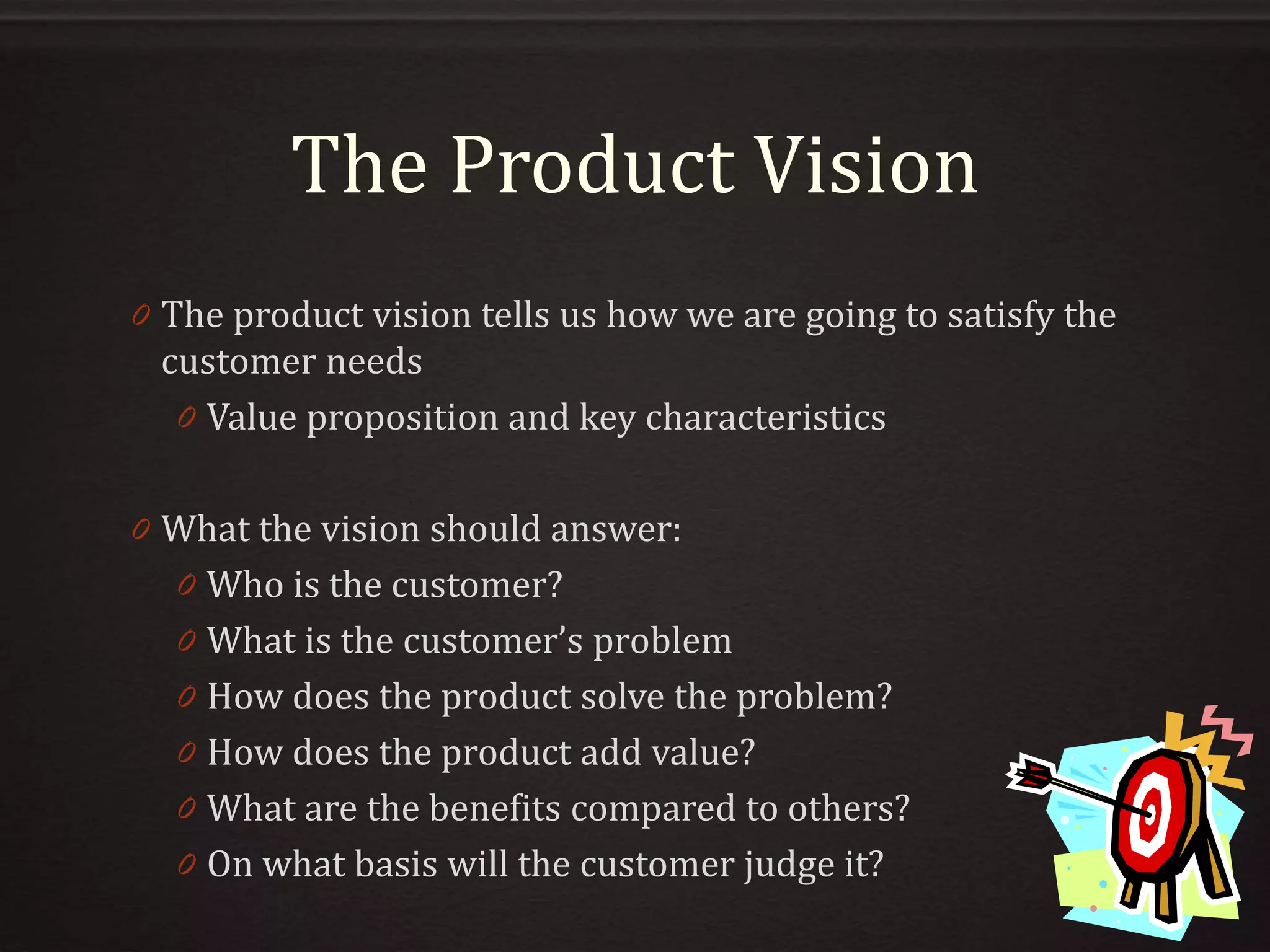
The Product Vision
0 The product vision tells us how we are going to satisfy the
customer needs
0 Value proposition and key characteristics
0 What the vision should answer:
0 Who is the customer?
0 What is the customer’s problem
0 How does the product solve the problem?
0 How does the product add value?
0 What are the benefits compared to others?
0 On what basis will the customer judge it?
Elevator Statement & Product
Box
For [frequent travelers]
Who [want an all in one
travel service]
[Travel Mate] is a [virtual
travel agent]
That [will do everything
for my trip]
Unlike [Itinerary Planner]
Our Product [will remove
the need to visit any other
website or shop for a trip]
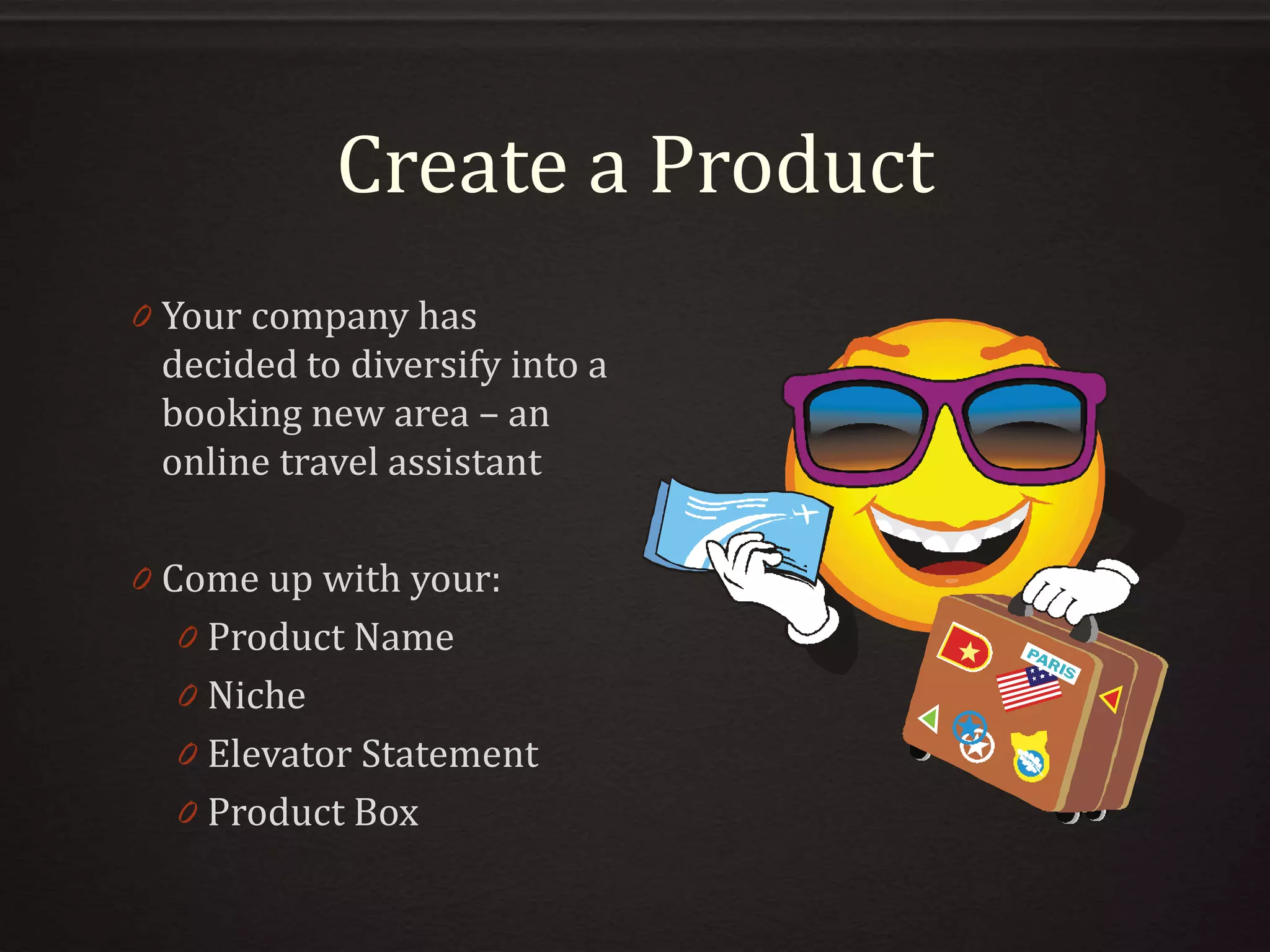
Create a Product
0 Your company has
decided to diversify into a
booking new area – an
online travel assistant
0 Come up with your:
0 Product Name
0 Niche
0 Elevator Statement
0 Product Box
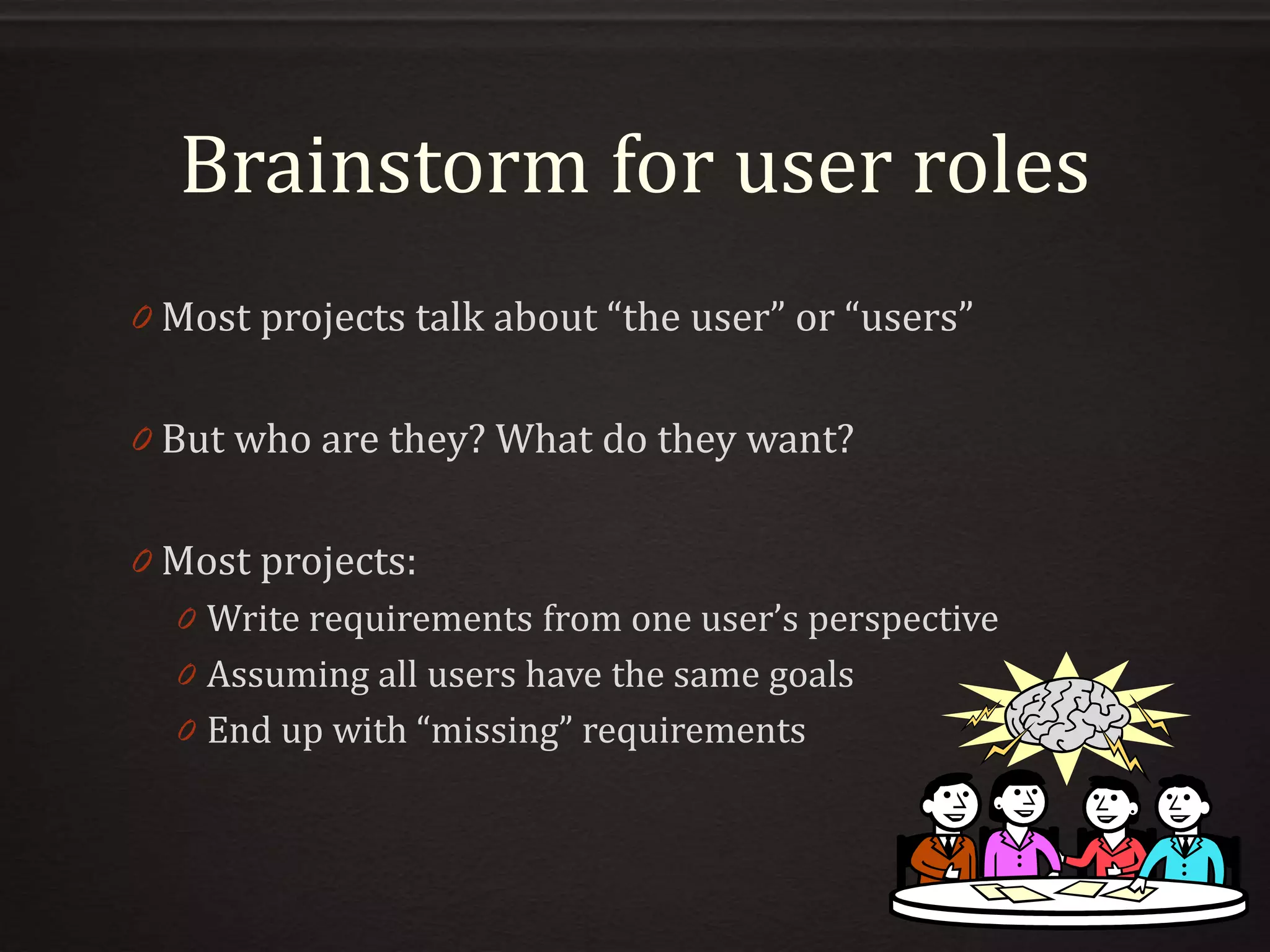
Brainstorm for user roles
0 Most projects talk about “the user” or “users”
0 But who are they? What do they want?
0 Most projects:
0 Write requirements from one user’s perspective
0 Assuming all users have the same goals
0 End up with “missing” requirements
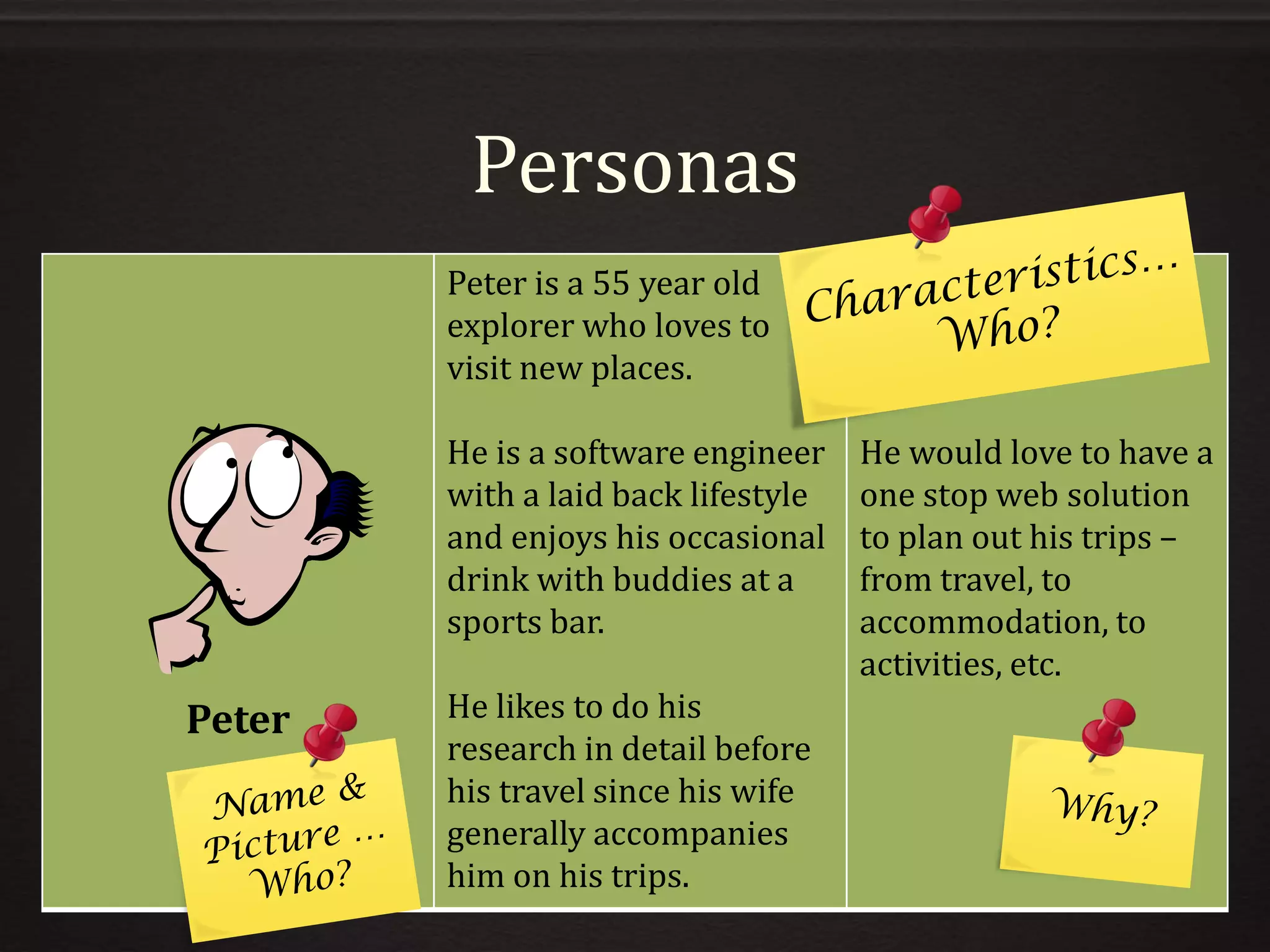
Personas
Peter
Peter is a 55 year old
explorer who loves to
visit new places.
He is a software engineer
with a laid back lifestyle
and enjoys his occasional
drink with buddies at a
sports bar.
He likes to do his
research in detail before
his travel since his wife
generally accompanies
him on his trips.
He would love to have a
one stop web solution
to plan out his trips –
from travel, to
accommodation, to
activities, etc.
Types of Personas
0 Focal – Primary users. Optimize the design for them. At least one
persona must be focal.
0 Secondary – Also use the product. Satisfy their requirements when
possible.
0 Unimportant – Low priority users, including infrequent,
unauthorized, or unskilled users, as well as those who misuse the
product.
0 Affected – They don’t use the product but are affected by it.
0 Exclusionary – Someone we’re not designing for. Useful to prevent
nonusers from our discussions.
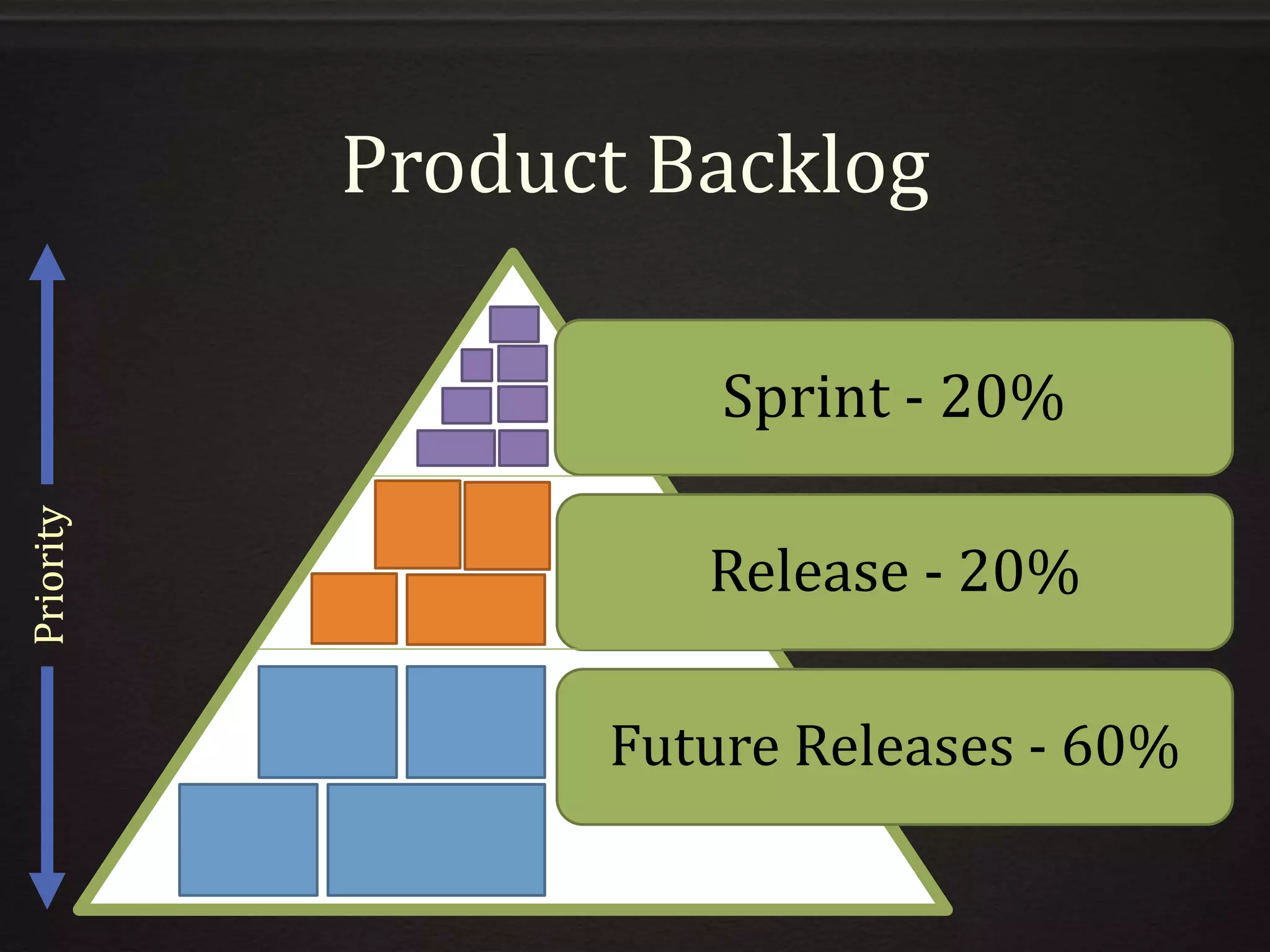
Product Backlog
Sprint - 20%
Release - 20%
Future Releases - 60%
Priority
DEEP Backlog
0 Detailed
0 Estimated
0 Emergent
0 Prioritized
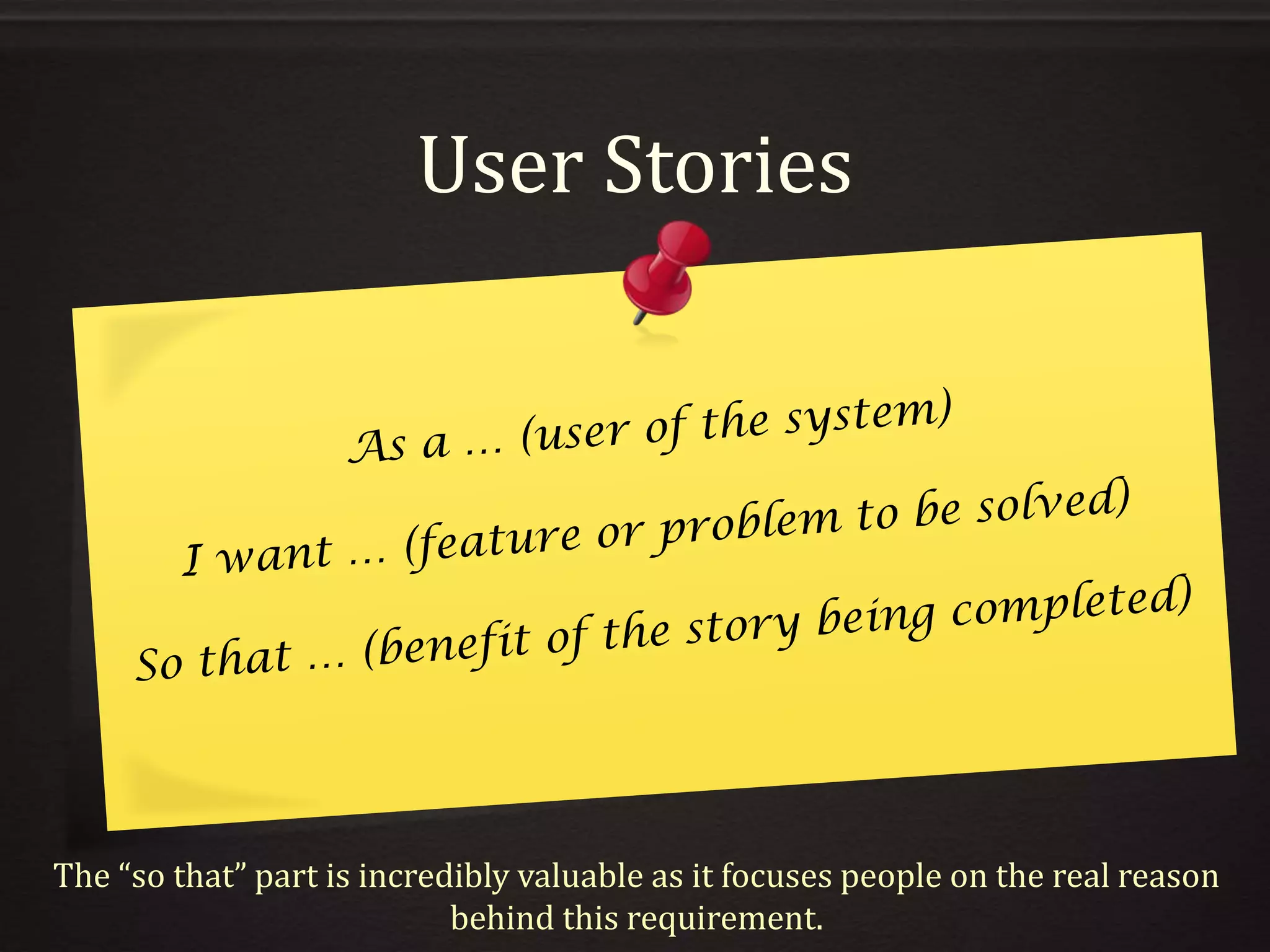
User Stories
The “so that” part is incredibly valuable as it focuses people on the real reason
behind this requirement.
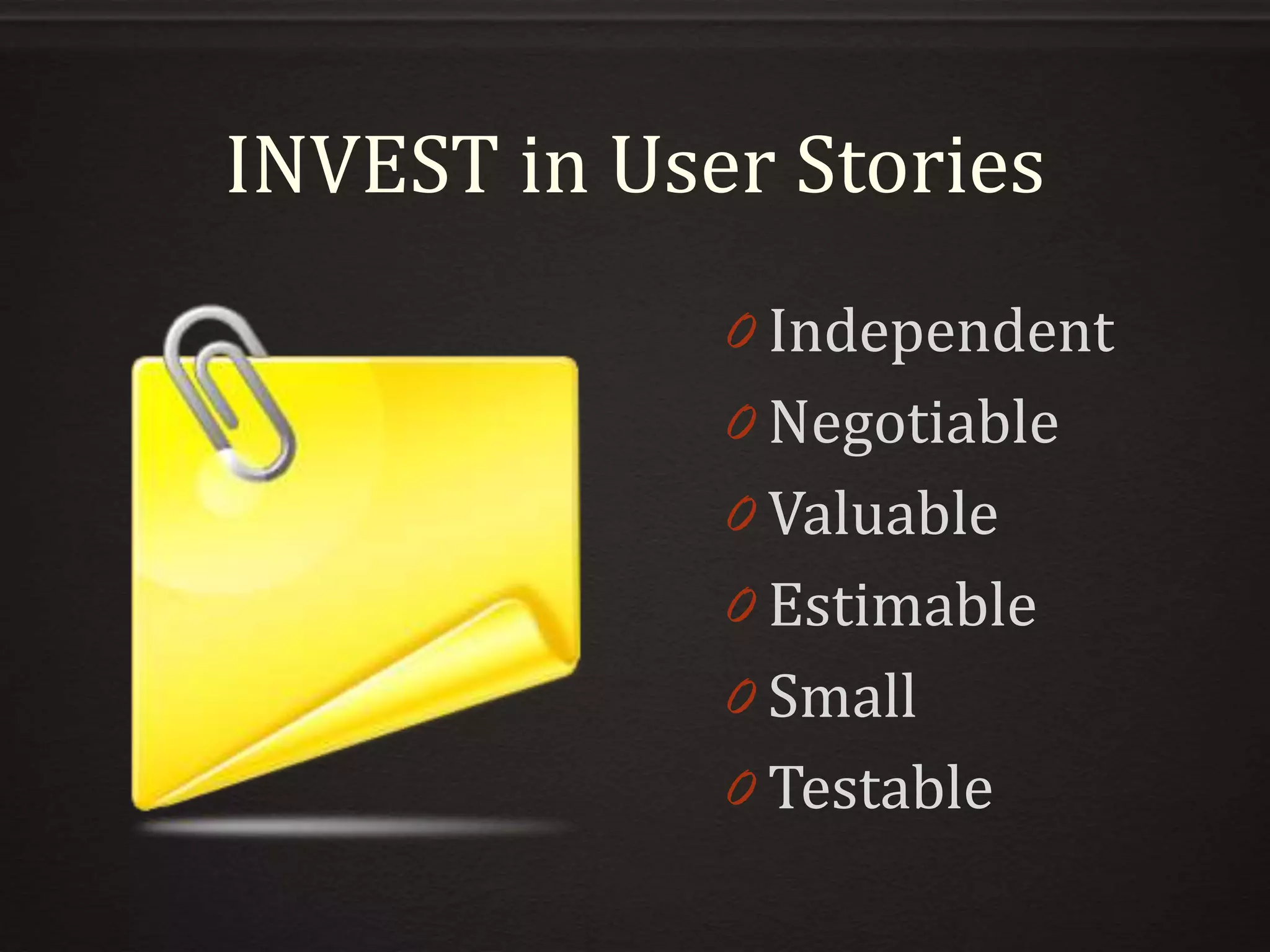
INVEST in User Stories
0 Independent
0 Negotiable
0 Valuable
0 Estimable
0 Small
0 Testable
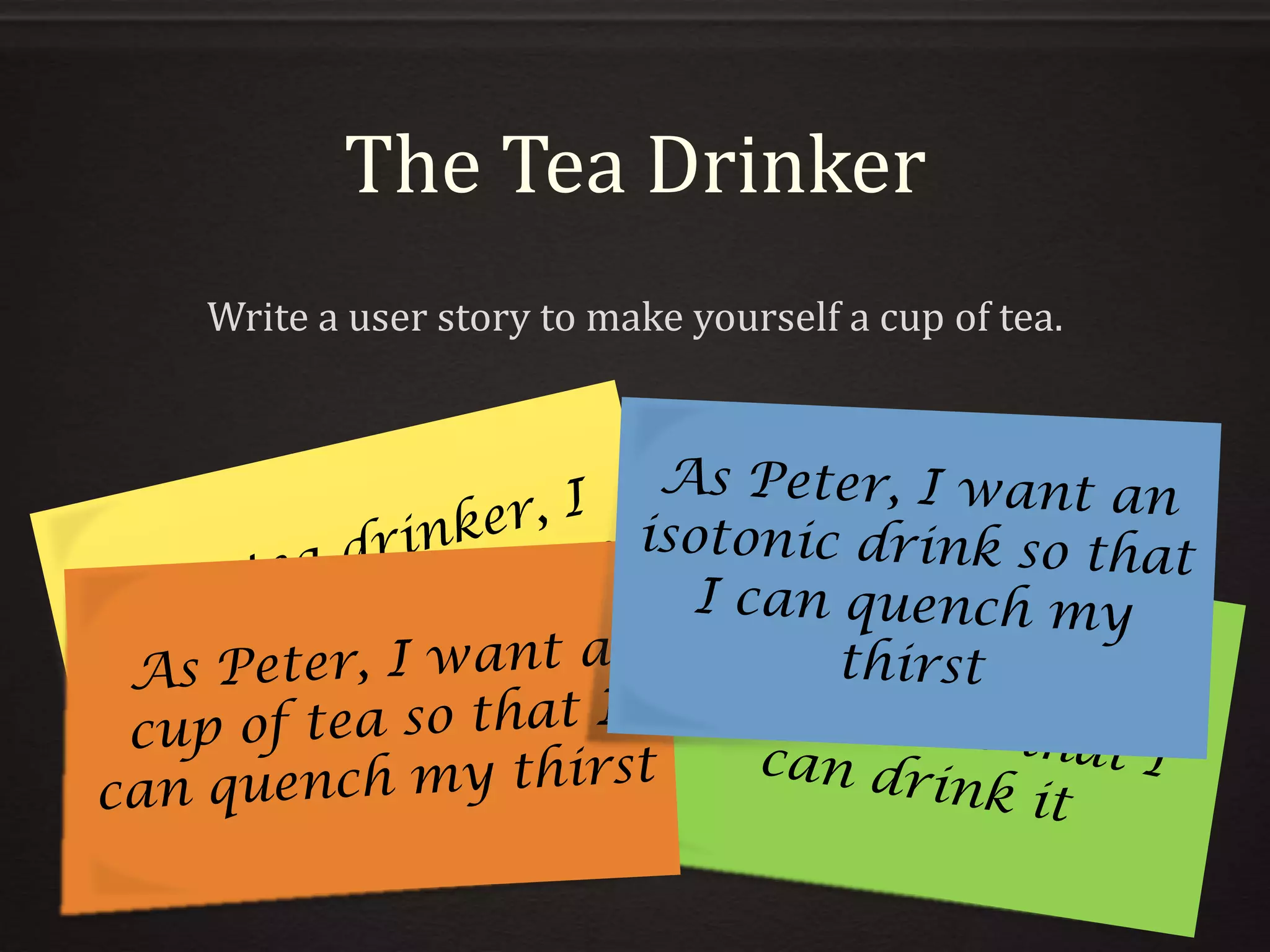
The Tea Drinker
Write a user story to make yourself a cup of tea.
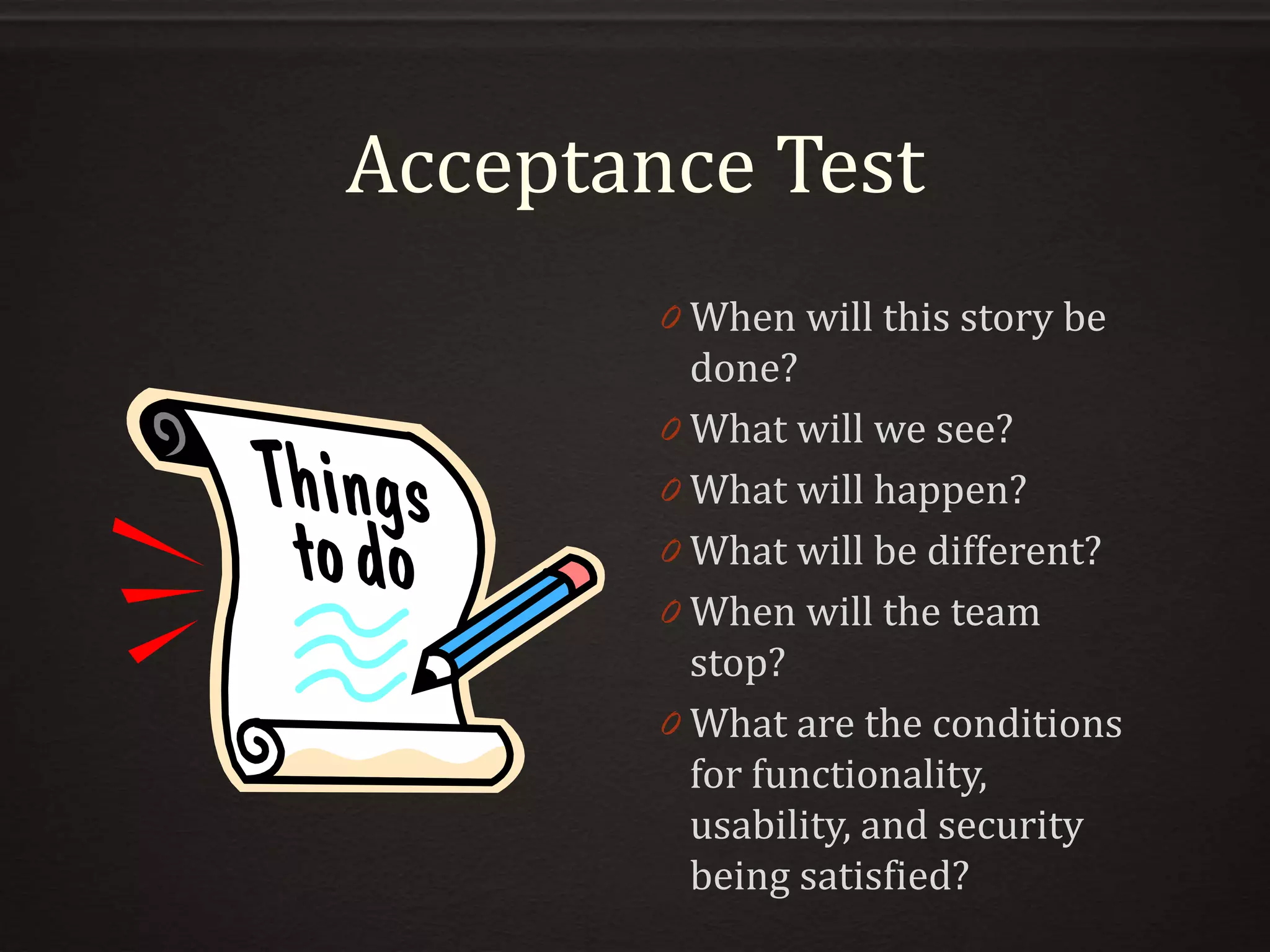
Acceptance Test
0 When will this story be
done?
0 What will we see?
0 What will happen?
0 What will be different?
0 When will the team
stop?
0 What are the conditions
for functionality,
usability, and security
being satisfied?
Acceptance Criteria
0 Different levels of
acceptance
0 Keep to appropriate
level
0 When will this story be
“done”?
0 Questions can help
0 Make them objective
0 Make them automated
Prioritization
0 Shouting Loudest
0 Priority Poker
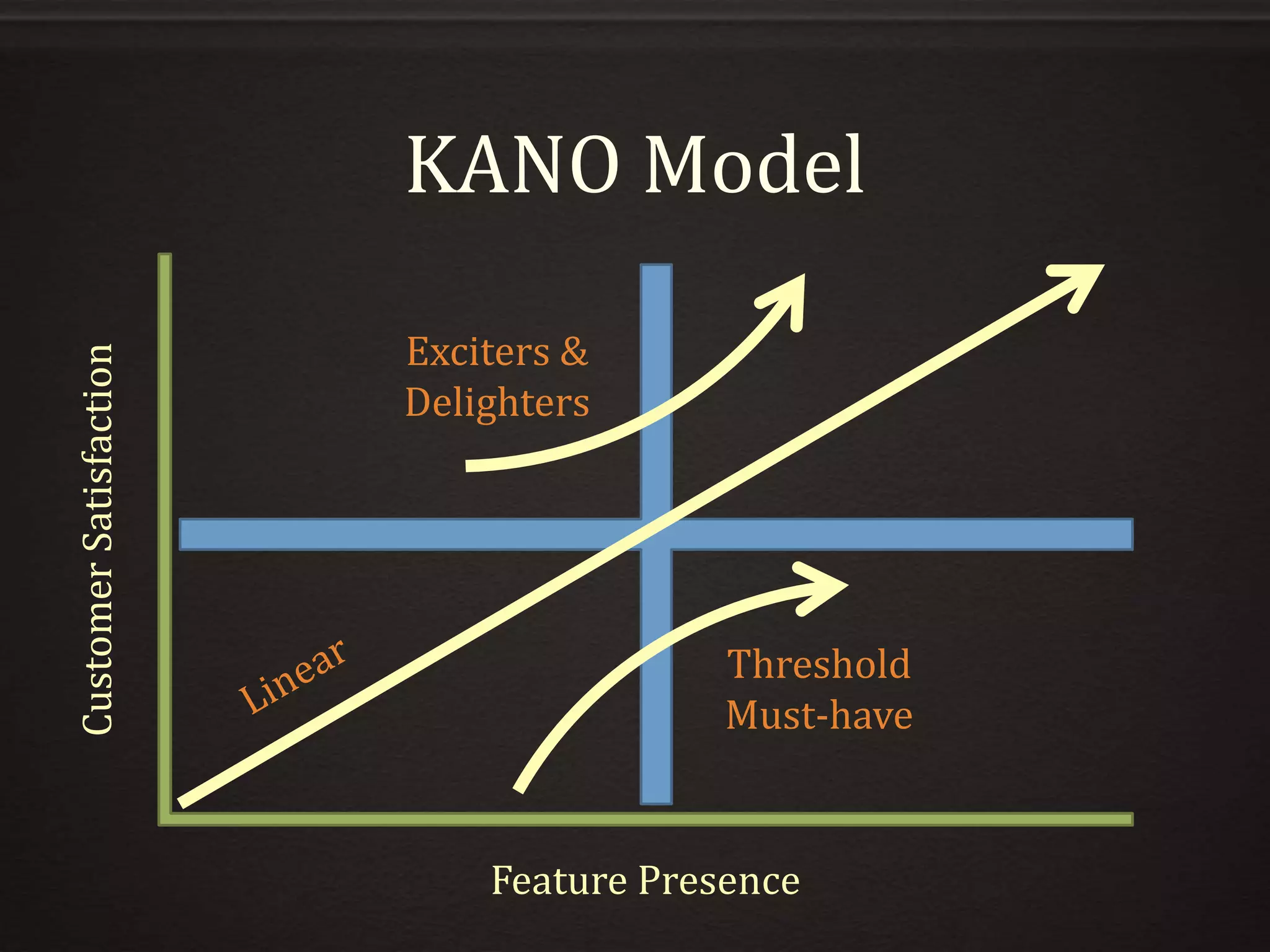
0 Kano Analysis
0 “35”
0 Free Market
0 Risk & Value
The Sinking Ship
0 Manmohan Singh
0 Narayan Murthy
0 Sachin Tendulkar
0 Sanjay Dutt
0 Zakir Hussain
0 Narendra Modi
0 Mukesh Ambani
0 Kailash Kher
0 Amitabh Bachchan
0 Rakhi Sawant
Your ship is sinking. It has a lifeboat that can carry only one person along with
you to safety. In which order will you save these people.
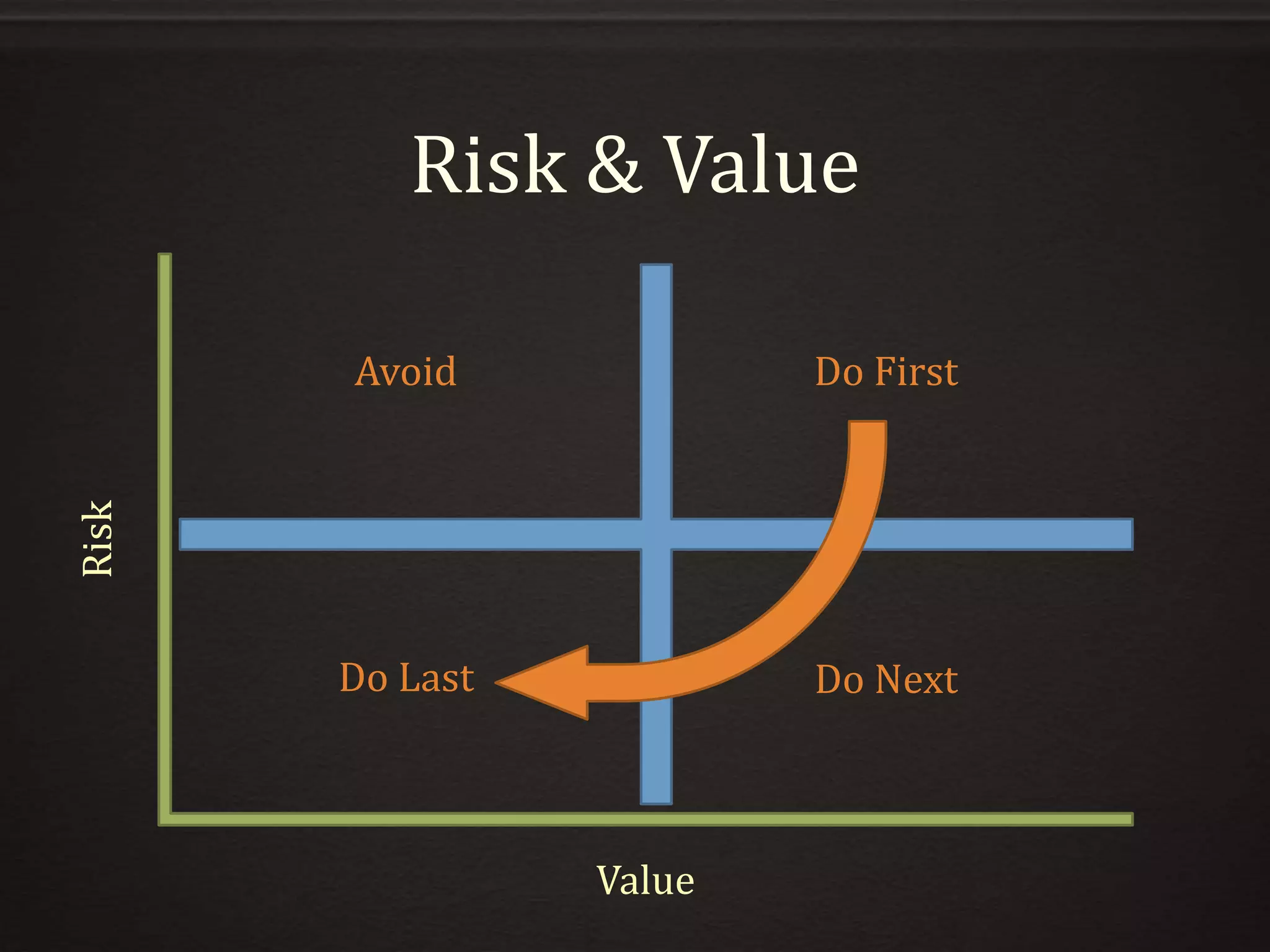
Risk & Value
Risk
Value
Avoid
Do Last Do Next
Do First
KANO Model
CustomerSatisfaction
Feature Presence
Exciters &
Delighters
Threshold
Must-have
Planning Poker
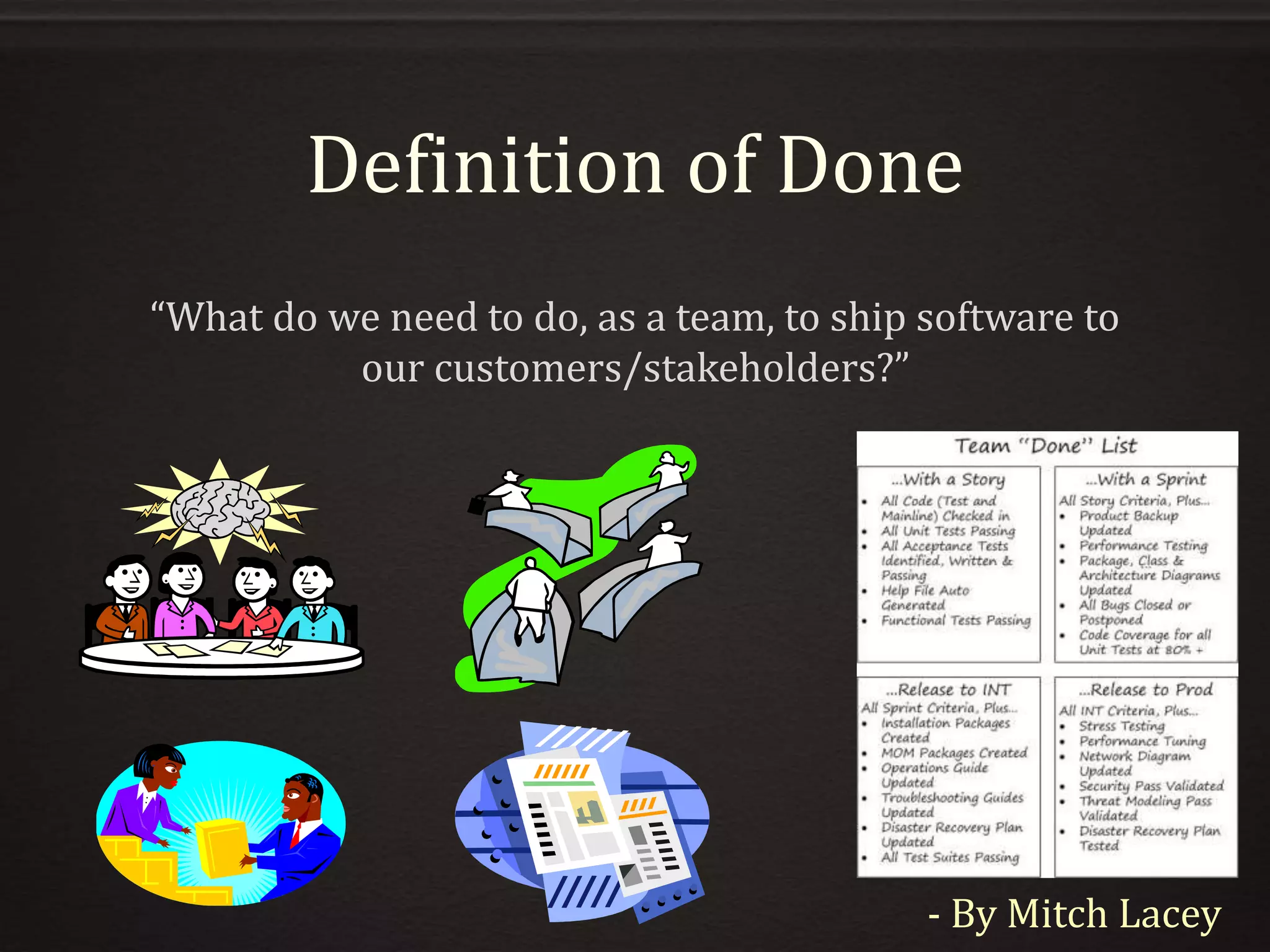
Definition of Done
“What do we need to do, as a team, to ship software to
our customers/stakeholders?”
- By Mitch Lacey
Sprint Planning
0 Define the sprint goal
0 Identify capacity
0 Create sprint backlog
0 Commit deliverables
0 Task breakout
Themes
0 Themes are group of
similar functionality /
requirement.
0 These can span across
sprints, releases, or
products.
0 Themes can be used for
prioritizing requirements.
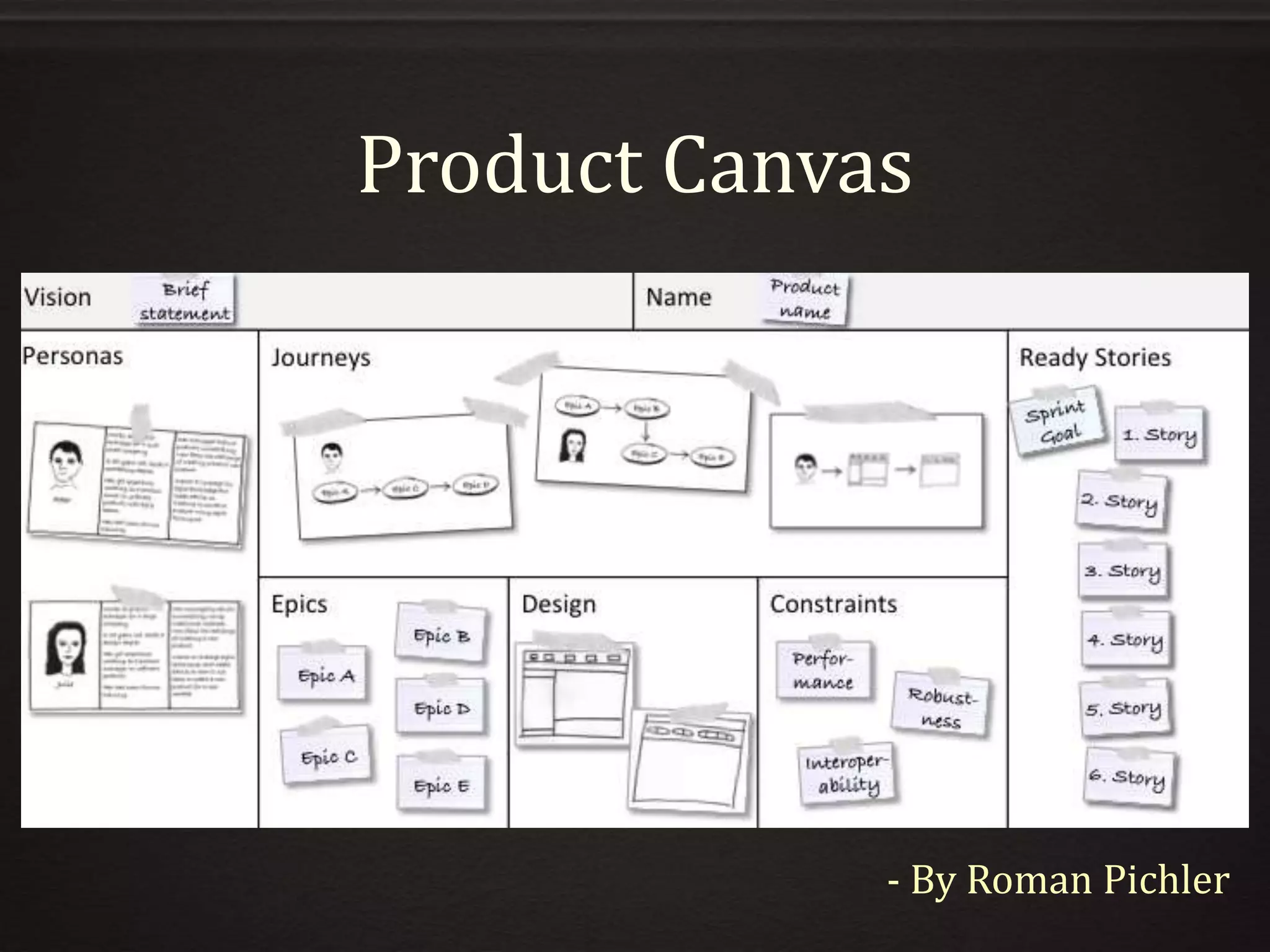
Product Canvas
- By Roman Pichler
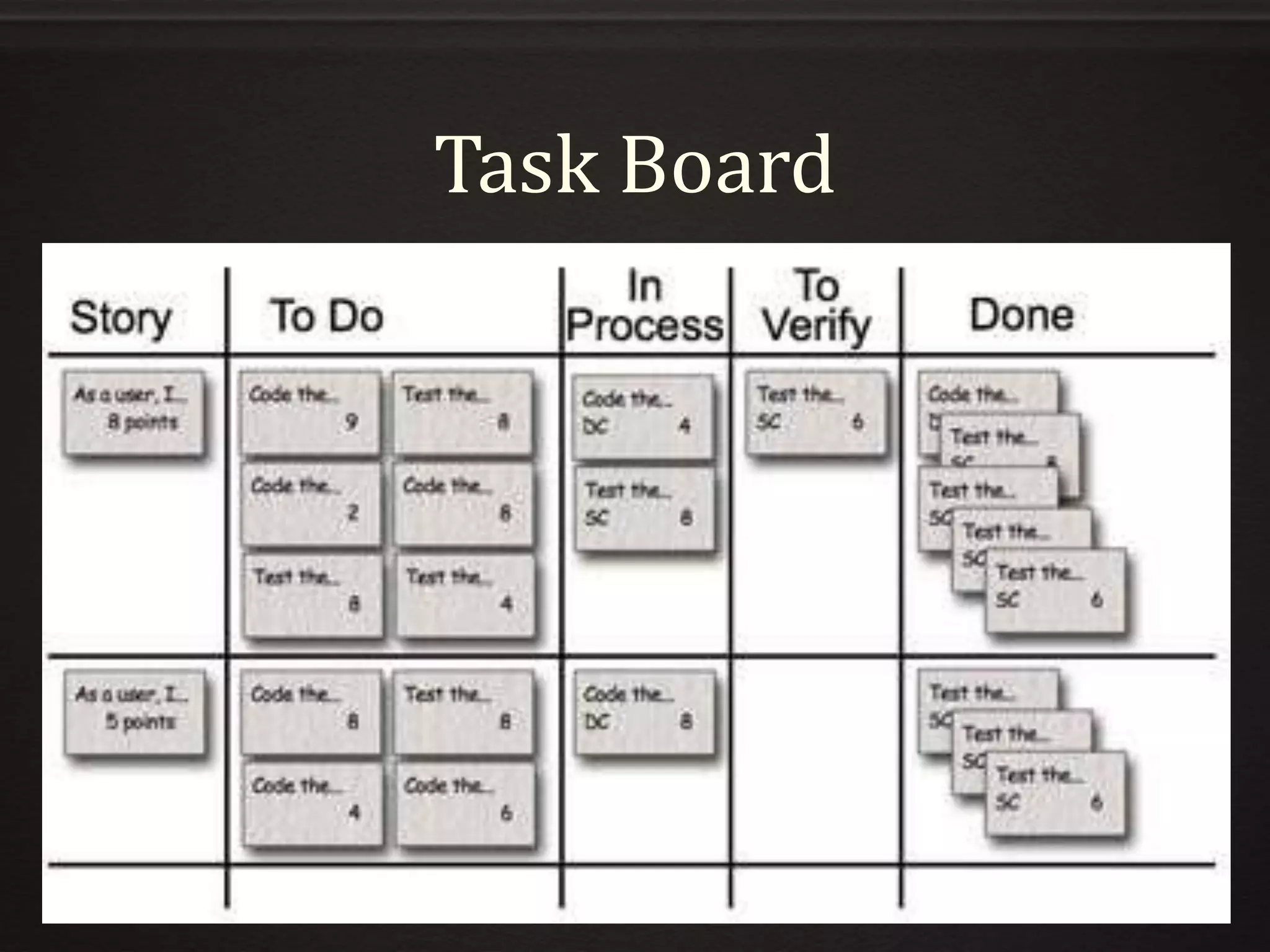
Task Board
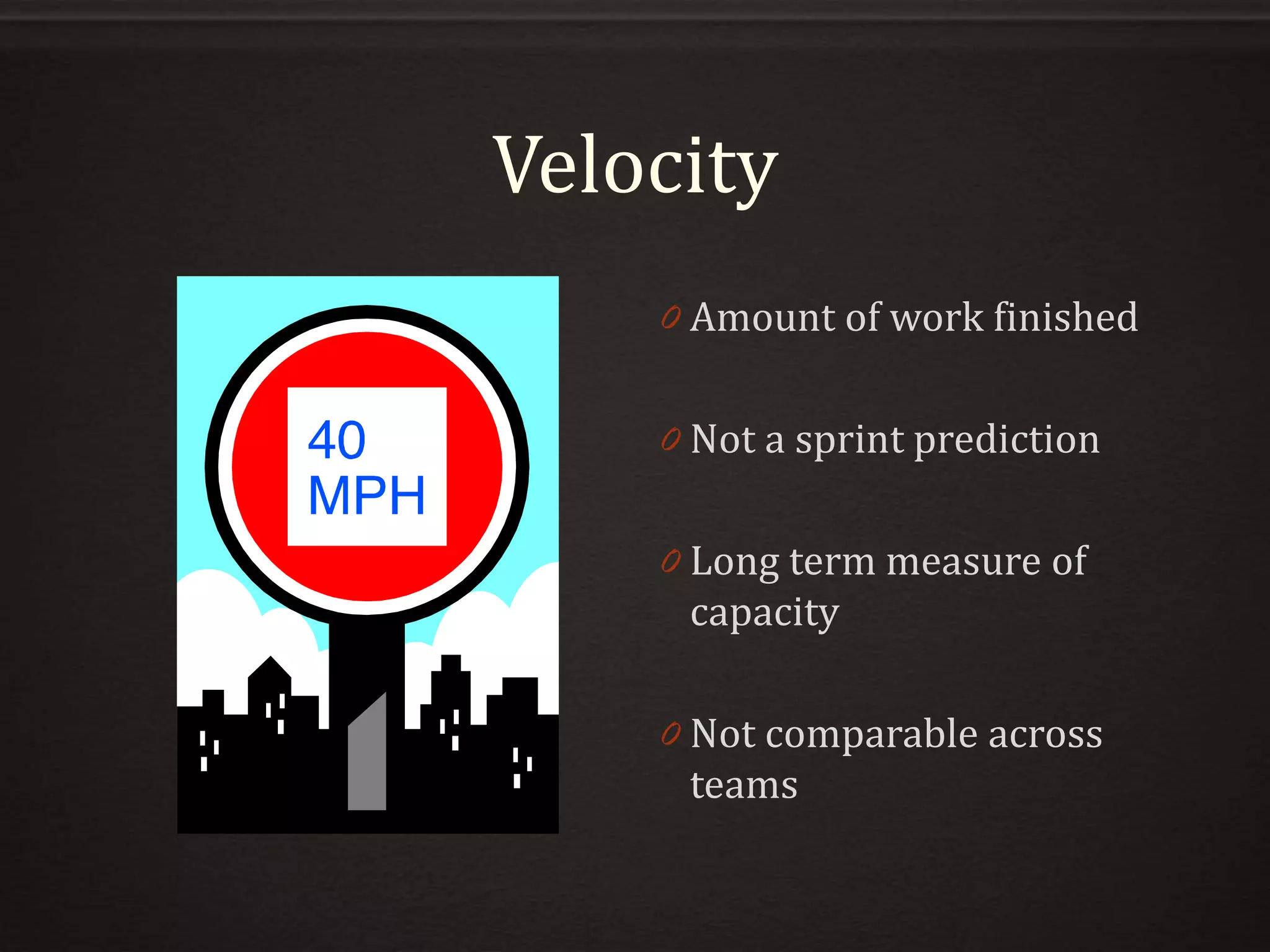
Velocity
0 Amount of work finished
0 Not a sprint prediction
0 Long term measure of
capacity
0 Not comparable across
teams
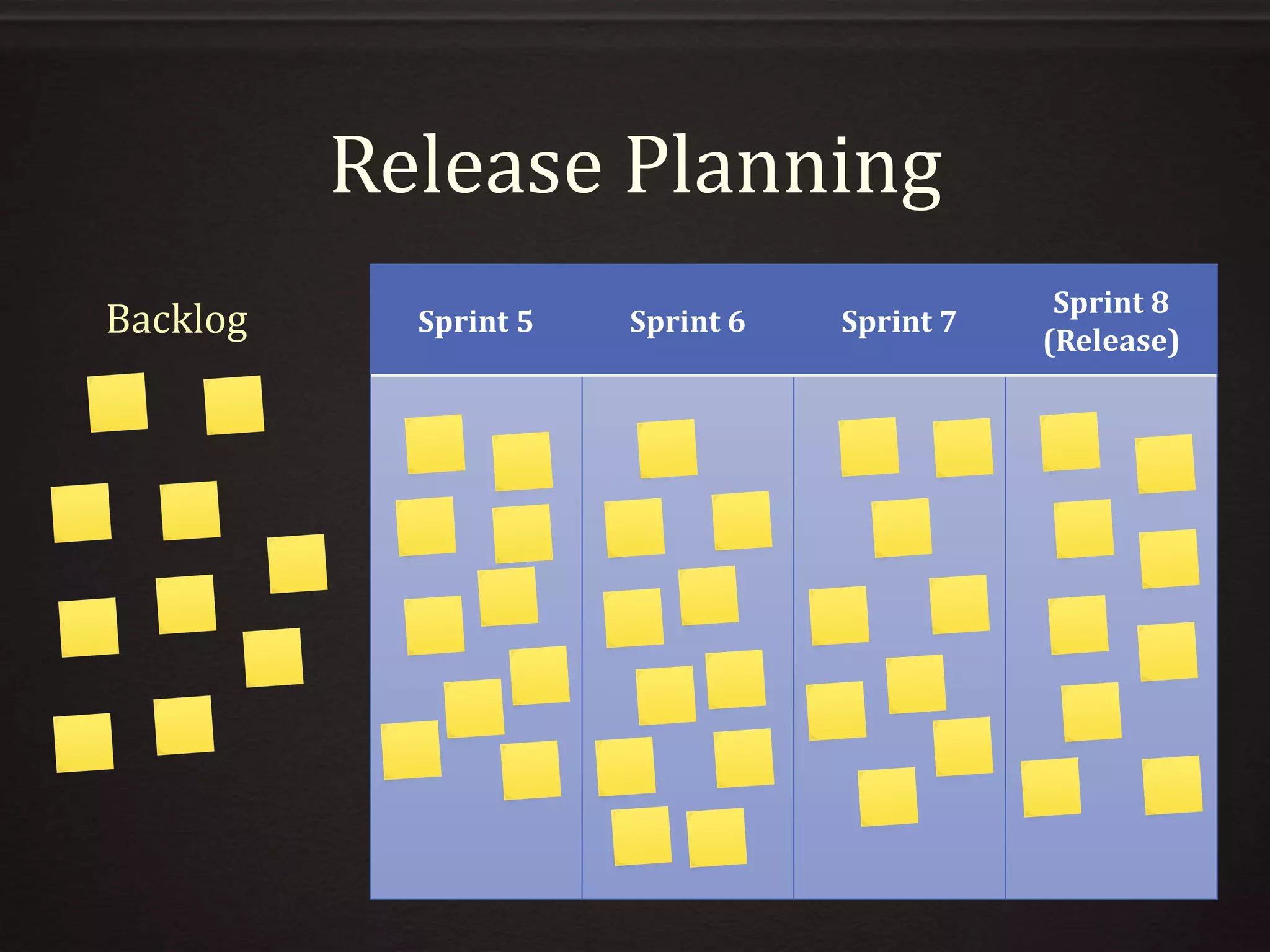
Release Planning
Sprint 5 Sprint 6 Sprint 7
Sprint 8
(Release)
Backlog
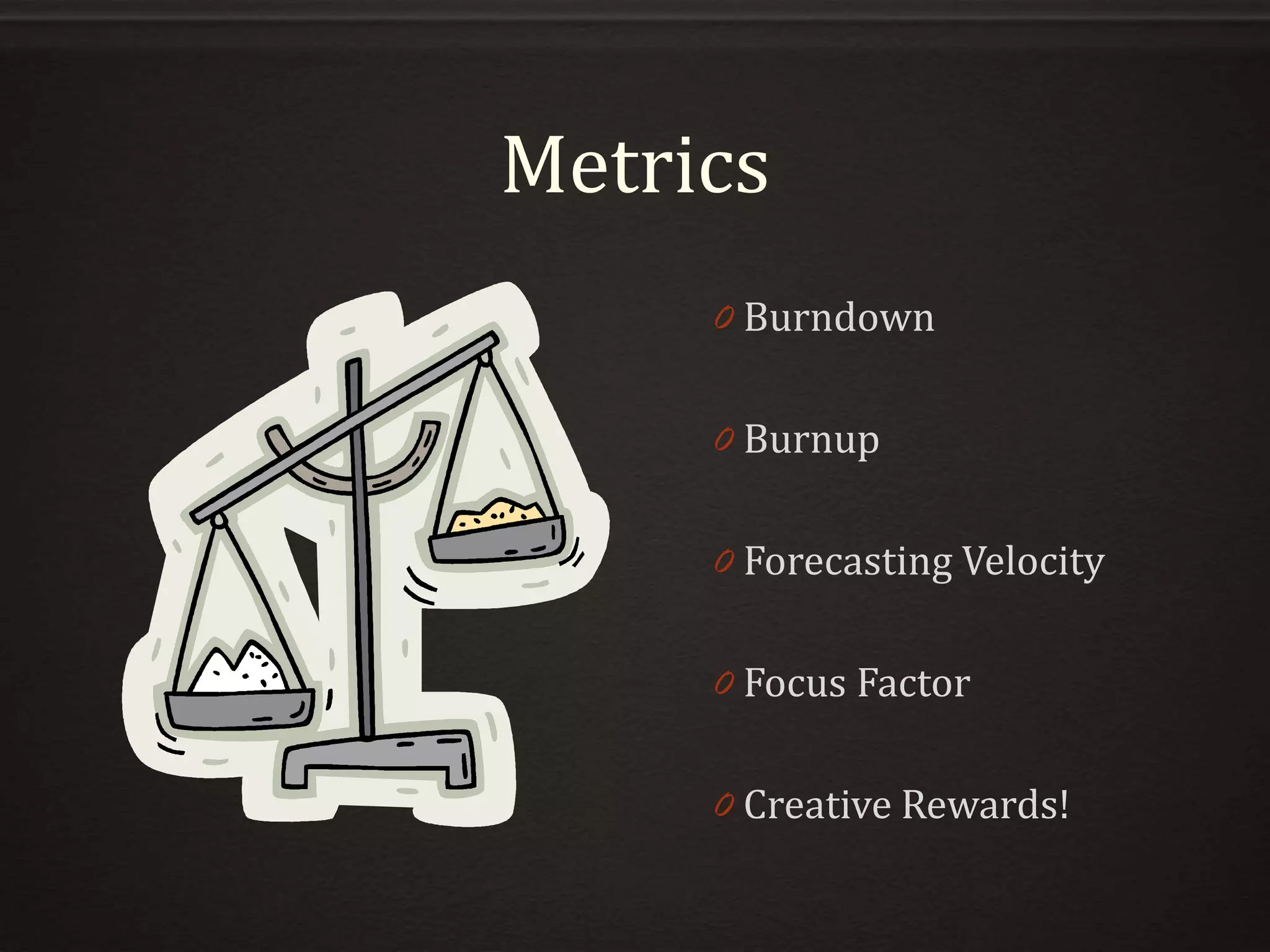
Metrics
0 Burndown
0 Burnup
0 Forecasting Velocity
0 Focus Factor
0 Creative Rewards!
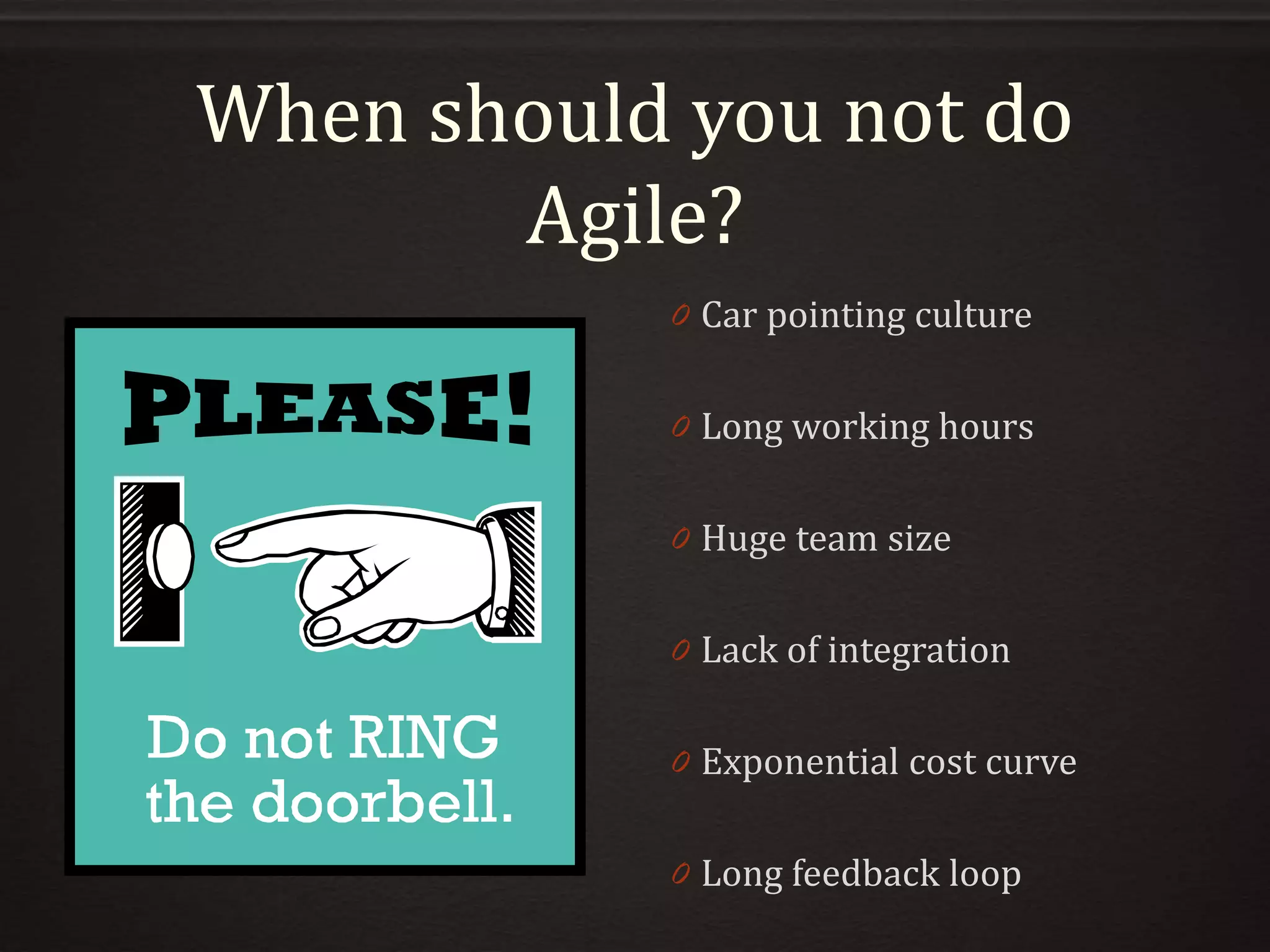
When should you not do
Agile?
0 Car pointing culture
0 Long working hours
0 Huge team size
0 Lack of integration
0 Exponential cost curve
0 Long feedback loop
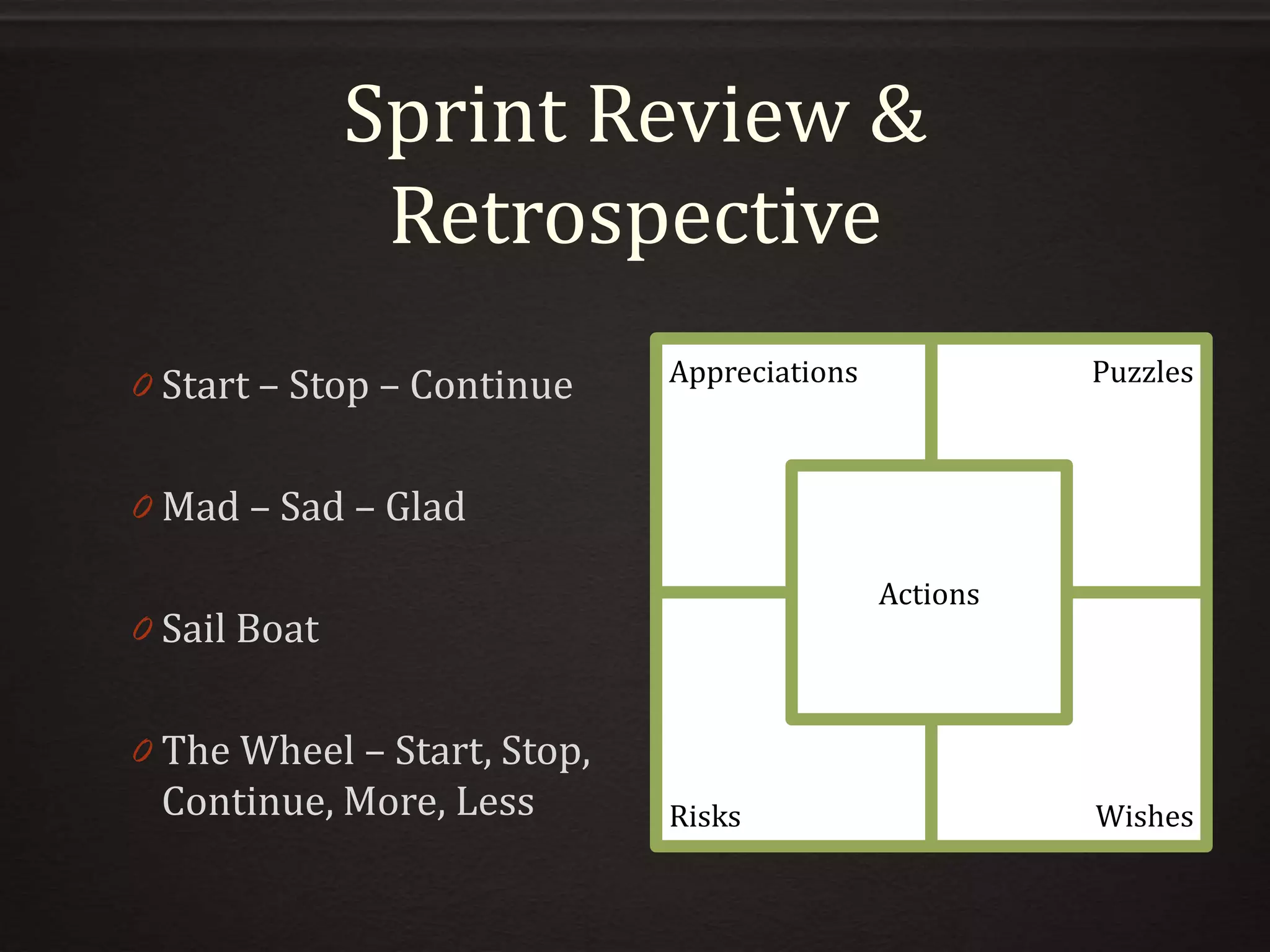
Sprint Review &
Retrospective
0 Start – Stop – Continue
0 Mad – Sad – Glad
0 Sail Boat
0 The Wheel – Start, Stop,
Continue, More, Less
Appreciations
Risks
Puzzles
Wishes
Actions
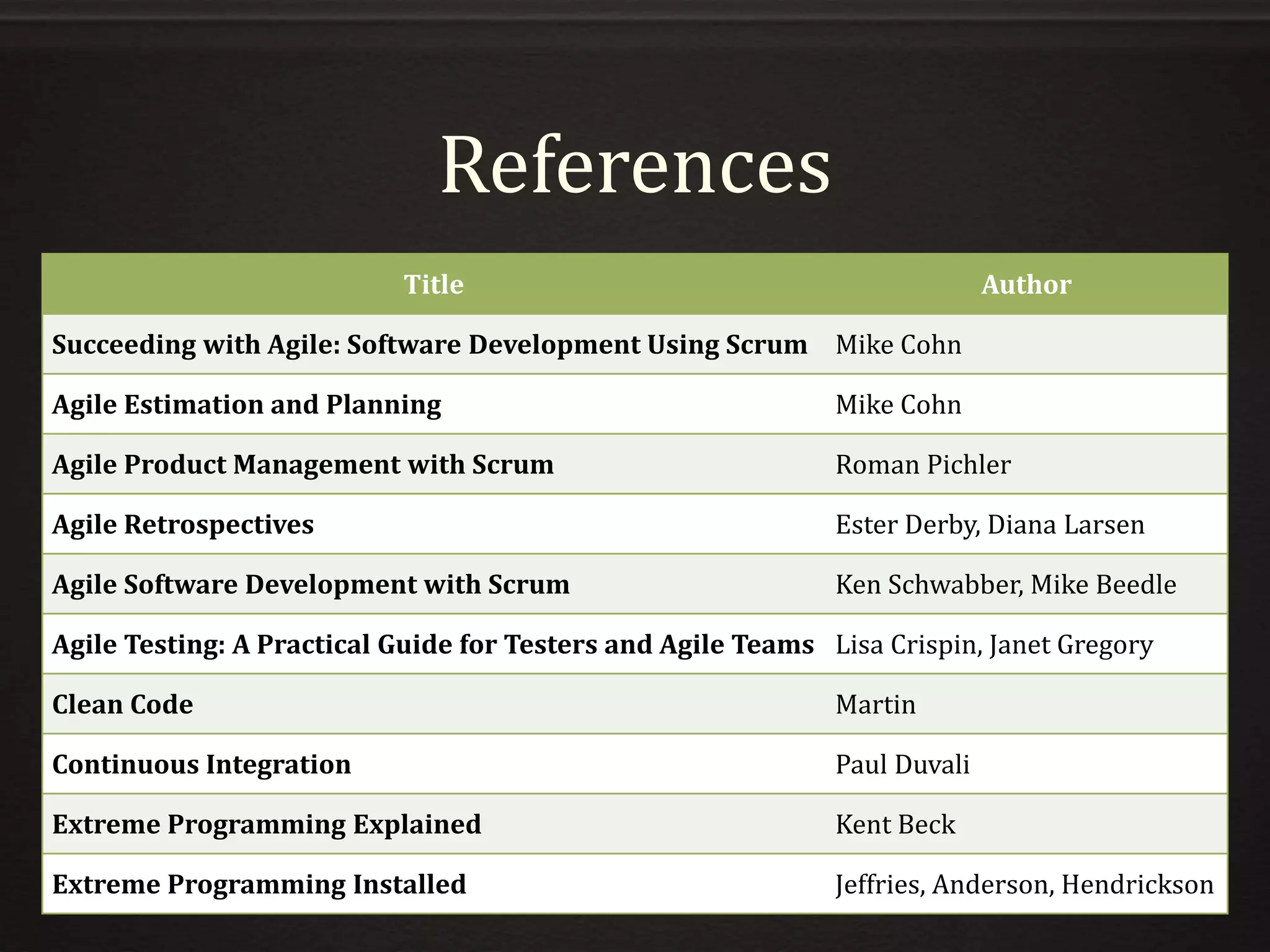
References
Title Author
Succeeding with Agile: Software Development Using Scrum Mike Cohn
Agile Estimation and Planning Mike Cohn
Agile Product Management with Scrum Roman Pichler
Agile Retrospectives Ester Derby, Diana Larsen
Agile Software Development with Scrum Ken Schwabber, Mike Beedle
Agile Testing: A Practical Guide for Testers and Agile Teams Lisa Crispin, Janet Gregory
Clean Code Martin
Continuous Integration Paul Duvali
Extreme Programming Explained Kent Beck
Extreme Programming Installed Jeffries, Anderson, Hendrickson
References (Contd…)
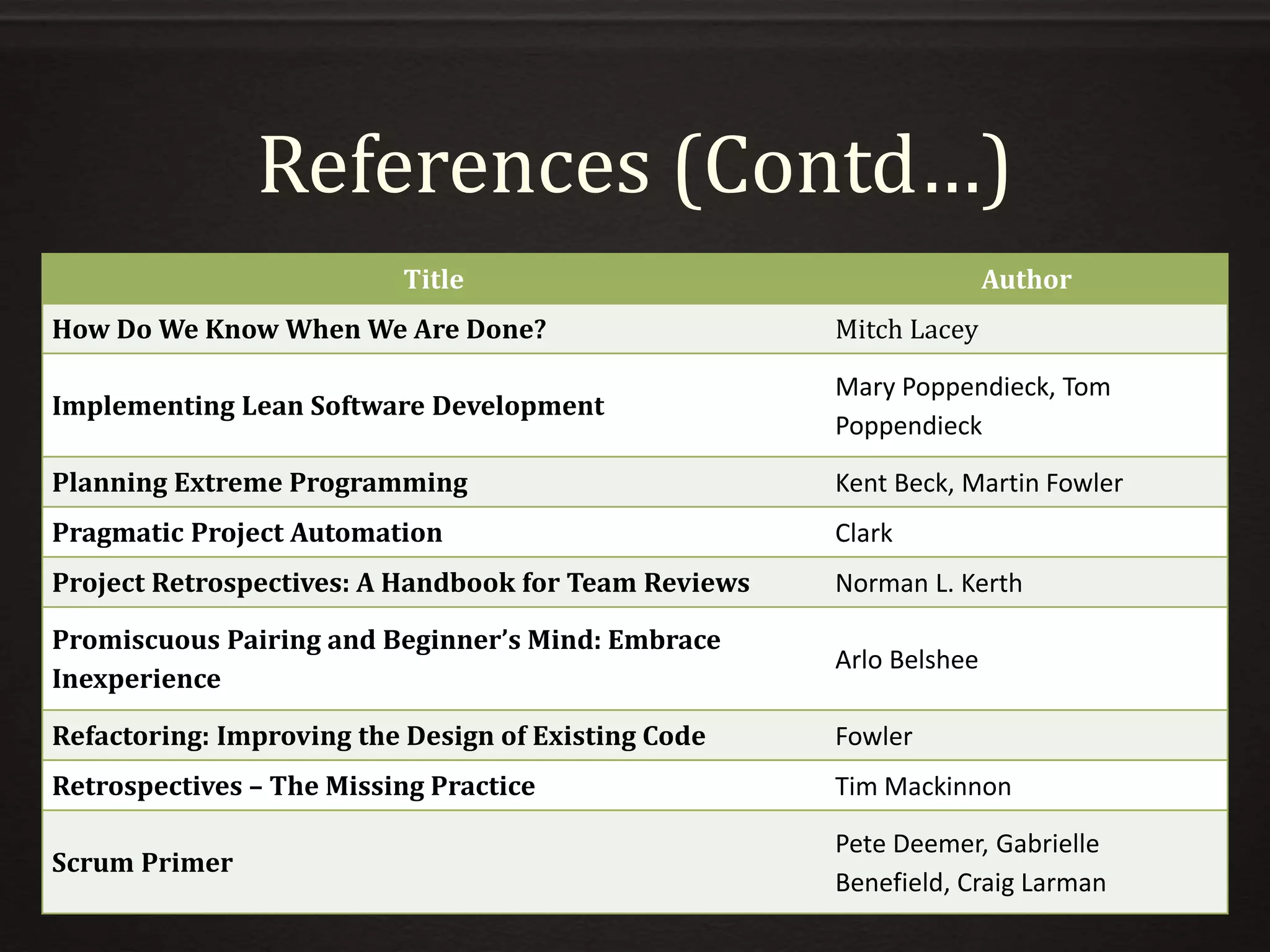
Title Author
How Do We Know When We Are Done? Mitch Lacey
Implementing Lean Software Development
Mary Poppendieck, Tom
Poppendieck
Planning Extreme Programming Kent Beck, Martin Fowler
Pragmatic Project Automation Clark
Project Retrospectives: A Handbook for Team Reviews Norman L. Kerth
Promiscuous Pairing and Beginner’s Mind: Embrace
Inexperience
Arlo Belshee
Refactoring: Improving the Design of Existing Code Fowler
Retrospectives – The Missing Practice Tim Mackinnon
Scrum Primer
Pete Deemer, Gabrielle
Benefield, Craig Larman
References (Contd…)
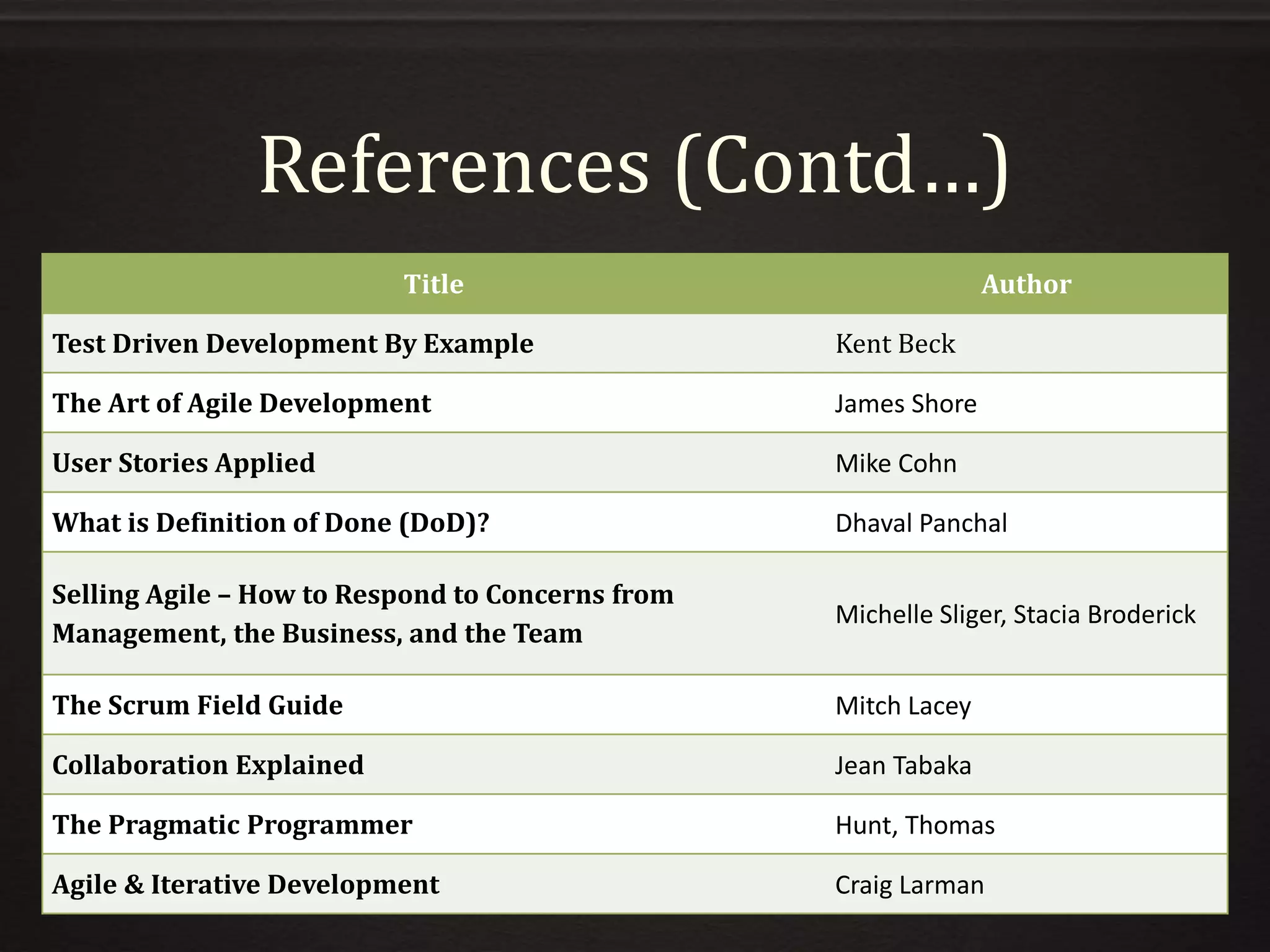
Title Author
Test Driven Development By Example Kent Beck
The Art of Agile Development James Shore
User Stories Applied Mike Cohn
What is Definition of Done (DoD)? Dhaval Panchal
Selling Agile – How to Respond to Concerns from
Management, the Business, and the Team
Michelle Sliger, Stacia Broderick
The Scrum Field Guide Mitch Lacey
Collaboration Explained Jean Tabaka
The Pragmatic Programmer Hunt, Thomas
Agile & Iterative Development Craig Larman
References (Contd…)
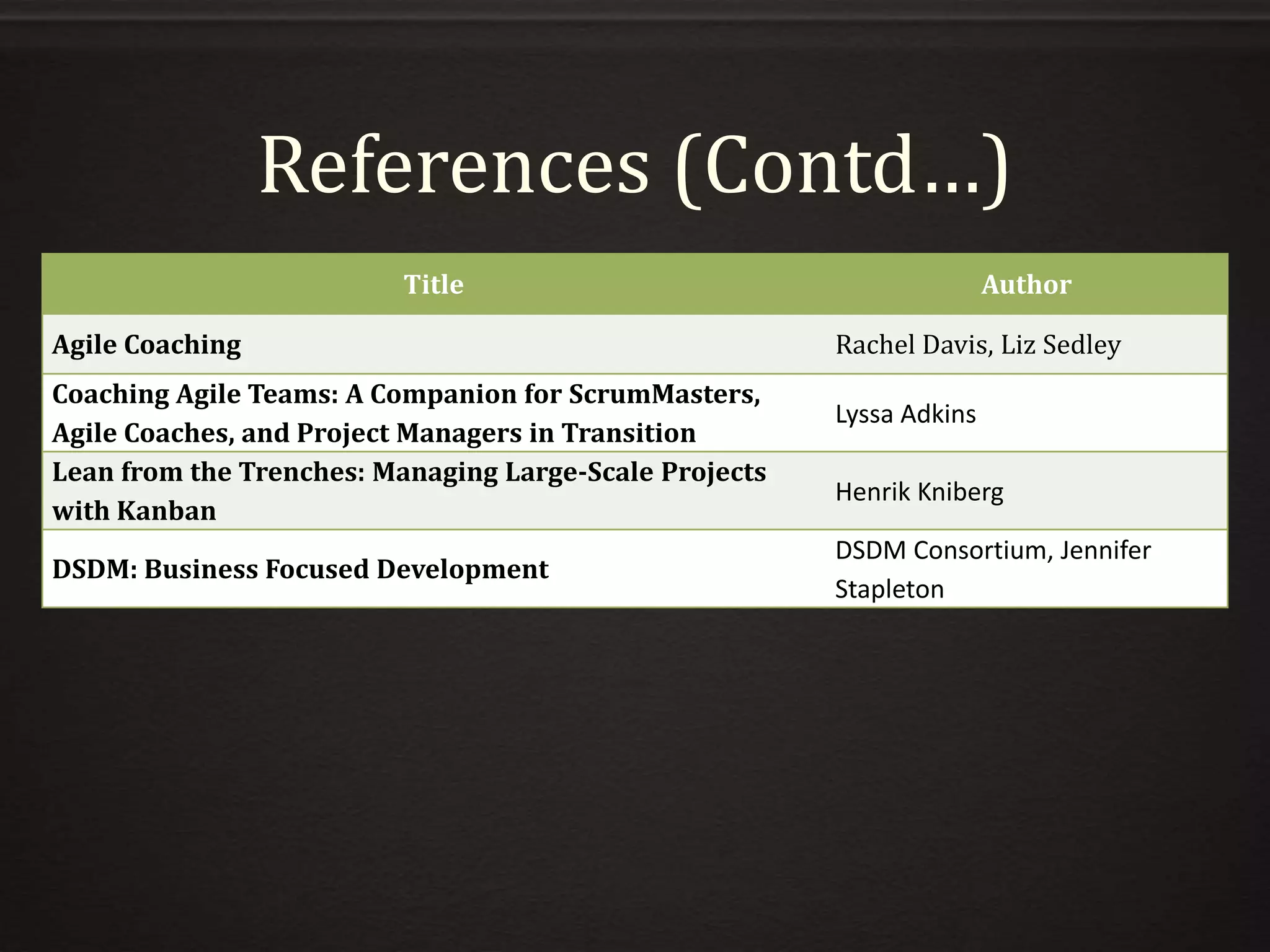
Title Author
Agile Coaching Rachel Davis, Liz Sedley
Coaching Agile Teams: A Companion for ScrumMasters,
Agile Coaches, and Project Managers in Transition
Lyssa Adkins
Lean from the Trenches: Managing Large-Scale Projects
with Kanban
Henrik Kniberg
DSDM: Business Focused Development
DSDM Consortium, Jennifer
Stapleton
Be Agile!
Happy Scrumming.

Scrum Product Owner

  • 2.
  • 3.
    The Daily Scrum Whatwill I do today?
  • 4.
  • 5.
    The Agile Manifesto AgileTraditional 0 Individuals and Interactions 0 Working Software 0 Customer Collaboration 0 Responding to Change over 0 Processes and Tools 0 Comprehensive Documentation 0 Contract Negotiation 0 Following a Plan Over While there is value in the items on the right, we value the items on the left more.
  • 6.
  • 7.
    Scrum Framework Inputs fromExecutives, Teams, Stakeholders, Customers, Users Product Backlog Sprint Backlog Task Breakout Sprint Planning Meeting Burndown/up Charts Daily Scrum 1-4 Week Sprint 24 hours Finished Work Sprint Review Sprint Retrospective
  • 8.
    Scrooge – TheProduct Owner 0 Voice of his customers 0 Discover needs 0 Prioritize features 0 Present a vision 0 Detail the next features 0 Responsible for ROI 0 Manage stakeholders 0 Accept / Reject work results
  • 9.
    Launchpad – The ScrumMaster 0Ensure follow of process 0 Remove blockers 0 Ensure full productivity 0 Enable co-operation 0 Shield from interference 0 Manage ceremonies 0 Facilitate daily scrums 0 Track progress
  • 10.
    Huey, Dewey, Louie– The Development Team 0 Cross-functional team 0 Negotiate sprint goal 0 Specify work results 0 Achieve committed goal 0 Self organizing team 0 Define processes 0 Demonstrate work results to product owner
  • 11.
    An Idea! I havea new money making plan and I need your help. My goal is to develop a brochure for a club in a 3 day sprint Conduct a sprint planning meeting in 12 mins. Decompose tasks from my backlog. Estimate tasks, and commit delivery.
  • 12.
    Scrooge’s Backlog 0 Createcover art, brand, and/or logo 0 Provide contact details 0 Outline full week lunch menu 0 Outline minimum requirements 0 Define service offerings 0 Write testimonials
  • 13.
    Mini Scrum 0 Conducta Sprint Day 1 – 8 minutes – deliver! 0 Conduct a Daily Scrum – 3 minutes 0 Conduct a Sprint Day 2 – 8 minutes – deliver! 0 Conduct a Daily Scrum – 3 minutes 0 Conduct a Sprint Day 3 – 8 minutes – deliver! 0 Conduct a Sprint Review and Demo – 13 minutes 0 Debrief as a group – 5 minutes 0 Make it creative and fun!
  • 14.
    Scrooge’s Vision For workingfamilies, who prefer personal attention for their single parent, “2nd Home” is an elderly daycare club that provides a nursing environment along with socializing activities, unlike “Next Steps”
  • 15.
    Scrooge’s Acceptance Criteria 0Cover art, brand, & logo 0 Pink / Gold 0 Must have the two word brand name 0 Must contain a happy picture of an elderly person 0 Lunch menu 0 7 different “themed buffet” with pictures 0 Services offered 0 5 different services out of 39 including transport 0 Must include our new “Foot Spa” service 0 Architectural conformance 0 Max A4 size 0 No loose sheets 0 Must fit in a handbag
  • 16.
    Peer Consensus 0 Eachmember write their view of the vision 0 Highlight 3 keywords each 0 Write one word per post-it 0 Re-arrange words to come up with a vision statement 0 Add / Change words as needed
  • 17.
    DRIVEN Product Owner 0Decisive 0 Realistic 0 Informed 0 Visionary 0 Empowered 0 Negotiable Scrooge has the right to cancel the project at anytime and be left with a working system reflecting investment to date.
  • 18.
    RE-TRAINED ScrumMaster 0 Resourceful 0Enabler 0 Tactful 0 Respected 0 Argumentative 0 Integrity 0 Networked 0 Empathetic Listener 0 Determined
  • 19.
    Generalized Specialist Team 0Cross – Functional 0 Self – Organized 0 Motivated 0 Collaborative 0 Communicative 0 Experimental Nature 0 Team Player 0 Courageous
  • 20.
    Software Economics You areworking at a burger joint and are the only person on duty. A customer approaches and orders a Cheese Burger Deluxe Meal, with chicken wings, large fries, and a large drink. The order sums up to INR 157 with taxes. The customer informs you that he has only INR 78. What do you do and what do you tell the customer?
  • 21.
  • 22.
    Sprint n Vertical Slices Database– Design, Code, Test, Integrate, Accept Data Access Layer – Design, Code, Test, Integrate, Accept Business Layer – Design, Code, Test, Integrate, Accept Application Layer – Design, Code, Test, Integrate, Accept User Interface – Design, Code, Test, Integrate, Accept Sprint 1 Sprint 2 Sprint 3
  • 23.
    The Product Vision 0The product vision tells us how we are going to satisfy the customer needs 0 Value proposition and key characteristics 0 What the vision should answer: 0 Who is the customer? 0 What is the customer’s problem 0 How does the product solve the problem? 0 How does the product add value? 0 What are the benefits compared to others? 0 On what basis will the customer judge it?
  • 24.
    Elevator Statement &Product Box For [frequent travelers] Who [want an all in one travel service] [Travel Mate] is a [virtual travel agent] That [will do everything for my trip] Unlike [Itinerary Planner] Our Product [will remove the need to visit any other website or shop for a trip]
  • 25.
    Create a Product 0Your company has decided to diversify into a booking new area – an online travel assistant 0 Come up with your: 0 Product Name 0 Niche 0 Elevator Statement 0 Product Box
  • 26.
    Brainstorm for userroles 0 Most projects talk about “the user” or “users” 0 But who are they? What do they want? 0 Most projects: 0 Write requirements from one user’s perspective 0 Assuming all users have the same goals 0 End up with “missing” requirements
  • 27.
    Personas Peter Peter is a55 year old explorer who loves to visit new places. He is a software engineer with a laid back lifestyle and enjoys his occasional drink with buddies at a sports bar. He likes to do his research in detail before his travel since his wife generally accompanies him on his trips. He would love to have a one stop web solution to plan out his trips – from travel, to accommodation, to activities, etc.
  • 28.
    Types of Personas 0Focal – Primary users. Optimize the design for them. At least one persona must be focal. 0 Secondary – Also use the product. Satisfy their requirements when possible. 0 Unimportant – Low priority users, including infrequent, unauthorized, or unskilled users, as well as those who misuse the product. 0 Affected – They don’t use the product but are affected by it. 0 Exclusionary – Someone we’re not designing for. Useful to prevent nonusers from our discussions.
  • 29.
    Product Backlog Sprint -20% Release - 20% Future Releases - 60% Priority
  • 30.
    DEEP Backlog 0 Detailed 0Estimated 0 Emergent 0 Prioritized
  • 31.
    User Stories The “sothat” part is incredibly valuable as it focuses people on the real reason behind this requirement.
  • 32.
    INVEST in UserStories 0 Independent 0 Negotiable 0 Valuable 0 Estimable 0 Small 0 Testable
  • 33.
    The Tea Drinker Writea user story to make yourself a cup of tea.
  • 34.
    Acceptance Test 0 Whenwill this story be done? 0 What will we see? 0 What will happen? 0 What will be different? 0 When will the team stop? 0 What are the conditions for functionality, usability, and security being satisfied?
  • 35.
    Acceptance Criteria 0 Differentlevels of acceptance 0 Keep to appropriate level 0 When will this story be “done”? 0 Questions can help 0 Make them objective 0 Make them automated
  • 36.
    Prioritization 0 Shouting Loudest 0Priority Poker 0 Kano Analysis 0 “35” 0 Free Market 0 Risk & Value
  • 37.
    The Sinking Ship 0Manmohan Singh 0 Narayan Murthy 0 Sachin Tendulkar 0 Sanjay Dutt 0 Zakir Hussain 0 Narendra Modi 0 Mukesh Ambani 0 Kailash Kher 0 Amitabh Bachchan 0 Rakhi Sawant Your ship is sinking. It has a lifeboat that can carry only one person along with you to safety. In which order will you save these people.
  • 38.
    Risk & Value Risk Value Avoid DoLast Do Next Do First
  • 39.
  • 40.
  • 41.
    Definition of Done “Whatdo we need to do, as a team, to ship software to our customers/stakeholders?” - By Mitch Lacey
  • 42.
    Sprint Planning 0 Definethe sprint goal 0 Identify capacity 0 Create sprint backlog 0 Commit deliverables 0 Task breakout
  • 43.
    Themes 0 Themes aregroup of similar functionality / requirement. 0 These can span across sprints, releases, or products. 0 Themes can be used for prioritizing requirements.
  • 44.
    Product Canvas - ByRoman Pichler
  • 45.
  • 46.
    Velocity 0 Amount ofwork finished 0 Not a sprint prediction 0 Long term measure of capacity 0 Not comparable across teams
  • 47.
    Release Planning Sprint 5Sprint 6 Sprint 7 Sprint 8 (Release) Backlog
  • 48.
    Metrics 0 Burndown 0 Burnup 0Forecasting Velocity 0 Focus Factor 0 Creative Rewards!
  • 49.
    When should younot do Agile? 0 Car pointing culture 0 Long working hours 0 Huge team size 0 Lack of integration 0 Exponential cost curve 0 Long feedback loop
  • 50.
    Sprint Review & Retrospective 0Start – Stop – Continue 0 Mad – Sad – Glad 0 Sail Boat 0 The Wheel – Start, Stop, Continue, More, Less Appreciations Risks Puzzles Wishes Actions
  • 51.
    References Title Author Succeeding withAgile: Software Development Using Scrum Mike Cohn Agile Estimation and Planning Mike Cohn Agile Product Management with Scrum Roman Pichler Agile Retrospectives Ester Derby, Diana Larsen Agile Software Development with Scrum Ken Schwabber, Mike Beedle Agile Testing: A Practical Guide for Testers and Agile Teams Lisa Crispin, Janet Gregory Clean Code Martin Continuous Integration Paul Duvali Extreme Programming Explained Kent Beck Extreme Programming Installed Jeffries, Anderson, Hendrickson
  • 52.
    References (Contd…) Title Author HowDo We Know When We Are Done? Mitch Lacey Implementing Lean Software Development Mary Poppendieck, Tom Poppendieck Planning Extreme Programming Kent Beck, Martin Fowler Pragmatic Project Automation Clark Project Retrospectives: A Handbook for Team Reviews Norman L. Kerth Promiscuous Pairing and Beginner’s Mind: Embrace Inexperience Arlo Belshee Refactoring: Improving the Design of Existing Code Fowler Retrospectives – The Missing Practice Tim Mackinnon Scrum Primer Pete Deemer, Gabrielle Benefield, Craig Larman
  • 53.
    References (Contd…) Title Author TestDriven Development By Example Kent Beck The Art of Agile Development James Shore User Stories Applied Mike Cohn What is Definition of Done (DoD)? Dhaval Panchal Selling Agile – How to Respond to Concerns from Management, the Business, and the Team Michelle Sliger, Stacia Broderick The Scrum Field Guide Mitch Lacey Collaboration Explained Jean Tabaka The Pragmatic Programmer Hunt, Thomas Agile & Iterative Development Craig Larman
  • 54.
    References (Contd…) Title Author AgileCoaching Rachel Davis, Liz Sedley Coaching Agile Teams: A Companion for ScrumMasters, Agile Coaches, and Project Managers in Transition Lyssa Adkins Lean from the Trenches: Managing Large-Scale Projects with Kanban Henrik Kniberg DSDM: Business Focused Development DSDM Consortium, Jennifer Stapleton
  • 55.