Project Communications Management
Pankaj Sharma, 9810996356
PROJECT COMMUNICATIONS MANAGEMENT
Processes required to ensure timely and appropriate generation, collection, distribution,
storage, retrieval and ultimate disposition of project information.This knowledge area is
made up of five processes to determine what to communicate, to whom, how often, and when
to reevaluate the plan
An effective project manager spends about 90% of his time communicating and 50% of that
time is spent communicating with the project team
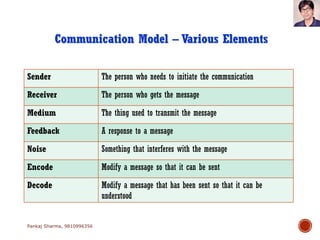
Sender The person who needs to initiate the communication
Receiver The person who gets the message
Medium The thing used to transmit the message
Feedback A response to a message
Noise Something that interferes with the message
Encode Modify a message so that it can be sent
Decode Modify a message that has been sent so that it can be
understood
Communication Model – Various Elements
Pankaj Sharma, 9810996356
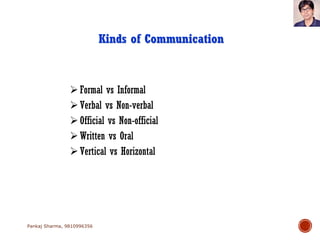
Formal vs Informal
Verbal vs Non-verbal
Official vs Non-official
Written vs Oral
Vertical vs Horizontal
Kinds of Communication
Pankaj Sharma, 9810996356
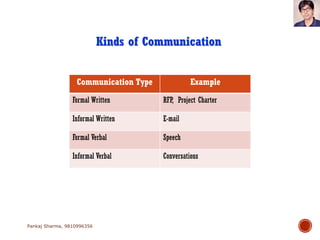
Kinds of Communication
Communication Type Example
Formal Written RFP, Project Charter
Informal Written E-mail
Formal Verbal Speech
Informal Verbal Conversations
Pankaj Sharma, 9810996356
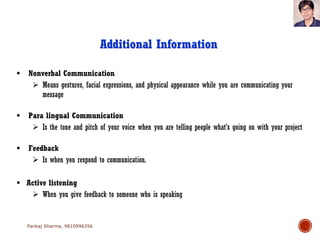
 Nonverbal Communication
 Means gestures, facial expressions, and physical appearance while you are communicating your
message
 Para lingual Communication
 Is the tone and pitch of your voice when you are telling people what’s going on with your project
 Feedback
 Is when you respond to communication.
 Active listening
 When you give feedback to someone who is speaking
Additional Information
Pankaj Sharma, 9810996356
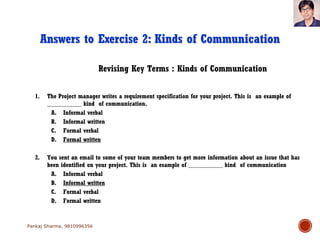
Revising Key Terms : Kinds of Communication
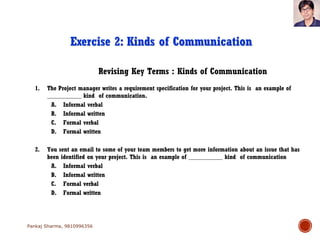
Exercise 2: Kinds of Communication
1. The Project manager writes a requirement specification for your project. This is an example of
___________ kind of communication.
A. Informal verbal
B. Informal written
C. Formal verbal
D. Formal written
2. You sent an email to some of your team members to get more information about an issue that has
been identified on your project. This is an example of ___________ kind of communication
A. Informal verbal
B. Informal written
C. Formal verbal
D. Formal written
Pankaj Sharma, 9810996356
Revising Key Terms : Kinds of Communication
Answers to Exercise 2: Kinds of Communication
1. The Project manager writes a requirement specification for your project. This is an example of
___________ kind of communication.
A. Informal verbal
B. Informal written
C. Formal verbal
D. Formal written
2. You sent an email to some of your team members to get more information about an issue that has
been identified on your project. This is an example of ___________ kind of communication
A. Informal verbal
B. Informal written
C. Formal verbal
D. Formal written
Pankaj Sharma, 9810996356
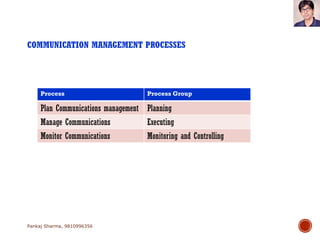
COMMUNICATION MANAGEMENT PROCESSES
Pankaj Sharma, 9810996356
Process Process Group
Plan Communications management Planning
Manage Communications Executing
Monitor Communications Monitoring and Controlling
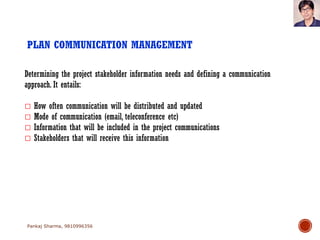
PLAN COMMUNICATION MANAGEMENT
Pankaj Sharma, 9810996356
Determining the project stakeholder information needs and defining a communication
approach. It entails:
□ How often communication will be distributed and updated
□ Mode of communication (email, teleconference etc)
□ Information that will be included in the project communications
□ Stakeholders that will receive this information
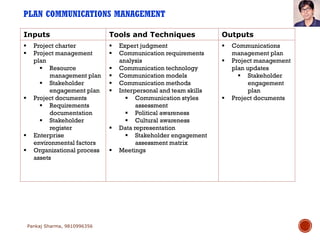
PLAN COMMUNICATIONS MANAGEMENT
Pankaj Sharma, 9810996356
Inputs Tools and Techniques Outputs
 Project charter
 Project management
plan
 Resource
management plan
 Stakeholder
engagement plan
 Project documents
 Requirements
documentation
 Stakeholder
register
 Enterprise
environmental factors
 Organizational process
assets
 Expert judgment
 Communication requirements
analysis
 Communication technology
 Communication models
 Communication methods
 Interpersonal and team skills
 Communication styles
assessment
 Political awareness
 Cultural awareness
 Data representation
 Stakeholder engagement
assessment matrix
 Meetings
 Communications
management plan
 Project management
plan updates
 Stakeholder
engagement
plan
 Project documents
COMMUNICATION REQUIREMENT ANALYSIS
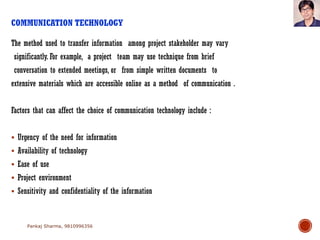
The analysis of the communication requirements determine the information needs of the
project stakeholders. The project manager should also consider the number of potential
communication channel or paths as an indicator of the complexity of a project’s
communications.
For Example if there are n people involve in a project communication.The total number of
channels would be n(n-1)/2
Pankaj Sharma, 9810996356
4 people – 6 channels
6 people – 15 channels
COMMUNICATION TECHNOLOGY
The method used to transfer information among project stakeholder may vary
significantly. For example, a project team may use technique from brief
conversation to extended meetings, or from simple written documents to
extensive materials which are accessible online as a method of communication .
Factors that can affect the choice of communication technology include :
 Urgency of the need for information
 Availability of technology
 Ease of use
 Project environment
 Sensitivity and confidentiality of the information
Pankaj Sharma, 9810996356
COMMUNICATION MODEL
Basic model of communication includes the following parameters
 Encode : Thoughts and ideas translated to a language which can be
understood by other
 Message & Feedback Message : Output of encoding
 Medium : The method used to convey the message
 Decode : Converting feedback back to understandable form
Pankaj Sharma, 9810996356
COMMUNICATION METHOD
Communication Methods are broadly classified into
 Interactive communication – Such as Video Conferencing, goto Meeting, Face to Face etc.
 Push Communication - Email,Text Messaging etc.
 Pull Communication – Intranet Portals
Pankaj Sharma, 9810996356
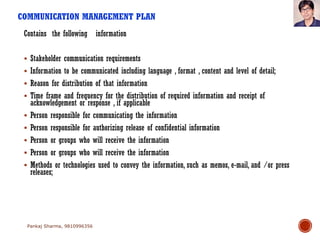
COMMUNICATION MANAGEMENT PLAN
Contains the following information
 Stakeholder communication requirements
 Information to be communicated including language , format , content and level of detail;
 Reason for distribution of that information
 Time frame and frequency for the distribution of required information and receipt of
acknowledgement or response , if applicable
 Person responsible for communicating the information
 Person responsible for authorizing release of confidential information
 Person or groups who will receive the information
 Methods or technologies used to convey the information, such as memos, e-mail, and /or press
releases;
Pankaj Sharma, 9810996356
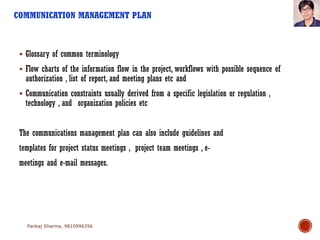
COMMUNICATION MANAGEMENT PLAN
 Glossary of common terminology
 Flow charts of the information flow in the project, workflows with possible sequence of
authorization , list of report, and meeting plans etc and
 Communication constraints usually derived from a specific legislation or regulation ,
technology , and organization policies etc
The communications management plan can also include guidelines and
templates for project status meetings , project team meetings , e-
meetings and e-mail messages.
Pankaj Sharma, 9810996356
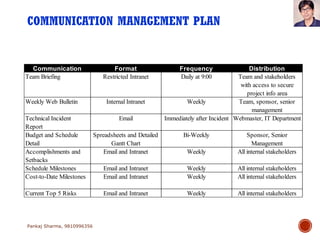
COMMUNICATION MANAGEMENT PLAN
Pankaj Sharma, 9810996356
Communication Format Frequency Distribution
Team Briefing Restricted Intranet Daily at 9:00 Team and stakeholders
with access to secure
project info area
Weekly Web Bulletin Internal Intranet Weekly Team, sponsor, senior
management
Technical Incident
Report
Email Immediately after Incident Webmaster, IT Department
Budget and Schedule
Detail
Spreadsheets and Detailed
Gantt Chart
Bi-Weekly Sponsor, Senior
Management
Accomplishments and
Setbacks
Email and Intranet Weekly All internal stakeholders
Schedule Milestones Email and Intranet Weekly All internal stakeholders
Cost-to-Date Milestones Email and Intranet Weekly All internal stakeholders
Current Top 5 Risks Email and Intranet Weekly All internal stakeholders
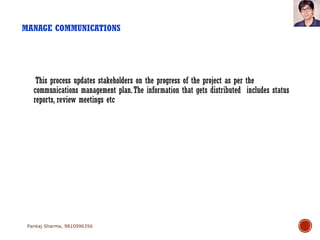
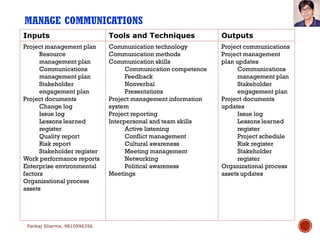
MANAGE COMMUNICATIONS
This process updates stakeholders on the progress of the project as per the
communications management plan.The information that gets distributed includes status
reports, review meetings etc
Pankaj Sharma, 9810996356
MANAGE COMMUNICATIONS
Pankaj Sharma, 9810996356
Inputs Tools and Techniques Outputs
Project management plan
Resource
management plan
Communications
management plan
Stakeholder
engagement plan
Project documents
Change log
Issue log
Lessons learned
register
Quality report
Risk report
Stakeholder register
Work performance reports
Enterprise environmental
factors
Organizational process
assets
Communication technology
Communication methods
Communication skills
Communication competence
Feedback
Nonverbal
Presentations
Project management information
system
Project reporting
Interpersonal and team skills
Active listening
Conflict management
Cultural awareness
Meeting management
Networking
Political awareness
Meetings
Project communications
Project management
plan updates
Communications
management plan
Stakeholder
engagement plan
Project documents
updates
Issue log
Lessons learned
register
Project schedule
Risk register
Stakeholder
register
Organizational process
assets updates
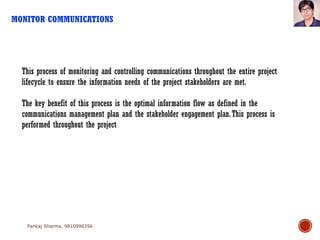
MONITOR COMMUNICATIONS
Pankaj Sharma, 9810996356
This process of monitoring and controlling communications throughout the entire project
lifecycle to ensure the information needs of the project stakeholders are met.
The key benefit of this process is the optimal information flow as defined in the
communications management plan and the stakeholder engagement plan.This process is
performed throughout the project
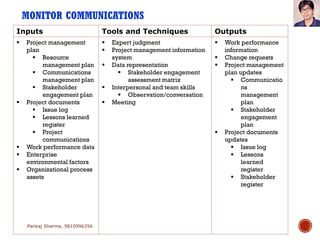
MONITOR COMMUNICATIONS
Pankaj Sharma, 9810996356
Inputs Tools and Techniques Outputs
 Project management
plan
 Resource
management plan
 Communications
management plan
 Stakeholder
engagement plan
 Project documents
 Issue log
 Lessons learned
register
 Project
communications
 Work performance data
 Enterprise
environmental factors
 Organizational process
assets
 Expert judgment
 Project management information
system
 Data representation
 Stakeholder engagement
assessment matrix
 Interpersonal and team skills
 Observation/conversation
 Meeting
 Work performance
information
 Change requests
 Project management
plan updates
 Communicatio
ns
management
plan
 Stakeholder
engagement
plan
 Project documents
updates
 Issue log
 Lessons
learned
register
 Stakeholder
register
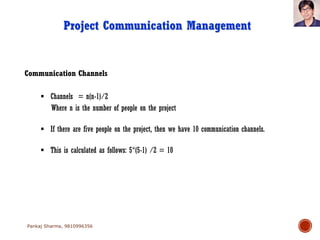
Communication Channels
 Channels = n(n-1)/2
Where n is the number of people on the project
 If there are five people on the project, then we have 10 communication channels.
 This is calculated as follows: 5*(5-1) /2 = 10
Project Communication Management
Pankaj Sharma, 9810996356
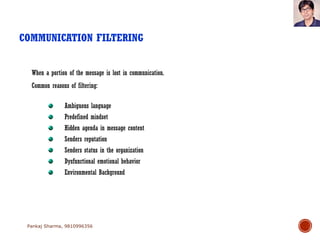
COMMUNICATION FILTERING
Pankaj Sharma, 9810996356
Ambiguous language
Predefined mindset
Hidden agenda in message content
Senders reputation
Senders status in the organization
Dysfunctional emotional behavior
Environmental Background
When a portion of the message is lost in communication.
Common reasons of filtering:
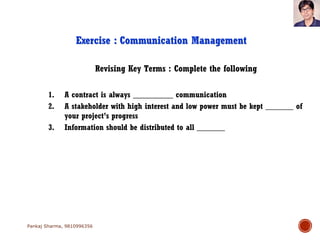
Revising Key Terms : Complete the following
Exercise : Communication Management
1. A contract is always __________ communication
2. A stakeholder with high interest and low power must be kept _______ of
your project’s progress
3. Information should be distributed to all _______
Pankaj Sharma, 9810996356
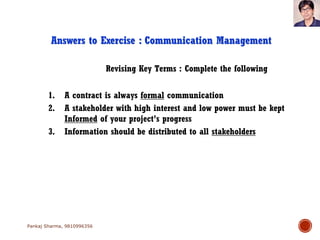
Revising Key Terms : Complete the following
Answers to Exercise : Communication Management
1. A contract is always formal communication
2. A stakeholder with high interest and low power must be kept
Informed of your project’s progress
3. Information should be distributed to all stakeholders
Pankaj Sharma, 9810996356
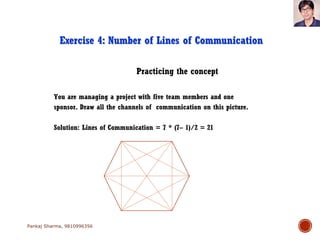
Practicing the concept
Exercise 4: Number of Lines of Communication
You are managing a project with five team members and one
sponsor. Draw all the channels of communication on this picture.
Solution: Lines of Communication = 7 * (7– 1)/2 = 21
Pankaj Sharma, 9810996356
QUIZ !
Pankaj Sharma, 9810996356

Project communications management PMBOK Sixth Edition

  • 1.
  • 2.
    Pankaj Sharma, 9810996356 PROJECTCOMMUNICATIONS MANAGEMENT Processes required to ensure timely and appropriate generation, collection, distribution, storage, retrieval and ultimate disposition of project information.This knowledge area is made up of five processes to determine what to communicate, to whom, how often, and when to reevaluate the plan An effective project manager spends about 90% of his time communicating and 50% of that time is spent communicating with the project team
  • 3.
    Sender The personwho needs to initiate the communication Receiver The person who gets the message Medium The thing used to transmit the message Feedback A response to a message Noise Something that interferes with the message Encode Modify a message so that it can be sent Decode Modify a message that has been sent so that it can be understood Communication Model – Various Elements Pankaj Sharma, 9810996356
  • 4.
    Formal vs Informal Verbalvs Non-verbal Official vs Non-official Written vs Oral Vertical vs Horizontal Kinds of Communication Pankaj Sharma, 9810996356
  • 5.
    Kinds of Communication CommunicationType Example Formal Written RFP, Project Charter Informal Written E-mail Formal Verbal Speech Informal Verbal Conversations Pankaj Sharma, 9810996356
  • 6.
     Nonverbal Communication Means gestures, facial expressions, and physical appearance while you are communicating your message  Para lingual Communication  Is the tone and pitch of your voice when you are telling people what’s going on with your project  Feedback  Is when you respond to communication.  Active listening  When you give feedback to someone who is speaking Additional Information Pankaj Sharma, 9810996356
  • 7.
    Revising Key Terms: Kinds of Communication Exercise 2: Kinds of Communication 1. The Project manager writes a requirement specification for your project. This is an example of ___________ kind of communication. A. Informal verbal B. Informal written C. Formal verbal D. Formal written 2. You sent an email to some of your team members to get more information about an issue that has been identified on your project. This is an example of ___________ kind of communication A. Informal verbal B. Informal written C. Formal verbal D. Formal written Pankaj Sharma, 9810996356
  • 8.
    Revising Key Terms: Kinds of Communication Answers to Exercise 2: Kinds of Communication 1. The Project manager writes a requirement specification for your project. This is an example of ___________ kind of communication. A. Informal verbal B. Informal written C. Formal verbal D. Formal written 2. You sent an email to some of your team members to get more information about an issue that has been identified on your project. This is an example of ___________ kind of communication A. Informal verbal B. Informal written C. Formal verbal D. Formal written Pankaj Sharma, 9810996356
  • 9.
    COMMUNICATION MANAGEMENT PROCESSES PankajSharma, 9810996356 Process Process Group Plan Communications management Planning Manage Communications Executing Monitor Communications Monitoring and Controlling
  • 10.
    PLAN COMMUNICATION MANAGEMENT PankajSharma, 9810996356 Determining the project stakeholder information needs and defining a communication approach. It entails: □ How often communication will be distributed and updated □ Mode of communication (email, teleconference etc) □ Information that will be included in the project communications □ Stakeholders that will receive this information
  • 11.
    PLAN COMMUNICATIONS MANAGEMENT PankajSharma, 9810996356 Inputs Tools and Techniques Outputs  Project charter  Project management plan  Resource management plan  Stakeholder engagement plan  Project documents  Requirements documentation  Stakeholder register  Enterprise environmental factors  Organizational process assets  Expert judgment  Communication requirements analysis  Communication technology  Communication models  Communication methods  Interpersonal and team skills  Communication styles assessment  Political awareness  Cultural awareness  Data representation  Stakeholder engagement assessment matrix  Meetings  Communications management plan  Project management plan updates  Stakeholder engagement plan  Project documents
  • 12.
    COMMUNICATION REQUIREMENT ANALYSIS Theanalysis of the communication requirements determine the information needs of the project stakeholders. The project manager should also consider the number of potential communication channel or paths as an indicator of the complexity of a project’s communications. For Example if there are n people involve in a project communication.The total number of channels would be n(n-1)/2 Pankaj Sharma, 9810996356 4 people – 6 channels 6 people – 15 channels
  • 13.
    COMMUNICATION TECHNOLOGY The methodused to transfer information among project stakeholder may vary significantly. For example, a project team may use technique from brief conversation to extended meetings, or from simple written documents to extensive materials which are accessible online as a method of communication . Factors that can affect the choice of communication technology include :  Urgency of the need for information  Availability of technology  Ease of use  Project environment  Sensitivity and confidentiality of the information Pankaj Sharma, 9810996356
  • 14.
    COMMUNICATION MODEL Basic modelof communication includes the following parameters  Encode : Thoughts and ideas translated to a language which can be understood by other  Message & Feedback Message : Output of encoding  Medium : The method used to convey the message  Decode : Converting feedback back to understandable form Pankaj Sharma, 9810996356
  • 15.
    COMMUNICATION METHOD Communication Methodsare broadly classified into  Interactive communication – Such as Video Conferencing, goto Meeting, Face to Face etc.  Push Communication - Email,Text Messaging etc.  Pull Communication – Intranet Portals Pankaj Sharma, 9810996356
  • 16.
    COMMUNICATION MANAGEMENT PLAN Containsthe following information  Stakeholder communication requirements  Information to be communicated including language , format , content and level of detail;  Reason for distribution of that information  Time frame and frequency for the distribution of required information and receipt of acknowledgement or response , if applicable  Person responsible for communicating the information  Person responsible for authorizing release of confidential information  Person or groups who will receive the information  Person or groups who will receive the information  Methods or technologies used to convey the information, such as memos, e-mail, and /or press releases; Pankaj Sharma, 9810996356
  • 17.
    COMMUNICATION MANAGEMENT PLAN Glossary of common terminology  Flow charts of the information flow in the project, workflows with possible sequence of authorization , list of report, and meeting plans etc and  Communication constraints usually derived from a specific legislation or regulation , technology , and organization policies etc The communications management plan can also include guidelines and templates for project status meetings , project team meetings , e- meetings and e-mail messages. Pankaj Sharma, 9810996356
  • 18.
    COMMUNICATION MANAGEMENT PLAN PankajSharma, 9810996356 Communication Format Frequency Distribution Team Briefing Restricted Intranet Daily at 9:00 Team and stakeholders with access to secure project info area Weekly Web Bulletin Internal Intranet Weekly Team, sponsor, senior management Technical Incident Report Email Immediately after Incident Webmaster, IT Department Budget and Schedule Detail Spreadsheets and Detailed Gantt Chart Bi-Weekly Sponsor, Senior Management Accomplishments and Setbacks Email and Intranet Weekly All internal stakeholders Schedule Milestones Email and Intranet Weekly All internal stakeholders Cost-to-Date Milestones Email and Intranet Weekly All internal stakeholders Current Top 5 Risks Email and Intranet Weekly All internal stakeholders
  • 19.
    MANAGE COMMUNICATIONS This processupdates stakeholders on the progress of the project as per the communications management plan.The information that gets distributed includes status reports, review meetings etc Pankaj Sharma, 9810996356
  • 20.
    MANAGE COMMUNICATIONS Pankaj Sharma,9810996356 Inputs Tools and Techniques Outputs Project management plan Resource management plan Communications management plan Stakeholder engagement plan Project documents Change log Issue log Lessons learned register Quality report Risk report Stakeholder register Work performance reports Enterprise environmental factors Organizational process assets Communication technology Communication methods Communication skills Communication competence Feedback Nonverbal Presentations Project management information system Project reporting Interpersonal and team skills Active listening Conflict management Cultural awareness Meeting management Networking Political awareness Meetings Project communications Project management plan updates Communications management plan Stakeholder engagement plan Project documents updates Issue log Lessons learned register Project schedule Risk register Stakeholder register Organizational process assets updates
  • 21.
    MONITOR COMMUNICATIONS Pankaj Sharma,9810996356 This process of monitoring and controlling communications throughout the entire project lifecycle to ensure the information needs of the project stakeholders are met. The key benefit of this process is the optimal information flow as defined in the communications management plan and the stakeholder engagement plan.This process is performed throughout the project
  • 22.
    MONITOR COMMUNICATIONS Pankaj Sharma,9810996356 Inputs Tools and Techniques Outputs  Project management plan  Resource management plan  Communications management plan  Stakeholder engagement plan  Project documents  Issue log  Lessons learned register  Project communications  Work performance data  Enterprise environmental factors  Organizational process assets  Expert judgment  Project management information system  Data representation  Stakeholder engagement assessment matrix  Interpersonal and team skills  Observation/conversation  Meeting  Work performance information  Change requests  Project management plan updates  Communicatio ns management plan  Stakeholder engagement plan  Project documents updates  Issue log  Lessons learned register  Stakeholder register
  • 23.
    Communication Channels  Channels= n(n-1)/2 Where n is the number of people on the project  If there are five people on the project, then we have 10 communication channels.  This is calculated as follows: 5*(5-1) /2 = 10 Project Communication Management Pankaj Sharma, 9810996356
  • 24.
    COMMUNICATION FILTERING Pankaj Sharma,9810996356 Ambiguous language Predefined mindset Hidden agenda in message content Senders reputation Senders status in the organization Dysfunctional emotional behavior Environmental Background When a portion of the message is lost in communication. Common reasons of filtering:
  • 25.
    Revising Key Terms: Complete the following Exercise : Communication Management 1. A contract is always __________ communication 2. A stakeholder with high interest and low power must be kept _______ of your project’s progress 3. Information should be distributed to all _______ Pankaj Sharma, 9810996356
  • 26.
    Revising Key Terms: Complete the following Answers to Exercise : Communication Management 1. A contract is always formal communication 2. A stakeholder with high interest and low power must be kept Informed of your project’s progress 3. Information should be distributed to all stakeholders Pankaj Sharma, 9810996356
  • 27.
    Practicing the concept Exercise4: Number of Lines of Communication You are managing a project with five team members and one sponsor. Draw all the channels of communication on this picture. Solution: Lines of Communication = 7 * (7– 1)/2 = 21 Pankaj Sharma, 9810996356
  • 28.