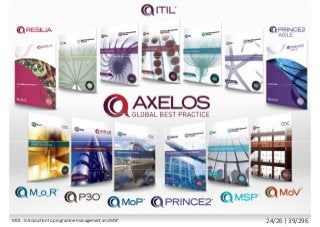
PRINCE2®,P3O®,MSP®,MoP®,M_o_R®,MoV®,ITIL®,P3M3®areregisteredtrademarksofAXELOSLtd.Theswirllogo™isatrademarkofAXELOSLtd
Start and finish Course style
LunchCoffee and breaks
M00 - Course introduction 2/15 | 2/296
 Explain the need for programme management
 Explain the role of programmes and programme
management in delivering business transformation
 Describe the responsibilities of the programme
team
 Describe the relationship between the MSP
Transformational Flow and the
Governance Themes
 Describe the correct sequence of processes in
the MSP Transformational Flow together with
the inputs, outputs, purpose and activities for each
process
Main goal
 Attempt Foundation exam with confidence
Secondary goal
 Benefits and value of programme management and MSP
M00 - Course introduction 3/15 | 3/296
 Please share with the class:
 Your name and surname
 Your organization
 Your profession (title, function, job
responsibilities)
 Your familiarity with the
PRINCE2/PMBOK
 Your familiarity with the programme
management
 Your experience with MSP/PgMP
 Your personal session expectations
M00 - Course introduction 4/15 | 4/296
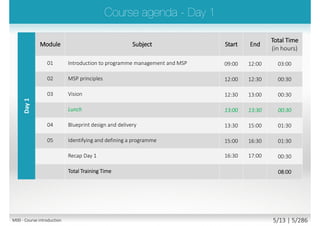
Day1
Module Subject Start End
Total Time
(in hours)
01 Introduction to programme management and MSP 09:00 12:00 03:00
02 MSP principles 12:00 12:30 00:30
03 Vision 12:30 13:00 00:30
Lunch 13:00 13:30 00:30
04 Blueprint design and delivery 13:30 15:00 01:30
05 Identifying and defining a programme 15:00 16:30 01:30
Recap Day 1 (including sample exam questions) 16:30 17:00 00:30
Total Training Time 08:00
M00 - Course introduction 5/15 | 5/296
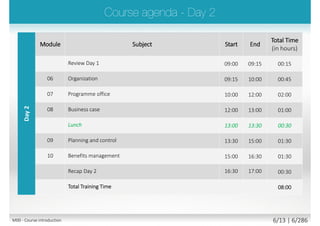
Day2
Module Subject Start End
Total Time
(in hours)
Review Day 1 09:00 09:15 00:15
06 Organization 09:15 10:00 00:45
07 Programme office 10:00 12:00 02:00
08 Business case 12:00 13:00 01:00
Lunch 13:00 13:30 00:30
09 Planning and control 13:30 15:00 01:30
10 Benefits management 15:00 16:30 01:30
Recap Day 2 (including sample exam questions) 16:30 17:00 00:30
Total Training Time 08:00
M00 - Course introduction 6/15 | 6/296
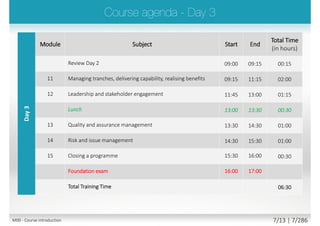
Day3
Module Subject Start End
Total Time
(in hours)
Review Day 2 09:00 09:15 00:15
11 Managing tranches, delivering capability, realising benefits 09:15 11:15 02:00
12 Leadership and stakeholder engagement 11:15 13:00 01:45
Lunch 13:00 13:30 00:30
13 Quality and assurance management 13:30 14:30 01:00
14 Risk and issue management 14:30 15:30 01:00
15 Closing a programme 15:30 16:00 00:30
Foundation exam 16:00 17:00
Total Training Time 07:00
M00 - Course introduction 7/15 | 7/296
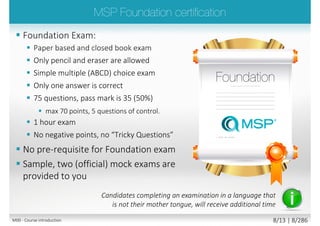
 Foundation Exam:
 Paper based and closed book exam
 Only pencil and eraser are allowed
 Simple multiple (ABCD) choice exam
 Only one answer is correct
 75 questions, pass mark is 35 (50%)
 max 70 points, 5 questions of control.
 1 hour exam
 No negative points, no “Tricky Questions”
 No pre-requisite for Foundation exam
 Sample, two (official) mock exams are
provided to you
Candidates completing an examination in a language that
is not their mother tongue, will receive additional time
M00 - Course introduction 8/15 | 8/296
 Practitioner Exam:
 Objective test based on a small programme
scenario
 Paper based and open book exam
 Reference to MSP handbook
 Handbook is provided for students
 2.5 hour
 4 questions worth 20 marks each (80
marks), pass mark is 40 (50%)
 Dictionary/translation lists allowed for non-
native speakers
 Non-scientific calculator for basic
calculations
Candidates completing an examination in a language that
is not their mother tongue, will receive additional time
M00 - Course introduction 9/15 | 9/296
 Advanced Practitioner Exam
 For (aspiring) programme managers
 Complex programme case study provided
in advance of the exam
 Paper based and open book exam
 Reference to MSP handbook
 Handbook is provided for students
 3 hour written exam
 Up to three questions with two or more
parts
 Pass mark is 50%
Candidates completing an examination in a language that
is not their mother tongue, will receive additional time
M00 - Course introduction 10/15 | 10/296
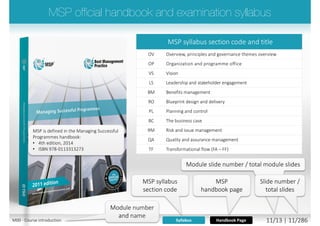
MSP syllabus section code and title
OV Overview, principles and governance themes overview
OP Organization and programme office
VS Vision
LS Leadership and stakeholder engagement
BM Benefits management
RO Blueprint design and delivery
PL Planning and control
BC The business case
RM Risk and issue management
QA Quality and assurance management
TF Transformational flow (FA – FF)
Module slide number / total module slides
Slide number /
total slides
Module number
and name
MSP
handbook page
MSP syllabus
section code
Syllabus Handbook PageM00 - Course introduction 11/15 | 11/296
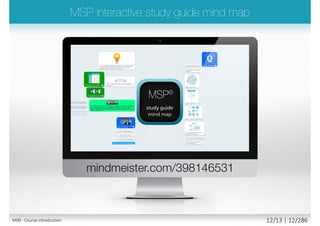
See Appendix #2 for more mind maps from AXELOS Global Best Practice
M00 - Course introduction 12/15 | 12/296
quizlet.com/42710311/
M00 - Course introduction 13/15 | 13/296
Freeware, scalable
MSP PDF reference
card
Governance Themes vs
Transformation Flow in one big
reference card with manual
reference
Free to download, use
and share
M00 - Course introduction 14/15 | 14/296
twitter.com/mirodabrowski
linkedin.com/in/miroslawdabrowski
google.com/+miroslawdabrowski
miroslaw_dabrowski
www.miroslawdabrowski.com
Mirosław Dąbrowski
Agile Coach, Trainer, Consultant
(former JEE/PHP developer, UX/UI designer, BA/SA)
Creator Writer / Translator Trainer / Coach
• Creator of 50+ mind maps from PPM and related
topics (2mln views): miroslawdabrowski.com
• Lead author of more than 50+ accredited materials
from PRINCE2, PRINCE2 Agile, MSP, MoP, P3O, ITIL,
M_o_R, MoV, PMP, Scrum, AgilePM, DSDM, CISSP,
CISA, CISM, CRISC, CGEIT, TOGAF, COBIT5 etc.
• Creator of 50+ interactive mind maps from PPM
topics: mindmeister.com/users/channel/2757050
• Product Owner of biggest Polish project
management portal: 4PM: 4pm.pl (15.000+ views
each month)
• Editorial Board Member of Official PMI Poland
Chapter magazine: “Strefa PMI”: strefapmi.pl
• Official PRINCE2 Agile, AgilePM, ASL2, BiSL methods
translator for Polish language
• English speaking, international, independent
trainer and coach from multiple domains.
• Master Lead Trainer
• 11+ years in training and coaching / 15.000+ hours
• 100+ certifications
• 5000+ people trained and coached
• 25+ trainers trained and coached
linkedin.com/in/miroslawdabrowski
Agile Coach / Scrum Master PM / IT architect Notable clients
• 8+ years of experience with Agile projects as a
Scrum Master, Product Owner and Agile Coach
• Coached 25+ teams from Agile and Scrum
• Agile Coach coaching C-level executives
• Scrum Master facilitating multiple teams
experienced with UX/UI + Dev teams
• Experience multiple Agile methods
• Author of AgilePM/DSDM Project Health Check
Questionnaire (PHCQ) audit tool
• Dozens of mobile and ecommerce projects
• IT architect experienced in IT projects with budget
above 10mln PLN and timeline of 3+ years
• Experienced with (“traditional”) projects under high
security, audit and compliance requirements based
on ISO/EIC 27001
• 25+ web portal design and development and
mobile application projects with iterative,
incremental and adaptive approach
ABB, AGH, Aiton Caldwell, Asseco, Capgemini, Deutsche Bank,
Descom, Ericsson, Ericpol, Euler Hermes, General Electric,
Glencore, HP Global Business Center, Ideo, Infovide-Matrix,
Interia, Kemira, Lufthansa Systems, Media-Satrun Group,
Ministry of Defense (Poland), Ministry of Justice (Poland),
Nokia Siemens Networks, Oracle, Orange, Polish Air Force,
Proama, Roche, Sabre Holdings, Samsung Electronics, Sescom,
Scania, Sopra Steria, Sun Microsystems, Tauron Polish Energy,
Tieto, University of Wroclaw, UBS Service Centre, Volvo IT…
miroslawdabrowski.com/about-me/clients-and-references/
Accreditations/certifications (selected): CISA, CISM, CRISC, CASP, Security+, Project+, Network+, Server+, Approved Trainer:
(MoP, MSP, PRINCE2, PRINCE2 Agile, M_o_R, MoV, P3O, ITIL Expert, RESILIA), ASL2, BiSL, Change Management,
Facilitation, Managing Benefits, COBIT5, TOGAF 8/9L2, OBASHI, CAPM, PSM I, SDC, SMC, ESMC, SPOC, AEC, DSDM Atern,
DSDM Agile Professional, DSDM Agile Trainer-Coach, AgilePM, OCUP Advanced, SCWCD, SCBCD, SCDJWS, SCMAD, ZCE 5.0,
ZCE 5.3, MCT, MCP, MCITP, MCSE-S, MCSA-S, MCS, MCSA, ISTQB, IQBBA, REQB, CIW Web Design / Web Development /
Web Security Professional, Playing Lean Facilitator, DISC D3 Consultant, SDI Facilitator, Certified Trainer Apollo 13 ITSM
Simulation …
M00 - Course introduction 15/15 | 15/296
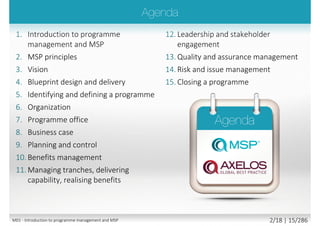
1. Introduction to programme
management and MSP
2. MSP principles
3. Vision
4. Blueprint design and delivery
5. Identifying and defining a programme
6. Organization
7. Programme office
8. Business case
9. Planning and control
10. Benefits management
11. Managing tranches, delivering
capability, realising benefits
12. Leadership and stakeholder
engagement
13. Quality and assurance management
14. Risk and issue management
15. Closing a programme
M01 - Introduction to programme management and MSP 2/26 | 17/296
©AXELOSLtd.2013.MaterialisreproducedunderlicencefromAXELOS.
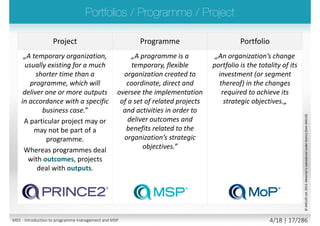
Project Programme Portfolio
A temporary organization,
usually existing for a much
shorter time than a
programme, which will
deliver one or more outputs
in accordance with a specific
business case.
A particular project may or
may not be part of a
programme.
Whereas programmes deal
with outcomes, projects
deal with outputs.
A programme is a temporary,
flexible organization created
to coordinate, direct and
oversee the implementation
of a set of related projects
and activities in order to
deliver outcomes and
benefits related to the
organization’s strategic
objectives.
An organization’s change
portfolio is the totality of its
investment (or segment
thereof) in the changes
required to achieve its
strategic objectives.
M01 - Introduction to programme management and MSP 3/26 | 18/296
©AXELOSLtd.2013.MaterialisreproducedunderlicencefromAXELOS.
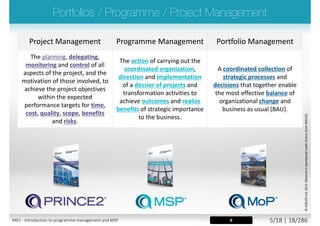
Project Management Programme Management Portfolio Management
The planning, delegating,
monitoring and control of all
aspects of the project, and the
motivation of those involved, to
achieve the project objectives
within the expected
performance targets for time,
cost, quality, scope, benefits
and risks.
The action of carrying out the
coordinated organization,
direction and implementation
of a dossier of projects and
transformation activities to
achieve outcomes and realize
benefits of strategic importance
to the business.
A coordinated collection of
strategic processes and
decisions that together enable
the most effective balance of
organizational change and
business as usual (BAU).
6M01 - Introduction to programme management and MSP 4/26 | 19/296
Side-effects and
consequences
Corporate
objectives
realize
further
also
cause
Project
outputs
Organizational
changes
Dis-benefits
enable
realize
helps achieve
one or more
Outcomes
Benefits
trigger
Result in
Capabilities
build
enable
Measurable
improvement
arising from an
outcome perceived
as an advantage by
one or more
stakeholders and
contributes to one
or more
organisational
objectives
Measurable
decline resulting
from an outcome
perceived as
negative by one or
more stakeholders
which reduces
one or more
organizational
objectives
Tangible or intangible
artefact produced,
constructed or created
as a result of a planned
activity
Completed set of project
outputs required to deliver an
outcome - exists prior to
transition
Result of change,
normally affecting
real-world behaviour
or circumstances
©AXELOSLtd.2013.MaterialisreproducedunderlicencefromAXELOS.
M01 - Introduction to programme management and MSP 5/26 | 20/296
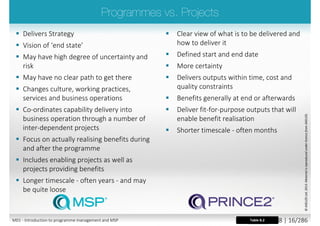
 Delivers Strategy
 Vision of ‘end state’
 May have high degree of uncertainty
 May have no clear path to get there
 Changes culture, working practices,
services and business operations
 Co-ordinates capability delivery into
business operation through a number of
inter-dependent projects
 Focus on actually realising benefits during
and after the programme
 Includes enabling projects as well as
projects providing benefits
 Longer timescale - often years - and may
be quite loose
 Clear view of what is to be delivered and
how to deliver it
 Clear end product definition (at least according
to PRINCE2). In case of Agile approaches this
does not apply in most cases
 Defined start and end date
 More certainty / Less risky
 Delivers outputs within time, cost and
quality constraints
 Benefits generally at end or afterwards
 Deliver fit-for-purpose outputs that will
enable benefit realisation
 Shorter timescale - often months
©AXELOSLtd.2013.MaterialisreproducedunderlicencefromAXELOS.
Table B.2M01 - Introduction to programme management and MSP 6/26 | 21/296
Key
Inner circle Transformational flow
Second ring Governance themes
Outer ring Principles
Programme
organization
Defining
Programme
Closing a
Programme
Delivering the
Capability
Realizing the
Benefits
Identifying a
Programme
Managingthe
Tranches
Remaining aligned
with corporate
strategy
©AXELOSLtd.2013.MaterialisreproducedunderlicencefromAXELOS.
Figure 1.5 MSP framework and concepts
M01 - Introduction to programme management and MSP 7/26 | 22/296
1999
• MSP V1
2003
• MSP V2
2007
• MSP V3
2011
• MSP V4
2013
• AXELOS
acquisition
M01 - Introduction to programme management and MSP 8/26 | 23/296
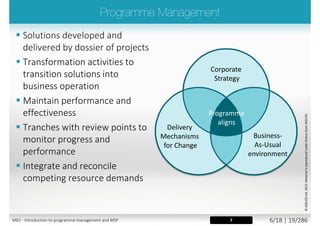
 Solutions developed and
delivered by dossier of projects
 Transformation activities to
transition solutions into
business operation
 Maintain performance and
effectiveness
 Tranches with review points to
monitor progress and
performance
 Integrate and reconcile
competing resource demands
Corporate
Strategy
Delivery
Mechanisms
for Change
Business-
As-Usual
environment
Programme
aligns
©AXELOSLtd.2013.MaterialisreproducedunderlicencefromAXELOS.
7M01 - Introduction to programme management and MSP 9/26 | 24/296
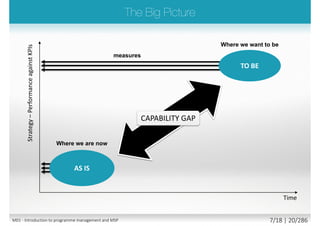
Where we want to be
CAPABILITY GAP
Where we are now
measures
Time
As is
Strategy–PerformanceagainstKPIs
To be
M01 - Introduction to programme management and MSP 10/26 | 25/296
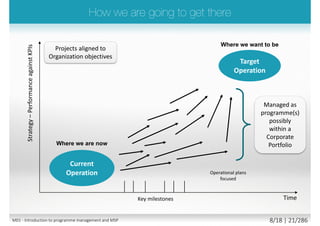
Projects aligned to
Organization objectives
Operational plans
focused
Key milestones
Managed as
programme(s)
possibly
within a
Corporate
Portfolio
Where we want to be
Target
Operation
Time
Current
Operation
Where we are now
Strategy–PerformanceagainstKPIs
M01 - Introduction to programme management and MSP 11/26 | 26/296
Tranche
end
Tranche
end
Projects aligned to
Organization objectives
Operational plans
focused
Key milestones
Where we want to be
Target
Operation
Time
Current
Operation
Where we are now
Strategy–PerformanceagainstKPIs
Managed as
programme(s)
possibly
within a
Corporate
Portfolio
M01 - Introduction to programme management and MSP 12/26 | 27/296
capability
project
project
activity
capability
Corporate
objective
Project life cycle
Programme
Programme
output
output
output
project
project
output
output
capability
benefits
dis-benefits
Outcomes
M01 - Introduction to programme management and MSP 13/26 | 28/296
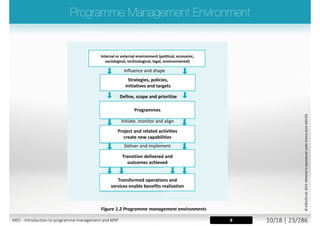
Strategies, policies,
Initiatives and targets
Define, scope and prioritize
Internal or external environment (political, economic,
sociological, technological, legal, environmental)
Influence and shape
Transformed operations and
services enable benefits realization
Transition delivered and
outcomes achieved
Project and related activities
create new capabilities
Deliver and implement
Programmes
Initiate, monitor and align
©AXELOSLtd.2013.MaterialisreproducedunderlicencefromAXELOS.
Figure 1.2 Programme management environments
8M01 - Introduction to programme management and MSP 14/26 | 29/296
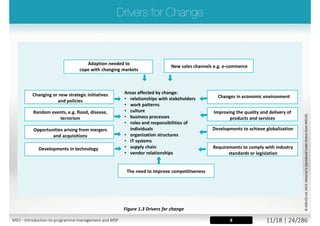
Changes in economic environment
Improving the quality and delivery of
products and services
Developments to achieve globalization
Requirements to comply with industry
standards or legislation
The need to improve competitiveness
Adaption needed to
cope with changing markets
New sales channels e.g. e-commerce
Changing or new strategic initiatives
and policies
Random events, e.g. flood, disease,
terrorism
Opportunities arising from mergers
and acquisitions
Developments in technology
Areas affected by change:
• relationships with stakeholders
• work patterns
• culture
• business processes
• roles and responsibilities of
individuals
• organization structures
• IT systems
• supply chain
• vendor relationships
©AXELOSLtd.2013.MaterialisreproducedunderlicencefromAXELOS.
Figure 1.3 Drivers for change
8M01 - Introduction to programme management and MSP 15/26 | 30/296
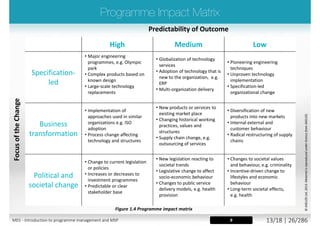
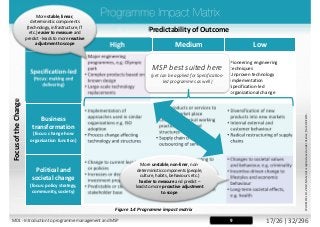
Predictability of Outcome
FocusoftheChange
©AXELOSLtd.2013.MaterialisreproducedunderlicencefromAXELOS.
Figure 1.4 Programme impact matrix
High Medium Low
Specification-led
(focus: making and
delivering)
• Major engineering
programmes, e.g. Olympic
park
• Complex products based on
known design
• Large-scale technology
replacements
• Globalization of technology
services
• Adoption of technology that is
new to the organization, e.g.
ERP
• Multi-organization delivery
• Pioneering engineering
techniques
• Unproven technology
implementation
• Specification-led
organizational change
Business
transformation
(focus: change how
organization function)
• Implementation of
approaches used in similar
organizations e.g. ISO
adoption
• Process change affecting
technology and structures
• New products or services to
existing market place
• Changing historical working
practices, values and
structures
• Supply chain change, e.g.
outsourcing of services
• Diversification of new
products into new markets
• Internal external and
customer behaviour
• Radical restructuring of supply
chains
Political and
societal change
(focus: policy strategy,
community, society)
• Change to current legislation
or policies
• Increases or decreases to
investment programmes
• Predictable or clear
stakeholder base
• New legislation reacting to
societal trends
• Legislative change to affect
socio-economic behaviour
• Changes to public service
delivery models, e.g. health
provision
• Changes to societal values
and behaviour, e.g. criminality
• Incentive-driven change to
lifestyles and economic
behaviour
• Long-term societal effects,
e.g. health
9M01 - Introduction to programme management and MSP 16/26 | 31/296
Predictability of Outcome
FocusoftheChange
©AXELOSLtd.2013.MaterialisreproducedunderlicencefromAXELOS.
Figure 1.4 Programme impact matrix
High Medium Low
Specification-led
(focus: making and
delivering)
• Major engineering
programmes, e.g. Olympic
park
• Complex products based on
known design
• Large-scale technology
replacements
• Globalization of technology
services
• Adoption of technology that is
new to the organization, e.g.
ERP
• Multi-organization delivery
• Pioneering engineering
techniques
• Unproven technology
implementation
• Specification-led
organizational change
Business
transformation
(focus: change how
organization function)
• Implementation of
approaches used in similar
organizations e.g. ISO
adoption
• Process change affecting
technology and structures
• New products or services to
existing market place
• Changing historical working
practices, values and
structures
• Supply chain change, e.g.
outsourcing of services
• Diversification of new
products into new markets
• Internal external and
customer behaviour
• Radical restructuring of supply
chains
Political and
societal change
(focus: policy strategy,
community, society)
• Change to current legislation
or policies
• Increases or decreases to
investment programmes
• Predictable or clear
stakeholder base
• New legislation reacting to
societal trends
• Legislative change to affect
socio-economic behaviour
• Changes to public service
delivery models, e.g. health
provision
• Changes to societal values
and behaviour, e.g. criminality
• Incentive-driven change to
lifestyles and economic
behaviour
• Long-term societal effects,
e.g. health
9
More stable, linear,
deterministic components
(technology, infrastructure, IT
etc.) easier to measure and
predict - leads to more reactive
adjustment to scope
MSP best suited here
(yet can be applied for Specification-
led programmes as well)
More unstable, non-liner, non-
deterministic components (people,
culture, habits, behaviours etc.)
harder to measure and predict –
leads to more proactive adjustment
to scope
M01 - Introduction to programme management and MSP 17/26 | 32/296
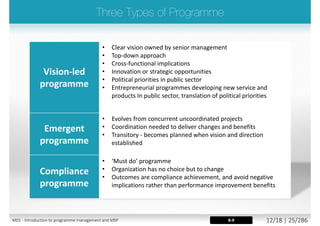
8-9
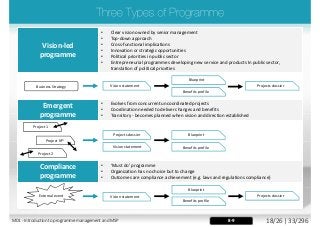
Vision-led
programme
• Clear vision owned by senior management
• Top-down approach
• Cross-functional implications
• Innovation or strategic opportunities
• Political priorities in public sector
• Entrepreneurial programmes developing new service and products In public sector,
translation of political priorities
Emergent
programme
• Evolves from concurrent uncoordinated projects
• Coordination needed to deliver changes and benefits
• Transitory - becomes planned when vision and direction established
Compliance
programme
• ‘Must do’ programme
• Organization has no choice but to change
• Outcomes are compliance achievement (e.g. laws and regulations compliance)
Vision statementBusiness Strategy
Project 1
Project 2
Project Nth
Vision statement
Vision statement
Blueprint
Benefits profile
External event Projects dossier
Projects dossier
Blueprint
Benefits profile
Projects dossier Blueprint
Benefits profile
M01 - Introduction to programme management and MSP 18/26 | 33/296
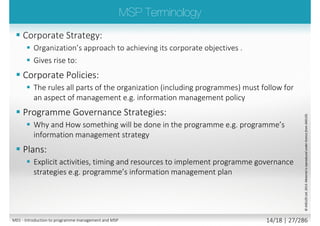
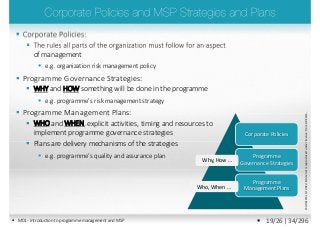
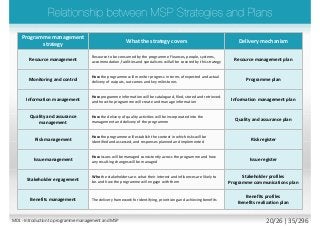
 Corporate Policies:
 The rules all parts of the organization must follow for an aspect
of management
 e.g. organization risk management policy
 Programme Governance Strategies:
 WHY and HOW something will be done in the programme
 e.g. programme’s risk management strategy
 Programme Management Plans:
 WHO and WHEN, explicit activities, timing and resources to
implement programme governance strategies
 Plans are delivery mechanisms of the strategies
 e.g. programme’s quality and assurance plan
©AXELOSLtd.2013.MaterialisreproducedunderlicencefromAXELOS.
Corporate Policies
Programme
Governance Strategies
Programme
Management Plans
Why, How …
Who, When …
 M01 - Introduction to programme management and MSP  19/26 | 34/296
Programme management
strategy
What the strategy covers Delivery mechanism
Resource management
Resource to be consumed by the programme Finances, people, systems,
accommodation, facilities and specialisms will all be covered by this strategy
Resource management plan
Monitoring and control
How the programme will monitor progress in terms of expected and actual
delivery of outputs, outcomes and key milestones
Programme plan
Information management
How programme information will be catalogued, filed, stored and retrieved.
and how the programme will create and manage information
Information management plan
Quality and assurance
management
How the delivery of quality activities will be incorporated into the
management and delivery of the programme
Quality and assurance plan
Risk management
How the programme will establish the context in which risks will be
identified and assessed, and responses planned and implemented
Risk register
Issue management
How issues will be managed consistently across the programme and how
any resulting changes will be managed
Issue register
Stakeholder engagement
Who the stakeholders are. what their interest and influences are likely to
be. and how the programme will engage with them
Stakeholder profiles
Programme communications plan
Benefits management The delivery framework for identifying, prioritizing and achieving benefits
Benefits profiles
Benefits realization plan
M01 - Introduction to programme management and MSP 20/26 | 35/296
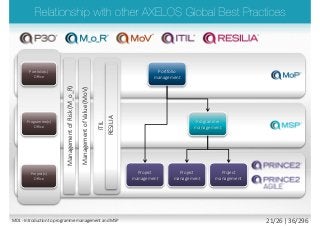
Portfolio
management
Portfolio(s)
Office
Programme
management
Programme(s)
Office
Project(s)
Office
Project
management
Project
management
Project
management
ManagementofRisk(M_o_R)
ITIL
ManagementofValue(MoV)
RESILIA
M01 - Introduction to programme management and MSP 21/26 | 36/296
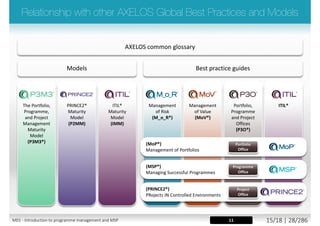
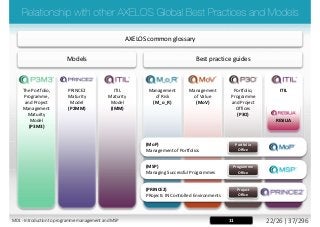
11
The Portfolio,
Programme,
and Project
Management
Maturity
Model
(P3M3)
ITIL
Maturity
Model
(IMM)
ITILPortfolio,
Programme
and Project
Offices
(P3O)
Management
of Value
(MoV)
Management
of Risk
(M_o_R)
Best practice guides
AXELOS common glossary
PRINCE2
Maturity
Model
(P2MM)
Models
(MoP)
Management of Portfolios
(MSP)
Managing Successful Programmes
(PRINCE2)
PRojects IN Controlled Environments
Portfolio
Office
Programme
Office
Project
Office
RESILIA
M01 - Introduction to programme management and MSP 22/26 | 37/296
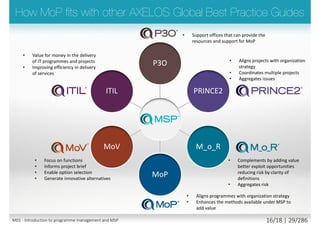
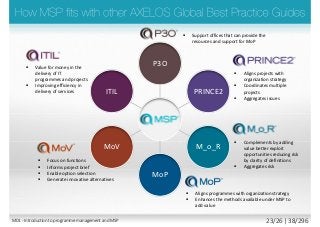
P3O
PRINCE2
M_o_R
MoP
MoV
ITIL
 Value for money in the
delivery of IT
programmes and projects
 Improving efficiency in
delivery of services
 Support offices that can provide the
resources and support for MoP
 Aligns projects with
organization strategy
 Coordinates multiple
projects
 Aggregates issues
 Complements by adding
value better exploit
opportunities reducing risk
by clarity of definitions
 Aggregates risk
 Aligns programmes with organization strategy
 Enhances the methods available under MSP to
add value
 Focus on functions
 Informs project brief
 Enable option selection
 Generate innovative alternatives
M01 - Introduction to programme management and MSP 23/26 | 38/296
M01 - Introduction to programme management and MSP 24/26 | 39/296
M01 - Introduction to programme management and MSP 25/26 | 40/296
I hope you enjoyed
this presentation. If so,
please like, share and
leave a comment
below.
Endorsements on
LinkedIn are also
highly appreciated! 
(your feedback = more free stuff)

MIROSLAWDABROWSKI.COM/downloads

AXELOS - MSP® - Managing Successful Programmes - Foundation

  • 1.
  • 2.
    Start and finishCourse style LunchCoffee and breaks M00 - Course introduction 2/15 | 2/296
  • 3.
     Explain theneed for programme management  Explain the role of programmes and programme management in delivering business transformation  Describe the responsibilities of the programme team  Describe the relationship between the MSP Transformational Flow and the Governance Themes  Describe the correct sequence of processes in the MSP Transformational Flow together with the inputs, outputs, purpose and activities for each process Main goal  Attempt Foundation exam with confidence Secondary goal  Benefits and value of programme management and MSP M00 - Course introduction 3/15 | 3/296
  • 4.
     Please sharewith the class:  Your name and surname  Your organization  Your profession (title, function, job responsibilities)  Your familiarity with the PRINCE2/PMBOK  Your familiarity with the programme management  Your experience with MSP/PgMP  Your personal session expectations M00 - Course introduction 4/15 | 4/296
  • 5.
    Day1 Module Subject StartEnd Total Time (in hours) 01 Introduction to programme management and MSP 09:00 12:00 03:00 02 MSP principles 12:00 12:30 00:30 03 Vision 12:30 13:00 00:30 Lunch 13:00 13:30 00:30 04 Blueprint design and delivery 13:30 15:00 01:30 05 Identifying and defining a programme 15:00 16:30 01:30 Recap Day 1 (including sample exam questions) 16:30 17:00 00:30 Total Training Time 08:00 M00 - Course introduction 5/15 | 5/296
  • 6.
    Day2 Module Subject StartEnd Total Time (in hours) Review Day 1 09:00 09:15 00:15 06 Organization 09:15 10:00 00:45 07 Programme office 10:00 12:00 02:00 08 Business case 12:00 13:00 01:00 Lunch 13:00 13:30 00:30 09 Planning and control 13:30 15:00 01:30 10 Benefits management 15:00 16:30 01:30 Recap Day 2 (including sample exam questions) 16:30 17:00 00:30 Total Training Time 08:00 M00 - Course introduction 6/15 | 6/296
  • 7.
    Day3 Module Subject StartEnd Total Time (in hours) Review Day 2 09:00 09:15 00:15 11 Managing tranches, delivering capability, realising benefits 09:15 11:15 02:00 12 Leadership and stakeholder engagement 11:15 13:00 01:45 Lunch 13:00 13:30 00:30 13 Quality and assurance management 13:30 14:30 01:00 14 Risk and issue management 14:30 15:30 01:00 15 Closing a programme 15:30 16:00 00:30 Foundation exam 16:00 17:00 Total Training Time 07:00 M00 - Course introduction 7/15 | 7/296
  • 8.
     Foundation Exam: Paper based and closed book exam  Only pencil and eraser are allowed  Simple multiple (ABCD) choice exam  Only one answer is correct  75 questions, pass mark is 35 (50%)  max 70 points, 5 questions of control.  1 hour exam  No negative points, no “Tricky Questions”  No pre-requisite for Foundation exam  Sample, two (official) mock exams are provided to you Candidates completing an examination in a language that is not their mother tongue, will receive additional time M00 - Course introduction 8/15 | 8/296
  • 9.
     Practitioner Exam: Objective test based on a small programme scenario  Paper based and open book exam  Reference to MSP handbook  Handbook is provided for students  2.5 hour  4 questions worth 20 marks each (80 marks), pass mark is 40 (50%)  Dictionary/translation lists allowed for non- native speakers  Non-scientific calculator for basic calculations Candidates completing an examination in a language that is not their mother tongue, will receive additional time M00 - Course introduction 9/15 | 9/296
  • 10.
     Advanced PractitionerExam  For (aspiring) programme managers  Complex programme case study provided in advance of the exam  Paper based and open book exam  Reference to MSP handbook  Handbook is provided for students  3 hour written exam  Up to three questions with two or more parts  Pass mark is 50% Candidates completing an examination in a language that is not their mother tongue, will receive additional time M00 - Course introduction 10/15 | 10/296
  • 11.
    MSP syllabus sectioncode and title OV Overview, principles and governance themes overview OP Organization and programme office VS Vision LS Leadership and stakeholder engagement BM Benefits management RO Blueprint design and delivery PL Planning and control BC The business case RM Risk and issue management QA Quality and assurance management TF Transformational flow (FA – FF) Module slide number / total module slides Slide number / total slides Module number and name MSP handbook page MSP syllabus section code Syllabus Handbook PageM00 - Course introduction 11/15 | 11/296
  • 12.
    See Appendix #2for more mind maps from AXELOS Global Best Practice M00 - Course introduction 12/15 | 12/296
  • 13.
    quizlet.com/42710311/ M00 - Courseintroduction 13/15 | 13/296
  • 14.
    Freeware, scalable MSP PDFreference card Governance Themes vs Transformation Flow in one big reference card with manual reference Free to download, use and share M00 - Course introduction 14/15 | 14/296
  • 15.
    twitter.com/mirodabrowski linkedin.com/in/miroslawdabrowski google.com/+miroslawdabrowski miroslaw_dabrowski www.miroslawdabrowski.com Mirosław Dąbrowski Agile Coach,Trainer, Consultant (former JEE/PHP developer, UX/UI designer, BA/SA) Creator Writer / Translator Trainer / Coach • Creator of 50+ mind maps from PPM and related topics (2mln views): miroslawdabrowski.com • Lead author of more than 50+ accredited materials from PRINCE2, PRINCE2 Agile, MSP, MoP, P3O, ITIL, M_o_R, MoV, PMP, Scrum, AgilePM, DSDM, CISSP, CISA, CISM, CRISC, CGEIT, TOGAF, COBIT5 etc. • Creator of 50+ interactive mind maps from PPM topics: mindmeister.com/users/channel/2757050 • Product Owner of biggest Polish project management portal: 4PM: 4pm.pl (15.000+ views each month) • Editorial Board Member of Official PMI Poland Chapter magazine: “Strefa PMI”: strefapmi.pl • Official PRINCE2 Agile, AgilePM, ASL2, BiSL methods translator for Polish language • English speaking, international, independent trainer and coach from multiple domains. • Master Lead Trainer • 11+ years in training and coaching / 15.000+ hours • 100+ certifications • 5000+ people trained and coached • 25+ trainers trained and coached linkedin.com/in/miroslawdabrowski Agile Coach / Scrum Master PM / IT architect Notable clients • 8+ years of experience with Agile projects as a Scrum Master, Product Owner and Agile Coach • Coached 25+ teams from Agile and Scrum • Agile Coach coaching C-level executives • Scrum Master facilitating multiple teams experienced with UX/UI + Dev teams • Experience multiple Agile methods • Author of AgilePM/DSDM Project Health Check Questionnaire (PHCQ) audit tool • Dozens of mobile and ecommerce projects • IT architect experienced in IT projects with budget above 10mln PLN and timeline of 3+ years • Experienced with (“traditional”) projects under high security, audit and compliance requirements based on ISO/EIC 27001 • 25+ web portal design and development and mobile application projects with iterative, incremental and adaptive approach ABB, AGH, Aiton Caldwell, Asseco, Capgemini, Deutsche Bank, Descom, Ericsson, Ericpol, Euler Hermes, General Electric, Glencore, HP Global Business Center, Ideo, Infovide-Matrix, Interia, Kemira, Lufthansa Systems, Media-Satrun Group, Ministry of Defense (Poland), Ministry of Justice (Poland), Nokia Siemens Networks, Oracle, Orange, Polish Air Force, Proama, Roche, Sabre Holdings, Samsung Electronics, Sescom, Scania, Sopra Steria, Sun Microsystems, Tauron Polish Energy, Tieto, University of Wroclaw, UBS Service Centre, Volvo IT… miroslawdabrowski.com/about-me/clients-and-references/ Accreditations/certifications (selected): CISA, CISM, CRISC, CASP, Security+, Project+, Network+, Server+, Approved Trainer: (MoP, MSP, PRINCE2, PRINCE2 Agile, M_o_R, MoV, P3O, ITIL Expert, RESILIA), ASL2, BiSL, Change Management, Facilitation, Managing Benefits, COBIT5, TOGAF 8/9L2, OBASHI, CAPM, PSM I, SDC, SMC, ESMC, SPOC, AEC, DSDM Atern, DSDM Agile Professional, DSDM Agile Trainer-Coach, AgilePM, OCUP Advanced, SCWCD, SCBCD, SCDJWS, SCMAD, ZCE 5.0, ZCE 5.3, MCT, MCP, MCITP, MCSE-S, MCSA-S, MCS, MCSA, ISTQB, IQBBA, REQB, CIW Web Design / Web Development / Web Security Professional, Playing Lean Facilitator, DISC D3 Consultant, SDI Facilitator, Certified Trainer Apollo 13 ITSM Simulation … M00 - Course introduction 15/15 | 15/296
  • 17.
    1. Introduction toprogramme management and MSP 2. MSP principles 3. Vision 4. Blueprint design and delivery 5. Identifying and defining a programme 6. Organization 7. Programme office 8. Business case 9. Planning and control 10. Benefits management 11. Managing tranches, delivering capability, realising benefits 12. Leadership and stakeholder engagement 13. Quality and assurance management 14. Risk and issue management 15. Closing a programme M01 - Introduction to programme management and MSP 2/26 | 17/296
  • 18.
    ©AXELOSLtd.2013.MaterialisreproducedunderlicencefromAXELOS. Project Programme Portfolio Atemporary organization, usually existing for a much shorter time than a programme, which will deliver one or more outputs in accordance with a specific business case. A particular project may or may not be part of a programme. Whereas programmes deal with outcomes, projects deal with outputs. A programme is a temporary, flexible organization created to coordinate, direct and oversee the implementation of a set of related projects and activities in order to deliver outcomes and benefits related to the organization’s strategic objectives. An organization’s change portfolio is the totality of its investment (or segment thereof) in the changes required to achieve its strategic objectives. M01 - Introduction to programme management and MSP 3/26 | 18/296
  • 19.
    ©AXELOSLtd.2013.MaterialisreproducedunderlicencefromAXELOS. Project Management ProgrammeManagement Portfolio Management The planning, delegating, monitoring and control of all aspects of the project, and the motivation of those involved, to achieve the project objectives within the expected performance targets for time, cost, quality, scope, benefits and risks. The action of carrying out the coordinated organization, direction and implementation of a dossier of projects and transformation activities to achieve outcomes and realize benefits of strategic importance to the business. A coordinated collection of strategic processes and decisions that together enable the most effective balance of organizational change and business as usual (BAU). 6M01 - Introduction to programme management and MSP 4/26 | 19/296
  • 20.
    Side-effects and consequences Corporate objectives realize further also cause Project outputs Organizational changes Dis-benefits enable realize helps achieve oneor more Outcomes Benefits trigger Result in Capabilities build enable Measurable improvement arising from an outcome perceived as an advantage by one or more stakeholders and contributes to one or more organisational objectives Measurable decline resulting from an outcome perceived as negative by one or more stakeholders which reduces one or more organizational objectives Tangible or intangible artefact produced, constructed or created as a result of a planned activity Completed set of project outputs required to deliver an outcome - exists prior to transition Result of change, normally affecting real-world behaviour or circumstances ©AXELOSLtd.2013.MaterialisreproducedunderlicencefromAXELOS. M01 - Introduction to programme management and MSP 5/26 | 20/296
  • 21.
     Delivers Strategy Vision of ‘end state’  May have high degree of uncertainty  May have no clear path to get there  Changes culture, working practices, services and business operations  Co-ordinates capability delivery into business operation through a number of inter-dependent projects  Focus on actually realising benefits during and after the programme  Includes enabling projects as well as projects providing benefits  Longer timescale - often years - and may be quite loose  Clear view of what is to be delivered and how to deliver it  Clear end product definition (at least according to PRINCE2). In case of Agile approaches this does not apply in most cases  Defined start and end date  More certainty / Less risky  Delivers outputs within time, cost and quality constraints  Benefits generally at end or afterwards  Deliver fit-for-purpose outputs that will enable benefit realisation  Shorter timescale - often months ©AXELOSLtd.2013.MaterialisreproducedunderlicencefromAXELOS. Table B.2M01 - Introduction to programme management and MSP 6/26 | 21/296
  • 22.
    Key Inner circle Transformationalflow Second ring Governance themes Outer ring Principles Programme organization Defining Programme Closing a Programme Delivering the Capability Realizing the Benefits Identifying a Programme Managingthe Tranches Remaining aligned with corporate strategy ©AXELOSLtd.2013.MaterialisreproducedunderlicencefromAXELOS. Figure 1.5 MSP framework and concepts M01 - Introduction to programme management and MSP 7/26 | 22/296
  • 23.
    1999 • MSP V1 2003 •MSP V2 2007 • MSP V3 2011 • MSP V4 2013 • AXELOS acquisition M01 - Introduction to programme management and MSP 8/26 | 23/296
  • 24.
     Solutions developedand delivered by dossier of projects  Transformation activities to transition solutions into business operation  Maintain performance and effectiveness  Tranches with review points to monitor progress and performance  Integrate and reconcile competing resource demands Corporate Strategy Delivery Mechanisms for Change Business- As-Usual environment Programme aligns ©AXELOSLtd.2013.MaterialisreproducedunderlicencefromAXELOS. 7M01 - Introduction to programme management and MSP 9/26 | 24/296
  • 25.
    Where we wantto be CAPABILITY GAP Where we are now measures Time As is Strategy–PerformanceagainstKPIs To be M01 - Introduction to programme management and MSP 10/26 | 25/296
  • 26.
    Projects aligned to Organizationobjectives Operational plans focused Key milestones Managed as programme(s) possibly within a Corporate Portfolio Where we want to be Target Operation Time Current Operation Where we are now Strategy–PerformanceagainstKPIs M01 - Introduction to programme management and MSP 11/26 | 26/296
  • 27.
    Tranche end Tranche end Projects aligned to Organizationobjectives Operational plans focused Key milestones Where we want to be Target Operation Time Current Operation Where we are now Strategy–PerformanceagainstKPIs Managed as programme(s) possibly within a Corporate Portfolio M01 - Introduction to programme management and MSP 12/26 | 27/296
  • 28.
  • 29.
    Strategies, policies, Initiatives andtargets Define, scope and prioritize Internal or external environment (political, economic, sociological, technological, legal, environmental) Influence and shape Transformed operations and services enable benefits realization Transition delivered and outcomes achieved Project and related activities create new capabilities Deliver and implement Programmes Initiate, monitor and align ©AXELOSLtd.2013.MaterialisreproducedunderlicencefromAXELOS. Figure 1.2 Programme management environments 8M01 - Introduction to programme management and MSP 14/26 | 29/296
  • 30.
    Changes in economicenvironment Improving the quality and delivery of products and services Developments to achieve globalization Requirements to comply with industry standards or legislation The need to improve competitiveness Adaption needed to cope with changing markets New sales channels e.g. e-commerce Changing or new strategic initiatives and policies Random events, e.g. flood, disease, terrorism Opportunities arising from mergers and acquisitions Developments in technology Areas affected by change: • relationships with stakeholders • work patterns • culture • business processes • roles and responsibilities of individuals • organization structures • IT systems • supply chain • vendor relationships ©AXELOSLtd.2013.MaterialisreproducedunderlicencefromAXELOS. Figure 1.3 Drivers for change 8M01 - Introduction to programme management and MSP 15/26 | 30/296
  • 31.
    Predictability of Outcome FocusoftheChange ©AXELOSLtd.2013.MaterialisreproducedunderlicencefromAXELOS. Figure1.4 Programme impact matrix High Medium Low Specification-led (focus: making and delivering) • Major engineering programmes, e.g. Olympic park • Complex products based on known design • Large-scale technology replacements • Globalization of technology services • Adoption of technology that is new to the organization, e.g. ERP • Multi-organization delivery • Pioneering engineering techniques • Unproven technology implementation • Specification-led organizational change Business transformation (focus: change how organization function) • Implementation of approaches used in similar organizations e.g. ISO adoption • Process change affecting technology and structures • New products or services to existing market place • Changing historical working practices, values and structures • Supply chain change, e.g. outsourcing of services • Diversification of new products into new markets • Internal external and customer behaviour • Radical restructuring of supply chains Political and societal change (focus: policy strategy, community, society) • Change to current legislation or policies • Increases or decreases to investment programmes • Predictable or clear stakeholder base • New legislation reacting to societal trends • Legislative change to affect socio-economic behaviour • Changes to public service delivery models, e.g. health provision • Changes to societal values and behaviour, e.g. criminality • Incentive-driven change to lifestyles and economic behaviour • Long-term societal effects, e.g. health 9M01 - Introduction to programme management and MSP 16/26 | 31/296
  • 32.
    Predictability of Outcome FocusoftheChange ©AXELOSLtd.2013.MaterialisreproducedunderlicencefromAXELOS. Figure1.4 Programme impact matrix High Medium Low Specification-led (focus: making and delivering) • Major engineering programmes, e.g. Olympic park • Complex products based on known design • Large-scale technology replacements • Globalization of technology services • Adoption of technology that is new to the organization, e.g. ERP • Multi-organization delivery • Pioneering engineering techniques • Unproven technology implementation • Specification-led organizational change Business transformation (focus: change how organization function) • Implementation of approaches used in similar organizations e.g. ISO adoption • Process change affecting technology and structures • New products or services to existing market place • Changing historical working practices, values and structures • Supply chain change, e.g. outsourcing of services • Diversification of new products into new markets • Internal external and customer behaviour • Radical restructuring of supply chains Political and societal change (focus: policy strategy, community, society) • Change to current legislation or policies • Increases or decreases to investment programmes • Predictable or clear stakeholder base • New legislation reacting to societal trends • Legislative change to affect socio-economic behaviour • Changes to public service delivery models, e.g. health provision • Changes to societal values and behaviour, e.g. criminality • Incentive-driven change to lifestyles and economic behaviour • Long-term societal effects, e.g. health 9 More stable, linear, deterministic components (technology, infrastructure, IT etc.) easier to measure and predict - leads to more reactive adjustment to scope MSP best suited here (yet can be applied for Specification- led programmes as well) More unstable, non-liner, non- deterministic components (people, culture, habits, behaviours etc.) harder to measure and predict – leads to more proactive adjustment to scope M01 - Introduction to programme management and MSP 17/26 | 32/296
  • 33.
    8-9 Vision-led programme • Clear visionowned by senior management • Top-down approach • Cross-functional implications • Innovation or strategic opportunities • Political priorities in public sector • Entrepreneurial programmes developing new service and products In public sector, translation of political priorities Emergent programme • Evolves from concurrent uncoordinated projects • Coordination needed to deliver changes and benefits • Transitory - becomes planned when vision and direction established Compliance programme • ‘Must do’ programme • Organization has no choice but to change • Outcomes are compliance achievement (e.g. laws and regulations compliance) Vision statementBusiness Strategy Project 1 Project 2 Project Nth Vision statement Vision statement Blueprint Benefits profile External event Projects dossier Projects dossier Blueprint Benefits profile Projects dossier Blueprint Benefits profile M01 - Introduction to programme management and MSP 18/26 | 33/296
  • 34.
     Corporate Policies: The rules all parts of the organization must follow for an aspect of management  e.g. organization risk management policy  Programme Governance Strategies:  WHY and HOW something will be done in the programme  e.g. programme’s risk management strategy  Programme Management Plans:  WHO and WHEN, explicit activities, timing and resources to implement programme governance strategies  Plans are delivery mechanisms of the strategies  e.g. programme’s quality and assurance plan ©AXELOSLtd.2013.MaterialisreproducedunderlicencefromAXELOS. Corporate Policies Programme Governance Strategies Programme Management Plans Why, How … Who, When …  M01 - Introduction to programme management and MSP  19/26 | 34/296
  • 35.
    Programme management strategy What thestrategy covers Delivery mechanism Resource management Resource to be consumed by the programme Finances, people, systems, accommodation, facilities and specialisms will all be covered by this strategy Resource management plan Monitoring and control How the programme will monitor progress in terms of expected and actual delivery of outputs, outcomes and key milestones Programme plan Information management How programme information will be catalogued, filed, stored and retrieved. and how the programme will create and manage information Information management plan Quality and assurance management How the delivery of quality activities will be incorporated into the management and delivery of the programme Quality and assurance plan Risk management How the programme will establish the context in which risks will be identified and assessed, and responses planned and implemented Risk register Issue management How issues will be managed consistently across the programme and how any resulting changes will be managed Issue register Stakeholder engagement Who the stakeholders are. what their interest and influences are likely to be. and how the programme will engage with them Stakeholder profiles Programme communications plan Benefits management The delivery framework for identifying, prioritizing and achieving benefits Benefits profiles Benefits realization plan M01 - Introduction to programme management and MSP 20/26 | 35/296
  • 36.
  • 37.
    11 The Portfolio, Programme, and Project Management Maturity Model (P3M3) ITIL Maturity Model (IMM) ITILPortfolio, Programme andProject Offices (P3O) Management of Value (MoV) Management of Risk (M_o_R) Best practice guides AXELOS common glossary PRINCE2 Maturity Model (P2MM) Models (MoP) Management of Portfolios (MSP) Managing Successful Programmes (PRINCE2) PRojects IN Controlled Environments Portfolio Office Programme Office Project Office RESILIA M01 - Introduction to programme management and MSP 22/26 | 37/296
  • 38.
    P3O PRINCE2 M_o_R MoP MoV ITIL  Value formoney in the delivery of IT programmes and projects  Improving efficiency in delivery of services  Support offices that can provide the resources and support for MoP  Aligns projects with organization strategy  Coordinates multiple projects  Aggregates issues  Complements by adding value better exploit opportunities reducing risk by clarity of definitions  Aggregates risk  Aligns programmes with organization strategy  Enhances the methods available under MSP to add value  Focus on functions  Informs project brief  Enable option selection  Generate innovative alternatives M01 - Introduction to programme management and MSP 23/26 | 38/296
  • 39.
    M01 - Introductionto programme management and MSP 24/26 | 39/296
  • 40.
    M01 - Introductionto programme management and MSP 25/26 | 40/296
  • 41.
    I hope youenjoyed this presentation. If so, please like, share and leave a comment below. Endorsements on LinkedIn are also highly appreciated!  (your feedback = more free stuff)  MIROSLAWDABROWSKI.COM/downloads