

PROGRAM
MANAGEMENT
        TRAINING
[
TRAINING


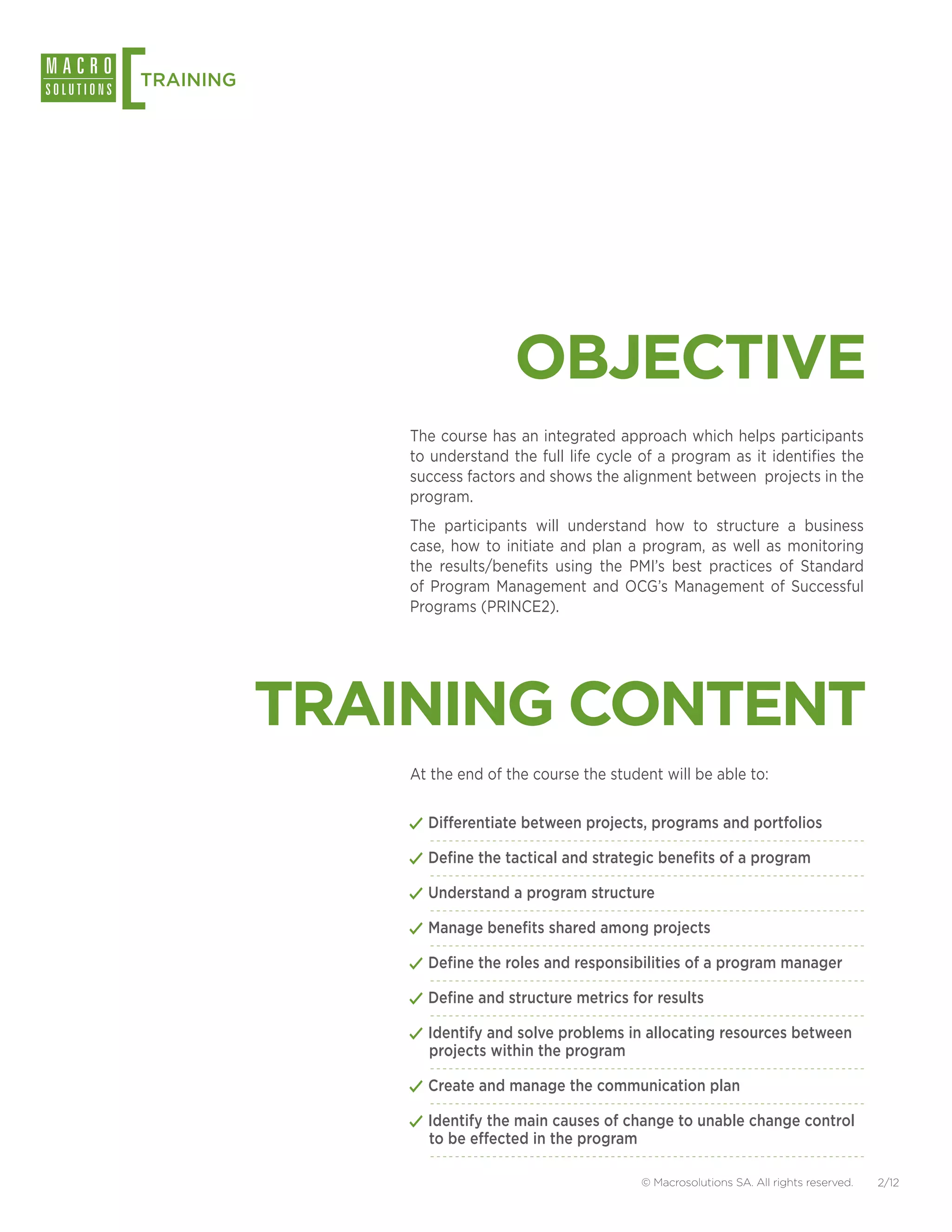
                              OBJECTIVE
               The course has an integrated approach which helps participants
               to understand the full life cycle of a program as it identifies the
               success factors and shows the alignment between projects in the
               program.
               The participants will understand how to structure a business
               case, how to initiate and plan a program, as well as monitoring
               the results/benefits using the PMI’s best practices of Standard
               of Program Management and OCG’s Management of Successful
               Programs (PRINCE2).


           TRAINING CONTENT
               At the end of the course the student will be able to:


               ✓✓Differentiate between projects, programs and portfolios
               ✓✓Define the tactical and strategic benefits of a program
               ✓✓Understand a program structure
               ✓✓Manage benefits shared among projects
               ✓✓Define the roles and responsibilities of a program manager
               ✓✓Define and structure metrics for results
               ✓✓Identify and solve problems in allocating resources between
                 projects within the program

               ✓✓Create and manage the communication plan
               ✓✓Identify the main causes of change to unable change control
                 to be effected in the program

                                                 © Macrosolutions SA. All rights reserved.   2/12
[
TRAINING


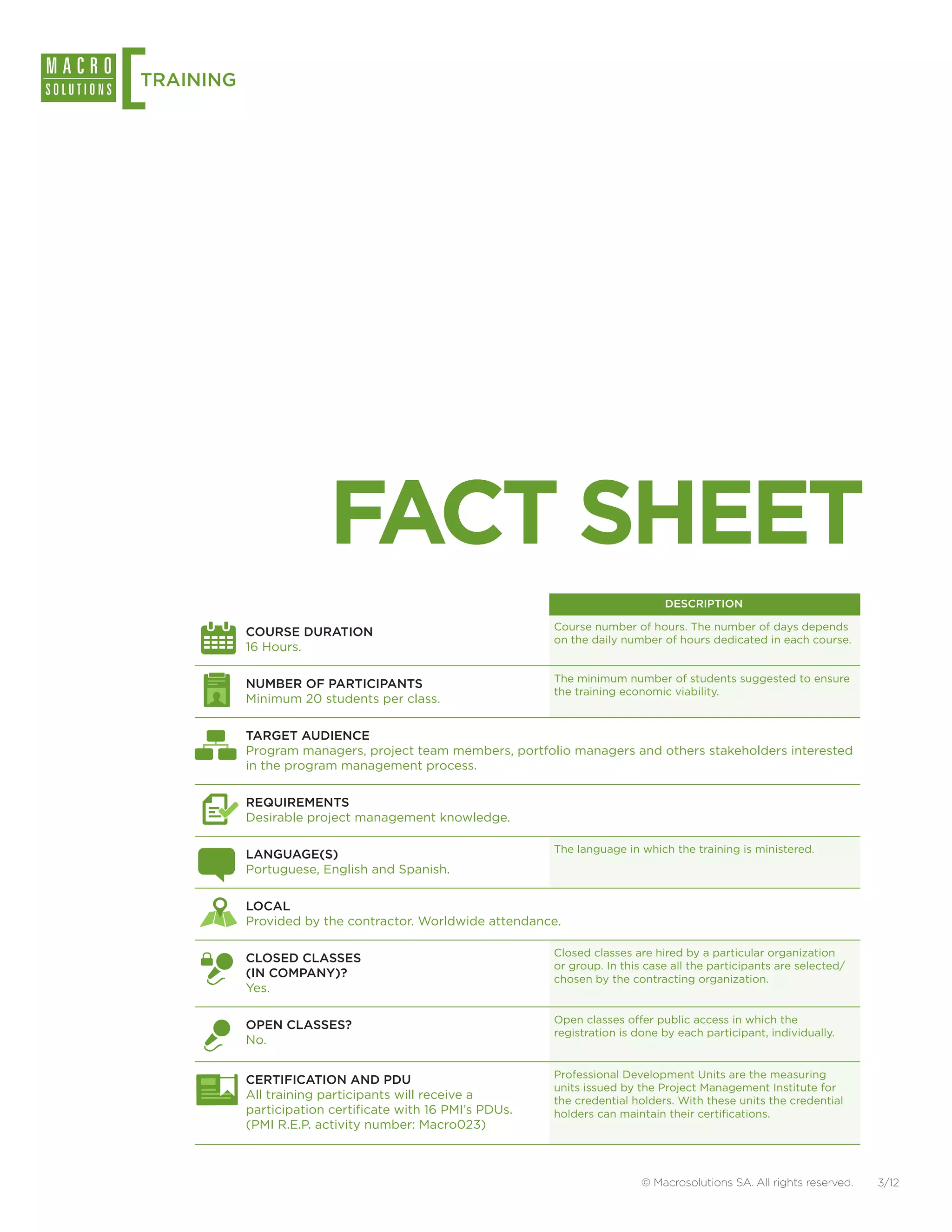
                         FACT SHEET
                                                                                DESCRIPTION

                                                           Course number of hours. The number of days depends
           COURSE DURATION
                                                           on the daily number of hours dedicated in each course.
           16 Hours.

                                                           The minimum number of students suggested to ensure
           NUMBER OF PARTICIPANTS
                                                           the training economic viability.
           Minimum 20 students per class.

           TARGET AUDIENCE
           Program managers, project team members, portfolio managers and others stakeholders interested
           in the program management process.

           REQUIREMENTS
           Desirable project management knowledge.

                                                           The language in which the training is ministered.
           LANGUAGE(S)
           Portuguese, English and Spanish.

           LOCAL
           Provided by the contractor. Worldwide attendance.

                                                           Closed classes are hired by a particular organization
           CLOSED CLASSES
                                                           or group. In this case all the participants are selected/
           (IN COMPANY)?                                   chosen by the contracting organization.
           Yes.

                                                           Open classes offer public access in which the
           OPEN CLASSES?
                                                           registration is done by each participant, individually.
           No.

                                                           Professional Development Units are the measuring
           CERTIFICATION AND PDU
                                                           units issued by the Project Management Institute for
           All training participants will receive a        the credential holders. With these units the credential
           participation certificate with 16 PMI’s PDUs.   holders can maintain their certifications.
           (PMI R.E.P. activity number: Macro023)


                                                                            © Macrosolutions SA. All rights reserved.   3/12
[
TRAINING


STANDARDS AND
METHODOLOGIES
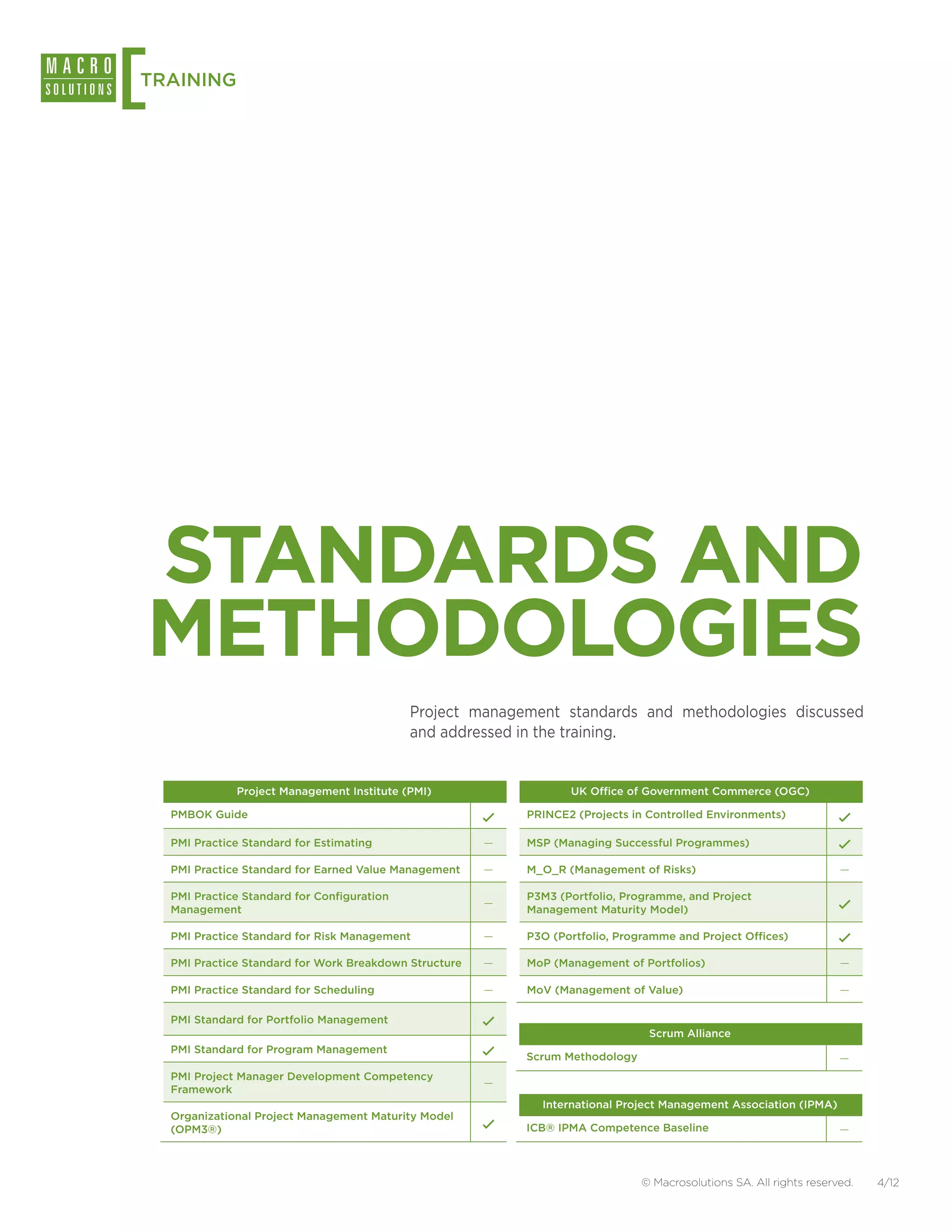
                                              Project management standards and methodologies discussed
                                              and addressed in the training.


               Project Management Institute (PMI)                   UK Office of Government Commerce (OGC)

    PMBOK Guide                                              PRINCE2 (Projects in Controlled Environments)

    PMI Practice Standard for Estimating                 —   MSP (Managing Successful Programmes)

    PMI Practice Standard for Earned Value Management    —   M_O_R (Management of Risks)                               —

    PMI Practice Standard for Configuration                  P3M3 (Portfolio, Programme, and Project
                                                         —
    Management                                               Management Maturity Model)

    PMI Practice Standard for Risk Management            —   P3O (Portfolio, Programme and Project Offices)

    PMI Practice Standard for Work Breakdown Structure   —   MoP (Management of Portfolios)                            —

    PMI Practice Standard for Scheduling                 —   MoV (Management of Value)                                 —

    PMI Standard for Portfolio Management
                                                                                  Scrum Alliance
    PMI Standard for Program Management
                                                             Scrum Methodology                                         —
    PMI Project Manager Development Competency
                                                         —
    Framework
                                                               International Project Management Association (IPMA)
    Organizational Project Management Maturity Model
    (OPM3®)                                                  ICB® IPMA Competence Baseline                             —


                                                                                 © Macrosolutions SA. All rights reserved.   4/12
[
TRAINING


                  BASIC
               PROGRAM
    [
    COURSE OPENING


    [
    CONTEXTUALIZING PROGRAM MANAGEMENT
    ›› Definition of Program Management
    ›› Difference between Programs, Portfolios and Projects
    ›› Managing benefits: understanding complexity in results
    ›› Structuring program governance
    ›› PMO and program management
    ›› General view o PMI’s Standard Program Management


    [
    PROGRAM LIFE CYCLE
    ›› Difference between program life cycle and product life cycle
    ›› 5 phases of the program life cycle
    ›› Governance and the 5 phases of the life cycle


    [
    INITIATING A PROGRAM
    ›› Creating a business case for the program
    ›› Developing program charter
    ›› Authorizing constituent projects
    ›› Structuring executive sponsorship
    ›› Training the teams

                                                                      © Macrosolutions SA. All rights reserved.   5/12
[
TRAINING
BASIC PROGRAM


    [
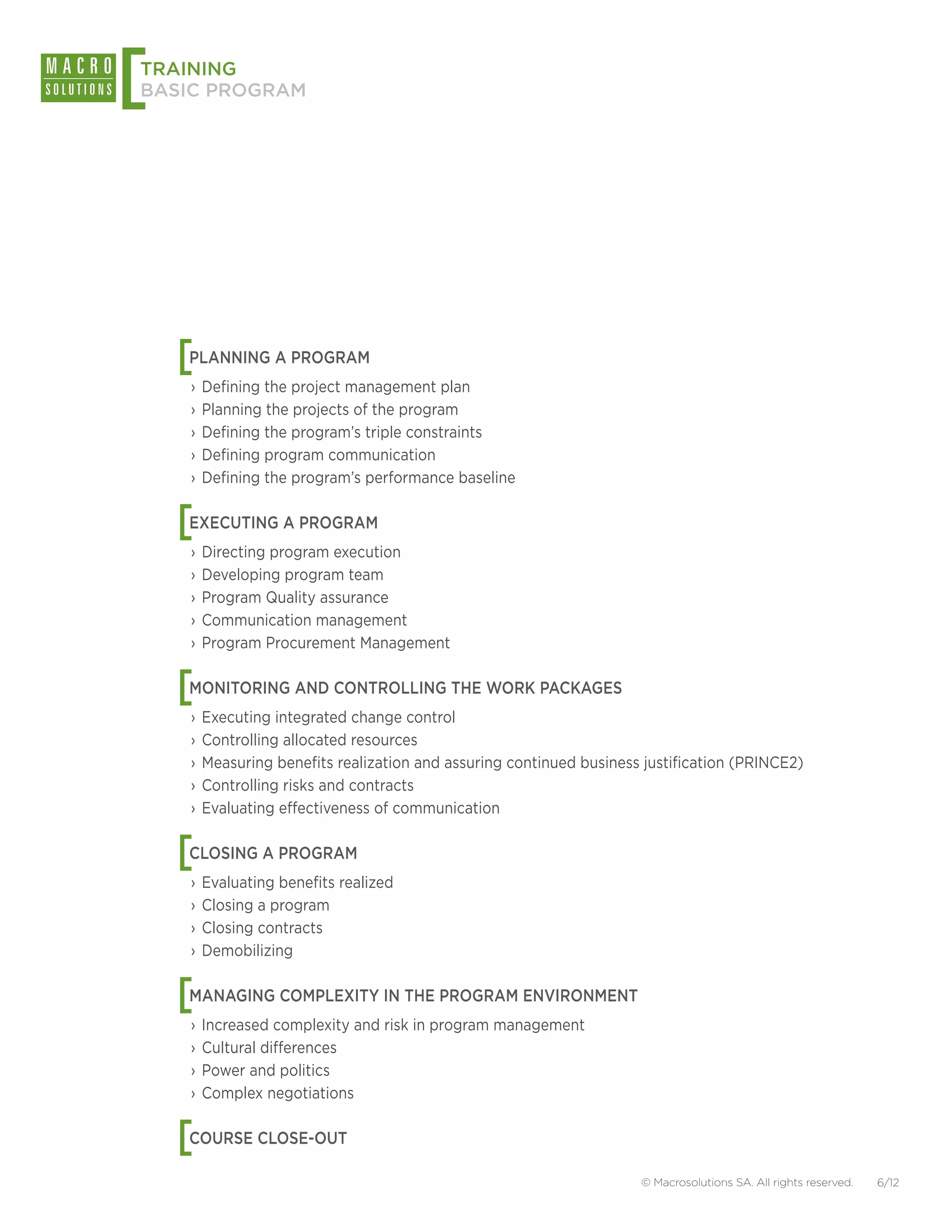
    PLANNING A PROGRAM
    ›› Defining the project management plan
    ›› Planning the projects of the program
    ›› Defining the program’s triple constraints
    ›› Defining program communication
    ›› Defining the program’s performance baseline


    [
    EXECUTING A PROGRAM
    ›› Directing program execution
    ›› Developing program team
    ›› Program Quality assurance
    ›› Communication management
    ›› Program Procurement Management


    [
    MONITORING AND CONTROLLING THE WORK PACKAGES
    ›› Executing integrated change control
    ›› Controlling allocated resources
    ›› Measuring benefits realization and assuring continued business justification (PRINCE2)
    ›› Controlling risks and contracts
    ›› Evaluating effectiveness of communication


    [
    CLOSING A PROGRAM
    ›› Evaluating benefits realized
    ›› Closing a program
    ›› Closing contracts
    ›› Demobilizing


    [
    MANAGING COMPLEXITY IN THE PROGRAM ENVIRONMENT
    ›› Increased complexity and risk in program management
    ›› Cultural differences
    ›› Power and politics
    ›› Complex negotiations


    [
    COURSE CLOSE-OUT

                                                                     © Macrosolutions SA. All rights reserved.   6/12
[
TRAINING


    PMRANK LITE                         ®


       DYNAMIC
                   Reduced version of the PMRank® portfolio management
                   workshop that is used during the trainings courses. It
                   takes about 2 hours long.
                    It presents a practical, direct and iterative way for the
                    main factors involved in the transformation of strategic
           interests into aligned projects.
           Discusses aspects directly related to the strategic initiatives
           prioritization, the establishment of the selection criteria and the
           application of these criteria in a number of potential projects.

                                             © Macrosolutions SA. All rights reserved.   7/12
[  TRAINING
      PMRANK LITE DYNAMIC


       CURRENT      POTENTIAL                                                 STRATEGIC
                                                                              MAP
                                                                                                                           VISION: TO BE THE LARGEST MANUFACTURER OF SCREWS
                                                                                                                          IN THE COUNTRY WITH A STRONG INTERNATIONAL PRESENCE


         PROJECTS   PROJECTS


                                             FINANCE
                                                                                  INCREASE REVENUE
                                                                                                                                                      IMPROVE FINANCIAL                                                                              REDUCE PRODUCTION
                                                                                WITH THE RIGHT MIX OF
                                                                                                                                                          RETURNS                                                                                          COSTS
                                                                                      PRODUCTS


                                                                                                                          STRATEGIC
                                                                                                                          MAP


                                             MARKET
                                                                                                          BE A LEADER IN THE                                                                 INCREASE
                                                                                                          DOMESTIC MARKET                                                                 INTERNATIONAL
                                                                                                                                                                                          MARKET SHARE


                                                                                                                                                             STRATEGIC                                VISION: TO BE THE LARGEST MANUFACTURER OF SCREWS
                                                                                                                                                             MAP                                     IN THE COUNTRY WITH A STRONG INTERNATIONAL PRESENCE

                                                                  CUSTOMER RELATIONSHIP            INTERNATIONALIZATION                                                                                                    OPERATIONAL EXCELLENCE


                                             INTERNAL PROCESSES


                                                                                                                            FINANCE
                                                                                                                                                                 INCREASE REVENUE
                                                                                                                                                                                                              IMPROVE FINANCIAL                            REDUCE PRODUCTION
                                                                                                                                                               WITH THE RIGHT MIX OF
                                                                                                                                                                                                                  RETURNS                                        COSTS
                                                                                                       DEVELOP                                                       PRODUCTS
                                                                  IMPROVE CUSTOMER                                                                                       INCREASE PROJECTS                                   REDUCE LOST-TIME                              OPTIMIZE THE PRODUCT
                                                                                                    INTERNATIONAL
                                                                       SERVICE                                                                                                RESULTS                                           ACCIDENTS                                           MIX
                                                                                                       MARKETS


                                                                                                                            MARKET
                                                                                                                                                                                       BE A LEADER IN THE                         INCREASE
                                                                                                                                                                                       DOMESTIC MARKET                         INTERNATIONAL
                                                                                                                                                                                                                               MARKET SHARE

                                                                                                MONITOR CUSTOMERS'                                                                                                                                                             REDUCE MACHINERY
                                                                  REDUCE CUSTOMER                                                                                        REDUCE OPERATING                              CONTROL MAINTENANCE
                                                                                                  NEEDS IN OTHER                                 CUSTOMER RELATIONSHIP        INTERNATIONALIZATION                               OPERATIONAL EXCELLENCE                          PROGRAMMING
                                                                    COMPLAINTS                                                                                                  LOSS                                          COSTS


                                                                                                                            INTERNAL PROCESSES
                                                                                                    COUNTRIES                                                                        DEVELOP                                                                                         TIME


                                                                                                     +
                                                                                                                                                 IMPROVE CUSTOMER                                                   INCREASE PROJECTS          REDUCE LOST-TIME      OPTIMIZE THE PRODUCT
                                                                                                                                                                                  INTERNATIONAL
                                                                                                                                                      SERVICE                                                            RESULTS                  ACCIDENTS                   MIX
                                                                                                                                                                                     MARKETS


                               CORPORATE INFORMATION
                                                                                                                                                                                MONITOR CUSTOMERS'                                                                    REDUCE MACHINERY
                                                                                                                                                 REDUCE CUSTOMER                                                     REDUCE OPERATING       CONTROL MAINTENANCE
                                                                                                                                                                                  NEEDS IN OTHER                                                                        PROGRAMMING
                                                                                                                                                   COMPLAINTS                                                              LOSS                    COSTS
                                                                                                                                                                                    COUNTRIES                                                                               TIME


                                             AND GROWTH
                                              LEARNING


                                                                                                                            AND GROWTH
                                                                                                                                                   STRENGTHEN INTERNAL                                                                             DEVELOP INFORMATION


                                                                                                                             LEARNING
                                                                                   DEVELOP HUMAN                                                         DEVELOP HUMAN
                                                                                                                                                                                                             STRENGTHEN INTERNAL                      DEVELOP INFORMATION
                                                                                                                                                     COMMUNICATION
                                                                                                                                                           RESOURCES
                                                                                                                                                                                                               COMMUNICATION
                                                                                                                                                                                                                                                        MANAGEMENT
                                                                                                                                                                                                                                                          MANAGEMENT
                                                                                     RESOURCES                                                                                                                  BETWEEN AREAS                               SYSTEMS
                                                                                                                                                      BETWEEN AREAS                                                                                         SYSTEMS


                                1    EVALUATION                                                                                                                                                                                                                                             CRITERIA DEFINITION
                                                                                                                                         CRITERION A
                                                                                                                                                                                                                                                                                            AND PRIORITIZATION
                                                                                                                                         CRITERION C                                                                                                                                            CRITERION A CRITERION D
                                2   PRIORITIZATION
                                                                                                                                         CRITERION F
                                                                                                                                                                                                                                                                                            CRITERION E CRITERION B
                                                                                                                                                                                                                                                                                                  CRITERION C
                                                                                                                                                                                                                                                                                              CRITERION F CRITERION G
                                                                                                                      PRIORITIZED                                                                                                                                                                  CRITERION G
                                3     BALANCING                                                                        CRITERIA


POSTPONED
OR CANCELED


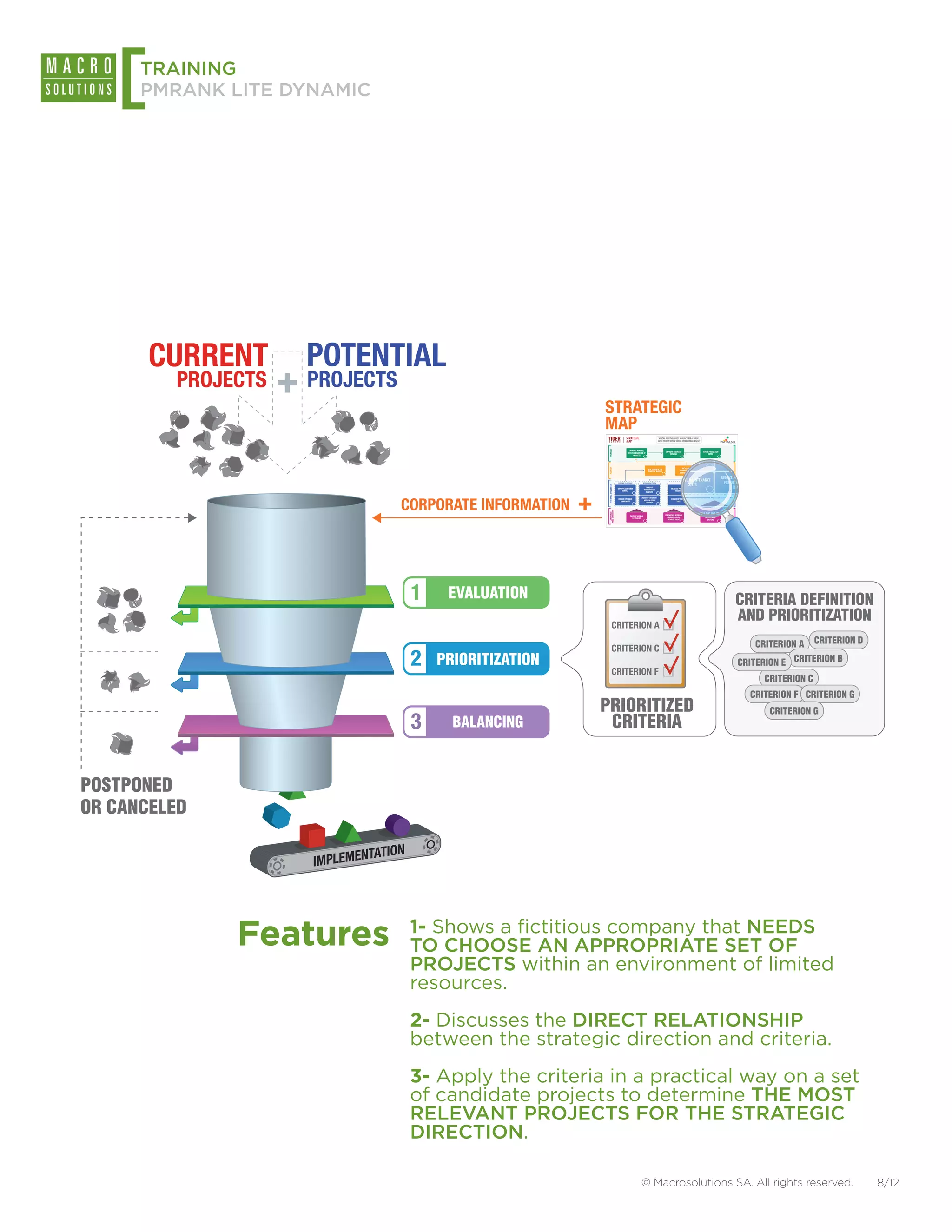
              Features          1- Shows a fictitious company that NEEDS
                                TO CHOOSE AN APPROPRIATE SET OF
                                PROJECTS within an environment of limited
                                resources.
                                2- Discusses the DIRECT RELATIONSHIP
                                between the strategic direction and criteria.
                                3- Apply the criteria in a practical way on a set
                                of candidate projects to determine THE MOST
                                RELEVANT PROJECTS FOR THE STRATEGIC
                                DIRECTION.

                                                                                                                                                                                © Macrosolutions SA. All rights reserved.                                                                                                 8/12
[
TRAINING


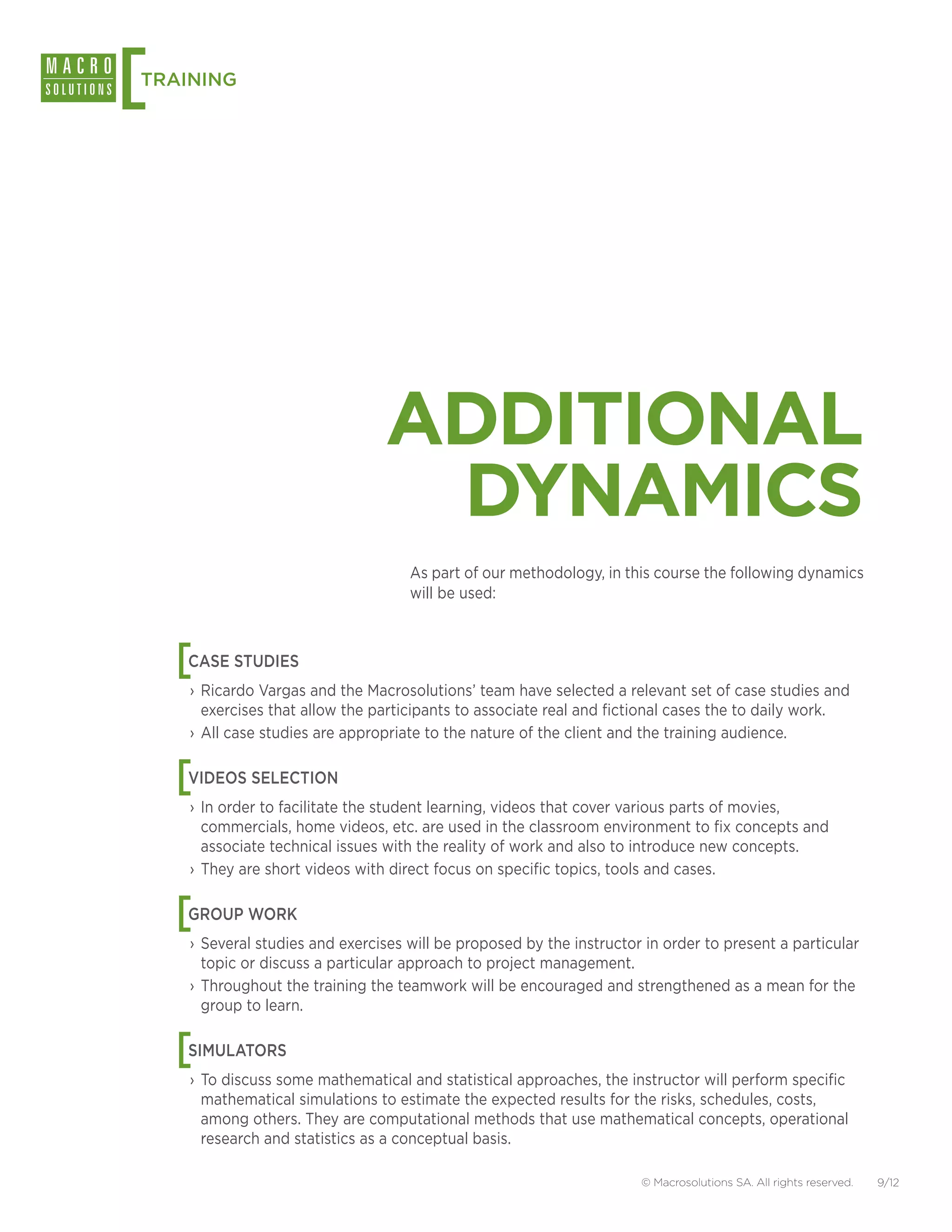
                                ADDITIONAL
                                 DYNAMICS
                                    As part of our methodology, in this course the following dynamics
                                    will be used:


    [
    CASE STUDIES
    › Ricardo Vargas and the Macrosolutions’ team have selected a relevant set of case studies and
      exercises that allow the participants to associate real and fictional cases the to daily work.
    › All case studies are appropriate to the nature of the client and the training audience.


    [
    VIDEOS SELECTION
    › In order to facilitate the student learning, videos that cover various parts of movies,
      commercials, home videos, etc. are used in the classroom environment to fix concepts and
      associate technical issues with the reality of work and also to introduce new concepts.
    › They are short videos with direct focus on specific topics, tools and cases.


    [
    GROUP WORK
    › Several studies and exercises will be proposed by the instructor in order to present a particular
      topic or discuss a particular approach to project management.
    › Throughout the training the teamwork will be encouraged and strengthened as a mean for the
      group to learn.


    [
    SIMULATORS
    › To discuss some mathematical and statistical approaches, the instructor will perform specific
      mathematical simulations to estimate the expected results for the risks, schedules, costs,
      among others. They are computational methods that use mathematical concepts, operational
      research and statistics as a conceptual basis.

                                                                      © Macrosolutions SA. All rights reserved.   9/12
[
TRAINING


EXCLUSIVE STUDENT
     ACCESS AREA
                                                          In addition to the exclusive printed material,
                                                          all participants will have access to the
                                                          courseware’s electronic version, to the files
                                                          of exercises and to the work done in the
                                                          classroom.
                                                          The access is given through the restricted
                                                          site that is available and prepared by the
                                                          Macrosolutions team considering each
                                                          course that we provide. This initiative is a
                                                          pioneer in the educational market and also
                                                          anticipates trends related to the documents’
                                                          electronic management
    Student Area’s on the website macrosolutions.com.br

                                                                       © Macrosolutions SA. All rights reserved.   10/12
[
TRAINING


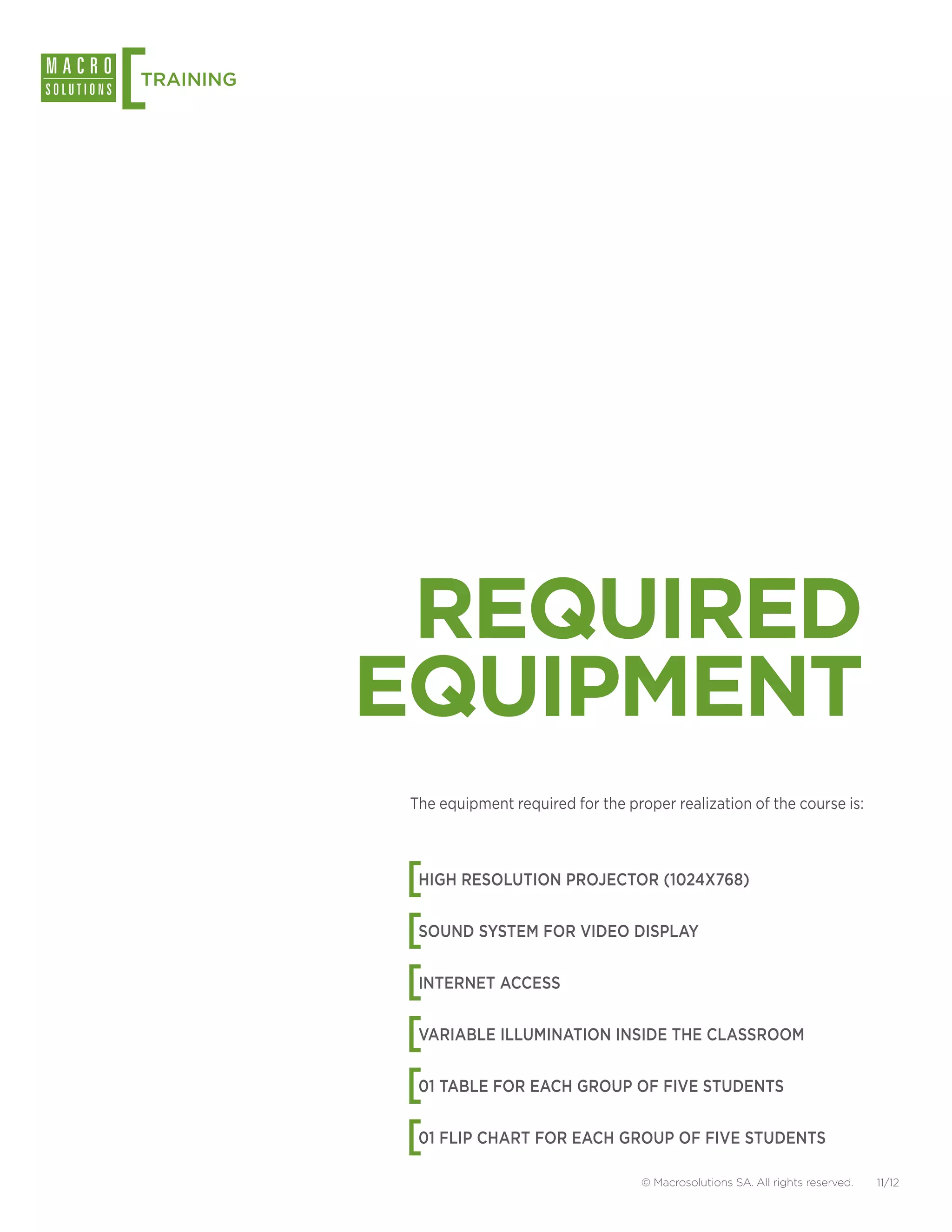
            REQUIRED
           EQUIPMENT
            The equipment required for the proper realization of the course is:


           [ HIGH RESOLUTION PROJECTOR (1024X768)


           [ SOUND SYSTEM FOR VIDEO DISPLAY


           [ INTERNET ACCESS


           [ VARIABLE ILLUMINATION INSIDE THE CLASSROOM


           [ 01 TABLE FOR EACH GROUP OF FIVE STUDENTS


           [ 01 FLIP CHART FOR EACH GROUP OF FIVE STUDENTS

                                              © Macrosolutions SA. All rights reserved.   11/12
[
TRAINING


         FURTHER
     INFORMATION
           For further information about this course, please contact:


           Phone: +55 31 3024-3003
           Fax: +55 31 3024-3005
           email: info@macrosolutions.com.br

                                            © Macrosolutions SA. All rights reserved.   12/12

Macrosolutions Training: Program Management

  • 1.
  • 2.
    [ TRAINING OBJECTIVE The course has an integrated approach which helps participants to understand the full life cycle of a program as it identifies the success factors and shows the alignment between projects in the program. The participants will understand how to structure a business case, how to initiate and plan a program, as well as monitoring the results/benefits using the PMI’s best practices of Standard of Program Management and OCG’s Management of Successful Programs (PRINCE2). TRAINING CONTENT At the end of the course the student will be able to: ✓✓Differentiate between projects, programs and portfolios ✓✓Define the tactical and strategic benefits of a program ✓✓Understand a program structure ✓✓Manage benefits shared among projects ✓✓Define the roles and responsibilities of a program manager ✓✓Define and structure metrics for results ✓✓Identify and solve problems in allocating resources between projects within the program ✓✓Create and manage the communication plan ✓✓Identify the main causes of change to unable change control to be effected in the program © Macrosolutions SA. All rights reserved. 2/12
  • 3.
    [ TRAINING FACT SHEET DESCRIPTION Course number of hours. The number of days depends COURSE DURATION on the daily number of hours dedicated in each course. 16 Hours. The minimum number of students suggested to ensure NUMBER OF PARTICIPANTS the training economic viability. Minimum 20 students per class. TARGET AUDIENCE Program managers, project team members, portfolio managers and others stakeholders interested in the program management process. REQUIREMENTS Desirable project management knowledge. The language in which the training is ministered. LANGUAGE(S) Portuguese, English and Spanish. LOCAL Provided by the contractor. Worldwide attendance. Closed classes are hired by a particular organization CLOSED CLASSES or group. In this case all the participants are selected/ (IN COMPANY)? chosen by the contracting organization. Yes. Open classes offer public access in which the OPEN CLASSES? registration is done by each participant, individually. No. Professional Development Units are the measuring CERTIFICATION AND PDU units issued by the Project Management Institute for All training participants will receive a the credential holders. With these units the credential participation certificate with 16 PMI’s PDUs. holders can maintain their certifications. (PMI R.E.P. activity number: Macro023) © Macrosolutions SA. All rights reserved. 3/12
  • 4.
    [ TRAINING STANDARDS AND METHODOLOGIES Project management standards and methodologies discussed and addressed in the training. Project Management Institute (PMI) UK Office of Government Commerce (OGC) PMBOK Guide PRINCE2 (Projects in Controlled Environments) PMI Practice Standard for Estimating — MSP (Managing Successful Programmes) PMI Practice Standard for Earned Value Management — M_O_R (Management of Risks) — PMI Practice Standard for Configuration P3M3 (Portfolio, Programme, and Project — Management Management Maturity Model) PMI Practice Standard for Risk Management — P3O (Portfolio, Programme and Project Offices) PMI Practice Standard for Work Breakdown Structure — MoP (Management of Portfolios) — PMI Practice Standard for Scheduling — MoV (Management of Value) — PMI Standard for Portfolio Management Scrum Alliance PMI Standard for Program Management Scrum Methodology — PMI Project Manager Development Competency — Framework International Project Management Association (IPMA) Organizational Project Management Maturity Model (OPM3®) ICB® IPMA Competence Baseline — © Macrosolutions SA. All rights reserved. 4/12
  • 5.
    [ TRAINING BASIC PROGRAM [ COURSE OPENING [ CONTEXTUALIZING PROGRAM MANAGEMENT ›› Definition of Program Management ›› Difference between Programs, Portfolios and Projects ›› Managing benefits: understanding complexity in results ›› Structuring program governance ›› PMO and program management ›› General view o PMI’s Standard Program Management [ PROGRAM LIFE CYCLE ›› Difference between program life cycle and product life cycle ›› 5 phases of the program life cycle ›› Governance and the 5 phases of the life cycle [ INITIATING A PROGRAM ›› Creating a business case for the program ›› Developing program charter ›› Authorizing constituent projects ›› Structuring executive sponsorship ›› Training the teams © Macrosolutions SA. All rights reserved. 5/12
  • 6.
    [ TRAINING BASIC PROGRAM [ PLANNING A PROGRAM ›› Defining the project management plan ›› Planning the projects of the program ›› Defining the program’s triple constraints ›› Defining program communication ›› Defining the program’s performance baseline [ EXECUTING A PROGRAM ›› Directing program execution ›› Developing program team ›› Program Quality assurance ›› Communication management ›› Program Procurement Management [ MONITORING AND CONTROLLING THE WORK PACKAGES ›› Executing integrated change control ›› Controlling allocated resources ›› Measuring benefits realization and assuring continued business justification (PRINCE2) ›› Controlling risks and contracts ›› Evaluating effectiveness of communication [ CLOSING A PROGRAM ›› Evaluating benefits realized ›› Closing a program ›› Closing contracts ›› Demobilizing [ MANAGING COMPLEXITY IN THE PROGRAM ENVIRONMENT ›› Increased complexity and risk in program management ›› Cultural differences ›› Power and politics ›› Complex negotiations [ COURSE CLOSE-OUT © Macrosolutions SA. All rights reserved. 6/12
  • 7.
    [ TRAINING PMRANK LITE ® DYNAMIC Reduced version of the PMRank® portfolio management workshop that is used during the trainings courses. It takes about 2 hours long. It presents a practical, direct and iterative way for the main factors involved in the transformation of strategic interests into aligned projects. Discusses aspects directly related to the strategic initiatives prioritization, the establishment of the selection criteria and the application of these criteria in a number of potential projects. © Macrosolutions SA. All rights reserved. 7/12
  • 8.
    [ TRAINING PMRANK LITE DYNAMIC CURRENT POTENTIAL STRATEGIC MAP VISION: TO BE THE LARGEST MANUFACTURER OF SCREWS IN THE COUNTRY WITH A STRONG INTERNATIONAL PRESENCE PROJECTS PROJECTS FINANCE INCREASE REVENUE IMPROVE FINANCIAL REDUCE PRODUCTION WITH THE RIGHT MIX OF RETURNS COSTS PRODUCTS STRATEGIC MAP MARKET BE A LEADER IN THE INCREASE DOMESTIC MARKET INTERNATIONAL MARKET SHARE STRATEGIC VISION: TO BE THE LARGEST MANUFACTURER OF SCREWS MAP IN THE COUNTRY WITH A STRONG INTERNATIONAL PRESENCE CUSTOMER RELATIONSHIP INTERNATIONALIZATION OPERATIONAL EXCELLENCE INTERNAL PROCESSES FINANCE INCREASE REVENUE IMPROVE FINANCIAL REDUCE PRODUCTION WITH THE RIGHT MIX OF RETURNS COSTS DEVELOP PRODUCTS IMPROVE CUSTOMER INCREASE PROJECTS REDUCE LOST-TIME OPTIMIZE THE PRODUCT INTERNATIONAL SERVICE RESULTS ACCIDENTS MIX MARKETS MARKET BE A LEADER IN THE INCREASE DOMESTIC MARKET INTERNATIONAL MARKET SHARE MONITOR CUSTOMERS' REDUCE MACHINERY REDUCE CUSTOMER REDUCE OPERATING CONTROL MAINTENANCE NEEDS IN OTHER CUSTOMER RELATIONSHIP INTERNATIONALIZATION OPERATIONAL EXCELLENCE PROGRAMMING COMPLAINTS LOSS COSTS INTERNAL PROCESSES COUNTRIES DEVELOP TIME + IMPROVE CUSTOMER INCREASE PROJECTS REDUCE LOST-TIME OPTIMIZE THE PRODUCT INTERNATIONAL SERVICE RESULTS ACCIDENTS MIX MARKETS CORPORATE INFORMATION MONITOR CUSTOMERS' REDUCE MACHINERY REDUCE CUSTOMER REDUCE OPERATING CONTROL MAINTENANCE NEEDS IN OTHER PROGRAMMING COMPLAINTS LOSS COSTS COUNTRIES TIME AND GROWTH LEARNING AND GROWTH STRENGTHEN INTERNAL DEVELOP INFORMATION LEARNING DEVELOP HUMAN DEVELOP HUMAN STRENGTHEN INTERNAL DEVELOP INFORMATION COMMUNICATION RESOURCES COMMUNICATION MANAGEMENT MANAGEMENT RESOURCES BETWEEN AREAS SYSTEMS BETWEEN AREAS SYSTEMS 1 EVALUATION CRITERIA DEFINITION CRITERION A AND PRIORITIZATION CRITERION C CRITERION A CRITERION D 2 PRIORITIZATION CRITERION F CRITERION E CRITERION B CRITERION C CRITERION F CRITERION G PRIORITIZED CRITERION G 3 BALANCING CRITERIA POSTPONED OR CANCELED Features 1- Shows a fictitious company that NEEDS TO CHOOSE AN APPROPRIATE SET OF PROJECTS within an environment of limited resources. 2- Discusses the DIRECT RELATIONSHIP between the strategic direction and criteria. 3- Apply the criteria in a practical way on a set of candidate projects to determine THE MOST RELEVANT PROJECTS FOR THE STRATEGIC DIRECTION. © Macrosolutions SA. All rights reserved. 8/12
  • 9.
    [ TRAINING ADDITIONAL DYNAMICS As part of our methodology, in this course the following dynamics will be used: [ CASE STUDIES › Ricardo Vargas and the Macrosolutions’ team have selected a relevant set of case studies and exercises that allow the participants to associate real and fictional cases the to daily work. › All case studies are appropriate to the nature of the client and the training audience. [ VIDEOS SELECTION › In order to facilitate the student learning, videos that cover various parts of movies, commercials, home videos, etc. are used in the classroom environment to fix concepts and associate technical issues with the reality of work and also to introduce new concepts. › They are short videos with direct focus on specific topics, tools and cases. [ GROUP WORK › Several studies and exercises will be proposed by the instructor in order to present a particular topic or discuss a particular approach to project management. › Throughout the training the teamwork will be encouraged and strengthened as a mean for the group to learn. [ SIMULATORS › To discuss some mathematical and statistical approaches, the instructor will perform specific mathematical simulations to estimate the expected results for the risks, schedules, costs, among others. They are computational methods that use mathematical concepts, operational research and statistics as a conceptual basis. © Macrosolutions SA. All rights reserved. 9/12
  • 10.
    [ TRAINING EXCLUSIVE STUDENT ACCESS AREA In addition to the exclusive printed material, all participants will have access to the courseware’s electronic version, to the files of exercises and to the work done in the classroom. The access is given through the restricted site that is available and prepared by the Macrosolutions team considering each course that we provide. This initiative is a pioneer in the educational market and also anticipates trends related to the documents’ electronic management Student Area’s on the website macrosolutions.com.br © Macrosolutions SA. All rights reserved. 10/12
  • 11.
    [ TRAINING REQUIRED EQUIPMENT The equipment required for the proper realization of the course is: [ HIGH RESOLUTION PROJECTOR (1024X768) [ SOUND SYSTEM FOR VIDEO DISPLAY [ INTERNET ACCESS [ VARIABLE ILLUMINATION INSIDE THE CLASSROOM [ 01 TABLE FOR EACH GROUP OF FIVE STUDENTS [ 01 FLIP CHART FOR EACH GROUP OF FIVE STUDENTS © Macrosolutions SA. All rights reserved. 11/12
  • 12.
    [ TRAINING FURTHER INFORMATION For further information about this course, please contact: Phone: +55 31 3024-3003 Fax: +55 31 3024-3005 email: info@macrosolutions.com.br © Macrosolutions SA. All rights reserved. 12/12