imagination at work
g GE Confidential
Metal-Enclosed
Switchgear
Load
Interrupter
Switches
San Francisco IEEE / IAS
Electrical Design and Applications Seminar
April 29,2011
Gary H. Fox, PE
GE Energy
Senior Specification Engineer
T 925 969 3608
C 510 219 6868
E gary.fox@ge.com
www.geindustrial.com/design
2120 Diamond Blvd., Suite 100
Concord, CA 94520
General Electric Company
imagination at work
g
2 /
SF IAS Electrical design Seminar/
2011
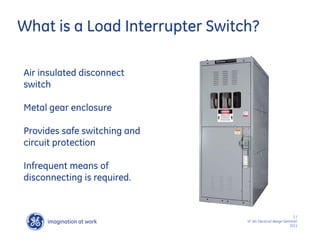
What is a Load Interrupter Switch?
Air insulated disconnect
switch
Metal gear enclosure
Provides safe switching and
circuit protection
Infrequent means of
disconnecting is required.
imagination at work
g
3 /
SF IAS Electrical design Seminar/
2011
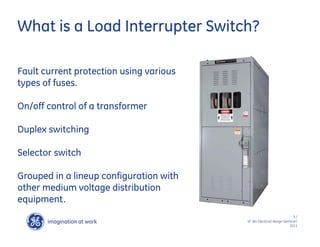
Fault current protection using various
types of fuses.
On/off control of a transformer
Duplex switching
Selector switch
Grouped in a lineup configuration with
other medium voltage distribution
equipment.
What is a Load Interrupter Switch?
imagination at work
g
4 /
SF IAS Electrical design Seminar/
2011
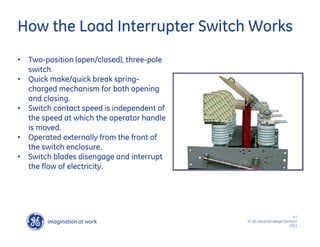
How the Load Interrupter Switch Works
• Two-position (open/closed), three-pole
switch.
• Quick make/quick break spring-
charged mechanism for both opening
and closing.
• Switch contact speed is independent of
the speed at which the operator handle
is moved.
• Operated externally from the front of
the switch enclosure.
• Switch blades disengage and interrupt
the flow of electricity.
imagination at work
g
5 /
SF IAS Electrical design Seminar/
2011
The Functions of a Load Interrupter
Switch
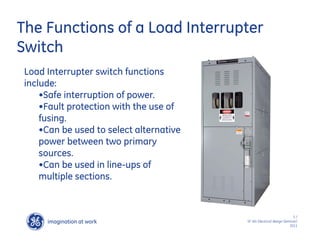
Load Interrupter switch functions
include:
•Safe interruption of power.
•Fault protection with the use of
fusing.
•Can be used to select alternative
power between two primary
sources.
•Can be used in line-ups of
multiple sections.
imagination at work
g
6 /
SF IAS Electrical design Seminar/
2011
Key Components
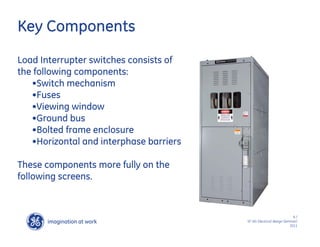
Load Interrupter switches consists of
the following components:
•Switch mechanism
•Fuses
•Viewing window
•Ground bus
•Bolted frame enclosure
•Horizontal and interphase barriers
These components more fully on the
following screens.
imagination at work
g
7 /
SF IAS Electrical design Seminar/
2011
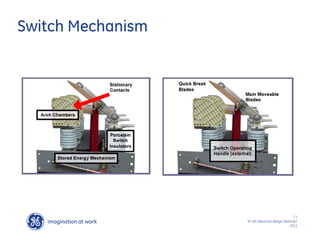
Switch Mechanism
imagination at work
g
8 /
SF IAS Electrical design Seminar/
2011
How the Switch Mechanism Operates
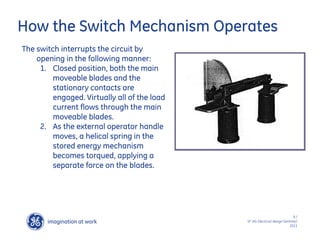
The switch interrupts the circuit by
opening in the following manner:
1. Closed position, both the main
moveable blades and the
stationary contacts are
engaged. Virtually all of the load
current flows through the main
moveable blades.
2. As the external operator handle
moves, a helical spring in the
stored energy mechanism
becomes torqued, applying a
separate force on the blades.
imagination at work
g
9 /
SF IAS Electrical design Seminar/
2011
How the Switch Mechanism Operates
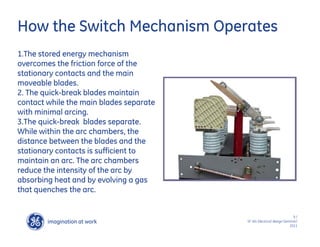
1.The stored energy mechanism
overcomes the friction force of the
stationary contacts and the main
moveable blades.
2. The quick-break blades maintain
contact while the main blades separate
with minimal arcing.
3.The quick-break blades separate.
While within the arc chambers, the
distance between the blades and the
stationary contacts is sufficient to
maintain an arc. The arc chambers
reduce the intensity of the arc by
absorbing heat and by evolving a gas
that quenches the arc.
imagination at work
g
10 /
SF IAS Electrical design Seminar/
2011
Fuses
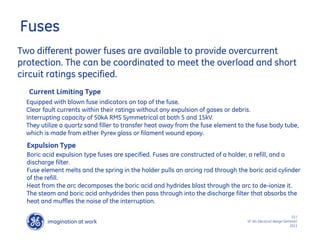
Two different power fuses are available to provide overcurrent
protection. The can be coordinated to meet the overload and short
circuit ratings specified.
Current Limiting Type
Expulsion Type
Equipped with blown fuse indicators on top of the fuse.
Clear fault currents within their ratings without any expulsion of gases or debris.
Interrupting capacity of 50kA RMS Symmetrical at both 5 and 15kV.
They utilize a quartz sand filler to transfer heat away from the fuse element to the fuse body tube,
which is made from either Pyrex glass or filament wound epoxy.
Boric acid expulsion type fuses are specified. Fuses are constructed of a holder, a refill, and a
discharge filter.
Fuse element melts and the spring in the holder pulls an arcing rod through the boric acid cylinder
of the refill.
Heat from the arc decomposes the boric acid and hydrides blast through the arc to de-ionize it.
The steam and boric acid anhydrides then pass through into the discharge filter that absorbs the
heat and muffles the noise of the interruption.
imagination at work
g
11 /
SF IAS Electrical design Seminar/
2011
Viewing Window
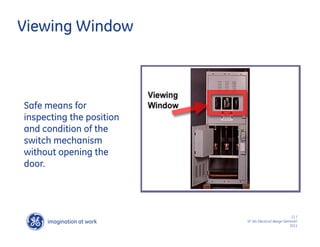
Safe means for
inspecting the position
and condition of the
switch mechanism
without opening the
door.
imagination at work
g
12 /
SF IAS Electrical design Seminar/
2011
Ground Bus
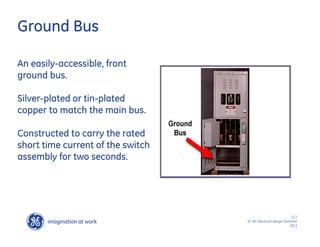
An easily-accessible, front
ground bus.
Silver-plated or tin-plated
copper to match the main bus.
Constructed to carry the rated
short time current of the switch
assembly for two seconds.
imagination at work
g
13 /
SF IAS Electrical design Seminar/
2011
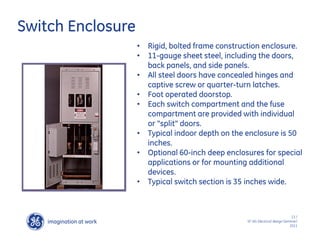
Switch Enclosure
• Rigid, bolted frame construction enclosure.
• 11-gauge sheet steel, including the doors,
back panels, and side panels.
• All steel doors have concealed hinges and
captive screw or quarter-turn latches.
• Foot operated doorstop.
• Each switch compartment and the fuse
compartment are provided with individual
or "split" doors.
• Typical indoor depth on the enclosure is 50
inches.
• Optional 60-inch deep enclosures for special
applications or for mounting additional
devices.
• Typical switch section is 35 inches wide.
imagination at work
g
14 /
SF IAS Electrical design Seminar/
2011
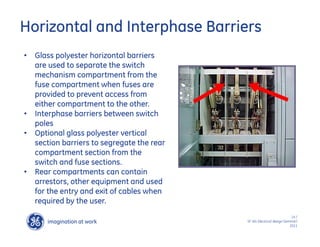
Horizontal and Interphase Barriers
• Glass polyester horizontal barriers
are used to separate the switch
mechanism compartment from the
fuse compartment when fuses are
provided to prevent access from
either compartment to the other.
• Interphase barriers between switch
poles
• Optional glass polyester vertical
section barriers to segregate the rear
compartment section from the
switch and fuse sections.
• Rear compartments can contain
arrestors, other equipment and used
for the entry and exit of cables when
required by the user.
imagination at work
g
15 /
SF IAS Electrical design Seminar/
2011
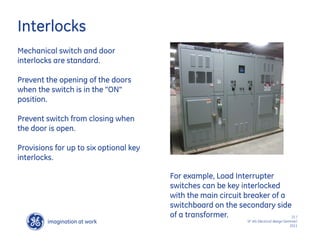
Interlocks
Mechanical switch and door
interlocks are standard.
Prevent the opening of the doors
when the switch is in the "ON"
position.
Prevent switch from closing when
the door is open.
Provisions for up to six optional key
interlocks.
For example, Load Interrupter
switches can be key interlocked
with the main circuit breaker of a
switchboard on the secondary side
of a transformer.
imagination at work
g
16 /
SF IAS Electrical design Seminar/
2011
Terminology
•Rated Withstand Current
•Rated Fault Making Current
•Rated Continuous Current
•Basic Impulse Level (BIL) Withstand Rating
imagination at work
g
17 /
SF IAS Electrical design Seminar/
2011
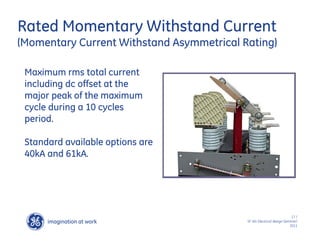
Rated Momentary Withstand Current
(Momentary Current Withstand Asymmetrical Rating)
Maximum rms total current
including dc offset at the
major peak of the maximum
cycle during a 10 cycles
period.
Standard available options are
40kA and 61kA.
imagination at work
g
18 /
SF IAS Electrical design Seminar/
2011
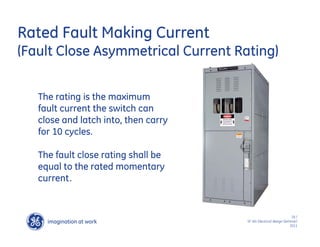
Rated Fault Making Current
(Fault Close Asymmetrical Current Rating)
The rating is the maximum
fault current the switch can
close and latch into, then carry
for 10 cycles.
The fault close rating shall be
equal to the rated momentary
current.
imagination at work
g
19 /
SF IAS Electrical design Seminar/
2011
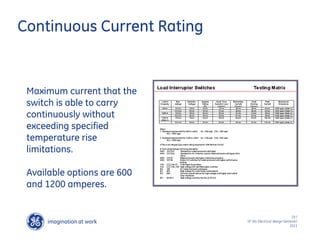
Continuous Current Rating
Maximum current that the
switch is able to carry
continuously without
exceeding specified
temperature rise
limitations.
Available options are 600
and 1200 amperes.
imagination at work
g
20 /
SF IAS Electrical design Seminar/
2011
Basic Impulse Level (BIL) Withstand
Rating
This rating is a measurement of the surge voltage withstand
capability of the switch assembly. The assembly can
withstand a surge voltage impulse of the rated value
without failing.
Standard BIL ratings
60kV @ 5kV
95kV @ 15kV
imagination at work
g
21 /
SF IAS Electrical design Seminar/
2011
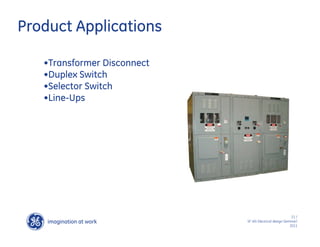
Product Applications
•Transformer Disconnect
•Duplex Switch
•Selector Switch
•Line-Ups
imagination at work
g
22 /
SF IAS Electrical design Seminar/
2011
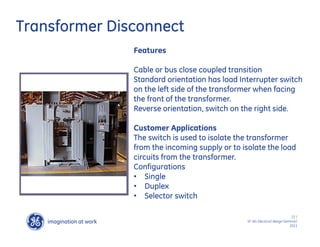
Transformer Disconnect
Features
Cable or bus close coupled transition
Standard orientation has load Interrupter switch
on the left side of the transformer when facing
the front of the transformer.
Reverse orientation, switch on the right side.
Customer Applications
The switch is used to isolate the transformer
from the incoming supply or to isolate the load
circuits from the transformer.
Configurations
• Single
• Duplex
• Selector switch
imagination at work
g
23 /
SF IAS Electrical design Seminar/
2011
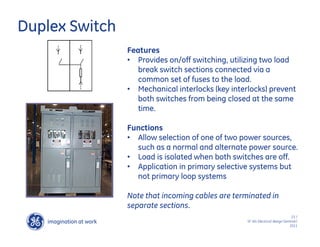
Duplex Switch
Features
• Provides on/off switching, utilizing two load
break switch sections connected via a
common set of fuses to the load.
• Mechanical interlocks (key interlocks) prevent
both switches from being closed at the same
time.
Functions
• Allow selection of one of two power sources,
such as a normal and alternate power source.
• Load is isolated when both switches are off.
• Application in primary selective systems but
not primary loop systems
Note that incoming cables are terminated in
separate sections.
imagination at work
g
24 /
SF IAS Electrical design Seminar/
2011
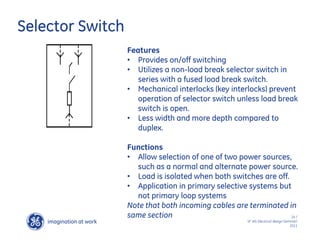
Selector Switch
Features
• Provides on/off switching
• Utilizes a non-load break selector switch in
series with a fused load break switch.
• Mechanical interlocks (key interlocks) prevent
operation of selector switch unless load break
switch is open.
• Less width and more depth compared to
duplex.
Functions
• Allow selection of one of two power sources,
such as a normal and alternate power source.
• Load is isolated when both switches are off.
• Application in primary selective systems but
not primary loop systems
Note that both incoming cables are terminated in
same section
imagination at work
g
25 /
SF IAS Electrical design Seminar/
2011
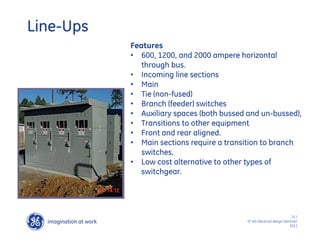
Line-Ups
Features
• 600, 1200, and 2000 ampere horizontal
through bus.
• Incoming line sections
• Main
• Tie (non-fused)
• Branch (feeder) switches
• Auxiliary spaces (both bussed and un-bussed),
• Transitions to other equipment
• Front and rear aligned.
• Main sections require a transition to branch
switches.
• Low cost alternative to other types of
switchgear.

Metal-Enclosed Switchgear Load Interrupter Switches

  • 1.
    imagination at work gGE Confidential Metal-Enclosed Switchgear Load Interrupter Switches San Francisco IEEE / IAS Electrical Design and Applications Seminar April 29,2011 Gary H. Fox, PE GE Energy Senior Specification Engineer T 925 969 3608 C 510 219 6868 E gary.fox@ge.com www.geindustrial.com/design 2120 Diamond Blvd., Suite 100 Concord, CA 94520 General Electric Company
  • 2.
    imagination at work g 2/ SF IAS Electrical design Seminar/ 2011 What is a Load Interrupter Switch? Air insulated disconnect switch Metal gear enclosure Provides safe switching and circuit protection Infrequent means of disconnecting is required.
  • 3.
    imagination at work g 3/ SF IAS Electrical design Seminar/ 2011 Fault current protection using various types of fuses. On/off control of a transformer Duplex switching Selector switch Grouped in a lineup configuration with other medium voltage distribution equipment. What is a Load Interrupter Switch?
  • 4.
    imagination at work g 4/ SF IAS Electrical design Seminar/ 2011 How the Load Interrupter Switch Works • Two-position (open/closed), three-pole switch. • Quick make/quick break spring- charged mechanism for both opening and closing. • Switch contact speed is independent of the speed at which the operator handle is moved. • Operated externally from the front of the switch enclosure. • Switch blades disengage and interrupt the flow of electricity.
  • 5.
    imagination at work g 5/ SF IAS Electrical design Seminar/ 2011 The Functions of a Load Interrupter Switch Load Interrupter switch functions include: •Safe interruption of power. •Fault protection with the use of fusing. •Can be used to select alternative power between two primary sources. •Can be used in line-ups of multiple sections.
  • 6.
    imagination at work g 6/ SF IAS Electrical design Seminar/ 2011 Key Components Load Interrupter switches consists of the following components: •Switch mechanism •Fuses •Viewing window •Ground bus •Bolted frame enclosure •Horizontal and interphase barriers These components more fully on the following screens.
  • 7.
    imagination at work g 7/ SF IAS Electrical design Seminar/ 2011 Switch Mechanism
  • 8.
    imagination at work g 8/ SF IAS Electrical design Seminar/ 2011 How the Switch Mechanism Operates The switch interrupts the circuit by opening in the following manner: 1. Closed position, both the main moveable blades and the stationary contacts are engaged. Virtually all of the load current flows through the main moveable blades. 2. As the external operator handle moves, a helical spring in the stored energy mechanism becomes torqued, applying a separate force on the blades.
  • 9.
    imagination at work g 9/ SF IAS Electrical design Seminar/ 2011 How the Switch Mechanism Operates 1.The stored energy mechanism overcomes the friction force of the stationary contacts and the main moveable blades. 2. The quick-break blades maintain contact while the main blades separate with minimal arcing. 3.The quick-break blades separate. While within the arc chambers, the distance between the blades and the stationary contacts is sufficient to maintain an arc. The arc chambers reduce the intensity of the arc by absorbing heat and by evolving a gas that quenches the arc.
  • 10.
    imagination at work g 10/ SF IAS Electrical design Seminar/ 2011 Fuses Two different power fuses are available to provide overcurrent protection. The can be coordinated to meet the overload and short circuit ratings specified. Current Limiting Type Expulsion Type Equipped with blown fuse indicators on top of the fuse. Clear fault currents within their ratings without any expulsion of gases or debris. Interrupting capacity of 50kA RMS Symmetrical at both 5 and 15kV. They utilize a quartz sand filler to transfer heat away from the fuse element to the fuse body tube, which is made from either Pyrex glass or filament wound epoxy. Boric acid expulsion type fuses are specified. Fuses are constructed of a holder, a refill, and a discharge filter. Fuse element melts and the spring in the holder pulls an arcing rod through the boric acid cylinder of the refill. Heat from the arc decomposes the boric acid and hydrides blast through the arc to de-ionize it. The steam and boric acid anhydrides then pass through into the discharge filter that absorbs the heat and muffles the noise of the interruption.
  • 11.
    imagination at work g 11/ SF IAS Electrical design Seminar/ 2011 Viewing Window Safe means for inspecting the position and condition of the switch mechanism without opening the door.
  • 12.
    imagination at work g 12/ SF IAS Electrical design Seminar/ 2011 Ground Bus An easily-accessible, front ground bus. Silver-plated or tin-plated copper to match the main bus. Constructed to carry the rated short time current of the switch assembly for two seconds.
  • 13.
    imagination at work g 13/ SF IAS Electrical design Seminar/ 2011 Switch Enclosure • Rigid, bolted frame construction enclosure. • 11-gauge sheet steel, including the doors, back panels, and side panels. • All steel doors have concealed hinges and captive screw or quarter-turn latches. • Foot operated doorstop. • Each switch compartment and the fuse compartment are provided with individual or "split" doors. • Typical indoor depth on the enclosure is 50 inches. • Optional 60-inch deep enclosures for special applications or for mounting additional devices. • Typical switch section is 35 inches wide.
  • 14.
    imagination at work g 14/ SF IAS Electrical design Seminar/ 2011 Horizontal and Interphase Barriers • Glass polyester horizontal barriers are used to separate the switch mechanism compartment from the fuse compartment when fuses are provided to prevent access from either compartment to the other. • Interphase barriers between switch poles • Optional glass polyester vertical section barriers to segregate the rear compartment section from the switch and fuse sections. • Rear compartments can contain arrestors, other equipment and used for the entry and exit of cables when required by the user.
  • 15.
    imagination at work g 15/ SF IAS Electrical design Seminar/ 2011 Interlocks Mechanical switch and door interlocks are standard. Prevent the opening of the doors when the switch is in the "ON" position. Prevent switch from closing when the door is open. Provisions for up to six optional key interlocks. For example, Load Interrupter switches can be key interlocked with the main circuit breaker of a switchboard on the secondary side of a transformer.
  • 16.
    imagination at work g 16/ SF IAS Electrical design Seminar/ 2011 Terminology •Rated Withstand Current •Rated Fault Making Current •Rated Continuous Current •Basic Impulse Level (BIL) Withstand Rating
  • 17.
    imagination at work g 17/ SF IAS Electrical design Seminar/ 2011 Rated Momentary Withstand Current (Momentary Current Withstand Asymmetrical Rating) Maximum rms total current including dc offset at the major peak of the maximum cycle during a 10 cycles period. Standard available options are 40kA and 61kA.
  • 18.
    imagination at work g 18/ SF IAS Electrical design Seminar/ 2011 Rated Fault Making Current (Fault Close Asymmetrical Current Rating) The rating is the maximum fault current the switch can close and latch into, then carry for 10 cycles. The fault close rating shall be equal to the rated momentary current.
  • 19.
    imagination at work g 19/ SF IAS Electrical design Seminar/ 2011 Continuous Current Rating Maximum current that the switch is able to carry continuously without exceeding specified temperature rise limitations. Available options are 600 and 1200 amperes.
  • 20.
    imagination at work g 20/ SF IAS Electrical design Seminar/ 2011 Basic Impulse Level (BIL) Withstand Rating This rating is a measurement of the surge voltage withstand capability of the switch assembly. The assembly can withstand a surge voltage impulse of the rated value without failing. Standard BIL ratings 60kV @ 5kV 95kV @ 15kV
  • 21.
    imagination at work g 21/ SF IAS Electrical design Seminar/ 2011 Product Applications •Transformer Disconnect •Duplex Switch •Selector Switch •Line-Ups
  • 22.
    imagination at work g 22/ SF IAS Electrical design Seminar/ 2011 Transformer Disconnect Features Cable or bus close coupled transition Standard orientation has load Interrupter switch on the left side of the transformer when facing the front of the transformer. Reverse orientation, switch on the right side. Customer Applications The switch is used to isolate the transformer from the incoming supply or to isolate the load circuits from the transformer. Configurations • Single • Duplex • Selector switch
  • 23.
    imagination at work g 23/ SF IAS Electrical design Seminar/ 2011 Duplex Switch Features • Provides on/off switching, utilizing two load break switch sections connected via a common set of fuses to the load. • Mechanical interlocks (key interlocks) prevent both switches from being closed at the same time. Functions • Allow selection of one of two power sources, such as a normal and alternate power source. • Load is isolated when both switches are off. • Application in primary selective systems but not primary loop systems Note that incoming cables are terminated in separate sections.
  • 24.
    imagination at work g 24/ SF IAS Electrical design Seminar/ 2011 Selector Switch Features • Provides on/off switching • Utilizes a non-load break selector switch in series with a fused load break switch. • Mechanical interlocks (key interlocks) prevent operation of selector switch unless load break switch is open. • Less width and more depth compared to duplex. Functions • Allow selection of one of two power sources, such as a normal and alternate power source. • Load is isolated when both switches are off. • Application in primary selective systems but not primary loop systems Note that both incoming cables are terminated in same section
  • 25.
    imagination at work g 25/ SF IAS Electrical design Seminar/ 2011 Line-Ups Features • 600, 1200, and 2000 ampere horizontal through bus. • Incoming line sections • Main • Tie (non-fused) • Branch (feeder) switches • Auxiliary spaces (both bussed and un-bussed), • Transitions to other equipment • Front and rear aligned. • Main sections require a transition to branch switches. • Low cost alternative to other types of switchgear.