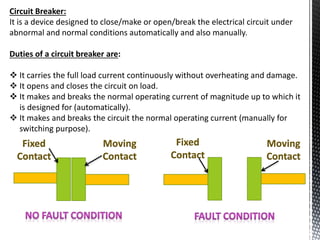
Circuit Breaker:
It is a device designed to close/make or open/break the electrical circuit under
abnormal and normal conditions automatically and also manually.
Duties of a circuit breaker are:
 It carries the full load current continuously without overheating and damage.
 It opens and closes the circuit on load.
 It makes and breaks the normal operating current of magnitude up to which it
is designed for (automatically).
 It makes and breaks the circuit the normal operating current (manually for
switching purpose).
Moving
Contact
Fixed
Contact
Moving
Contact
Fixed
Contact
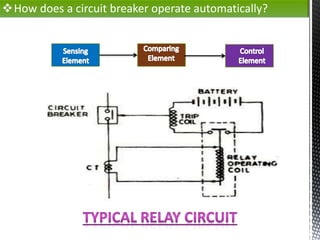
How does a circuit breaker operate automatically?
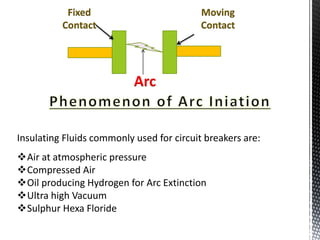
Fixed
Contact
Moving
Contact
Arc
Insulating Fluids commonly used for circuit breakers are:
Air at atmospheric pressure
Compressed Air
Oil producing Hydrogen for Arc Extinction
Ultra high Vacuum
Sulphur Hexa Floride
Arc Resistance depends on factors like:
Degree of Ionization
Length of the arc
Cross section of arc
Methods of Arc Quenching:
1) High Resistance Method:
Arc resistance is made to increase with time so that current is
reduced to a value insufficient to maintain the arc.
2) Low Resistance Method:
Dielectric Medium between the contacts is built up more rapidly
so that the arc fails to restrike and the current will be
interrupted.
High Resistance Method:
 Lengthening of arc
 Reducing the cross section of the arc
 Splitting the arc
Low resistance Method:
 Lengthening the gap
 High pressure in the vicinity of the arc
 Cooling the dielectric medium
 Blast Effect
Significant Terms associated with Circuit Breakers:
 Arc Voltage
 Restriking Voltage
 Recovery Voltage
 Breaking Capacity
 Making Capacity
 Short Time Capacity
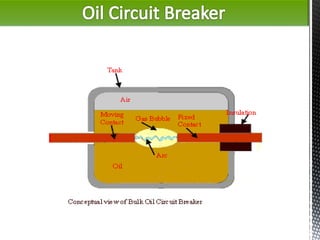
Pros of Oil Circuit Breakers:
It absorbs the arc energy to decompose the oil into gasses which
have excellent cooling properties.
It acts as an insulator and permits smaller clearance between live
conductors and earthed components.
Cons of Oil Circuit Breakers:
Oil is inflammable there is a risk of fire.
Oil may form an explosive mixture when it comes in contact with
air.
Arcing products like carbon remain in the oil and its quality
deteriorates with successive operations. This requires periodic
checking and replacement of oil.
Rating: Bulk Oil CB= Up to 12 KV
Minimum Oil CB= 13.6 KV to 146 KV
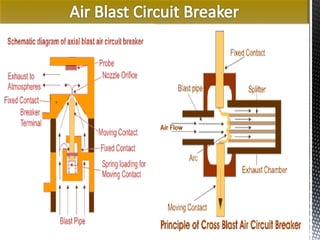
Pros of Air Blast Circuit Breakers:
Risk of fire is totally eliminated.
The size of the circuit breaker is reduced.
High speed operation and suitable for frequent operation.
Negligible maintenance.
Cons of Air Blast Circuit Breakers:
Air insulation is lesser than other medium like as oil etc.
Considerable Maintenance required for the compressor plant
which supplies air blast.
Rating: 110 KV & above
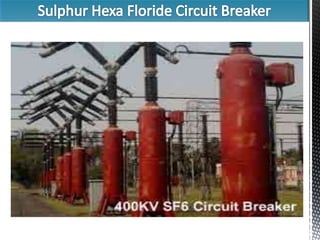
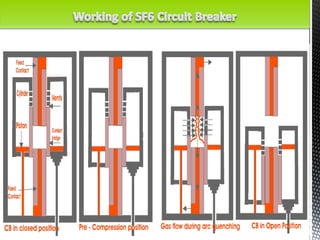
Pros of SF6 Circuit Breakers:
Very Sort Arcing Time
Can Interrupt very large currents due to high dielectric strength.
Noiseless Operation due to its closed/sealed gas circuit.
No problem of moisture.
No risk of fire as SF6 is inflammable.
Low Maintenance Cost.
Cons of SF6 Circuit Breakers:
SF6 Circuit Breakers are costly due to high cost of SF6.
Since SF6 gas has to be reconditioned after every operation of the
breaker additional equipment is needed for this purpose.
Rating: 3.6 KV to 760 KV
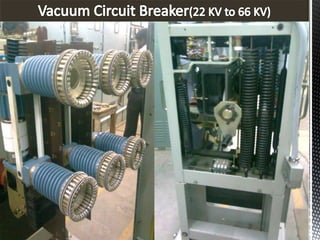
Advantages of VCB:
Compact & reliable.
Less Maintenance and quite in
operation.
Withstand Lightning Surges.
Small Power for control
mechanism.
Perfect breaking of any heavy
fault current.
No risk of Fire.
Routine tests conducted on VCB:
 Voltage Test with different
frequencies.
 High Voltage Test
 Timing Test
 Penetration Test
 Insulation Test
Conclusion:
Therefore by using appropriate circuit breaker for appropriate
operating voltages we can provide protection for busbar and
electrical equipments like Power transformers, generators, C.T.’s ,
P.T.’s, wave traps etc. from different faults that occur in power system.
Study of circuit breakers

Study of circuit breakers

  • 2.
    Circuit Breaker: It isa device designed to close/make or open/break the electrical circuit under abnormal and normal conditions automatically and also manually. Duties of a circuit breaker are:  It carries the full load current continuously without overheating and damage.  It opens and closes the circuit on load.  It makes and breaks the normal operating current of magnitude up to which it is designed for (automatically).  It makes and breaks the circuit the normal operating current (manually for switching purpose). Moving Contact Fixed Contact Moving Contact Fixed Contact
  • 3.
    How does acircuit breaker operate automatically?
  • 4.
    Fixed Contact Moving Contact Arc Insulating Fluids commonlyused for circuit breakers are: Air at atmospheric pressure Compressed Air Oil producing Hydrogen for Arc Extinction Ultra high Vacuum Sulphur Hexa Floride
  • 5.
    Arc Resistance dependson factors like: Degree of Ionization Length of the arc Cross section of arc Methods of Arc Quenching: 1) High Resistance Method: Arc resistance is made to increase with time so that current is reduced to a value insufficient to maintain the arc. 2) Low Resistance Method: Dielectric Medium between the contacts is built up more rapidly so that the arc fails to restrike and the current will be interrupted.
  • 6.
    High Resistance Method: Lengthening of arc  Reducing the cross section of the arc  Splitting the arc Low resistance Method:  Lengthening the gap  High pressure in the vicinity of the arc  Cooling the dielectric medium  Blast Effect Significant Terms associated with Circuit Breakers:  Arc Voltage  Restriking Voltage  Recovery Voltage  Breaking Capacity  Making Capacity  Short Time Capacity
  • 8.
    Pros of OilCircuit Breakers: It absorbs the arc energy to decompose the oil into gasses which have excellent cooling properties. It acts as an insulator and permits smaller clearance between live conductors and earthed components. Cons of Oil Circuit Breakers: Oil is inflammable there is a risk of fire. Oil may form an explosive mixture when it comes in contact with air. Arcing products like carbon remain in the oil and its quality deteriorates with successive operations. This requires periodic checking and replacement of oil. Rating: Bulk Oil CB= Up to 12 KV Minimum Oil CB= 13.6 KV to 146 KV
  • 10.
    Pros of AirBlast Circuit Breakers: Risk of fire is totally eliminated. The size of the circuit breaker is reduced. High speed operation and suitable for frequent operation. Negligible maintenance. Cons of Air Blast Circuit Breakers: Air insulation is lesser than other medium like as oil etc. Considerable Maintenance required for the compressor plant which supplies air blast. Rating: 110 KV & above
  • 13.
    Pros of SF6Circuit Breakers: Very Sort Arcing Time Can Interrupt very large currents due to high dielectric strength. Noiseless Operation due to its closed/sealed gas circuit. No problem of moisture. No risk of fire as SF6 is inflammable. Low Maintenance Cost. Cons of SF6 Circuit Breakers: SF6 Circuit Breakers are costly due to high cost of SF6. Since SF6 gas has to be reconditioned after every operation of the breaker additional equipment is needed for this purpose. Rating: 3.6 KV to 760 KV
  • 15.
    Advantages of VCB: Compact& reliable. Less Maintenance and quite in operation. Withstand Lightning Surges. Small Power for control mechanism. Perfect breaking of any heavy fault current. No risk of Fire. Routine tests conducted on VCB:  Voltage Test with different frequencies.  High Voltage Test  Timing Test  Penetration Test  Insulation Test
  • 16.
    Conclusion: Therefore by usingappropriate circuit breaker for appropriate operating voltages we can provide protection for busbar and electrical equipments like Power transformers, generators, C.T.’s , P.T.’s, wave traps etc. from different faults that occur in power system.