SEMINAR ON
CIRCUIT BREAKERS
What Is Circuit Breaker?What Is Circuit Breaker?
Working Principle Of Circuit BreakerWorking Principle Of Circuit Breaker
Arc PhenomenonArc Phenomenon
1. Degree of ionization
2. Length of the arc
3. Cross-section of the arc
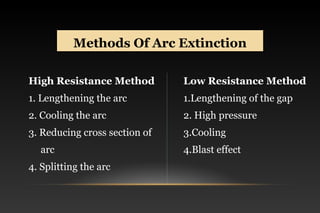
High Resistance Method
1. Lengthening the arc
2. Cooling the arc
3. Reducing cross section of
arc
4. Splitting the arc
Low Resistance Method
1.Lengthening of the gap
2. High pressure
3.Cooling
4.Blast effect
Methods Of Arc ExtinctionMethods Of Arc Extinction
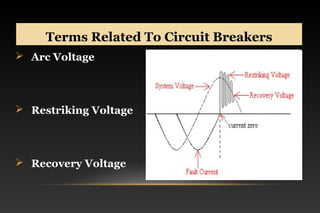
Terms Related To Circuit BreakersTerms Related To Circuit Breakers
 Arc Voltage
 Restriking Voltage
 Recovery Voltage
Different Types Of Circuit BreakerDifferent Types Of Circuit Breaker
 Oil Circuit Breaker
 Air Blast Circuit Breaker
 Sulpher Hexafluroide Circuit Breakers
 Vacuum Circuit Breakers
 Low Voltage Circuit Breakers
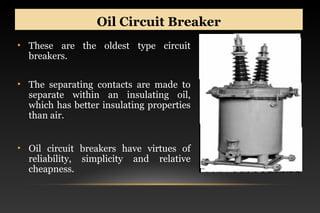
Oil Circuit BreakerOil Circuit Breaker
• These are the oldest type circuit
breakers.
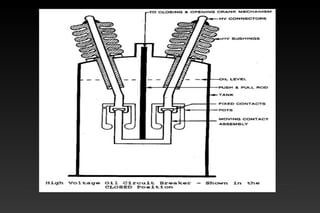
• The separating contacts are made to
separate within an insulating oil,
which has better insulating properties
than air.
• Oil circuit breakers have virtues of
reliability, simplicity and relative
cheapness.
• By connecting several interrupting mechanism in series, the voltage
rating of the breaker can be increased.
• By careful design the interrupting capacity rating can be increased up
to 26000 MVA.
• Quiet operation.
Advantages-
Disadvantages-
• The breaker contains flammable oil , consequently it should located
outdoor.
• Oil breakdown at high temperature forms carbon which gets dissolved in
the oil, this increases the oil conductivity.
• Becomes an environmental hazard if spillage occurs.
Air –Blast Circuit BreakerAir –Blast Circuit Breaker
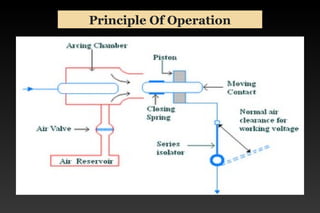
• These breakers employ a high pressure air blast as an arc quenching medium.
• The contacts are opened in a flow of air blast.
• The air blast cools the arc and sweeps away the arcing products to the atmosphere.
• This rapidly increases the dielectric strength of the medium between contacts and
prevents from arc.
• The arc is extinguished and flow of current is interrupted.
Principle Of Operation
(i) Axial-blast type (ii)Cross-blast type (iii)Radial-blast type
Types
• The risk of fire is eliminated.
• The arcing products are completely removed by the blast.
• The arcing time is very small due to the rapid build up of dielectric
strength between contacts.
Advantages-
Disadvantages-
• Air has relatively inferior arc extinguishing properties.
• Air blast circuit breakers are very sensitive to the variations in the rate of
restriking voltage.
• Considerable maintenance is required for the compressor plant which supplies
the air blast.
Application-
The air blast circuit breakers are finding wide applications in high voltage
installations. Majority of the circuit breakers for voltages beyond 110 kV are of
this type.
 Principle of Operation
 Working
 Advantage & Disadvantage
 Application
Vacuum Circuit BreakersVacuum Circuit Breakers
SF6 Circuit BreakerSF6 Circuit Breaker
• Properties Of Sulphur Hexafluoride Gas
• Extremely Stable
• Moisture Content Harmful
• Thermal Conductivity Higher
• Chemical Stable Upto 500 Degree Centigrade
• Higher Dielectric Strength
• Colourless, odourless
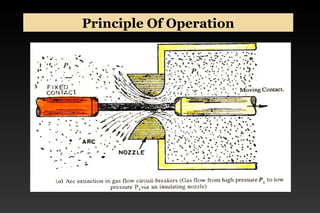
Principle Of OperationPrinciple Of Operation
• Very short arcing time
• Non-inflammable
• High dielectric strength 2 to 3 time that of air
• Noiseless operation
• Minimum maintenance
Advantages-
Disadvantages-
• Sealing Problems
• Poisonous
• Special Facility Required
Application-
• Capable of dealing current up to 60 kA and voltages ranges in the range
up to 50-80KV.
• Also developed for voltages 115kV to 230 kV , power ratings 10 MVA to
20 MVA.
The purpose of this seminar was the study of circuit breaker,
and we know circuit breaker plays a vital role in power system.
By this seminar we gather new information about circuit
breaker as well as power system, which will help us in other in
the journey of electrical engineering.
CONCLUSIONCONCLUSION
THANK YOU

Circuit breakers

  • 1.
  • 2.
    What Is CircuitBreaker?What Is Circuit Breaker? Working Principle Of Circuit BreakerWorking Principle Of Circuit Breaker
  • 3.
    Arc PhenomenonArc Phenomenon 1.Degree of ionization 2. Length of the arc 3. Cross-section of the arc
  • 4.
    High Resistance Method 1.Lengthening the arc 2. Cooling the arc 3. Reducing cross section of arc 4. Splitting the arc Low Resistance Method 1.Lengthening of the gap 2. High pressure 3.Cooling 4.Blast effect Methods Of Arc ExtinctionMethods Of Arc Extinction
  • 5.
    Terms Related ToCircuit BreakersTerms Related To Circuit Breakers  Arc Voltage  Restriking Voltage  Recovery Voltage
  • 6.
    Different Types OfCircuit BreakerDifferent Types Of Circuit Breaker  Oil Circuit Breaker  Air Blast Circuit Breaker  Sulpher Hexafluroide Circuit Breakers  Vacuum Circuit Breakers  Low Voltage Circuit Breakers
  • 7.
    Oil Circuit BreakerOilCircuit Breaker • These are the oldest type circuit breakers. • The separating contacts are made to separate within an insulating oil, which has better insulating properties than air. • Oil circuit breakers have virtues of reliability, simplicity and relative cheapness.
  • 9.
    • By connectingseveral interrupting mechanism in series, the voltage rating of the breaker can be increased. • By careful design the interrupting capacity rating can be increased up to 26000 MVA. • Quiet operation. Advantages- Disadvantages- • The breaker contains flammable oil , consequently it should located outdoor. • Oil breakdown at high temperature forms carbon which gets dissolved in the oil, this increases the oil conductivity. • Becomes an environmental hazard if spillage occurs.
  • 10.
    Air –Blast CircuitBreakerAir –Blast Circuit Breaker • These breakers employ a high pressure air blast as an arc quenching medium. • The contacts are opened in a flow of air blast. • The air blast cools the arc and sweeps away the arcing products to the atmosphere. • This rapidly increases the dielectric strength of the medium between contacts and prevents from arc. • The arc is extinguished and flow of current is interrupted.
  • 11.
  • 12.
    (i) Axial-blast type(ii)Cross-blast type (iii)Radial-blast type Types
  • 13.
    • The riskof fire is eliminated. • The arcing products are completely removed by the blast. • The arcing time is very small due to the rapid build up of dielectric strength between contacts. Advantages- Disadvantages- • Air has relatively inferior arc extinguishing properties. • Air blast circuit breakers are very sensitive to the variations in the rate of restriking voltage. • Considerable maintenance is required for the compressor plant which supplies the air blast. Application- The air blast circuit breakers are finding wide applications in high voltage installations. Majority of the circuit breakers for voltages beyond 110 kV are of this type.
  • 14.
     Principle ofOperation  Working  Advantage & Disadvantage  Application Vacuum Circuit BreakersVacuum Circuit Breakers
  • 15.
    SF6 Circuit BreakerSF6Circuit Breaker • Properties Of Sulphur Hexafluoride Gas • Extremely Stable • Moisture Content Harmful • Thermal Conductivity Higher • Chemical Stable Upto 500 Degree Centigrade • Higher Dielectric Strength • Colourless, odourless
  • 16.
  • 17.
    • Very shortarcing time • Non-inflammable • High dielectric strength 2 to 3 time that of air • Noiseless operation • Minimum maintenance Advantages- Disadvantages- • Sealing Problems • Poisonous • Special Facility Required Application- • Capable of dealing current up to 60 kA and voltages ranges in the range up to 50-80KV. • Also developed for voltages 115kV to 230 kV , power ratings 10 MVA to 20 MVA.
  • 18.
    The purpose ofthis seminar was the study of circuit breaker, and we know circuit breaker plays a vital role in power system. By this seminar we gather new information about circuit breaker as well as power system, which will help us in other in the journey of electrical engineering. CONCLUSIONCONCLUSION
  • 19.